

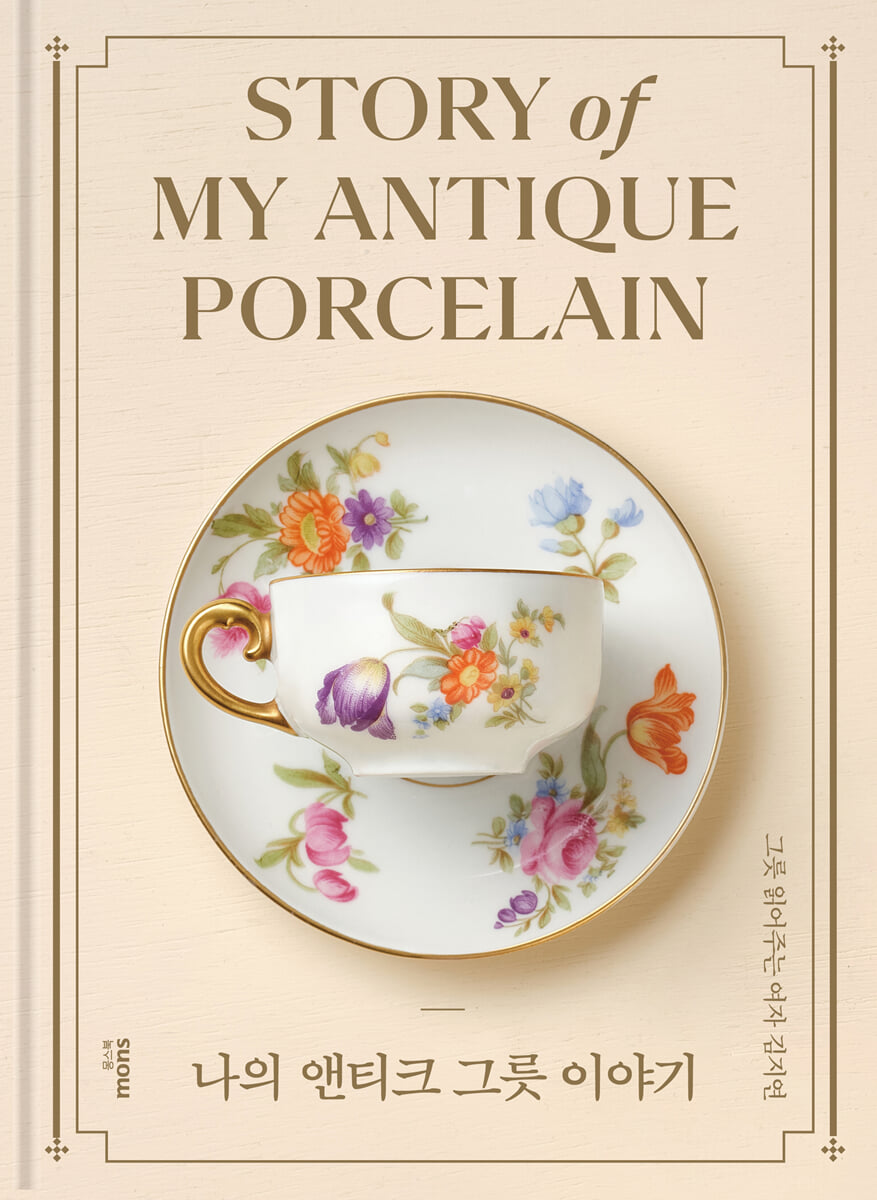
My Antique Bowl Story
 |
Description
Book Introduction
From Europe's first porcelain, 'Meissen', to 'Herend' and 'Royal Copenhagen'...
The story of antique pottery is more beautiful than a painting and more interesting than Western art history.
Antique enthusiasts from all over the world are crazy about it.
The author has thousands of historical vessels
A story of a vast collection spanning 30 years
& The history and brand story of antique dishes
A total of 10 countries, 35 brands, and over 100 designs!
Pictures more beautiful than a pictorial, capturing the elegance of the dishes!
A book that can be used by everyone from beginners to experts in antiques.
“When you look into a teacup that is over 100 or 200 years old, you can picture the stories of that time.
The beautiful patterns and colors of the pottery, which are difficult to imitate even in modern times, have always created a flower garden in my heart.
The antique dishes collected from around the world have now numbered in the thousands.
“Countless vessels each have their own history, one that one cannot help but fall into.” - Kim Ji-yeon, the woman who reads vessels
The types, origin stories, and even patterns of antique pottery from around the world!
Anyone who loves pottery will know that the world's three most prestigious porcelain brands are Germany's Meissen, Hungary's Herend, and Denmark's Royal Copenhagen.
However, it is difficult to know the details of how these brands gained this reputation and what history exists that led to their fame.
『My Antique Bowl Story』 Author Jiyeon Kim, who has collected antique bowls for 30 years and has studied world history, Western art history, and even flower names, introduces everything about antique bowls from around the world, including their types, birth stories, and patterns.
In addition to well-known domestic tableware brands such as Royal Crown Derby, Shelley, and Wedgwood, the book also covers information on antique tableware that cannot be found anywhere else, including unfamiliar luxury tableware discovered through the author's eye, such as Unterweissbach Thuringia in Germany and Bellick in Ireland. In addition, it provides proper know-how related to antique tableware, such as secrets to maintaining antique tableware, how to read backmarks, and types of teacups.
The story of antique pottery is more beautiful than a painting and more interesting than Western art history.
Antique enthusiasts from all over the world are crazy about it.
The author has thousands of historical vessels
A story of a vast collection spanning 30 years
& The history and brand story of antique dishes
A total of 10 countries, 35 brands, and over 100 designs!
Pictures more beautiful than a pictorial, capturing the elegance of the dishes!
A book that can be used by everyone from beginners to experts in antiques.
“When you look into a teacup that is over 100 or 200 years old, you can picture the stories of that time.
The beautiful patterns and colors of the pottery, which are difficult to imitate even in modern times, have always created a flower garden in my heart.
The antique dishes collected from around the world have now numbered in the thousands.
“Countless vessels each have their own history, one that one cannot help but fall into.” - Kim Ji-yeon, the woman who reads vessels
The types, origin stories, and even patterns of antique pottery from around the world!
Anyone who loves pottery will know that the world's three most prestigious porcelain brands are Germany's Meissen, Hungary's Herend, and Denmark's Royal Copenhagen.
However, it is difficult to know the details of how these brands gained this reputation and what history exists that led to their fame.
『My Antique Bowl Story』 Author Jiyeon Kim, who has collected antique bowls for 30 years and has studied world history, Western art history, and even flower names, introduces everything about antique bowls from around the world, including their types, birth stories, and patterns.
In addition to well-known domestic tableware brands such as Royal Crown Derby, Shelley, and Wedgwood, the book also covers information on antique tableware that cannot be found anywhere else, including unfamiliar luxury tableware discovered through the author's eye, such as Unterweissbach Thuringia in Germany and Bellick in Ireland. In addition, it provides proper know-how related to antique tableware, such as secrets to maintaining antique tableware, how to read backmarks, and types of teacups.
- You can preview some of the book's contents.
Preview
index
1 GERMANY
Europe's first porcelain born from human desire
Meissen 28
- Quarter Foil Watteau
- Waves Relief
- Flower
- B-Form
- Zwiebelmuster
Show off a variety of colorful styles
Bavaria 44
- Arzberg
- Tirschenreuth
- Waldershof Bavaria Rosenkavalier
- JKW Bavaria
- Bareuther Bavaria
- Krautheim
Adding glamour to Meissen porcelain
Dresden 68
- Karl Thime Dresden
- Angel Chalet and Four-legged Chalet Porzellan Putten-Schale
- Lace Figurine
Representative German porcelain that combines practicality and design
Rosenthal 82
- Sanssouci
- Bahnhof
Presenting a timeless and diverse collection
Hutschenreuther 92
- Dresden Moritzburg
- Maria Theresia Coburg
A synonym for rational German cuisine
Villeroy & Boch 98
- Bankruptcy
- Auden
- Design 1900 Design 1900
West Germany's representative luxury porcelain
Lindner 108
- Princess Rose
- Marie Luise Schuppen
Germany's second oldest porcelain brand
Furstenberg 116
German porcelain praised by Goethe
Weimar 120
A dish that is German yet not German
Unterweiβbach Schaubachkunst 124
A glimpse of 100% pure cobalt blue
Lichte 128
2 UNITED KINGDOM
A bowl loved by the British royal family
Royal Crown Derby 134
- Old Imari 1128 Old Imari Traditional Imari 2451 Imari Traditional
- Aves Series Aves Olde Avesbury
- Cotswold
A bowl loved by the Queen and her people
Wedgwood 146
- Basalt Black Basalt
- Jasper
- Queensware
- Florentine
- Appledore vs. Appledore
Fairford
- Medeleine
- Bianca Chinese Flowers
British tableware, a mother's dream
Aynseley 164
- Orchard Gold
- Pembroke
British luxury porcelain that showcased a variety of styles
Coalport 170
- Batwing
- Ming Rose
- Revelry
A latecomer to becoming a representative British porcelain
Royal Doulton 176
- Brambly Hedge
- Old Colony
Representative British porcelain, available only in vintage and antique form.
Crown Staffordshire 182
- Ellesmere
- F9213
The epitome of rose bowls
Royal Albert 186
- Old Country Roses
- Old English Rose
- Senorita
Porcelain guaranteed by the British Royal Family
Paragon 196
- Tree of Kashmir
The epitome of blue willow pattern
Booths 204
British porcelain with a large fan base
Shelley 208
The #1 British porcelain in my heart
Minton 216
The quintessence of British porcelain flowerpot teapots
Royale Stratford 220
3 IRELAND
The Jewel of Ireland
Belleek 226
- Neptune
- New Shell Shamrock Erne Limpet
4 DENMARK
Denmark's representative porcelain, well-known for its reputation
Royal Copenhagen 236
- Blue Fluted
- Flora Danica
- Blue Flower Angular
- Fan Service Gold 414
- Bing Grøndahl
- Bing Grøndahl Christmas Rose
- Irregular plate
5 AUSTRIA
Porcelain made by the Austrian Empress
Royal Vienna 260
- Royal Vienna Style
6 HUNGARY
A small Hungarian town becomes synonymous with luxury porcelain.
Herend 270
- Queen Victoria
- Rothschild
- Apponyi
- Teapot collection
7 FRANCE
French pride
Sevres 288
French luxury porcelain
Jiang Given 294
The home of French luxury porcelain
Limoges 298
- Haviland
- Giraud Fils
- Fragonard plate
8 ITALY
Italian pride
Richard Ginori 308
- Rapallo
- Granduca Coreana
9 RUSSIA
Russian national porcelain
Gzhel 314
Russian Imperial Porcelain
Lomonosov 316
- Samovar Motives Design
- Cobalt Net
10 USA
White House bowl
Lenox 328
Bowls that are back with a retro feel
Milk Glass 334
341 Useful Antique Tableware Facts to Know
Europe's first porcelain born from human desire
Meissen 28
- Quarter Foil Watteau
- Waves Relief
- Flower
- B-Form
- Zwiebelmuster
Show off a variety of colorful styles
Bavaria 44
- Arzberg
- Tirschenreuth
- Waldershof Bavaria Rosenkavalier
- JKW Bavaria
- Bareuther Bavaria
- Krautheim
Adding glamour to Meissen porcelain
Dresden 68
- Karl Thime Dresden
- Angel Chalet and Four-legged Chalet Porzellan Putten-Schale
- Lace Figurine
Representative German porcelain that combines practicality and design
Rosenthal 82
- Sanssouci
- Bahnhof
Presenting a timeless and diverse collection
Hutschenreuther 92
- Dresden Moritzburg
- Maria Theresia Coburg
A synonym for rational German cuisine
Villeroy & Boch 98
- Bankruptcy
- Auden
- Design 1900 Design 1900
West Germany's representative luxury porcelain
Lindner 108
- Princess Rose
- Marie Luise Schuppen
Germany's second oldest porcelain brand
Furstenberg 116
German porcelain praised by Goethe
Weimar 120
A dish that is German yet not German
Unterweiβbach Schaubachkunst 124
A glimpse of 100% pure cobalt blue
Lichte 128
2 UNITED KINGDOM
A bowl loved by the British royal family
Royal Crown Derby 134
- Old Imari 1128 Old Imari Traditional Imari 2451 Imari Traditional
- Aves Series Aves Olde Avesbury
- Cotswold
A bowl loved by the Queen and her people
Wedgwood 146
- Basalt Black Basalt
- Jasper
- Queensware
- Florentine
- Appledore vs. Appledore
Fairford
- Medeleine
- Bianca Chinese Flowers
British tableware, a mother's dream
Aynseley 164
- Orchard Gold
- Pembroke
British luxury porcelain that showcased a variety of styles
Coalport 170
- Batwing
- Ming Rose
- Revelry
A latecomer to becoming a representative British porcelain
Royal Doulton 176
- Brambly Hedge
- Old Colony
Representative British porcelain, available only in vintage and antique form.
Crown Staffordshire 182
- Ellesmere
- F9213
The epitome of rose bowls
Royal Albert 186
- Old Country Roses
- Old English Rose
- Senorita
Porcelain guaranteed by the British Royal Family
Paragon 196
- Tree of Kashmir
The epitome of blue willow pattern
Booths 204
British porcelain with a large fan base
Shelley 208
The #1 British porcelain in my heart
Minton 216
The quintessence of British porcelain flowerpot teapots
Royale Stratford 220
3 IRELAND
The Jewel of Ireland
Belleek 226
- Neptune
- New Shell Shamrock Erne Limpet
4 DENMARK
Denmark's representative porcelain, well-known for its reputation
Royal Copenhagen 236
- Blue Fluted
- Flora Danica
- Blue Flower Angular
- Fan Service Gold 414
- Bing Grøndahl
- Bing Grøndahl Christmas Rose
- Irregular plate
5 AUSTRIA
Porcelain made by the Austrian Empress
Royal Vienna 260
- Royal Vienna Style
6 HUNGARY
A small Hungarian town becomes synonymous with luxury porcelain.
Herend 270
- Queen Victoria
- Rothschild
- Apponyi
- Teapot collection
7 FRANCE
French pride
Sevres 288
French luxury porcelain
Jiang Given 294
The home of French luxury porcelain
Limoges 298
- Haviland
- Giraud Fils
- Fragonard plate
8 ITALY
Italian pride
Richard Ginori 308
- Rapallo
- Granduca Coreana
9 RUSSIA
Russian national porcelain
Gzhel 314
Russian Imperial Porcelain
Lomonosov 316
- Samovar Motives Design
- Cobalt Net
10 USA
White House bowl
Lenox 328
Bowls that are back with a retro feel
Milk Glass 334
341 Useful Antique Tableware Facts to Know
Detailed image

Into the book
I studied world history and art history through pottery, and learned about painting and flowers.
Above all, I have met many precious people through the medium of vessels.
One of the fruits of that relationship is the book, “My Story of Antique Tableware,” which compiles the story of 30 years of life spent with antique tableware.
--- p.14 From the "Prologue"
From around 1780, Meissen began to move away from the sensual and luxurious Rococo style and began to be influenced by the Neoclassic style that originated in France (also called Neoclassicism, an artistic movement that pursues the elegant and neat form of classical beauty with a longing for ancient Greece and Rome). From this time on, Meissen painters began to produce porcelain in a simple style, painting flowers, butterflies, and fruits on a white background.
--- p.34 From "Meissen, the first European porcelain born from human desire"
The two Titzenrohitter mocha sets I own have different designs, but they both have a vintage vibe.
The Titzenlohitter High Handle Four-legged Moka Cup and Coffee Pot with their raised handles are a statement piece in themselves, but they stand out even more when paired with bling-bling gold shoes.
In particular, the mocha cup has a unique design with a sharp handle that makes it seem like you have to lift your little finger to hold it, so you have to accept some inconvenience when using it.
--- p.54 From “Bavaria, Showcasing a Variety of Colorful Styles”
If I were asked to name just one city as the most important in the history of European ceramics, I would say without hesitation, Dresden.
Dresden is the capital of Saxony, located in eastern Germany. It is called the Florence of Germany because of its beautiful scenery, especially the old town along the Elbe River.
I can't forget the scenery of Dresden that I first encountered when I went on a European ceramics tour about 10 years ago.
--- p.68 From "Dresden, Adding Splendor to Meissen Porcelain"
Villeroy & Boch is the most popular German dishware brand in Korea, so much so that both those who like antique dishes and those who like modern dishes have at least one.
Many porcelain brands are named after places or founders, and Villeroy & Boch is also named after its two founders.
--- p.98 From “Villeroy & Boch, the synonym for rational German tableware”
Lindner's patterns are typical of Lindner, but the shape of the porcelain is so classic that you can tell it's Lindner even without the picture.
The handles of the pot and glass are not of a perfect line, but have been modified more than once, and the lines of the plate are not smooth but unique.
--- p.108 From “Lindner, the representative luxury porcelain of West Germany”
This teacup uses toned-down colors that are not commonly seen in German ceramics.
It's a very bright color that stands out right away, but it doesn't feel light at all.
Additionally, the gold flower pattern adds a three-dimensional feel, making it feel even more gorgeous and grand.
Thick engraving is also a very rare expression in German porcelain.
The overall feel is obviously German pottery, but when you look at each element, it is a very mysterious and mystical item that does not seem like German pottery.
--- p.126 From "Unterweissbach Schaubachkunst, a vessel that is German yet not German"
There is one bowl that stood out in both my mother-in-law's cupboard, who was indifferent to bowls, and my mother-in-law's cupboard, who loved bowls.
Ansley's Orchard Gold, which stands out with its intense primary colors and appetizing fruit patterns.
In the 1970s and 1980s, with the economic growth and the full liberalization of overseas travel, foreign tableware began to gradually flow into the country, and among them, the gorgeous Ansley certainly stood out.
--- p.164 From “Ansley, the British tableware that was mothers’ dream”
Royal warrants are granted to various companies, including porcelain companies, when they have provided services to the British Royal Family or other royal households for more than five years, and entitle them to provide services not only to their own country but also to the royal families of the Netherlands, Belgium, Luxembourg, Denmark, Sweden, and Japan.
Also, since this warranty is re-examined every five years, in the case of Paragon, even if it is a product of the same pattern, some may have the Royal Warrant phrase and some may not, depending on the year of release.
--- p.196 From “Paragon, Porcelain Guaranteed by the British Royal Family”
Belick, an Irish luxury porcelain with an overwhelming visual appeal, boasts a design and color reminiscent of seashells.
When I first introduced Bellic through the blog “The Woman Who Reads Dishes” in 2014, it was a very unfamiliar brand that was barely known in Korea, but after about 10 years, it has gained a certain level of recognition among dish collectors.
A long time ago, I first saw Bellick porcelain at the Porcelain Museum in England and was shocked by how different it felt from the pottery I had known before.
--- p.226 From "Bellik, the Jewel of Ireland"
Royal Copenhagen is currently one of the most familiar European tableware brands in Korea, recognized for both quality and design, but it did not achieve this reputation from the beginning.
Like other European countries, Denmark was fascinated by the blue and white porcelain exported from China during the Ming and Qing dynasties, and the history of Royal Copenhagen began with imitating it.
--- p.236 From “Royal Copenhagen, the undisputed representative Danish porcelain”
Like Hungary, which had to have a winding history due to its geographical location, Herend also faced several crises over the past 200 years, but each time it grew step by step and built its current reputation.
In fact, regardless of this historical background or story, the reason I first started collecting Herends was simply because they were relatively easy to obtain.
--- p.272 From "Hungarian small town, synonymous with luxury porcelain, Herend"
When talking about Richard Ginori, the most important figure is Italian architect Gio Ponti. He served as artistic director of Richard Ginori's manufacturing division from 1923 to 1933, and spread oriental sensibility and beauty to European tables.
Thanks to Gio Ponti's efforts, Richard Ginori established itself as a luxury vessel with both popularity and artistry.
--- p.308 From “The Pride of Italy, Richard Ginori”
The brand that appeared as the teacup of the male protagonist's mother in the drama "The Heirs," which deals with the high-teen romance of the 0.1% upper class in Korea, is none other than Lomonosov, a representative Russian porcelain.
The cobalt net pattern, which expresses nets and knots using only 22-karat gold and cobalt blue, also appeared in the drama "Sky Castle," which was about the entrance exams to prestigious families, and in Korea, Lomonosov has a strong image of being "exclusive to the upper class" or a "luxury product."
That's understandable, as Lomonosov started out as a porcelain brand owned by the Russian imperial family.
--- p.316 From “Russian Imperial Porcelain, Lomonosov”
In the American ceramics market, where European products held an overwhelming advantage, Lenox steadily expanded its market share by maintaining innovative designs and quality, and by the mid-20th century, it achieved the feat of occupying a quarter of the domestic market.
In the 1960s, the company expanded its scale by acquiring Bryce Brothers, the oldest crystal company in the United States, and continued to prosper, but it was unable to avoid the aftermath of COVID-19.
The closure of Lenox's only U.S. plant in 2020 virtually halted all production.
Above all, I have met many precious people through the medium of vessels.
One of the fruits of that relationship is the book, “My Story of Antique Tableware,” which compiles the story of 30 years of life spent with antique tableware.
--- p.14 From the "Prologue"
From around 1780, Meissen began to move away from the sensual and luxurious Rococo style and began to be influenced by the Neoclassic style that originated in France (also called Neoclassicism, an artistic movement that pursues the elegant and neat form of classical beauty with a longing for ancient Greece and Rome). From this time on, Meissen painters began to produce porcelain in a simple style, painting flowers, butterflies, and fruits on a white background.
--- p.34 From "Meissen, the first European porcelain born from human desire"
The two Titzenrohitter mocha sets I own have different designs, but they both have a vintage vibe.
The Titzenlohitter High Handle Four-legged Moka Cup and Coffee Pot with their raised handles are a statement piece in themselves, but they stand out even more when paired with bling-bling gold shoes.
In particular, the mocha cup has a unique design with a sharp handle that makes it seem like you have to lift your little finger to hold it, so you have to accept some inconvenience when using it.
--- p.54 From “Bavaria, Showcasing a Variety of Colorful Styles”
If I were asked to name just one city as the most important in the history of European ceramics, I would say without hesitation, Dresden.
Dresden is the capital of Saxony, located in eastern Germany. It is called the Florence of Germany because of its beautiful scenery, especially the old town along the Elbe River.
I can't forget the scenery of Dresden that I first encountered when I went on a European ceramics tour about 10 years ago.
--- p.68 From "Dresden, Adding Splendor to Meissen Porcelain"
Villeroy & Boch is the most popular German dishware brand in Korea, so much so that both those who like antique dishes and those who like modern dishes have at least one.
Many porcelain brands are named after places or founders, and Villeroy & Boch is also named after its two founders.
--- p.98 From “Villeroy & Boch, the synonym for rational German tableware”
Lindner's patterns are typical of Lindner, but the shape of the porcelain is so classic that you can tell it's Lindner even without the picture.
The handles of the pot and glass are not of a perfect line, but have been modified more than once, and the lines of the plate are not smooth but unique.
--- p.108 From “Lindner, the representative luxury porcelain of West Germany”
This teacup uses toned-down colors that are not commonly seen in German ceramics.
It's a very bright color that stands out right away, but it doesn't feel light at all.
Additionally, the gold flower pattern adds a three-dimensional feel, making it feel even more gorgeous and grand.
Thick engraving is also a very rare expression in German porcelain.
The overall feel is obviously German pottery, but when you look at each element, it is a very mysterious and mystical item that does not seem like German pottery.
--- p.126 From "Unterweissbach Schaubachkunst, a vessel that is German yet not German"
There is one bowl that stood out in both my mother-in-law's cupboard, who was indifferent to bowls, and my mother-in-law's cupboard, who loved bowls.
Ansley's Orchard Gold, which stands out with its intense primary colors and appetizing fruit patterns.
In the 1970s and 1980s, with the economic growth and the full liberalization of overseas travel, foreign tableware began to gradually flow into the country, and among them, the gorgeous Ansley certainly stood out.
--- p.164 From “Ansley, the British tableware that was mothers’ dream”
Royal warrants are granted to various companies, including porcelain companies, when they have provided services to the British Royal Family or other royal households for more than five years, and entitle them to provide services not only to their own country but also to the royal families of the Netherlands, Belgium, Luxembourg, Denmark, Sweden, and Japan.
Also, since this warranty is re-examined every five years, in the case of Paragon, even if it is a product of the same pattern, some may have the Royal Warrant phrase and some may not, depending on the year of release.
--- p.196 From “Paragon, Porcelain Guaranteed by the British Royal Family”
Belick, an Irish luxury porcelain with an overwhelming visual appeal, boasts a design and color reminiscent of seashells.
When I first introduced Bellic through the blog “The Woman Who Reads Dishes” in 2014, it was a very unfamiliar brand that was barely known in Korea, but after about 10 years, it has gained a certain level of recognition among dish collectors.
A long time ago, I first saw Bellick porcelain at the Porcelain Museum in England and was shocked by how different it felt from the pottery I had known before.
--- p.226 From "Bellik, the Jewel of Ireland"
Royal Copenhagen is currently one of the most familiar European tableware brands in Korea, recognized for both quality and design, but it did not achieve this reputation from the beginning.
Like other European countries, Denmark was fascinated by the blue and white porcelain exported from China during the Ming and Qing dynasties, and the history of Royal Copenhagen began with imitating it.
--- p.236 From “Royal Copenhagen, the undisputed representative Danish porcelain”
Like Hungary, which had to have a winding history due to its geographical location, Herend also faced several crises over the past 200 years, but each time it grew step by step and built its current reputation.
In fact, regardless of this historical background or story, the reason I first started collecting Herends was simply because they were relatively easy to obtain.
--- p.272 From "Hungarian small town, synonymous with luxury porcelain, Herend"
When talking about Richard Ginori, the most important figure is Italian architect Gio Ponti. He served as artistic director of Richard Ginori's manufacturing division from 1923 to 1933, and spread oriental sensibility and beauty to European tables.
Thanks to Gio Ponti's efforts, Richard Ginori established itself as a luxury vessel with both popularity and artistry.
--- p.308 From “The Pride of Italy, Richard Ginori”
The brand that appeared as the teacup of the male protagonist's mother in the drama "The Heirs," which deals with the high-teen romance of the 0.1% upper class in Korea, is none other than Lomonosov, a representative Russian porcelain.
The cobalt net pattern, which expresses nets and knots using only 22-karat gold and cobalt blue, also appeared in the drama "Sky Castle," which was about the entrance exams to prestigious families, and in Korea, Lomonosov has a strong image of being "exclusive to the upper class" or a "luxury product."
That's understandable, as Lomonosov started out as a porcelain brand owned by the Russian imperial family.
--- p.316 From “Russian Imperial Porcelain, Lomonosov”
In the American ceramics market, where European products held an overwhelming advantage, Lenox steadily expanded its market share by maintaining innovative designs and quality, and by the mid-20th century, it achieved the feat of occupying a quarter of the domestic market.
In the 1960s, the company expanded its scale by acquiring Bryce Brothers, the oldest crystal company in the United States, and continued to prosper, but it was unable to avoid the aftermath of COVID-19.
The closure of Lenox's only U.S. plant in 2020 virtually halted all production.
--- p.330 From "Lennox, the Vessel of the White House"
Publisher's Review
Antique dishes collected over 30 years to reflect my taste
Most antique (or vintage) pottery collectors active in Korea prefer specific brands or collect well-known pottery that is in fashion at the time.
It is rare for someone like the author to have a wide selection of dishes from various brands or to add completely unknown items with his own unique taste.
Since I look at dishes for the purpose of holding them rather than reselling them, I tend to collect 'dishes that I like' rather than 'dishes that other people like'.
And our eyes and hearts are more drawn to things we see for the first time than to things we are familiar with.
When a new item comes onto my radar, I use every means available, including the brand's pattern book and Googling, to research and learn about the dish.
Because I believe that even if the material value is less, the process of exploring new vessels will ultimately lead to self-growth.
-In the text
Introducing 10 countries, 35 brands, and over 100 design lines.
The author, who has been collecting antique dishes for the past 30 years, boasts a diverse list of dishes, to the point where he boasts that he has the most diverse collection of dishes in the country.
The selection includes iconic porcelains such as Meissen, Herend, and Royal Copenhagen, as well as brands with a strong fan base such as Wedgwood, Shelley, Haviland, and Lomonosov, as well as pieces discovered through his own discerning eye, such as Unterweisbach Thuringia from Germany and Bellick from Ireland.
His unique insight into pottery was possible because of his attitude toward life that allowed him to embrace new things and his extraordinary passion for studying both online and offline.
I enjoyed visiting online shopping malls and auction sites frequently, keeping up with antique market trends and exploring new pieces whenever I saw them.
Moreover, wherever I go abroad, I make sure to visit museums where I can encounter pottery, and I even lived in Paris for a month twice for the sole purpose of pottery.
In "My Antique Tableware Story," the author introduces a total of 35 brands and over 100 design lines from 10 countries, carefully selected based on his know-how derived from many years of experience and effort.
The Woman Who Reads the World: How She Became a 'Sungdeok'
Another thing that sets the author apart from other antique pottery collectors is that he doesn't just collect pottery; he also records it and shares it with others.
He, whose life motto is 'Learn and then give', started a blog called 'The Woman Who Reads Dishes' when he had collected a certain number of dishes.
I thought about making a list of the antique dishes I own, categorizing them by country, brand, and line, taking pictures, organizing related information, and uploading them to my blog whenever I had the chance.
As I meticulously recorded not only the information I found on the web and in books, but also the new facts I learned on my antique crockery journey, the number of people visiting my blog gradually increased, and the cumulative number of visitors reached 1.4 million, and I naturally became a 'fanatic'.
Over time, my knowledge of bowls and related dishes has accumulated, and my blog has over 400 bowl-related posts, and my bowl room and tea room are filled with hundreds of thousands of bowls.
I was looking for a way to share my carefully collected teaware with many people, and that's how I came to run a tea class.
As I talked about pottery with people who liked pottery both online and offline, my hobby soon became my main job.
-At the West Gate
Turning what you love into a career is the dream of many nerds, but it's difficult to achieve, and even if you do, it's not as happy or romantic as you'd hope.
The moment your hobby becomes your job, the sense of responsibility becomes heavier and it is no longer just a hobby.
But the author was willing to bear the weight of responsibility.
Since then, he has been actively sharing what he has learned with people who share the same interests, such as starting a 'Tea Class' that features tea, pottery, and cultural stories, and planning and conducting a 'Ceramics & Tea Tour' that travels to pottery and tea producing regions around the world.
If I get the chance, I'm thinking of creating an antique tableware museum, and I'd like to display only blue teacups in one corner.
We plan to show the difference intuitively through countless blue porcelains from around the world without detailed explanations.
-In the text
A book that can be used by everyone from beginners to experts.
The dishes introduced in this book are actually owned and used by the author, and the book mainly focuses on the history of the dishes and the brand story.
It explains the birth story of a specific brand and its rise and fall against a historical backdrop, and introduces colorful stories that can be inferred from patterns.
In addition, the book shares the author's accumulated experience and know-how over many years, including human stories such as special relationships formed through antique vessels while reading brands and patterns, methods for obtaining vessel information, and advice for beginners.
In addition, we generously share the basics of antique tableware, including the definitions of antique and vintage, how to care for antique tableware, how to read backmarks, how to distinguish fakes, antique tableware terminology, and names based on the shape of the tableware.
Meissen porcelain is infinitely elegant and beautiful, but its origin story is not.
17th century Europe was deeply fascinated by Chinese porcelain.
In particular, the royal family and the nobility treasured Chinese porcelain, calling it “gold from the East” and spending a lot of money to obtain it.
The European upper class's love of Chinese porcelain can also be seen in the chinoiserie trend, which is French for "Chinese style" or "Chinese taste."
-In the text
If you find a piece of pottery you want to buy on an online marketplace, first check whether it has a back mark, and if so, compare it with the back mark on an authentic piece to see if it actually existed.
Some sellers say that it's rare to find a piece that's so old that it doesn't even have a back mark, but if it's a valuable piece, it's better to exclude it altogether, as it should be in a museum.
If the price of the bowl is too cheap, you should be suspicious first and carefully check the condition of the pattern details through detailed images.
Remember that a bowl without a white mark is like a bowl without a name.
-Good to know information about antique dishes
Most antique (or vintage) pottery collectors active in Korea prefer specific brands or collect well-known pottery that is in fashion at the time.
It is rare for someone like the author to have a wide selection of dishes from various brands or to add completely unknown items with his own unique taste.
Since I look at dishes for the purpose of holding them rather than reselling them, I tend to collect 'dishes that I like' rather than 'dishes that other people like'.
And our eyes and hearts are more drawn to things we see for the first time than to things we are familiar with.
When a new item comes onto my radar, I use every means available, including the brand's pattern book and Googling, to research and learn about the dish.
Because I believe that even if the material value is less, the process of exploring new vessels will ultimately lead to self-growth.
-In the text
Introducing 10 countries, 35 brands, and over 100 design lines.
The author, who has been collecting antique dishes for the past 30 years, boasts a diverse list of dishes, to the point where he boasts that he has the most diverse collection of dishes in the country.
The selection includes iconic porcelains such as Meissen, Herend, and Royal Copenhagen, as well as brands with a strong fan base such as Wedgwood, Shelley, Haviland, and Lomonosov, as well as pieces discovered through his own discerning eye, such as Unterweisbach Thuringia from Germany and Bellick from Ireland.
His unique insight into pottery was possible because of his attitude toward life that allowed him to embrace new things and his extraordinary passion for studying both online and offline.
I enjoyed visiting online shopping malls and auction sites frequently, keeping up with antique market trends and exploring new pieces whenever I saw them.
Moreover, wherever I go abroad, I make sure to visit museums where I can encounter pottery, and I even lived in Paris for a month twice for the sole purpose of pottery.
In "My Antique Tableware Story," the author introduces a total of 35 brands and over 100 design lines from 10 countries, carefully selected based on his know-how derived from many years of experience and effort.
The Woman Who Reads the World: How She Became a 'Sungdeok'
Another thing that sets the author apart from other antique pottery collectors is that he doesn't just collect pottery; he also records it and shares it with others.
He, whose life motto is 'Learn and then give', started a blog called 'The Woman Who Reads Dishes' when he had collected a certain number of dishes.
I thought about making a list of the antique dishes I own, categorizing them by country, brand, and line, taking pictures, organizing related information, and uploading them to my blog whenever I had the chance.
As I meticulously recorded not only the information I found on the web and in books, but also the new facts I learned on my antique crockery journey, the number of people visiting my blog gradually increased, and the cumulative number of visitors reached 1.4 million, and I naturally became a 'fanatic'.
Over time, my knowledge of bowls and related dishes has accumulated, and my blog has over 400 bowl-related posts, and my bowl room and tea room are filled with hundreds of thousands of bowls.
I was looking for a way to share my carefully collected teaware with many people, and that's how I came to run a tea class.
As I talked about pottery with people who liked pottery both online and offline, my hobby soon became my main job.
-At the West Gate
Turning what you love into a career is the dream of many nerds, but it's difficult to achieve, and even if you do, it's not as happy or romantic as you'd hope.
The moment your hobby becomes your job, the sense of responsibility becomes heavier and it is no longer just a hobby.
But the author was willing to bear the weight of responsibility.
Since then, he has been actively sharing what he has learned with people who share the same interests, such as starting a 'Tea Class' that features tea, pottery, and cultural stories, and planning and conducting a 'Ceramics & Tea Tour' that travels to pottery and tea producing regions around the world.
If I get the chance, I'm thinking of creating an antique tableware museum, and I'd like to display only blue teacups in one corner.
We plan to show the difference intuitively through countless blue porcelains from around the world without detailed explanations.
-In the text
A book that can be used by everyone from beginners to experts.
The dishes introduced in this book are actually owned and used by the author, and the book mainly focuses on the history of the dishes and the brand story.
It explains the birth story of a specific brand and its rise and fall against a historical backdrop, and introduces colorful stories that can be inferred from patterns.
In addition, the book shares the author's accumulated experience and know-how over many years, including human stories such as special relationships formed through antique vessels while reading brands and patterns, methods for obtaining vessel information, and advice for beginners.
In addition, we generously share the basics of antique tableware, including the definitions of antique and vintage, how to care for antique tableware, how to read backmarks, how to distinguish fakes, antique tableware terminology, and names based on the shape of the tableware.
Meissen porcelain is infinitely elegant and beautiful, but its origin story is not.
17th century Europe was deeply fascinated by Chinese porcelain.
In particular, the royal family and the nobility treasured Chinese porcelain, calling it “gold from the East” and spending a lot of money to obtain it.
The European upper class's love of Chinese porcelain can also be seen in the chinoiserie trend, which is French for "Chinese style" or "Chinese taste."
-In the text
If you find a piece of pottery you want to buy on an online marketplace, first check whether it has a back mark, and if so, compare it with the back mark on an authentic piece to see if it actually existed.
Some sellers say that it's rare to find a piece that's so old that it doesn't even have a back mark, but if it's a valuable piece, it's better to exclude it altogether, as it should be in a museum.
If the price of the bowl is too cheap, you should be suspicious first and carefully check the condition of the pattern details through detailed images.
Remember that a bowl without a white mark is like a bowl without a name.
-Good to know information about antique dishes
GOODS SPECIFICS
- Date of issue: March 8, 2024
- Format: Hardcover book binding method guide
- Page count, weight, size: 372 pages | 1,142g | 182*246*227mm
- ISBN13: 9791191401813
- ISBN10: 1191401812
You may also like
카테고리
korean


korean

![GQ KOREA Mark (Monthly): December [2025]](http://librairie.coreenne.fr/cdn/shop/files/8ef265dbbfbf186523ed75ba7319009d.jpg?v=1765340328&width=3840)


