

There is no reason for animals' kindness
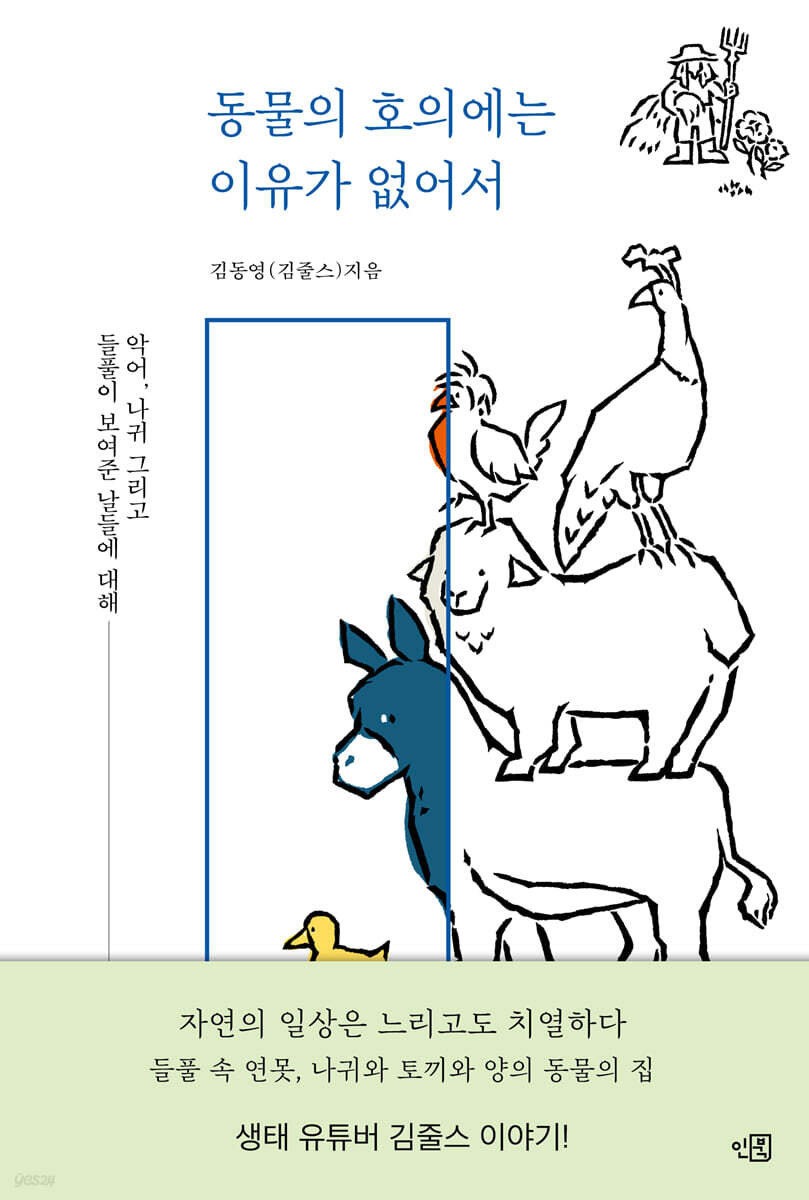 |
Description
Book Introduction
From crocodile dad to pond-making YouTuber
Living with animals of all sizes, such as donkeys, ducks, and pheasants, and learning about plants
The first story from ecological YouTuber Jules Kim!
Hongcheon, Gangwon-do, has the largest daily temperature range in South Korea.
Kim Jules, a YouTuber who lives there and builds eco-ponds and animal houses, has a large number of subscribers.
He was originally famous as a YouTuber who raised crocodiles in Gangnam.
Every time a video was uploaded, issues big and small were created, but those who have been watching for a long time have continued to watch and support him with a consistent heart because they know his philosophy.
How did the YouTube channel Kim Jules, which has many long-time subscribers, get started?
The starting point was a 3 pyeong room.
When he was a high school senior preparing for the college entrance exam, the author started a business and started importing rare animals.
Although there were challenges, both big and small, Jules Shop was recognized as an unrivaled leader in the trade of rare animals, including reptiles, thanks to its reputation for conducting business in a healthy environment based on information on the origin of the animals.
Why did Kim Jules return to farming in Hongcheon, Gangwon Province? How did he succeed in creating an ecological pond, something most people fail at?
The first story of Jules Kim, who is currently learning about plants while living with animals of all sizes, including donkeys, sheep, and ducks, by the ecological pond.
In an age where we increasingly click on short, intense videos, why do people revel in the slowly changing landscapes of wildflowers and ponds?
Hear his story about why he looks forward to seeing donkeys, ducks, sheep and peacocks together every day and why he is so happy.
Living with animals of all sizes, such as donkeys, ducks, and pheasants, and learning about plants
The first story from ecological YouTuber Jules Kim!
Hongcheon, Gangwon-do, has the largest daily temperature range in South Korea.
Kim Jules, a YouTuber who lives there and builds eco-ponds and animal houses, has a large number of subscribers.
He was originally famous as a YouTuber who raised crocodiles in Gangnam.
Every time a video was uploaded, issues big and small were created, but those who have been watching for a long time have continued to watch and support him with a consistent heart because they know his philosophy.
How did the YouTube channel Kim Jules, which has many long-time subscribers, get started?
The starting point was a 3 pyeong room.
When he was a high school senior preparing for the college entrance exam, the author started a business and started importing rare animals.
Although there were challenges, both big and small, Jules Shop was recognized as an unrivaled leader in the trade of rare animals, including reptiles, thanks to its reputation for conducting business in a healthy environment based on information on the origin of the animals.
Why did Kim Jules return to farming in Hongcheon, Gangwon Province? How did he succeed in creating an ecological pond, something most people fail at?
The first story of Jules Kim, who is currently learning about plants while living with animals of all sizes, including donkeys, sheep, and ducks, by the ecological pond.
In an age where we increasingly click on short, intense videos, why do people revel in the slowly changing landscapes of wildflowers and ponds?
Hear his story about why he looks forward to seeing donkeys, ducks, sheep and peacocks together every day and why he is so happy.
- You can preview some of the book's contents.
Preview
index
Chapter 1
1.
VIP guests of the aquarium
2.
The Reality of the Cheonggyecheon Reptile Market
3.
First transaction, and
4.
A busy 3-pyeong store
Chapter 2
1.
The beginning of expansion
2.
Start YouTube
3.
Kim Jules, who raises crocodiles
4.
All animals are the same creatures.
5.
YouTube channel featuring only animals
Chapter 3
1.
I also wanted to cover sensitive topics.
2.
Reptile breeding environment that requires knowledge
3.
I decided to make a pond
4.
I had no intention of becoming a farmer
5.
Get to know plants
Chapter 4
1.
Creatures of the Gamulchi Pond
2.
Construction again
3.
I decided to make a duck pond.
Chapter 5
1.
Make an animal house
2.
I found out after stepping into the farmhouse.
3.
About Kim Jules Channel
Chapter 6
1.
Making a pond
2.
Seasonal pond management
3.
Understanding the ecosystem comes first.
1.
VIP guests of the aquarium
2.
The Reality of the Cheonggyecheon Reptile Market
3.
First transaction, and
4.
A busy 3-pyeong store
Chapter 2
1.
The beginning of expansion
2.
Start YouTube
3.
Kim Jules, who raises crocodiles
4.
All animals are the same creatures.
5.
YouTube channel featuring only animals
Chapter 3
1.
I also wanted to cover sensitive topics.
2.
Reptile breeding environment that requires knowledge
3.
I decided to make a pond
4.
I had no intention of becoming a farmer
5.
Get to know plants
Chapter 4
1.
Creatures of the Gamulchi Pond
2.
Construction again
3.
I decided to make a duck pond.
Chapter 5
1.
Make an animal house
2.
I found out after stepping into the farmhouse.
3.
About Kim Jules Channel
Chapter 6
1.
Making a pond
2.
Seasonal pond management
3.
Understanding the ecosystem comes first.
Into the book
There was an aquarium 10 minutes away from my house.
It was a place where not only fish but also squirrels, raccoons, guinea pigs, rabbits, etc. were sold.
It became my playground and school.
“How big of a container do I need to raise a cross sister?”
“What are the characteristics of a squirrel?”
“Isn’t the guinea pig too noisy?”
The aquarium, which I started visiting when I was in elementary school, remained my hideout even after I entered middle school.
There are things about animals that can only be felt by seeing them and interacting with them directly.
It was not possible to know from books, videos, or photos that the meowing of guinea pigs differs subtly depending on their mood.
As I met and touched things in person every day, I was able to feel more things, and my curiosity began to turn into affection.
--- From "Aquarium VIP Customers"
Until then, I liked reptiles, but I didn't know about the market atmosphere for selling reptiles.
Most of the creatures in the local aquarium come from Cheonggyecheon, but because they are small in number, they are well managed.
However, after seeing Cheonggyecheon Market with my own eyes, I felt a serious sense of crisis about Korea's rare animal distribution system, including reptiles.
I began to think deeply about whether there was anything I could do to change this market that viewed living things solely as commodities.
--- From "The Reality of the Cheonggyecheon Reptile Market"
Guests always asked me my age.
I was curious because it seemed difficult, but I hated being asked questions like this.
The more I thought about it, the more I wanted to learn more.
I decided to take the exam again.
I had a desire for knowledge, but I also wanted to show that I wasn't starting a business to avoid studying.
Because I had to work, I only studied by taking online lectures.
Then, 100 days before the college entrance exam, the store temporarily closed.
A notice was posted on the site's homepage.
'Due to personal reasons, we will be temporarily closed.' But strangely, after seeing this notice, this comment was posted.
--- From "A Busy 3-Pyeong Store"
The length and width of a caiman's enclosure, its height, water depth, land area, and locking devices are all stipulated by law.
They cannot be raised anywhere, and must be raised in a breeding facility that complies with the regulations set forth in the law.
The problem is that this rule is based on adult crocodiles.
At that time, the water level was regulated to be 80cm, which made it impossible to raise newborn 30cm baby crocodiles.
Although crocodiles are aquatic reptiles, they do not breathe through gills like fish, so they can drown.
If you follow the law, you will end up in a horrific situation where a living thing could die.
I explained it to the authorities, but even though they pretended to understand, the conclusion was the same.
… … Anyway, I couldn’t raise Akak like that.
It was built by stacking bricks inside a large tank measuring approximately 3m wide, 1.5m long, and 1.5m high, so that the height can be adjusted.
This tank has been licensed for breeding.
And we decided to keep a small tank separately and raise the fish there until they grow to a certain size.
The large tank could not be left empty until the fish grew bigger.
So, we adopted an adult crocodile called a 'dwarf caiman'.
… … Thanks to Aktu, my YouTube channel has grown a lot.
The mere appearance of Aktu garnered an explosive response, and the video featuring Aktu reached 400,000 views shortly after being uploaded.
The video of a cicada eating a goldfish has over 1.9 million views.
Then, YouTubers who followed us and raised crocodiles emerged.
--- From "Kim Jules, the Crocodile Raiser"
When raising fish, you must always check what species it is.
There are common and rare guppies, and there are dozens of types of shrimp.
There are just as many different types of tropical fish.
Even for the same guppy, each species has slightly different characteristics, so the filtration cycle, required plants, and lighting brightness are all different.
It is not necessarily beneficial only for living things to have a good understanding of their characteristics.
Depending on how you use it, you can manage your tank more efficiently, so it can also be of practical help to those who keep it.
--- From "Reptile Breeding Environments That Require Knowledge"
One of the biggest mistakes people make when building their first pond is to overstock it with their favorite creatures right from the start.
Especially for those who enjoy fishing, they put in large fish such as salmon or catfish that they caught themselves first.
This usually fails.
Small creatures should be added to the pond first.
Large freshwater fish eat a lot and have a lot of metabolic activity, so water quality is quickly polluted.
Then, the excess material causes green algae to grow in such large quantities that it becomes impossible to control.
I didn't put in large pieces of koi fish, but deliberately put in fry.
When you think of YouTube, you naturally have to include big, pretty adults.
Because it can draw a lot of aggro.
But that wasn't the case.
--- From "I decided to make a pond"
I wanted to create a sustainable ecosystem in the Gamulchi Pond.
Every plant has animals that live in its ecology.
So, I thought that planting as many different plants as possible would be good for both aesthetics and ecological reasons.
In fact, the 'titular' lays its eggs on the pine trees in the pond area every year, and the 'cuckoo' that saw this also laid its eggs.
When planning planting, it is important to understand the characteristics of the site.
I also studied the terrain carefully.
The Gamulchi Pond is located on the top of a mountain and receives full sunlight.
This initially caused a lot of green algae to grow in the pond.
After thinking about how to supplement it, I chose the zelkova tree.
I thought that if there were big trees, they would block out some of the sunlight.
It was over 10 meters tall, and the roots alone were taller than an adult man.
It was a large tree weighing 15 tons, so it was difficult to plant.
Now this tree plays an important role in the Gamulchi Pond.
Not only does it provide a large shaded area where I can rest, but bees also visit every year to build their hives.
--- From "Getting to Know Plants"
I think empathy is actually an emotion that humans feel.
However, it seemed that even animals had a concept of family or companionship.
It's too deep a concept to call it family, so I think it's more like a group of people who eat together.
If someone other than family members harasses him, he goes and fights them, but he can also harass him.
My dog is very timid and sensitive, but he has never barked or attacked any of the animals I raise.
It could be because they're scared, or it could be because they want to harm me and I'm stopping them, but they seem to be aware of its existence.
At first, the donkey was scared when a sheep came near, but now it stays still even when eating right next to it.
It's the same if you smell it from the front.
Chickens play beside the donkeys eating, and ducks and geese roam freely.
There has never been a fight between different types of animals.
These days, geese always chase the ducks and act as guards.
If even one of them is missing, it will cry until your ears burst, but the ducks don't seem to care because they don't understand.
However, when different species of animals meet for the first time, they tend to study in advance and be careful.
Because the wild environment and habits are different, you should provide them with plenty of food in the beginning and avoid any interference.
Then, we need to gradually get to know each other.
Then you either become enemies forever or become family.
It was a place where not only fish but also squirrels, raccoons, guinea pigs, rabbits, etc. were sold.
It became my playground and school.
“How big of a container do I need to raise a cross sister?”
“What are the characteristics of a squirrel?”
“Isn’t the guinea pig too noisy?”
The aquarium, which I started visiting when I was in elementary school, remained my hideout even after I entered middle school.
There are things about animals that can only be felt by seeing them and interacting with them directly.
It was not possible to know from books, videos, or photos that the meowing of guinea pigs differs subtly depending on their mood.
As I met and touched things in person every day, I was able to feel more things, and my curiosity began to turn into affection.
--- From "Aquarium VIP Customers"
Until then, I liked reptiles, but I didn't know about the market atmosphere for selling reptiles.
Most of the creatures in the local aquarium come from Cheonggyecheon, but because they are small in number, they are well managed.
However, after seeing Cheonggyecheon Market with my own eyes, I felt a serious sense of crisis about Korea's rare animal distribution system, including reptiles.
I began to think deeply about whether there was anything I could do to change this market that viewed living things solely as commodities.
--- From "The Reality of the Cheonggyecheon Reptile Market"
Guests always asked me my age.
I was curious because it seemed difficult, but I hated being asked questions like this.
The more I thought about it, the more I wanted to learn more.
I decided to take the exam again.
I had a desire for knowledge, but I also wanted to show that I wasn't starting a business to avoid studying.
Because I had to work, I only studied by taking online lectures.
Then, 100 days before the college entrance exam, the store temporarily closed.
A notice was posted on the site's homepage.
'Due to personal reasons, we will be temporarily closed.' But strangely, after seeing this notice, this comment was posted.
--- From "A Busy 3-Pyeong Store"
The length and width of a caiman's enclosure, its height, water depth, land area, and locking devices are all stipulated by law.
They cannot be raised anywhere, and must be raised in a breeding facility that complies with the regulations set forth in the law.
The problem is that this rule is based on adult crocodiles.
At that time, the water level was regulated to be 80cm, which made it impossible to raise newborn 30cm baby crocodiles.
Although crocodiles are aquatic reptiles, they do not breathe through gills like fish, so they can drown.
If you follow the law, you will end up in a horrific situation where a living thing could die.
I explained it to the authorities, but even though they pretended to understand, the conclusion was the same.
… … Anyway, I couldn’t raise Akak like that.
It was built by stacking bricks inside a large tank measuring approximately 3m wide, 1.5m long, and 1.5m high, so that the height can be adjusted.
This tank has been licensed for breeding.
And we decided to keep a small tank separately and raise the fish there until they grow to a certain size.
The large tank could not be left empty until the fish grew bigger.
So, we adopted an adult crocodile called a 'dwarf caiman'.
… … Thanks to Aktu, my YouTube channel has grown a lot.
The mere appearance of Aktu garnered an explosive response, and the video featuring Aktu reached 400,000 views shortly after being uploaded.
The video of a cicada eating a goldfish has over 1.9 million views.
Then, YouTubers who followed us and raised crocodiles emerged.
--- From "Kim Jules, the Crocodile Raiser"
When raising fish, you must always check what species it is.
There are common and rare guppies, and there are dozens of types of shrimp.
There are just as many different types of tropical fish.
Even for the same guppy, each species has slightly different characteristics, so the filtration cycle, required plants, and lighting brightness are all different.
It is not necessarily beneficial only for living things to have a good understanding of their characteristics.
Depending on how you use it, you can manage your tank more efficiently, so it can also be of practical help to those who keep it.
--- From "Reptile Breeding Environments That Require Knowledge"
One of the biggest mistakes people make when building their first pond is to overstock it with their favorite creatures right from the start.
Especially for those who enjoy fishing, they put in large fish such as salmon or catfish that they caught themselves first.
This usually fails.
Small creatures should be added to the pond first.
Large freshwater fish eat a lot and have a lot of metabolic activity, so water quality is quickly polluted.
Then, the excess material causes green algae to grow in such large quantities that it becomes impossible to control.
I didn't put in large pieces of koi fish, but deliberately put in fry.
When you think of YouTube, you naturally have to include big, pretty adults.
Because it can draw a lot of aggro.
But that wasn't the case.
--- From "I decided to make a pond"
I wanted to create a sustainable ecosystem in the Gamulchi Pond.
Every plant has animals that live in its ecology.
So, I thought that planting as many different plants as possible would be good for both aesthetics and ecological reasons.
In fact, the 'titular' lays its eggs on the pine trees in the pond area every year, and the 'cuckoo' that saw this also laid its eggs.
When planning planting, it is important to understand the characteristics of the site.
I also studied the terrain carefully.
The Gamulchi Pond is located on the top of a mountain and receives full sunlight.
This initially caused a lot of green algae to grow in the pond.
After thinking about how to supplement it, I chose the zelkova tree.
I thought that if there were big trees, they would block out some of the sunlight.
It was over 10 meters tall, and the roots alone were taller than an adult man.
It was a large tree weighing 15 tons, so it was difficult to plant.
Now this tree plays an important role in the Gamulchi Pond.
Not only does it provide a large shaded area where I can rest, but bees also visit every year to build their hives.
--- From "Getting to Know Plants"
I think empathy is actually an emotion that humans feel.
However, it seemed that even animals had a concept of family or companionship.
It's too deep a concept to call it family, so I think it's more like a group of people who eat together.
If someone other than family members harasses him, he goes and fights them, but he can also harass him.
My dog is very timid and sensitive, but he has never barked or attacked any of the animals I raise.
It could be because they're scared, or it could be because they want to harm me and I'm stopping them, but they seem to be aware of its existence.
At first, the donkey was scared when a sheep came near, but now it stays still even when eating right next to it.
It's the same if you smell it from the front.
Chickens play beside the donkeys eating, and ducks and geese roam freely.
There has never been a fight between different types of animals.
These days, geese always chase the ducks and act as guards.
If even one of them is missing, it will cry until your ears burst, but the ducks don't seem to care because they don't understand.
However, when different species of animals meet for the first time, they tend to study in advance and be careful.
Because the wild environment and habits are different, you should provide them with plenty of food in the beginning and avoid any interference.
Then, we need to gradually get to know each other.
Then you either become enemies forever or become family.
--- From "Building an Animal House"
Publisher's Review
“Do what you love.”
From little VIP at the aquarium to high school president
“When did you start liking animals?” “Why did you like them?” These are the questions the author receives most often.
As a child, I visited the aquarium, which was 10 minutes away from my house, every day until middle school. By watching the animals all day, I was able to feel many things that could not be learned from books or words.
… … Afterwards, influenced by his parents’ words that ‘animals must be raised responsibly until the end’, he started raising small animals that he could take care of on his own even at a young age.
As I began to raise animals and develop deep bonds with them, those times became part of the author's daily life and life.
Birds are flying animals.
But I left the cage door open and raised them free.
Since I had a good understanding of the characteristics of parakeets, I didn't think it was special to raise them with the cage door open.
It was a breeding method based on experience.
… … I didn’t just collect information through text or pictures.
Thanks to this, I was able to connect more deeply with the animals and ultimately raise them in a freer environment.
_ Among the "Aquarium's VIP Customers"
During his high school years, the author, who lived in Mokdong and went to a private academy until late at night, was contemplating his future path when he was influenced by Shin Hae-chul and decided to do what he loved.
And, after confirming that there is no age limit for starting a business, he becomes the president of a rare animal import business that uses his room as a store in his third year of high school.
He opened his own 10-pyeong room in the apartment where his whole family lived as a business.
Shin Hae-chul said the most to listeners on the radio who were worried about their futures: “Do what you love.”
Like most students who love animals, I have long dreamed of becoming a veterinarian.
But no matter how much I thought about it, it seemed like it would be difficult for me to become a veterinarian with my grades.
As I was thinking about what to do, Shin Hae-chul's words suddenly came to mind.
‘What do I like and what am I good at?’ … … First, let’s do what I like and what I am good at.
'This would be better than going to college.' That's how I organized my thoughts.
_ From “The Reality of the Cheonggyecheon Reptile Market”
My MBTI type wasn't suited for business, but I needed to expand my base.
The author does not like people who talk a lot, and prefers to spend time alone and quietly with animals.
A business started by a high school student with no social experience inevitably faces difficulties.
In particular, when dealing with African companies whose business environments are different from those of Korea, they are subjected to large and small scams and experience frustration as a result.
But this one had to do with the author's favorite animal.
Because there was a will to expand the base through healthy trading of living things, the business began to flourish even in difficult circumstances.
There was 3 million won in the water.
It was money I saved up from my allowance and newspaper delivery job.
… … It was around January.
It was incredibly cold.
After receiving a call that my order had arrived, I got in my father's car and went to Incheon Airport with a heavy heart.
But as soon as I received the product, I was surprised to see the condition of the packaging.
When I ordered, I asked that it be packaged with a hot pack and styrofoam, but there was no hot pack at all.
… … The water and the box containing the fish were both frozen solid.
Of course, the fish were also wiped out.
To make matters worse, the dealer listed fish that had not even been sent on the invoice, and overpackaged them with too much water, resulting in exorbitant customs duties and shipping costs.
The customs duty alone was about 5 million won, and I thought my life was over that day.
_ From "The First Deal, and"
The opening of a YouTube channel and the emergence of Aktu
The author, who had been promoting mainly through the community, suddenly noticed that there was a growing number of YouTube channels related to rare animals.
However, most of them were based on inaccurate information, emphasizing provocative things, or easily introducing creatures that should not be adopted because they are unique.
The author, who wanted to enable more people to raise reptiles in a healthy environment, started a YouTube channel based on his experiences with them.
Owning a reptile is different from owning a dog.
There are no hospitals and no way for the general public to obtain information.
Consumers who are worried about the realistic difficulties will never raise a reptile again if the one they were raising dies.
Because I'm sick of it.
… … People who adopt animals like this no longer keep reptiles, and the decline in adoption is not good for the reptile industry as a whole.
For this reason, I was concerned that they were promoting the product by highlighting only its unique appearance without properly researching its breeding environment.
_ From "Starting YouTube"
Crocodiles are unfamiliar and fearful animals to the general public.
However, there are many different types of crocodiles, and some of them are docile and can be kept as pets.
People are unaware of this and fear crocodiles as a single species.
The author wants to show that even crocodiles can be cute creatures if raised with love, so he starts raising them himself.
And when a crocodile appeared on YouTube, many people started to pay attention, and Kim Jules started to be called the crocodile dad.
It was difficult to run a blog and then see the opinions of hundreds of thousands of people on YouTube.
I have raised issues that I have never thought about in my life, such as whether to release or abandon animals.
Of course, I intended to take responsibility for all the animals and raise them until the end.
… … Some people say that seeing a crocodile eating a fish is cruelty to the fish, while others enjoy the sight.
In the food chain, someone is bound to become food, and that is inevitable.
Also, from the perspective of survival and reproduction, it is not bad for the entire species for humans to raise animals.
Even if the animal is edible.
_ From "Kim Jules, the Crocodile Raiser"
I had no intention of returning to farming, but the ecological pond was completed.
A store in Seocho-gu was raising crocodiles, leading to a flood of police reports and complaints.
The problem is that government agencies cannot give a clear answer when asked what is wrong.
Although she did nothing wrong because she followed the rules, Kim Jules was exhausted.
The author liked to be alone and quiet with animals.
Business was going very well, but he became tired of people, so he decided to build a pond in a deserted place and spend time with his favorite animals.
When raising crocodiles and loaches and creating a pond, he realized that the most important thing was ecosystem management, and after searching for a suitable place, he settled in Hongcheon, Gangwon-do.
Until then, I had no thoughts of returning to farming.
However, when the gizzard shad pond and duck pond were completed and he began to live with ducks, goats, and geese, Kim Jules went into the nature of Gangwon-do.
I started my own business at the age of eighteen and am proud to say that I lived a busier life than anyone my age until I was thirty-one.
Being busy may not be the same thing as what people call success or accomplishment, but I was really busy.
Meanwhile, reptiles, once considered a breed of nerds, have become a part of popular culture.
I think I had a lot of influence in this change.
… … However, I felt that there was nothing more I could do.
Most people were concerned with the logic of capital rather than biology, and were more concerned with tomorrow than a year ahead.
There was nothing more I could do here.
_ From "I had no intention of becoming a farmer"
Between the animal house and the wild grass
Dreaming of a complex ecological space
Hongcheon, Gangwon-do, has the largest daily temperature range in South Korea.
Spending several years there, Kim Jules experiences the power of nature.
Through the ecological pond, we learn about soil, water, and wind, and we also study plants by looking for water in the rice fields.
The belief that you can only raise a living thing if you know it brought me back to my days as a high school senior.
But no matter how much you study, you can't beat the power of learning through direct experience.
The author is experiencing new things as the animals he used to live with leave and the flowers he planted with great expectations fail to bloom.
I spend each day dreaming of a complex ecological space where animals, people, and culture can coexist.
Kim Jules builds animal homes so that animals big and small can live safely despite environmental changes, and dreams a new dream of her own as she watches the land where flowers and trees take firm root through the power of nature.
It seemed that even animals had a concept of family or companionship.
At first, the donkey was scared when a sheep came near, but now it stays still even when eating right next to it.
It's the same if you smell it from the front.
Chickens play beside the donkeys eating, and ducks and geese roam freely.
There has never been a fight between different types of animals.
… …
In the past year, we have seen the birth of new animals and the passing of animals that were with us.
It's something I've experienced many times before, but I can't seem to get used to it.
__ From "Building an Animal House"
When I first started working on the manuscript, I pulled out the weeds that were creeping up the hydrangeas every day, and I was frustrated to see the hydrangeas and other plants that could not survive the winter in Hongcheon that year and the following year.
This year, I gave up and didn't remove any weeds or do any other maintenance, but I succeeded in overwintering naturally.
In the meantime, the roots of the plants have taken root, and thicker branches have developed during the same growing period, which I think has given them the strength to survive the winter.
I wonder if I grew stronger through competition with the wild weeds around me.
Even a still plant brings up many thoughts when you look at it.
__ From "Epilogue"
From little VIP at the aquarium to high school president
“When did you start liking animals?” “Why did you like them?” These are the questions the author receives most often.
As a child, I visited the aquarium, which was 10 minutes away from my house, every day until middle school. By watching the animals all day, I was able to feel many things that could not be learned from books or words.
… … Afterwards, influenced by his parents’ words that ‘animals must be raised responsibly until the end’, he started raising small animals that he could take care of on his own even at a young age.
As I began to raise animals and develop deep bonds with them, those times became part of the author's daily life and life.
Birds are flying animals.
But I left the cage door open and raised them free.
Since I had a good understanding of the characteristics of parakeets, I didn't think it was special to raise them with the cage door open.
It was a breeding method based on experience.
… … I didn’t just collect information through text or pictures.
Thanks to this, I was able to connect more deeply with the animals and ultimately raise them in a freer environment.
_ Among the "Aquarium's VIP Customers"
During his high school years, the author, who lived in Mokdong and went to a private academy until late at night, was contemplating his future path when he was influenced by Shin Hae-chul and decided to do what he loved.
And, after confirming that there is no age limit for starting a business, he becomes the president of a rare animal import business that uses his room as a store in his third year of high school.
He opened his own 10-pyeong room in the apartment where his whole family lived as a business.
Shin Hae-chul said the most to listeners on the radio who were worried about their futures: “Do what you love.”
Like most students who love animals, I have long dreamed of becoming a veterinarian.
But no matter how much I thought about it, it seemed like it would be difficult for me to become a veterinarian with my grades.
As I was thinking about what to do, Shin Hae-chul's words suddenly came to mind.
‘What do I like and what am I good at?’ … … First, let’s do what I like and what I am good at.
'This would be better than going to college.' That's how I organized my thoughts.
_ From “The Reality of the Cheonggyecheon Reptile Market”
My MBTI type wasn't suited for business, but I needed to expand my base.
The author does not like people who talk a lot, and prefers to spend time alone and quietly with animals.
A business started by a high school student with no social experience inevitably faces difficulties.
In particular, when dealing with African companies whose business environments are different from those of Korea, they are subjected to large and small scams and experience frustration as a result.
But this one had to do with the author's favorite animal.
Because there was a will to expand the base through healthy trading of living things, the business began to flourish even in difficult circumstances.
There was 3 million won in the water.
It was money I saved up from my allowance and newspaper delivery job.
… … It was around January.
It was incredibly cold.
After receiving a call that my order had arrived, I got in my father's car and went to Incheon Airport with a heavy heart.
But as soon as I received the product, I was surprised to see the condition of the packaging.
When I ordered, I asked that it be packaged with a hot pack and styrofoam, but there was no hot pack at all.
… … The water and the box containing the fish were both frozen solid.
Of course, the fish were also wiped out.
To make matters worse, the dealer listed fish that had not even been sent on the invoice, and overpackaged them with too much water, resulting in exorbitant customs duties and shipping costs.
The customs duty alone was about 5 million won, and I thought my life was over that day.
_ From "The First Deal, and"
The opening of a YouTube channel and the emergence of Aktu
The author, who had been promoting mainly through the community, suddenly noticed that there was a growing number of YouTube channels related to rare animals.
However, most of them were based on inaccurate information, emphasizing provocative things, or easily introducing creatures that should not be adopted because they are unique.
The author, who wanted to enable more people to raise reptiles in a healthy environment, started a YouTube channel based on his experiences with them.
Owning a reptile is different from owning a dog.
There are no hospitals and no way for the general public to obtain information.
Consumers who are worried about the realistic difficulties will never raise a reptile again if the one they were raising dies.
Because I'm sick of it.
… … People who adopt animals like this no longer keep reptiles, and the decline in adoption is not good for the reptile industry as a whole.
For this reason, I was concerned that they were promoting the product by highlighting only its unique appearance without properly researching its breeding environment.
_ From "Starting YouTube"
Crocodiles are unfamiliar and fearful animals to the general public.
However, there are many different types of crocodiles, and some of them are docile and can be kept as pets.
People are unaware of this and fear crocodiles as a single species.
The author wants to show that even crocodiles can be cute creatures if raised with love, so he starts raising them himself.
And when a crocodile appeared on YouTube, many people started to pay attention, and Kim Jules started to be called the crocodile dad.
It was difficult to run a blog and then see the opinions of hundreds of thousands of people on YouTube.
I have raised issues that I have never thought about in my life, such as whether to release or abandon animals.
Of course, I intended to take responsibility for all the animals and raise them until the end.
… … Some people say that seeing a crocodile eating a fish is cruelty to the fish, while others enjoy the sight.
In the food chain, someone is bound to become food, and that is inevitable.
Also, from the perspective of survival and reproduction, it is not bad for the entire species for humans to raise animals.
Even if the animal is edible.
_ From "Kim Jules, the Crocodile Raiser"
I had no intention of returning to farming, but the ecological pond was completed.
A store in Seocho-gu was raising crocodiles, leading to a flood of police reports and complaints.
The problem is that government agencies cannot give a clear answer when asked what is wrong.
Although she did nothing wrong because she followed the rules, Kim Jules was exhausted.
The author liked to be alone and quiet with animals.
Business was going very well, but he became tired of people, so he decided to build a pond in a deserted place and spend time with his favorite animals.
When raising crocodiles and loaches and creating a pond, he realized that the most important thing was ecosystem management, and after searching for a suitable place, he settled in Hongcheon, Gangwon-do.
Until then, I had no thoughts of returning to farming.
However, when the gizzard shad pond and duck pond were completed and he began to live with ducks, goats, and geese, Kim Jules went into the nature of Gangwon-do.
I started my own business at the age of eighteen and am proud to say that I lived a busier life than anyone my age until I was thirty-one.
Being busy may not be the same thing as what people call success or accomplishment, but I was really busy.
Meanwhile, reptiles, once considered a breed of nerds, have become a part of popular culture.
I think I had a lot of influence in this change.
… … However, I felt that there was nothing more I could do.
Most people were concerned with the logic of capital rather than biology, and were more concerned with tomorrow than a year ahead.
There was nothing more I could do here.
_ From "I had no intention of becoming a farmer"
Between the animal house and the wild grass
Dreaming of a complex ecological space
Hongcheon, Gangwon-do, has the largest daily temperature range in South Korea.
Spending several years there, Kim Jules experiences the power of nature.
Through the ecological pond, we learn about soil, water, and wind, and we also study plants by looking for water in the rice fields.
The belief that you can only raise a living thing if you know it brought me back to my days as a high school senior.
But no matter how much you study, you can't beat the power of learning through direct experience.
The author is experiencing new things as the animals he used to live with leave and the flowers he planted with great expectations fail to bloom.
I spend each day dreaming of a complex ecological space where animals, people, and culture can coexist.
Kim Jules builds animal homes so that animals big and small can live safely despite environmental changes, and dreams a new dream of her own as she watches the land where flowers and trees take firm root through the power of nature.
It seemed that even animals had a concept of family or companionship.
At first, the donkey was scared when a sheep came near, but now it stays still even when eating right next to it.
It's the same if you smell it from the front.
Chickens play beside the donkeys eating, and ducks and geese roam freely.
There has never been a fight between different types of animals.
… …
In the past year, we have seen the birth of new animals and the passing of animals that were with us.
It's something I've experienced many times before, but I can't seem to get used to it.
__ From "Building an Animal House"
When I first started working on the manuscript, I pulled out the weeds that were creeping up the hydrangeas every day, and I was frustrated to see the hydrangeas and other plants that could not survive the winter in Hongcheon that year and the following year.
This year, I gave up and didn't remove any weeds or do any other maintenance, but I succeeded in overwintering naturally.
In the meantime, the roots of the plants have taken root, and thicker branches have developed during the same growing period, which I think has given them the strength to survive the winter.
I wonder if I grew stronger through competition with the wild weeds around me.
Even a still plant brings up many thoughts when you look at it.
__ From "Epilogue"
GOODS SPECIFICS
- Date of issue: May 8, 2025
- Page count, weight, size: 304 pages | 135*200*30mm
- ISBN13: 9791130322995
- ISBN10: 1130322998
You may also like
카테고리
korean


korean

![GQ KOREA Mark (Monthly): December [2025]](http://librairie.coreenne.fr/cdn/shop/files/8ef265dbbfbf186523ed75ba7319009d.jpg?v=1765340328&width=3840)


