

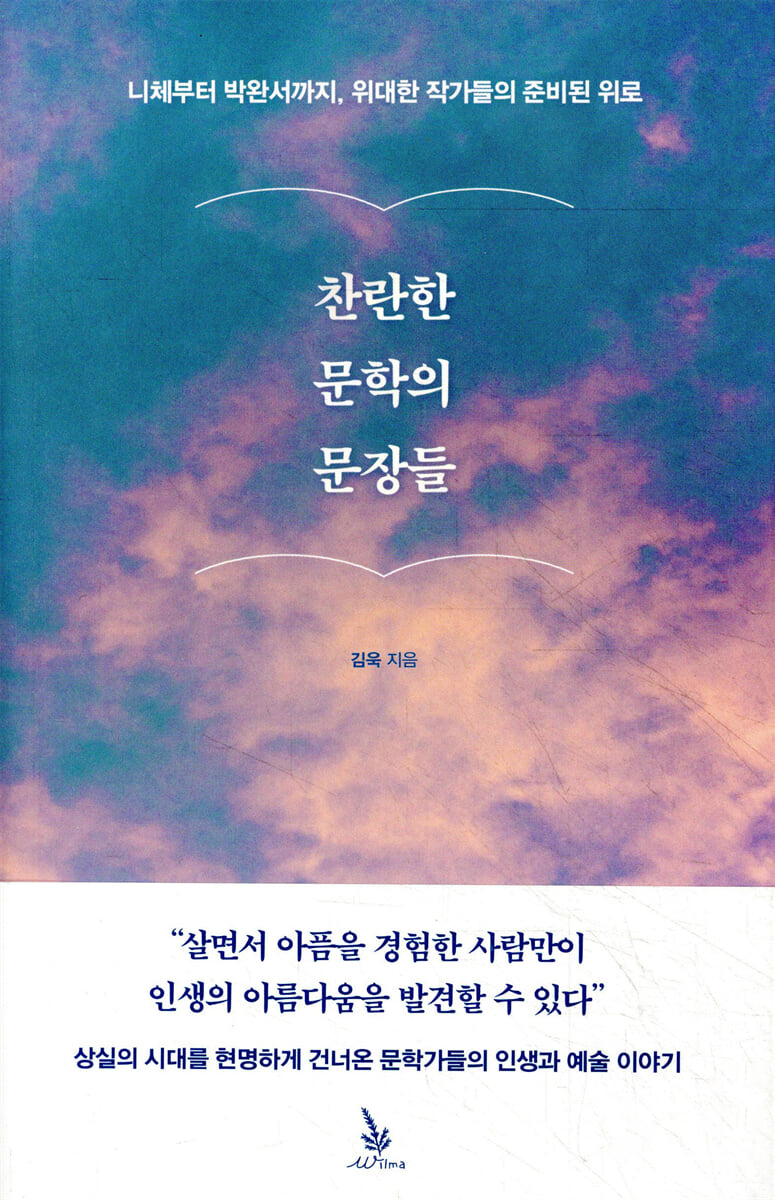
Sentences of brilliant literature
 |
Description
Book Introduction
“Some sentences stick with you forever the moment you read them.”
The precious things of life lost in the hardships of everyday life
Life lessons discovered in the most elegant language
Nietzsche said that life is surprisingly bearable if you have just one person or something that understands your heart.
From the moment I wake up until I go to bed, I'm torn between what I want to do and what I have to do to earn a living, and I'm so caught up in relationships that I often forget what supports me in life.
Fortunately, we have a record called literature.
Nietzsche, Park Wan-seo, Hesse, Kim So-wol, Yang Gui-ja, … .
Those who left behind works we love lived in a different era, but their concerns were no different from ours today.
In the midst of their difficult lives, they expressed their wounds and pain through writing, expressing hope and the brilliance of life.
Through the language of 'literature', which writers have created by finding the light of life even in dark, small rooms where no light shines, we find comfort in the fact that 'I am not the only one who is suffering', 'we all experience pain', and 'there is no one who lives unshaken', and we gain the strength to recover from our wounds without sacrificing ourselves.
If it weren't for the words of great writers, where would we find solace and endure this difficult life?
The books contained in this volume, the thoughts contained in those books, and the lives of the authors who could not help but think of such thoughts will bring a small thrill to the weary hearts that must live tomorrow.
The precious things of life lost in the hardships of everyday life
Life lessons discovered in the most elegant language
Nietzsche said that life is surprisingly bearable if you have just one person or something that understands your heart.
From the moment I wake up until I go to bed, I'm torn between what I want to do and what I have to do to earn a living, and I'm so caught up in relationships that I often forget what supports me in life.
Fortunately, we have a record called literature.
Nietzsche, Park Wan-seo, Hesse, Kim So-wol, Yang Gui-ja, … .
Those who left behind works we love lived in a different era, but their concerns were no different from ours today.
In the midst of their difficult lives, they expressed their wounds and pain through writing, expressing hope and the brilliance of life.
Through the language of 'literature', which writers have created by finding the light of life even in dark, small rooms where no light shines, we find comfort in the fact that 'I am not the only one who is suffering', 'we all experience pain', and 'there is no one who lives unshaken', and we gain the strength to recover from our wounds without sacrificing ourselves.
If it weren't for the words of great writers, where would we find solace and endure this difficult life?
The books contained in this volume, the thoughts contained in those books, and the lives of the authors who could not help but think of such thoughts will bring a small thrill to the weary hearts that must live tomorrow.
- You can preview some of the book's contents.
Preview
index
Introduction - The Comfort of Such Deep and Brilliant Literature
Chapter 1.
There is no one who lives unshaken.
Tomorrow may be worse than today - Friedrich Nietzsche, Thus Spoke Zarathustra
Moments That Require Anger - Yuksa Lee, "Yuksa Poetry Collection"
At the Crossroads of Motherhood, Women, and Social Life - Park Wan-seo, "Who Ate All the Singa?"
Even if the world is a mess, I can't be a mess either. - Spinoza, Ethics
Do your best before expecting reward - Choi Myung-hee, "Soul Fire"
The Force That Makes Us Live - Cheon Kyung-ja, "Page 49 of My Sad Legend"
Chapter 2.
The reason today is hard is because of making a living.
A consolation for those who cannot leave the empty house of their profession - Ki Hyeong-do, "Empty House"
Why We Fall into Temptation - Seo Jeong-ju, Self-Portrait
The belief that it's not too late - Seicho Matsumoto, "A Certain Kokura Diary"
Waiting for the deep fragrance hidden behind the bitter life - Cheon Sang-byeong, "Bird"
Living Together Sometimes Means Subtraction - Kim Sowol, "Azaleas"
The Melancholy of Youth Without Even the Chance to Fail - Jeon Seong-tae, "The Season of the Typhoon"
Chapter 3.
The problem is always love and people
Some Springs Are Cold - Kim Yu-jeong, "Spring Spring"
Love is love, and man is saved as man - Fyodor Dostoevsky, Crime and Punishment
Nevertheless, life must continue - Park Kyung-ni, "Land"
The Pain of Living in the Temptation of Selfishness - Albert Schweitzer, Between Water and the Primeval Forest
Humans Reflect Each Other - Jean Grenier, Remembering Camus
Things That Make Life Lonely - Baek Seok, Nam Shin-ui-ju, Yoo Dong-bak, and Park Si-bong
Our bonds, preserved with sincerity - Picheon Deuk, "Inyeon"
Comforting an Era Where Living Together Has Become Painful - Yang Gui-ja, "The People of Wonmi-dong"
Chapter 4.
How to navigate dark times wisely
Has my life been stolen by someone? - Franz Kafka, The Metamorphosis
Tame the world, or the world bow before me - Shin Kyeong-rim, "Farming"
Who is the real fool? - Leo Tolstoy, The Fool Ivan
To those standing on the great test bench of society - Kim Dong-ri, "The Shaman's Map"
I hope I won't close my eyes, I won't remain silent - Kim Jeong-han, "Sahachon"
Connection, the Blue Hope that Keeps Individuals Alive - Sim Hoon, "Evergreen"
The sadness that turns wounds into laughter - Lee Mun-gu, "My Body Has Been Standing or Walking for Too Long"
Chapter 5.
Attitude for a brilliant and free life
Don't Get Used to Despair - Gao Xingjian, On Creation
Embarking on a Forbidden Journey into the World - Isabella Bird, Korea and Her Neighbors
Realizing How to Live with the Power of the Mind - Ayako Sono, "The Wisdom of Aging"
The courage to embrace a life of curves while dreaming of a straight line - Lee Yun-gi, "Hidden Picture"
For Whom We Grow - Hermann Hesse, Beneath the Wheel
Articles and books cited in the text
Chapter 1.
There is no one who lives unshaken.
Tomorrow may be worse than today - Friedrich Nietzsche, Thus Spoke Zarathustra
Moments That Require Anger - Yuksa Lee, "Yuksa Poetry Collection"
At the Crossroads of Motherhood, Women, and Social Life - Park Wan-seo, "Who Ate All the Singa?"
Even if the world is a mess, I can't be a mess either. - Spinoza, Ethics
Do your best before expecting reward - Choi Myung-hee, "Soul Fire"
The Force That Makes Us Live - Cheon Kyung-ja, "Page 49 of My Sad Legend"
Chapter 2.
The reason today is hard is because of making a living.
A consolation for those who cannot leave the empty house of their profession - Ki Hyeong-do, "Empty House"
Why We Fall into Temptation - Seo Jeong-ju, Self-Portrait
The belief that it's not too late - Seicho Matsumoto, "A Certain Kokura Diary"
Waiting for the deep fragrance hidden behind the bitter life - Cheon Sang-byeong, "Bird"
Living Together Sometimes Means Subtraction - Kim Sowol, "Azaleas"
The Melancholy of Youth Without Even the Chance to Fail - Jeon Seong-tae, "The Season of the Typhoon"
Chapter 3.
The problem is always love and people
Some Springs Are Cold - Kim Yu-jeong, "Spring Spring"
Love is love, and man is saved as man - Fyodor Dostoevsky, Crime and Punishment
Nevertheless, life must continue - Park Kyung-ni, "Land"
The Pain of Living in the Temptation of Selfishness - Albert Schweitzer, Between Water and the Primeval Forest
Humans Reflect Each Other - Jean Grenier, Remembering Camus
Things That Make Life Lonely - Baek Seok, Nam Shin-ui-ju, Yoo Dong-bak, and Park Si-bong
Our bonds, preserved with sincerity - Picheon Deuk, "Inyeon"
Comforting an Era Where Living Together Has Become Painful - Yang Gui-ja, "The People of Wonmi-dong"
Chapter 4.
How to navigate dark times wisely
Has my life been stolen by someone? - Franz Kafka, The Metamorphosis
Tame the world, or the world bow before me - Shin Kyeong-rim, "Farming"
Who is the real fool? - Leo Tolstoy, The Fool Ivan
To those standing on the great test bench of society - Kim Dong-ri, "The Shaman's Map"
I hope I won't close my eyes, I won't remain silent - Kim Jeong-han, "Sahachon"
Connection, the Blue Hope that Keeps Individuals Alive - Sim Hoon, "Evergreen"
The sadness that turns wounds into laughter - Lee Mun-gu, "My Body Has Been Standing or Walking for Too Long"
Chapter 5.
Attitude for a brilliant and free life
Don't Get Used to Despair - Gao Xingjian, On Creation
Embarking on a Forbidden Journey into the World - Isabella Bird, Korea and Her Neighbors
Realizing How to Live with the Power of the Mind - Ayako Sono, "The Wisdom of Aging"
The courage to embrace a life of curves while dreaming of a straight line - Lee Yun-gi, "Hidden Picture"
For Whom We Grow - Hermann Hesse, Beneath the Wheel
Articles and books cited in the text
Detailed image
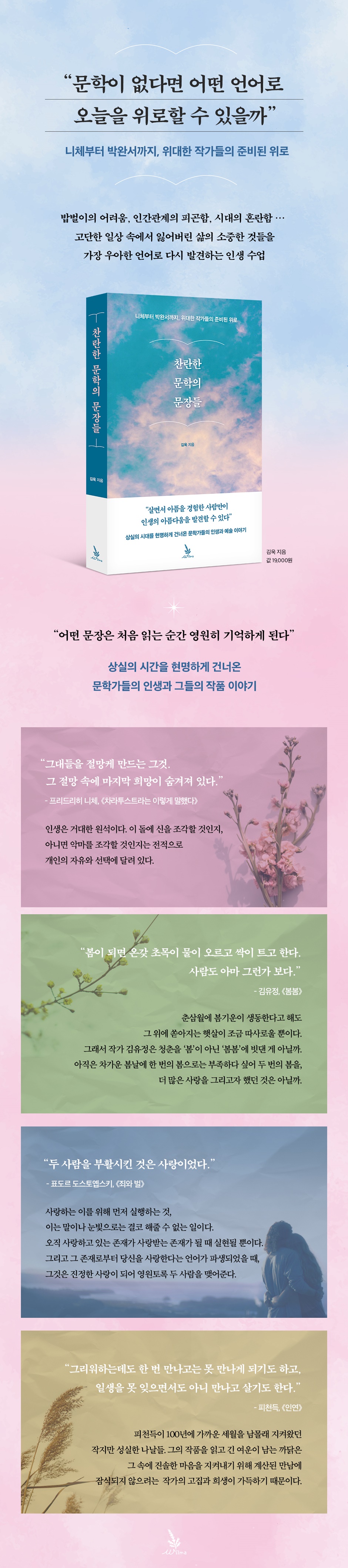
Into the book
In a small, dark room where the light of the world cannot reach, someone is expressing, without a single false whisper, the cries of despair that I am witnessing and the human passions that bloom from it.
That is literature, and when we keep literature by our side, we gain the strength to recover from wounds without sacrificing ourselves.
Even if you don't become a victor in the struggle against the world, you can still seize a new stage beyond the great barrier.
Because all humans have the ability to empathize and be moved.
I just found out.
It is not only human nature to fall into hurt, be robbed, and be frustrated.
When you fall, you open your eyes to a space you couldn't see, when you lose something, you realize what was truly precious, and frustration becomes knowledge that allows you to properly judge the signposts of a path you shouldn't take.
--- From "Introductory Remarks - A Consolation Called Literature, Deeper and More Splendid"
“You walk the great path prepared for you.
The greatest adventure that once held you captive has now become your last refuge.
There is no road behind you.
“Now the only answer you can choose is to walk forward.”
Life is a huge gem.
Whether one carves a god or a devil into this stone is entirely up to the individual's freedom and choice.
Nietzsche defined human life as a struggle toward uniformity.
In a world that does not recognize differences between us, the path that humans must take is clear and simple.
We must break away from the universal path that humanity walks.
It is scary to be classified as a loser because of that, but to tell the truth, being left behind is a prejudice that arises from differences in position and perspective.
Nietzsche's life and death are proof of this.
--- "Tomorrow may be worse than today - Friedrich Nietzsche, from 'Thus Spoke Zarathustra'"
“I had a feeling that I would write about it someday in the future.
That premonition drove out the fear.
“I wasn’t worried about the little food we had.”
No matter how much the world hurt, oppressed, and ignored her, Park Wan-seo never gave up writing novels.
Because before novels became a liberating force that allowed her to realize herself or something that brought her fame, they were a job that generated income.
Park Wan-seo could not tolerate insults to her profession as a novelist more than the human insults that mentioned the limitations of women.
She respected and loved her job.
By becoming a novelist, she finally achieved independence as a human being, not as a woman, and succeeded in establishing a foundation for self-esteem.
--- "At the crossroads of mothers, women, and members of society - from Park Wan-seo, "Who Ate All Those Singa?"
“Like a blind man, I now grope and lock the door.
“My poor love is trapped in an empty house.”
There is something I remember from the articles written by Kihyungdo during his lifetime.
'This is our land.
The land is the hope of the soil.
We cannot leave life. In a world where life is becoming as empty as an empty house, what will we rely on to survive this futile cycle?
I am skeptical because it seems like Gihyeongdo's life is telling me that the right answer is just the right answer, not the absolute truth.
Young Gihyeongdo loved his mother who went out to the radish field to dig holes even under the scorching summer sun.
I remembered the empty house my mother would return to.
And then he left us like an empty house.
As we read his poem, “Empty House,” we realize that life is not something we bring but something we leave behind, that it is not a process of filling but a process of emptying, and that is why we feel sad and empty more often than we feel happy.
--- "Comfort for those who cannot leave the empty house called work - Ki Hyeong-do, "Empty House"
“It was love that brought the two back to life.
“In each other’s hearts, there was a constant spring of love for the other’s heart.”
To do what you want from someone you love first for them is something that can never be done with words or a look.
It is only realized when the one who loves becomes the one who is loved.
And when the language of loving you is derived from that being, it becomes true love and binds two people together forever.
--- "Love is love, and people are saved as people - Fyodor Dostoevsky, from 'Crime and Punishment'"
“I know very well why Albert Camus’s voice pierces the lungs.
There are no secrets or hints to him.
He doesn't speak in a muffled voice, not even in a gentle voice.
He says directly what he needs to say.”
Camus and Grenier were unable to understand each other's world or find a compromise until the very end.
However, I did not let go of the thread of empathy that it could be the other person's position.
The driving force behind the long-term, uninterrupted relationship between two completely different people as literary companions was that Camus and Grenier's "differences" were not a means of division, but rather a secret key to delving deeper into their respective lives and philosophies.
To them, their differences were not differences, but a third alternative, a new horizon that could not be seen without going through each other.
Camus could exist because of Grenier.
Because of Camus, I was able to exist as Grenier.
--- "Humans mirror each other - Jean Grenier, from "Remembering Camus"
“Even though we miss each other, we meet once and then never meet again, and even though we can’t forget each other for the rest of our lives, we live without meeting each other.
Asako and I met three times.
“It would have been better if we hadn’t met the third time.”
The clear language contained in a single piece of writing, the small but sincere days that Picheon Deuk secretly kept for nearly 100 years until that language was created.
It means making other people's hearts ache and replacing lost relationships...
I believe that we, who still seek out his writings today, are the greatest connection that Picheon Deuk hoped for during his lifetime, and that each day, though not special, is filled with more of 'me' because of it.
--- "Our relationship preserved with sincerity - from Picheon Deuk's "Relationship"
“Getting older is a wonderful experience.
Even if you go to a dangerous place, you are free and at peace because you are at an age where you will die anyway.
It is a free state, free from all shackles.
It's time to embark on the adventure you've been saving up for.
In that sense, I believe that the adventure of life is a privilege reserved for old age, not for youth or middle age.”
"The Wisdom of Aging" is a book written by Ayako Sono, who is nearing eighty, to reflect on the meaning of life she has regained along with her eyesight.
The wisdom of life that Sono Ayako discovered was generosity and self-reliance.
For her, who miraculously regained her sight and started a new life at an age when others would be preparing to retire, fifty was just a number to count the seasons of her life.
Undeterred by the numbers, she reached out to anyone trapped in the darkness, holding the light she had been given.
That is why the fresh scent of life always vibrates in Sono Ayako's old life.
That is literature, and when we keep literature by our side, we gain the strength to recover from wounds without sacrificing ourselves.
Even if you don't become a victor in the struggle against the world, you can still seize a new stage beyond the great barrier.
Because all humans have the ability to empathize and be moved.
I just found out.
It is not only human nature to fall into hurt, be robbed, and be frustrated.
When you fall, you open your eyes to a space you couldn't see, when you lose something, you realize what was truly precious, and frustration becomes knowledge that allows you to properly judge the signposts of a path you shouldn't take.
--- From "Introductory Remarks - A Consolation Called Literature, Deeper and More Splendid"
“You walk the great path prepared for you.
The greatest adventure that once held you captive has now become your last refuge.
There is no road behind you.
“Now the only answer you can choose is to walk forward.”
Life is a huge gem.
Whether one carves a god or a devil into this stone is entirely up to the individual's freedom and choice.
Nietzsche defined human life as a struggle toward uniformity.
In a world that does not recognize differences between us, the path that humans must take is clear and simple.
We must break away from the universal path that humanity walks.
It is scary to be classified as a loser because of that, but to tell the truth, being left behind is a prejudice that arises from differences in position and perspective.
Nietzsche's life and death are proof of this.
--- "Tomorrow may be worse than today - Friedrich Nietzsche, from 'Thus Spoke Zarathustra'"
“I had a feeling that I would write about it someday in the future.
That premonition drove out the fear.
“I wasn’t worried about the little food we had.”
No matter how much the world hurt, oppressed, and ignored her, Park Wan-seo never gave up writing novels.
Because before novels became a liberating force that allowed her to realize herself or something that brought her fame, they were a job that generated income.
Park Wan-seo could not tolerate insults to her profession as a novelist more than the human insults that mentioned the limitations of women.
She respected and loved her job.
By becoming a novelist, she finally achieved independence as a human being, not as a woman, and succeeded in establishing a foundation for self-esteem.
--- "At the crossroads of mothers, women, and members of society - from Park Wan-seo, "Who Ate All Those Singa?"
“Like a blind man, I now grope and lock the door.
“My poor love is trapped in an empty house.”
There is something I remember from the articles written by Kihyungdo during his lifetime.
'This is our land.
The land is the hope of the soil.
We cannot leave life. In a world where life is becoming as empty as an empty house, what will we rely on to survive this futile cycle?
I am skeptical because it seems like Gihyeongdo's life is telling me that the right answer is just the right answer, not the absolute truth.
Young Gihyeongdo loved his mother who went out to the radish field to dig holes even under the scorching summer sun.
I remembered the empty house my mother would return to.
And then he left us like an empty house.
As we read his poem, “Empty House,” we realize that life is not something we bring but something we leave behind, that it is not a process of filling but a process of emptying, and that is why we feel sad and empty more often than we feel happy.
--- "Comfort for those who cannot leave the empty house called work - Ki Hyeong-do, "Empty House"
“It was love that brought the two back to life.
“In each other’s hearts, there was a constant spring of love for the other’s heart.”
To do what you want from someone you love first for them is something that can never be done with words or a look.
It is only realized when the one who loves becomes the one who is loved.
And when the language of loving you is derived from that being, it becomes true love and binds two people together forever.
--- "Love is love, and people are saved as people - Fyodor Dostoevsky, from 'Crime and Punishment'"
“I know very well why Albert Camus’s voice pierces the lungs.
There are no secrets or hints to him.
He doesn't speak in a muffled voice, not even in a gentle voice.
He says directly what he needs to say.”
Camus and Grenier were unable to understand each other's world or find a compromise until the very end.
However, I did not let go of the thread of empathy that it could be the other person's position.
The driving force behind the long-term, uninterrupted relationship between two completely different people as literary companions was that Camus and Grenier's "differences" were not a means of division, but rather a secret key to delving deeper into their respective lives and philosophies.
To them, their differences were not differences, but a third alternative, a new horizon that could not be seen without going through each other.
Camus could exist because of Grenier.
Because of Camus, I was able to exist as Grenier.
--- "Humans mirror each other - Jean Grenier, from "Remembering Camus"
“Even though we miss each other, we meet once and then never meet again, and even though we can’t forget each other for the rest of our lives, we live without meeting each other.
Asako and I met three times.
“It would have been better if we hadn’t met the third time.”
The clear language contained in a single piece of writing, the small but sincere days that Picheon Deuk secretly kept for nearly 100 years until that language was created.
It means making other people's hearts ache and replacing lost relationships...
I believe that we, who still seek out his writings today, are the greatest connection that Picheon Deuk hoped for during his lifetime, and that each day, though not special, is filled with more of 'me' because of it.
--- "Our relationship preserved with sincerity - from Picheon Deuk's "Relationship"
“Getting older is a wonderful experience.
Even if you go to a dangerous place, you are free and at peace because you are at an age where you will die anyway.
It is a free state, free from all shackles.
It's time to embark on the adventure you've been saving up for.
In that sense, I believe that the adventure of life is a privilege reserved for old age, not for youth or middle age.”
"The Wisdom of Aging" is a book written by Ayako Sono, who is nearing eighty, to reflect on the meaning of life she has regained along with her eyesight.
The wisdom of life that Sono Ayako discovered was generosity and self-reliance.
For her, who miraculously regained her sight and started a new life at an age when others would be preparing to retire, fifty was just a number to count the seasons of her life.
Undeterred by the numbers, she reached out to anyone trapped in the darkness, holding the light she had been given.
That is why the fresh scent of life always vibrates in Sono Ayako's old life.
--- "Realizing how to live with the power of the mind - Sono Ayako, from "The Wisdom of Aging"
Publisher's Review
“Only those who have experienced pain in life
“You can discover the beauty of life”
Wisely passing through the time of loss
Stories of the lives and works of writers
Perhaps the anxiety, distress, and frustration felt between what we want to do and what we have to do, the loneliness felt in society and relationships, the external pressure, and the conflict with the absurd world are the sorrows felt on the journey of life.
The lives of the writers we know were the same.
Seicho Matsumoto made his debut at the late age of forty-one, completing his novel on the subway during his commute to work.
However, I was often hurt and despaired by the world's view that a newspaper clerk who did all the menial work should not write novels.
Kim Yoo-jung was brutally dumped by the girl she had a crush on because she had a speech impediment.
Kafka was a sensitive and timid son who had to struggle to live up to the expectations of his wealthy and successful father.
Park Wan-seo was a working mom who juggled her career as a mother and a novelist.
All of them built their own worlds, nourished by their own inferiority complex, shame, and humiliating memories.
The sentences that writers write after overcoming their own wounds become a mirror called literature, allowing us to look at ourselves objectively without realizing it.
It most accurately brings out the wounds inside me that I most want to keep hidden, the repeated failures and frustrations, the emptiness and anxiety that come without a cause, and gives me the strength to endure my difficult life again.
Some wounds lock me up and make me shrink.
The desire to turn away, avoid, and avoid being hurt ultimately leads to being tied down by the hurt.
At times like these, literature brings change or comfort to our difficult daily lives.
When a ninety-year-old writer wanders in despair, if you follow the works that silently stood by his side, walking the path of pain alongside him, and the trajectory of the authors who wrote those works, you will find small solace in the midst of a difficult and arduous day.
“You can discover the beauty of life”
Wisely passing through the time of loss
Stories of the lives and works of writers
Perhaps the anxiety, distress, and frustration felt between what we want to do and what we have to do, the loneliness felt in society and relationships, the external pressure, and the conflict with the absurd world are the sorrows felt on the journey of life.
The lives of the writers we know were the same.
Seicho Matsumoto made his debut at the late age of forty-one, completing his novel on the subway during his commute to work.
However, I was often hurt and despaired by the world's view that a newspaper clerk who did all the menial work should not write novels.
Kim Yoo-jung was brutally dumped by the girl she had a crush on because she had a speech impediment.
Kafka was a sensitive and timid son who had to struggle to live up to the expectations of his wealthy and successful father.
Park Wan-seo was a working mom who juggled her career as a mother and a novelist.
All of them built their own worlds, nourished by their own inferiority complex, shame, and humiliating memories.
The sentences that writers write after overcoming their own wounds become a mirror called literature, allowing us to look at ourselves objectively without realizing it.
It most accurately brings out the wounds inside me that I most want to keep hidden, the repeated failures and frustrations, the emptiness and anxiety that come without a cause, and gives me the strength to endure my difficult life again.
Some wounds lock me up and make me shrink.
The desire to turn away, avoid, and avoid being hurt ultimately leads to being tied down by the hurt.
At times like these, literature brings change or comfort to our difficult daily lives.
When a ninety-year-old writer wanders in despair, if you follow the works that silently stood by his side, walking the path of pain alongside him, and the trajectory of the authors who wrote those works, you will find small solace in the midst of a difficult and arduous day.
GOODS SPECIFICS
- Date of issue: March 10, 2025
- Page count, weight, size: 336 pages | 486g | 135*210*23mm
- ISBN13: 9791198889539
- ISBN10: 1198889535
You may also like
카테고리
korean


korean

![GQ KOREA Mark (Monthly): December [2025]](http://librairie.coreenne.fr/cdn/shop/files/8ef265dbbfbf186523ed75ba7319009d.jpg?v=1765340328&width=3840)


