

If only I could be a traveler
 |
Description
Book Introduction
“There are surprisingly many joys I can enjoy in my own way.”
The first of five unpublished manuscripts!
Commemorating the 14th anniversary of Park Wan-seo's death, the complete edition of her travel essays is published.
To commemorate the 14th anniversary of the passing of Park Wan-seo, a giant of Korean literature, Munhakdongne is publishing the prose collection, “If I Could Only Be a Traveler.”
Park Wan-seo was born in 1931 during the Japanese colonial period and endured the turbulent times of modern and contemporary Korean history, including the liberation of her country, the Korean War, the division of North and South Korea, the April 19 Revolution, and the IMF crisis. Until her death in 2011, she produced numerous masterpieces in various fields, including short stories, novels, fairy tales, and prose collections.
"If Only I Could Be a Traveler" is a vivid travelogue written by the author during his lifetime, covering diverse places he visited, from domestic locations like Namhansanseong and Gangneung to unknown foreign destinations like the Vatican, Tibet, and Ethiopia, and even places like Kaesong and Baekdu Mountain, which evoke indescribable emotions in us.
This is a re-edited version of 『The Lost Suitcase』 (Silcheonmunhaksa), published in 2005, and includes five previously unpublished manuscripts, making it a veritable "complete edition of Park Wan-seo's travel essays."
This book is particularly significant as the tenth book published in the 10th year since the first volume of the "Park Wan-seo Prose Collection" series, "Embarrassing Confession," was published by Munhakdongne in 2015 to commemorate Park Wan-seo's footsteps as an outstanding prose writer.
It is also noteworthy that the book includes the preface, “Mother’s Travel Bag,” by the eldest daughter, author Ho Won-sook, who has always been a strong supporter of her mother Park Wan-seo, who has been actively engaged in her writing career.
This book, filled with the joy and happiness felt through travel, as well as reflections on humanity, will provide readers with a different kind of emotion than his novels.
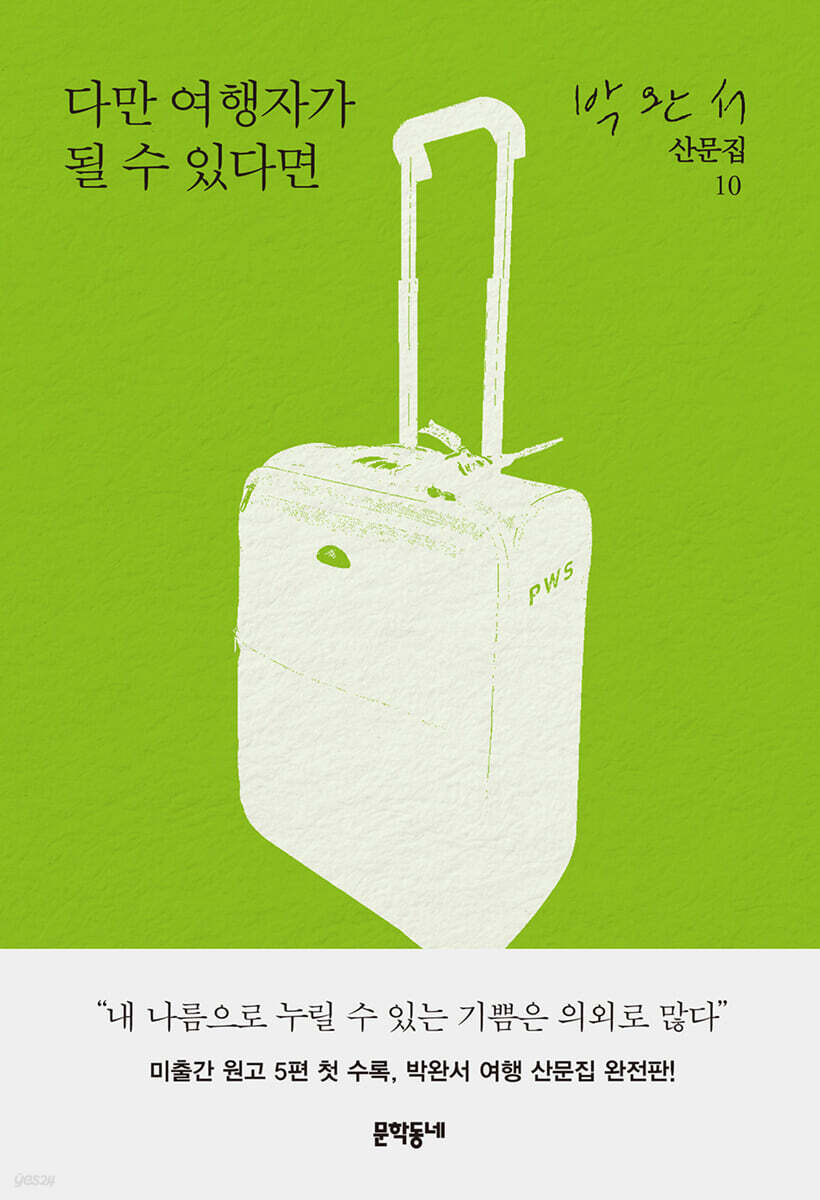
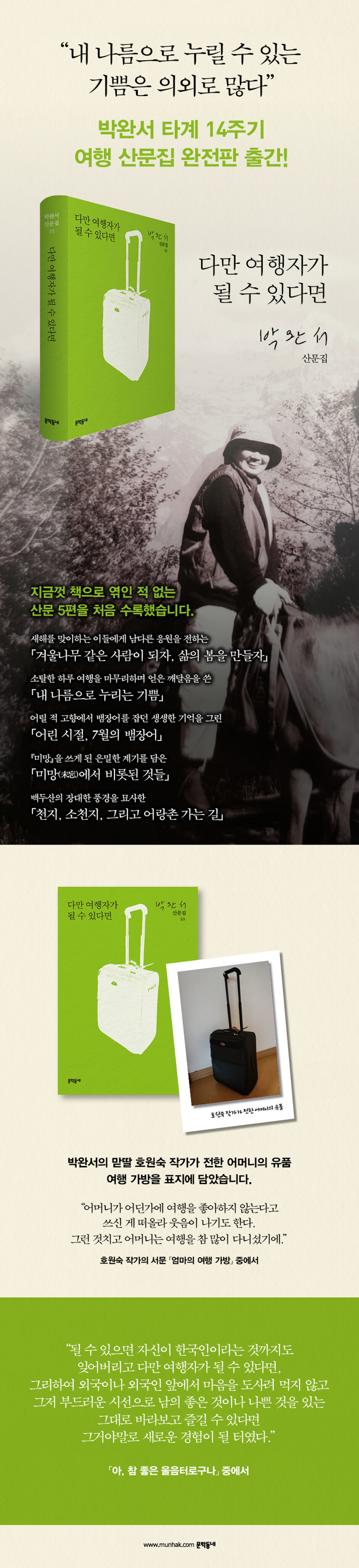
My mother's suitcase, which was also decorated as the cover of this book, still has a red Christmas ribbon on it.
It's just an ordinary carrier, but when I look at it, it reminds me of my mother and makes me smile.
I sometimes laugh when I remember my mother writing somewhere that she doesn't like to travel.
Despite all that, my mother traveled a lot.
_Ho Won-suk, Preface to "Mom's Travel Bag," p. 4
The first of five unpublished manuscripts!
Commemorating the 14th anniversary of Park Wan-seo's death, the complete edition of her travel essays is published.
To commemorate the 14th anniversary of the passing of Park Wan-seo, a giant of Korean literature, Munhakdongne is publishing the prose collection, “If I Could Only Be a Traveler.”
Park Wan-seo was born in 1931 during the Japanese colonial period and endured the turbulent times of modern and contemporary Korean history, including the liberation of her country, the Korean War, the division of North and South Korea, the April 19 Revolution, and the IMF crisis. Until her death in 2011, she produced numerous masterpieces in various fields, including short stories, novels, fairy tales, and prose collections.
"If Only I Could Be a Traveler" is a vivid travelogue written by the author during his lifetime, covering diverse places he visited, from domestic locations like Namhansanseong and Gangneung to unknown foreign destinations like the Vatican, Tibet, and Ethiopia, and even places like Kaesong and Baekdu Mountain, which evoke indescribable emotions in us.
This is a re-edited version of 『The Lost Suitcase』 (Silcheonmunhaksa), published in 2005, and includes five previously unpublished manuscripts, making it a veritable "complete edition of Park Wan-seo's travel essays."
This book is particularly significant as the tenth book published in the 10th year since the first volume of the "Park Wan-seo Prose Collection" series, "Embarrassing Confession," was published by Munhakdongne in 2015 to commemorate Park Wan-seo's footsteps as an outstanding prose writer.
It is also noteworthy that the book includes the preface, “Mother’s Travel Bag,” by the eldest daughter, author Ho Won-sook, who has always been a strong supporter of her mother Park Wan-seo, who has been actively engaged in her writing career.
This book, filled with the joy and happiness felt through travel, as well as reflections on humanity, will provide readers with a different kind of emotion than his novels.
My mother's suitcase, which was also decorated as the cover of this book, still has a red Christmas ribbon on it.
It's just an ordinary carrier, but when I look at it, it reminds me of my mother and makes me smile.
I sometimes laugh when I remember my mother writing somewhere that she doesn't like to travel.
Despite all that, my mother traveled a lot.
_Ho Won-suk, Preface to "Mom's Travel Bag," p. 4
- You can preview some of the book's contents.
Preview
index
Introduction | Mom's Travel Bag
Part 1: Something as original as a dream
Let's be like winter trees, let's create spring in life.
The joy I enjoy in my own way
Childhood, July Eel
Things that come from forgetting
Lost suitcase
Part 2: A Good and Generous Peace
Ah, what a wonderful place to cry - A Journey Through Manchuria, China
The Road to Cheonji, Socheonji, and Eorangchon - A Journey to Baekdu Mountain
A Connection with Shanghai - A Travelogue of Shanghai
Hoping for everyone's help - A trip to Mongolia
Part 3: Asking Why We Are Human
The feeling of being there - A Vatican Journey
The Land That Doesn't Breathe - A Visit to Ethiopia
Life Goes On - A Trip to Indonesia
Desecration - A Journey to Tibet
City of the Gods - Kathmandu Travelogue
Author's chronology
Part 1: Something as original as a dream
Let's be like winter trees, let's create spring in life.
The joy I enjoy in my own way
Childhood, July Eel
Things that come from forgetting
Lost suitcase
Part 2: A Good and Generous Peace
Ah, what a wonderful place to cry - A Journey Through Manchuria, China
The Road to Cheonji, Socheonji, and Eorangchon - A Journey to Baekdu Mountain
A Connection with Shanghai - A Travelogue of Shanghai
Hoping for everyone's help - A trip to Mongolia
Part 3: Asking Why We Are Human
The feeling of being there - A Vatican Journey
The Land That Doesn't Breathe - A Visit to Ethiopia
Life Goes On - A Trip to Indonesia
Desecration - A Journey to Tibet
City of the Gods - Kathmandu Travelogue
Author's chronology
Detailed image
Into the book
Eels were a delicacy, as they were rare and had been caught with great effort.
If you split the fish alive along the ship's line, sprinkle a little salt on it, place it on a griddle, and roast it, a lot of oil will come out and the flames will go out uncontrollably.
When you chew the properly grilled eel with the spine still attached, the oily, rich, and sweet taste is exquisite.
I felt like I was going to gain weight like a pig right away.
---p.35 From "Childhood, July Eel"
As I get older, my forgetting process becomes more active, so I wish I had written down things from time to time, but I haven't been able to do it yet.
It's partly because of laziness that makes it difficult to form new habits, but it's also because there are still words that survive and sway for a long time without dying immediately.
---p.39 From “Things that come from forgetfulness”
Isn't it true that all human beings, regardless of social status, race, ethnicity, skin color, or cultural differences, have a desire to have their dignity confirmed?
I will always cherish the feeling of gratitude and consider it a great blessing to have been given such an opportunity.
---p.109 From "The Feeling of Being There - A Trip to the Vatican"
Is there any other death as slow and painful as starvation?
(…) I felt like I wasn’t even human if I didn’t do anything for these children.
It wasn't because we remembered that the participating countries helped us during the Korean War, or that our children once had their hunger satisfied thanks to UNICEF.
Just seeing it was a huge responsibility.
I didn't have the confidence to take responsibility, but it seemed like it would be even more difficult to do nothing.
---pp.115-116 From "The Land That Doesn't Breathe - A Visit to Ethiopia"
I was more worried about what would happen to the people who survived there than about the city that had disappeared.
People are born and then cities are born, not cities being born and then people being born.
Humans are so cruel that they can bury their children and still eat that day, but when one day their parents and children suddenly disappear, relatives and neighbors they trusted and relied on disappear without a trace, and everything they have grown accustomed to can no longer be seen, will they be able to accept that reality and continue living a normal life?
Even if you haven't experienced it, it's obvious that it absolutely can't happen.
If you ask why, it's like asking why we are human.
---p.131 From "Life Goes On - A Trip to Indonesia"
The sky in Tibet is a deeper blue than our sky at that time.
Was this the color of the primordial sky, before the breath of humankind, before its dawn? But even in the beginning, the sky over Tibet must have been quite different from that of any other place.
You can feel it more clearly when you look at the sunlight.
The sharpness with which the eyes are shot out as if a needle has been unraveled even gives the impression of hostility.
Perhaps it was the unworn, wild aggression of sunlight filtering through the oxygen-thin air.
If you split the fish alive along the ship's line, sprinkle a little salt on it, place it on a griddle, and roast it, a lot of oil will come out and the flames will go out uncontrollably.
When you chew the properly grilled eel with the spine still attached, the oily, rich, and sweet taste is exquisite.
I felt like I was going to gain weight like a pig right away.
---p.35 From "Childhood, July Eel"
As I get older, my forgetting process becomes more active, so I wish I had written down things from time to time, but I haven't been able to do it yet.
It's partly because of laziness that makes it difficult to form new habits, but it's also because there are still words that survive and sway for a long time without dying immediately.
---p.39 From “Things that come from forgetfulness”
Isn't it true that all human beings, regardless of social status, race, ethnicity, skin color, or cultural differences, have a desire to have their dignity confirmed?
I will always cherish the feeling of gratitude and consider it a great blessing to have been given such an opportunity.
---p.109 From "The Feeling of Being There - A Trip to the Vatican"
Is there any other death as slow and painful as starvation?
(…) I felt like I wasn’t even human if I didn’t do anything for these children.
It wasn't because we remembered that the participating countries helped us during the Korean War, or that our children once had their hunger satisfied thanks to UNICEF.
Just seeing it was a huge responsibility.
I didn't have the confidence to take responsibility, but it seemed like it would be even more difficult to do nothing.
---pp.115-116 From "The Land That Doesn't Breathe - A Visit to Ethiopia"
I was more worried about what would happen to the people who survived there than about the city that had disappeared.
People are born and then cities are born, not cities being born and then people being born.
Humans are so cruel that they can bury their children and still eat that day, but when one day their parents and children suddenly disappear, relatives and neighbors they trusted and relied on disappear without a trace, and everything they have grown accustomed to can no longer be seen, will they be able to accept that reality and continue living a normal life?
Even if you haven't experienced it, it's obvious that it absolutely can't happen.
If you ask why, it's like asking why we are human.
---p.131 From "Life Goes On - A Trip to Indonesia"
The sky in Tibet is a deeper blue than our sky at that time.
Was this the color of the primordial sky, before the breath of humankind, before its dawn? But even in the beginning, the sky over Tibet must have been quite different from that of any other place.
You can feel it more clearly when you look at the sunlight.
The sharpness with which the eyes are shot out as if a needle has been unraveled even gives the impression of hostility.
Perhaps it was the unworn, wild aggression of sunlight filtering through the oxygen-thin air.
---p.135 From "Desecration - A Journey to Tibet"
Publisher's Review
"I thought winter lingered the longest in the mountains, but spring also arrived first." A poem that brings a vibrant spring, passing through darkness and cold.
Part 1, “Original as a Dream,” contains five pieces, including four delightful unpublished manuscripts discovered by author Ho Won-sook by chance: “Let’s Become People Like Winter Trees, Let’s Create the Spring of Life,” “The Joy of Enjoying in My Own Way,” “Childhood, Eels in July,” and “Things Originating from Unforgettable Thoughts.”
“Let’s become people like winter trees, let’s create spring in our lives” is a story that the author told when he lived in Jamsil and often visited Namhansanseong Fortress, where he heard “the sound of a carefree stream and the babbling of children” and “the lively sounds of spring” (p. 18). It is a powerful piece of writing that strengthens our hearts as we endure the darkness and cold and wait for the new year to come.
“The Joy of Enjoying in My Own Way,” which tells the story of a day trip to Gangneung with a friend and a delicious restaurant found by chance in a neighborhood where I took the wrong road, and brings to the realization that “the joy that can be enjoyed by thinking in my own way what others thought in their own way” (p. 26) is “luxury” (p. 25); “Eels in July in Childhood,” which expresses longing for the people of my hometown through a poignant, vignette-like memory of eating grilled eels caught by my uncle in the countryside during my poor childhood; and “Things Originating from Unforgettable” which makes readers think about what novel writing is through an intimate recollection of how he came to write the epic novel “Unforgettable”; all of these make readers long for the innocence of the past that they have forgotten, sometimes reflect on shame, and through this, contemplate the future that they will live in.
‘Travel’ as told by Park Wan-seo, a master of Korean literature
It is a process of reflecting on oneself through others.
Why We Need to Read Park Wan-seo Again Now
Part 2, “A Good and Generous Peace,” highlights the author’s deep and broad perspective on China, a neighboring country with a long history.
"Ah, what a wonderful place to cry - A Journey through Manchuria, China" is a moving piece imbued with respect for our ancestors who struggled to reclaim their homeland by vividly depicting Manchuria, the vast stage where independence fighters were active during the Japanese colonial period.
Another unpublished manuscript, "Cheonji, Socheonji, and the Road to Eorangchon - A Journey to Baekdu Mountain," is a piece in which the author uses his own heavenly expressiveness to describe the majestic scenery he witnessed while reaching Cheonji on Baekdu Mountain.
The spatial contrast between the mysterious Baekdu Mountains, where “clouds” that are “always changeable and spiritual” “move in waves across the sky above the earth, using the valleys between the peaks as passageways” (p. 80), and the familiar “huts” of the lower village Korean compatriots who support the landscape, evokes the humility of humans who worship Mother Nature, while the author’s compassion and solidarity with his compatriots living in Manchuria and Yanbian resonates deeply.
The author's emotional line seems to be connected to the "carnal affection" (p. 99) that the author, who went to Mongolia as a UNICEF delegation member in "Hoping for Everyone's Help - A Journey to Mongolia" included at the end of Part 2, feels for the Mongolian people, who "are so much like us that we often forget that we are in a foreign country" (p. 94).
The author's heartfelt sorrow for the poor living conditions in Korea, once a developing country, is fully conveyed to the reader through their "school attendance problems," "sanitation problems," and "drinking water problems" (p. 97).
Traveling to another country is an act of looking into the people who live there, and it can also be an act of reflecting on oneself through them.
Standing right there in that very place is what it means to be a 'traveler', as the author says.
While human interaction and global exchanges have become more active than in the past, isolation and anxiety have also deepened. Isn't reading Park Wan-seo a way to broaden one's horizons and see the world through a broader lens?
Couldn't we just look at other people's political systems, cultures, and national incomes as their own way of life, without comparing them to ours? If only we could forget that we are Korean and simply become travelers, and not be afraid of foreign countries or foreigners, and just look at and enjoy the good and bad things about others with a gentle gaze, that would be a truly new experience.
_「Ah, what a wonderful place to cry - A Journey through Manchuria, China」, p. 58
The author's footsteps engraved in a distant foreign land,
Revived in breath-like language
Unlike Part 2, which makes us look back on our past and present through a trip to East Asia, which is close to our country, Part 3, "Asking Why We Are Human," makes us think about what humans, gods, religion, and faith are by experiencing more distant and unfamiliar foreign lands such as the Vatican, Ethiopia, Indonesia, Tibet, and Nepal.
“The Emotion of Being There - A Journey to the Vatican” is a beautiful piece written by the author, who visited the Vatican as part of a delegation to pay tribute to the passing of Pope John Paul II, in which he elevates the value of “the dignity of existence that is inherent in all human beings, regardless of social status, race, ethnicity, skin color, or culture” (p. 109).
"A Land That Doesn't Breathe - A Visit to Ethiopia" is a book about refugee camps on the border between Ethiopia and Somalia that were destroyed by a long civil war and military dictatorship, and "Life Goes On - A Visit to Indonesia" is a book about the author's heartbreaking sorrow and agony as a UNICEF worker visiting Indonesia, which suffered severe damage from a tsunami.
The author, who witnessed “how harsh it is for people to survive” (p. 113), not only prays earnestly for people to be able to live like human beings, but also emphasizes the importance of “UNICEF’s key projects” (p. 128), such as groundwater development, in a very realistic voice that is also impressive.
"A Trip to Tibet" and "A Trip to Kathmandu, the City of Gods" are records of visits to Tibet and Nepal, lands near the Himalayas and holy places for pilgrims.
He sings of the surprising fulfillment of “acknowledging and appreciating the other’s culture as it is” (p. 239) while experiencing Tibetan Buddhism, which feels more “human” (p. 144) through the blending of “Buddha and humanity, sacred and profane” (pp. 143-144), and Nepali Hindu culture, which believes in reincarnation.
The author, who traveled through the harsh terrain of the highlands, finally confesses at the end of his journey that “walking is the best, better than running, crawling, or jumping” (p. 239).
The bold footsteps of the master, who took each step in a distant foreign land, were revived in a book with his breath-like language.
"If Only I Could Be a Traveler" will be remembered by readers as an unforgettable new travel destination.
Part 1, “Original as a Dream,” contains five pieces, including four delightful unpublished manuscripts discovered by author Ho Won-sook by chance: “Let’s Become People Like Winter Trees, Let’s Create the Spring of Life,” “The Joy of Enjoying in My Own Way,” “Childhood, Eels in July,” and “Things Originating from Unforgettable Thoughts.”
“Let’s become people like winter trees, let’s create spring in our lives” is a story that the author told when he lived in Jamsil and often visited Namhansanseong Fortress, where he heard “the sound of a carefree stream and the babbling of children” and “the lively sounds of spring” (p. 18). It is a powerful piece of writing that strengthens our hearts as we endure the darkness and cold and wait for the new year to come.
“The Joy of Enjoying in My Own Way,” which tells the story of a day trip to Gangneung with a friend and a delicious restaurant found by chance in a neighborhood where I took the wrong road, and brings to the realization that “the joy that can be enjoyed by thinking in my own way what others thought in their own way” (p. 26) is “luxury” (p. 25); “Eels in July in Childhood,” which expresses longing for the people of my hometown through a poignant, vignette-like memory of eating grilled eels caught by my uncle in the countryside during my poor childhood; and “Things Originating from Unforgettable” which makes readers think about what novel writing is through an intimate recollection of how he came to write the epic novel “Unforgettable”; all of these make readers long for the innocence of the past that they have forgotten, sometimes reflect on shame, and through this, contemplate the future that they will live in.
‘Travel’ as told by Park Wan-seo, a master of Korean literature
It is a process of reflecting on oneself through others.
Why We Need to Read Park Wan-seo Again Now
Part 2, “A Good and Generous Peace,” highlights the author’s deep and broad perspective on China, a neighboring country with a long history.
"Ah, what a wonderful place to cry - A Journey through Manchuria, China" is a moving piece imbued with respect for our ancestors who struggled to reclaim their homeland by vividly depicting Manchuria, the vast stage where independence fighters were active during the Japanese colonial period.
Another unpublished manuscript, "Cheonji, Socheonji, and the Road to Eorangchon - A Journey to Baekdu Mountain," is a piece in which the author uses his own heavenly expressiveness to describe the majestic scenery he witnessed while reaching Cheonji on Baekdu Mountain.
The spatial contrast between the mysterious Baekdu Mountains, where “clouds” that are “always changeable and spiritual” “move in waves across the sky above the earth, using the valleys between the peaks as passageways” (p. 80), and the familiar “huts” of the lower village Korean compatriots who support the landscape, evokes the humility of humans who worship Mother Nature, while the author’s compassion and solidarity with his compatriots living in Manchuria and Yanbian resonates deeply.
The author's emotional line seems to be connected to the "carnal affection" (p. 99) that the author, who went to Mongolia as a UNICEF delegation member in "Hoping for Everyone's Help - A Journey to Mongolia" included at the end of Part 2, feels for the Mongolian people, who "are so much like us that we often forget that we are in a foreign country" (p. 94).
The author's heartfelt sorrow for the poor living conditions in Korea, once a developing country, is fully conveyed to the reader through their "school attendance problems," "sanitation problems," and "drinking water problems" (p. 97).
Traveling to another country is an act of looking into the people who live there, and it can also be an act of reflecting on oneself through them.
Standing right there in that very place is what it means to be a 'traveler', as the author says.
While human interaction and global exchanges have become more active than in the past, isolation and anxiety have also deepened. Isn't reading Park Wan-seo a way to broaden one's horizons and see the world through a broader lens?
Couldn't we just look at other people's political systems, cultures, and national incomes as their own way of life, without comparing them to ours? If only we could forget that we are Korean and simply become travelers, and not be afraid of foreign countries or foreigners, and just look at and enjoy the good and bad things about others with a gentle gaze, that would be a truly new experience.
_「Ah, what a wonderful place to cry - A Journey through Manchuria, China」, p. 58
The author's footsteps engraved in a distant foreign land,
Revived in breath-like language
Unlike Part 2, which makes us look back on our past and present through a trip to East Asia, which is close to our country, Part 3, "Asking Why We Are Human," makes us think about what humans, gods, religion, and faith are by experiencing more distant and unfamiliar foreign lands such as the Vatican, Ethiopia, Indonesia, Tibet, and Nepal.
“The Emotion of Being There - A Journey to the Vatican” is a beautiful piece written by the author, who visited the Vatican as part of a delegation to pay tribute to the passing of Pope John Paul II, in which he elevates the value of “the dignity of existence that is inherent in all human beings, regardless of social status, race, ethnicity, skin color, or culture” (p. 109).
"A Land That Doesn't Breathe - A Visit to Ethiopia" is a book about refugee camps on the border between Ethiopia and Somalia that were destroyed by a long civil war and military dictatorship, and "Life Goes On - A Visit to Indonesia" is a book about the author's heartbreaking sorrow and agony as a UNICEF worker visiting Indonesia, which suffered severe damage from a tsunami.
The author, who witnessed “how harsh it is for people to survive” (p. 113), not only prays earnestly for people to be able to live like human beings, but also emphasizes the importance of “UNICEF’s key projects” (p. 128), such as groundwater development, in a very realistic voice that is also impressive.
"A Trip to Tibet" and "A Trip to Kathmandu, the City of Gods" are records of visits to Tibet and Nepal, lands near the Himalayas and holy places for pilgrims.
He sings of the surprising fulfillment of “acknowledging and appreciating the other’s culture as it is” (p. 239) while experiencing Tibetan Buddhism, which feels more “human” (p. 144) through the blending of “Buddha and humanity, sacred and profane” (pp. 143-144), and Nepali Hindu culture, which believes in reincarnation.
The author, who traveled through the harsh terrain of the highlands, finally confesses at the end of his journey that “walking is the best, better than running, crawling, or jumping” (p. 239).
The bold footsteps of the master, who took each step in a distant foreign land, were revived in a book with his breath-like language.
"If Only I Could Be a Traveler" will be remembered by readers as an unforgettable new travel destination.
GOODS SPECIFICS
- Date of issue: January 7, 2025
- Page count, weight, size: 248 pages | 344g | 128*188*15mm
- ISBN13: 9791141601706
- ISBN10: 1141601702
You may also like
카테고리
korean


korean

![GQ KOREA Mark (Monthly): December [2025]](http://librairie.coreenne.fr/cdn/shop/files/8ef265dbbfbf186523ed75ba7319009d.jpg?v=1765340328&width=3840)


