

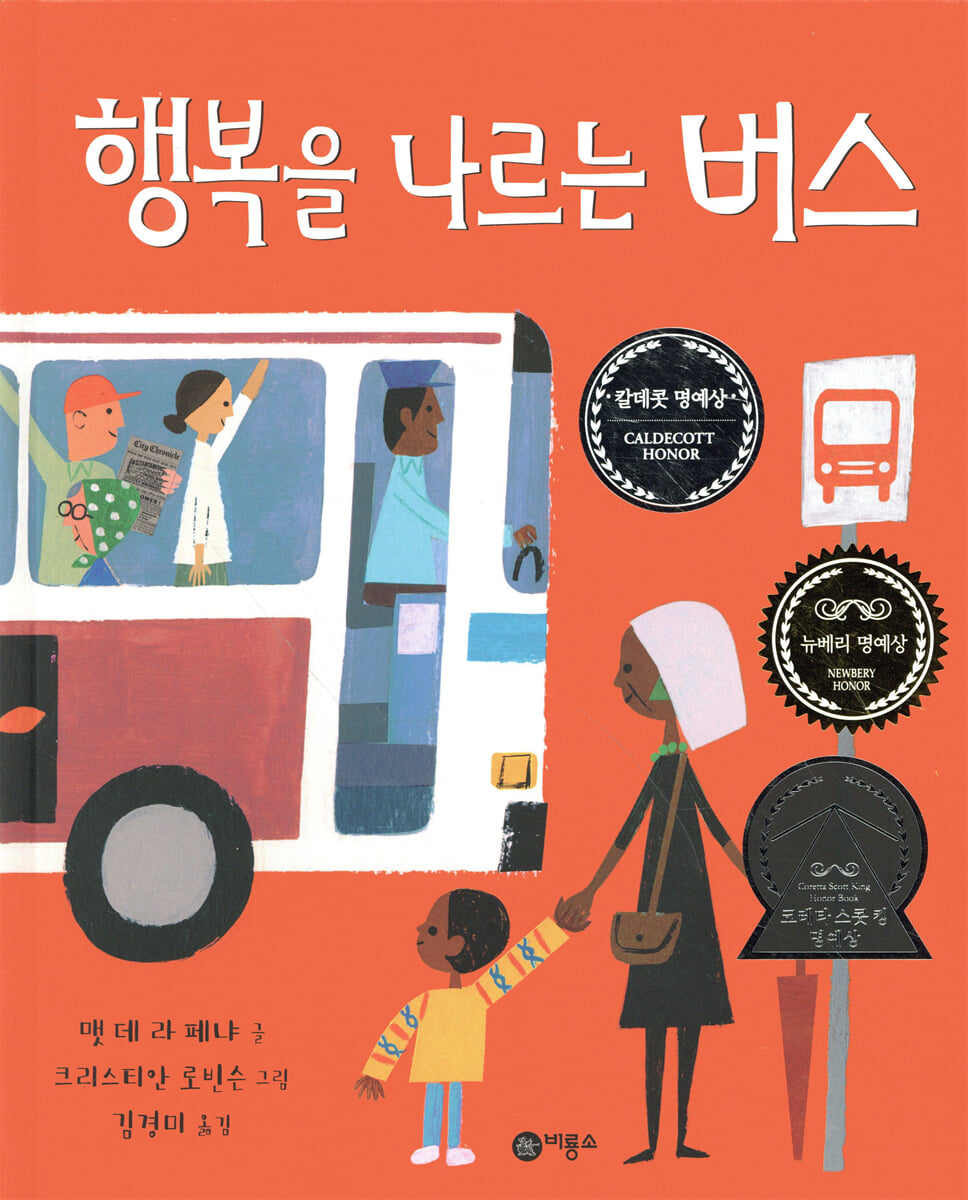
The bus that carries happiness
 |
Description
Book Introduction
The first picture book to win both the 2016 Newbery Medal and Caldecott Honor!
2016 Coretta Scott King Illustrator Honor Award
The New York Times Book Review's "Notable Children's Books of 2015"
The Wall Street Journal's 2015 Children's Books of the Year
Publisher's Weekly's 2015 Books of the Year
National Public Radio's 2015 Books of the Year
The Boston Globe's 2015 Books of the Year
Kirkus Reviews' 2015 Books of the Year
Book Page's "2015 Must-Read Picture Books of the Year"
An amazing book that tells you what true happiness is.
―Publisher's Weekly
This is by far the best picture book among the notable picture books of 2015.
―The Huffington Post
We are different in appearance and way of life,
A bus where everyone is happy together!
The Happy Bus, which received attention as the first picture book to win both the Newbery Medal and the Caldecott Honor in 2016, has been published by Biryongso.
Christian Robinson, who drew the illustrations, received the Coretta Scott King Illustrator Honor Award for his portrayal of diverse races, including African Americans, in the book.
It also received simultaneous praise from over 20 renowned media outlets upon its publication, including being selected as one of the New York Times' "Notable Children's Books of 2015," the Wall Street Journal's "Children's Book of the Year 2015," Publisher's Weekly's "Book of the Year 2015," and BookPage's "Must-Read Illustrated Books of 2015."
"The Bus that Carries Happiness" is a story about a grandmother and her young grandson, CJ, who encounter colorful neighbors while riding a bus to the last stop and come to realize what true happiness is.
The calm and witty writing and the warm and calm atmosphere of the illustrations make the reader feel both entertained and moved.
Additionally, the book includes reading activity sheets, so you can enjoy various post-reading activities such as 'Find the Different Pictures' or 'Draw the Town I Live in' after reading the book.
2016 Coretta Scott King Illustrator Honor Award
The New York Times Book Review's "Notable Children's Books of 2015"
The Wall Street Journal's 2015 Children's Books of the Year
Publisher's Weekly's 2015 Books of the Year
National Public Radio's 2015 Books of the Year
The Boston Globe's 2015 Books of the Year
Kirkus Reviews' 2015 Books of the Year
Book Page's "2015 Must-Read Picture Books of the Year"
An amazing book that tells you what true happiness is.
―Publisher's Weekly
This is by far the best picture book among the notable picture books of 2015.
―The Huffington Post
We are different in appearance and way of life,
A bus where everyone is happy together!
The Happy Bus, which received attention as the first picture book to win both the Newbery Medal and the Caldecott Honor in 2016, has been published by Biryongso.
Christian Robinson, who drew the illustrations, received the Coretta Scott King Illustrator Honor Award for his portrayal of diverse races, including African Americans, in the book.
It also received simultaneous praise from over 20 renowned media outlets upon its publication, including being selected as one of the New York Times' "Notable Children's Books of 2015," the Wall Street Journal's "Children's Book of the Year 2015," Publisher's Weekly's "Book of the Year 2015," and BookPage's "Must-Read Illustrated Books of 2015."
"The Bus that Carries Happiness" is a story about a grandmother and her young grandson, CJ, who encounter colorful neighbors while riding a bus to the last stop and come to realize what true happiness is.
The calm and witty writing and the warm and calm atmosphere of the illustrations make the reader feel both entertained and moved.
Additionally, the book includes reading activity sheets, so you can enjoy various post-reading activities such as 'Find the Different Pictures' or 'Draw the Town I Live in' after reading the book.
- You can preview some of the book's contents.
Preview
Detailed image
Publisher's Review
Learn about the world with Grandma!
CJ is a curious boy.
The world is full of mysteries to CJ: why does it rain so much, why does he always have to go to the soup kitchen that his friends don't go to, how did the blind man end up losing his sight of the world?
Some adults either ignore a child's question or try to give them just one correct answer.
But my grandmother never gives an empty answer to any question.
Grandma listens carefully to Sijei's questions and then answers them one by one wisely.
It rains because thirsty trees need rainwater to drink, it's a shame not to meet diverse neighbors at a soup kitchen, and the blind man sees the world through his ears instead of his eyes.
Grandma respects CJ's feelings while also guiding CJ to see the world from a new perspective.
In this way, “The Bus that Carries Happiness” provides an example of a conversation that transcends generations.
A grandmother's wisdom in responding to her young grandson's awkward questions with a gentle smile will bring profound insight to adults and instill a warm and affectionate energy in children.
A warm picture book that makes you look after your neighbors
CJ is an active boy who is very curious and wants to do many things.
He wants to speed around in a car like his friends and run around outside, but all he can do is watch the cars whizzing by and the boys riding bicycles outside the bus window.
However, this situation does not pose much of a problem to CJ.
Rather, CJ enjoys the journey to the last stop with her grandmother.
CJ smiles when he gets on the bus, smiles when he meets the blind man, and smiles when he arrives at the soup kitchen.
The reason is simple.
On the contrary, CJ has a daily life that other people of the same age do not easily enjoy.
As CJ travels with his grandmother on a bus to the final stop, he vividly experiences the colorful neighborhood and the raw world.
The liveliness of the neighborhood that I could not have experienced if I had only driven a car, the poverty of the neighborhood that I could not have learned if I had not gone to the soup kitchen.
CJ sees, hears, and experiences all of these things firsthand, and vaguely learns the truth of life: that the world we know is not everything.
The happiness of finding beauty hidden everywhere!
If the world we know isn't everything, what world is there we don't know? Matt de la Peña and Christian Robinson have captured that world in a bus and a soup kitchen.
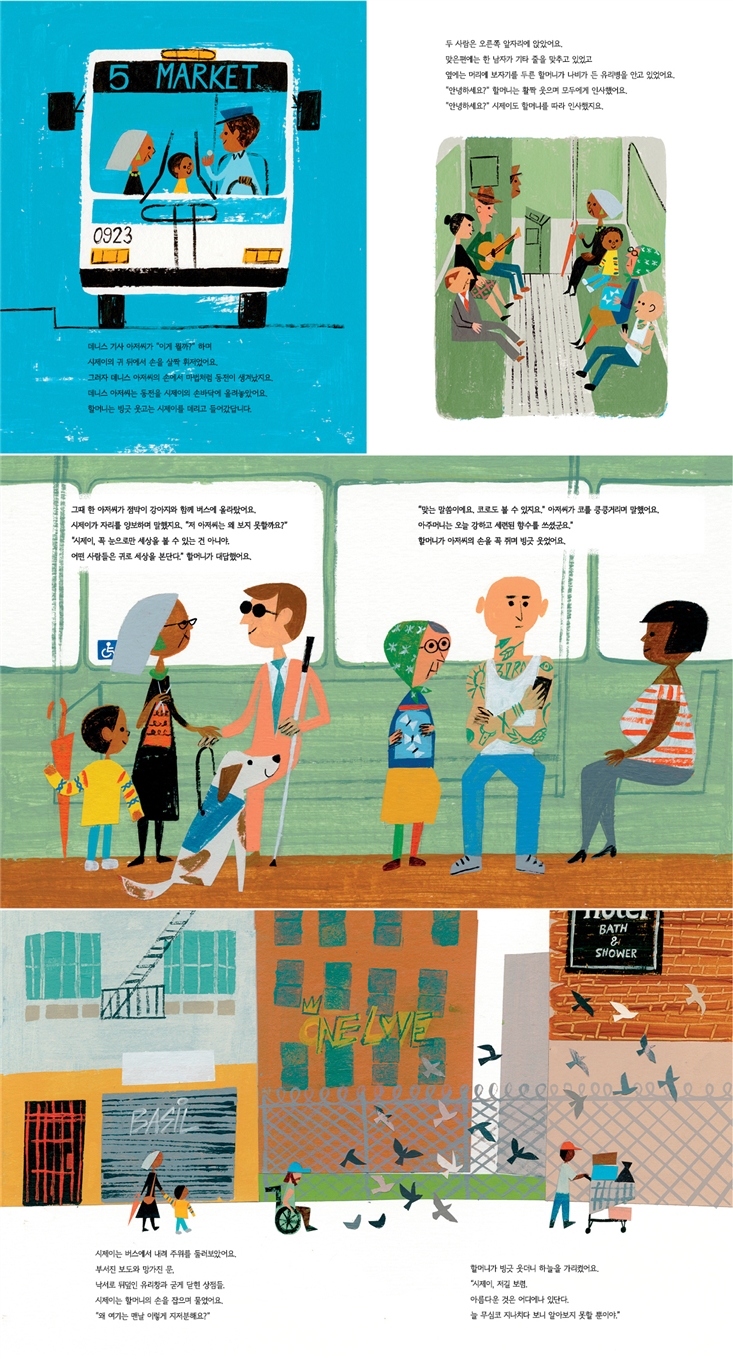
First of all, a bus is filled with diverse neighbors of different ages, genders, races, and classes.
A balding, pot-bellied man, a pregnant black woman with short hair who looks good on her, a bespectacled old woman holding a bottle of butterflies, a blind man in a nice suit, and a young guitarist wearing a fedora.
Christian created a collage of cut-and-paste paper pieces to highlight his neighbors on the bus.
The last stop, Market Street, which has a free cafeteria, is also impressive.
Passing through the so-called 'slums' where the poor live together, and reaching the soup kitchen, Christian meticulously arranged people, animals, and objects.
For example, a white man in a wheelchair, a cat in an alley, and a rainbow of colors floating over a dirty building.
In this way, "The Bus that Carries Happiness" reminds us not to miss the joy and happiness of discovering the beauty hidden in the gaps between neighbors and things around us.
Also, the final scene where the grandmother and CJ are volunteering at a free cafeteria full of people tells us that the happiness of living together is that we, who look and live differently, open our hearts to each other and reach out to each other.
So perhaps, Sijei, who is able to vividly experience these moments, is extremely lucky.
Those moments are a gift from a grandmother to her beloved grandson, and they are the greatest treasures that CJ can enjoy.
CJ is a curious boy.
The world is full of mysteries to CJ: why does it rain so much, why does he always have to go to the soup kitchen that his friends don't go to, how did the blind man end up losing his sight of the world?
Some adults either ignore a child's question or try to give them just one correct answer.
But my grandmother never gives an empty answer to any question.
Grandma listens carefully to Sijei's questions and then answers them one by one wisely.
It rains because thirsty trees need rainwater to drink, it's a shame not to meet diverse neighbors at a soup kitchen, and the blind man sees the world through his ears instead of his eyes.
Grandma respects CJ's feelings while also guiding CJ to see the world from a new perspective.
In this way, “The Bus that Carries Happiness” provides an example of a conversation that transcends generations.
A grandmother's wisdom in responding to her young grandson's awkward questions with a gentle smile will bring profound insight to adults and instill a warm and affectionate energy in children.
A warm picture book that makes you look after your neighbors
CJ is an active boy who is very curious and wants to do many things.
He wants to speed around in a car like his friends and run around outside, but all he can do is watch the cars whizzing by and the boys riding bicycles outside the bus window.
However, this situation does not pose much of a problem to CJ.
Rather, CJ enjoys the journey to the last stop with her grandmother.
CJ smiles when he gets on the bus, smiles when he meets the blind man, and smiles when he arrives at the soup kitchen.
The reason is simple.
On the contrary, CJ has a daily life that other people of the same age do not easily enjoy.
As CJ travels with his grandmother on a bus to the final stop, he vividly experiences the colorful neighborhood and the raw world.
The liveliness of the neighborhood that I could not have experienced if I had only driven a car, the poverty of the neighborhood that I could not have learned if I had not gone to the soup kitchen.
CJ sees, hears, and experiences all of these things firsthand, and vaguely learns the truth of life: that the world we know is not everything.
The happiness of finding beauty hidden everywhere!
If the world we know isn't everything, what world is there we don't know? Matt de la Peña and Christian Robinson have captured that world in a bus and a soup kitchen.
First of all, a bus is filled with diverse neighbors of different ages, genders, races, and classes.
A balding, pot-bellied man, a pregnant black woman with short hair who looks good on her, a bespectacled old woman holding a bottle of butterflies, a blind man in a nice suit, and a young guitarist wearing a fedora.
Christian created a collage of cut-and-paste paper pieces to highlight his neighbors on the bus.
The last stop, Market Street, which has a free cafeteria, is also impressive.
Passing through the so-called 'slums' where the poor live together, and reaching the soup kitchen, Christian meticulously arranged people, animals, and objects.
For example, a white man in a wheelchair, a cat in an alley, and a rainbow of colors floating over a dirty building.
In this way, "The Bus that Carries Happiness" reminds us not to miss the joy and happiness of discovering the beauty hidden in the gaps between neighbors and things around us.
Also, the final scene where the grandmother and CJ are volunteering at a free cafeteria full of people tells us that the happiness of living together is that we, who look and live differently, open our hearts to each other and reach out to each other.
So perhaps, Sijei, who is able to vividly experience these moments, is extremely lucky.
Those moments are a gift from a grandmother to her beloved grandson, and they are the greatest treasures that CJ can enjoy.
GOODS SPECIFICS
- Date of issue: May 4, 2016
- Format: Hardcover book binding method guide
- Page count, weight, size: 40 pages | 424g | 216*267*15mm
- ISBN13: 9788949112657
- ISBN10: 8949112655
You may also like
카테고리
korean


korean

![GQ KOREA Mark (Monthly): December [2025]](http://librairie.coreenne.fr/cdn/shop/files/8ef265dbbfbf186523ed75ba7319009d.jpg?v=1765340328&width=3840)


