

When a door closes, a window opens somewhere.
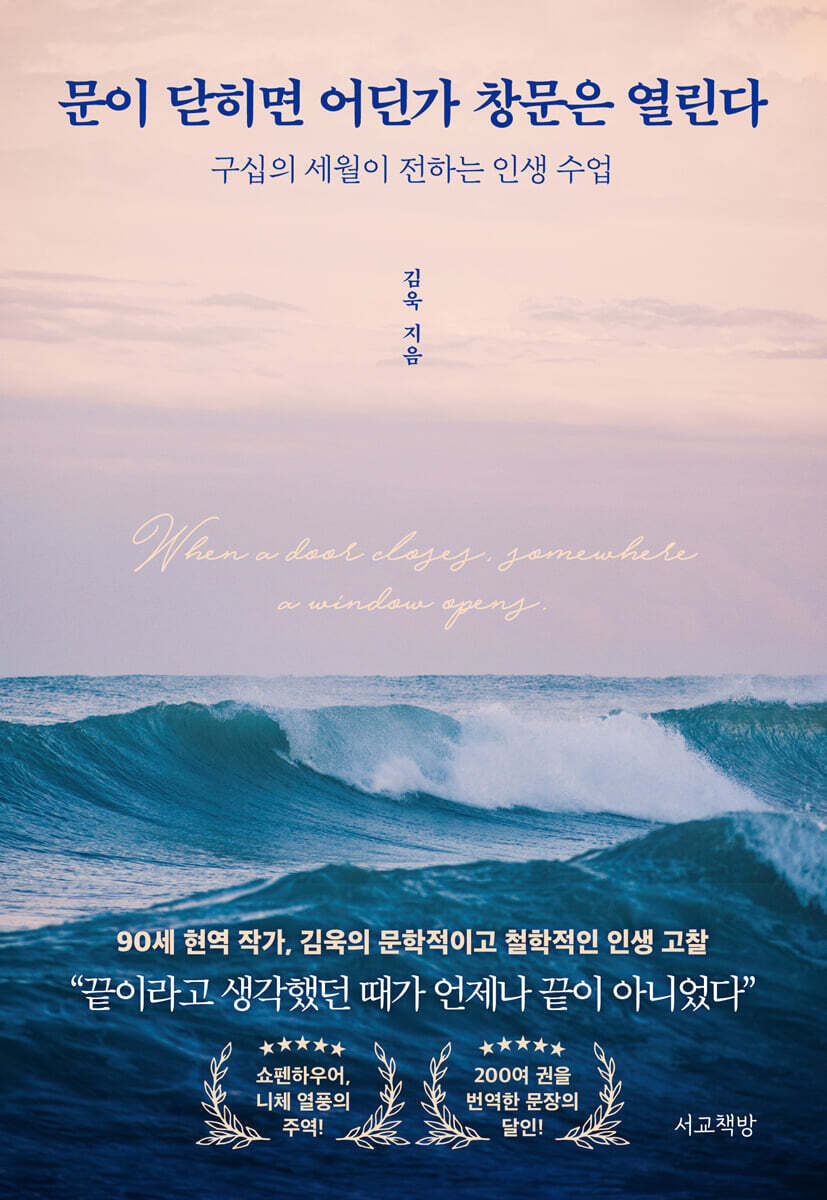 |
Description
Book Introduction
Ninety years of experience,
Things you see when life ends
★★★ Schopenhauer, the protagonist of the Nietzsche craze!
★★★ A master of sentences who has translated over 200 books!
The translation work that began at the age of seventy has now resulted in over 200 books.
In the meantime, I also wrote several essays.
A book that compiled and translated the books of philosophers Schopenhauer and Nietzsche, who were a great comfort in my life, became a bestseller, selling over 100,000 copies.
People call him a writer who opened the era of old talent, as he continued to write even at the age of ninety.
I applaud him for drinking peanut butter coffee every day to write one more line and for planning to write until he is ninety-five.
However, although he appears to be a noble man of letters, his life, which spans nearly a hundred years and has been a part of modern and contemporary history in the Republic of Korea, could not have been smooth.
Born as the eldest son of a poor family, he had to endure the weight of being the head of the household while compromising with the changing world.
After retirement, I lost my place to live because I failed to invest my retirement fund and house as collateral.
What I saved from that end by not giving up and starting to write is my current life and hope.
That is why the story of his life, although sometimes dark and gloomy, ultimately ends with 'positivity' and 'love'.
The author says that one good thing about getting older is that he can be honest without feeling embarrassed.
In that way, it is not difficult to find images of my grandfather, father, and myself in his worries and thoughts that he expresses without reservation.
A life lived as if it would last forever and a life lived with death in mind are bound to be different.
The author, who says that this is an age when one cannot help but think about death, says that there is no teaching contained in this article.
It simply contains things I have painfully realized while reflecting on my life, things I have only just come to know, and the joy of living 'today'.
If you pick up this book, you will be able to put aside the prejudice that it is obvious that it is written by an old person.
This book is filled with the most faithful 'concerns about living today' and 'love for life'.
Things you see when life ends
★★★ Schopenhauer, the protagonist of the Nietzsche craze!
★★★ A master of sentences who has translated over 200 books!
The translation work that began at the age of seventy has now resulted in over 200 books.
In the meantime, I also wrote several essays.
A book that compiled and translated the books of philosophers Schopenhauer and Nietzsche, who were a great comfort in my life, became a bestseller, selling over 100,000 copies.
People call him a writer who opened the era of old talent, as he continued to write even at the age of ninety.
I applaud him for drinking peanut butter coffee every day to write one more line and for planning to write until he is ninety-five.
However, although he appears to be a noble man of letters, his life, which spans nearly a hundred years and has been a part of modern and contemporary history in the Republic of Korea, could not have been smooth.
Born as the eldest son of a poor family, he had to endure the weight of being the head of the household while compromising with the changing world.
After retirement, I lost my place to live because I failed to invest my retirement fund and house as collateral.
What I saved from that end by not giving up and starting to write is my current life and hope.
That is why the story of his life, although sometimes dark and gloomy, ultimately ends with 'positivity' and 'love'.
The author says that one good thing about getting older is that he can be honest without feeling embarrassed.
In that way, it is not difficult to find images of my grandfather, father, and myself in his worries and thoughts that he expresses without reservation.
A life lived as if it would last forever and a life lived with death in mind are bound to be different.
The author, who says that this is an age when one cannot help but think about death, says that there is no teaching contained in this article.
It simply contains things I have painfully realized while reflecting on my life, things I have only just come to know, and the joy of living 'today'.
If you pick up this book, you will be able to put aside the prejudice that it is obvious that it is written by an old person.
This book is filled with the most faithful 'concerns about living today' and 'love for life'.
- You can preview some of the book's contents.
Preview
index
prolog
Organizing the old thoughts of the old body
Chapter 1.
Things you see when life ends
Only after losing everything did I begin to dream again.
A reason to stay alive
Even as we grow older, life is a series of fears.
The last bit of confidence I have left in my life
Only time was on my side.
If you want to surround yourself with useful people, you must first become a useful person.
Chapter 2.
Even if you waver, wander, and fail,
I couldn't give up Schopenhauer
The lie that if you do what you love, you won't get tired
Why are you talking to me there?
I will not take off my mask until the play is over.
The power to give your all when everyone else is telling you to give up
Things that make life's moments precious
“Son, you will live a better life than I did.”
Chapter 3.
It ain't over till it's over
Only love that has weathered storms and hardships can sustain a marriage.
“You can do it.
You can't give up here.
Let's hold on"
My worst nightmare was when I found myself no longer dreaming.
Forgiving others, embracing differences
Time still flows and people still miss each other
Chapter 4.
I want to live like Schopenhauer and die like Tolstoy.
The Drifting Story of an Eighty-Year-Old Boy
Parents are weak and vulnerable beings.
I want to die like Tolstoy
African elders were ashamed of compensation for their age.
“Don’t let anyone have more influence in your life than you do.”
Wisdom of a couple who have bickered for decades
Chapter 5.
When a door closes, a window opens somewhere.
Because I failed today, I can find something new tomorrow.
I suffered from so much anxiety
The good thing about death is that it turns our gaze from the outside to the inside.
If you are qualified to be a member of the family
When I'm asked to write a story about a disaster, I get a really smug look on my face.
It wasn't until I hit rock bottom that I realized I was brave.
Last wish
Epilogue
A final farewell to the world
Organizing the old thoughts of the old body
Chapter 1.
Things you see when life ends
Only after losing everything did I begin to dream again.
A reason to stay alive
Even as we grow older, life is a series of fears.
The last bit of confidence I have left in my life
Only time was on my side.
If you want to surround yourself with useful people, you must first become a useful person.
Chapter 2.
Even if you waver, wander, and fail,
I couldn't give up Schopenhauer
The lie that if you do what you love, you won't get tired
Why are you talking to me there?
I will not take off my mask until the play is over.
The power to give your all when everyone else is telling you to give up
Things that make life's moments precious
“Son, you will live a better life than I did.”
Chapter 3.
It ain't over till it's over
Only love that has weathered storms and hardships can sustain a marriage.
“You can do it.
You can't give up here.
Let's hold on"
My worst nightmare was when I found myself no longer dreaming.
Forgiving others, embracing differences
Time still flows and people still miss each other
Chapter 4.
I want to live like Schopenhauer and die like Tolstoy.
The Drifting Story of an Eighty-Year-Old Boy
Parents are weak and vulnerable beings.
I want to die like Tolstoy
African elders were ashamed of compensation for their age.
“Don’t let anyone have more influence in your life than you do.”
Wisdom of a couple who have bickered for decades
Chapter 5.
When a door closes, a window opens somewhere.
Because I failed today, I can find something new tomorrow.
I suffered from so much anxiety
The good thing about death is that it turns our gaze from the outside to the inside.
If you are qualified to be a member of the family
When I'm asked to write a story about a disaster, I get a really smug look on my face.
It wasn't until I hit rock bottom that I realized I was brave.
Last wish
Epilogue
A final farewell to the world
Detailed image

Into the book
Life is never small.
Everyone's life is grander than any great man's, and as full of potential as any famous person's.
Having lived without dreams, I finally published a book in my name when I was over seventy years old and had lost everything.
When I lost the wealth, fame, and even my status as a member of society that I had built with my own hands, the only thing that remained by my side was the dream of writing again.
Foolishly, I only began to dream again after I had lost everything.
It was half a century after I was twenty years old and caught up in the whirlwind of war.
--- p.21
While writing over ten books, I have had a significant number of manuscripts rejected.
Among them, the manuscript that leaves the most regret was the one dealing with Schopenhauer's life.
'I shouldn't have been born in the first place.
I don't know why Schopenhauer's reckless denialism, which said, 'If not, it's better to die early,' didn't seem like childish nonsense to me.
The more I immersed myself in Schopenhauer's writings about life being a tragedy in itself, the more vividly I felt the yearning of a human being to survive properly.
As a result, I felt anew the agony of Schopenhauer struggling against the world's obvious and common views, and I came to judge that his lips cursing the tragedy of life were a true tribute to life, unadulterated by abomination.
--- p.67
So I wake up at dawn and dissolve a spoonful of peanut butter in my hot black coffee.
It's a ritual I perform before writing, a repetitive routine that has continued for nearly twenty years.
I turn on the stand, praying earnestly that a few peanuts in that butter will give strength and courage to the old cells in my head.
Don't type sloppily on your laptop keyboard.
At this moment, I must be honest with myself.
It is unfortunate that the brain cannot keep up with the hands.
I fill the Parker fountain pen, which I've held in my hand for well over thirty years, with the blue-black ink that I fell in love with only after hearing rumors that Sartre loved it during his lifetime, and on the white margins, I add letters one by one, desperately hoping that someone will read them.
--- p.79
I love the word 'unfinished' to an extreme.
There are those who use the excuse of "unfinished beauty" as an excuse for being lazy and petty and not being able to finish everything, but I can't stand the ecstasy of experiences that are too good to give up because they are not yet complete.
So, whenever I think of my unfinished work and my unfinished life, I gain boundless freedom and confidence.
--- p.107
As I walked up the hill to the National Cemetery alone, holding my father, who had returned to a handful of ashes in the crematorium after I died, I gave my only advice as a father to my son, who would face death for the first time in his life. It was this: do not let anyone make excuses or justify themselves for you throughout your life.
Live with dignity so that no one can have more influence and direction in your life than you.
Even if your world, where no one looks after you, is so shabby and worthless that it is too miserable to show to anyone but yourself, do not look for responsibility and cause outside of yourself… … .
Although this teaching might sound like the bitter self-reproach of an old man who must live with the memory of being an incompetent and irresponsible father to his son's ears, I couldn't help but hope that he would remember it.
--- pp.204~205
Life is a perspective.
Perspectives don't keep up with life.
What am I looking at now?
Why are you looking there?
I am looking back on my failures now.
To be precise, I am looking at my past time, which is clearly on the inside of failure when measured by the world's standards.
He is confessing his failure.
If I hadn't failed, no one would have listened to my story.
If I hadn't failed, I would never have had the chance to confess the times I lived.
People love to hear stories of my failures.
People keep asking how it went wrong.
At that age and having experienced such things, how can one still be alive and not die?
I paid off my debt by writing my story of failure, made a small name for myself, and received thanks from readers I didn't know.
Everyone's life is grander than any great man's, and as full of potential as any famous person's.
Having lived without dreams, I finally published a book in my name when I was over seventy years old and had lost everything.
When I lost the wealth, fame, and even my status as a member of society that I had built with my own hands, the only thing that remained by my side was the dream of writing again.
Foolishly, I only began to dream again after I had lost everything.
It was half a century after I was twenty years old and caught up in the whirlwind of war.
--- p.21
While writing over ten books, I have had a significant number of manuscripts rejected.
Among them, the manuscript that leaves the most regret was the one dealing with Schopenhauer's life.
'I shouldn't have been born in the first place.
I don't know why Schopenhauer's reckless denialism, which said, 'If not, it's better to die early,' didn't seem like childish nonsense to me.
The more I immersed myself in Schopenhauer's writings about life being a tragedy in itself, the more vividly I felt the yearning of a human being to survive properly.
As a result, I felt anew the agony of Schopenhauer struggling against the world's obvious and common views, and I came to judge that his lips cursing the tragedy of life were a true tribute to life, unadulterated by abomination.
--- p.67
So I wake up at dawn and dissolve a spoonful of peanut butter in my hot black coffee.
It's a ritual I perform before writing, a repetitive routine that has continued for nearly twenty years.
I turn on the stand, praying earnestly that a few peanuts in that butter will give strength and courage to the old cells in my head.
Don't type sloppily on your laptop keyboard.
At this moment, I must be honest with myself.
It is unfortunate that the brain cannot keep up with the hands.
I fill the Parker fountain pen, which I've held in my hand for well over thirty years, with the blue-black ink that I fell in love with only after hearing rumors that Sartre loved it during his lifetime, and on the white margins, I add letters one by one, desperately hoping that someone will read them.
--- p.79
I love the word 'unfinished' to an extreme.
There are those who use the excuse of "unfinished beauty" as an excuse for being lazy and petty and not being able to finish everything, but I can't stand the ecstasy of experiences that are too good to give up because they are not yet complete.
So, whenever I think of my unfinished work and my unfinished life, I gain boundless freedom and confidence.
--- p.107
As I walked up the hill to the National Cemetery alone, holding my father, who had returned to a handful of ashes in the crematorium after I died, I gave my only advice as a father to my son, who would face death for the first time in his life. It was this: do not let anyone make excuses or justify themselves for you throughout your life.
Live with dignity so that no one can have more influence and direction in your life than you.
Even if your world, where no one looks after you, is so shabby and worthless that it is too miserable to show to anyone but yourself, do not look for responsibility and cause outside of yourself… … .
Although this teaching might sound like the bitter self-reproach of an old man who must live with the memory of being an incompetent and irresponsible father to his son's ears, I couldn't help but hope that he would remember it.
--- pp.204~205
Life is a perspective.
Perspectives don't keep up with life.
What am I looking at now?
Why are you looking there?
I am looking back on my failures now.
To be precise, I am looking at my past time, which is clearly on the inside of failure when measured by the world's standards.
He is confessing his failure.
If I hadn't failed, no one would have listened to my story.
If I hadn't failed, I would never have had the chance to confess the times I lived.
People love to hear stories of my failures.
People keep asking how it went wrong.
At that age and having experienced such things, how can one still be alive and not die?
I paid off my debt by writing my story of failure, made a small name for myself, and received thanks from readers I didn't know.
--- pp.256~257
Publisher's Review
“The times I thought were the end weren’t always the end.”
A literary and philosophical reflection on life by Kim Wook, a 90-year-old active writer.
I love my life and my dreams.
I love that about myself.
I can't help but love myself like this.
Man is a creature that cannot endure without loving himself.
If even I hate myself, then everything will really be over.
I learned the hard way that the scariest person in the world is myself.
-Author's Note
The boy who dreamed of becoming a novelist has now become a ninety-year-old man.
In the meantime, I've worked like everyone else, owned a house, and lost everything I owned.
I didn't want to pass on poverty to my children, so I didn't want to have children, but things don't always go as planned in this world.
At the age of fifty, he also had a son.
Reading the author's writings, in which he calmly reflects on his past life, one wonders if he is really an 'old man' who is close to 100 years old.
Because his worries and thoughts are not much different from ours these days.
Come to think of it, the works of Tolstoy, Schopenhauer, and Osamu Dashi, which he said he read and was influenced by, are books that are still widely read today.
This may be the reason why the writings of a ninety-year-old man still remain relevant and resonate today.
It is certain that author Kim Wook has an uncommon background.
At the age of seventy, when most people give up work, I started the second act of my life as a translator.
When a successful journalist at a major newspaper fell from being a successful journalist to a gravedigger performing ancestral rites for other people's homes after a failed investment, the author made a different choice.
People now pointed fingers at him, calling him a 'failure' and 'the end'.
But the author, like a penguin that cannot fly in the sky but jumps into the sea, changed the direction of his life to find his new sky.
He knocked on the doors of publishers on his own to find translation work, and has translated over 200 books to date, including “How Should You Live” and “Keeping a Little Distance”, while also writing books such as “Schopenhauer’s Aphorisms: Why Do You Think Your Life Should Not Be Difficult” and “Nietzsche’s Aphorisms: If You Can’t Be Alone, You Can’t Move On.”
I took the ordeal of turning seventy as an opportunity to find the dream I had forgotten about: to write.
What exactly was the driving force?
The evaluation that 'I lived well'
Only you can do it
Literature and philosophy were always by the author's side, as he took a different path.
The author's words, "The more I immersed myself in Schopenhauer's writing that life itself is a tragedy, the more vividly I felt the yearning of a human being to live properly as if it were my own," contain his attitude toward life, striving to live his life with dignity as an individual subject, even if shaken by worldly events.
Messages like, "Don't waste your life worrying about what others think," "Life is inherently lonely," and "The only way to learn is from failure" are the author's life itself, even if you don't necessarily seek them out in philosophy.
In this book, the author says:
If someone asks you to write a story about your own downfall, you sit down at your desk with a smug look on your face.
Because I have experienced in life that failure was not a failure after all, and that the happiness I have today is because of failure.
It's a well-known saying, but we're always afraid of failure and lament why life is so hard.
So, the author's sincerity, as he complains that he is frustrated and resentful that he failed at nothing, comes across as fresh.
People believe that life is divided into periods and that each period has different things to do.
However, as we enter the age of centenarians, we have reached a point where we must change many of the customs and ideas that have persisted for a long time.
The author presents a new image of old age by showing how to live as 'me' rather than as a son, husband, office worker, or father.
Moreover, the author says that there is no law that says that even 'death' will not change.
He found the answer in Tolstoy's death, but it doesn't matter whether it is the answer for everyone or not.
Ultimately, what he wants to tell us is a life in which ‘I’ am the subject.
In it, we will naturally learn to love life and ourselves.
Therefore, as the author of the ninety did, only one can evaluate whether one has 'lived well'.
A literary and philosophical reflection on life by Kim Wook, a 90-year-old active writer.
I love my life and my dreams.
I love that about myself.
I can't help but love myself like this.
Man is a creature that cannot endure without loving himself.
If even I hate myself, then everything will really be over.
I learned the hard way that the scariest person in the world is myself.
-Author's Note
The boy who dreamed of becoming a novelist has now become a ninety-year-old man.
In the meantime, I've worked like everyone else, owned a house, and lost everything I owned.
I didn't want to pass on poverty to my children, so I didn't want to have children, but things don't always go as planned in this world.
At the age of fifty, he also had a son.
Reading the author's writings, in which he calmly reflects on his past life, one wonders if he is really an 'old man' who is close to 100 years old.
Because his worries and thoughts are not much different from ours these days.
Come to think of it, the works of Tolstoy, Schopenhauer, and Osamu Dashi, which he said he read and was influenced by, are books that are still widely read today.
This may be the reason why the writings of a ninety-year-old man still remain relevant and resonate today.
It is certain that author Kim Wook has an uncommon background.
At the age of seventy, when most people give up work, I started the second act of my life as a translator.
When a successful journalist at a major newspaper fell from being a successful journalist to a gravedigger performing ancestral rites for other people's homes after a failed investment, the author made a different choice.
People now pointed fingers at him, calling him a 'failure' and 'the end'.
But the author, like a penguin that cannot fly in the sky but jumps into the sea, changed the direction of his life to find his new sky.
He knocked on the doors of publishers on his own to find translation work, and has translated over 200 books to date, including “How Should You Live” and “Keeping a Little Distance”, while also writing books such as “Schopenhauer’s Aphorisms: Why Do You Think Your Life Should Not Be Difficult” and “Nietzsche’s Aphorisms: If You Can’t Be Alone, You Can’t Move On.”
I took the ordeal of turning seventy as an opportunity to find the dream I had forgotten about: to write.
What exactly was the driving force?
The evaluation that 'I lived well'
Only you can do it
Literature and philosophy were always by the author's side, as he took a different path.
The author's words, "The more I immersed myself in Schopenhauer's writing that life itself is a tragedy, the more vividly I felt the yearning of a human being to live properly as if it were my own," contain his attitude toward life, striving to live his life with dignity as an individual subject, even if shaken by worldly events.
Messages like, "Don't waste your life worrying about what others think," "Life is inherently lonely," and "The only way to learn is from failure" are the author's life itself, even if you don't necessarily seek them out in philosophy.
In this book, the author says:
If someone asks you to write a story about your own downfall, you sit down at your desk with a smug look on your face.
Because I have experienced in life that failure was not a failure after all, and that the happiness I have today is because of failure.
It's a well-known saying, but we're always afraid of failure and lament why life is so hard.
So, the author's sincerity, as he complains that he is frustrated and resentful that he failed at nothing, comes across as fresh.
People believe that life is divided into periods and that each period has different things to do.
However, as we enter the age of centenarians, we have reached a point where we must change many of the customs and ideas that have persisted for a long time.
The author presents a new image of old age by showing how to live as 'me' rather than as a son, husband, office worker, or father.
Moreover, the author says that there is no law that says that even 'death' will not change.
He found the answer in Tolstoy's death, but it doesn't matter whether it is the answer for everyone or not.
Ultimately, what he wants to tell us is a life in which ‘I’ am the subject.
In it, we will naturally learn to love life and ourselves.
Therefore, as the author of the ninety did, only one can evaluate whether one has 'lived well'.
GOODS SPECIFICS
- Date of issue: November 5, 2024
- Page count, weight, size: 280 pages | 350g | 130*188*17mm
- ISBN13: 9791198752499
- ISBN10: 1198752491
You may also like
카테고리
korean


korean

![GQ KOREA Mark (Monthly): December [2025]](http://librairie.coreenne.fr/cdn/shop/files/8ef265dbbfbf186523ed75ba7319009d.jpg?v=1765340328&width=3840)


