

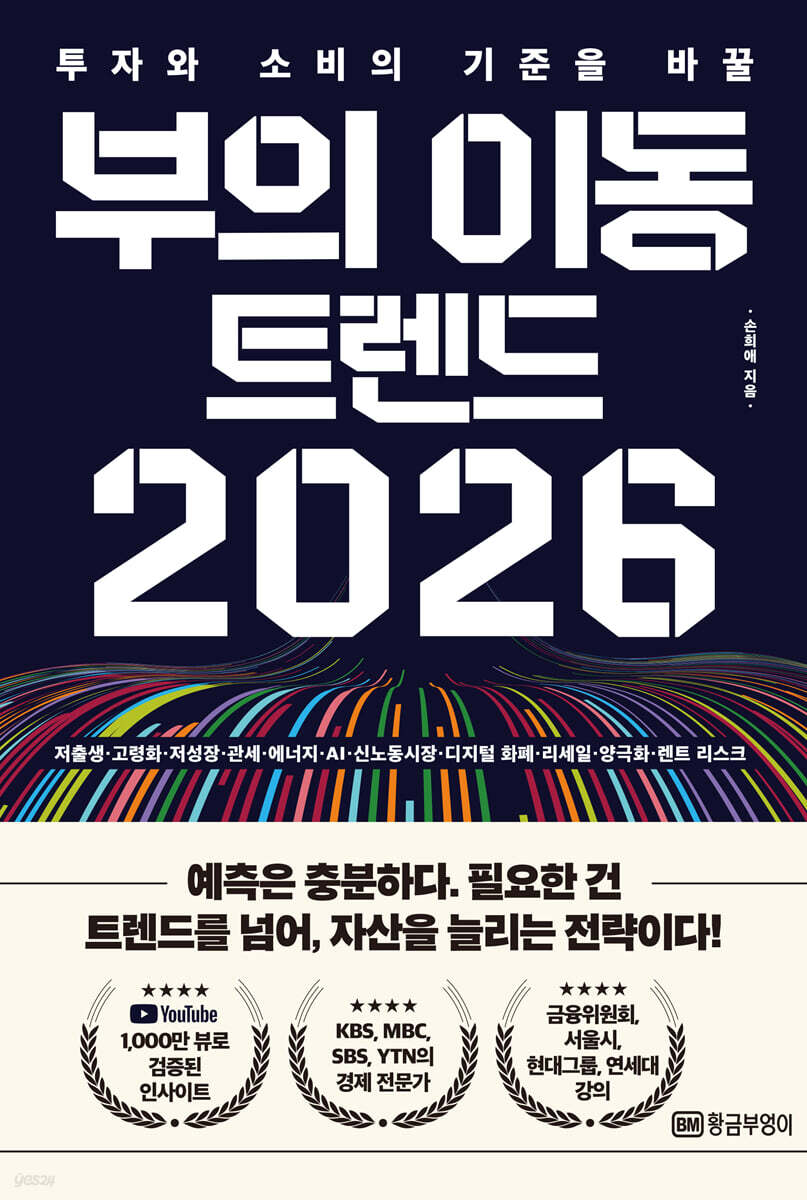
Wealth Transfer Trends 2026
 |
Description
Book Introduction
“In a rapidly changing economy, who will lead the transfer of wealth?”
Penetrating into investment, consumption, and even career
Wealth Expansion Strategies: 10 Key Economic Keywords
Beyond leading industries, we must plant our flag in the expanding derivatives market!
The transfer of wealth is happening faster than ever.
The institutionalization of internationally shared central bank digital currencies (CBDCs), the resale market emerging as a key channel for the fashion industry, and the AI infrastructure industry, which even the world's largest asset management companies are entering.
If we simply follow others in this great transition, it will be difficult to expect future expansion of wealth.
"Wealth Mobility Trends 2026" presents opportunities for wealth acquisition that can be preempted through 10 keywords that will shape the new economic order: gig workers, digital currency, resale, wealth polarization, rent risk, AI, energy costs, tariffs, low growth, and a low birth rate and aging population.
Based on the current economic situation, it not only predicts the future, but also identifies industries with explosive growth potential, helping you make wise choices in investing, spending, and your career overall.
This book will serve as a strategic guide to overcoming economic uncertainty in 2026.
Penetrating into investment, consumption, and even career
Wealth Expansion Strategies: 10 Key Economic Keywords
Beyond leading industries, we must plant our flag in the expanding derivatives market!
The transfer of wealth is happening faster than ever.
The institutionalization of internationally shared central bank digital currencies (CBDCs), the resale market emerging as a key channel for the fashion industry, and the AI infrastructure industry, which even the world's largest asset management companies are entering.
If we simply follow others in this great transition, it will be difficult to expect future expansion of wealth.
"Wealth Mobility Trends 2026" presents opportunities for wealth acquisition that can be preempted through 10 keywords that will shape the new economic order: gig workers, digital currency, resale, wealth polarization, rent risk, AI, energy costs, tariffs, low growth, and a low birth rate and aging population.
Based on the current economic situation, it not only predicts the future, but also identifies industries with explosive growth potential, helping you make wise choices in investing, spending, and your career overall.
This book will serve as a strategic guide to overcoming economic uncertainty in 2026.
- You can preview some of the book's contents.
Preview
index
prolog
Part 1: The Reality South Korea Faces
01 Low Birth Rates and Aging Population - Survival Strategies in an Era of Population Decline
- The Population Bonus Era vs. the Population Onus Era
- New subject of labor
South Korea's Growth Plate Has Stalled | An Aging Workforce and a Cross-Border Workforce | The Age of Machine Companions
- Where is the money flowing?
The Economics of the Very Important Baby (VIB) | The Market Changing with Active Seniors | Consumption in a Society Where Living Alone Is the Standard | Cities Disappearing from the Map
02 Low growth - 0% potential growth rate in the future
- What is holding us back?
The Decline of Globalization and the G2 (US-China) Risk | The End of Free Money and the Weight of Debt | The Korea Discount, Outdated Regulations, and Stagnant Innovation
- Current status in the low-growth era
The Evolution of Zantech: A Desperate Game for Survival | Corporate Survival: Forgo Growth and Protect Cash | The End of Effort: A Society Driven to Burnout
Where Does Money Flow in an Era of Low Growth?
Focus on exclusivity, not scale | The great migration of private wealth | The growing importance of small luxuries and taste communities
03 Customs - Cracks in the G2 Shield
- The fate of a country that lives on trade
Why is Korea so sensitive to tariffs? | What sustains trade with the US? | What's holding back trade with China?
Beyond Tariffs: Invisible Trade Risks
Will China Be America's Next Target? | Fears of a China Shock, Losing Manufacturing Jobs | Weaponizing China's Supply Chain
- Embark on a new voyage beyond tariff barriers
Finding New Markets | Beneficiaries of Friendshoring | An Era of Security and Monetary Benefits
- Our survival strategy
04 Energy Costs - The Burden of Transition
- What makes the energy transition expensive?
The Renewable Energy Dilemma | Are Mini Nuclear SMRs the Perfect Answer? | The Resource War That's Adding to Energy Costs
- Current status of energy costs
Choices and Dilemmas in the Automotive Market | The Fear of a Carbon Border Tax | How Electricity Bills Change the Home
- Homo economicus in the age of energy costs
People saving money by saving electricity | Consumers pulling out calculators | People building energy fortresses
Investment opportunities in the energy transition era
Infrastructure Where Money Flows | Powerhouses in Core Materials and Efficiency Technologies | Green Bubbles and Investment Traps
Part 2: The Emergence of a New Environment
01 AI - A Partner Reshaping Industries
- A new landscape for the consumer market transformed by AI
"The factory awaits me": The era of on-demand, customized production | "Prices change in real time": The era of dynamic pricing | "AI-guided shopping": The evolution of curation
- How does AI know me so well?
"Every Click Is Prey to AI": Digital Personas | "Before I Even Want It": AI's Predictive Shopping | The Fine Line Between Smart Consumers and Algorithm Slaves
The Future of Consumer Industries: A New Future for AI
The Brain and Blood Vessels of the AI Era | Technology Creating a World Just for You | Technology to Block the Shadow of AI | New Experts in the AI Era
02 New Labor Market - Jobs Where Every Second Matters
- The changing employment landscape of companies
The Era of Public Recruitment | Partners, Not Employees: The Rise of External Workers
- Individuals who have no choice but to become N-jobbers
The way we work has changed | Why we're forced to become N-jobbers
- Old order and new safety net
Blind Spots in the Social Safety Net | Shaping the Future Labor Market
- New opportunities in the new labor market
Infrastructure Industry for Gig Workers | The Explosion of Lifelong Learning and Upskilling Markets | The Emergence of Finance for the New Workforce
03 Digital Currency - The Choice of Homo Cryptiens
CBDC: The Battle for Digital Gold
China's Ambition: The Digital Yuan and the Challenge to Dollar Hegemony | The US's Bypass Strategy: A Private-Sector-Driven Digital Dollar | Europe: Data Sovereignty and a Check on Big Tech | South Korea: A Gamble to Become a Financial Powerhouse
Big Tech Strikes Back: Redesigning Monetary Power
The Payments Revolution and the Future of Stablecoins | Starbucks and Naver: How Corporate Currency Evolves | The Power of Digital Gold, Bitcoin
- How digital currency is changing our daily lives
The Zero-Fees War Begins | The Changing Future of Financial Services | How Digital Currency Is Changing the Investment Landscape
New Normal, the Criteria for Part 3 Selection
01 Resale - From Second-Hand Trading to Investment Market
- Three factors driving the growth of the resale market
Because my wallet is precious! | New isn't always the answer! | My room is a department store!
- The new landscape of the resale market: What is being traded and how?
The Spectacular Rise of Luxury Goods Resale | The New World of Resale Tech | "Trading Everything from Furniture to Appliances": The Secondhand Market's Rise
- The darkening shadow cast by the growth of the resale market
The Never-ending War on Counterfeiting | Secondhand Market Fraud: Increasing Sophistication | Does Resale Actually Encourage Consumption?
- A new era for the resale market
The Future of Platforms: Integration and Expansion vs. Specialization and Focus | The Future of Brands: Sleeping with the Enemy | The Ultimate Direction of the Resale Market
02 Wealth Polarization - A New Flow of Assets Amidst Concentration
- The collapse of the middle class
Am I middle class? | An hourglass-shaped society with a disappearing waist | The cries of Generation Z: "This life is a failure."
- What separated us?
Asset growth outpaces labor value | The officially proven rate of asset growth | Korea's version of the invincible real estate myth
- Landscapes depicted by the polarization of wealth
VVIPs, A League of Their Own | People Going Beyond Value for Money | The Lost in the Middle
- The future of a divided Republic of Korea
Future Growth Opportunities in the Ultra-Low-Price Market | The Evolution of Premium | The Future of the Digital Psychological Care Market
03 Rent Risk - Alternatives to Avoiding Lease Fraud
- Current status of the rental market
Data Reveals the Preference for Apartment Monthly Rent | The Trap of Reverse and Fixed-Rent Leases | People Crushed by Housing Costs
- The root cause of rent risk
Laws and Systems That Ignore Tenants | Betrayal of Guarantees and the Limits of Brokerage | The Tragedy of the Dark Market: A Disaster Caused by Lack of Transparency
A future society that overcomes rent risk
Corporate Landlords and Proptech | Subscription Living and Co-living
Part 1: The Reality South Korea Faces
01 Low Birth Rates and Aging Population - Survival Strategies in an Era of Population Decline
- The Population Bonus Era vs. the Population Onus Era
- New subject of labor
South Korea's Growth Plate Has Stalled | An Aging Workforce and a Cross-Border Workforce | The Age of Machine Companions
- Where is the money flowing?
The Economics of the Very Important Baby (VIB) | The Market Changing with Active Seniors | Consumption in a Society Where Living Alone Is the Standard | Cities Disappearing from the Map
02 Low growth - 0% potential growth rate in the future
- What is holding us back?
The Decline of Globalization and the G2 (US-China) Risk | The End of Free Money and the Weight of Debt | The Korea Discount, Outdated Regulations, and Stagnant Innovation
- Current status in the low-growth era
The Evolution of Zantech: A Desperate Game for Survival | Corporate Survival: Forgo Growth and Protect Cash | The End of Effort: A Society Driven to Burnout
Where Does Money Flow in an Era of Low Growth?
Focus on exclusivity, not scale | The great migration of private wealth | The growing importance of small luxuries and taste communities
03 Customs - Cracks in the G2 Shield
- The fate of a country that lives on trade
Why is Korea so sensitive to tariffs? | What sustains trade with the US? | What's holding back trade with China?
Beyond Tariffs: Invisible Trade Risks
Will China Be America's Next Target? | Fears of a China Shock, Losing Manufacturing Jobs | Weaponizing China's Supply Chain
- Embark on a new voyage beyond tariff barriers
Finding New Markets | Beneficiaries of Friendshoring | An Era of Security and Monetary Benefits
- Our survival strategy
04 Energy Costs - The Burden of Transition
- What makes the energy transition expensive?
The Renewable Energy Dilemma | Are Mini Nuclear SMRs the Perfect Answer? | The Resource War That's Adding to Energy Costs
- Current status of energy costs
Choices and Dilemmas in the Automotive Market | The Fear of a Carbon Border Tax | How Electricity Bills Change the Home
- Homo economicus in the age of energy costs
People saving money by saving electricity | Consumers pulling out calculators | People building energy fortresses
Investment opportunities in the energy transition era
Infrastructure Where Money Flows | Powerhouses in Core Materials and Efficiency Technologies | Green Bubbles and Investment Traps
Part 2: The Emergence of a New Environment
01 AI - A Partner Reshaping Industries
- A new landscape for the consumer market transformed by AI
"The factory awaits me": The era of on-demand, customized production | "Prices change in real time": The era of dynamic pricing | "AI-guided shopping": The evolution of curation
- How does AI know me so well?
"Every Click Is Prey to AI": Digital Personas | "Before I Even Want It": AI's Predictive Shopping | The Fine Line Between Smart Consumers and Algorithm Slaves
The Future of Consumer Industries: A New Future for AI
The Brain and Blood Vessels of the AI Era | Technology Creating a World Just for You | Technology to Block the Shadow of AI | New Experts in the AI Era
02 New Labor Market - Jobs Where Every Second Matters
- The changing employment landscape of companies
The Era of Public Recruitment | Partners, Not Employees: The Rise of External Workers
- Individuals who have no choice but to become N-jobbers
The way we work has changed | Why we're forced to become N-jobbers
- Old order and new safety net
Blind Spots in the Social Safety Net | Shaping the Future Labor Market
- New opportunities in the new labor market
Infrastructure Industry for Gig Workers | The Explosion of Lifelong Learning and Upskilling Markets | The Emergence of Finance for the New Workforce
03 Digital Currency - The Choice of Homo Cryptiens
CBDC: The Battle for Digital Gold
China's Ambition: The Digital Yuan and the Challenge to Dollar Hegemony | The US's Bypass Strategy: A Private-Sector-Driven Digital Dollar | Europe: Data Sovereignty and a Check on Big Tech | South Korea: A Gamble to Become a Financial Powerhouse
Big Tech Strikes Back: Redesigning Monetary Power
The Payments Revolution and the Future of Stablecoins | Starbucks and Naver: How Corporate Currency Evolves | The Power of Digital Gold, Bitcoin
- How digital currency is changing our daily lives
The Zero-Fees War Begins | The Changing Future of Financial Services | How Digital Currency Is Changing the Investment Landscape
New Normal, the Criteria for Part 3 Selection
01 Resale - From Second-Hand Trading to Investment Market
- Three factors driving the growth of the resale market
Because my wallet is precious! | New isn't always the answer! | My room is a department store!
- The new landscape of the resale market: What is being traded and how?
The Spectacular Rise of Luxury Goods Resale | The New World of Resale Tech | "Trading Everything from Furniture to Appliances": The Secondhand Market's Rise
- The darkening shadow cast by the growth of the resale market
The Never-ending War on Counterfeiting | Secondhand Market Fraud: Increasing Sophistication | Does Resale Actually Encourage Consumption?
- A new era for the resale market
The Future of Platforms: Integration and Expansion vs. Specialization and Focus | The Future of Brands: Sleeping with the Enemy | The Ultimate Direction of the Resale Market
02 Wealth Polarization - A New Flow of Assets Amidst Concentration
- The collapse of the middle class
Am I middle class? | An hourglass-shaped society with a disappearing waist | The cries of Generation Z: "This life is a failure."
- What separated us?
Asset growth outpaces labor value | The officially proven rate of asset growth | Korea's version of the invincible real estate myth
- Landscapes depicted by the polarization of wealth
VVIPs, A League of Their Own | People Going Beyond Value for Money | The Lost in the Middle
- The future of a divided Republic of Korea
Future Growth Opportunities in the Ultra-Low-Price Market | The Evolution of Premium | The Future of the Digital Psychological Care Market
03 Rent Risk - Alternatives to Avoiding Lease Fraud
- Current status of the rental market
Data Reveals the Preference for Apartment Monthly Rent | The Trap of Reverse and Fixed-Rent Leases | People Crushed by Housing Costs
- The root cause of rent risk
Laws and Systems That Ignore Tenants | Betrayal of Guarantees and the Limits of Brokerage | The Tragedy of the Dark Market: A Disaster Caused by Lack of Transparency
A future society that overcomes rent risk
Corporate Landlords and Proptech | Subscription Living and Co-living
Detailed image

Into the book
The most representative shield in the AI era is undoubtedly the intelligent cybersecurity industry.
As cyberattacks become more sophisticated with the advent of AI technology, technologies to prevent them are also evolving to be AI-based.
Recently, deepfake voice phishing, a fraudulent technique that perfectly replicates a person's voice using AI to deceive victims into thinking they are family or acquaintances, and intelligent ransomware, where AI learns attack strategies on its own, have emerged, causing significant damage to both companies and individuals.
To combat these new threats, leading global companies like Darktrace (a British AI-based cybersecurity company) and CrowdStrike (a US cloud-based endpoint security company) use AI to learn the normal activities of an organization's network, detecting and blocking new anomalies in real time in addition to known threats.
The intelligent cybersecurity market is expected to grow rapidly from approximately $240 billion (approximately KRW 336 trillion) in 2024 to approximately $500 billion (approximately KRW 700 trillion) in 2030.
--- From "AI - A Partner Reshaping Industry"
Therefore, it's crucial to focus on technology companies that are helping banks achieve their digital transformation, rather than on the banks themselves. The AI financial assistant revolution cannot be achieved solely by banks.
Let's pay particular attention to the growth of the robo-advisor industry.
A robo-advisor is a service that uses artificial intelligence (AI) to analyze a customer's investment tendencies and financial goals and automatically construct and manage a portfolio.
The global robo-advisor market is expected to grow explosively from USD 10.86 billion in 2025 to USD 69.32 billion in 2032, at a compound annual growth rate of 30.3%.
Even in Korea, companies like Pint and Quantec are rapidly increasing their assets under management, armed with sophisticated AI-based investment algorithms.
--- From "Digital Currency - The Choice of Homo Cryptiens"
Now, companies are going beyond simply purchasing raw materials and are entering the war to secure resources themselves.
POSCO Holdings' acquisition of the lithium brine rights in Argentina's Hombre Muerto in 2018 and its participation in the bidding for the development of Chile's Maricunga and Alto Andinos brine in 2024, and LG Energy Solution's signing of a 345 billion won convertible bond investment and a 15-year contract to supply 1.75 million tons of lithium concentrate with Australian lithium mining company Liontown in July 2024, are not simply efforts to reduce costs, but rather desperate survival investments to protect the fate of our cutting-edge industries in an era of uncertainty.
In conclusion, new opportunities in future industries converge under the keyword of economic security.
The defense industry, responsible for physical security in the new Cold War era, nuclear power, which has emerged as an alternative to energy security, and the competition to secure key minerals, the foundation of industrial security, will be the most certain growth engines in the new reality created by the tariff war.
--- From "Customs - Cracks in the G2 Shield"
In a zero-sum society where the economic pie no longer grows, it is difficult for mediocre second- and third-place companies to survive.
Even in a recession, all the profits are concentrated in the hands of a few monopolistic companies that can raise prices.
The most powerful monopoly advantage in this era comes from technological prowess.
Technological monopolies also wield powerful influence in less visible areas such as materials, components, and equipment.
ASML in the Netherlands is the only company in the world that makes EUV (extreme ultraviolet lithography) exposure equipment essential for cutting-edge semiconductor production.
Since the annual production volume is only a few dozen units, if Samsung Electronics, TSMC, and Intel do not secure this equipment, they will not be able to produce semiconductors under 3nm, even though they only design them.
Now ASML's equipment monopoly has become a geopolitical weapon.
The United States strictly controls the transfer of ASML equipment to China to maintain its hegemony.
It's rare for a single, irreplaceable technology to emerge as a key player in the global race for hegemony.
--- From "Low Growth - A Future with a Potential Growth Rate of 0%"
As the new labor market rapidly restructures, it's no longer possible to secure a lifetime of security with just one skill acquired. AI and automation are redefining entire industries, shortening the lifespan of careers.
According to the World Economic Forum's (WEF) 'Future of Jobs 2025 Report', 44% of the core skills held by workers worldwide will change in the next five years, and 59% of workers worldwide will need retraining or upskilling.
This means the job security of the past is gone, leading directly to a desperate demand for lifelong learning and upskilling.
The fear of being pushed out by automation is intertwined with the desire for higher incomes and new opportunities in an increasingly competitive market.
The global smart education and learning market is expected to grow at a CAGR of 20.4% from USD 68.12 billion in 2024 to USD 159.48 billion in 2030.
Lifelong learning has now become a core pillar of personal survival strategies.
As cyberattacks become more sophisticated with the advent of AI technology, technologies to prevent them are also evolving to be AI-based.
Recently, deepfake voice phishing, a fraudulent technique that perfectly replicates a person's voice using AI to deceive victims into thinking they are family or acquaintances, and intelligent ransomware, where AI learns attack strategies on its own, have emerged, causing significant damage to both companies and individuals.
To combat these new threats, leading global companies like Darktrace (a British AI-based cybersecurity company) and CrowdStrike (a US cloud-based endpoint security company) use AI to learn the normal activities of an organization's network, detecting and blocking new anomalies in real time in addition to known threats.
The intelligent cybersecurity market is expected to grow rapidly from approximately $240 billion (approximately KRW 336 trillion) in 2024 to approximately $500 billion (approximately KRW 700 trillion) in 2030.
--- From "AI - A Partner Reshaping Industry"
Therefore, it's crucial to focus on technology companies that are helping banks achieve their digital transformation, rather than on the banks themselves. The AI financial assistant revolution cannot be achieved solely by banks.
Let's pay particular attention to the growth of the robo-advisor industry.
A robo-advisor is a service that uses artificial intelligence (AI) to analyze a customer's investment tendencies and financial goals and automatically construct and manage a portfolio.
The global robo-advisor market is expected to grow explosively from USD 10.86 billion in 2025 to USD 69.32 billion in 2032, at a compound annual growth rate of 30.3%.
Even in Korea, companies like Pint and Quantec are rapidly increasing their assets under management, armed with sophisticated AI-based investment algorithms.
--- From "Digital Currency - The Choice of Homo Cryptiens"
Now, companies are going beyond simply purchasing raw materials and are entering the war to secure resources themselves.
POSCO Holdings' acquisition of the lithium brine rights in Argentina's Hombre Muerto in 2018 and its participation in the bidding for the development of Chile's Maricunga and Alto Andinos brine in 2024, and LG Energy Solution's signing of a 345 billion won convertible bond investment and a 15-year contract to supply 1.75 million tons of lithium concentrate with Australian lithium mining company Liontown in July 2024, are not simply efforts to reduce costs, but rather desperate survival investments to protect the fate of our cutting-edge industries in an era of uncertainty.
In conclusion, new opportunities in future industries converge under the keyword of economic security.
The defense industry, responsible for physical security in the new Cold War era, nuclear power, which has emerged as an alternative to energy security, and the competition to secure key minerals, the foundation of industrial security, will be the most certain growth engines in the new reality created by the tariff war.
--- From "Customs - Cracks in the G2 Shield"
In a zero-sum society where the economic pie no longer grows, it is difficult for mediocre second- and third-place companies to survive.
Even in a recession, all the profits are concentrated in the hands of a few monopolistic companies that can raise prices.
The most powerful monopoly advantage in this era comes from technological prowess.
Technological monopolies also wield powerful influence in less visible areas such as materials, components, and equipment.
ASML in the Netherlands is the only company in the world that makes EUV (extreme ultraviolet lithography) exposure equipment essential for cutting-edge semiconductor production.
Since the annual production volume is only a few dozen units, if Samsung Electronics, TSMC, and Intel do not secure this equipment, they will not be able to produce semiconductors under 3nm, even though they only design them.
Now ASML's equipment monopoly has become a geopolitical weapon.
The United States strictly controls the transfer of ASML equipment to China to maintain its hegemony.
It's rare for a single, irreplaceable technology to emerge as a key player in the global race for hegemony.
--- From "Low Growth - A Future with a Potential Growth Rate of 0%"
As the new labor market rapidly restructures, it's no longer possible to secure a lifetime of security with just one skill acquired. AI and automation are redefining entire industries, shortening the lifespan of careers.
According to the World Economic Forum's (WEF) 'Future of Jobs 2025 Report', 44% of the core skills held by workers worldwide will change in the next five years, and 59% of workers worldwide will need retraining or upskilling.
This means the job security of the past is gone, leading directly to a desperate demand for lifelong learning and upskilling.
The fear of being pushed out by automation is intertwined with the desire for higher incomes and new opportunities in an increasingly competitive market.
The global smart education and learning market is expected to grow at a CAGR of 20.4% from USD 68.12 billion in 2024 to USD 159.48 billion in 2030.
Lifelong learning has now become a core pillar of personal survival strategies.
--- From "The New Labor Market? Jobs Where Every Second Matters"
Publisher's Review
It's not enough to just identify trends.
It's time to read up on strategies to grow your wealth!
Macro threats such as a decline in potential growth and a tariff war are shaking the economy.
The 'population' change that made South Korea the world's number one in robot density to compensate for the labor shortage, the 'low growth' that is fostering a stable dividend investment market amid fears of uncertainty, the 'tariff' war that is increasing the value of military, energy, and supply chain security, the 'energy' market supported by the next-generation battery materials industry that is expected to reach 100 trillion won in 2030, 'AI' as a partner that will increase corporate sales and productivity by 90%, the 'new labor market' where spot work and gig work that maximize flexibility will become the new standard, the 'digital currency' that has changed our consumer culture, including stable coins and big tech with the potential of 500 trillion won, the 'resale' market that has become a pipeline for additional income through resale tech, the 'polarization of wealth' that is the driving force of the online shopping market that is growing at an increasing rate every year, and the 'rent' risk that has become the spark for the technology-linked real estate market that is expected to exceed 50 trillion won in 3 years and the subscription and co-housing market.
In this time of great transition, the old formulas for success no longer apply.
Beyond trends, we need a prescription to increase wealth.
This book analyzes ten economic issues that will shape 2026.
It clearly explains the current situation, detailed analysis, future outlook, and even how to connect this to personal economic gain.
For example, let's look at AI, which will still be a major topic of interest in 2026.
Currently, 75% of companies worldwide are leveraging customer data generated by generative AI to maximize sales and productivity.
Consumers are also increasingly relying on AI thanks to the convenience of personalized curation.
As the AI consumer revolution permeates our lives, new investment avenues will emerge as we dispel our fears and aversions toward AI.
The most promising markets are semiconductors and cloud computing, which are the body and brain of AI.
Global market research firms have predicted explosive growth in both industries, which can be interpreted as a green light for investment.
Another opportunity lies in the evolving nature of criminal cases as technology advances.
Cybersecurity technologies to counter hacking, especially the decentralized identity verification market, which is growing at an average annual rate of nearly 90%, should be given special attention.
This book deeply analyzes 10 trends and provides insight into the wealth opportunities within them.
"Wealth Transfer Trends 2026," which guides you on the optimal path to growing your wealth, will serve as the most intuitive navigation for all economic choices, including investment and consumption.
It's time to read up on strategies to grow your wealth!
Macro threats such as a decline in potential growth and a tariff war are shaking the economy.
The 'population' change that made South Korea the world's number one in robot density to compensate for the labor shortage, the 'low growth' that is fostering a stable dividend investment market amid fears of uncertainty, the 'tariff' war that is increasing the value of military, energy, and supply chain security, the 'energy' market supported by the next-generation battery materials industry that is expected to reach 100 trillion won in 2030, 'AI' as a partner that will increase corporate sales and productivity by 90%, the 'new labor market' where spot work and gig work that maximize flexibility will become the new standard, the 'digital currency' that has changed our consumer culture, including stable coins and big tech with the potential of 500 trillion won, the 'resale' market that has become a pipeline for additional income through resale tech, the 'polarization of wealth' that is the driving force of the online shopping market that is growing at an increasing rate every year, and the 'rent' risk that has become the spark for the technology-linked real estate market that is expected to exceed 50 trillion won in 3 years and the subscription and co-housing market.
In this time of great transition, the old formulas for success no longer apply.
Beyond trends, we need a prescription to increase wealth.
This book analyzes ten economic issues that will shape 2026.
It clearly explains the current situation, detailed analysis, future outlook, and even how to connect this to personal economic gain.
For example, let's look at AI, which will still be a major topic of interest in 2026.
Currently, 75% of companies worldwide are leveraging customer data generated by generative AI to maximize sales and productivity.
Consumers are also increasingly relying on AI thanks to the convenience of personalized curation.
As the AI consumer revolution permeates our lives, new investment avenues will emerge as we dispel our fears and aversions toward AI.
The most promising markets are semiconductors and cloud computing, which are the body and brain of AI.
Global market research firms have predicted explosive growth in both industries, which can be interpreted as a green light for investment.
Another opportunity lies in the evolving nature of criminal cases as technology advances.
Cybersecurity technologies to counter hacking, especially the decentralized identity verification market, which is growing at an average annual rate of nearly 90%, should be given special attention.
This book deeply analyzes 10 trends and provides insight into the wealth opportunities within them.
"Wealth Transfer Trends 2026," which guides you on the optimal path to growing your wealth, will serve as the most intuitive navigation for all economic choices, including investment and consumption.
GOODS SPECIFICS
- Date of issue: November 26, 2025
- Page count, weight, size: 320 pages | 152*225*30mm
- ISBN13: 9788960306547
- ISBN10: 8960306541
You may also like
카테고리
korean


korean

![GQ KOREA Mark (Monthly): December [2025]](http://librairie.coreenne.fr/cdn/shop/files/8ef265dbbfbf186523ed75ba7319009d.jpg?v=1765340328&width=3840)


