

The holes in our body
 |
Description
Book Introduction
|
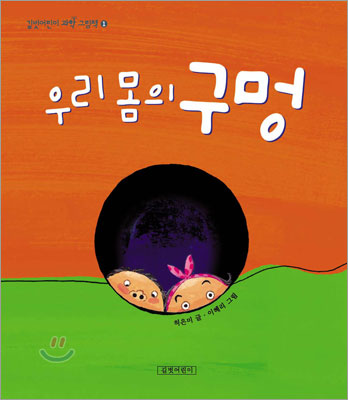
This book, which contains the story of our body, is a science picture book that allows children aged 3 and older to develop a stronger curiosity about the world while having fun imagining things through the picture book. When you open the first page, you will see a black circle, which you will soon realize is a drain hole. Next up is the shower hole, which is full of tiny black dots... Holes in objects that children commonly encounter around them open the beginning of the book. The next page shows two more tunnel-like holes. It shows the holes in our body one by one, including the nose, mouth, ears, eyes, and sweat pores. And it answers the question of what to do with that hole, and furthermore, it naturally makes us realize that just as a hole is a medium that connects this side to the other side, the holes in our body are also passages that connect us to the world. Often, writing that conveys information runs the risk of becoming loose and verbose. However, this book is written in short, rhythmic dialogues such as, "What is this?", "Aha, a drainage hole?", and "And this is it?", which adds to the enjoyment of reading the book. The illustrations are humorous and lively overall, and in particular, they show the anatomy of each body organ in an easy-to-understand way, allowing children to see and understand the structure of our body at a glance without needing a long explanation. Children around the age of three show an intense and tireless curiosity and interest in everything they see, hear, and experience in the world. Exposing children of this age to good science picture books is crucial to helping them explore and learn about the world. However, children do not enjoy picture books that contain scientific information. I look at picture books with joyful curiosity and anticipation, but the information presented in a descriptive manner is boring, and I end up getting overwhelmed by the sheer volume of information. This book was created with this in mind to arouse children's curiosity. |
- You can preview some of the book's contents.
Preview
Detailed image

Into the book
There are so many holes in our body.
There is also a large hole like a mouth,
There are also small holes like sweat pores.
There is also a large hole like a mouth,
There are also small holes like sweat pores.
--- p.
'Hey, what's this?'
'The orifices in our bodies all perform different tasks, but they all do the necessary work.'
'The hole is really amazing.' 'Hey, what is this?'
'The orifices in our bodies all perform different tasks, but they all do the necessary work.'
'The hole is really great'
'The orifices in our bodies all perform different tasks, but they all do the necessary work.'
'The hole is really amazing.' 'Hey, what is this?'
'The orifices in our bodies all perform different tasks, but they all do the necessary work.'
'The hole is really great'
--- p.
There are ears that hear sounds,
When the sound of a bird reaches the eardrum, the eardrum vibrates like a drum.
The vibration is transmitted to the brain and it is recognized as a new sound.
There are eyes that can see,
When light reflects off a bird and enters the eye, it is transmitted to the brain through the nerves.
The brain quickly tells you 'bird'.
There are ears that hear sounds,
When the sound of a bird reaches the eardrum, the eardrum vibrates like a drum.
The vibration is transmitted to the brain and it is recognized as a new sound.
There are eyes that can see,
When light reflects off a bird and enters the eye, it is transmitted to the brain through the nerves.
The brain quickly tells you 'bird'.
When the sound of a bird reaches the eardrum, the eardrum vibrates like a drum.
The vibration is transmitted to the brain and it is recognized as a new sound.
There are eyes that can see,
When light reflects off a bird and enters the eye, it is transmitted to the brain through the nerves.
The brain quickly tells you 'bird'.
There are ears that hear sounds,
When the sound of a bird reaches the eardrum, the eardrum vibrates like a drum.
The vibration is transmitted to the brain and it is recognized as a new sound.
There are eyes that can see,
When light reflects off a bird and enters the eye, it is transmitted to the brain through the nerves.
The brain quickly tells you 'bird'.
---pp14~15
Publisher's Review
We learn about our bodies through play!
By the age of three, children begin to take an active interest in their bodies.
Parents are left struggling to find appropriate answers to the endless barrage of questions from their children, which progress from "What is this?" to "Why?"
What book should be read first to our children who are just beginning to take an interest in their bodies?
Most of the scientific books currently published on the body are structured like encyclopedias, collecting all information about the body in one volume.
Despite the advantage of these books being rich in information, they have difficulty sustaining children's interest due to the flat presentation of information.
In other words, children can study from books that provide fragmented knowledge, but they cannot enjoy it.
This book, which does not repeat the problems of existing science books, will be a 'first science book' for children that allows them to learn about the body in a fun and playful way.
Freshness of idea - knowledge about the body through holes!
This book is a unique book that explains the organic connections and individual functions of the major organs of our body, such as the mouth, nose, ears, eyes, anus, and navel, through the medium of holes.
When you open the first page, there is a black circle.
"Oh, what is this?" You turn the page and say, "Aha, a drain hole." You can tell at a glance that the black circle is the hole in the bathroom floor.
Next was a shower hole filled with tiny black dots, then a tunnel of two holes… … .
Holes in objects that children commonly encounter around them open the beginning of the book.
On the next page, there are two more tunnel-like holes, and when I turn the page thinking, "There's another tunnel," I see a runny nostril.
At this point, children are inwardly surprised and become absorbed in the book, saying, "There are holes in our bodies too?"
The story of this book, which began with an unexpected curiosity, shows the holes in our body one by one, including the nose, mouth, ears, eyes, sweat pores, anus, urinary tract, and even the blocked navel.
And it gives an answer to the question, 'What should we do with that hole?' and furthermore, it naturally makes us realize that just as a hole is a medium that connects this side and that side, the holes in our body are also passages that connect 'me' and 'the world.'
Rhythmic text and well-structured illustrations
Often, writing that conveys information runs the risk of becoming loose and verbose.
However, this book is written in short, rhythmic dialogues such as, "What is this?" "Aha, a drainage hole." "Then, this is..." "Aha, a drainage hole." This adds to the enjoyment of reading the book.
The illustrations are humorous and lively overall, and in particular, they show the anatomy of each body organ in an easy-to-understand way, allowing children to see and understand the structure of our body at a glance without a long explanation.
By the age of three, children begin to take an active interest in their bodies.
Parents are left struggling to find appropriate answers to the endless barrage of questions from their children, which progress from "What is this?" to "Why?"
What book should be read first to our children who are just beginning to take an interest in their bodies?
Most of the scientific books currently published on the body are structured like encyclopedias, collecting all information about the body in one volume.
Despite the advantage of these books being rich in information, they have difficulty sustaining children's interest due to the flat presentation of information.
In other words, children can study from books that provide fragmented knowledge, but they cannot enjoy it.
This book, which does not repeat the problems of existing science books, will be a 'first science book' for children that allows them to learn about the body in a fun and playful way.
Freshness of idea - knowledge about the body through holes!
This book is a unique book that explains the organic connections and individual functions of the major organs of our body, such as the mouth, nose, ears, eyes, anus, and navel, through the medium of holes.
When you open the first page, there is a black circle.
"Oh, what is this?" You turn the page and say, "Aha, a drain hole." You can tell at a glance that the black circle is the hole in the bathroom floor.
Next was a shower hole filled with tiny black dots, then a tunnel of two holes… … .
Holes in objects that children commonly encounter around them open the beginning of the book.
On the next page, there are two more tunnel-like holes, and when I turn the page thinking, "There's another tunnel," I see a runny nostril.
At this point, children are inwardly surprised and become absorbed in the book, saying, "There are holes in our bodies too?"
The story of this book, which began with an unexpected curiosity, shows the holes in our body one by one, including the nose, mouth, ears, eyes, sweat pores, anus, urinary tract, and even the blocked navel.
And it gives an answer to the question, 'What should we do with that hole?' and furthermore, it naturally makes us realize that just as a hole is a medium that connects this side and that side, the holes in our body are also passages that connect 'me' and 'the world.'
Rhythmic text and well-structured illustrations
Often, writing that conveys information runs the risk of becoming loose and verbose.
However, this book is written in short, rhythmic dialogues such as, "What is this?" "Aha, a drainage hole." "Then, this is..." "Aha, a drainage hole." This adds to the enjoyment of reading the book.
The illustrations are humorous and lively overall, and in particular, they show the anatomy of each body organ in an easy-to-understand way, allowing children to see and understand the structure of our body at a glance without a long explanation.
GOODS SPECIFICS
- Date of issue: June 15, 2000
- Format: Hardcover book binding method guide
- Page count, weight, size: 50 pages | 380g | 212*243*15mm
- ISBN13: 9788955821185
- ISBN10: 8955821182
You may also like
카테고리
korean


korean

![GQ KOREA Mark (Monthly): December [2025]](http://librairie.coreenne.fr/cdn/shop/files/8ef265dbbfbf186523ed75ba7319009d.jpg?v=1765340328&width=3840)


