

Because I like it
 |
Description
Book Introduction
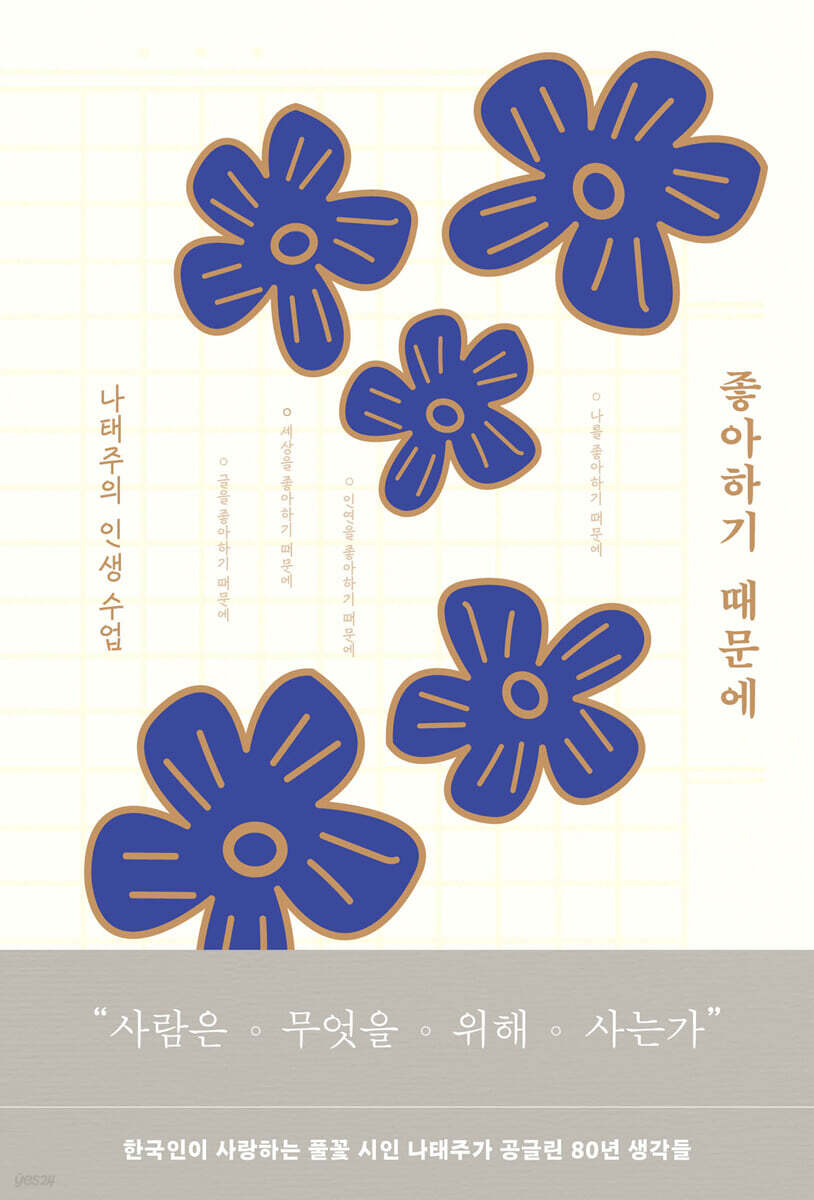
80 Years of Thoughts from Na Tae-ju, the "Wildflower Poet" beloved by Koreans “We should live by speaking kind words, good words, and words that benefit others.” Poet Na Tae-ju, who made poetry bloom in our hearts with his beloved Korean poem “Wildflower,” is publishing a collection of essays titled “Because I Like It” to commemorate his eighty-year anniversary. I revised the first draft of 1,200 pages and reduced it to 600 pages. This book is a compilation of 80 years of thoughts from 1945 to 2024, so it could be compiled into one thick volume, but I chose to keep it simple and concise, and only include the stories I really wanted to convey. This book contains the poetic heart and sincerity refined over half a century, the worries and center that were brought to bear not only through battling cancer but also through overcoming many near-death experiences, and the words and footsteps that lead us to understand and love this world. From his childhood and youth when he dreamed of becoming a poet, to his 43 years as a teacher with children, to his struggles with illness, to his current life where he writes words like a will every day, it is fully reflected in his life. 'Because I like it' is like the feeling you get when you rub a newborn's face. These are words that fill a lonely side with warmth. Living well is something you enjoy. “It is so,” says the poet. I recommend adding 'like' before 'because', which is used when blaming and resenting someone. I might end up wiping away my opponent's tears while we were having a snowball fight. A world that explodes like a volcano can become gentle like a mountain behind us. Do you want to let life flow in a beautiful direction? Do you want to turn off the lights of conflict? Don't you want to feel the thoughts of a person who is trying to keep his life from being ruined? If so, I hope you will open this book. You will be able to experience something good taking root in your heart like a wildflower. |
- You can preview some of the book's contents.
Preview
index
Opening remarks.
What I gave up
Part 1.
Because you like me
When you're sick
Near death
The power of minors
I like it
Next to the revenge grass and the wild chives
Work in the garden
Success in life
favorite motto
At the age of eighty
Into this bright sunlight
I asked if he was happy
Favorite song
Hardline
Songbang
Self-esteem and self-respect
Boy, have a little dream
Do you have a star?
I can't live without hope
Part 2.
Because I like relationships
Where is a tree without a backbone?
two pounds of beef
cheeks
Mr. Park Mok-wol
The day Myeongju came
A house that changes but doesn't change
What kind of greeting card
Three-person trip
A friendship that spans half a century
Chung and Seo
fatality
slip of the tongue
Naturally rambunctious
There is no one
Part 3.
Because I love the world
Humans are not frogs
lotus field
About tears
Okay
Old man and latte
'Wrong' and 'different'
older people
It's already serious
Dandelions and Bees
The era of humanization
We're in big trouble
Even if it's fast, it's too fast
Social distancing
Jemincheon fish
Delicious restaurants
Other-person sensibility
A welcoming heart
You have to know when it's time to stop
Don't postpone happiness
Part 4.
Because I like writing
old poet
There is no second time
That's exactly what it should be
First poetry collection
Wild flower names
Spring doesn't come alone
virtuous cycle
Words I hate
The joy of writing
old bookstore
A record of experimental life
Poet Sowol
After leaving this world
It will be as you say.
ambition
Learn from Tolstoy
The reason for the bees
monologue
Closing remarks.
Let's love the back view
What I gave up
Part 1.
Because you like me
When you're sick
Near death
The power of minors
I like it
Next to the revenge grass and the wild chives
Work in the garden
Success in life
favorite motto
At the age of eighty
Into this bright sunlight
I asked if he was happy
Favorite song
Hardline
Songbang
Self-esteem and self-respect
Boy, have a little dream
Do you have a star?
I can't live without hope
Part 2.
Because I like relationships
Where is a tree without a backbone?
two pounds of beef
cheeks
Mr. Park Mok-wol
The day Myeongju came
A house that changes but doesn't change
What kind of greeting card
Three-person trip
A friendship that spans half a century
Chung and Seo
fatality
slip of the tongue
Naturally rambunctious
There is no one
Part 3.
Because I love the world
Humans are not frogs
lotus field
About tears
Okay
Old man and latte
'Wrong' and 'different'
older people
It's already serious
Dandelions and Bees
The era of humanization
We're in big trouble
Even if it's fast, it's too fast
Social distancing
Jemincheon fish
Delicious restaurants
Other-person sensibility
A welcoming heart
You have to know when it's time to stop
Don't postpone happiness
Part 4.
Because I like writing
old poet
There is no second time
That's exactly what it should be
First poetry collection
Wild flower names
Spring doesn't come alone
virtuous cycle
Words I hate
The joy of writing
old bookstore
A record of experimental life
Poet Sowol
After leaving this world
It will be as you say.
ambition
Learn from Tolstoy
The reason for the bees
monologue
Closing remarks.
Let's love the back view
Detailed image

Into the book
There is something I cannot give up.
It's about loving people and writing well.
Maybe those two things are related.
From the beginning, writing starts from loving people, loving the world, and caring for nature.
It's true.
Without that, good writing cannot be produced.
---p.11
A life lived with love brings satisfaction to oneself.
Even if it is lacking and fails, it leaves room for trying again and continuing.
This is it.
How I see myself.
My life as I evaluate it.
Not the external landscape, but the internal landscape.
That's self-esteem.
---p.26
As time goes by little by little, I become old.
During that time, instead of Bin-i-mu-cheom, I kept in my heart the saying, "Let's live each day as if it were the first day of this world and live each day as if it were the last day of this world," and as I got older, I also made "not getting food or being scolded" my life's motto.
---p.39
It is very important to have someone you miss and want to see.
It is, in fact, a concrete hope for life.
Let's have someone we miss and want to see in our hearts.
We humans cannot live a single day without hope.
no.
Life is something that cannot be endured for even a moment without someone you love.
---p.72
I want to roll over and say something.
If you feel like crying, don't hold it in, just cry.
Shed tears too.
Only then will our human world become clearer, more profound, more humane, and ultimately more purified.
Tears are the best refresher for the human heart.
It's a cleaning tool.
It is the ultimate catharsis.
It is reconciliation and forgiveness.
---p.136
I would like to coin a new term, ‘other-recognition sensitivity.’
The world is no longer a place where I can live by insisting on my own position.
We must live with full consideration for others' positions.
Otherwise, we would be so harsh on each other that we wouldn't be able to survive.
There is an urgent need to be considerate of others and see the world from their perspective.
---pp.174-175
It's a matter of living while saying pretty words.
It is a matter of living while saying good things.
It is a life worth living while speaking words that benefit others.
When that happens, good things will happen to me, good things will happen to others, and things in the world will gradually turn out for the better.
It will be as you say.
It's a good word, but it's also a scary word.
It's about loving people and writing well.
Maybe those two things are related.
From the beginning, writing starts from loving people, loving the world, and caring for nature.
It's true.
Without that, good writing cannot be produced.
---p.11
A life lived with love brings satisfaction to oneself.
Even if it is lacking and fails, it leaves room for trying again and continuing.
This is it.
How I see myself.
My life as I evaluate it.
Not the external landscape, but the internal landscape.
That's self-esteem.
---p.26
As time goes by little by little, I become old.
During that time, instead of Bin-i-mu-cheom, I kept in my heart the saying, "Let's live each day as if it were the first day of this world and live each day as if it were the last day of this world," and as I got older, I also made "not getting food or being scolded" my life's motto.
---p.39
It is very important to have someone you miss and want to see.
It is, in fact, a concrete hope for life.
Let's have someone we miss and want to see in our hearts.
We humans cannot live a single day without hope.
no.
Life is something that cannot be endured for even a moment without someone you love.
---p.72
I want to roll over and say something.
If you feel like crying, don't hold it in, just cry.
Shed tears too.
Only then will our human world become clearer, more profound, more humane, and ultimately more purified.
Tears are the best refresher for the human heart.
It's a cleaning tool.
It is the ultimate catharsis.
It is reconciliation and forgiveness.
---p.136
I would like to coin a new term, ‘other-recognition sensitivity.’
The world is no longer a place where I can live by insisting on my own position.
We must live with full consideration for others' positions.
Otherwise, we would be so harsh on each other that we wouldn't be able to survive.
There is an urgent need to be considerate of others and see the world from their perspective.
---pp.174-175
It's a matter of living while saying pretty words.
It is a matter of living while saying good things.
It is a life worth living while speaking words that benefit others.
When that happens, good things will happen to me, good things will happen to others, and things in the world will gradually turn out for the better.
It will be as you say.
It's a good word, but it's also a scary word.
---pp.232-233
Publisher's Review
The definitive edition of Na Tae-ju's essays, a poet who embraces the small, low, and fragile.
A book for everyone who wants their life to flow in a beautiful direction.
1.
There is a poet named 'Na Tae-ju'.
His poem “Wildflowers” with the lines “If you look closely/ it’s pretty// If you look for a long time/ it’s lovely// You too” is a beloved poem by Koreans.
He has published over 190 books, including poetry collections, prose collections, and fairy tales.
He gives lectures all over the country and communicates with people of various generations.
With death by my side every day, I write 'poems like a will' and dream of becoming 'a useful poet, not a famous poet'.
A master of lyric poetry who never thought of himself as anything other than a poet, we call him the 'poet of wild flowers' and the 'national poet.'
There is a person named 'Na Tae-ju'.
He saves life by creating a flower garden in an empty yard, planting and cultivating flowers (〈Work in the Garden〉, 〈Names of Wildflowers〉, etc.).
Although I am old, I still ride my bike around the neighborhood and look into the stream (〈Jemincheon Fish〉, 〈Into This Bright Sunlight〉, etc.).
Like an ordinary person, he is depressed and lonely, but he still lives with hope (〈Beside the Revenge Grass and the Wildflowers〉, 〈Monologue〉, etc.).
He is grateful to his wife for putting white porridge and croaker stew on the table for him when he is sick (〈Border on Death〉), and he ponders what to say to the difficult stories of the guests who visit the literature museum (〈I Asked If You Are Happy〉〈Spring Does Not Come Alone〉, etc.).
A person who tries not to make the world he walks on a hell, the more we get to know him, the more we think of the good side of his life.
Poet Tae-ju Na, a 'natural poet', is publishing a collection of essays titled 'Because I Like It' to commemorate his eighty-year anniversary.
This book contains 54 years of poetry history since his debut in the Seoul Shinmun New Year’s Literary Contest in 1971.
As a boy dreaming of becoming a poet, as a child living with children for 43 years, as a child battling acute pancreatic cancer just before retirement, he miraculously recovered and said, “Let’s be kinder to ourselves.
Forgive and love yourself (page 64) “If you feel like crying, don’t hold it in, just cry.
He honestly expressed what he saw, heard, and felt until he came to the realization that “tears should also be shed” (p. 136).
The title of the book that was born that way, “Because I Like It,” was inspired by the word “good,” one of the words he uses often.
Although it is an ordinary phrase, it tickles the stiff daily life and brings a smile. “Because I Like You” contains the poet’s deep meaning of wishing for us to live a life where we become flowers, not swords.
The subtitle is 'Nat's Life Lessons'.
If we write it differently, it is 'Nataeju's Life Lesson', because it whispers the full thoughts of living faithfully each day for 80 years.
In the opening verse, the poet asks himself and us about one thing that he can give up—food, clothing, sleep, and transportation—but cannot give up.
“There is something I cannot give up.
It's about loving people and writing well.
Maybe those two things are related.
From the beginning, writing starts from loving people, loving the world, and caring for nature.
It's true.
Without that, good writing cannot be produced.
"What do people live for? What is hope, and what is the purpose and reward of life?" (pp. 11-12)
2.
If you have any questions about life, you can read this book, which consists of 69 chapters in 4 parts.
However, poet Na Tae-ju recommends focusing on ‘feeling’ rather than ‘learning.’
In Part 1, “Because You Like Me,” he unfolds the wisdom he has accumulated throughout his life, from his short and weak childhood (“The Power of a Minor”), to his high school days when he was determined to become a poet despite being good at nothing (“Liking It”), to his teaching days when he never let go of poetry (“Do You Have a Star”), to his later years when he took to heart the words, “Let’s live each day as if it were the first day of this world and live each day as if it were the last day of this world” (p. 39), to his present life (“Motto”).
In Part 2, 'Because I Like Relationships', looking back, the author recalls the bloodlines that were his support (father, mother, etc.), the teachers that influenced his first and second half of life (Lee Eo-ryeong, Park Mok-wol, Lim Kang-bin, etc.), the friends he relied on and shared friendship with (Song Su-kwon, Lee Seong-seon, Kim Ye-won, etc.), the students and teachers he met within the school fence (Myeong-ju, his high school teacher, etc.), and the residents he often greets in the neighborhood (Lucia's Garden, the couple he frequents at the laundry shop, etc.), and depicts his life living separately and together.
In Part 3, “Because I Love the World,” he voices concerns about materialism (“Humans Are Not Frogs”), the climate crisis and population crisis (“Already Worse”), and a high-speed society that has lost its slowness (“Even Fast Is Too Fast”), and says that a society that insists on only its own position needs “sensitivity to others.”
“You must live with full consideration for others’ positions.
Otherwise, we would be so harsh on each other that we wouldn't be able to survive.
“It is necessary to have an attitude of consideration for others and to see the world from others’ perspectives” (p. 175).
Part 4, “Because I Love Writing,” tells of the heart of writing poetry with an old body but an old spirit (“Old Poet”), advice to younger poets (“Be That Way”), the mission of a poet living in the age of artificial intelligence (“Spring Does Not Come Alone”), the sorrows and joys of reading and writing (“Old Bookstore”, “Record of Experimental Life”, etc.), and stories of authors who have influenced the world of poetry (“Poet Sowol,” “After Leaving the World,” “It Will Be as You Say,” “Learning from Tolstoy,” “Monologue,” etc.).
3.
When this book was being produced at the printing house and factory, I asked poet Na Tae-ju.
“How can we live without ruin?” He answered with a smile, “Be frugal yourself, humble to others, and honest when living with others.”
And in the book, he says, “We must try to choose and use pretty words and beautiful words” (page 211), and “People don’t age for nothing.
“We grow older to become better at something, and we grow older to help others” (p. 102).
Poet Na Tae-ju seems to be on a treasure hunt his entire life.
The treasure he seeks to discover is not something like gold-plated porcelain.
It is not like a dynastic relic buried deep in the ground.
It is like a small, low-growing wildflower.
It's like me saying that I smile when I see that wildflower.
It's a pretty expression made when you kneel down and squat down and look at something you like.
On the signpost in front of the garden of the Wildflower Literature Museum, this request is written.
“Please only step on the stepping stones.” This is a consideration for the flowers that might take root between the stepping stones.
Following the life and writings of poet Na Tae-ju, I truly come to think that 'living well means loving what you do.'
The flowers blooming on the book cover are wild flowers.
Wildflowers do not grow as tall as sunflowers.
It blooms quietly under a person's calf.
Such wild flowers resemble poet Na Tae-ju.
It is like shining light in a low place rather than a high place.
Just like his poem, “I like it just by looking at you from afar/ Sometimes I like it just by hearing your voice” (excerpt from “Violet Love Affair 1”), I hope that “Because I Like You” will be a good book to keep by your side.
When we blame and resent someone, let's add the word 'like' before the word 'because'.
Discord will diminish and peace will bloom in your heart.
Opening a clenched fist to shake hands, changing a sharp gaze into a deep one, and rounding out pointed lips all come from a 'heart of liking'.
Isn't a life where you learn to 'like' rather than 'dislike' what makes life worth living?
This book contains the voices and footsteps that lead us to understand and love this world.
A book for everyone who wants their life to flow in a beautiful direction.
1.
There is a poet named 'Na Tae-ju'.
His poem “Wildflowers” with the lines “If you look closely/ it’s pretty// If you look for a long time/ it’s lovely// You too” is a beloved poem by Koreans.
He has published over 190 books, including poetry collections, prose collections, and fairy tales.
He gives lectures all over the country and communicates with people of various generations.
With death by my side every day, I write 'poems like a will' and dream of becoming 'a useful poet, not a famous poet'.
A master of lyric poetry who never thought of himself as anything other than a poet, we call him the 'poet of wild flowers' and the 'national poet.'
There is a person named 'Na Tae-ju'.
He saves life by creating a flower garden in an empty yard, planting and cultivating flowers (〈Work in the Garden〉, 〈Names of Wildflowers〉, etc.).
Although I am old, I still ride my bike around the neighborhood and look into the stream (〈Jemincheon Fish〉, 〈Into This Bright Sunlight〉, etc.).
Like an ordinary person, he is depressed and lonely, but he still lives with hope (〈Beside the Revenge Grass and the Wildflowers〉, 〈Monologue〉, etc.).
He is grateful to his wife for putting white porridge and croaker stew on the table for him when he is sick (〈Border on Death〉), and he ponders what to say to the difficult stories of the guests who visit the literature museum (〈I Asked If You Are Happy〉〈Spring Does Not Come Alone〉, etc.).
A person who tries not to make the world he walks on a hell, the more we get to know him, the more we think of the good side of his life.
Poet Tae-ju Na, a 'natural poet', is publishing a collection of essays titled 'Because I Like It' to commemorate his eighty-year anniversary.
This book contains 54 years of poetry history since his debut in the Seoul Shinmun New Year’s Literary Contest in 1971.
As a boy dreaming of becoming a poet, as a child living with children for 43 years, as a child battling acute pancreatic cancer just before retirement, he miraculously recovered and said, “Let’s be kinder to ourselves.
Forgive and love yourself (page 64) “If you feel like crying, don’t hold it in, just cry.
He honestly expressed what he saw, heard, and felt until he came to the realization that “tears should also be shed” (p. 136).
The title of the book that was born that way, “Because I Like It,” was inspired by the word “good,” one of the words he uses often.
Although it is an ordinary phrase, it tickles the stiff daily life and brings a smile. “Because I Like You” contains the poet’s deep meaning of wishing for us to live a life where we become flowers, not swords.
The subtitle is 'Nat's Life Lessons'.
If we write it differently, it is 'Nataeju's Life Lesson', because it whispers the full thoughts of living faithfully each day for 80 years.
In the opening verse, the poet asks himself and us about one thing that he can give up—food, clothing, sleep, and transportation—but cannot give up.
“There is something I cannot give up.
It's about loving people and writing well.
Maybe those two things are related.
From the beginning, writing starts from loving people, loving the world, and caring for nature.
It's true.
Without that, good writing cannot be produced.
"What do people live for? What is hope, and what is the purpose and reward of life?" (pp. 11-12)
2.
If you have any questions about life, you can read this book, which consists of 69 chapters in 4 parts.
However, poet Na Tae-ju recommends focusing on ‘feeling’ rather than ‘learning.’
In Part 1, “Because You Like Me,” he unfolds the wisdom he has accumulated throughout his life, from his short and weak childhood (“The Power of a Minor”), to his high school days when he was determined to become a poet despite being good at nothing (“Liking It”), to his teaching days when he never let go of poetry (“Do You Have a Star”), to his later years when he took to heart the words, “Let’s live each day as if it were the first day of this world and live each day as if it were the last day of this world” (p. 39), to his present life (“Motto”).
In Part 2, 'Because I Like Relationships', looking back, the author recalls the bloodlines that were his support (father, mother, etc.), the teachers that influenced his first and second half of life (Lee Eo-ryeong, Park Mok-wol, Lim Kang-bin, etc.), the friends he relied on and shared friendship with (Song Su-kwon, Lee Seong-seon, Kim Ye-won, etc.), the students and teachers he met within the school fence (Myeong-ju, his high school teacher, etc.), and the residents he often greets in the neighborhood (Lucia's Garden, the couple he frequents at the laundry shop, etc.), and depicts his life living separately and together.
In Part 3, “Because I Love the World,” he voices concerns about materialism (“Humans Are Not Frogs”), the climate crisis and population crisis (“Already Worse”), and a high-speed society that has lost its slowness (“Even Fast Is Too Fast”), and says that a society that insists on only its own position needs “sensitivity to others.”
“You must live with full consideration for others’ positions.
Otherwise, we would be so harsh on each other that we wouldn't be able to survive.
“It is necessary to have an attitude of consideration for others and to see the world from others’ perspectives” (p. 175).
Part 4, “Because I Love Writing,” tells of the heart of writing poetry with an old body but an old spirit (“Old Poet”), advice to younger poets (“Be That Way”), the mission of a poet living in the age of artificial intelligence (“Spring Does Not Come Alone”), the sorrows and joys of reading and writing (“Old Bookstore”, “Record of Experimental Life”, etc.), and stories of authors who have influenced the world of poetry (“Poet Sowol,” “After Leaving the World,” “It Will Be as You Say,” “Learning from Tolstoy,” “Monologue,” etc.).
3.
When this book was being produced at the printing house and factory, I asked poet Na Tae-ju.
“How can we live without ruin?” He answered with a smile, “Be frugal yourself, humble to others, and honest when living with others.”
And in the book, he says, “We must try to choose and use pretty words and beautiful words” (page 211), and “People don’t age for nothing.
“We grow older to become better at something, and we grow older to help others” (p. 102).
Poet Na Tae-ju seems to be on a treasure hunt his entire life.
The treasure he seeks to discover is not something like gold-plated porcelain.
It is not like a dynastic relic buried deep in the ground.
It is like a small, low-growing wildflower.
It's like me saying that I smile when I see that wildflower.
It's a pretty expression made when you kneel down and squat down and look at something you like.
On the signpost in front of the garden of the Wildflower Literature Museum, this request is written.
“Please only step on the stepping stones.” This is a consideration for the flowers that might take root between the stepping stones.
Following the life and writings of poet Na Tae-ju, I truly come to think that 'living well means loving what you do.'
The flowers blooming on the book cover are wild flowers.
Wildflowers do not grow as tall as sunflowers.
It blooms quietly under a person's calf.
Such wild flowers resemble poet Na Tae-ju.
It is like shining light in a low place rather than a high place.
Just like his poem, “I like it just by looking at you from afar/ Sometimes I like it just by hearing your voice” (excerpt from “Violet Love Affair 1”), I hope that “Because I Like You” will be a good book to keep by your side.
When we blame and resent someone, let's add the word 'like' before the word 'because'.
Discord will diminish and peace will bloom in your heart.
Opening a clenched fist to shake hands, changing a sharp gaze into a deep one, and rounding out pointed lips all come from a 'heart of liking'.
Isn't a life where you learn to 'like' rather than 'dislike' what makes life worth living?
This book contains the voices and footsteps that lead us to understand and love this world.
GOODS SPECIFICS
- Date of issue: February 29, 2024
- Format: Hardcover book binding method guide
- Page count, weight, size: 252 pages | 422g | 134*198*20mm
- ISBN13: 9788934956938
- ISBN10: 8934956933
You may also like
카테고리
korean


korean

![GQ KOREA Mark (Monthly): December [2025]](http://librairie.coreenne.fr/cdn/shop/files/8ef265dbbfbf186523ed75ba7319009d.jpg?v=1765340328&width=3840)


