

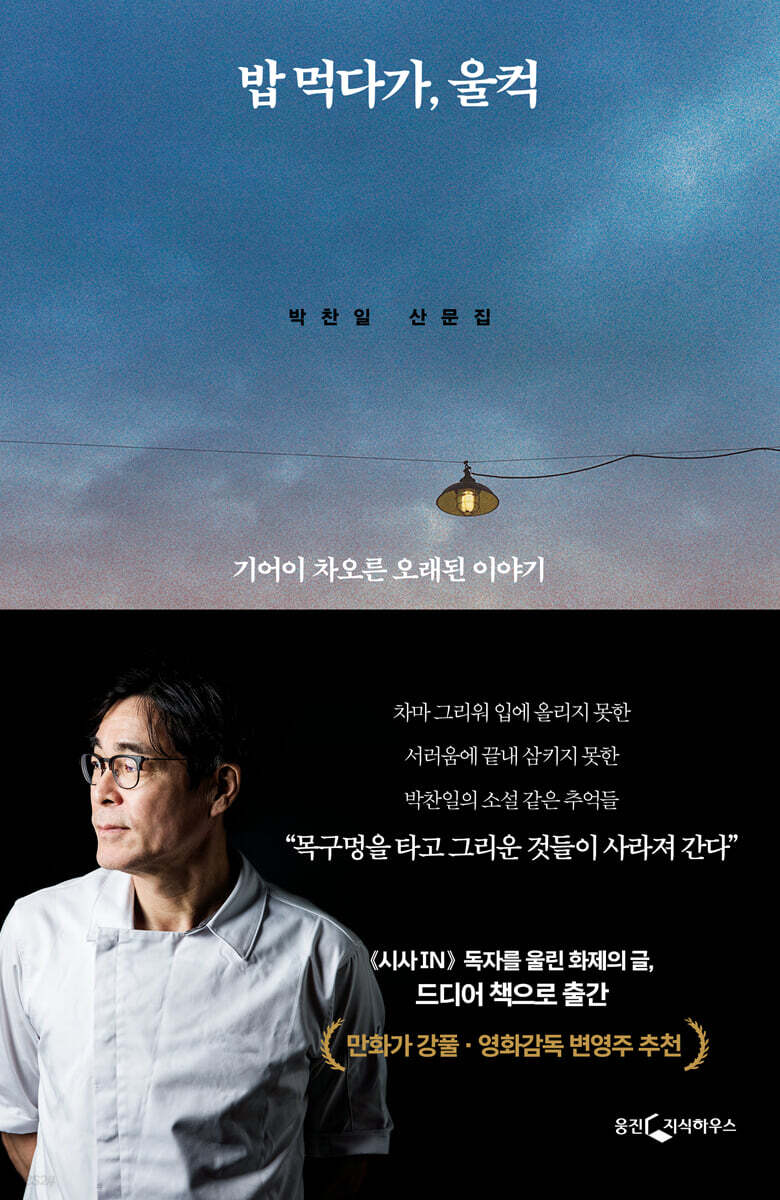
While eating, I suddenly cried
 |
Description
Book Introduction
Park Chan-il's old comfort in a lonely and desolate era “The things I miss are disappearing down my throat.” I couldn't bring myself to say it because I missed you so much I couldn't swallow it because of the sadness Memories that bring tears to your eyes, like a novel ★ Recommended by cartoonist Kang Full? Film director Byun Young-joo ★ ★《Sisa IN》 A hotly-talked-about series that left readers in tears ★ Rice is just rice, but there is rice that makes you cry while eating it. Just looking at the brand of gochujang sent by a guy I can no longer meet, who traveled halfway around the world, or the sea urchins that the elderly female divers worked so hard to make that life and death can be decided by 'one arm's length', it's hard to swallow because it weighs heavily on my heart. In this way, we have collected all the memories that touched the heart of chef and writer Park Chan-il, and thus, they have come to be like a novel. The collection of essays titled "Eating, I Cried" is a collection of essays that were written by refining and adding to the essays that touched readers' hearts during the serialization of "Sisa IN" and that prompted a flood of inquiries from the readers' committee upon news of the serial's discontinuation. In this book, he painstakingly recounts memories of people who have passed through his life. Sometimes, it comforts those things that are constantly disappearing, bringing up people we have missed so much that we have not been able to speak of them for years, the stories of kitchen workers whose sorrow and hardship are too difficult to swallow, and memories of our impoverished childhood in a neighborhood on the outskirts of Seoul. As readers read the stories of food and people who were immature yet affectionate and tearfully grateful, which finally came to life in an increasingly cold world, they will also feel a surge of longing in their hearts. |
- You can preview some of the book's contents.
Preview
index
What those who read it first said
As I write this, I write so I don't forget.
1 | It's disappearing like that
There was a person who was more serious about dumplings than anyone else.
The guy's heart has come halfway around the world
Whenever I eat jajangmyeon as a side dish, I think of him.
The alcohol bill paid off after 40 years
Even if medium rare becomes well done
Which instrument has my name engraved on it?
I went to a hamburger restaurant with a lonely appetite.
My brother seemed like a man without hatred.
The era of buffets is gone, and so are friends.
2 | Things that are hard to swallow
It's a story no one will believe anyway
I can't eat sea urchins carelessly because I can hear them squeaking.
A dish for chefs, spaghetti alla girepasi
The act of not being able to put something in one's mouth
I barely manage to find a disappearing restaurant and eat frugally.
After all that hard work, I became a first-class baker.
I'd rather pour oil on your arm
Was it because my aunt wasn't a worker?
Baedal Minjok's whole body hurts
The last drink of my life with salty snacks
3 | The wine of memories, the food of tears
My tongue grew while starving
The fate of the rice cooker for the family of six in the gatehouse
On Sundays when the smell of curry was in the air
Memories of the hole in the Jongno Umigwan
The steamed dog ate mantou after being hit
That day we ate tofu stew 1
That day we ate tofu stew 2
That's how we fought against poverty
The name Noeul is sad
I only drank cold soju with spicy pork intestines
As I write this, I write so I don't forget.
1 | It's disappearing like that
There was a person who was more serious about dumplings than anyone else.
The guy's heart has come halfway around the world
Whenever I eat jajangmyeon as a side dish, I think of him.
The alcohol bill paid off after 40 years
Even if medium rare becomes well done
Which instrument has my name engraved on it?
I went to a hamburger restaurant with a lonely appetite.
My brother seemed like a man without hatred.
The era of buffets is gone, and so are friends.
2 | Things that are hard to swallow
It's a story no one will believe anyway
I can't eat sea urchins carelessly because I can hear them squeaking.
A dish for chefs, spaghetti alla girepasi
The act of not being able to put something in one's mouth
I barely manage to find a disappearing restaurant and eat frugally.
After all that hard work, I became a first-class baker.
I'd rather pour oil on your arm
Was it because my aunt wasn't a worker?
Baedal Minjok's whole body hurts
The last drink of my life with salty snacks
3 | The wine of memories, the food of tears
My tongue grew while starving
The fate of the rice cooker for the family of six in the gatehouse
On Sundays when the smell of curry was in the air
Memories of the hole in the Jongno Umigwan
The steamed dog ate mantou after being hit
That day we ate tofu stew 1
That day we ate tofu stew 2
That's how we fought against poverty
The name Noeul is sad
I only drank cold soju with spicy pork intestines
Detailed image

Into the book
He went to school really desperately.
They made better instruments than the Italian students.
He kept cutting, tightening, and gluing without rest.
They say that my name is engraved on one of the instruments he made during his student days.
It was the price I paid for the instrument wood that helped me get through that bleak day, the price I paid for the hot water bottle I gave him and the money I gave him to put me to sleep.
It might have been his way of remembering that kindness.
In the fall of 2023, I closed the restaurant I had run for 10 years.
As I was unpacking, the large wooden cutting board he had sent me caught my eye.
A large cutting board carved from the finest wood just for me.
The only chopping board in the world.
I quietly hugged the cutting board.
Remembering him as the maestro.
---From "My name is engraved on a certain instrument"
The reason we called our old friends to ask for money was to pay our employees' salaries.
When the company was going bankrupt, he used all the money he had to pay off debts from business partners.
Then he borrowed money from his friends to pay his employees' salaries one last time.
The shopping district was bustling.
It was like a mutual aid.
It was a seed sown by a foolish friend.
As we turned around, the woman cried and gave us each an envelope.
I thought it was a thank you envelope for transportation expenses.
Friends gathered again for Samwooje.
They were the guys who lent a lot of money to their friends.
The thank-you envelope contained an apology letter from my friend.
Eight letters were collected and burned in the temple yard during the Samwooje ceremony.
My friend's last night was the time to write that letter.
The days of buffets, which were like a whirlwind, have passed and so have my friends.
---From "The era of buffets is gone, and so are my friends"
Just when I was getting so tired, a package arrived at the store.
When I opened it, it was 1 kilogram of gochujang and dried anchovies.
How did he know, it was the guy from Seoul who sent it.
The shipping cost was ten times the price of the gochujang and anchovies, and it took half a trip around the world for the guy to come.
I cooked rice, added about two spoons of gochujang, crushed a few anchovies, and mixed it with extra virgin olive oil.
I cried while eating.
When I actually came to Korea, something happened that made me cry really hard.
The guy suddenly passed away at a young age.
My heart sank when I saw my junior smiling in the portrait.
Even now, whenever I see gochujang at the supermarket, whenever I see the same red brand gochujang that was sent to me, I feel like the soles of my feet are about to give out.
---From "The guy's heart came halfway around the world"
The old woman diver, shaking off her still-wet hair, sets the table for the guests who come to her home.
Even if you try to dissuade her, she quickly sets the table, just like a mother would.
I remembered the seaweed salad called 'Cheoncho' because it was delicious, but I later heard someone say it and ended up forgetting it.
“It is said that when that seaweed grows luxuriantly in the sea, it grabs the feet of female divers working and does not let go.
In that black sea, life and death are decided in an instant.
That's why some people say that the sky is like grass.
Because you might be able to go to heaven.
The bottom of the sea is the dragon palace, and above is the sky.
Anyway, there are many female divers who hate that dangerous cheoncho… … .”
---From "I can't eat sea urchins carelessly, because I can hear them croaking"
“It used to be the best hotel, but it’s old.
I feel sad because I built it.
When I'm walking down the street and there's a tall building, I just can't see it.
You can see stairs and scaffolding (temporary work platforms installed on the exterior walls of buildings).
The shape of the building is visible to the naked eye.
People don't know.
“We have to work our butts off to build a building.”
I got a shop in the market street.
He started his business by putting up a sign with the words "Daepotjip" in paint and giving 10,000 won.
The business was good because the food was good.
It's already been 50 years.
While many well-established stores are praised as old establishments, this one is located in a corner of the market that is hard to find and seems to be half-not there.
Daytime drinking is intoxicating.
As I walk out, the old tourist hotel he built stands there, barely breathing.
A lukewarm time is filling this provincial city again.
---From "The Last Drink of My Life with Salty Snacks"
Facebook reported Jin-gyu's news.
We met again at the central market.
It's been 30 years, I think.
It was a side dish of pork intestines.
It was still spicy.
I drank it by pouring cold soju into my mouth.
As time passed, the alcohol content of soju decreased from 25 degrees to 18 degrees, and we grew old.
It is said that Jin-gyu took over a pork intestine stall in that alley and ran it for a while.
Business was going well.
Was it a country-like thing to do where one person opens a restaurant and runs a cafe or bar?
Jin-gyu, who was a technician, stir-fries tripe, and I, who was a writer, stir-fries pasta.
Everyone is stir-frying, so whose job is it to buy and eat?
Well, I wonder if the restaurant owners are just taking turns selling each other's food to survive.
They made better instruments than the Italian students.
He kept cutting, tightening, and gluing without rest.
They say that my name is engraved on one of the instruments he made during his student days.
It was the price I paid for the instrument wood that helped me get through that bleak day, the price I paid for the hot water bottle I gave him and the money I gave him to put me to sleep.
It might have been his way of remembering that kindness.
In the fall of 2023, I closed the restaurant I had run for 10 years.
As I was unpacking, the large wooden cutting board he had sent me caught my eye.
A large cutting board carved from the finest wood just for me.
The only chopping board in the world.
I quietly hugged the cutting board.
Remembering him as the maestro.
---From "My name is engraved on a certain instrument"
The reason we called our old friends to ask for money was to pay our employees' salaries.
When the company was going bankrupt, he used all the money he had to pay off debts from business partners.
Then he borrowed money from his friends to pay his employees' salaries one last time.
The shopping district was bustling.
It was like a mutual aid.
It was a seed sown by a foolish friend.
As we turned around, the woman cried and gave us each an envelope.
I thought it was a thank you envelope for transportation expenses.
Friends gathered again for Samwooje.
They were the guys who lent a lot of money to their friends.
The thank-you envelope contained an apology letter from my friend.
Eight letters were collected and burned in the temple yard during the Samwooje ceremony.
My friend's last night was the time to write that letter.
The days of buffets, which were like a whirlwind, have passed and so have my friends.
---From "The era of buffets is gone, and so are my friends"
Just when I was getting so tired, a package arrived at the store.
When I opened it, it was 1 kilogram of gochujang and dried anchovies.
How did he know, it was the guy from Seoul who sent it.
The shipping cost was ten times the price of the gochujang and anchovies, and it took half a trip around the world for the guy to come.
I cooked rice, added about two spoons of gochujang, crushed a few anchovies, and mixed it with extra virgin olive oil.
I cried while eating.
When I actually came to Korea, something happened that made me cry really hard.
The guy suddenly passed away at a young age.
My heart sank when I saw my junior smiling in the portrait.
Even now, whenever I see gochujang at the supermarket, whenever I see the same red brand gochujang that was sent to me, I feel like the soles of my feet are about to give out.
---From "The guy's heart came halfway around the world"
The old woman diver, shaking off her still-wet hair, sets the table for the guests who come to her home.
Even if you try to dissuade her, she quickly sets the table, just like a mother would.
I remembered the seaweed salad called 'Cheoncho' because it was delicious, but I later heard someone say it and ended up forgetting it.
“It is said that when that seaweed grows luxuriantly in the sea, it grabs the feet of female divers working and does not let go.
In that black sea, life and death are decided in an instant.
That's why some people say that the sky is like grass.
Because you might be able to go to heaven.
The bottom of the sea is the dragon palace, and above is the sky.
Anyway, there are many female divers who hate that dangerous cheoncho… … .”
---From "I can't eat sea urchins carelessly, because I can hear them croaking"
“It used to be the best hotel, but it’s old.
I feel sad because I built it.
When I'm walking down the street and there's a tall building, I just can't see it.
You can see stairs and scaffolding (temporary work platforms installed on the exterior walls of buildings).
The shape of the building is visible to the naked eye.
People don't know.
“We have to work our butts off to build a building.”
I got a shop in the market street.
He started his business by putting up a sign with the words "Daepotjip" in paint and giving 10,000 won.
The business was good because the food was good.
It's already been 50 years.
While many well-established stores are praised as old establishments, this one is located in a corner of the market that is hard to find and seems to be half-not there.
Daytime drinking is intoxicating.
As I walk out, the old tourist hotel he built stands there, barely breathing.
A lukewarm time is filling this provincial city again.
---From "The Last Drink of My Life with Salty Snacks"
Facebook reported Jin-gyu's news.
We met again at the central market.
It's been 30 years, I think.
It was a side dish of pork intestines.
It was still spicy.
I drank it by pouring cold soju into my mouth.
As time passed, the alcohol content of soju decreased from 25 degrees to 18 degrees, and we grew old.
It is said that Jin-gyu took over a pork intestine stall in that alley and ran it for a while.
Business was going well.
Was it a country-like thing to do where one person opens a restaurant and runs a cafe or bar?
Jin-gyu, who was a technician, stir-fries tripe, and I, who was a writer, stir-fries pasta.
Everyone is stir-frying, so whose job is it to buy and eat?
Well, I wonder if the restaurant owners are just taking turns selling each other's food to survive.
---From "I only drank cold soju with spicy pork intestines"
Publisher's Review
I miss the things that are disappearing, and I write this story so I don't forget them.
― In a world that is becoming increasingly colder, I bring out novel-like memories that rise to my throat.
Some memories are too scary to bring up.
Haven't you also buried in the back of your memory those moments when you miss someone so much that you can't even speak when you think about them?
Things like the food and drinks we shared with him, the temperature of the day we walked together, and the scenery that unfolded before our eyes.
As everything changes faster and faster, things we miss disappear and are forgotten.
Park Chan-il, the "chef who writes" who defined the relationship between life and food as "half of memories is taste," has come to readers with his new book, "While Eating, I Suddenly Cried," a compilation of stories he had a hard time recalling in order to remember fading memories.
When it comes to writing about food, alcohol, old stores, and memories in Korea, it's hard to think of Park Chan-il without mentioning him.
Starting out as a journalist, he studied cooking in Italy and is the one who created the pasta syndrome in the Cheongdam-dong area in the 2000s by adding local ingredients to the menu. He is also an unrivaled essayist in the domestic bookstore world who earned the title of the first “chef who writes” by crossing over from wine and cooking to seasonal food and even the dining table at Buddhist temples.
As the novelist Kim Jung-hyuk called him, he was a great 'noodle lover' (a nickname given to him because he loved noodles from jajangmyeon to naengmyeon), and he also wrote and wrote books about noodle dishes.
He also became a 'donor of materials to the National Folk Museum' through his books ('What I Learned at a Century-Old Restaurant' and 'Business Methods of an Old Store') and interviews he wrote while covering old stores across the country.
The theme of this book, which shows his prose world that has become more intense and profound, is 'stories written so as not to be forgotten, stories about people I miss that I found difficult to bring myself to say.'
From the gochujang of the guy who flew halfway around the world
A phone call you should make even if your medium rare steak is well done.
Even the last letter left by a friend who turned his back on the whirlwind of times
― 29 essays that convey the deep 'pathos' of life, that old comfort.
This book is a collection of articles that were refined and added to the manuscripts serialized in the column of the same name, “While Eating, I Suddenly Cried,” in the weekly magazine [Sisa IN] from 2022 onwards.
The news of the series' discontinuation in June 2023 prompted a barrage of inquiries from the Readers' Committee asking for the reason for the discontinuation, and the series received a passionate response, touching readers' hearts every week.
In a world where the desire for wealth and success, and the admiration for technology and innovation, reign supreme, this "Old Comfort" by author Park Chan-il, filled with people, memories, longing, and sighs, feels like a story set in reverse.
One reader commented that his writing was “a piece that deeply felt the ‘pathos’ of life,” deeply and powerfully stimulating memories and times that everyone had forgotten.
The author, who said, “I’ve reached an age where I tend to forget things,” and “I even memorized the 100 famous mountains of Korea and the subway line 2 map,” decided to write about the people he misses so much that he doesn’t forget them.
People and food that are simply indescribable, like the Korean-Chinese Mr. Jinjian Long who, when he was trying to open a restaurant, solved the complicated construction problems of an unlicensed building in one fell swoop and disappeared, saying, “I am an unlicensed person” (pp. 19-25), or a junior who, when he was studying abroad in Italy and struggling and not even having a proper meal, sent him gochujang and anchovies to make him cry, and then suddenly passed away (pp. 31-33).
Now he knows vaguely.
His friend, who had great business acumen, borrowed money from his friends when his business was booming, and instead of that, he gave them the heart he had written in a letter before he died (pp. 88-90). His mentor, who suffered from cognitive impairment, called to say, “I’ll read you some poetry” during dinner time, when the chef was busiest, and he told them why he should accept it “even if it means a medium-rare steak is well-done” (pp. 49-55).
In the end, it was the human heart that enabled people to endure the hardships of life.
The lady whose eyes turned red at the sight of the letter addressed to her, ‘General Affairs Manager’
Sea urchins from female divers that you cannot eat if you know about them.
Delivery drivers carrying a three-tiered stone pot bibimbap tray were left with a bruised body.
― Hearing the stories of those who support restaurant kitchens and find it difficult to swallow rice.
In this book, which is divided into three parts, the first part mainly contains stories about the people the author cannot forget in his life and whom he misses and is grateful for, while the second part is centered around the sad and difficult people he met in his workplace, the restaurant and kitchen, and their stories.
When I see the elderly female divers I met on the coast of Gyeongsang Province squatting on the ground, doing the back-breaking work of removing the spines and intestines of sea urchins, “those soft, beautiful sea urchins get caught in my throat” (pp. 105-109), and when I see the owner of Gunsan’s ‘Hongjip’, who has been running the store for over 40 years in place of his missing bride, casually handing out seasonal delicacies and the absurd receipt he receives at the end, I am left speechless (pp. 93-99).
In particular, it is difficult to easily overlook the story of 'Ms. Yoon', who has worked with the author for a long time.
In the food service industry, she was called "arai" (洗い), one of the "assistant workers in the lowest job of cooking, which is even lower than that of the lowest job," and when you see the various titles she was called by, such as "aunt," "ajumma," "chanmo," or "eomma," who wouldn't feel a pang of guilt?
The writer gave her a business card with the name ‘General Affairs OOO’ (page 154).
She, who was weeping with red eyes, saying, "This is the first time in my life that I've ever held a government position," has suffered numerous non-payments and wage thefts and now works as a "formal waitress" at a restaurant in Yeouido.
“Come visit me sometime,” I’ve been texting him every holiday for 20 years.
Reading the "round" stories of hardships of Chinese chefs who jokingly compete to see who can make the biggest "oil bread" (red marks on the hands or arms from oil splatter), and the "straight" stories of prowess of Western chefs who use their knives so much that they leave "Kandinsky-style" scars, leaves one speechless (pp. 144-145).
The female manager, who had been delivering food at Dongdaemun Market all her life by stacking a ‘three-story tray’ on her head, suffered from arthritis and a herniated disc that was not covered by industrial accident compensation, causing pain from her spine to her knees (pp. 162-165).
We don't know much about the aftermath of the countless delivery women who endured the era of the stone pot bibimbap craze, where the stone pot alone weighed over a kilogram.
Why have we been so indifferent to the shocking stories of those who struggle and sacrifice to feed others?
“I feel like I'm only living in the past even though I've lived my whole life.”
Park Chan-il's childhood was a desperate struggle against poverty.
Friends who endured and grew up together, and my father…
― The comfort of writing tirelessly to remember the memories of those who made me who I am.
The author says that on his bucket list, he once wrote down, “Go to the neighborhood bathhouse with my father, take a bath, and drink bottled milk.”
It's a wish that can no longer be fulfilled.
His father, a master of tofu dishes, who worked long hours at construction sites and contracted tuberculosis, always making a 'keungkeum' sound, is no longer with him. The image of his father buying him a glass of hot milk and smoking a cigarette while reading the newspaper lives on in his memory.
He said, “I feel like I’m only living in the past even though I’ve lived my whole life.
That is why the writings he wrote to not forget, confessing that “I could not become an adult” (pp. 8-9), are all the more sorrowful and poignant.
It was a time when everyone was poor and had a difficult time growing up, to the point where people could say, 'We fought against poverty.'
As you read the episodes with friends who spent those days together, you will all be reminded of your own childhood and the moments when you would stroll down the alleys.
Now, the guy who used to frequent the movie theater 'Dog Hole' with me and the friend who was like a hero to me who saved me from the neighborhood gangsters are each walking their own paths.
Some have been to prison, others have pulled food carts, others have become public service fire lookouts, or others have simply disappeared.
The author, who had always transferred schools and hated going to school, became a chef and began writing.
He has written extensively for over 20 years since leaving his journalistic title, and is still writing today.
He wrote this book in order not to forget, and his final words were, “I poured out all the regrets deep in my heart.”
I hope that through this book, readers will be able to touch upon a certain point in their lives, shake off their regrets, and find solace through it.
― In a world that is becoming increasingly colder, I bring out novel-like memories that rise to my throat.
Some memories are too scary to bring up.
Haven't you also buried in the back of your memory those moments when you miss someone so much that you can't even speak when you think about them?
Things like the food and drinks we shared with him, the temperature of the day we walked together, and the scenery that unfolded before our eyes.
As everything changes faster and faster, things we miss disappear and are forgotten.
Park Chan-il, the "chef who writes" who defined the relationship between life and food as "half of memories is taste," has come to readers with his new book, "While Eating, I Suddenly Cried," a compilation of stories he had a hard time recalling in order to remember fading memories.
When it comes to writing about food, alcohol, old stores, and memories in Korea, it's hard to think of Park Chan-il without mentioning him.
Starting out as a journalist, he studied cooking in Italy and is the one who created the pasta syndrome in the Cheongdam-dong area in the 2000s by adding local ingredients to the menu. He is also an unrivaled essayist in the domestic bookstore world who earned the title of the first “chef who writes” by crossing over from wine and cooking to seasonal food and even the dining table at Buddhist temples.
As the novelist Kim Jung-hyuk called him, he was a great 'noodle lover' (a nickname given to him because he loved noodles from jajangmyeon to naengmyeon), and he also wrote and wrote books about noodle dishes.
He also became a 'donor of materials to the National Folk Museum' through his books ('What I Learned at a Century-Old Restaurant' and 'Business Methods of an Old Store') and interviews he wrote while covering old stores across the country.
The theme of this book, which shows his prose world that has become more intense and profound, is 'stories written so as not to be forgotten, stories about people I miss that I found difficult to bring myself to say.'
From the gochujang of the guy who flew halfway around the world
A phone call you should make even if your medium rare steak is well done.
Even the last letter left by a friend who turned his back on the whirlwind of times
― 29 essays that convey the deep 'pathos' of life, that old comfort.
This book is a collection of articles that were refined and added to the manuscripts serialized in the column of the same name, “While Eating, I Suddenly Cried,” in the weekly magazine [Sisa IN] from 2022 onwards.
The news of the series' discontinuation in June 2023 prompted a barrage of inquiries from the Readers' Committee asking for the reason for the discontinuation, and the series received a passionate response, touching readers' hearts every week.
In a world where the desire for wealth and success, and the admiration for technology and innovation, reign supreme, this "Old Comfort" by author Park Chan-il, filled with people, memories, longing, and sighs, feels like a story set in reverse.
One reader commented that his writing was “a piece that deeply felt the ‘pathos’ of life,” deeply and powerfully stimulating memories and times that everyone had forgotten.
The author, who said, “I’ve reached an age where I tend to forget things,” and “I even memorized the 100 famous mountains of Korea and the subway line 2 map,” decided to write about the people he misses so much that he doesn’t forget them.
People and food that are simply indescribable, like the Korean-Chinese Mr. Jinjian Long who, when he was trying to open a restaurant, solved the complicated construction problems of an unlicensed building in one fell swoop and disappeared, saying, “I am an unlicensed person” (pp. 19-25), or a junior who, when he was studying abroad in Italy and struggling and not even having a proper meal, sent him gochujang and anchovies to make him cry, and then suddenly passed away (pp. 31-33).
Now he knows vaguely.
His friend, who had great business acumen, borrowed money from his friends when his business was booming, and instead of that, he gave them the heart he had written in a letter before he died (pp. 88-90). His mentor, who suffered from cognitive impairment, called to say, “I’ll read you some poetry” during dinner time, when the chef was busiest, and he told them why he should accept it “even if it means a medium-rare steak is well-done” (pp. 49-55).
In the end, it was the human heart that enabled people to endure the hardships of life.
The lady whose eyes turned red at the sight of the letter addressed to her, ‘General Affairs Manager’
Sea urchins from female divers that you cannot eat if you know about them.
Delivery drivers carrying a three-tiered stone pot bibimbap tray were left with a bruised body.
― Hearing the stories of those who support restaurant kitchens and find it difficult to swallow rice.
In this book, which is divided into three parts, the first part mainly contains stories about the people the author cannot forget in his life and whom he misses and is grateful for, while the second part is centered around the sad and difficult people he met in his workplace, the restaurant and kitchen, and their stories.
When I see the elderly female divers I met on the coast of Gyeongsang Province squatting on the ground, doing the back-breaking work of removing the spines and intestines of sea urchins, “those soft, beautiful sea urchins get caught in my throat” (pp. 105-109), and when I see the owner of Gunsan’s ‘Hongjip’, who has been running the store for over 40 years in place of his missing bride, casually handing out seasonal delicacies and the absurd receipt he receives at the end, I am left speechless (pp. 93-99).
In particular, it is difficult to easily overlook the story of 'Ms. Yoon', who has worked with the author for a long time.
In the food service industry, she was called "arai" (洗い), one of the "assistant workers in the lowest job of cooking, which is even lower than that of the lowest job," and when you see the various titles she was called by, such as "aunt," "ajumma," "chanmo," or "eomma," who wouldn't feel a pang of guilt?
The writer gave her a business card with the name ‘General Affairs OOO’ (page 154).
She, who was weeping with red eyes, saying, "This is the first time in my life that I've ever held a government position," has suffered numerous non-payments and wage thefts and now works as a "formal waitress" at a restaurant in Yeouido.
“Come visit me sometime,” I’ve been texting him every holiday for 20 years.
Reading the "round" stories of hardships of Chinese chefs who jokingly compete to see who can make the biggest "oil bread" (red marks on the hands or arms from oil splatter), and the "straight" stories of prowess of Western chefs who use their knives so much that they leave "Kandinsky-style" scars, leaves one speechless (pp. 144-145).
The female manager, who had been delivering food at Dongdaemun Market all her life by stacking a ‘three-story tray’ on her head, suffered from arthritis and a herniated disc that was not covered by industrial accident compensation, causing pain from her spine to her knees (pp. 162-165).
We don't know much about the aftermath of the countless delivery women who endured the era of the stone pot bibimbap craze, where the stone pot alone weighed over a kilogram.
Why have we been so indifferent to the shocking stories of those who struggle and sacrifice to feed others?
“I feel like I'm only living in the past even though I've lived my whole life.”
Park Chan-il's childhood was a desperate struggle against poverty.
Friends who endured and grew up together, and my father…
― The comfort of writing tirelessly to remember the memories of those who made me who I am.
The author says that on his bucket list, he once wrote down, “Go to the neighborhood bathhouse with my father, take a bath, and drink bottled milk.”
It's a wish that can no longer be fulfilled.
His father, a master of tofu dishes, who worked long hours at construction sites and contracted tuberculosis, always making a 'keungkeum' sound, is no longer with him. The image of his father buying him a glass of hot milk and smoking a cigarette while reading the newspaper lives on in his memory.
He said, “I feel like I’m only living in the past even though I’ve lived my whole life.
That is why the writings he wrote to not forget, confessing that “I could not become an adult” (pp. 8-9), are all the more sorrowful and poignant.
It was a time when everyone was poor and had a difficult time growing up, to the point where people could say, 'We fought against poverty.'
As you read the episodes with friends who spent those days together, you will all be reminded of your own childhood and the moments when you would stroll down the alleys.
Now, the guy who used to frequent the movie theater 'Dog Hole' with me and the friend who was like a hero to me who saved me from the neighborhood gangsters are each walking their own paths.
Some have been to prison, others have pulled food carts, others have become public service fire lookouts, or others have simply disappeared.
The author, who had always transferred schools and hated going to school, became a chef and began writing.
He has written extensively for over 20 years since leaving his journalistic title, and is still writing today.
He wrote this book in order not to forget, and his final words were, “I poured out all the regrets deep in my heart.”
I hope that through this book, readers will be able to touch upon a certain point in their lives, shake off their regrets, and find solace through it.
GOODS SPECIFICS
- Date of issue: February 5, 2024
- Page count, weight, size: 260 pages | 458g | 132*203*18mm
- ISBN13: 9788901279374
- ISBN10: 8901279371
You may also like
카테고리
korean


korean

![GQ KOREA Mark (Monthly): December [2025]](http://librairie.coreenne.fr/cdn/shop/files/8ef265dbbfbf186523ed75ba7319009d.jpg?v=1765340328&width=3840)


