

Grief is fermenting
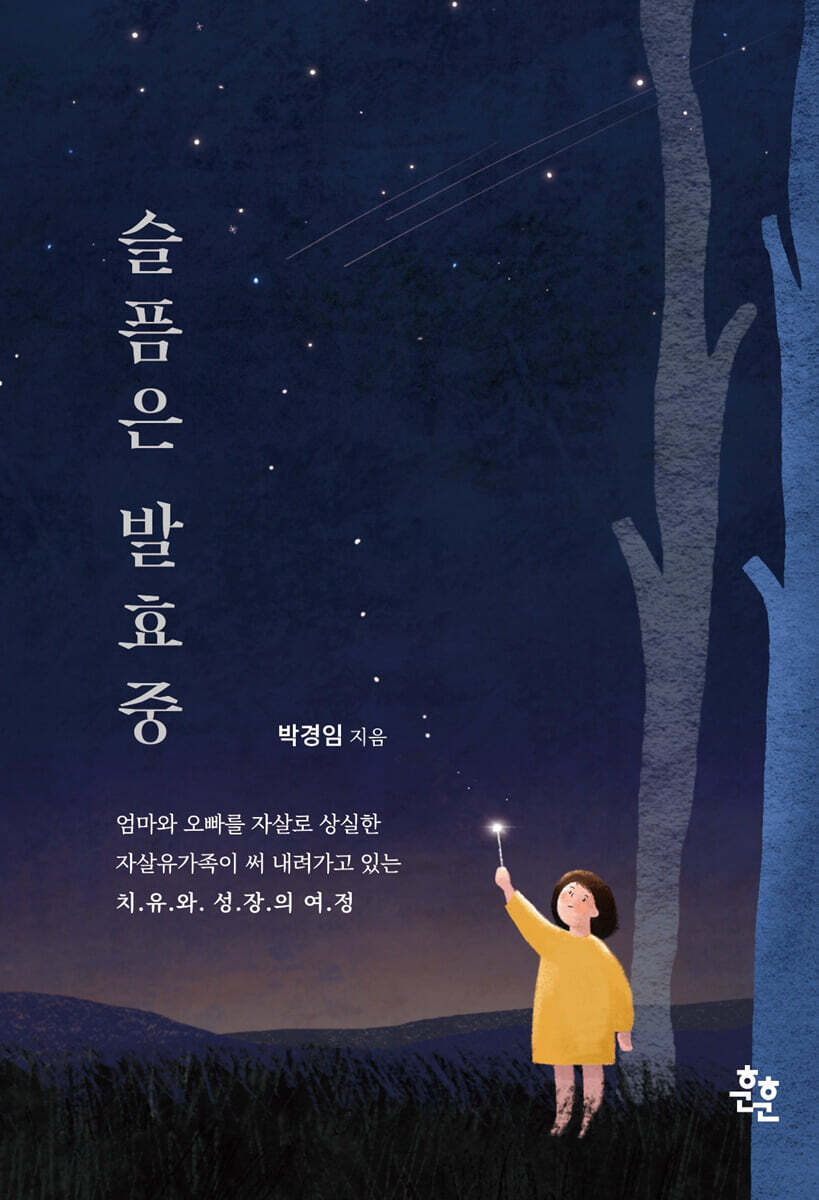 |
Description
Book Introduction
Lost my mother and older brother to suicide
The suicide victim's bereaved family is writing
A Deep Journey of Healing and Growth
“Sorrow is Fermenting” is like a textbook for the bereaved families of suicide victims.
He expressed the emotions he had accumulated over the years with delicate expressions, and compiled them into a book that spanned 40 years.
I hope that by reading this book, other bereaved families can shorten the time of their pain from 40 years to 10 years, or even just 1 year.
And if you are thinking about suicide, I hope you will stop thinking about it after considering the pain your remaining family is going through.
And above all, I hope that everyone will read this book, get rid of the prejudice against bereaved families, and talk about “let’s all live together.” - Seong-don Cho, Director of Life Hope Christian Suicide Prevention Center / Professor at the Graduate School of Practical Theology
"Sorrow is Fermenting" is a journey of healing and growth written by a survivor of suicide who lost her mother to suicide when she was five years old, and then had to send her older brother off to suicide over a decade later.
Since 2003 (excluding 2016 and 2017), South Korea has maintained the dubious distinction of being the country with the highest suicide rate among OECD countries.
When we imagine South Korea decades ago, when awareness of suicide was still not fully developed, it is difficult to even imagine the pain author Park Kyung-im must have endured as a bereaved family member of a suicide victim.
By entering into this intense and vivid scene that seems so difficult to reach, the author brings those times out to the readers.
The suicide victim's bereaved family is writing
A Deep Journey of Healing and Growth
“Sorrow is Fermenting” is like a textbook for the bereaved families of suicide victims.
He expressed the emotions he had accumulated over the years with delicate expressions, and compiled them into a book that spanned 40 years.
I hope that by reading this book, other bereaved families can shorten the time of their pain from 40 years to 10 years, or even just 1 year.
And if you are thinking about suicide, I hope you will stop thinking about it after considering the pain your remaining family is going through.
And above all, I hope that everyone will read this book, get rid of the prejudice against bereaved families, and talk about “let’s all live together.” - Seong-don Cho, Director of Life Hope Christian Suicide Prevention Center / Professor at the Graduate School of Practical Theology
"Sorrow is Fermenting" is a journey of healing and growth written by a survivor of suicide who lost her mother to suicide when she was five years old, and then had to send her older brother off to suicide over a decade later.
Since 2003 (excluding 2016 and 2017), South Korea has maintained the dubious distinction of being the country with the highest suicide rate among OECD countries.
When we imagine South Korea decades ago, when awareness of suicide was still not fully developed, it is difficult to even imagine the pain author Park Kyung-im must have endured as a bereaved family member of a suicide victim.
By entering into this intense and vivid scene that seems so difficult to reach, the author brings those times out to the readers.
- You can preview some of the book's contents.
Preview
index
Recommendation
prolog
First Story: Even sadness has its own unique expression.
The longing that remains in me
Secret friend
Words that break me down. Words. Words. Words
Goblin Grandpa
Grief is fermenting
A gift from my brother
forgive me
Suicide survivors meet with their loved ones (1)
Second story, going through the tunnel of sorrow
Teacher in my heart
The clothes that don't suit me the most, wedding
Such a good love
You can be a child in front of me
I'm glad I have a sister
Shame vs. Pain
Living as a suicide survivor
Suicide survivors meet with their loved ones (2)
The Third Story: The Journey of Sorrow Continues
Father's well-being
A letter from a forty-eight-year-old daughter to her mother
Just embrace their sorrow
Alien-like new mother
A psychotherapist who listens with one ear
Embrace with warm hospitality
visitor
Umma! You are my home
Here's how to help the families of suicide victims.
Epilogue
Special Contribution: To the Bereaved Families Who Have Lost a Beloved Family Member to Suicide (Director Sim So-young, Save You Counseling and Welfare Research Institute)
Suicide Survivors' Rights Charter
Where to Get Help for Suicide Survivors
prolog
First Story: Even sadness has its own unique expression.
The longing that remains in me
Secret friend
Words that break me down. Words. Words. Words
Goblin Grandpa
Grief is fermenting
A gift from my brother
forgive me
Suicide survivors meet with their loved ones (1)
Second story, going through the tunnel of sorrow
Teacher in my heart
The clothes that don't suit me the most, wedding
Such a good love
You can be a child in front of me
I'm glad I have a sister
Shame vs. Pain
Living as a suicide survivor
Suicide survivors meet with their loved ones (2)
The Third Story: The Journey of Sorrow Continues
Father's well-being
A letter from a forty-eight-year-old daughter to her mother
Just embrace their sorrow
Alien-like new mother
A psychotherapist who listens with one ear
Embrace with warm hospitality
visitor
Umma! You are my home
Here's how to help the families of suicide victims.
Epilogue
Special Contribution: To the Bereaved Families Who Have Lost a Beloved Family Member to Suicide (Director Sim So-young, Save You Counseling and Welfare Research Institute)
Suicide Survivors' Rights Charter
Where to Get Help for Suicide Survivors
Into the book
#1
Just like that, one day, my mother disappeared without a trace.
I thought that if I waited for my mom, she would come back.
I thought that when morning came, I would hear my mother's voice again, shaking me awake from my late sleep.
But Mom never came back again, never again.
Accepting my mother's absence felt like losing my whole world.
I was so angry that my mother disappeared and left me alone.
I hated my mother for betraying my love and leaving me.
I couldn't understand why on earth he had abandoned me.
It felt like the roots of my life that had supported me had been completely uprooted.
On days when my anxiety about not being able to do anything without my mom snowballed, I wet my pants.
Even if I burst into tears, there was no one left to tolerate my tantrums.
As I lived my daily life without my mother, some days her face became clearer, and other days it gradually faded away.
Now I don't remember my mother's face, voice, or smell.
There were no traces or belongings left to remember my mother.
All that's left for me is 'longing,' only longing.
If I had left behind even one photo of my mother back then, would the days filled with longing have been a little less?
My mother's death changed the course of my life into a rough sea.
--- p.34
#2
“What sin have I committed?
“Is it my fault that I have a family member who committed suicide?”
It was cruel that the world stabbed a child who had lost his mother with a sharp condemnation of death rather than offering warm words of comfort.
Could I have said that if I had weighed the weight of grief the one left behind must bear? For me, who finds it difficult to survive a single day without my mother, people, with their own words, etched scarlet letters into my heart.
Even to hide my shame, I didn't want to tell anyone that my mother had committed suicide.
Because I was afraid of people's prejudice and criticism towards the bereaved families of suicide victims.
Shame seemed to flow through my cells and blood vessels like a part of my body.
How could I be the only one who has been subjected to verbal abuse, denigration, and stigmatization simply for being a bereaved family member of a suicide victim? Broadly speaking, it's estimated that 10% of South Korea's population is a bereaved family member of a suicide victim.
In the “Suicide Survivors’ Rights Charter” published by the Citizens’ Coalition for Respect for Life, it is written, “I have the right to maintain my own independent personality and not be judged by my death by suicide.”
Words, words, words… words that push people who are going through the pain of loss into a deeper swamp.
I wish there were more people who offered warm words of sympathy and comfort to those who lost a family member to suicide, rather than adding to their pain by saying, “The deceased has gone to hell.”
The 'right not to be judged',
Doesn't that include the 'duty not to judge'?
--- p.45
#3
It's been 23 years since my brother left.
Even though time has passed, I am not completely free from the pain of loss.
Who doesn't feel pain when they experience letting someone go?
We all experience loss in different ways, but no one is immune.
I lived my life patting myself on the back, telling myself that I didn't have to struggle to escape from sadness.
I just hoped I could learn to embrace my sadness and live with it.
Even on days when sadness came, he welcomed me instead of pushing me away.
My grief over losing my mother and brother to suicide is still ongoing.
Fermentation is a microbial process that has beneficial effects on humans, so it is distinct from decay, which is a similar process.
Just as lactic acid ferments through lack of oxygen, the sadness that cannot be easily shared with anyone and cannot be comforted socially is fermenting into beneficial enzymes.
Like kimchi or soybean paste, which develops a deeper flavor over time,
My sorrow has matured deeply
If I can reach someone who needs comfort,
I am grateful enough for that.
--- p.59
#4
“It’s not your fault that my brother left.”
When he told me what he had never been able to say before, an uncontrollable storm raged.
He cried out loud, saying, “It’s not your fault, it’s not your fault.”
Finally, the dark clouds of guilt began to clear and the sunlight of ‘self-forgiveness’ began to shine.
The person who blamed me the most for living under the weight of a sorrow that was so terrifyingly cruel was myself.
In the end, it was 'me' who could free me from the heavy guilt that was binding me.
My life, which I lived by whipping myself with blame, became even more painful.
When he started to hug me like that, I remembered the last conversation I had with my brother.
“Kyung-im! I want you to be happy.” Living with guilt, I had completely forgotten the warmth my brother had given me.
What I needed most was forgiveness for myself.
In this way, self-forgiveness freed me from the heavy burden of guilt.
Only after I made peace with myself was I able to let go.
He hugged me and told me that everyone has flaws and can fail, and that it was okay.
I stopped pushing myself and started looking at my pain with a warm heart.
He embraced my life, which had been filled with sadness, depression, and anxiety.
“It’s okay to be sad and depressed.
He started to comfort me, saying, “It’s okay to be anxious.”
He embraced me, not the sparkling me, but the shaky and anxious me, and accepted me as I am, even though I am not okay.
As I began to accept myself for who I am, I was able to become a little more forgiving towards myself.
--- p.76
#5
After my mother passed away, I hugged the small, fragile child with all my might as I recalled my childhood, when I thought I would see her again if I waited.
Only then did I understand my mother's feelings.
My mother didn't abandon me, she just wanted to end my suffering.
Standing alone on the edge of life's precipice, which seemed like the edge of a cliff, I felt the pain of my mother who had left me alone, and I held my child in my arms and cried endlessly.
It was the moment when the misunderstanding about my mother that had not been resolved turned into understanding.
I whispered softly to myself, rubbing my cheek against the child's tear-stained cheek, promising to give the child the motherly love I longed to receive.
“Hey, thank you so much for coming to me like a gift.
When you face a difficult moment in life, look back.
Mom will be standing there.
Don't forget.
“That your mother is always behind you.”
From then on, I wanted to be a strong mother who could support my child.
But the child learned too early how fragile I was.
Instead, he wiped away my tears and understood my heart more deeply than anyone else.
Raising a child allowed me to experience the grace of healing the wounds I had from growing up without a mother.
Should I say that I didn't raise the child, but rather the child raised me?
My child, who had been studying in Korea as a college student, came to visit me for a short time after two and a half years.
Just looking at my son eating a home-cooked meal after a long time makes me happy.
Could there be another love as good as this?
--- p.107
#6
Through the professor's words, "If you resemble your mother, your mother must have been a truly beautiful person," I was able to free myself from the fear of dying like my mother.
I was finally able to miss my mother to my heart's content.
The magic language the professor gave me reminded me of how beautiful my mother was.
How much better would it have been if I had been able to open up about the pain in my life a little earlier? Perhaps then, I might have spent less time alone suffering.
Perhaps what I needed during those times when I lived alone, cowering in a society that forced me to be ashamed, was the courage to speak out.
I hope that social perceptions of suicide survivors will change.
I long for the slogan, “Losing a family member to suicide is not a shame, but a pain that requires shared weeping,” to be universally understood.
I hope that the bereaved families of suicide victims, who live in isolation and loneliness, driven by shame, can come out into the world.
A world where people like me can cry freely and find comfort in our losses.
I dream of such a world.
If a family that has lost a loved one has to suffer from self-reproach rather than mourning and remembering, how painful that life must be.
Loss itself is an unbearable pain, so how much deeper must the grief be when even the right to mourn is taken away?
We must no longer deprive people of their right to mourn,
That right must be returned.
--- p.128
#7
The sad reality of bereaved families of suicide victims, who have lost their loved ones but are unable to find comfort, are driven into deeper pain by social stigma and negative prejudice, and are still prevalent.
This social phenomenon not only increases the level of depression in bereaved families of suicide victims, but also acts as a risk factor that increases the likelihood of suicide compared to the general population.
According to related data, suicide survivors are 18 times more likely to develop depression and are twice as likely to commit suicide compared to the general population.
After losing my brother, I realized how important it is to raise awareness and provide care for the families of suicide victims.
Supporting and caring for survivors of suicide directly leads to suicide prevention because suicide survivors are classified as a high-risk group for suicide.
Suicide survivors, who receive condemnation and criticism instead of comfort from themselves, their families, and society, are living in a blind spot of comfort.
I hope that society will become one where more people can empathize with the pain of suicide survivors who live with isolation and loneliness and cry with them so that they can come out into the world.
Not a gaze of stigma and condemnation
With a heart of ‘hospitality’
Warmly embracing the lives of suicide survivors,
I'm talking about those kinds of people.
--- p.136
#8
I lived my life ignoring the unbearable sorrow of my father, who had to bury even his only son in his heart.
Even though it's been over 40 years since Mom passed away, my father still gets sick every year in the fourth lunar month.
Self-reproach for not being able to prevent the suicide of a family member, and regret for not being able to do better for them…
A father who endured and lived his life, bearing the blame of the world and his children, with his wife and son buried in his heart.
When I realized how much he felt, I felt ashamed of myself for thinking of him as an “incompetent father who did nothing for me.”
Just by enduring the harsh weight of life and living, isn't it enough for my father to have done his part?
My father is now well over eighty years old.
It seems that the older you get, the more you miss your children.
Sometimes when I call, I say, “Thank you for calling.
“Have you eaten? Does anything hurt?” he asks.
The greetings I longed to hear so much as a child, even though I'm almost fifty years old, my eyes still turn red when I hear them from my father.
I lean against my father's love and whisper.
“Father, do not abandon us,
Endure that harsh life
Thank you so much for keeping me alive.
“You have worked very hard to survive.”
--- p.155
#9
After my mother left, people would criticize her and say things I couldn't bring myself to say in front of her, like "what a bitch."
For those who only remember the last image of their mother, the life of a mother is devalued.
I was so caught up in the condemnation of that world that I couldn't even bring myself to say 'mother'.
On my child's birthday, I broke a 43-year silence.
“Mom! I miss you.
“My dear mother.”
The moment I said it out loud, the sadness that had been dormant like a volcano burst out and I cried out loud.
I've lived a very shaky life up until now.
After sending my mother and older brother away first, I lived pretending to be strong to hide the anxiety in my heart.
I wonder if I, a fragile and tearful person, have been living for too long wearing the mask of a strong warrior.
Now I want to take off my mask and live as myself.
Let go of the stiffness in your body and let it sway like a flexible reed.
With the mask off, I feel freer than before.
My mother must have wanted me to live freely more than anyone else.
After my mother left, I had no future in sight.
But now I've become a pretty decent adult, something I never imagined I would become when I was young.
You'd be surprised to see me now that I'm a middle-aged woman.
Was it because anxiety shone through that I was able to grow up like this?
Or is it because of the mystery of pain that is so sadly beautiful?
How wonderful it would be if my mother could see me living today. I wrote this long letter because I wanted to tell her I love her and how much I miss her.
i love you,
mom!
--- p.162
#10
Through my journey of healing, I was able to learn how to ‘cry with others’ rather than ‘cry alone.’
I gained the mental space and strength to distance myself from my wounds and pain, and I was able to look at my life from a new perspective.
Looking back, I realize that the countless losses I experienced as a psychotherapist were gifts to those suffering from pain and trauma.
I am grateful for the abundant darkness that has become the fertilizer of my life.
As someone who has gone through times of darkness and loss, I was able to understand the grief of my clients more deeply.
I was able to help clients stay in their grief and look at themselves fully, helping them feel and talk about their feelings honestly.
I could be a counselor who would accompany them in accepting the loss and sorrow of that life.
The time I spent with them was a time of comfort for me and a time of healing my wounds.
The journey of loss is not over.
There are days when I still find myself in a maze of sadness and burst into tears, and there are days when I burst into laughter with happy laughter.
I believe that the losses etched into our lives are not things we can overcome or forget.
It is natural to grieve and mourn loss.
Because as time passes, the pain of loss only fades, it doesn't disappear.
Every time a sad feeling comes over me
It is a matter of willingly embracing sadness.
Maybe this is what I'm supposed to do for the rest of my life.
--- p.183
#11
Perhaps the reason people want to hide the loss of their family to suicide and their mental illness is because of the fear of shame and stigma.
Some of the villagers of Shamolog actually threw stones at her.
How cruel are the hateful looks directed at her, calling her a “crazy bitch,” without any empathy for the pain she experienced as a migrant worker living abroad?
After I lost my mother when I was young, my best friend from the neighborhood stopped playing with me, so I asked him why.
“My mom told me not to play with you.
“Good luck will come to you.”
When I most desperately needed comfort, I was left speechless for a moment after hearing my friend's violent words.
As long as we hear statements like, “People commit suicide because they are mentally weak,” and “People with mental illness are possessed by demons,” the reality that people suffering from mental illness are forced to hide their pain and feel ashamed of it will continue to persist.
The villagers who saw her being welcomed into the church despite her suffering from social stigma, discrimination, and hatred no longer threw stones at her.
Hugging Rita was also like 'embracing the time I lived without being able to express my pain even in church.'
This is a mystery.
Pain and suffering are connected
The mystery of miracles, where healing takes place.
Just like that, one day, my mother disappeared without a trace.
I thought that if I waited for my mom, she would come back.
I thought that when morning came, I would hear my mother's voice again, shaking me awake from my late sleep.
But Mom never came back again, never again.
Accepting my mother's absence felt like losing my whole world.
I was so angry that my mother disappeared and left me alone.
I hated my mother for betraying my love and leaving me.
I couldn't understand why on earth he had abandoned me.
It felt like the roots of my life that had supported me had been completely uprooted.
On days when my anxiety about not being able to do anything without my mom snowballed, I wet my pants.
Even if I burst into tears, there was no one left to tolerate my tantrums.
As I lived my daily life without my mother, some days her face became clearer, and other days it gradually faded away.
Now I don't remember my mother's face, voice, or smell.
There were no traces or belongings left to remember my mother.
All that's left for me is 'longing,' only longing.
If I had left behind even one photo of my mother back then, would the days filled with longing have been a little less?
My mother's death changed the course of my life into a rough sea.
--- p.34
#2
“What sin have I committed?
“Is it my fault that I have a family member who committed suicide?”
It was cruel that the world stabbed a child who had lost his mother with a sharp condemnation of death rather than offering warm words of comfort.
Could I have said that if I had weighed the weight of grief the one left behind must bear? For me, who finds it difficult to survive a single day without my mother, people, with their own words, etched scarlet letters into my heart.
Even to hide my shame, I didn't want to tell anyone that my mother had committed suicide.
Because I was afraid of people's prejudice and criticism towards the bereaved families of suicide victims.
Shame seemed to flow through my cells and blood vessels like a part of my body.
How could I be the only one who has been subjected to verbal abuse, denigration, and stigmatization simply for being a bereaved family member of a suicide victim? Broadly speaking, it's estimated that 10% of South Korea's population is a bereaved family member of a suicide victim.
In the “Suicide Survivors’ Rights Charter” published by the Citizens’ Coalition for Respect for Life, it is written, “I have the right to maintain my own independent personality and not be judged by my death by suicide.”
Words, words, words… words that push people who are going through the pain of loss into a deeper swamp.
I wish there were more people who offered warm words of sympathy and comfort to those who lost a family member to suicide, rather than adding to their pain by saying, “The deceased has gone to hell.”
The 'right not to be judged',
Doesn't that include the 'duty not to judge'?
--- p.45
#3
It's been 23 years since my brother left.
Even though time has passed, I am not completely free from the pain of loss.
Who doesn't feel pain when they experience letting someone go?
We all experience loss in different ways, but no one is immune.
I lived my life patting myself on the back, telling myself that I didn't have to struggle to escape from sadness.
I just hoped I could learn to embrace my sadness and live with it.
Even on days when sadness came, he welcomed me instead of pushing me away.
My grief over losing my mother and brother to suicide is still ongoing.
Fermentation is a microbial process that has beneficial effects on humans, so it is distinct from decay, which is a similar process.
Just as lactic acid ferments through lack of oxygen, the sadness that cannot be easily shared with anyone and cannot be comforted socially is fermenting into beneficial enzymes.
Like kimchi or soybean paste, which develops a deeper flavor over time,
My sorrow has matured deeply
If I can reach someone who needs comfort,
I am grateful enough for that.
--- p.59
#4
“It’s not your fault that my brother left.”
When he told me what he had never been able to say before, an uncontrollable storm raged.
He cried out loud, saying, “It’s not your fault, it’s not your fault.”
Finally, the dark clouds of guilt began to clear and the sunlight of ‘self-forgiveness’ began to shine.
The person who blamed me the most for living under the weight of a sorrow that was so terrifyingly cruel was myself.
In the end, it was 'me' who could free me from the heavy guilt that was binding me.
My life, which I lived by whipping myself with blame, became even more painful.
When he started to hug me like that, I remembered the last conversation I had with my brother.
“Kyung-im! I want you to be happy.” Living with guilt, I had completely forgotten the warmth my brother had given me.
What I needed most was forgiveness for myself.
In this way, self-forgiveness freed me from the heavy burden of guilt.
Only after I made peace with myself was I able to let go.
He hugged me and told me that everyone has flaws and can fail, and that it was okay.
I stopped pushing myself and started looking at my pain with a warm heart.
He embraced my life, which had been filled with sadness, depression, and anxiety.
“It’s okay to be sad and depressed.
He started to comfort me, saying, “It’s okay to be anxious.”
He embraced me, not the sparkling me, but the shaky and anxious me, and accepted me as I am, even though I am not okay.
As I began to accept myself for who I am, I was able to become a little more forgiving towards myself.
--- p.76
#5
After my mother passed away, I hugged the small, fragile child with all my might as I recalled my childhood, when I thought I would see her again if I waited.
Only then did I understand my mother's feelings.
My mother didn't abandon me, she just wanted to end my suffering.
Standing alone on the edge of life's precipice, which seemed like the edge of a cliff, I felt the pain of my mother who had left me alone, and I held my child in my arms and cried endlessly.
It was the moment when the misunderstanding about my mother that had not been resolved turned into understanding.
I whispered softly to myself, rubbing my cheek against the child's tear-stained cheek, promising to give the child the motherly love I longed to receive.
“Hey, thank you so much for coming to me like a gift.
When you face a difficult moment in life, look back.
Mom will be standing there.
Don't forget.
“That your mother is always behind you.”
From then on, I wanted to be a strong mother who could support my child.
But the child learned too early how fragile I was.
Instead, he wiped away my tears and understood my heart more deeply than anyone else.
Raising a child allowed me to experience the grace of healing the wounds I had from growing up without a mother.
Should I say that I didn't raise the child, but rather the child raised me?
My child, who had been studying in Korea as a college student, came to visit me for a short time after two and a half years.
Just looking at my son eating a home-cooked meal after a long time makes me happy.
Could there be another love as good as this?
--- p.107
#6
Through the professor's words, "If you resemble your mother, your mother must have been a truly beautiful person," I was able to free myself from the fear of dying like my mother.
I was finally able to miss my mother to my heart's content.
The magic language the professor gave me reminded me of how beautiful my mother was.
How much better would it have been if I had been able to open up about the pain in my life a little earlier? Perhaps then, I might have spent less time alone suffering.
Perhaps what I needed during those times when I lived alone, cowering in a society that forced me to be ashamed, was the courage to speak out.
I hope that social perceptions of suicide survivors will change.
I long for the slogan, “Losing a family member to suicide is not a shame, but a pain that requires shared weeping,” to be universally understood.
I hope that the bereaved families of suicide victims, who live in isolation and loneliness, driven by shame, can come out into the world.
A world where people like me can cry freely and find comfort in our losses.
I dream of such a world.
If a family that has lost a loved one has to suffer from self-reproach rather than mourning and remembering, how painful that life must be.
Loss itself is an unbearable pain, so how much deeper must the grief be when even the right to mourn is taken away?
We must no longer deprive people of their right to mourn,
That right must be returned.
--- p.128
#7
The sad reality of bereaved families of suicide victims, who have lost their loved ones but are unable to find comfort, are driven into deeper pain by social stigma and negative prejudice, and are still prevalent.
This social phenomenon not only increases the level of depression in bereaved families of suicide victims, but also acts as a risk factor that increases the likelihood of suicide compared to the general population.
According to related data, suicide survivors are 18 times more likely to develop depression and are twice as likely to commit suicide compared to the general population.
After losing my brother, I realized how important it is to raise awareness and provide care for the families of suicide victims.
Supporting and caring for survivors of suicide directly leads to suicide prevention because suicide survivors are classified as a high-risk group for suicide.
Suicide survivors, who receive condemnation and criticism instead of comfort from themselves, their families, and society, are living in a blind spot of comfort.
I hope that society will become one where more people can empathize with the pain of suicide survivors who live with isolation and loneliness and cry with them so that they can come out into the world.
Not a gaze of stigma and condemnation
With a heart of ‘hospitality’
Warmly embracing the lives of suicide survivors,
I'm talking about those kinds of people.
--- p.136
#8
I lived my life ignoring the unbearable sorrow of my father, who had to bury even his only son in his heart.
Even though it's been over 40 years since Mom passed away, my father still gets sick every year in the fourth lunar month.
Self-reproach for not being able to prevent the suicide of a family member, and regret for not being able to do better for them…
A father who endured and lived his life, bearing the blame of the world and his children, with his wife and son buried in his heart.
When I realized how much he felt, I felt ashamed of myself for thinking of him as an “incompetent father who did nothing for me.”
Just by enduring the harsh weight of life and living, isn't it enough for my father to have done his part?
My father is now well over eighty years old.
It seems that the older you get, the more you miss your children.
Sometimes when I call, I say, “Thank you for calling.
“Have you eaten? Does anything hurt?” he asks.
The greetings I longed to hear so much as a child, even though I'm almost fifty years old, my eyes still turn red when I hear them from my father.
I lean against my father's love and whisper.
“Father, do not abandon us,
Endure that harsh life
Thank you so much for keeping me alive.
“You have worked very hard to survive.”
--- p.155
#9
After my mother left, people would criticize her and say things I couldn't bring myself to say in front of her, like "what a bitch."
For those who only remember the last image of their mother, the life of a mother is devalued.
I was so caught up in the condemnation of that world that I couldn't even bring myself to say 'mother'.
On my child's birthday, I broke a 43-year silence.
“Mom! I miss you.
“My dear mother.”
The moment I said it out loud, the sadness that had been dormant like a volcano burst out and I cried out loud.
I've lived a very shaky life up until now.
After sending my mother and older brother away first, I lived pretending to be strong to hide the anxiety in my heart.
I wonder if I, a fragile and tearful person, have been living for too long wearing the mask of a strong warrior.
Now I want to take off my mask and live as myself.
Let go of the stiffness in your body and let it sway like a flexible reed.
With the mask off, I feel freer than before.
My mother must have wanted me to live freely more than anyone else.
After my mother left, I had no future in sight.
But now I've become a pretty decent adult, something I never imagined I would become when I was young.
You'd be surprised to see me now that I'm a middle-aged woman.
Was it because anxiety shone through that I was able to grow up like this?
Or is it because of the mystery of pain that is so sadly beautiful?
How wonderful it would be if my mother could see me living today. I wrote this long letter because I wanted to tell her I love her and how much I miss her.
i love you,
mom!
--- p.162
#10
Through my journey of healing, I was able to learn how to ‘cry with others’ rather than ‘cry alone.’
I gained the mental space and strength to distance myself from my wounds and pain, and I was able to look at my life from a new perspective.
Looking back, I realize that the countless losses I experienced as a psychotherapist were gifts to those suffering from pain and trauma.
I am grateful for the abundant darkness that has become the fertilizer of my life.
As someone who has gone through times of darkness and loss, I was able to understand the grief of my clients more deeply.
I was able to help clients stay in their grief and look at themselves fully, helping them feel and talk about their feelings honestly.
I could be a counselor who would accompany them in accepting the loss and sorrow of that life.
The time I spent with them was a time of comfort for me and a time of healing my wounds.
The journey of loss is not over.
There are days when I still find myself in a maze of sadness and burst into tears, and there are days when I burst into laughter with happy laughter.
I believe that the losses etched into our lives are not things we can overcome or forget.
It is natural to grieve and mourn loss.
Because as time passes, the pain of loss only fades, it doesn't disappear.
Every time a sad feeling comes over me
It is a matter of willingly embracing sadness.
Maybe this is what I'm supposed to do for the rest of my life.
--- p.183
#11
Perhaps the reason people want to hide the loss of their family to suicide and their mental illness is because of the fear of shame and stigma.
Some of the villagers of Shamolog actually threw stones at her.
How cruel are the hateful looks directed at her, calling her a “crazy bitch,” without any empathy for the pain she experienced as a migrant worker living abroad?
After I lost my mother when I was young, my best friend from the neighborhood stopped playing with me, so I asked him why.
“My mom told me not to play with you.
“Good luck will come to you.”
When I most desperately needed comfort, I was left speechless for a moment after hearing my friend's violent words.
As long as we hear statements like, “People commit suicide because they are mentally weak,” and “People with mental illness are possessed by demons,” the reality that people suffering from mental illness are forced to hide their pain and feel ashamed of it will continue to persist.
The villagers who saw her being welcomed into the church despite her suffering from social stigma, discrimination, and hatred no longer threw stones at her.
Hugging Rita was also like 'embracing the time I lived without being able to express my pain even in church.'
This is a mystery.
Pain and suffering are connected
The mystery of miracles, where healing takes place.
--- p.190
Publisher's Review
Author Park Kyung-im speaks to readers.
“There are so many bereaved families in pain.
Only a small number of suicide victims' families tell their stories.
So, I want to help the families of suicide victims grieve through my story, which spans a long period of time, from when I was 5 to when I was 48.
Rather than just staying in the sadness, I want to go back into that painful place and go through it together.
That's why there is a present and a future.
“That fierce desperation drove me to write.”
Author Park Kyung-im does not say that she has “already overcome” the pain that has come upon her.
It doesn't even say, "You have to overcome it too."
He says he still feels the sadness from the loss and he doesn't try to suppress it.
However, she says her “sadness is fermenting.”
“My grief over the loss of my mother and brother is still ongoing.
Just as lactic acid is fermented through lack of oxygen, the sadness that cannot be easily shared with anyone and cannot be comforted socially is fermenting into beneficial enzymes.
Just as kimchi or soybean paste develop a deeper flavor over time, if my sorrow could mature fragrantly and reach someone in need of comfort, wouldn't even my pain become painfully beautiful?
I hope that my book, "Sorrow is Fermenting," can play a role in improving social awareness of suicide survivors and helping them, who have been living in hiding, to come out into the world.
So, I hope that more suicide survivors will be reconnected with their families and reconnected with their communities.
And if there are any bereaved families of suicide victims who felt so desperately alone, I hope that through “Sorrow is Fermenting,” they will be able to wear the clothes of love again.
The reason I wrote about my life is not to 'exhibit tragedy'.
“I pressed hard on the pencil as I wrote, hoping that the mystery of pain and suffering, connected by the ability to live again, would be conveyed throughout this book.”
As author Park Kyung-im says, “Sadness is Fermenting” is not a book that simply shows the pain the author has experienced.
The purpose is to improve awareness of the families of suicide victims by expressing the joys and sorrows he encountered while going through a painful journey in universal language, and to convey the language of hope that says, “Now, let’s live again in the place that has been given to me.”
After becoming a bereaved family member of a suicide victim, author Park Kyung-im has grown into a middle-aged healer who comforts the hearts of others over the past 40 years.
“Losing a family member to suicide is not a shame, but a pain that we must cry together with,” he said, and his deep and warm message of becoming a “witness of hope” who gives hope to other suicide victims’ families is contained in “Sorrow is Fermenting.”
“There are so many bereaved families in pain.
Only a small number of suicide victims' families tell their stories.
So, I want to help the families of suicide victims grieve through my story, which spans a long period of time, from when I was 5 to when I was 48.
Rather than just staying in the sadness, I want to go back into that painful place and go through it together.
That's why there is a present and a future.
“That fierce desperation drove me to write.”
Author Park Kyung-im does not say that she has “already overcome” the pain that has come upon her.
It doesn't even say, "You have to overcome it too."
He says he still feels the sadness from the loss and he doesn't try to suppress it.
However, she says her “sadness is fermenting.”
“My grief over the loss of my mother and brother is still ongoing.
Just as lactic acid is fermented through lack of oxygen, the sadness that cannot be easily shared with anyone and cannot be comforted socially is fermenting into beneficial enzymes.
Just as kimchi or soybean paste develop a deeper flavor over time, if my sorrow could mature fragrantly and reach someone in need of comfort, wouldn't even my pain become painfully beautiful?
I hope that my book, "Sorrow is Fermenting," can play a role in improving social awareness of suicide survivors and helping them, who have been living in hiding, to come out into the world.
So, I hope that more suicide survivors will be reconnected with their families and reconnected with their communities.
And if there are any bereaved families of suicide victims who felt so desperately alone, I hope that through “Sorrow is Fermenting,” they will be able to wear the clothes of love again.
The reason I wrote about my life is not to 'exhibit tragedy'.
“I pressed hard on the pencil as I wrote, hoping that the mystery of pain and suffering, connected by the ability to live again, would be conveyed throughout this book.”
As author Park Kyung-im says, “Sadness is Fermenting” is not a book that simply shows the pain the author has experienced.
The purpose is to improve awareness of the families of suicide victims by expressing the joys and sorrows he encountered while going through a painful journey in universal language, and to convey the language of hope that says, “Now, let’s live again in the place that has been given to me.”
After becoming a bereaved family member of a suicide victim, author Park Kyung-im has grown into a middle-aged healer who comforts the hearts of others over the past 40 years.
“Losing a family member to suicide is not a shame, but a pain that we must cry together with,” he said, and his deep and warm message of becoming a “witness of hope” who gives hope to other suicide victims’ families is contained in “Sorrow is Fermenting.”
GOODS SPECIFICS
- Date of issue: December 1, 2023
- Page count, weight, size: 224 pages | 140*205*20mm
- ISBN13: 9791198380432
- ISBN10: 1198380438
You may also like
카테고리
korean


korean

![GQ KOREA Mark (Monthly): December [2025]](http://librairie.coreenne.fr/cdn/shop/files/8ef265dbbfbf186523ed75ba7319009d.jpg?v=1765340328&width=3840)


