

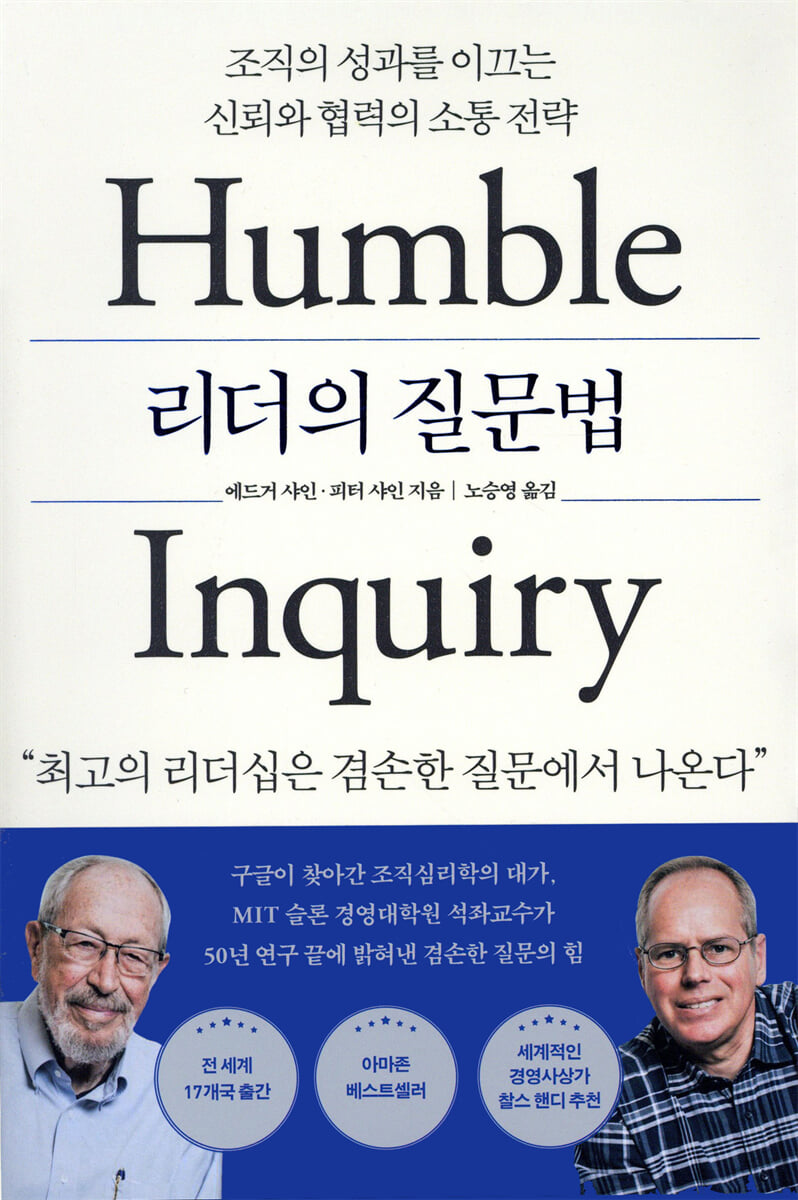
The Leader's Questioning Method
 |
Description
Book Introduction
“The best leadership comes from humble questioning, not directives.” A leading expert in organizational psychology and a distinguished professor at MIT's Sloan School of Management The key tools of successful leaders, discovered by Edgar Schein after 50 years of research. Edgar Schein, a leading expert in organizational psychology who has consulted for numerous companies including Google, Apple, Citibank, PG&E, Hewlett-Packard, and Shell, and a distinguished professor at MIT Sloan School of Management, has compiled effective communication strategies he has discovered after 50 years of research in his book, "Leadership: The Questions You Ask." It is a condensation of what he has learned and practiced throughout his life helping leaders succeed. In this book, he introduces the concept and specific implementation methods of "humble questioning," a communication strategy that leads organizational performance based on trust and cooperation. 'Humble questioning' is 'the art of drawing out the other person's words, asking about things you don't know the answer to, and building a relationship based on curiosity and interest in the other person.' Shine says that in times of uncertainty like today, the key qualities for leaders in organizations that are sensitive to change are to ask questions, listen to others, and understand what's going on, rather than directing and asserting. This book is a must-read not only for leaders who want to create a collaborative organizational culture, but also for anyone who wants to build productive and positive relationships, understand the realities of life, be more helpful to others, and ponder where to begin in this new era. |
- You can preview some of the book's contents.
Preview
index
Recommendation_To succeed in the relay race called management in the new world
Preface to the Revised Edition: The Best Leadership Comes from Humble Questioning, Not Directives
Preface: What is a Humble Question?
Chapter 1.
Should we assert arrogantly or ask humbly?
The Four Stages of Relationships│The Pitfalls of Assertion│Exercise Humility Here and Now│Conclusion
Chapter 2.
Humble questions are both an attitude and a conversational tactic.
Humble questioning as an attitude│The importance of purpose: Understand your own situation first│The attitude of humble questioning
The Impact on People│The Power of Humble Questions on Organizations│Should Humble Questions Be Sincere?│
conclusion
Chapter 3.
How are humble questions different from other questions?
Diagnostic, Direct, and Procedural Questions│Conclusion
Chapter 4.
From the old way to the new way
Relationships or Results? │The Temptation of Assertion │Why Open Communication and Trust Are Crucial in This Era │Conclusion
Chapter 5.
Should I pursue a relationship or keep my distance?
What determines attitudes based on status│We can choose the direction of relationships│High level
Building Trust│Conclusion
Chapter 6.
Building relationships through questioning and revealing
Jo Hae-ri Chang: The Four Parts of the Social Psychological Self│The Basis for Judging Authenticity and Truth│How Far Can You Reveal It?
Is it?│A conversation that promotes teamwork│Conclusion
Chapter 7.
What happens in our heads
Observation│Reaction│Judgment│Intervention│Conclusion
Chapter 8.
How to Cultivate a Humble Attitude to Question
Anxiety Factors We Need to Resolve│Seven Ideas for Forgetting and Relearning│Conclusion
Acknowledgements
Appendix 1 Discussion and Practice
Appendix 2: Twelve Case Studies of Humble Questions
Chapter 234
Preface to the Revised Edition: The Best Leadership Comes from Humble Questioning, Not Directives
Preface: What is a Humble Question?
Chapter 1.
Should we assert arrogantly or ask humbly?
The Four Stages of Relationships│The Pitfalls of Assertion│Exercise Humility Here and Now│Conclusion
Chapter 2.
Humble questions are both an attitude and a conversational tactic.
Humble questioning as an attitude│The importance of purpose: Understand your own situation first│The attitude of humble questioning
The Impact on People│The Power of Humble Questions on Organizations│Should Humble Questions Be Sincere?│
conclusion
Chapter 3.
How are humble questions different from other questions?
Diagnostic, Direct, and Procedural Questions│Conclusion
Chapter 4.
From the old way to the new way
Relationships or Results? │The Temptation of Assertion │Why Open Communication and Trust Are Crucial in This Era │Conclusion
Chapter 5.
Should I pursue a relationship or keep my distance?
What determines attitudes based on status│We can choose the direction of relationships│High level
Building Trust│Conclusion
Chapter 6.
Building relationships through questioning and revealing
Jo Hae-ri Chang: The Four Parts of the Social Psychological Self│The Basis for Judging Authenticity and Truth│How Far Can You Reveal It?
Is it?│A conversation that promotes teamwork│Conclusion
Chapter 7.
What happens in our heads
Observation│Reaction│Judgment│Intervention│Conclusion
Chapter 8.
How to Cultivate a Humble Attitude to Question
Anxiety Factors We Need to Resolve│Seven Ideas for Forgetting and Relearning│Conclusion
Acknowledgements
Appendix 1 Discussion and Practice
Appendix 2: Twelve Case Studies of Humble Questions
Chapter 234
Detailed image
.jpg)
Into the book
As the world becomes more connected and cultures become more intertwined, it's becoming increasingly difficult to know what's actually happening or why it's happening now.
But if you expand the humble questioning approach described in this book even deeper and broader, you'll be able to hone your skills to see through the other person's rude assertions and learn what really matters.
--- p.18
Similar problems can be seen in operating rooms, hospitals, and throughout the health care system.
If nurses and medical technicians feel uncomfortable challenging doctors—whether to offer alternatives or to stop doctors from making mistakes—it's clear that patients will suffer.
Doctors may claim they ask genuine questions and are open and honest about the information they receive, but if nurses and medical technicians feel uneasy about providing adequate context, patients are at greater risk.
--- p.37
Unfortunately, leaders often fail to recognize that if they aren't genuinely curious about the situation or if they fail to convince employees that their questions are honest and credible, they'll only get predictable answers.
If humility is not present in the question being asked, the employee is more likely to remain silent, distort, or report falsely, which could only make matters worse.
--- p.37
Humble questions are an investment because they force you to pay attention, acknowledge your own ignorance, and empower the other person.
The question conveys this intention to the other person.
"I'm ready to listen to you and humble myself." If this teaches you something you didn't know before, then your investment has paid off.
You can gain new information and develop positive relationships through follow-up questions and answers.
--- p.58
Humble questioning is a combination of acts of helping, connecting, and interpreting situations.
So, the most important skill for you as a learner is to understand the situation.
As situations change, the behaviors required or permitted will change, so the next important skill is to be nimble in deciding what, when, and how to ask, when to reveal yourself, and when to respond empathetically.
All of these elements come together to form what we consider a humble attitude of inquiry.
--- p.67~68
If I were to demonstrate humility here and now, this alone would arouse in you a very positive and genuine curiosity and interest.
You will feel accepted, and the reason you will feel psychologically safe is because of this temporary 'lowering of posture' on my part.
This will increase the likelihood that you will provide me with the information I need to complete my mission and that we will have a constructive relationship.
--- p.69
Basically, life is a series of situations that we either brought upon ourselves, walked into, or were dragged into by others.
Knowing when to focus to seize the opportunity for humble questioning is similar to understanding the situation.
--- p.70
Purpose determines attitude.
Knowing why you are having a conversation can help you clear your mind of distracting thoughts and inappropriate emotions.
A friend of mine, an actor, played the role of a butler who announces the arrival of guests, and he expressed his state of mind when he stood on stage with only one line of dialogue.
“You have to remember that the whole scene hinges on one line of dialogue from my character, explaining why I’m there.” This might sound like I’m reading too much into a single, minor line of dialogue from a minor scene.
But if you develop this behavioral muscle memory, you will be able to easily handle more important acting roles later.
--- p.71
Let's say you're a doctor and you think that your diagnosis and treatment will be more effective if you build closer relationships with your patients.
Even within the extremely limited timeframe of 10 to 15 minutes per patient, try to embrace the idea that you can connect with your patients—especially when time is at a premium.
For example, it is said like this.
“I’m sorry that the consultation time is tight, but let’s make the most of the time we have.
“Where are you uncomfortable?” It is also effective to tie the doctor and patient together.
Then you can accept the time constraints as a given and focus on the patient's problem.
--- p.74
Humble questions have the power to transcend hierarchies and geographical boundaries and bring humanity to relationships.
This is especially true when people reveal themselves and build rapport.
Of course, each person's experience is unique.
But all the stories we tell each other reveal how we perceive, feel, and act, and they provide clues to empathy.
The questioner can build rapport with the other person by drawing on similar examples from his or her own experience.
--- p.80~81
We often value individual competitiveness—whether it's beating an opponent in a debate, using a clever trick, or even selling a customer a "benefit" they don't need—over relationships and teamwork.
We do not question the belief that those who are fooled are fools.
The saying, "One new person is born every minute" is a witty remark that justifies competitiveness.
We value freedom, but we fail to recognize that this breeds not only competitiveness but also suspicion and distrust of one another.
--- p.116
As we move from the age of industrial machines, which was characterized by rapid growth, to a technologically complex, globally connected, and ever-changing era, culture is evolving.
We should have learned to deal with VUCA (Volatility, Uncertainty, Complexity, Ambiguity) through terrorist attacks, severe pandemics, and climate change.
As information technology proliferates, awareness of complex interdependence grows, and the individualistic and competitive tendencies within American culture become more pronounced, raising concerns about their potential (if not dangerous) dysfunction.
--- p.127
When we encounter a new situation, meet someone, start a conversation, or attend a meeting, we first unconsciously compare our own status with that of the other person.
Some might argue that, from a biological perspective, humans are innately inclined to rank things.
Humble questions can play a vital role in these situations.
This is because you can determine whether the person you are talking to is higher or lower in rank than you, and whether you should be polite or expect politeness from the other person.
For example, you could start a conversation with a broad question like this:
What do you do? What brings you here? Where did you work before coming to our company? --- p.139-140
What happens in your head determines the 'result' of a conversation.
You cannot adopt a humble attitude appropriate to the situation if you misread or misinterpret the situation, or if you do not know what is appropriate in the situation or ignore what you know.
We need to understand how our minds constantly create biases, perceptual distortions, and inappropriate impulses.
To effectively use humble questioning, we must understand the nature of these biases and distortions and learn to avoid them so they don't hinder us from building relationships, offering help, and finding meaning.
--- p.177
The biggest problem in a culture of assertion-after-the-fact is that we cannot know in which situations it is appropriate and proper to make or hear assertions without asking questions.
If you want to open the door to communication and build a relationship with someone, you need to keep your eyes wide open and avoid inaccurate or unsubstantiated information as much as possible.
Asking questions with curiosity and humility to verify facts is a key process for building relationships and making collective sense.
--- p.186
The times when humble questioning is most necessary are when we observe something and feel anger or anxiety.
It is at such times that we must calm our minds and ask ourselves and others, “What is happening?” to confirm the facts.
Then, ask yourself how valid your reaction is before making a decision and taking action.
--- p.187
The attitude of humble questioning essentially implies a willingness to be more mindful of the way we act and (where possible) to let go of ingrained, stereotypical behaviors.
Genetically determined temperament, learned personality, and, above all, socialization to behave appropriately for the situation—all of these factors come into play in every situation, getting us into trouble or preventing us from communicating honestly and fully.
The attitude of humble inquiry is ultimately a positive way to build better relationships and an analytical method to initiate a learning process toward this goal.
--- p.192
If you can't accurately assess the nature of your situation, the current state of your relationship, and most importantly, what's going on in your head and heart, it's difficult to determine when it's appropriate to ask questions or make assertions.
There's no harm in asking yourself these questions before taking action:
What do I think, feel, and desire? Furthermore, answering the following questions is paramount to achieving tasks effectively and reliably.
Who do I depend on? Who depends on me? To improve communication, with whom do I need to improve my relationships? --- p.204
It's always helpful to ask yourself these questions.
"Am I so sure of my answer that I don't need to adopt a humble attitude of inquiry?" If a leader or manager perceives the situation correctly, they can clearly see that they have the right answer and that it's okay to assert it.
Leaders and managers who use humble questions can gain a sharper perspective in situations where more information is needed.
The final hurdle is to remember not to succumb to the temptation to assert yourself in such moments.
Because now more than ever it's important to always ask questions and find the truth in context.
But if you expand the humble questioning approach described in this book even deeper and broader, you'll be able to hone your skills to see through the other person's rude assertions and learn what really matters.
--- p.18
Similar problems can be seen in operating rooms, hospitals, and throughout the health care system.
If nurses and medical technicians feel uncomfortable challenging doctors—whether to offer alternatives or to stop doctors from making mistakes—it's clear that patients will suffer.
Doctors may claim they ask genuine questions and are open and honest about the information they receive, but if nurses and medical technicians feel uneasy about providing adequate context, patients are at greater risk.
--- p.37
Unfortunately, leaders often fail to recognize that if they aren't genuinely curious about the situation or if they fail to convince employees that their questions are honest and credible, they'll only get predictable answers.
If humility is not present in the question being asked, the employee is more likely to remain silent, distort, or report falsely, which could only make matters worse.
--- p.37
Humble questions are an investment because they force you to pay attention, acknowledge your own ignorance, and empower the other person.
The question conveys this intention to the other person.
"I'm ready to listen to you and humble myself." If this teaches you something you didn't know before, then your investment has paid off.
You can gain new information and develop positive relationships through follow-up questions and answers.
--- p.58
Humble questioning is a combination of acts of helping, connecting, and interpreting situations.
So, the most important skill for you as a learner is to understand the situation.
As situations change, the behaviors required or permitted will change, so the next important skill is to be nimble in deciding what, when, and how to ask, when to reveal yourself, and when to respond empathetically.
All of these elements come together to form what we consider a humble attitude of inquiry.
--- p.67~68
If I were to demonstrate humility here and now, this alone would arouse in you a very positive and genuine curiosity and interest.
You will feel accepted, and the reason you will feel psychologically safe is because of this temporary 'lowering of posture' on my part.
This will increase the likelihood that you will provide me with the information I need to complete my mission and that we will have a constructive relationship.
--- p.69
Basically, life is a series of situations that we either brought upon ourselves, walked into, or were dragged into by others.
Knowing when to focus to seize the opportunity for humble questioning is similar to understanding the situation.
--- p.70
Purpose determines attitude.
Knowing why you are having a conversation can help you clear your mind of distracting thoughts and inappropriate emotions.
A friend of mine, an actor, played the role of a butler who announces the arrival of guests, and he expressed his state of mind when he stood on stage with only one line of dialogue.
“You have to remember that the whole scene hinges on one line of dialogue from my character, explaining why I’m there.” This might sound like I’m reading too much into a single, minor line of dialogue from a minor scene.
But if you develop this behavioral muscle memory, you will be able to easily handle more important acting roles later.
--- p.71
Let's say you're a doctor and you think that your diagnosis and treatment will be more effective if you build closer relationships with your patients.
Even within the extremely limited timeframe of 10 to 15 minutes per patient, try to embrace the idea that you can connect with your patients—especially when time is at a premium.
For example, it is said like this.
“I’m sorry that the consultation time is tight, but let’s make the most of the time we have.
“Where are you uncomfortable?” It is also effective to tie the doctor and patient together.
Then you can accept the time constraints as a given and focus on the patient's problem.
--- p.74
Humble questions have the power to transcend hierarchies and geographical boundaries and bring humanity to relationships.
This is especially true when people reveal themselves and build rapport.
Of course, each person's experience is unique.
But all the stories we tell each other reveal how we perceive, feel, and act, and they provide clues to empathy.
The questioner can build rapport with the other person by drawing on similar examples from his or her own experience.
--- p.80~81
We often value individual competitiveness—whether it's beating an opponent in a debate, using a clever trick, or even selling a customer a "benefit" they don't need—over relationships and teamwork.
We do not question the belief that those who are fooled are fools.
The saying, "One new person is born every minute" is a witty remark that justifies competitiveness.
We value freedom, but we fail to recognize that this breeds not only competitiveness but also suspicion and distrust of one another.
--- p.116
As we move from the age of industrial machines, which was characterized by rapid growth, to a technologically complex, globally connected, and ever-changing era, culture is evolving.
We should have learned to deal with VUCA (Volatility, Uncertainty, Complexity, Ambiguity) through terrorist attacks, severe pandemics, and climate change.
As information technology proliferates, awareness of complex interdependence grows, and the individualistic and competitive tendencies within American culture become more pronounced, raising concerns about their potential (if not dangerous) dysfunction.
--- p.127
When we encounter a new situation, meet someone, start a conversation, or attend a meeting, we first unconsciously compare our own status with that of the other person.
Some might argue that, from a biological perspective, humans are innately inclined to rank things.
Humble questions can play a vital role in these situations.
This is because you can determine whether the person you are talking to is higher or lower in rank than you, and whether you should be polite or expect politeness from the other person.
For example, you could start a conversation with a broad question like this:
What do you do? What brings you here? Where did you work before coming to our company? --- p.139-140
What happens in your head determines the 'result' of a conversation.
You cannot adopt a humble attitude appropriate to the situation if you misread or misinterpret the situation, or if you do not know what is appropriate in the situation or ignore what you know.
We need to understand how our minds constantly create biases, perceptual distortions, and inappropriate impulses.
To effectively use humble questioning, we must understand the nature of these biases and distortions and learn to avoid them so they don't hinder us from building relationships, offering help, and finding meaning.
--- p.177
The biggest problem in a culture of assertion-after-the-fact is that we cannot know in which situations it is appropriate and proper to make or hear assertions without asking questions.
If you want to open the door to communication and build a relationship with someone, you need to keep your eyes wide open and avoid inaccurate or unsubstantiated information as much as possible.
Asking questions with curiosity and humility to verify facts is a key process for building relationships and making collective sense.
--- p.186
The times when humble questioning is most necessary are when we observe something and feel anger or anxiety.
It is at such times that we must calm our minds and ask ourselves and others, “What is happening?” to confirm the facts.
Then, ask yourself how valid your reaction is before making a decision and taking action.
--- p.187
The attitude of humble questioning essentially implies a willingness to be more mindful of the way we act and (where possible) to let go of ingrained, stereotypical behaviors.
Genetically determined temperament, learned personality, and, above all, socialization to behave appropriately for the situation—all of these factors come into play in every situation, getting us into trouble or preventing us from communicating honestly and fully.
The attitude of humble inquiry is ultimately a positive way to build better relationships and an analytical method to initiate a learning process toward this goal.
--- p.192
If you can't accurately assess the nature of your situation, the current state of your relationship, and most importantly, what's going on in your head and heart, it's difficult to determine when it's appropriate to ask questions or make assertions.
There's no harm in asking yourself these questions before taking action:
What do I think, feel, and desire? Furthermore, answering the following questions is paramount to achieving tasks effectively and reliably.
Who do I depend on? Who depends on me? To improve communication, with whom do I need to improve my relationships? --- p.204
It's always helpful to ask yourself these questions.
"Am I so sure of my answer that I don't need to adopt a humble attitude of inquiry?" If a leader or manager perceives the situation correctly, they can clearly see that they have the right answer and that it's okay to assert it.
Leaders and managers who use humble questions can gain a sharper perspective in situations where more information is needed.
The final hurdle is to remember not to succumb to the temptation to assert yourself in such moments.
Because now more than ever it's important to always ask questions and find the truth in context.
--- p.209~210
Publisher's Review
“What to ask, how to ask, and when to ask”
A supporter of numerous companies including Google, Apple, PG&E, and Hewlett-Packard.
A leading organizational psychologist shares his communication strategies for trust and cooperation.
Karen May, a vice president at Google who is well known for practicing empathetic leadership, invited Edgar Schein, a distinguished professor at MIT Sloan School of Management, and asked him the following:
“What should leaders do first to ensure that their organizations, sensitive to change, continue to thrive?” Edgar Schein answered this question.
“By asking questions like, ‘What’s happening here right now?’ and ‘What else do we need to know?’, we can discover what we really need to know.”
It is often said that a competent leader is one who provides clear direction and answers immediately.
However, Edgar Schein argues that in today's uncertain times, where the pace of change is rapid and the work environment is constantly shifting, organizations led by leaders who ask open questions are more likely to thrive than those who dictate and assert.
Developing positive, open, and trustworthy relationships and communicating across all levels, from top to bottom, is crucial for solving complex challenges involving numerous interlocking elements, effectively completing missions, and fostering innovation.
So what questioning skills should leaders of this era possess? Edgar Schein found the answer in "humble questioning—the sophisticated art of asking questions about questions for which there are no known answers."
Humble questioning is an essential organizational strategy for improving human relationships and more intelligently solving problems that arise in everyday interactions.
The new book, "Leader's Questioning Method," is a guide that helps leaders, who tend to lean toward assertions rather than questions, build honesty and trust through "humble questions" and create a culture of cooperation in their organizations.
This book was first published in 2013, and a revised edition was written in 2021, when he was 92, with his son Peter Shine, a strategy consultant in Silicon Valley. It has been published in 17 countries around the world and has sold over 200,000 copies in the United States alone.
World-renowned management scholars such as Charles Handy and John Van Manen also praised this book.
Co-author Peter Schein is a strategic consultant who has led marketing and product development in Silicon Valley for about 30 years. He has contributed to expanding Edgar Schein's theories by incorporating his accumulated experience and analytical perspective into this book.
Edgar Schein was appointed a distinguished professor at the MIT Sloan School of Management in 1956 and taught there for approximately 52 years, making significant contributions to establishing and developing the theoretical foundations of organizational culture and organizational development.
Google announced through its 'Aristotle Project' that 'it is a condition for creating a top-tier team', and he is also the first scholar to mention 'psychological safety', which many companies are currently paying attention to, along with leadership guru Warren Bennis in 1965.
He has consulted with numerous organizations, including Apple, Digital Equipment Corporation, Citibank, PG&E, Hewlett-Packard, Shell, BP, the Singapore government, and the International Atomic Energy Agency.
In this book, he explains why humble questions are necessary for organizational management and team operation, using the metaphor of running a race.
“To achieve a goal, both outstanding individual achievement and effective teamwork are required. To win a race, you must not only run fast (compete) but also pass the baton properly (cooperate). To pass the baton properly, there must be open communication and deep trust between runners.”
'Humble questions' are a powerful catalyst that drives organizational performance based on trust.
“Humble questions are both an attitude and a conversational tactic.”
So why are questions and positive relationships so important in an increasingly unstable and culturally diverse world? Shine explains: "1) the assumption that others' values, while different, are never less or better than my own; and 2) the need to know what others know to solve my own problems.
“If you don’t learn to ask questions and build relationships based on these two things, you won’t be able to understand and collaborate with people from different cultures, industries, or nationalities than you,” he says.
Due to COVID-19, remote work has become the norm and we've become more accustomed to communicating through social media. However, in this environment, revealing more about yourself and asking questions with curiosity and interest in others can help you find common ground for communication.
For example, if you are having trouble communicating with team members in their 20s or 30s, you can start the conversation by asking, “What is most important to you while working on this project?”
Humble questions also help us understand complex situations that we might not be able to understand on our own.
If your department is struggling with the headache of follow-up, asking questions like, "What else do we need to know?" or "How did we get to this point?" can provide clues and help you navigate the problem.
Especially in hazardous industries where safety is paramount, such as operating rooms and hospitals, or in medical service-related industries, open communication plays a crucial role in preventing accidents.
Shine says that critical information that could have prevented or mitigated tragic outcomes in aviation accidents, oil and chemical accidents, nuclear power plant accidents, and medical accidents is often not communicated to higher-ups, or is ignored or dismissed. He says that if people feel insecure about providing timely and appropriate information, they are putting their organizations at greater risk.
In organizational cultures where leaders don't listen to employees and take their input seriously, employees are more likely to remain silent, distort, or lie, making problems worse.
But asking humble questions is not as easy as it sounds.
This is because we are more accustomed to a culture that encourages 'accomplishing missions and proving success,' a society that encourages 'fail fast and constantly improve,' and a culture of command and control.
The book suggests trying three things to practice humble questioning:
1) See, feel, and suppress impulsive speech.
2) Get into the habit of listening and understanding what's going on before taking action.
3) Try to listen carefully, understand, and acknowledge what the other person is trying to convey.
Mastering humble questioning requires 'unlearning' and 'relearning.'
Shine says that in an atmosphere rife with individualism and competition, it may feel unnatural to pace yourself, assess the situation, observe yourself and others, and adjust your behavior accordingly. However, just as relay racers sprint and then quickly slow down to pass the baton, in today's world, groups need to find a common work pace to achieve greater results.
“Less efficient may actually be more effective.”
He says that if you slow down, pace yourself, focus mindfully, and review, analyze, and reflect on what you've done to unlearn and relearn, you can get one step closer to humble inquiry.
This book guides readers to learn humble questions and increase trust in relationships through the differences between humble questions and other types of questions (diagnostic questions, direct questions, and process-oriented questions), examples of the author's daily life, practical examples of applying humble questions in consulting, and practice problems included in the appendix.
The 'humility' mentioned in this book does not refer to a humble personality.
Even the most arrogant leader can use 'humble questions' when he has to rely on others.
The author calls this humility “humility here and now.”
Humility here and now means accepting that we depend on each other to share information and accomplish tasks.
This book encourages you to be more discerning about your current situation and your role, without being tied down by your personality or the leadership style you've practiced, and to wisely determine when it's time to ask "humble questions."
As tasks become more complex and interconnected, collaboration, teamwork, and relationship building through humble questioning are essential for achieving the best possible outcomes.
A supporter of numerous companies including Google, Apple, PG&E, and Hewlett-Packard.
A leading organizational psychologist shares his communication strategies for trust and cooperation.
Karen May, a vice president at Google who is well known for practicing empathetic leadership, invited Edgar Schein, a distinguished professor at MIT Sloan School of Management, and asked him the following:
“What should leaders do first to ensure that their organizations, sensitive to change, continue to thrive?” Edgar Schein answered this question.
“By asking questions like, ‘What’s happening here right now?’ and ‘What else do we need to know?’, we can discover what we really need to know.”
It is often said that a competent leader is one who provides clear direction and answers immediately.
However, Edgar Schein argues that in today's uncertain times, where the pace of change is rapid and the work environment is constantly shifting, organizations led by leaders who ask open questions are more likely to thrive than those who dictate and assert.
Developing positive, open, and trustworthy relationships and communicating across all levels, from top to bottom, is crucial for solving complex challenges involving numerous interlocking elements, effectively completing missions, and fostering innovation.
So what questioning skills should leaders of this era possess? Edgar Schein found the answer in "humble questioning—the sophisticated art of asking questions about questions for which there are no known answers."
Humble questioning is an essential organizational strategy for improving human relationships and more intelligently solving problems that arise in everyday interactions.
The new book, "Leader's Questioning Method," is a guide that helps leaders, who tend to lean toward assertions rather than questions, build honesty and trust through "humble questions" and create a culture of cooperation in their organizations.
This book was first published in 2013, and a revised edition was written in 2021, when he was 92, with his son Peter Shine, a strategy consultant in Silicon Valley. It has been published in 17 countries around the world and has sold over 200,000 copies in the United States alone.
World-renowned management scholars such as Charles Handy and John Van Manen also praised this book.
Co-author Peter Schein is a strategic consultant who has led marketing and product development in Silicon Valley for about 30 years. He has contributed to expanding Edgar Schein's theories by incorporating his accumulated experience and analytical perspective into this book.
Edgar Schein was appointed a distinguished professor at the MIT Sloan School of Management in 1956 and taught there for approximately 52 years, making significant contributions to establishing and developing the theoretical foundations of organizational culture and organizational development.
Google announced through its 'Aristotle Project' that 'it is a condition for creating a top-tier team', and he is also the first scholar to mention 'psychological safety', which many companies are currently paying attention to, along with leadership guru Warren Bennis in 1965.
He has consulted with numerous organizations, including Apple, Digital Equipment Corporation, Citibank, PG&E, Hewlett-Packard, Shell, BP, the Singapore government, and the International Atomic Energy Agency.
In this book, he explains why humble questions are necessary for organizational management and team operation, using the metaphor of running a race.
“To achieve a goal, both outstanding individual achievement and effective teamwork are required. To win a race, you must not only run fast (compete) but also pass the baton properly (cooperate). To pass the baton properly, there must be open communication and deep trust between runners.”
'Humble questions' are a powerful catalyst that drives organizational performance based on trust.
“Humble questions are both an attitude and a conversational tactic.”
So why are questions and positive relationships so important in an increasingly unstable and culturally diverse world? Shine explains: "1) the assumption that others' values, while different, are never less or better than my own; and 2) the need to know what others know to solve my own problems.
“If you don’t learn to ask questions and build relationships based on these two things, you won’t be able to understand and collaborate with people from different cultures, industries, or nationalities than you,” he says.
Due to COVID-19, remote work has become the norm and we've become more accustomed to communicating through social media. However, in this environment, revealing more about yourself and asking questions with curiosity and interest in others can help you find common ground for communication.
For example, if you are having trouble communicating with team members in their 20s or 30s, you can start the conversation by asking, “What is most important to you while working on this project?”
Humble questions also help us understand complex situations that we might not be able to understand on our own.
If your department is struggling with the headache of follow-up, asking questions like, "What else do we need to know?" or "How did we get to this point?" can provide clues and help you navigate the problem.
Especially in hazardous industries where safety is paramount, such as operating rooms and hospitals, or in medical service-related industries, open communication plays a crucial role in preventing accidents.
Shine says that critical information that could have prevented or mitigated tragic outcomes in aviation accidents, oil and chemical accidents, nuclear power plant accidents, and medical accidents is often not communicated to higher-ups, or is ignored or dismissed. He says that if people feel insecure about providing timely and appropriate information, they are putting their organizations at greater risk.
In organizational cultures where leaders don't listen to employees and take their input seriously, employees are more likely to remain silent, distort, or lie, making problems worse.
But asking humble questions is not as easy as it sounds.
This is because we are more accustomed to a culture that encourages 'accomplishing missions and proving success,' a society that encourages 'fail fast and constantly improve,' and a culture of command and control.
The book suggests trying three things to practice humble questioning:
1) See, feel, and suppress impulsive speech.
2) Get into the habit of listening and understanding what's going on before taking action.
3) Try to listen carefully, understand, and acknowledge what the other person is trying to convey.
Mastering humble questioning requires 'unlearning' and 'relearning.'
Shine says that in an atmosphere rife with individualism and competition, it may feel unnatural to pace yourself, assess the situation, observe yourself and others, and adjust your behavior accordingly. However, just as relay racers sprint and then quickly slow down to pass the baton, in today's world, groups need to find a common work pace to achieve greater results.
“Less efficient may actually be more effective.”
He says that if you slow down, pace yourself, focus mindfully, and review, analyze, and reflect on what you've done to unlearn and relearn, you can get one step closer to humble inquiry.
This book guides readers to learn humble questions and increase trust in relationships through the differences between humble questions and other types of questions (diagnostic questions, direct questions, and process-oriented questions), examples of the author's daily life, practical examples of applying humble questions in consulting, and practice problems included in the appendix.
The 'humility' mentioned in this book does not refer to a humble personality.
Even the most arrogant leader can use 'humble questions' when he has to rely on others.
The author calls this humility “humility here and now.”
Humility here and now means accepting that we depend on each other to share information and accomplish tasks.
This book encourages you to be more discerning about your current situation and your role, without being tied down by your personality or the leadership style you've practiced, and to wisely determine when it's time to ask "humble questions."
As tasks become more complex and interconnected, collaboration, teamwork, and relationship building through humble questioning are essential for achieving the best possible outcomes.
GOODS SPECIFICS
- Publication date: March 10, 2022
- Page count, weight, size: 236 pages | 386g | 140*210*20mm
- ISBN13: 9791156759430
- ISBN10: 1156759439
You may also like
카테고리
korean


korean

![GQ KOREA Mark (Monthly): December [2025]](http://librairie.coreenne.fr/cdn/shop/files/8ef265dbbfbf186523ed75ba7319009d.jpg?v=1765340328&width=3840)


