

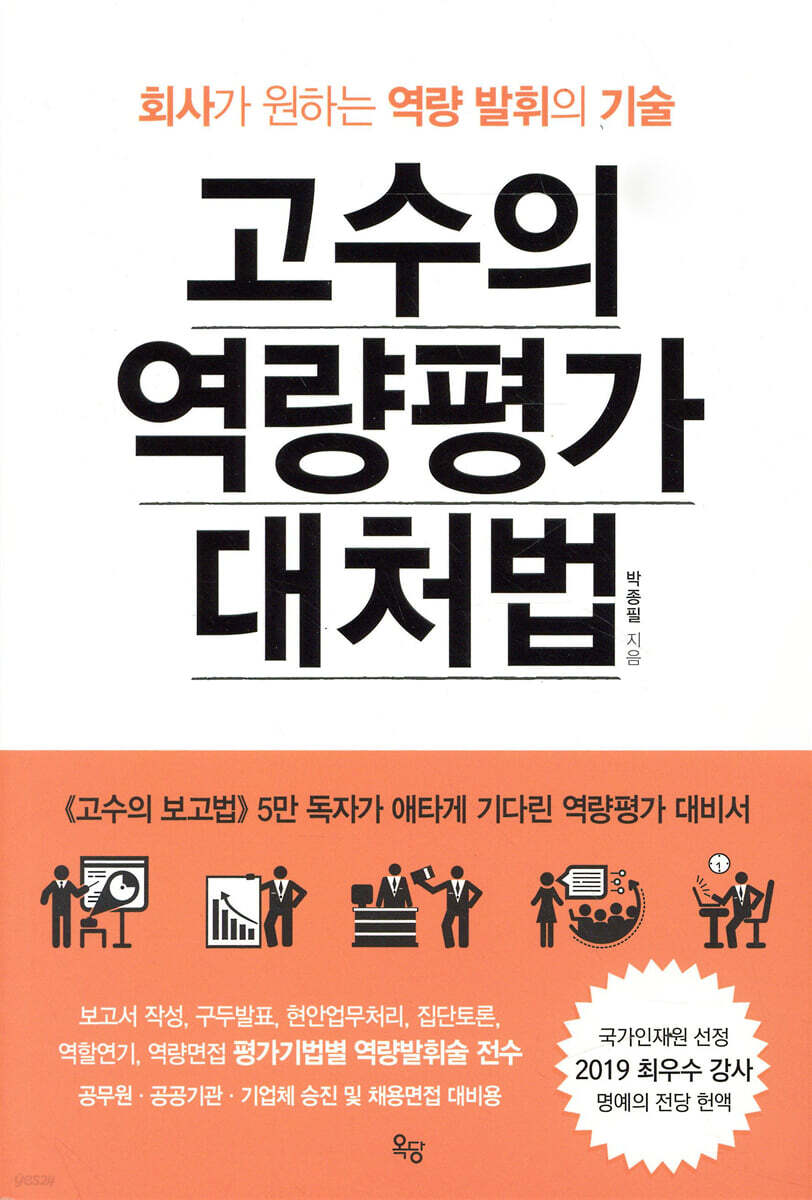
How to deal with a high-level competency assessment
 |
Description
Book Introduction
"The Expert's Reporting Method": The Competency Assessment Preparation Guide Eagerly Awaited by 30,000 Readers
Report writing, oral presentation, current affairs processing, group discussion, role-playing, competency interview, etc.
Disclosure of competency demonstration techniques by evaluation technique
The importance of competency assessment is increasing in hiring and promotion at companies, including civil servants and public corporations.
Is there a way to thoroughly understand the essence of competency assessments conducted by each organization and how to leverage this essence to develop your own capabilities? For civil servants and job seekers struggling to find valuable insights amidst the deluge of information, author Park Jong-pil, known as the "reporting expert," has stepped forward.
He is a person recognized for his outstanding skills in planning and reporting, having been the longest-serving Planning and Finance Officer at the Ministry of Employment and Labor for the past 20 years.
He is currently working as the Director of the Food and Drug Policy Bureau at the Office for Government Policy Coordination.
In this book, the author presents the essence of competency assessment and specific strategies for each assessment technique for civil servants and job seekers awaiting promotion.
Part 1 introduces the author's method of developing personal capabilities, and Part 2 contains strategies for each evaluation technique based on that method of developing capabilities.
The book also offers tips on how to prepare for competency assessments in your daily life.
Report writing, oral presentation, current affairs processing, group discussion, role-playing, competency interview, etc.
Disclosure of competency demonstration techniques by evaluation technique
The importance of competency assessment is increasing in hiring and promotion at companies, including civil servants and public corporations.
Is there a way to thoroughly understand the essence of competency assessments conducted by each organization and how to leverage this essence to develop your own capabilities? For civil servants and job seekers struggling to find valuable insights amidst the deluge of information, author Park Jong-pil, known as the "reporting expert," has stepped forward.
He is a person recognized for his outstanding skills in planning and reporting, having been the longest-serving Planning and Finance Officer at the Ministry of Employment and Labor for the past 20 years.
He is currently working as the Director of the Food and Drug Policy Bureau at the Office for Government Policy Coordination.
In this book, the author presents the essence of competency assessment and specific strategies for each assessment technique for civil servants and job seekers awaiting promotion.
Part 1 introduces the author's method of developing personal capabilities, and Part 2 contains strategies for each evaluation technique based on that method of developing capabilities.
The book also offers tips on how to prepare for competency assessments in your daily life.
- You can preview some of the book's contents.
Preview
index
preface
Prologue: How can I demonstrate my capabilities?
Part 1: How to Unleash the Power of a Master
Chapter 1: Understanding the Essence of Competency Assessment
· First, let's identify the types of competencies.
· Understand the nature of the organization
· There are only two essential competencies.
· Let's understand the essence of each evaluation technique.
Chapter 2: Through the Eyes of an Evaluator
· What to evaluate? - Competency over skill
· What to look at first? - Understanding rather than expression
· What is the right answer? - Process over outcome
· What to look for? - Relationships rather than lists
Chapter 3 Story Plus
· Distinguish between branches and lumps
· Let's put a story into the lump
· Be different from others in the story of the part
· Storytelling, making the most of it
Part 2: Strategy by Evaluation Technique
Chapter 4: Paper Writing
· Finding the Essence | Organizing Your Thoughts Well into Writing
· Reading materials | Read with your mind, not just your eyes.
· Analyze | You need to analyze the facts to see the story.
· Expressing | 5 Principles for Writing Clean Sentences
Rule 1 | Cut off the 0.2-line tail
Rule 2 | Erase the cosmetic text.
Rule 3: Use the Right Verb
Rule 4: Look for Errors as You Read Sentences
Rule 5 | Look Again and Think Again
Take a break from thinking 1. Write a performance report - Write about what you did well!
Chapter 5 Oral Presentation
· Finding the Essence | Organizing Your Thoughts Well in Writing and Speaking
· Reading and Analyzing Data | The more urgent the situation, the more likely it is to read in a flow-like manner.
· Expressing 1 | Presentation Principles to Engage Evaluators 3
Rule 1: When you go in, go in right away.
Rule 2: Talk, Don't Read
Rule 3: When you finish, finish it right away.
· Expressing 2 | Story-based Answering Principles for Coping with Sequential Questions 4
Rule 1 | Anticipate Questions
Rule 2: Wait for the evidence, prepare with a story
Rule 3: Keep your speech brief.
Rule 4: Don't Fight with Your Evaluator
Thinking Break 2: The Art of Presenting on One Page
Chapter 6: Handling Current Issues In-Basket
· Finding the Essence | Organizing your thoughts quickly and effectively in writing and speech
· Reading and Analyzing Data | 4 Steps to Current Issue Analysis
Step 1 | What to Do? - Identifying the Problem
Step 2 | Where to Start? - Prioritize
Step 3 | How to Solve It? - Developing a Solution
Step 4 | How to Handle It? - Choose a Handling Method
· Expressing | Principle 4: Quickly and Accurately Processing Multiple Tasks
Rule 1: Focus on content, not form.
Rule 2: Focus on the whole thing, not the details.
Rule 3: Shorten but Write Well
Principle 4: State the Relationships Between Tasks
Take a Mind Break 3: Make Time to Think! - Phrases and Shortcuts
Chapter 7 Group Discussion
· Finding the essence | Bringing together various thoughts
· Read the material | Break it down into chunks and create a discussion point.
· Analyze | Let's allocate resources rationally.
· Expressing | 4 Debate Principles for Getting Your Opponent on Your Side
Rule 1: If the other person is doing well? - Acknowledge and leverage their skills.
Rule 2 | What if the other person is strange? Respond logically.
Rule 3 | If Adjustment Is Necessary - Concession Instead of Exchange
Rule 4 | How to Get on My Side? - Respond with a Partial Story
Take a break from thinking 4 If you want to become a god of debate, throw away the scenario!
Chapter 8 Role Play
· Finding the Essence | Bringing Different Thoughts to Your Side
· Read and analyze the data | Get alternatives in a package.
· Expressing | 4 Steps to Persuading Everyone to Empathize
Step 1 | Trust → Open Yourself to the Other Person
Step 2 | Check → Read the other person's mind
Step 3 | Persuade → Give the other person some leeway.
Step 4 | Organize → Become "us," not "the other."
Take a break from thinking 5 persuasive phrases for each situation - Let's get a feel for the atmosphere!
Chapter 9 Competency/NCS-based Interview
· Finding the Essence | Connecting with the Other Person
· Experience Interview | Describe your behavior in detail
Situational Interview | Presenting your judgment logically
General Interview | Introduce yourself with sincerity
· Expressing | 4 Interview Principles to Avoid Being a Parrot
Rule 1 | Ambiguous? - Let's organize it into a question.
Rule 2 | You Know It? - Don't Get Excited
Rule 3 | Want to speak well? - Cut it off and get it sorted.
Principle 4 | In a Crisis? - Escape with Sincerity
Take a break from thinking 6 Writing a self-introduction - Don't reveal my past!
Epilogue_What is the plus alpha obtained from?
[Special Lecture] Competency Assessment: Preparing for It in Everyday Life
D-1 Year_Developing Basic Skills
Developing thinking skills → Thinking in a competency-assessment way
Developing the ability to understand → Reading newspaper editorials by breaking them up and underlining them
Developing expressive skills → Splitting, summarizing, and rewriting
Developing Practice Skills → Seeing Through Third-Party Eyes
D-1st Quarter_Developing the Capacity for Delicacy
Collecting content and stories
Rethink
January D-1_Developing the Capacity for Familiarity
Get familiar with the story
Take care of the side dishes too
D-1_Displaying the power of abandonment
Don't do what you can't do
Feel at ease
D-1 minute_Unleash your superpowers
The more difficult it is, the more we return to the basics.
The more urgent it is, the more you have to think it through to the end.
Prologue: How can I demonstrate my capabilities?
Part 1: How to Unleash the Power of a Master
Chapter 1: Understanding the Essence of Competency Assessment
· First, let's identify the types of competencies.
· Understand the nature of the organization
· There are only two essential competencies.
· Let's understand the essence of each evaluation technique.
Chapter 2: Through the Eyes of an Evaluator
· What to evaluate? - Competency over skill
· What to look at first? - Understanding rather than expression
· What is the right answer? - Process over outcome
· What to look for? - Relationships rather than lists
Chapter 3 Story Plus
· Distinguish between branches and lumps
· Let's put a story into the lump
· Be different from others in the story of the part
· Storytelling, making the most of it
Part 2: Strategy by Evaluation Technique
Chapter 4: Paper Writing
· Finding the Essence | Organizing Your Thoughts Well into Writing
· Reading materials | Read with your mind, not just your eyes.
· Analyze | You need to analyze the facts to see the story.
· Expressing | 5 Principles for Writing Clean Sentences
Rule 1 | Cut off the 0.2-line tail
Rule 2 | Erase the cosmetic text.
Rule 3: Use the Right Verb
Rule 4: Look for Errors as You Read Sentences
Rule 5 | Look Again and Think Again
Take a break from thinking 1. Write a performance report - Write about what you did well!
Chapter 5 Oral Presentation
· Finding the Essence | Organizing Your Thoughts Well in Writing and Speaking
· Reading and Analyzing Data | The more urgent the situation, the more likely it is to read in a flow-like manner.
· Expressing 1 | Presentation Principles to Engage Evaluators 3
Rule 1: When you go in, go in right away.
Rule 2: Talk, Don't Read
Rule 3: When you finish, finish it right away.
· Expressing 2 | Story-based Answering Principles for Coping with Sequential Questions 4
Rule 1 | Anticipate Questions
Rule 2: Wait for the evidence, prepare with a story
Rule 3: Keep your speech brief.
Rule 4: Don't Fight with Your Evaluator
Thinking Break 2: The Art of Presenting on One Page
Chapter 6: Handling Current Issues In-Basket
· Finding the Essence | Organizing your thoughts quickly and effectively in writing and speech
· Reading and Analyzing Data | 4 Steps to Current Issue Analysis
Step 1 | What to Do? - Identifying the Problem
Step 2 | Where to Start? - Prioritize
Step 3 | How to Solve It? - Developing a Solution
Step 4 | How to Handle It? - Choose a Handling Method
· Expressing | Principle 4: Quickly and Accurately Processing Multiple Tasks
Rule 1: Focus on content, not form.
Rule 2: Focus on the whole thing, not the details.
Rule 3: Shorten but Write Well
Principle 4: State the Relationships Between Tasks
Take a Mind Break 3: Make Time to Think! - Phrases and Shortcuts
Chapter 7 Group Discussion
· Finding the essence | Bringing together various thoughts
· Read the material | Break it down into chunks and create a discussion point.
· Analyze | Let's allocate resources rationally.
· Expressing | 4 Debate Principles for Getting Your Opponent on Your Side
Rule 1: If the other person is doing well? - Acknowledge and leverage their skills.
Rule 2 | What if the other person is strange? Respond logically.
Rule 3 | If Adjustment Is Necessary - Concession Instead of Exchange
Rule 4 | How to Get on My Side? - Respond with a Partial Story
Take a break from thinking 4 If you want to become a god of debate, throw away the scenario!
Chapter 8 Role Play
· Finding the Essence | Bringing Different Thoughts to Your Side
· Read and analyze the data | Get alternatives in a package.
· Expressing | 4 Steps to Persuading Everyone to Empathize
Step 1 | Trust → Open Yourself to the Other Person
Step 2 | Check → Read the other person's mind
Step 3 | Persuade → Give the other person some leeway.
Step 4 | Organize → Become "us," not "the other."
Take a break from thinking 5 persuasive phrases for each situation - Let's get a feel for the atmosphere!
Chapter 9 Competency/NCS-based Interview
· Finding the Essence | Connecting with the Other Person
· Experience Interview | Describe your behavior in detail
Situational Interview | Presenting your judgment logically
General Interview | Introduce yourself with sincerity
· Expressing | 4 Interview Principles to Avoid Being a Parrot
Rule 1 | Ambiguous? - Let's organize it into a question.
Rule 2 | You Know It? - Don't Get Excited
Rule 3 | Want to speak well? - Cut it off and get it sorted.
Principle 4 | In a Crisis? - Escape with Sincerity
Take a break from thinking 6 Writing a self-introduction - Don't reveal my past!
Epilogue_What is the plus alpha obtained from?
[Special Lecture] Competency Assessment: Preparing for It in Everyday Life
D-1 Year_Developing Basic Skills
Developing thinking skills → Thinking in a competency-assessment way
Developing the ability to understand → Reading newspaper editorials by breaking them up and underlining them
Developing expressive skills → Splitting, summarizing, and rewriting
Developing Practice Skills → Seeing Through Third-Party Eyes
D-1st Quarter_Developing the Capacity for Delicacy
Collecting content and stories
Rethink
January D-1_Developing the Capacity for Familiarity
Get familiar with the story
Take care of the side dishes too
D-1_Displaying the power of abandonment
Don't do what you can't do
Feel at ease
D-1 minute_Unleash your superpowers
The more difficult it is, the more we return to the basics.
The more urgent it is, the more you have to think it through to the end.
Publisher's Review
How to pass the competency assessment, the final hurdle for promotion and employment at civil servants, public institutions, and corporations!
The author of "The Master's Reporting Method" clearly explains how to utilize your abilities and how to utilize abilities by evaluation technique.
“I know what a competency assessment is, but when it comes to actually preparing for it, I can’t quite get a feel for it.”
This is what people preparing for competency assessments say most often.
As the importance of competency assessments increases, including their adoption in national civil service promotion evaluations for managers and above, as well as in civil service and public institution recruitment exams, the urgency of those preparing for them is growing.
But it's not easy to find a guide that breaks straight.
There are two main reasons why it is difficult to prepare for competency assessments.
This is because the types of competency assessments vary by organization and company, and individual abilities vary greatly.
Even if you look at a specific organization's competency assessment case or someone's success story, it's not easy to make it completely 'your own.'
Accordingly, Park Jong-pil, author of “The Expert’s Reporting Method,” has returned with “The Expert’s Way to Deal with Competency Assessment.”
He advises, “Competency assessment can be done by weaving together your thoughts, through the other person’s eyes, with your own story, and in a way that is different from others.”
He explains the method as the '3-step method of demonstrating competence', and in this book, he presents specific methods of demonstrating competence according to six evaluation techniques.
The author graduated from the Department of History at Korea University and received a master's degree in public administration from Yonsei University and the University of Birmingham in the UK.
After passing the 38th Higher Civil Service Examination in 1994, he has worked at the Ministry of Employment and Labor, and after serving as the head of the Gangwon Regional Office and the chairman of the Gyeongbuk Regional Labor Relations Committee, he is currently serving as the Director of the Employment, Food and Drug Policy Bureau at the Office for Government Policy Coordination.
He is recognized for his outstanding skills in planning and reporting, having been the longest-serving Planning and Finance Officer at the Ministry of Employment and Labor for the past 20 years.
Therefore, he is called a ‘reporting expert’ among civil servants, and he has written a book titled ‘Reporting Methods of an Expert’.
Competence is not knowledge or skills in a specific field, but rather the 'power to solve a task or problem.'
Therefore, 'competency assessment' is a method of setting up a simulation task that frequently occurs in an organization and having multiple people evaluate the competencies that an individual demonstrates in the process of resolving the task.
According to the authors, organizations want to see three competencies through the competency assessment process:
That is, the ability to organize thoughts, the ability to communicate with others, and the extra ability, namely the ability to tell stories.
Rather than gathering and listing existing information, we want to see the ability to group it together and create new meaning, or a story.
These abilities soon become a measure of how well members can solve problems that arise in the organization.
Accordingly, the author suggests a 'three-step method for demonstrating one's abilities' and advises practicing it to properly demonstrate one's abilities.
Presentation of specific strategies, including principles for writing neat sentences, presentation principles for engaging evaluators, and discussion principles for winning over opponents.
The book is largely divided into two parts, Part 1 and Part 2, and a special lecture.
Part 1 introduces the ‘3-step method of demonstrating competence.’
Here, he emphasizes understanding the essence of the problem (organizing thinking ability), seeing it through the eyes of the evaluator (communication ability), and adding a story (plus alpha ability).
The author suggests that practicing the three steps of the competency development method is effective when time is tight and work is busy, making it difficult to make time.
In Part 2, we will learn strategies for each evaluation technique based on the competency demonstration method of Part 1.
We provide specific strategies for each assessment technique, including report writing, oral presentations, current affairs processing, group discussions, role-playing, and competency/NCS-based interviews.
For example, when writing a report, it provides '5 principles for writing neat sentences', when giving an oral presentation, it provides '3 principles for presenting to engage the evaluator', when handling current issues, it provides '4 steps for analyzing current issues', and when evaluating group discussions, it provides '4 principles for discussing to make the other person take your side'.
Each strategy is explained by comparing the thoughts of a 'novice' and a 'master' to help understanding.
At the end of the book, there is a special lecture by the author.
This section contains tips on how to prepare for competency assessments in your daily life.
To develop basic skills, we explain to readers how to read newspaper editorials in pieces and how to copy and rewrite reports written by others, using examples.
This book may not be suitable for readers who simply want to acquire 'skills'.
Because there is little mention of skills.
Instead, it has the advantage of introducing specific and realistic ways to organize your thoughts.
This book suggests a path closer to 'moderateness' rather than 'tricks'.
This book shows you not just a 'taste', but a real 'taste'.
I recommend this book to readers who want to learn the fundamentals so they won't be shaken when faced with any competency assessment.
The author of "The Master's Reporting Method" clearly explains how to utilize your abilities and how to utilize abilities by evaluation technique.
“I know what a competency assessment is, but when it comes to actually preparing for it, I can’t quite get a feel for it.”
This is what people preparing for competency assessments say most often.
As the importance of competency assessments increases, including their adoption in national civil service promotion evaluations for managers and above, as well as in civil service and public institution recruitment exams, the urgency of those preparing for them is growing.
But it's not easy to find a guide that breaks straight.
There are two main reasons why it is difficult to prepare for competency assessments.
This is because the types of competency assessments vary by organization and company, and individual abilities vary greatly.
Even if you look at a specific organization's competency assessment case or someone's success story, it's not easy to make it completely 'your own.'
Accordingly, Park Jong-pil, author of “The Expert’s Reporting Method,” has returned with “The Expert’s Way to Deal with Competency Assessment.”
He advises, “Competency assessment can be done by weaving together your thoughts, through the other person’s eyes, with your own story, and in a way that is different from others.”
He explains the method as the '3-step method of demonstrating competence', and in this book, he presents specific methods of demonstrating competence according to six evaluation techniques.
The author graduated from the Department of History at Korea University and received a master's degree in public administration from Yonsei University and the University of Birmingham in the UK.
After passing the 38th Higher Civil Service Examination in 1994, he has worked at the Ministry of Employment and Labor, and after serving as the head of the Gangwon Regional Office and the chairman of the Gyeongbuk Regional Labor Relations Committee, he is currently serving as the Director of the Employment, Food and Drug Policy Bureau at the Office for Government Policy Coordination.
He is recognized for his outstanding skills in planning and reporting, having been the longest-serving Planning and Finance Officer at the Ministry of Employment and Labor for the past 20 years.
Therefore, he is called a ‘reporting expert’ among civil servants, and he has written a book titled ‘Reporting Methods of an Expert’.
Competence is not knowledge or skills in a specific field, but rather the 'power to solve a task or problem.'
Therefore, 'competency assessment' is a method of setting up a simulation task that frequently occurs in an organization and having multiple people evaluate the competencies that an individual demonstrates in the process of resolving the task.
According to the authors, organizations want to see three competencies through the competency assessment process:
That is, the ability to organize thoughts, the ability to communicate with others, and the extra ability, namely the ability to tell stories.
Rather than gathering and listing existing information, we want to see the ability to group it together and create new meaning, or a story.
These abilities soon become a measure of how well members can solve problems that arise in the organization.
Accordingly, the author suggests a 'three-step method for demonstrating one's abilities' and advises practicing it to properly demonstrate one's abilities.
Presentation of specific strategies, including principles for writing neat sentences, presentation principles for engaging evaluators, and discussion principles for winning over opponents.
The book is largely divided into two parts, Part 1 and Part 2, and a special lecture.
Part 1 introduces the ‘3-step method of demonstrating competence.’
Here, he emphasizes understanding the essence of the problem (organizing thinking ability), seeing it through the eyes of the evaluator (communication ability), and adding a story (plus alpha ability).
The author suggests that practicing the three steps of the competency development method is effective when time is tight and work is busy, making it difficult to make time.
In Part 2, we will learn strategies for each evaluation technique based on the competency demonstration method of Part 1.
We provide specific strategies for each assessment technique, including report writing, oral presentations, current affairs processing, group discussions, role-playing, and competency/NCS-based interviews.
For example, when writing a report, it provides '5 principles for writing neat sentences', when giving an oral presentation, it provides '3 principles for presenting to engage the evaluator', when handling current issues, it provides '4 steps for analyzing current issues', and when evaluating group discussions, it provides '4 principles for discussing to make the other person take your side'.
Each strategy is explained by comparing the thoughts of a 'novice' and a 'master' to help understanding.
At the end of the book, there is a special lecture by the author.
This section contains tips on how to prepare for competency assessments in your daily life.
To develop basic skills, we explain to readers how to read newspaper editorials in pieces and how to copy and rewrite reports written by others, using examples.
This book may not be suitable for readers who simply want to acquire 'skills'.
Because there is little mention of skills.
Instead, it has the advantage of introducing specific and realistic ways to organize your thoughts.
This book suggests a path closer to 'moderateness' rather than 'tricks'.
This book shows you not just a 'taste', but a real 'taste'.
I recommend this book to readers who want to learn the fundamentals so they won't be shaken when faced with any competency assessment.
GOODS SPECIFICS
- Date of issue: February 15, 2019
- Page count, weight, size: 334 pages | 495g | 152*224*16mm
- ISBN13: 9791196412869
- ISBN10: 1196412863
You may also like
카테고리
korean


korean

![GQ KOREA Mark (Monthly): December [2025]](http://librairie.coreenne.fr/cdn/shop/files/8ef265dbbfbf186523ed75ba7319009d.jpg?v=1765340328&width=3840)


