

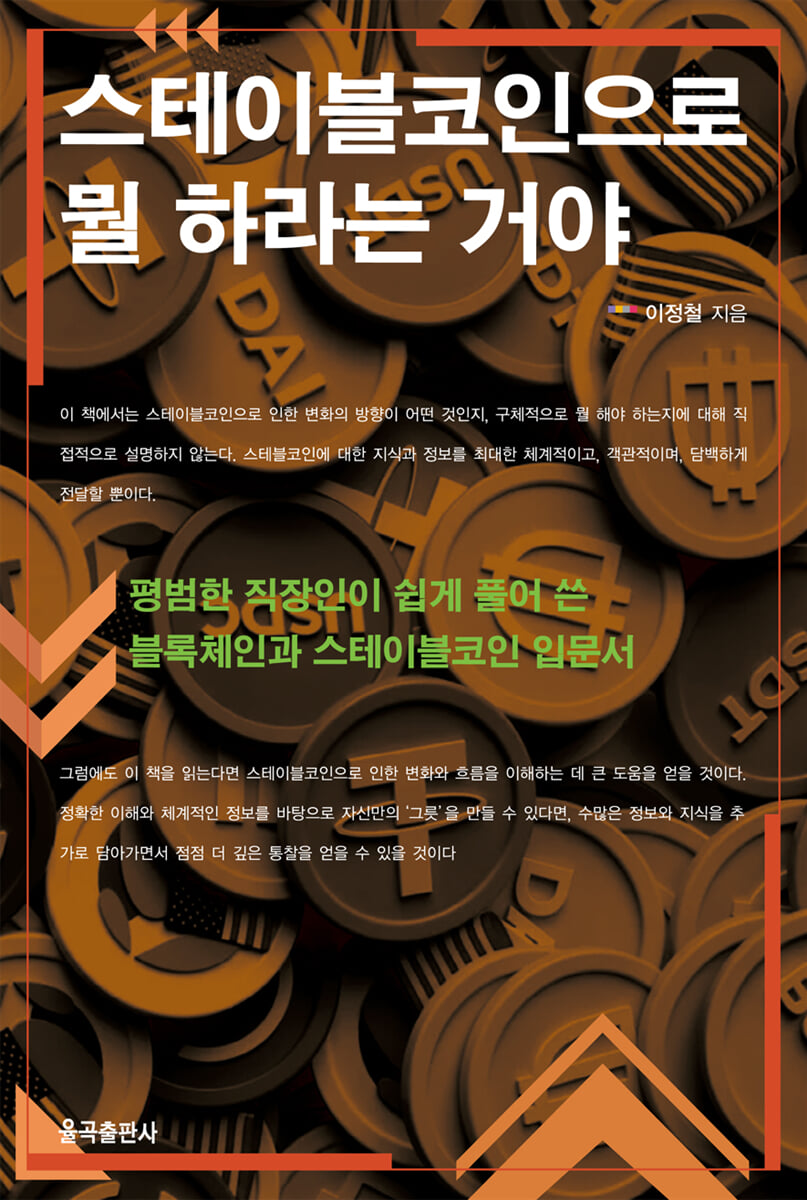
What do you want me to do with stablecoins?
 |
Description
Book Introduction
"What do you want me to do with stablecoins?" This is a question I've been hearing frequently from people around me lately.
It could be a question asked out of genuine curiosity, an expression of the frustration of facing an unfamiliar change, or a reaction mixed with fatigue from the various technologies that appeared and disappeared like fads in the past.
Since the National Assembly introduced the "Basic Digital Asset Act" on June 10, 2025, many corporate executives have been busy.
Whether it's leveraging stablecoins as a new growth engine or establishing a defense against external threats, we're in a situation where we absolutely must respond in some way.
However, practitioners like me in the business field don't have much knowledge or experience with stablecoins.
This is because virtual assets and cryptocurrencies have been outside the legal framework, so there was no need to consider them from a business perspective.
This is a situation where the expression 'a peacock in the middle of the night' is perfectly appropriate.
But unfortunately, the pace of change is accelerating.
On July 18, 2025, US President Trump signed the so-called "GENIUS Act" into law, integrating stablecoins into the system, leading to projections that the global stablecoin market capitalization would grow to $2 trillion by 2028.
Circle, the issuer of USDC, the world's second-largest stablecoin, listed on the New York Stock Exchange on June 5, 2025. Its initial public offering price was $31, and as of early October 2025, it was trading at around $150.
This isn't just an American thing.
In Korea, the new government has included "building a digital asset ecosystem" as a national agenda, and both the ruling and opposition parties are competing to propose related bills.
Financial institutions and large corporations are making secret moves to find partners to join forces with.
Virtual assets, which were called "digital tulips" and "speculative frenzy" just a few years ago, have now reemerged as "digital assets" and "digital gold."
These changes are expected to allow stablecoins to be used as currencies in everyday life.
A stablecoin ATM that accepts withdrawals in Korean Won has already appeared in Namdaemun, Seoul.
But few people really explain why this is happening and why we should pay attention to this change.
Mobile payments are already conveniently established, so why are stablecoins necessary? And how do they relate to the Bank of Korea's proposed CBDC (Central Bank Digital Currency)? There are so many situations that are difficult to understand.
It seems like a big change is happening, but what it is isn't clear.
Some people say they've made a fortune with virtual assets, while others dismiss it as one of the world's absurdities.
Do you feel like you're being left behind amidst unfamiliar concepts like blockchain, stablecoins, CBDCs, and DeFi?
According to one survey, the older we get, the less sensitive we become to change.
Perhaps it's because I've accumulated experiences that say the world changes, but the things around me haven't really changed much.
But has everything really changed? In fact, haven't we already become accustomed to constant change? The smartphone I always carry with me has completely changed compared to ten years ago, and terms like blockchain and stablecoin are now used as proper nouns.
It's not uncommon to hear rumors of people making a lot of money by investing in virtual assets that they don't even know what they are.
Will you be the same as you are now, 10 years from now, or even 5 years from now? If your child were to ask you what major they should choose in college or what career they should prepare for, would you be able to confidently answer? How will you record the changes you've made in the distant future?
Fortunately, I've been working in digital planning in the financial sector since 2015, which has allowed me to study blockchain from the very beginning.
Thanks to this, I was able to connect new knowledge and information and develop the ability to interpret the flow of change on my own.
There were often opportunities to explain related topics through various means.
While previously, questions primarily focused on investing in virtual assets, the most common question I've been asked recently is, "Why do we need stablecoins? What can they actually do?"
This book is a direct translation of what I have been explaining in detail so far to answer that question.
This book does not provide direct answers to the questions of what direction change should take or what specific actions should be taken.
No, it would be more accurate to say that I can't give it to you.
It's difficult to define the current phenomenon with fragmented knowledge, and more than anything, as a practitioner in the business field, I'm not suited to the role of interpreting change.
Instead, I aimed to convey knowledge and information about stablecoins as systematically, objectively, and simply as possible.
Nevertheless, reading this book will greatly help you understand the changes and trends brought about by stablecoins.
If you can create your own "vessel" based on accurate understanding and systematic information, you will be able to gain deeper and deeper insights as you add more information and knowledge.
And I hope that through this book, each of you can complete your own 'vessel'.
I hope this can be of some help to many people, especially those who, like me, are struggling with rapid change and those with an interest and intellectual curiosity about future changes.
This book is divided into two parts. Part 1 provides a step-by-step explanation of everything from blockchain principles to the concept and application of stablecoins. Part 2, based on a basic understanding, collects and answers specific questions you might have.
I tried to write it as “easy but not shallow” as possible.
It is written in an easy-to-understand manner so that anyone can understand it, even without basic knowledge, while also providing specific details that can be referenced by practitioners in the business field.
Those who have some understanding can read only the necessary parts first, but we recommend reading 'Understanding Blockchain' in PART 1 first.
November 2025
It could be a question asked out of genuine curiosity, an expression of the frustration of facing an unfamiliar change, or a reaction mixed with fatigue from the various technologies that appeared and disappeared like fads in the past.
Since the National Assembly introduced the "Basic Digital Asset Act" on June 10, 2025, many corporate executives have been busy.
Whether it's leveraging stablecoins as a new growth engine or establishing a defense against external threats, we're in a situation where we absolutely must respond in some way.
However, practitioners like me in the business field don't have much knowledge or experience with stablecoins.
This is because virtual assets and cryptocurrencies have been outside the legal framework, so there was no need to consider them from a business perspective.
This is a situation where the expression 'a peacock in the middle of the night' is perfectly appropriate.
But unfortunately, the pace of change is accelerating.
On July 18, 2025, US President Trump signed the so-called "GENIUS Act" into law, integrating stablecoins into the system, leading to projections that the global stablecoin market capitalization would grow to $2 trillion by 2028.
Circle, the issuer of USDC, the world's second-largest stablecoin, listed on the New York Stock Exchange on June 5, 2025. Its initial public offering price was $31, and as of early October 2025, it was trading at around $150.
This isn't just an American thing.
In Korea, the new government has included "building a digital asset ecosystem" as a national agenda, and both the ruling and opposition parties are competing to propose related bills.
Financial institutions and large corporations are making secret moves to find partners to join forces with.
Virtual assets, which were called "digital tulips" and "speculative frenzy" just a few years ago, have now reemerged as "digital assets" and "digital gold."
These changes are expected to allow stablecoins to be used as currencies in everyday life.
A stablecoin ATM that accepts withdrawals in Korean Won has already appeared in Namdaemun, Seoul.
But few people really explain why this is happening and why we should pay attention to this change.
Mobile payments are already conveniently established, so why are stablecoins necessary? And how do they relate to the Bank of Korea's proposed CBDC (Central Bank Digital Currency)? There are so many situations that are difficult to understand.
It seems like a big change is happening, but what it is isn't clear.
Some people say they've made a fortune with virtual assets, while others dismiss it as one of the world's absurdities.
Do you feel like you're being left behind amidst unfamiliar concepts like blockchain, stablecoins, CBDCs, and DeFi?
According to one survey, the older we get, the less sensitive we become to change.
Perhaps it's because I've accumulated experiences that say the world changes, but the things around me haven't really changed much.
But has everything really changed? In fact, haven't we already become accustomed to constant change? The smartphone I always carry with me has completely changed compared to ten years ago, and terms like blockchain and stablecoin are now used as proper nouns.
It's not uncommon to hear rumors of people making a lot of money by investing in virtual assets that they don't even know what they are.
Will you be the same as you are now, 10 years from now, or even 5 years from now? If your child were to ask you what major they should choose in college or what career they should prepare for, would you be able to confidently answer? How will you record the changes you've made in the distant future?
Fortunately, I've been working in digital planning in the financial sector since 2015, which has allowed me to study blockchain from the very beginning.
Thanks to this, I was able to connect new knowledge and information and develop the ability to interpret the flow of change on my own.
There were often opportunities to explain related topics through various means.
While previously, questions primarily focused on investing in virtual assets, the most common question I've been asked recently is, "Why do we need stablecoins? What can they actually do?"
This book is a direct translation of what I have been explaining in detail so far to answer that question.
This book does not provide direct answers to the questions of what direction change should take or what specific actions should be taken.
No, it would be more accurate to say that I can't give it to you.
It's difficult to define the current phenomenon with fragmented knowledge, and more than anything, as a practitioner in the business field, I'm not suited to the role of interpreting change.
Instead, I aimed to convey knowledge and information about stablecoins as systematically, objectively, and simply as possible.
Nevertheless, reading this book will greatly help you understand the changes and trends brought about by stablecoins.
If you can create your own "vessel" based on accurate understanding and systematic information, you will be able to gain deeper and deeper insights as you add more information and knowledge.
And I hope that through this book, each of you can complete your own 'vessel'.
I hope this can be of some help to many people, especially those who, like me, are struggling with rapid change and those with an interest and intellectual curiosity about future changes.
This book is divided into two parts. Part 1 provides a step-by-step explanation of everything from blockchain principles to the concept and application of stablecoins. Part 2, based on a basic understanding, collects and answers specific questions you might have.
I tried to write it as “easy but not shallow” as possible.
It is written in an easy-to-understand manner so that anyone can understand it, even without basic knowledge, while also providing specific details that can be referenced by practitioners in the business field.
Those who have some understanding can read only the necessary parts first, but we recommend reading 'Understanding Blockchain' in PART 1 first.
November 2025
index
PART 1 Understanding it step by step
CHAPTER 1 Understanding Blockchain from the Ground Up
Why should we start by understanding blockchain?
Blockchain's Attributes: Decentralization, Smart Contracts, and Reward Design
Decentralization: The World Bitcoin Dreamed of
Smart Contracts: A Technology Even the Bank of Korea Covets
Reward Design: Why the General Public Will Participate in Decentralization
CHAPTER 2: Understanding Stablecoins
Why are stablecoins needed?
Different types of stablecoins
Where are stablecoins being used?
The stablecoin ecosystem is scalable
Stablecoins are being recognized as official currencies.
PART 2: 30 Questions and Answers on Stablecoins
CHAPTER 3 DEEPENING THE CONCEPTS
1.
Do stablecoins and CBDCs conflict or complement each other?
2.
How do stablecoins work in DeFi?
3. How are stablecoins related to other digital assets, such as STOs, RWAs, and NFTs?
4.
What's the difference between public and private blockchains?
5.
What is the difference between a coin and a token?
CHAPTER 4 Stablecoin Regulation
6.
How does stablecoin regulation relate to other laws?
7.
Can stablecoins be regulated since they operate on a decentralized basis?
8.
What specific reserve-related regulations must stablecoin issuers adhere to?
9.
How are stablecoins reflected in corporate accounting?
10.
Does holding stablecoins raise tax issues?
CHAPTER 5: Stablecoin Business
11.
Will a KRW stablecoin be competitive?
12.
What areas should stablecoin issuers collaborate with?
13.
Can a stablecoin issuer directly distribute it?
14.
How can I become competitive in the wallet service market?
15. What are some examples of NFTs being linked to stablecoins?
16.
What exactly is the Treasury strategy?
17.
What new business areas could emerge from the activation of stablecoins?
CHAPTER 6: Considerations Before Introduction
18.
How do I utilize the ERC token standard provided by Ethereum?
19.
Which mainnet should I choose when issuing a stablecoin?
20.
Is it possible to transfer between mainnets?
21.
What infrastructure is required to connect internal corporate systems to the mainnet?
22.
What additional costs may arise when circulating stablecoins?
23.
Is there any way to reduce gas pee?
24.
Is it necessary to issue a token to create a smart contract?
25.
Are there any considerations when designing smart contracts?
26.
How can I reflect internal company data on a blockchain network?
27.
How do I manage a blacklist of stablecoin addresses?
CHAPTER 7: THE FUTURE OF STABLECOINS
28.
Why is blockchain called the second Internet?
29.
Could the metaverse proliferate again when stablecoins become active?
30. How does it connect with other technologies like AI and IoT?
Appendix: Understanding Stablecoin Terminology
CHAPTER 1 Understanding Blockchain from the Ground Up
Why should we start by understanding blockchain?
Blockchain's Attributes: Decentralization, Smart Contracts, and Reward Design
Decentralization: The World Bitcoin Dreamed of
Smart Contracts: A Technology Even the Bank of Korea Covets
Reward Design: Why the General Public Will Participate in Decentralization
CHAPTER 2: Understanding Stablecoins
Why are stablecoins needed?
Different types of stablecoins
Where are stablecoins being used?
The stablecoin ecosystem is scalable
Stablecoins are being recognized as official currencies.
PART 2: 30 Questions and Answers on Stablecoins
CHAPTER 3 DEEPENING THE CONCEPTS
1.
Do stablecoins and CBDCs conflict or complement each other?
2.
How do stablecoins work in DeFi?
3. How are stablecoins related to other digital assets, such as STOs, RWAs, and NFTs?
4.
What's the difference between public and private blockchains?
5.
What is the difference between a coin and a token?
CHAPTER 4 Stablecoin Regulation
6.
How does stablecoin regulation relate to other laws?
7.
Can stablecoins be regulated since they operate on a decentralized basis?
8.
What specific reserve-related regulations must stablecoin issuers adhere to?
9.
How are stablecoins reflected in corporate accounting?
10.
Does holding stablecoins raise tax issues?
CHAPTER 5: Stablecoin Business
11.
Will a KRW stablecoin be competitive?
12.
What areas should stablecoin issuers collaborate with?
13.
Can a stablecoin issuer directly distribute it?
14.
How can I become competitive in the wallet service market?
15. What are some examples of NFTs being linked to stablecoins?
16.
What exactly is the Treasury strategy?
17.
What new business areas could emerge from the activation of stablecoins?
CHAPTER 6: Considerations Before Introduction
18.
How do I utilize the ERC token standard provided by Ethereum?
19.
Which mainnet should I choose when issuing a stablecoin?
20.
Is it possible to transfer between mainnets?
21.
What infrastructure is required to connect internal corporate systems to the mainnet?
22.
What additional costs may arise when circulating stablecoins?
23.
Is there any way to reduce gas pee?
24.
Is it necessary to issue a token to create a smart contract?
25.
Are there any considerations when designing smart contracts?
26.
How can I reflect internal company data on a blockchain network?
27.
How do I manage a blacklist of stablecoin addresses?
CHAPTER 7: THE FUTURE OF STABLECOINS
28.
Why is blockchain called the second Internet?
29.
Could the metaverse proliferate again when stablecoins become active?
30. How does it connect with other technologies like AI and IoT?
Appendix: Understanding Stablecoin Terminology
GOODS SPECIFICS
- Date of issue: November 20, 2025
- Format: Paperback book binding method guide
- Page count, weight, size: 204 pages | 152*225*11mm
- ISBN13: 9791194359357
You may also like
카테고리
korean


korean

![GQ KOREA Mark (Monthly): December [2025]](http://librairie.coreenne.fr/cdn/shop/files/8ef265dbbfbf186523ed75ba7319009d.jpg?v=1765340328&width=3840)


