

So we listen to music
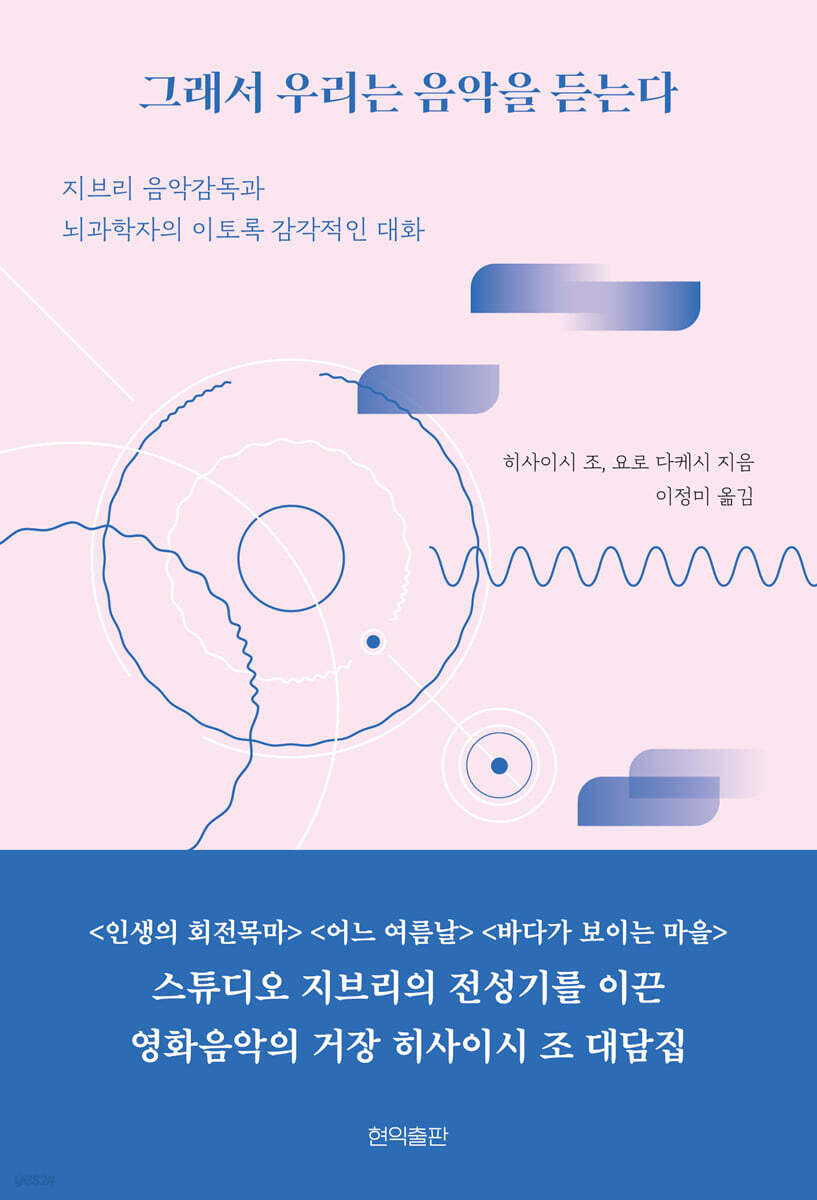 |
Description
Book Introduction
- A word from MD
-
Joe Hisaishi, a neuroscientist and expertWhat is good music? Why are people moved by music? How does life become art? A collection of conversations between Studio Ghibli music director Joe Hisaishi and neuroscientist Takeshi Yoro.
The stories of two masters on art and creation, humanity and society, provide readers with rich intellectual stimulation, and the sensuous sentences make them think about the meaning of life and art.
December 12, 2023. Art PD Ahn Hyun-jae
Joe Hisaishi, the master who led the golden age of Studio Ghibli,
A sensory encounter between Takeshi Yoro, a bestselling author and neuroscientist who has sold over a million copies!
Looking at Humanity and Society at the Crossroads of Music and Brain Science
Joe Hisaishi, a modern classical musician well known in Korea as the music director of countless masterpieces representing Studio Ghibli, including [My Neighbor Totoro], [Spirited Away], [Howl's Moving Castle], and [Ponyo on the Cliff by the Sea].
He has been consistently active in various fields such as composing, conducting, and performing, and has moved many people with his music.
In particular, his tireless efforts to think about 'what is good music' are fully reflected in his music, giving us a deep resonance.
The collection of essays, “So We Listen to Music,” is also an extension of such considerations.
In this book, Joe Hisaishi meets with Takeshi Yoro, an anatomist and authority on neuroscience, and engages in a conversation full of wisdom and inspiration.
Their discussion, unfolding within the broader theme of "Why do humans create music, and what significance do art and sensibility have for society?", broadly encompasses music, art, science, philosophy, sociology, humanities, and even insect ecology, providing readers with a wealth of intellectual stimulation.
The conversation between two masters who have reached the top of their respective fields is a delightful and engaging read, but at the same time, it is a sharp insight that pierces the heart and makes us reflect on our lives in modern society.
This book is highly recommended for readers who love Joe Hisaishi's music, want to delve into his musical thinking, or are intrigued by the delicate and sensual connection between music and humanity.
A sensory encounter between Takeshi Yoro, a bestselling author and neuroscientist who has sold over a million copies!
Looking at Humanity and Society at the Crossroads of Music and Brain Science
Joe Hisaishi, a modern classical musician well known in Korea as the music director of countless masterpieces representing Studio Ghibli, including [My Neighbor Totoro], [Spirited Away], [Howl's Moving Castle], and [Ponyo on the Cliff by the Sea].
He has been consistently active in various fields such as composing, conducting, and performing, and has moved many people with his music.
In particular, his tireless efforts to think about 'what is good music' are fully reflected in his music, giving us a deep resonance.
The collection of essays, “So We Listen to Music,” is also an extension of such considerations.
In this book, Joe Hisaishi meets with Takeshi Yoro, an anatomist and authority on neuroscience, and engages in a conversation full of wisdom and inspiration.
Their discussion, unfolding within the broader theme of "Why do humans create music, and what significance do art and sensibility have for society?", broadly encompasses music, art, science, philosophy, sociology, humanities, and even insect ecology, providing readers with a wealth of intellectual stimulation.
The conversation between two masters who have reached the top of their respective fields is a delightful and engaging read, but at the same time, it is a sharp insight that pierces the heart and makes us reflect on our lives in modern society.
This book is highly recommended for readers who love Joe Hisaishi's music, want to delve into his musical thinking, or are intrigued by the delicate and sensual connection between music and humanity.
- You can preview some of the book's contents.
Preview
index
Entering
Chapter 1: A Human Moved by Music
Great songs don't interfere with the brain.
The brain perceives music before images.
The human brain integrates information from the eyes and ears
Brainless insects are also inflexible.
A society built on consciousness
A feeling that cannot be expressed in words
Modern society with dulled senses
Another role of the eyes and ears
Dual structure of touch and smell
Why Humans Are Easily Moved by Music
Melody, a memory device of space and time
The most logical sense
The power of hearing
Chapter 2: The Soil of the Senses Where Sensitivity Sproutes
A modern society that rejects touch
Past technology better than modern technology
Individuality comes from the body
The Sense of Smell and the Odorless Society
Taste memory
Differences in consciousness according to social system
Differences in thinking according to language structure
Differences in values across cultures
Structural differences between Eastern and Western music
Colorless music
As the environment changes, so do our emotions.
Art reflects the local culture.
The most moving way to listen to music
Chapter 3: What is Good Music?
The key to composition is not inspiration.
The ability to capture coincidences
Two composition methods
Music that only exists in rhythm
The Truth About the Mozart Effect
What is the baby hearing in the womb?
Music as a Structure in Time
Music engraved through experience
Music that stimulates human emotions
Rhythm of sentences, rhythm of musical scores
Rhythm is fundamental to all living things.
Chapter 4 Human Consciousness and Speech
History of Modern Music
Modernity is consciousness-centered
What is conveyed through words
Orientation and sense
Tension and perspective
The driving force of the body is the unconscious.
The last string of concentration
Informatization and information processing
The curse words that fill society
whopper
People fall for 'certain fiction'
A language that should enrich the world
Chapter 5 Empathy and Creativity
Voice and conversation
The ability to adapt to others
Conversation begins with mimicry.
absolute pitch
What it means to sing together
Match the rhythm to survive
Different ways of life
The brain system that empathizes with others
empathetic brain
Resonance with the times
A series of coincidences
Creativity in Empathy
Creators seeking the best solution
A story where characters come alive and breathe
The fun of not knowing what will happen
Chapter 6: Every Man Is an Artist
A person's life is like a work of art.
A life of continuous change
Merry Old People
A society where everyone naturally integrates
The dogmatism of a healthy person
People who can't think for themselves
What we want from the community
Harmony between city and countryside
wild accident
In conclusion
Chapter 1: A Human Moved by Music
Great songs don't interfere with the brain.
The brain perceives music before images.
The human brain integrates information from the eyes and ears
Brainless insects are also inflexible.
A society built on consciousness
A feeling that cannot be expressed in words
Modern society with dulled senses
Another role of the eyes and ears
Dual structure of touch and smell
Why Humans Are Easily Moved by Music
Melody, a memory device of space and time
The most logical sense
The power of hearing
Chapter 2: The Soil of the Senses Where Sensitivity Sproutes
A modern society that rejects touch
Past technology better than modern technology
Individuality comes from the body
The Sense of Smell and the Odorless Society
Taste memory
Differences in consciousness according to social system
Differences in thinking according to language structure
Differences in values across cultures
Structural differences between Eastern and Western music
Colorless music
As the environment changes, so do our emotions.
Art reflects the local culture.
The most moving way to listen to music
Chapter 3: What is Good Music?
The key to composition is not inspiration.
The ability to capture coincidences
Two composition methods
Music that only exists in rhythm
The Truth About the Mozart Effect
What is the baby hearing in the womb?
Music as a Structure in Time
Music engraved through experience
Music that stimulates human emotions
Rhythm of sentences, rhythm of musical scores
Rhythm is fundamental to all living things.
Chapter 4 Human Consciousness and Speech
History of Modern Music
Modernity is consciousness-centered
What is conveyed through words
Orientation and sense
Tension and perspective
The driving force of the body is the unconscious.
The last string of concentration
Informatization and information processing
The curse words that fill society
whopper
People fall for 'certain fiction'
A language that should enrich the world
Chapter 5 Empathy and Creativity
Voice and conversation
The ability to adapt to others
Conversation begins with mimicry.
absolute pitch
What it means to sing together
Match the rhythm to survive
Different ways of life
The brain system that empathizes with others
empathetic brain
Resonance with the times
A series of coincidences
Creativity in Empathy
Creators seeking the best solution
A story where characters come alive and breathe
The fun of not knowing what will happen
Chapter 6: Every Man Is an Artist
A person's life is like a work of art.
A life of continuous change
Merry Old People
A society where everyone naturally integrates
The dogmatism of a healthy person
People who can't think for themselves
What we want from the community
Harmony between city and countryside
wild accident
In conclusion
Detailed image

Into the book
It's easy to think that we hear sounds or music only with our ears, but in fact, we don't necessarily hear sounds only with our ears, because we detect vibrations in various parts of our body.
The ear is not only an organ that captures the external world, but is also deeply connected to the inside of the body.
--- p.45 From “Chapter 1: Humans Moved by Music”
I think that kind of experience is important in music.
Music that can be easily received with a few presses of a button on the phone doesn't contain any emotion.
You'll get sick of it soon.
Whatever it is, it is not easy to throw away or give up something that you have achieved through your own efforts and efforts.
At first, it's okay to download and listen, but I hope that will lead you to become a fan of that musician, buy the CD, find out when and where the concert is, buy a ticket, and go listen.
The most moving way to listen to music is to try to do it yourself.
If you do that, the music will become unforgettable.
--- p.103 From “Chapter 2: The Soil of Senses Where Sensitivity Sprouts”
Let's put one note in time.
I believe that the best music is the one that is created as an objective object from the moment the architectural work of composing music in time begins through various organic combinations.
Of course, there are many times when things don't work out well.
In that sense, I think Mozart's music was able to become universally good music that transcended time because it was a masterpiece objectively constructed over time.
--- p.127 From “Chapter 3: What is Good Music”
As I progress along the path of pursuing that 'real exhaust', I begin to think that it is not me who creates it or chooses the sound.
It's not that I choose, but that there must be a best answer somewhere, an answer where all the pieces fall into place, and I have to find it.
That doesn't mean, in a fundamentalist way, that placing this element here necessarily leads to this development.
But I think there's a difference between thinking that I'm the one making the choices and thinking that there's some optimal solution and working hard to reach it.
If you look at it that way, even if you are a composer, you don't write songs based on your own emotions.
What would happen if we did this? What would change if we did this? What would change if we did this?
It's a work of thought and exploration.
--- p.226 From “Chapter 5 Empathy and Creation”
These days, people show an attitude of not accepting anything that does not benefit them.
But whatever material we are given, we must spend our lives creating works with it.
When you think about it that way, even things that you thought would be useless take on new meaning.
Even if you only have cheap canvas and dirty paint, your life's work is to paint as best you can with that.
I think people in the past had an implicit feeling that they had such a task.
I think it came in the form of a performance.
--- p.236 From “Chapter 6: All Humans Are Artists”
If you establish the premise that people are changeable beings, you will be able to cherish this moment very much.
Tomorrow's me will be different from today's me.
It's okay if it's different.
Even if you're not an artist by profession, if you think of life as a work of art and that you're the artist who creates that work, wouldn't you be able to find something worth referencing, something that could serve as a clue, in the life of that artist?
The ear is not only an organ that captures the external world, but is also deeply connected to the inside of the body.
--- p.45 From “Chapter 1: Humans Moved by Music”
I think that kind of experience is important in music.
Music that can be easily received with a few presses of a button on the phone doesn't contain any emotion.
You'll get sick of it soon.
Whatever it is, it is not easy to throw away or give up something that you have achieved through your own efforts and efforts.
At first, it's okay to download and listen, but I hope that will lead you to become a fan of that musician, buy the CD, find out when and where the concert is, buy a ticket, and go listen.
The most moving way to listen to music is to try to do it yourself.
If you do that, the music will become unforgettable.
--- p.103 From “Chapter 2: The Soil of Senses Where Sensitivity Sprouts”
Let's put one note in time.
I believe that the best music is the one that is created as an objective object from the moment the architectural work of composing music in time begins through various organic combinations.
Of course, there are many times when things don't work out well.
In that sense, I think Mozart's music was able to become universally good music that transcended time because it was a masterpiece objectively constructed over time.
--- p.127 From “Chapter 3: What is Good Music”
As I progress along the path of pursuing that 'real exhaust', I begin to think that it is not me who creates it or chooses the sound.
It's not that I choose, but that there must be a best answer somewhere, an answer where all the pieces fall into place, and I have to find it.
That doesn't mean, in a fundamentalist way, that placing this element here necessarily leads to this development.
But I think there's a difference between thinking that I'm the one making the choices and thinking that there's some optimal solution and working hard to reach it.
If you look at it that way, even if you are a composer, you don't write songs based on your own emotions.
What would happen if we did this? What would change if we did this? What would change if we did this?
It's a work of thought and exploration.
--- p.226 From “Chapter 5 Empathy and Creation”
These days, people show an attitude of not accepting anything that does not benefit them.
But whatever material we are given, we must spend our lives creating works with it.
When you think about it that way, even things that you thought would be useless take on new meaning.
Even if you only have cheap canvas and dirty paint, your life's work is to paint as best you can with that.
I think people in the past had an implicit feeling that they had such a task.
I think it came in the form of a performance.
--- p.236 From “Chapter 6: All Humans Are Artists”
If you establish the premise that people are changeable beings, you will be able to cherish this moment very much.
Tomorrow's me will be different from today's me.
It's okay if it's different.
Even if you're not an artist by profession, if you think of life as a work of art and that you're the artist who creates that work, wouldn't you be able to find something worth referencing, something that could serve as a clue, in the life of that artist?
--- p.239 From “Chapter 6: All Humans Are Artists”
Publisher's Review
A master of modern classical music loved by Ghibli,
Meet a neuroscientist who dissects the inner workings of modern society.
Studio Ghibli's animations, which have captured the hearts of people around the world, are loved for their fantastical and lyrical stories, colorful visuals, and, above all, beautiful music that maximizes emotion and immersion.
And at the center of it all is Joe Hisaishi, a musician who is considered the symbol of Ghibli music.
He was the music director for works that highlighted the golden age of Ghibli, such as “My Neighbor Totoro,” “Spirited Away,” and “Ponyo on the Cliff by the Sea.” In particular, “Carousel of Life,” which was used as the OST for the film “Howl’s Moving Castle,” is a song that is familiar to the Korean public.
In addition to Ghibli's animations, Joe Hisaishi continues to compose music for various films, while also showcasing his skills as an outstanding performer and conductor, establishing himself as a true master of modern classical music.
He, who has continued to pursue such an active musical career and has always thought about 'good music', meets Takeshi Yoro, a renowned neuroscientist and anatomist.
What kind of conversation will these two masters, each at the top of their respective fields, share?
Joe Hisaishi and Takeshi Yoro's "So We Listen to Music" is a collection of conversations that explores the delicate and sensual link between music and humanity.
The two authors' stories freely explore a wide range of topics, including how the human body and mind listen to music, what constitutes good music, and what sensibilities we need to live in modern society. While being a pleasant and easy read, they also leave readers with something to think about.
As you follow the flow of intellectual conversation, weaving together a vast range of knowledge from music, art, science, philosophy, sociology, humanities, and even insect ecology, you will find yourself broadening your horizons.
This book is especially valuable for Joe Hisaishi fans because it provides a glimpse into the music he pursues, the points he considers important in composition, and the intimate thoughts behind his creative process.
The reason why the conversation between the two people feels comfortable even though it covers a topic that is not entirely light is probably because their stories convey a sense of mutual respect and admiration.
Joe Hisaishi respects Takeshi Yoro's expertise and perspectives in neuroscience, anatomy with a focus on insect research, and social and cultural criticism.
Meanwhile, Yoro Takeshi also enriches the discussion by actively listening to Joe Hisaishi as he discusses music theory, composition, and recording studios.
The synergy between the two authors shines brightly in a dialogue where they share different experiences and opinions from scientific and musical perspectives, even within the same topic.
Listening to Mr. Hisaishi's well-organized story feels like listening to good music.
Talking with Mr. Hisaishi, I realized that music and language are deeply connected.
_ Yoro Takeshi
I sincerely hope that someday, when I am Mr. Yoro's age, I will be able to embody the contents of this book and speak about them.
Of course, this must be done while working as an active composer.
_ Joe Hisaishi
A world expanded by the senses
Why we need to reclaim the lost rhythm of life
Language is an essential element for humans to form a society and live together, but there are things in the world that cannot be explained through language alone.
Art in its various forms exists precisely to fill and express that void.
In this book, Takeshi Yoro says, "A bad habit of people today is thinking that anything can be explained and understood with words."
As he said, modern society has a tendency to overestimate the influence of human consciousness represented by language, and to relatively neglect the senses of the body.
The sense of nature's pulsating vitality is losing its place among the high-rise buildings built one after another by human consciousness.
The two authors warn against such a trend of ritual-centeredness and emphasize the importance of awakening our senses in modern society.
"So We Listen to Music" takes music as its main theme, but does not limit the scope of discussion on the senses to hearing alone. It mentions all five senses, including sight, smell, taste, and touch, and suggests expanding our world both internally and externally through the various senses of the body.
This is a proposal to revive the forgotten senses of the body in order to solve the chronic problems of modern society that arise from being trapped in the framework of consciousness.
Joe Hisaishi says the following in the text:
This is a story that also appears in Levi-Strauss's "Wild Thoughts," and it is assumed that humans were originally capable of sensitive reactions, and it is said that it is important to live with that sense preserved for as long as possible.
Now the senses are clearly on the path to decline.
Our antennas are dull.
The problems arising from that are being revealed here and there.
Shouldn't we return to the wild side of thinking and consider a lifestyle that awakens what humans originally possessed?
_ From the text, Joe Hisaishi
Regaining one's senses is also closely related to one's attitude toward life in terms of 'feeling fully alive.'
"So We Listen to Music" is both a message of encouragement and a celebration of human life from two authors now in their later years.
A life where you sharpen your sense of life and feel the meaning of living with your whole body is beautiful.
Ultimately, isn't that why we love art and why we listen to music?
This collection of conversations, filled with the wisdom accumulated by Joe Hisaishi and Takeshi Yoro over many years of dedication to their respective fields, will be an invaluable gift to those who love art, music, and, above all, life.
Meet a neuroscientist who dissects the inner workings of modern society.
Studio Ghibli's animations, which have captured the hearts of people around the world, are loved for their fantastical and lyrical stories, colorful visuals, and, above all, beautiful music that maximizes emotion and immersion.
And at the center of it all is Joe Hisaishi, a musician who is considered the symbol of Ghibli music.
He was the music director for works that highlighted the golden age of Ghibli, such as “My Neighbor Totoro,” “Spirited Away,” and “Ponyo on the Cliff by the Sea.” In particular, “Carousel of Life,” which was used as the OST for the film “Howl’s Moving Castle,” is a song that is familiar to the Korean public.
In addition to Ghibli's animations, Joe Hisaishi continues to compose music for various films, while also showcasing his skills as an outstanding performer and conductor, establishing himself as a true master of modern classical music.
He, who has continued to pursue such an active musical career and has always thought about 'good music', meets Takeshi Yoro, a renowned neuroscientist and anatomist.
What kind of conversation will these two masters, each at the top of their respective fields, share?
Joe Hisaishi and Takeshi Yoro's "So We Listen to Music" is a collection of conversations that explores the delicate and sensual link between music and humanity.
The two authors' stories freely explore a wide range of topics, including how the human body and mind listen to music, what constitutes good music, and what sensibilities we need to live in modern society. While being a pleasant and easy read, they also leave readers with something to think about.
As you follow the flow of intellectual conversation, weaving together a vast range of knowledge from music, art, science, philosophy, sociology, humanities, and even insect ecology, you will find yourself broadening your horizons.
This book is especially valuable for Joe Hisaishi fans because it provides a glimpse into the music he pursues, the points he considers important in composition, and the intimate thoughts behind his creative process.
The reason why the conversation between the two people feels comfortable even though it covers a topic that is not entirely light is probably because their stories convey a sense of mutual respect and admiration.
Joe Hisaishi respects Takeshi Yoro's expertise and perspectives in neuroscience, anatomy with a focus on insect research, and social and cultural criticism.
Meanwhile, Yoro Takeshi also enriches the discussion by actively listening to Joe Hisaishi as he discusses music theory, composition, and recording studios.
The synergy between the two authors shines brightly in a dialogue where they share different experiences and opinions from scientific and musical perspectives, even within the same topic.
Listening to Mr. Hisaishi's well-organized story feels like listening to good music.
Talking with Mr. Hisaishi, I realized that music and language are deeply connected.
_ Yoro Takeshi
I sincerely hope that someday, when I am Mr. Yoro's age, I will be able to embody the contents of this book and speak about them.
Of course, this must be done while working as an active composer.
_ Joe Hisaishi
A world expanded by the senses
Why we need to reclaim the lost rhythm of life
Language is an essential element for humans to form a society and live together, but there are things in the world that cannot be explained through language alone.
Art in its various forms exists precisely to fill and express that void.
In this book, Takeshi Yoro says, "A bad habit of people today is thinking that anything can be explained and understood with words."
As he said, modern society has a tendency to overestimate the influence of human consciousness represented by language, and to relatively neglect the senses of the body.
The sense of nature's pulsating vitality is losing its place among the high-rise buildings built one after another by human consciousness.
The two authors warn against such a trend of ritual-centeredness and emphasize the importance of awakening our senses in modern society.
"So We Listen to Music" takes music as its main theme, but does not limit the scope of discussion on the senses to hearing alone. It mentions all five senses, including sight, smell, taste, and touch, and suggests expanding our world both internally and externally through the various senses of the body.
This is a proposal to revive the forgotten senses of the body in order to solve the chronic problems of modern society that arise from being trapped in the framework of consciousness.
Joe Hisaishi says the following in the text:
This is a story that also appears in Levi-Strauss's "Wild Thoughts," and it is assumed that humans were originally capable of sensitive reactions, and it is said that it is important to live with that sense preserved for as long as possible.
Now the senses are clearly on the path to decline.
Our antennas are dull.
The problems arising from that are being revealed here and there.
Shouldn't we return to the wild side of thinking and consider a lifestyle that awakens what humans originally possessed?
_ From the text, Joe Hisaishi
Regaining one's senses is also closely related to one's attitude toward life in terms of 'feeling fully alive.'
"So We Listen to Music" is both a message of encouragement and a celebration of human life from two authors now in their later years.
A life where you sharpen your sense of life and feel the meaning of living with your whole body is beautiful.
Ultimately, isn't that why we love art and why we listen to music?
This collection of conversations, filled with the wisdom accumulated by Joe Hisaishi and Takeshi Yoro over many years of dedication to their respective fields, will be an invaluable gift to those who love art, music, and, above all, life.
GOODS SPECIFICS
- Date of issue: November 30, 2023
- Page count, weight, size: 272 pages | 312g | 128*188*20mm
- ISBN13: 9791193217085
- ISBN10: 1193217083
You may also like
카테고리
korean


korean

![GQ KOREA Mark (Monthly): December [2025]](http://librairie.coreenne.fr/cdn/shop/files/8ef265dbbfbf186523ed75ba7319009d.jpg?v=1765340328&width=3840)


