

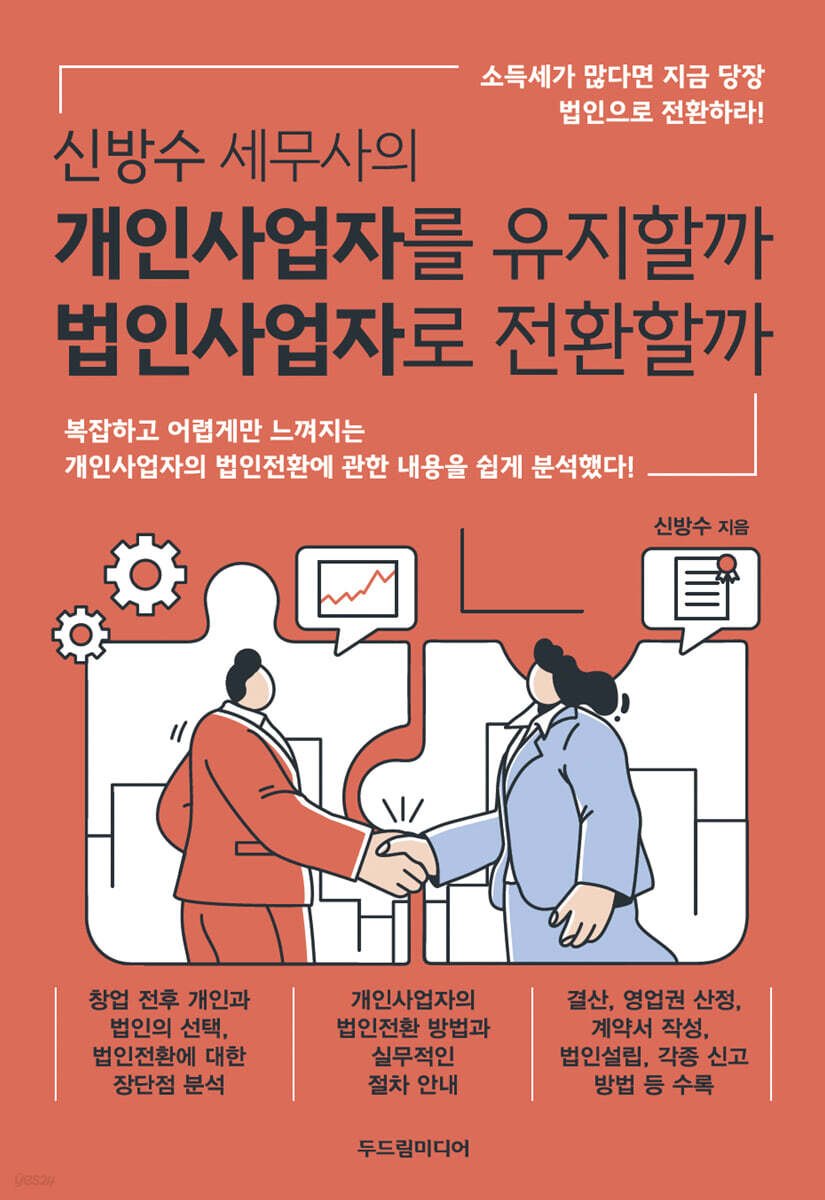
Should I keep Shin Bang-soo's business as a sole proprietor or convert to a corporate business?
 |
Description
Book Introduction
Bestselling author and tax accountant Shin Bang-soo
Corporate Conversion Tax Practice Guide!
One of the biggest concerns and questions for those currently running a business or preparing to start one is, "Is it better to start a business as a sole proprietor or as a corporation?"
This book provides criteria for those who are considering whether it would be better to maintain a sole proprietorship or convert to a corporate business.
Incorporation is not a new concept; it has existed in the past.
That is why many business owners who are currently running their own businesses are aware of the advantages of incorporating a business.
However, the majority of business owners still remain individuals.
Moreover, a trend has emerged of avoiding corporate conversion, considering it to be a very difficult and complex concept.
However, since incorporation is given preferential treatment under tax law, it has the advantage of allowing you to enjoy various benefits with just a little bit of care.
Accordingly, the author analyzed various topics from the perspective of how individual business owners who are considering incorporation can maximize the advantages of incorporation while minimizing its disadvantages.
This book covers everything necessary for corporate conversion from the perspectives of individual business owners and practitioners who need to convert to a corporation.
In addition to the basic content, we have uncovered as many practical examples as possible to enhance your understanding.
I hope that simply observing how the author solves problems in the field will help you easily solve similar problems.
In addition, we have added more practical and useful information to the information by including it in tips and tax-saving research.
Additionally, we have tried to provide summarized key information throughout to increase adaptability when applying it in practice.
It analyzes the pros and cons of choosing between an individual and a corporation before and after starting a business, and the pros and cons of converting to a corporation. It also includes methods and practical procedures for converting a sole proprietor to a corporation, as well as settlement, calculation of goodwill, contract writing, incorporation, and various reporting methods. It is recommended for anyone who wants to become proficient in tax processing for converting a sole proprietor to a corporation!
Corporate Conversion Tax Practice Guide!
One of the biggest concerns and questions for those currently running a business or preparing to start one is, "Is it better to start a business as a sole proprietor or as a corporation?"
This book provides criteria for those who are considering whether it would be better to maintain a sole proprietorship or convert to a corporate business.
Incorporation is not a new concept; it has existed in the past.
That is why many business owners who are currently running their own businesses are aware of the advantages of incorporating a business.
However, the majority of business owners still remain individuals.
Moreover, a trend has emerged of avoiding corporate conversion, considering it to be a very difficult and complex concept.
However, since incorporation is given preferential treatment under tax law, it has the advantage of allowing you to enjoy various benefits with just a little bit of care.
Accordingly, the author analyzed various topics from the perspective of how individual business owners who are considering incorporation can maximize the advantages of incorporation while minimizing its disadvantages.
This book covers everything necessary for corporate conversion from the perspectives of individual business owners and practitioners who need to convert to a corporation.
In addition to the basic content, we have uncovered as many practical examples as possible to enhance your understanding.
I hope that simply observing how the author solves problems in the field will help you easily solve similar problems.
In addition, we have added more practical and useful information to the information by including it in tips and tax-saving research.
Additionally, we have tried to provide summarized key information throughout to increase adaptability when applying it in practice.
It analyzes the pros and cons of choosing between an individual and a corporation before and after starting a business, and the pros and cons of converting to a corporation. It also includes methods and practical procedures for converting a sole proprietor to a corporation, as well as settlement, calculation of goodwill, contract writing, incorporation, and various reporting methods. It is recommended for anyone who wants to become proficient in tax processing for converting a sole proprietor to a corporation!
index
preface
Note
Chapter 1: Choice of Individuals and Corporations
The never-ending debate: Is it better to be an individual or a corporation?
How are other people doing business?
Is the income tax I am paying now appropriate?
How much will my income tax be reduced if I pay corporate tax?
Cases of Individual Business Owners Using Corporations: Choosing Between Individuals and Corporations
[Tax Savings Exploration 1] Pros and Cons of Incorporation
[Tax Savings Exploration 2] Key Criteria for Incorporating a Corporation
Chapter 2: Things That Change When You Do Business as a Corporation
Operating principles for individuals and corporations
Income tax and corporate tax calculation structure
Account Management Act
Cost processing method
Business Car Expense Processing Method
[Tax Savings Exploration 1] Summary of Tax Law Obligations to Cooperate
[Tax Savings Exploration 2] Comparison of the Honest Declaration Verification System for Individuals and Corporations
[Tax Savings Exploration 3] Tax Law Disadvantages for Small-Scale Corporations Subject to Confirmation of Honest Reporting
Chapter 3. Selection and Procedure for Incorporation Method
How to convert to a corporation
Choosing a method of corporate conversion
Business transfer and corporate conversion are widely used in practice.
Procedure for conversion of business transfer to corporation
[Tax Savings Exploration 1] Comparing Business Acquisitions and In-Kind Contributions
[Tax Savings Exploration 2] When converting to a corporation, are fixed business assets required to be appraised?
[Tax Savings Exploration 3] Why It Is Appropriate to Valuate Inventory Assets at Book Value When Converting to a Corporation
[Tax Savings Exploration 4] Summary of Taxes Arising from Incorporation
Chapter 4: Why Settling Individual Business Accounts is Key to Incorporation
The relationship between personal business settlement and corporate conversion
Settlement procedures for corporate conversion
Things to check when closing accounts
Method of measuring net asset value under tax law
Incorrect net asset value and tax issues
Requirements for comprehensive transfer of capital to be reconfirmed at settlement
[Tax Savings Exploration] Incorporation and Financial Statement Accounts
Chapter 5 Goodwill Tax Treatment Act
Goodwill and Tax Issues
Goodwill and Corporate Accounting Standards (How is goodwill created?)
Goodwill Measurement Method
Why It's Important to Distinguish Goodwill Income
Goodwill Transfer Income and Transfer Tax Treatment (including whether carryover tax applies)
[Tax Savings Exploration] Goodwill Omission and Tax Issues
Chapter 6 Business Transfer Agreement and Tax Issues
Why a Transfer Agreement is Important
Recheck the requirements for comprehensive transfer
Comprehensive transfer contract execution and subsequent tax treatment
Accounting treatment of business transfer parties
[Tax Savings Exploration] In-Kind Contribution Agreements and Tax Issues
Chapter 7. Precautions when establishing a corporation for corporate conversion
Issues related to corporate establishment and taxation when converting to a corporation
General procedures for incorporation
Key points to consider before establishing a corporation
How should the shareholder structure be structured?
Chapter 8 Transfer Tax Carryover and Acquisition Tax Reduction Application
Transfer tax carryover and acquisition tax reduction
Transfer tax carryover and post-management
Acquisition tax reduction application and follow-up management
Chapter 9. VAT and Income Tax for Individual Businesses, and Corporate Tax Reporting for Converted Corporations
Business closure report and VAT report
Example of VAT reporting upon conversion to a corporation
Income tax reporting and tax issues related to business closure
Opening balance sheet of the converted corporation
Corporate financial statements and corporate tax calculation methods, corporate real estate transfer and carryover tax treatment methods
[Appendix] Incorporation Methods by Industry
How to Convert a Sole Proprietorship into a Corporation
Service industry and corporate conversion (asset transfer method)
Inventory business and corporate conversion (business transfer method)
Real estate holding industry and corporate conversion (in-kind contribution method)
[Tax Savings Exploration] Analysis of Real Estate Lease Transfer Tax Carryover and Acquisition Tax Reductions
Note
Chapter 1: Choice of Individuals and Corporations
The never-ending debate: Is it better to be an individual or a corporation?
How are other people doing business?
Is the income tax I am paying now appropriate?
How much will my income tax be reduced if I pay corporate tax?
Cases of Individual Business Owners Using Corporations: Choosing Between Individuals and Corporations
[Tax Savings Exploration 1] Pros and Cons of Incorporation
[Tax Savings Exploration 2] Key Criteria for Incorporating a Corporation
Chapter 2: Things That Change When You Do Business as a Corporation
Operating principles for individuals and corporations
Income tax and corporate tax calculation structure
Account Management Act
Cost processing method
Business Car Expense Processing Method
[Tax Savings Exploration 1] Summary of Tax Law Obligations to Cooperate
[Tax Savings Exploration 2] Comparison of the Honest Declaration Verification System for Individuals and Corporations
[Tax Savings Exploration 3] Tax Law Disadvantages for Small-Scale Corporations Subject to Confirmation of Honest Reporting
Chapter 3. Selection and Procedure for Incorporation Method
How to convert to a corporation
Choosing a method of corporate conversion
Business transfer and corporate conversion are widely used in practice.
Procedure for conversion of business transfer to corporation
[Tax Savings Exploration 1] Comparing Business Acquisitions and In-Kind Contributions
[Tax Savings Exploration 2] When converting to a corporation, are fixed business assets required to be appraised?
[Tax Savings Exploration 3] Why It Is Appropriate to Valuate Inventory Assets at Book Value When Converting to a Corporation
[Tax Savings Exploration 4] Summary of Taxes Arising from Incorporation
Chapter 4: Why Settling Individual Business Accounts is Key to Incorporation
The relationship between personal business settlement and corporate conversion
Settlement procedures for corporate conversion
Things to check when closing accounts
Method of measuring net asset value under tax law
Incorrect net asset value and tax issues
Requirements for comprehensive transfer of capital to be reconfirmed at settlement
[Tax Savings Exploration] Incorporation and Financial Statement Accounts
Chapter 5 Goodwill Tax Treatment Act
Goodwill and Tax Issues
Goodwill and Corporate Accounting Standards (How is goodwill created?)
Goodwill Measurement Method
Why It's Important to Distinguish Goodwill Income
Goodwill Transfer Income and Transfer Tax Treatment (including whether carryover tax applies)
[Tax Savings Exploration] Goodwill Omission and Tax Issues
Chapter 6 Business Transfer Agreement and Tax Issues
Why a Transfer Agreement is Important
Recheck the requirements for comprehensive transfer
Comprehensive transfer contract execution and subsequent tax treatment
Accounting treatment of business transfer parties
[Tax Savings Exploration] In-Kind Contribution Agreements and Tax Issues
Chapter 7. Precautions when establishing a corporation for corporate conversion
Issues related to corporate establishment and taxation when converting to a corporation
General procedures for incorporation
Key points to consider before establishing a corporation
How should the shareholder structure be structured?
Chapter 8 Transfer Tax Carryover and Acquisition Tax Reduction Application
Transfer tax carryover and acquisition tax reduction
Transfer tax carryover and post-management
Acquisition tax reduction application and follow-up management
Chapter 9. VAT and Income Tax for Individual Businesses, and Corporate Tax Reporting for Converted Corporations
Business closure report and VAT report
Example of VAT reporting upon conversion to a corporation
Income tax reporting and tax issues related to business closure
Opening balance sheet of the converted corporation
Corporate financial statements and corporate tax calculation methods, corporate real estate transfer and carryover tax treatment methods
[Appendix] Incorporation Methods by Industry
How to Convert a Sole Proprietorship into a Corporation
Service industry and corporate conversion (asset transfer method)
Inventory business and corporate conversion (business transfer method)
Real estate holding industry and corporate conversion (in-kind contribution method)
[Tax Savings Exploration] Analysis of Real Estate Lease Transfer Tax Carryover and Acquisition Tax Reductions
Into the book
Of course, if sales increase, profits increase accordingly and the income tax burden also increases.
However, even if sales are high, if the cost of sales or the proportion of expenses is high, profits may not be high.
Therefore, do not choose a corporation based solely on sales volume.
--- p.26
In order for a sole proprietor to convert to a corporation, the sole proprietor must reorganize the business and establish a new corporation.
The simplest way at this time is to wind down your personal business and establish a separate corporation to start your business.
However, if a personal business (converted business) has complex and intertwined assets such as inventory assets, real estate, personnel, existing business partners, and receivables and payables, it is not easy to organize them all at once.
-p.38
One of the most important aspects of the corporate conversion process is whether or not to conduct an appraisal of assets, including real estate.
As you know, there are costs associated with conducting emotional assessments.
Of course, there is also the advantage of having many tax issues resolved through emotional appraisal.
Therefore, it would be a good idea to review in advance how emotional evaluations can be received and utilized.
--- p.107
There are cases where a private business is converted into a corporation to generate a lot of profit or to ensure stable succession of the family business.
However, when converting to a corporation while there is a lot of profit, there are many cases where goodwill is omitted, which later causes problems.
This is because the tax law views this as a low-value transfer of assets and responds to it by imposing income tax on individuals and gift tax on corporate shareholders.
--- p.185
If real estate is included in a sole proprietor's business fixed assets, the sole proprietor must pay transfer tax, and the acquiring corporation must pay acquisition tax.
However, the tax law allows for transfer tax carryover and acquisition tax reduction to facilitate corporate conversion.
However, there are restrictions in place to prevent indiscriminate reductions.
However, even if sales are high, if the cost of sales or the proportion of expenses is high, profits may not be high.
Therefore, do not choose a corporation based solely on sales volume.
--- p.26
In order for a sole proprietor to convert to a corporation, the sole proprietor must reorganize the business and establish a new corporation.
The simplest way at this time is to wind down your personal business and establish a separate corporation to start your business.
However, if a personal business (converted business) has complex and intertwined assets such as inventory assets, real estate, personnel, existing business partners, and receivables and payables, it is not easy to organize them all at once.
-p.38
One of the most important aspects of the corporate conversion process is whether or not to conduct an appraisal of assets, including real estate.
As you know, there are costs associated with conducting emotional assessments.
Of course, there is also the advantage of having many tax issues resolved through emotional appraisal.
Therefore, it would be a good idea to review in advance how emotional evaluations can be received and utilized.
--- p.107
There are cases where a private business is converted into a corporation to generate a lot of profit or to ensure stable succession of the family business.
However, when converting to a corporation while there is a lot of profit, there are many cases where goodwill is omitted, which later causes problems.
This is because the tax law views this as a low-value transfer of assets and responds to it by imposing income tax on individuals and gift tax on corporate shareholders.
--- p.185
If real estate is included in a sole proprietor's business fixed assets, the sole proprietor must pay transfer tax, and the acquiring corporation must pay acquisition tax.
However, the tax law allows for transfer tax carryover and acquisition tax reduction to facilitate corporate conversion.
However, there are restrictions in place to prevent indiscriminate reductions.
--- p.232
Publisher's Review
It just feels complicated and difficult
We provide clear answers to the questions about converting a sole proprietorship into a corporation!
This book consists of nine chapters and an appendix, covering all the information necessary for corporate conversion from the perspectives of individual business owners and practitioners who need to convert to a corporation.
Chapters 1 to 2 cover the practical benefits of corporate conversion and the basics thereof, while Chapters 3 to 9 cover the content and practical procedures of corporate conversion.
The appendix covers the methods of incorporation by industry.
· Chapter 1: Choice of Individuals and Corporations
· Chapter 2: Things that change when you do business as a corporation
· Chapter 3 Methods and Procedures for Incorporation
Chapter 4: Why Individual Business Settlement is Key to Incorporation
· Chapter 5 Goodwill Tax Treatment Act
Chapter 6: Business Transfer Agreement and Tax Issues
· Chapter 7. Things to keep in mind when establishing a corporation for corporate conversion
· Chapter 8 Transfer Tax Carryover and Acquisition Tax Reduction Application
· Chapter 9: Value Added Tax and Income Tax for Individual Businesses, and Corporate Tax Reporting for Converted Corporations
· Appendix: How to convert to a corporation by industry
This book will be of great help to self-employed individuals, tax accounting professionals, and the general public who wish to develop their skills, as well as those who wish to understand the tax and accounting issues surrounding corporate conversion in the easiest possible way.
We provide clear answers to the questions about converting a sole proprietorship into a corporation!
This book consists of nine chapters and an appendix, covering all the information necessary for corporate conversion from the perspectives of individual business owners and practitioners who need to convert to a corporation.
Chapters 1 to 2 cover the practical benefits of corporate conversion and the basics thereof, while Chapters 3 to 9 cover the content and practical procedures of corporate conversion.
The appendix covers the methods of incorporation by industry.
· Chapter 1: Choice of Individuals and Corporations
· Chapter 2: Things that change when you do business as a corporation
· Chapter 3 Methods and Procedures for Incorporation
Chapter 4: Why Individual Business Settlement is Key to Incorporation
· Chapter 5 Goodwill Tax Treatment Act
Chapter 6: Business Transfer Agreement and Tax Issues
· Chapter 7. Things to keep in mind when establishing a corporation for corporate conversion
· Chapter 8 Transfer Tax Carryover and Acquisition Tax Reduction Application
· Chapter 9: Value Added Tax and Income Tax for Individual Businesses, and Corporate Tax Reporting for Converted Corporations
· Appendix: How to convert to a corporation by industry
This book will be of great help to self-employed individuals, tax accounting professionals, and the general public who wish to develop their skills, as well as those who wish to understand the tax and accounting issues surrounding corporate conversion in the easiest possible way.
GOODS SPECIFICS
- Date of issue: January 7, 2025
- Page count, weight, size: 306 pages | 152*225*25mm
- ISBN13: 9791194223283
- ISBN10: 1194223281
You may also like
카테고리
korean


korean

![GQ KOREA Mark (Monthly): December [2025]](http://librairie.coreenne.fr/cdn/shop/files/8ef265dbbfbf186523ed75ba7319009d.jpg?v=1765340328&width=3840)


