

It's good to think about death in the morning.
 |
Description
Book Introduction
“Contemplate life boldly, without hope or despair.”
Professor Kim Young-min's masterpiece, loved by 100,000 readers
『It's Good to Think About Death in the Morning』 5th Anniversary Revised Edition Released!
What is Chuseok, what is growth, what is power.
Professor Kim Young-min of Seoul National University, who raised sharp questions about existence and reminded us of the importance of reflection in everyday life.
Professor Kim Young-min, who did not let his daily life pass by carelessly, but rather stimulated students at school, witnessed absurdities in society, raised questions through movies, and discovered himself through conversation, has published the 5th anniversary revised edition of his first prose collection, "It's Good to Think About Death in the Morning," with a new format and design.
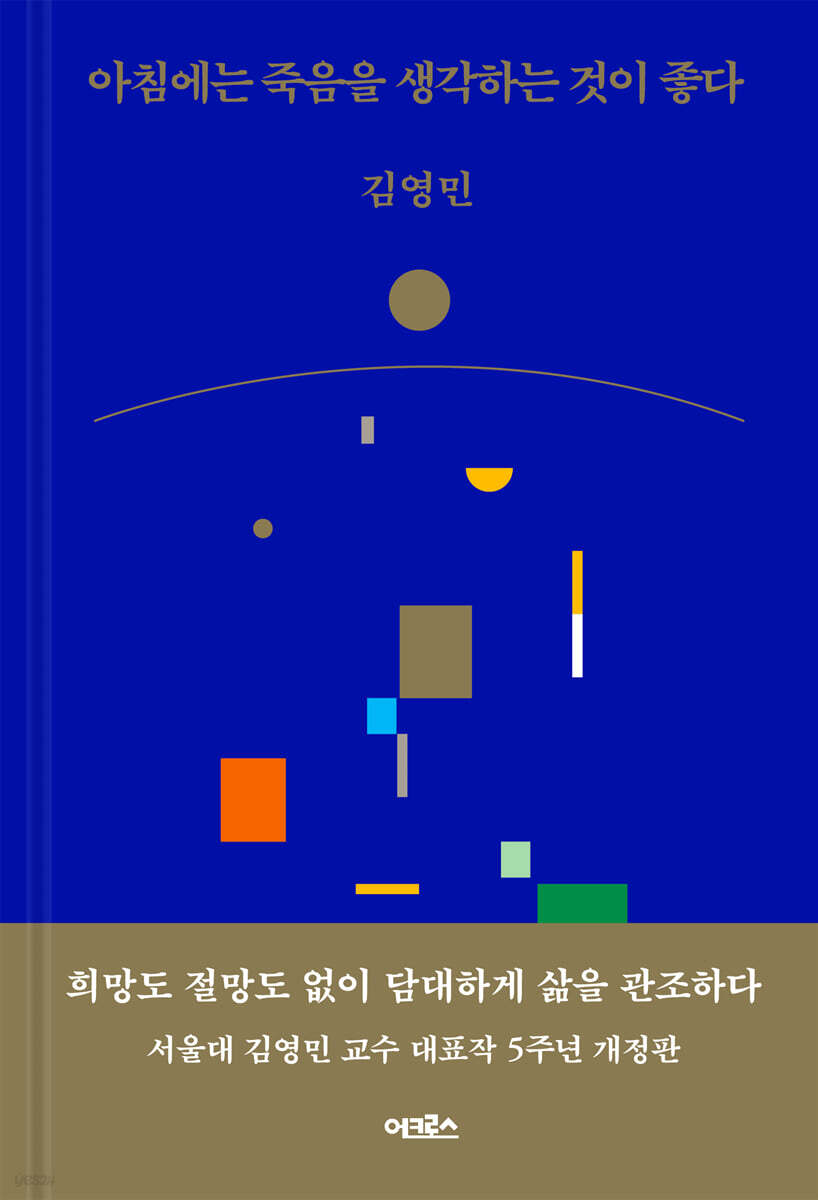
The revised edition has been completely redesigned with refined graphics and bold use of color by North Korean designer Seok Yoon-i.
In addition, the revised edition's preface, "Why Am I Still Alive," provides an opportunity to reconsider the fundamental meaning of life and death.
Furthermore, an interview with big data expert Song Gil-young about the complex existence of humans and a conversation with Na Yoon-seok, a reporter for Munhwa Ilbo, based on the question, “What is Kim Young-min?” were added.
“Why am I still alive?
In the scorching heat, the Earth rotates, glaciers melt and disappear even today, the ruins of society are rapidly revealing themselves, and humanity's anger quietly runs wild, in this place where the desire to be a good person has faded, in this place where propaganda about saving lives is rampant, in this place where people are busy hating others by judging their lives, in this place where they only think of themselves and their families.
Why am I still alive in this place where people are increasingly reluctant to have children?
“I am still alive because I thought of death in the morning.”
Professor Kim Young-min's masterpiece, loved by 100,000 readers
『It's Good to Think About Death in the Morning』 5th Anniversary Revised Edition Released!
What is Chuseok, what is growth, what is power.
Professor Kim Young-min of Seoul National University, who raised sharp questions about existence and reminded us of the importance of reflection in everyday life.
Professor Kim Young-min, who did not let his daily life pass by carelessly, but rather stimulated students at school, witnessed absurdities in society, raised questions through movies, and discovered himself through conversation, has published the 5th anniversary revised edition of his first prose collection, "It's Good to Think About Death in the Morning," with a new format and design.
The revised edition has been completely redesigned with refined graphics and bold use of color by North Korean designer Seok Yoon-i.
In addition, the revised edition's preface, "Why Am I Still Alive," provides an opportunity to reconsider the fundamental meaning of life and death.
Furthermore, an interview with big data expert Song Gil-young about the complex existence of humans and a conversation with Na Yoon-seok, a reporter for Munhwa Ilbo, based on the question, “What is Kim Young-min?” were added.
“Why am I still alive?
In the scorching heat, the Earth rotates, glaciers melt and disappear even today, the ruins of society are rapidly revealing themselves, and humanity's anger quietly runs wild, in this place where the desire to be a good person has faded, in this place where propaganda about saving lives is rampant, in this place where people are busy hating others by judging their lives, in this place where they only think of themselves and their families.
Why am I still alive in this place where people are increasingly reluctant to have children?
“I am still alive because I thought of death in the morning.”
- You can preview some of the book's contents.
Preview
index
Revised Edition: Why Am I Still Alive 4
Prologue: Chronicles of Those Who Thought of Death in the Morning, Part 8
Part 1 In the muddy waters of time
It's good to think about death in the morning 21
I have no plans to be happy in the new year 26
30 in the muddy waters of time
Kyoto Travelogue: 35 in the style of Mujin Travelogue
What is Growth 39
Theory and Practice of Dishwashing 44
Three Wedding Speeches for Those Who Are Definitely Getting Married 48
Three Episodes About Children, Part 58
What is Chuseok? How to Celebrate the Holidays 1 64
How to Enjoy Chuseok_ How to Spend the Holidays 2 68
An Atheist's Chuseok_How to Celebrate the Holidays 3 72
Part 2 In a faint hope
79 after the CSAT
Martial Arts Novel for Freshmen 83
Encouragement for Students Aspiring to Become the So-Called Elite, Part 2, No. 87
Give Me Comics or Give Me Death 92
I want to go to graduate school 97
Lady Bird and the Little Princess 102
I Can Speak 107
Professor K's State Theory 111
International Student Declaration 115
119 to the February graduates
What is Corruption? 123
How to Avoid Being a Slave 127
Seoul National University's Identity 131
What is Power 135
Graduation Montage 140
Last Class Imagination 144
Part 3: Solitude and Neighborhood
The Smell of June 151
Reply 1988 155
Asking for Hope 159
163 to the square
Waiting for the Constitutional Court's decision 167
Hymn of the Republic 172
How to Debate a Presidential Candidate 176
What Freedom and Dignity Will You Choose? 180
The disaster lasts a long time 185
Invisible Country 189
Disappearing People 193
Hades and Sisyphus 197
What the Ministry of Education Should Do Regarding the Pig and Dog Issues 201
Table and Spoon 206
Medieval Winter Thoughts in Summer 210
The Meaning of Liberation 214
Memories of Urine 218
From Dangun to Modernization 222
Belly Fat Dream 226
It's time to wake up 230
They will come 234
The Man Called Walnut Fist 238
Column for Column 242
Part 4: On Things That Are of This World and Not of This World
Movie of My Life: Antonia's Line 249
A Flower That Isn't a Rose in the Snow: Hong Sang-soo's Early Films 271
The knowledgeable, romantic, and artistic killer: Hannibal Lecter 282
The Hero as Antihero, the Materialist as Idealist, the Living as the Dead: Ghostdog 302
Part 5: I want to live a life of "small worries" rather than fleeting happiness.
The Complexity of Human Beings: Interview with Song Gil-young from Domus Korea 314
Why I Dream of a Life of Small Unhappiness Rather Than Happiness _ Interview with Shin Dong-A reporter Song Hwa-seon, Part 351
What is Kim Young-min? _ A Conversation with Na Yoon-seok, Munhwa Ilbo Reporter, Part 372
383 until the epilogue book comes out
Prologue: Chronicles of Those Who Thought of Death in the Morning, Part 8
Part 1 In the muddy waters of time
It's good to think about death in the morning 21
I have no plans to be happy in the new year 26
30 in the muddy waters of time
Kyoto Travelogue: 35 in the style of Mujin Travelogue
What is Growth 39
Theory and Practice of Dishwashing 44
Three Wedding Speeches for Those Who Are Definitely Getting Married 48
Three Episodes About Children, Part 58
What is Chuseok? How to Celebrate the Holidays 1 64
How to Enjoy Chuseok_ How to Spend the Holidays 2 68
An Atheist's Chuseok_How to Celebrate the Holidays 3 72
Part 2 In a faint hope
79 after the CSAT
Martial Arts Novel for Freshmen 83
Encouragement for Students Aspiring to Become the So-Called Elite, Part 2, No. 87
Give Me Comics or Give Me Death 92
I want to go to graduate school 97
Lady Bird and the Little Princess 102
I Can Speak 107
Professor K's State Theory 111
International Student Declaration 115
119 to the February graduates
What is Corruption? 123
How to Avoid Being a Slave 127
Seoul National University's Identity 131
What is Power 135
Graduation Montage 140
Last Class Imagination 144
Part 3: Solitude and Neighborhood
The Smell of June 151
Reply 1988 155
Asking for Hope 159
163 to the square
Waiting for the Constitutional Court's decision 167
Hymn of the Republic 172
How to Debate a Presidential Candidate 176
What Freedom and Dignity Will You Choose? 180
The disaster lasts a long time 185
Invisible Country 189
Disappearing People 193
Hades and Sisyphus 197
What the Ministry of Education Should Do Regarding the Pig and Dog Issues 201
Table and Spoon 206
Medieval Winter Thoughts in Summer 210
The Meaning of Liberation 214
Memories of Urine 218
From Dangun to Modernization 222
Belly Fat Dream 226
It's time to wake up 230
They will come 234
The Man Called Walnut Fist 238
Column for Column 242
Part 4: On Things That Are of This World and Not of This World
Movie of My Life: Antonia's Line 249
A Flower That Isn't a Rose in the Snow: Hong Sang-soo's Early Films 271
The knowledgeable, romantic, and artistic killer: Hannibal Lecter 282
The Hero as Antihero, the Materialist as Idealist, the Living as the Dead: Ghostdog 302
Part 5: I want to live a life of "small worries" rather than fleeting happiness.
The Complexity of Human Beings: Interview with Song Gil-young from Domus Korea 314
Why I Dream of a Life of Small Unhappiness Rather Than Happiness _ Interview with Shin Dong-A reporter Song Hwa-seon, Part 351
What is Kim Young-min? _ A Conversation with Na Yoon-seok, Munhwa Ilbo Reporter, Part 372
383 until the epilogue book comes out
Detailed image

Into the book
It's good to think about death in the morning.
It is not good to be afraid of death while looking at the sunset.
It is not good to be overwhelmed by death while holding a glass of wine in front of you.
It is not good to stare at the ceiling and suffer from the urge to die.
It is good to wake up in the morning and 'think' about death with the trained muscles of the mind.
Franz Kafka once said, “People take pictures of things in order to drive them out of their minds.”
By thinking about death, you can drive it out of your life.
We can temporarily banish the shameless language and flashy fake desires that make life sick.
--- From "Why Am I Still Alive"
If there are no wounds, it is just a canvas on which nothing has been painted, a life that ended after hesitating due to lack of courage.
Once you are born, you have no choice but to grow, and wounds are inevitable during the process of growth.
Proper growth gives us a broader perspective and distance, so that we can look at our wounds even when we are hurt.
That even wounds can eventually stop bleeding and become aesthetic objects.
That is the promise of salvation that growth and art give us.
--- From "What is Growth?"
When your mother asks, “Are you going to get married or not?” answer, “What is marriage?”
When someone says to him, “Is he crazy?”, reply, “What is sanity?”
When my father says, “Give me at least one grandchild,” I ask, “What is a descendant?”
When someone says, “I feel lonely all the time,” ask, “What is loneliness?”
When people say, “Can’t you even talk about this with your family?” I ask, “What is family?”
These conversations about identity will become sacred incantations that will banish old, demonic influences and set you free.
--- From "What is Chuseok"
If you have studied hard to get into college, you must experience a lightbulb going on in your head through knowledge.
Like a cat that has been trapped in a sack, you have to wander the campus in search of such luxurious intellectual experiences.
And the true compensation for the tedious time spent preparing for the entrance exams must come from that bright knowledge.
So that you don't die without ever knowing that there are other kinds of study in the world that you might truly enjoy.
--- From "After the CSAT"
When we face death in the future and evaluate our own lives, what criteria should we use? It won't be how much money we earned, how much social prestige we enjoyed, or who lived the longest.
I think a more fundamental criterion is who has a good life story.
So what makes a good story?
--- From "To the February Graduates"
Just as every story has an end, so too does life.
Just as the meaning of all stories is determined by their ending, the meaning of life is determined by the way we die.
Depending on the ending, the meaning of the events that have unfolded so far may change.
This is what is meant by the saying, “Every human being lives in order to die properly.”
It is not good to be afraid of death while looking at the sunset.
It is not good to be overwhelmed by death while holding a glass of wine in front of you.
It is not good to stare at the ceiling and suffer from the urge to die.
It is good to wake up in the morning and 'think' about death with the trained muscles of the mind.
Franz Kafka once said, “People take pictures of things in order to drive them out of their minds.”
By thinking about death, you can drive it out of your life.
We can temporarily banish the shameless language and flashy fake desires that make life sick.
--- From "Why Am I Still Alive"
If there are no wounds, it is just a canvas on which nothing has been painted, a life that ended after hesitating due to lack of courage.
Once you are born, you have no choice but to grow, and wounds are inevitable during the process of growth.
Proper growth gives us a broader perspective and distance, so that we can look at our wounds even when we are hurt.
That even wounds can eventually stop bleeding and become aesthetic objects.
That is the promise of salvation that growth and art give us.
--- From "What is Growth?"
When your mother asks, “Are you going to get married or not?” answer, “What is marriage?”
When someone says to him, “Is he crazy?”, reply, “What is sanity?”
When my father says, “Give me at least one grandchild,” I ask, “What is a descendant?”
When someone says, “I feel lonely all the time,” ask, “What is loneliness?”
When people say, “Can’t you even talk about this with your family?” I ask, “What is family?”
These conversations about identity will become sacred incantations that will banish old, demonic influences and set you free.
--- From "What is Chuseok"
If you have studied hard to get into college, you must experience a lightbulb going on in your head through knowledge.
Like a cat that has been trapped in a sack, you have to wander the campus in search of such luxurious intellectual experiences.
And the true compensation for the tedious time spent preparing for the entrance exams must come from that bright knowledge.
So that you don't die without ever knowing that there are other kinds of study in the world that you might truly enjoy.
--- From "After the CSAT"
When we face death in the future and evaluate our own lives, what criteria should we use? It won't be how much money we earned, how much social prestige we enjoyed, or who lived the longest.
I think a more fundamental criterion is who has a good life story.
So what makes a good story?
--- From "To the February Graduates"
Just as every story has an end, so too does life.
Just as the meaning of all stories is determined by their ending, the meaning of life is determined by the way we die.
Depending on the ending, the meaning of the events that have unfolded so far may change.
This is what is meant by the saying, “Every human being lives in order to die properly.”
--- From "What Freedom and Dignity Will You Choose?"
Publisher's Review
It's like a letter of encouragement from the universe to me when I'm exhausted.
- Aladdin Reader Reviews
His writing glides between the micro and macro aspects of life with wit.
- Chosun Ilbo
He has a unique sense for twisting what is taken for granted.
- Maeil Business Newspaper
Writing that transcends futility and approaches essence - JoongAng Ilbo
Warm advice from a senior who has walked a few more steps on the path of life.
- Sisa In
'What is Chuseok?' by Professor Kim Young-min of Seoul National University
A story about the vanity and beauty of life
Professor Kim Young-min's book, "It's Good to Think About Death in the Morning," which uniquely reads our times with essential yet not boring questions and clear yet not frivolous answers, contains the essence of Kim Young-min's writing, which breaks through the banality of everyday life and approaches the essence with counter-questions, twists, sharp humor, and free thinking.
This book contains stories about Professor Kim Young-min's concerns and affections between daily life and society, school and students, movies and reading.
He says he wanted to use this book as a medium to “talk about living with the people around me” and “share a critical awareness that breaks the unwritten rules that apply in our society.”
“So, when times were tough, I would go to a quiet place, close the door, and think about death.
After spending a day like that, I felt like my life, which had been unstable, had become more stable.
It is that very feeling that still forms the basis of my life.
It's a time far from life, but perhaps the most solid and stable time in life.
When life hurts, think about that time and talk to yourself.
“I can somehow endure and live on because I am already dead.”
Paradox: Insight into death, the opposite side of life,
Revealing the meaning of our lives today
From the book title, “It’s Good to Think About Death in the Morning,” to “There Are No Plans to Be Happy in the New Year,” “A Wedding Address for Those Who Decide to Get Married,” and “What is Chuseok?”
Professor Kim Young-min's story begins with a fresh, yet weighty question.
He believes that the key to getting to the heart of the matter lies in asking whether what you believe or take for granted is beyond doubt.
Through repeated questions throughout the book, Professor Kim Young-min delivers a message that penetrates the core of life, the world, and academia.
Through this, readers will have the opportunity to achieve a renewal of awareness and examine what questions they are currently living with.
Mark Tyson, one of the greatest boxers of all time, once said:
'Everyone has a plausible plan.
'Until it hits you.' People usually start the year with good expectations, but soon realize how helpless they all are.
When you step into the ring, you have to be prepared to get hit.
So I don't have any plans to be happy in the new year.”
Humor: something you won't easily find in existing essays.
Writing that gives a sense of exhilaration and novelty
The reason essayist Kim Young-min garners so much attention is not only because of his themes and messages, but also because of his solid yet flexible writing, imbued with a sense of rhythm, humor, and wit that is not easily found in traditional newspaper columns or Korean essays.
In newspaper columns, which were considered a strict domain, any level of playfulness, humor, aggression, or sarcasm beyond that was considered taboo.
But Professor Kim Young-min's writing goes beyond that barrier.
He uses humor to effectively convey his message, but he infuses his writing with an exquisite sense of rhythm that goes beyond 'joking' to be dignified and engaging.
His humor creates an opportunity to look at the obvious as something not so obvious, and boldly reveals tastes outside the shackles of strictness, solemnity, and seriousness. In a way, like a child's question, it has the power to hit the nail on the head when everyone else is straining their necks.
Many readers expressed their exhilaration and novelty in the tightrope walk that combines his writing skills, sensibilities, knowledge, and experience.
“I don’t like boring writing.
The fun we're talking about here has a very broad meaning, and frankly, I don't think it should be boring.
“Life is too short to eat tasteless desserts.”
Gaze: Not a teacher who sells baseless hopes
The teacher's role as a fellow student learning together with his students
This book, which covers a wide range of topics, from daily life and society to movies and books, also highlights Professor Kim Young-min's position as a teacher and the perspective he presents.
In his writings, which do not hide his identity as a teacher, he does not hesitate to talk about the lives of students in our society.
In this day and age, when we struggle with anxiety about a future that we cannot see even an inch ahead of, the days when we could simply tell the youth of this era, "It hurts, that's youth," are over.
There is no use in telling people that youth is an age where they can do anything and that they can overcome anything at any time.
Kim Young-min, a thoughtful yet cautious teacher who cares for his students more than anyone else in the world, speaks through various formats (graduation speech, congratulatory address, conversation).
Through his graduation speech, he welcomes those entering the world of the older generation with a sympathetic heart, and his calm reflections leave a touching impression.
"What criteria should we use when evaluating our own lives? It's not about how much money we've earned, how much social prestige we've enjoyed, or how long we've lived.
“I think a more fundamental criterion is, ‘Who has a good life story?’”
Attitude: We all accept uncertainty as part of life.
I would rather live enjoying small worries than momentary happiness.
“It’s Good to Think About Death in the Morning” contains a total of 56 essays.
The stories he encounters and experiences in everyday life, at school, in society, in movies, and in conversations end with a conversation between Zarathustra and actress Jeon Do-yeon.
In this epilogue, dramatized by Professor Kim Young-min, he argues that it is the reader's privilege to read what they want to read, but he is concerned that readers should avoid reading too plausible a message from the book.
He has no desire to read or write books that preach a definite meaning in life, books that present a clear blueprint for Korea's revival, or books that make definitive predictions about the future of human civilization.
Professor Kim Young-min is unsure about many things, but he is even less confident about such claims.
He says he hopes this book will help us all embrace uncertainty as part of life and live a more joyful and enriching life without great suffering.
Just like his wish to live a life of ‘small worries’ rather than momentary happiness.
- Aladdin Reader Reviews
His writing glides between the micro and macro aspects of life with wit.
- Chosun Ilbo
He has a unique sense for twisting what is taken for granted.
- Maeil Business Newspaper
Writing that transcends futility and approaches essence - JoongAng Ilbo
Warm advice from a senior who has walked a few more steps on the path of life.
- Sisa In
'What is Chuseok?' by Professor Kim Young-min of Seoul National University
A story about the vanity and beauty of life
Professor Kim Young-min's book, "It's Good to Think About Death in the Morning," which uniquely reads our times with essential yet not boring questions and clear yet not frivolous answers, contains the essence of Kim Young-min's writing, which breaks through the banality of everyday life and approaches the essence with counter-questions, twists, sharp humor, and free thinking.
This book contains stories about Professor Kim Young-min's concerns and affections between daily life and society, school and students, movies and reading.
He says he wanted to use this book as a medium to “talk about living with the people around me” and “share a critical awareness that breaks the unwritten rules that apply in our society.”
“So, when times were tough, I would go to a quiet place, close the door, and think about death.
After spending a day like that, I felt like my life, which had been unstable, had become more stable.
It is that very feeling that still forms the basis of my life.
It's a time far from life, but perhaps the most solid and stable time in life.
When life hurts, think about that time and talk to yourself.
“I can somehow endure and live on because I am already dead.”
Paradox: Insight into death, the opposite side of life,
Revealing the meaning of our lives today
From the book title, “It’s Good to Think About Death in the Morning,” to “There Are No Plans to Be Happy in the New Year,” “A Wedding Address for Those Who Decide to Get Married,” and “What is Chuseok?”
Professor Kim Young-min's story begins with a fresh, yet weighty question.
He believes that the key to getting to the heart of the matter lies in asking whether what you believe or take for granted is beyond doubt.
Through repeated questions throughout the book, Professor Kim Young-min delivers a message that penetrates the core of life, the world, and academia.
Through this, readers will have the opportunity to achieve a renewal of awareness and examine what questions they are currently living with.
Mark Tyson, one of the greatest boxers of all time, once said:
'Everyone has a plausible plan.
'Until it hits you.' People usually start the year with good expectations, but soon realize how helpless they all are.
When you step into the ring, you have to be prepared to get hit.
So I don't have any plans to be happy in the new year.”
Humor: something you won't easily find in existing essays.
Writing that gives a sense of exhilaration and novelty
The reason essayist Kim Young-min garners so much attention is not only because of his themes and messages, but also because of his solid yet flexible writing, imbued with a sense of rhythm, humor, and wit that is not easily found in traditional newspaper columns or Korean essays.
In newspaper columns, which were considered a strict domain, any level of playfulness, humor, aggression, or sarcasm beyond that was considered taboo.
But Professor Kim Young-min's writing goes beyond that barrier.
He uses humor to effectively convey his message, but he infuses his writing with an exquisite sense of rhythm that goes beyond 'joking' to be dignified and engaging.
His humor creates an opportunity to look at the obvious as something not so obvious, and boldly reveals tastes outside the shackles of strictness, solemnity, and seriousness. In a way, like a child's question, it has the power to hit the nail on the head when everyone else is straining their necks.
Many readers expressed their exhilaration and novelty in the tightrope walk that combines his writing skills, sensibilities, knowledge, and experience.
“I don’t like boring writing.
The fun we're talking about here has a very broad meaning, and frankly, I don't think it should be boring.
“Life is too short to eat tasteless desserts.”
Gaze: Not a teacher who sells baseless hopes
The teacher's role as a fellow student learning together with his students
This book, which covers a wide range of topics, from daily life and society to movies and books, also highlights Professor Kim Young-min's position as a teacher and the perspective he presents.
In his writings, which do not hide his identity as a teacher, he does not hesitate to talk about the lives of students in our society.
In this day and age, when we struggle with anxiety about a future that we cannot see even an inch ahead of, the days when we could simply tell the youth of this era, "It hurts, that's youth," are over.
There is no use in telling people that youth is an age where they can do anything and that they can overcome anything at any time.
Kim Young-min, a thoughtful yet cautious teacher who cares for his students more than anyone else in the world, speaks through various formats (graduation speech, congratulatory address, conversation).
Through his graduation speech, he welcomes those entering the world of the older generation with a sympathetic heart, and his calm reflections leave a touching impression.
"What criteria should we use when evaluating our own lives? It's not about how much money we've earned, how much social prestige we've enjoyed, or how long we've lived.
“I think a more fundamental criterion is, ‘Who has a good life story?’”
Attitude: We all accept uncertainty as part of life.
I would rather live enjoying small worries than momentary happiness.
“It’s Good to Think About Death in the Morning” contains a total of 56 essays.
The stories he encounters and experiences in everyday life, at school, in society, in movies, and in conversations end with a conversation between Zarathustra and actress Jeon Do-yeon.
In this epilogue, dramatized by Professor Kim Young-min, he argues that it is the reader's privilege to read what they want to read, but he is concerned that readers should avoid reading too plausible a message from the book.
He has no desire to read or write books that preach a definite meaning in life, books that present a clear blueprint for Korea's revival, or books that make definitive predictions about the future of human civilization.
Professor Kim Young-min is unsure about many things, but he is even less confident about such claims.
He says he hopes this book will help us all embrace uncertainty as part of life and live a more joyful and enriching life without great suffering.
Just like his wish to live a life of ‘small worries’ rather than momentary happiness.
GOODS SPECIFICS
- Date of issue: September 15, 2023
- Format: Hardcover book binding method guide
- Page count, weight, size: 388 pages | 128*188*26mm
- ISBN13: 9791167741165
You may also like
카테고리
korean


korean

![GQ KOREA Mark (Monthly): December [2025]](http://librairie.coreenne.fr/cdn/shop/files/8ef265dbbfbf186523ed75ba7319009d.jpg?v=1765340328&width=3840)


