

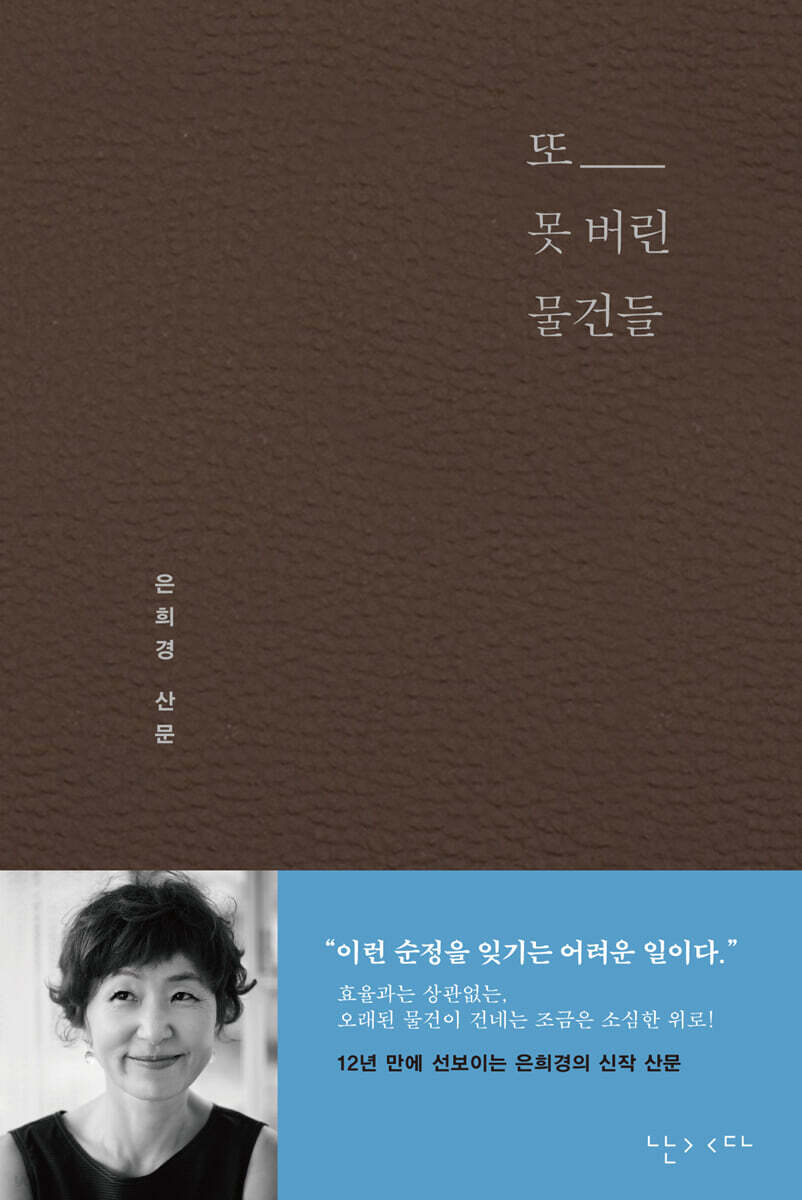
Other things I can't throw away
 |
Description
Book Introduction
- A word from MD
-
Precious memories discovered in everyday life by Eun Hee-kyungAs this is Eun Hee-kyung's first collection of prose in 12 years, it is a welcome book for readers who have been reading her novels.
The photographs he took of objects that prove time by their very existence, and the stories they contain, are full of affection.
The precious and poignant discoveries of life come to me too.
September 1, 2023. Essay PD Lee Na-young
Novelist Eun Hee-kyung, who always promises new fun, is publishing her new prose work, “Things I Can’t Throw Away Again,” through Nanda Publishing after 12 years.
The manuscript of 'Eun Hee-kyung's Things', which was serialized on Channel Yes from July to December 2022 and received much love from readers, has been carefully edited and bound into a book.
Although it has nothing to do with efficiency, I included twenty-four prose pieces about objects that cannot be easily thrown away because they are steeped in the time we spent together and the trajectory of our lives, along with photos I took myself.
This could be said to be the work in which Eun Hee-kyung, a novelist with 28 years of experience, makes her full-fledged debut in the prose genre.
It's quite fun to try to guess the sources of Eun Hee-kyung's novels cited throughout the book and in which works these items appear.
This book will be especially welcome to those who are keen on Eun Hee-kyung's previous works.
The manuscript of 'Eun Hee-kyung's Things', which was serialized on Channel Yes from July to December 2022 and received much love from readers, has been carefully edited and bound into a book.
Although it has nothing to do with efficiency, I included twenty-four prose pieces about objects that cannot be easily thrown away because they are steeped in the time we spent together and the trajectory of our lives, along with photos I took myself.
This could be said to be the work in which Eun Hee-kyung, a novelist with 28 years of experience, makes her full-fledged debut in the prose genre.
It's quite fun to try to guess the sources of Eun Hee-kyung's novels cited throughout the book and in which works these items appear.
This book will be especially welcome to those who are keen on Eun Hee-kyung's previous works.
- You can preview some of the book's contents.
Preview
index
0 My things started talking about me… 7
1 The capacity of a glass is not proportional to the amount of alcohol consumed… 13
2 To avoid cutting your hands with a potato peeler… 21
3 My shoehorn, is this okay? … 31
4. Gifting an umbrella and calendar… 39
5 Things You Shouldn't Lend to Your Friends… 47
6 Which of the following is not my pencil? … 57
7 Which of the following is not one of my luxuries? … 67
8 Remembering the departed… 77
9 Characters of the Necklace … 89
10 The Boy and the Mask of Evil… 99
11 The Pot-Bap Diet… 109
12 Things I Like About Stone and Iron… 119
13 Happy Endings for Ballet… 129
14 Cocktails and Mahjong, Duras and Tang Wei… 139
15 More Things I Can't Throw Away… 149
16 The dolls we loved back then… 161
17 The Season of Stockings… 169
Have you ever tried 18 medals? … 181
19 Things you see when you sit at your desk… 193
20 Finally, the cat… 203
21 The question of why it is necessary is rejected… 213
22 Maps, Territories, and License Plates… 223
00 Like a winter brunch… 235
1 The capacity of a glass is not proportional to the amount of alcohol consumed… 13
2 To avoid cutting your hands with a potato peeler… 21
3 My shoehorn, is this okay? … 31
4. Gifting an umbrella and calendar… 39
5 Things You Shouldn't Lend to Your Friends… 47
6 Which of the following is not my pencil? … 57
7 Which of the following is not one of my luxuries? … 67
8 Remembering the departed… 77
9 Characters of the Necklace … 89
10 The Boy and the Mask of Evil… 99
11 The Pot-Bap Diet… 109
12 Things I Like About Stone and Iron… 119
13 Happy Endings for Ballet… 129
14 Cocktails and Mahjong, Duras and Tang Wei… 139
15 More Things I Can't Throw Away… 149
16 The dolls we loved back then… 161
17 The Season of Stockings… 169
Have you ever tried 18 medals? … 181
19 Things you see when you sit at your desk… 193
20 Finally, the cat… 203
21 The question of why it is necessary is rejected… 213
22 Maps, Territories, and License Plates… 223
00 Like a winter brunch… 235
Into the book
I remember the set of six beer glasses I bought with the royalties from my first book after becoming a writer.
Why did you start with that?
When I was raising children and barely able to go out, there were guests who suddenly came to my house with beer.
I quickly gathered the glasses on a tray, barely able to arrange five glasses for the number of people seated, but there was not a single pair that matched.
Even the sizes were different, so when I poured the beer, the amount of alcohol was different for each.
That table somehow seemed like a shabby representation of my makeshift life.
Since then, for me, a set of glasses seemed to be the beginning of a private luxury, along with the act of drinking.
---From “The capacity of a glass is not proportional to the amount of alcohol consumed”
There is another pen in the picture, not a pencil.
A blue ballpoint pen given to visitors by banks, with the name of the bank and branch printed on it.
I received the pen not from the bank, but from the poet who I guessed had been to the bank.
We ran into each other at a literary event for the first time in about ten years, sat at the same table for a moment, and then he suddenly took it out of his bag and handed it to me.
The teacher spoke calmly to me as I looked at him with a puzzled look.
Yeah, I'm so happy.
At that time, I felt a lump in my throat and just stared at the ballpoint pen in my palm without saying a word.
A period of youth was slowly passing by over my head.
The nights I fell asleep reading my teacher's poetry under the covers because I was afraid of life, the distant futures I promised my friends while reading my teacher's poetry book together, the trip south I took just to lean on a high rock by the sea and mutter my teacher's poetry.
---“Which of the following is not my pencil?”
Above all, when I, in my mid-thirties, exhausted from raising two children and working, decided to set out on my own to write a novel, my mother never said things like, "What about the kids?" or "What is a middle-aged woman going to do now?"
Instead, I came to the resort room that I had obtained with my father's help alone and read the text I was writing (my mother read the sentences in the dialect so awkwardly that since then, I have only used standard Korean in my novels).
And when I, who had barely managed to win the New Year's literary contest but was frustrated by the lack of requests, decided to write a novel, it was my mother who used her connections at the Senior Buddhist University to find me a room in a remote temple.
---From "Remembering the Departed"
After all, humans are not simple beings.
It is a complex being.
Therefore, I think that anyone can have the common sense of delicacy as long as they are conscious of it.
Others are complex beings, just like me, and should not be recklessly interpreted within my own framework.
I may not be an artist who creates just one thing, but I want to write with the thought that it helps us preserve the uniqueness that literature gives us, the uniqueness that humans have.
---From "The Necklace's Character"
The warm steam and the savory smell of freshly cooked rice that hit your face when you open the lid.
A soft and smooth texture that touches the spatula.
And the nurungji that is softly cooked in the remaining heat of the pot in the water poured in.
Although rice cooked in a stone pot with abalone or eel is good, I am more drawn to rice cooked in a stone pot with mushrooms, wild vegetables, ginkgo nuts, and jujubes.
Even in the hot summer, my choice is pot rice over rice bowl.
I have a friend who says that it's because you get older, but that's not true.
I've loved warm food since I was little.
I still remember coming home from school on a hot day, carefully pouring water from the kettle my mom had set down on the tiled kitchen floor to cool down the barley tea she had just made, and holding the warm cup in my hand.
He loved walking under the blazing sun and by the end of summer vacation he was a pitch-black kid.
---From "The Pot-Bob Diet"
Being a beginner also means becoming a minor, like a traveler or a student.
I find myself looking at myself from an unfamiliar and strange point.
Growing older, growing apart from friends, changes and losses.
New and unfamiliar things always come to us.
We are all beginners in this time we have never experienced before, and as long as life continues, it will always be a first journey.
So, wouldn't it be good to do a training session or two to prepare for the coming time as an 'unknown person'?
---From "Cocktails and Mahjong, Duras and Tang Wei"
It's useless, but what can you do?
I like the extraordinary feeling I get when I look at the shape, texture, and craftsmanship of such objects.
The proof of the existence of the useless is what allows me to discover and revive another self within me, someone I don't know.
(…) The time I spend with things also plays a part in making them impossible to throw away.
Objects contain memories of me when I bought them, me when I used them, and the people who were with me at that time, and I want to respect that time.
---From "Things I Can't Throw Away"
Living abroad as a clumsy, incompetent stranger and minority, running gave me a sense of accomplishment, however small.
The moment I control and pull my body to the point I want, I feel a little stronger and relieved that I have done my best.
Perhaps it was more of a confirmation and assurance that I was not weak and that I had strength within me, rather than a feeling of having become stronger.
By then, old tracksuits were quite fitting, but it also meant that I had gained the courage to not care about my clothes.
Why did you start with that?
When I was raising children and barely able to go out, there were guests who suddenly came to my house with beer.
I quickly gathered the glasses on a tray, barely able to arrange five glasses for the number of people seated, but there was not a single pair that matched.
Even the sizes were different, so when I poured the beer, the amount of alcohol was different for each.
That table somehow seemed like a shabby representation of my makeshift life.
Since then, for me, a set of glasses seemed to be the beginning of a private luxury, along with the act of drinking.
---From “The capacity of a glass is not proportional to the amount of alcohol consumed”
There is another pen in the picture, not a pencil.
A blue ballpoint pen given to visitors by banks, with the name of the bank and branch printed on it.
I received the pen not from the bank, but from the poet who I guessed had been to the bank.
We ran into each other at a literary event for the first time in about ten years, sat at the same table for a moment, and then he suddenly took it out of his bag and handed it to me.
The teacher spoke calmly to me as I looked at him with a puzzled look.
Yeah, I'm so happy.
At that time, I felt a lump in my throat and just stared at the ballpoint pen in my palm without saying a word.
A period of youth was slowly passing by over my head.
The nights I fell asleep reading my teacher's poetry under the covers because I was afraid of life, the distant futures I promised my friends while reading my teacher's poetry book together, the trip south I took just to lean on a high rock by the sea and mutter my teacher's poetry.
---“Which of the following is not my pencil?”
Above all, when I, in my mid-thirties, exhausted from raising two children and working, decided to set out on my own to write a novel, my mother never said things like, "What about the kids?" or "What is a middle-aged woman going to do now?"
Instead, I came to the resort room that I had obtained with my father's help alone and read the text I was writing (my mother read the sentences in the dialect so awkwardly that since then, I have only used standard Korean in my novels).
And when I, who had barely managed to win the New Year's literary contest but was frustrated by the lack of requests, decided to write a novel, it was my mother who used her connections at the Senior Buddhist University to find me a room in a remote temple.
---From "Remembering the Departed"
After all, humans are not simple beings.
It is a complex being.
Therefore, I think that anyone can have the common sense of delicacy as long as they are conscious of it.
Others are complex beings, just like me, and should not be recklessly interpreted within my own framework.
I may not be an artist who creates just one thing, but I want to write with the thought that it helps us preserve the uniqueness that literature gives us, the uniqueness that humans have.
---From "The Necklace's Character"
The warm steam and the savory smell of freshly cooked rice that hit your face when you open the lid.
A soft and smooth texture that touches the spatula.
And the nurungji that is softly cooked in the remaining heat of the pot in the water poured in.
Although rice cooked in a stone pot with abalone or eel is good, I am more drawn to rice cooked in a stone pot with mushrooms, wild vegetables, ginkgo nuts, and jujubes.
Even in the hot summer, my choice is pot rice over rice bowl.
I have a friend who says that it's because you get older, but that's not true.
I've loved warm food since I was little.
I still remember coming home from school on a hot day, carefully pouring water from the kettle my mom had set down on the tiled kitchen floor to cool down the barley tea she had just made, and holding the warm cup in my hand.
He loved walking under the blazing sun and by the end of summer vacation he was a pitch-black kid.
---From "The Pot-Bob Diet"
Being a beginner also means becoming a minor, like a traveler or a student.
I find myself looking at myself from an unfamiliar and strange point.
Growing older, growing apart from friends, changes and losses.
New and unfamiliar things always come to us.
We are all beginners in this time we have never experienced before, and as long as life continues, it will always be a first journey.
So, wouldn't it be good to do a training session or two to prepare for the coming time as an 'unknown person'?
---From "Cocktails and Mahjong, Duras and Tang Wei"
It's useless, but what can you do?
I like the extraordinary feeling I get when I look at the shape, texture, and craftsmanship of such objects.
The proof of the existence of the useless is what allows me to discover and revive another self within me, someone I don't know.
(…) The time I spend with things also plays a part in making them impossible to throw away.
Objects contain memories of me when I bought them, me when I used them, and the people who were with me at that time, and I want to respect that time.
---From "Things I Can't Throw Away"
Living abroad as a clumsy, incompetent stranger and minority, running gave me a sense of accomplishment, however small.
The moment I control and pull my body to the point I want, I feel a little stronger and relieved that I have done my best.
Perhaps it was more of a confirmation and assurance that I was not weak and that I had strength within me, rather than a feeling of having become stronger.
By then, old tracksuits were quite fitting, but it also meant that I had gained the courage to not care about my clothes.
---From "Have you ever worn a medal?"
Publisher's Review
"It's hard to forget such innocence."
Regardless of efficiency,
A little bit of timid comfort from old things!
Eun Hee-kyung's new prose, presented after 12 years
Novelist Eun Hee-kyung, who always promises new fun, is publishing her new prose work, “Things I Can’t Throw Away Again,” through Nanda Publishing after 12 years.
The manuscript of 'Eun Hee-kyung's Things', which was serialized on Channel Yes from July to December 2022 and received much love from readers, has been carefully edited and bound into a book.
Although it has nothing to do with efficiency, I included twenty-four prose pieces about objects that cannot be easily thrown away because they are steeped in the time we spent together and the trajectory of our lives, along with photos I took myself.
This could be said to be the work in which Eun Hee-kyung, a novelist with 28 years of experience, makes her full-fledged debut in the prose genre.
It's quite fun to try to guess the sources of Eun Hee-kyung's novels cited throughout the book and in which works these items appear.
This book will be especially welcome to those who are keen on Eun Hee-kyung's previous works.
Eun Hee-kyung's story, written with familiar objects that reflect her taste, such as glasses, potato knives, shoehorns, umbrellas, calendars, and necklaces, makes us realize how precious it is to continue living our daily lives.
The author's argument(?) that it takes sufficient time to say goodbye to these objects because they are not special because they are expensive or rare, but because they contain memories of my shortcomings, changes, growth, and passing through.
Those who are not good at organizing may find themselves nodding along in agreement.
The inevitable changes and losses in life, things that made us laugh and cry, are vividly depicted through loving and humorous sentences, using objects we cannot throw away.
That lively attitude makes you take a step back and look at life, which can be heavy, in a lighter way.
It's refreshing to experience life intuitively, as this perspective reminds us that life isn't just about what's in front of us.
When I try to organize my things (!) and become lost in the memories and relationships that were there, I look back on how I became who I am today.
When faced with the question, “Why is that necessary?”, the proof of the existence of this useless thing may resemble the comfort of art and literature, which always maintain their place on the side of humanity and seem useless in real life.
Eunhee Kyung writes.
We are all beginners in this time we have never experienced before.
As we reunite with the time contained in the object, the author quietly gives us the courage to take a step forward as an ‘unknown person.’
The book also includes 24 photos taken by author Eunhee Kyung with an iPhone 11.
The author says that just as he composed the story in words, he had fun figuring out how to capture this story in a single photo.
The meticulous details captured in the photos with a loving gaze give a sense of longing that encompasses memories, the present, and the future to come at the end of the story.
I chose each color that stood out from the 24 photos in the book and designed the background color of the text, and used this glossy paper for the text.
The sturdy suit is made of eco-friendly paper with a leather texture and stamped with a silver foil that gives it a subtle shine.
Because these past times that I tried to throw away but couldn't are what ultimately make me imagine my future self.
I hope this book will be one you can keep close by and pat, and open again when you want to gain the strength to become your own unique self.
Looking back, it seems that various personal feelings were at play in leading me to write this article.
Above all, I had a selfish desire to become light and simple.
If you are a heavy and complicated person, you must have thought about it at least once.
Sometimes that lightness and simplicity, like the cool air when you open a window on a sleepless morning, reminds us that life doesn't just lie before us.
It is important to put your beliefs into practice, but it is also important to keep your daily life going.
(…)
I think in front of old things.
I changed little by little and became who I am.
Everyone would do that every day.
With the passage of time for things.
_The part about "My things started talking about me"
Regardless of efficiency,
A little bit of timid comfort from old things!
Eun Hee-kyung's new prose, presented after 12 years
Novelist Eun Hee-kyung, who always promises new fun, is publishing her new prose work, “Things I Can’t Throw Away Again,” through Nanda Publishing after 12 years.
The manuscript of 'Eun Hee-kyung's Things', which was serialized on Channel Yes from July to December 2022 and received much love from readers, has been carefully edited and bound into a book.
Although it has nothing to do with efficiency, I included twenty-four prose pieces about objects that cannot be easily thrown away because they are steeped in the time we spent together and the trajectory of our lives, along with photos I took myself.
This could be said to be the work in which Eun Hee-kyung, a novelist with 28 years of experience, makes her full-fledged debut in the prose genre.
It's quite fun to try to guess the sources of Eun Hee-kyung's novels cited throughout the book and in which works these items appear.
This book will be especially welcome to those who are keen on Eun Hee-kyung's previous works.
Eun Hee-kyung's story, written with familiar objects that reflect her taste, such as glasses, potato knives, shoehorns, umbrellas, calendars, and necklaces, makes us realize how precious it is to continue living our daily lives.
The author's argument(?) that it takes sufficient time to say goodbye to these objects because they are not special because they are expensive or rare, but because they contain memories of my shortcomings, changes, growth, and passing through.
Those who are not good at organizing may find themselves nodding along in agreement.
The inevitable changes and losses in life, things that made us laugh and cry, are vividly depicted through loving and humorous sentences, using objects we cannot throw away.
That lively attitude makes you take a step back and look at life, which can be heavy, in a lighter way.
It's refreshing to experience life intuitively, as this perspective reminds us that life isn't just about what's in front of us.
When I try to organize my things (!) and become lost in the memories and relationships that were there, I look back on how I became who I am today.
When faced with the question, “Why is that necessary?”, the proof of the existence of this useless thing may resemble the comfort of art and literature, which always maintain their place on the side of humanity and seem useless in real life.
Eunhee Kyung writes.
We are all beginners in this time we have never experienced before.
As we reunite with the time contained in the object, the author quietly gives us the courage to take a step forward as an ‘unknown person.’
The book also includes 24 photos taken by author Eunhee Kyung with an iPhone 11.
The author says that just as he composed the story in words, he had fun figuring out how to capture this story in a single photo.
The meticulous details captured in the photos with a loving gaze give a sense of longing that encompasses memories, the present, and the future to come at the end of the story.
I chose each color that stood out from the 24 photos in the book and designed the background color of the text, and used this glossy paper for the text.
The sturdy suit is made of eco-friendly paper with a leather texture and stamped with a silver foil that gives it a subtle shine.
Because these past times that I tried to throw away but couldn't are what ultimately make me imagine my future self.
I hope this book will be one you can keep close by and pat, and open again when you want to gain the strength to become your own unique self.
Looking back, it seems that various personal feelings were at play in leading me to write this article.
Above all, I had a selfish desire to become light and simple.
If you are a heavy and complicated person, you must have thought about it at least once.
Sometimes that lightness and simplicity, like the cool air when you open a window on a sleepless morning, reminds us that life doesn't just lie before us.
It is important to put your beliefs into practice, but it is also important to keep your daily life going.
(…)
I think in front of old things.
I changed little by little and became who I am.
Everyone would do that every day.
With the passage of time for things.
_The part about "My things started talking about me"
GOODS SPECIFICS
- Date of issue: August 31, 2023
- Format: Hardcover book binding method guide
- Page count, weight, size: 248 pages | 394g | 124*188*20mm
- ISBN13: 9791191859591
- ISBN10: 1191859592
You may also like
카테고리
korean


korean

![GQ KOREA Mark (Monthly): December [2025]](http://librairie.coreenne.fr/cdn/shop/files/8ef265dbbfbf186523ed75ba7319009d.jpg?v=1765340328&width=3840)


