

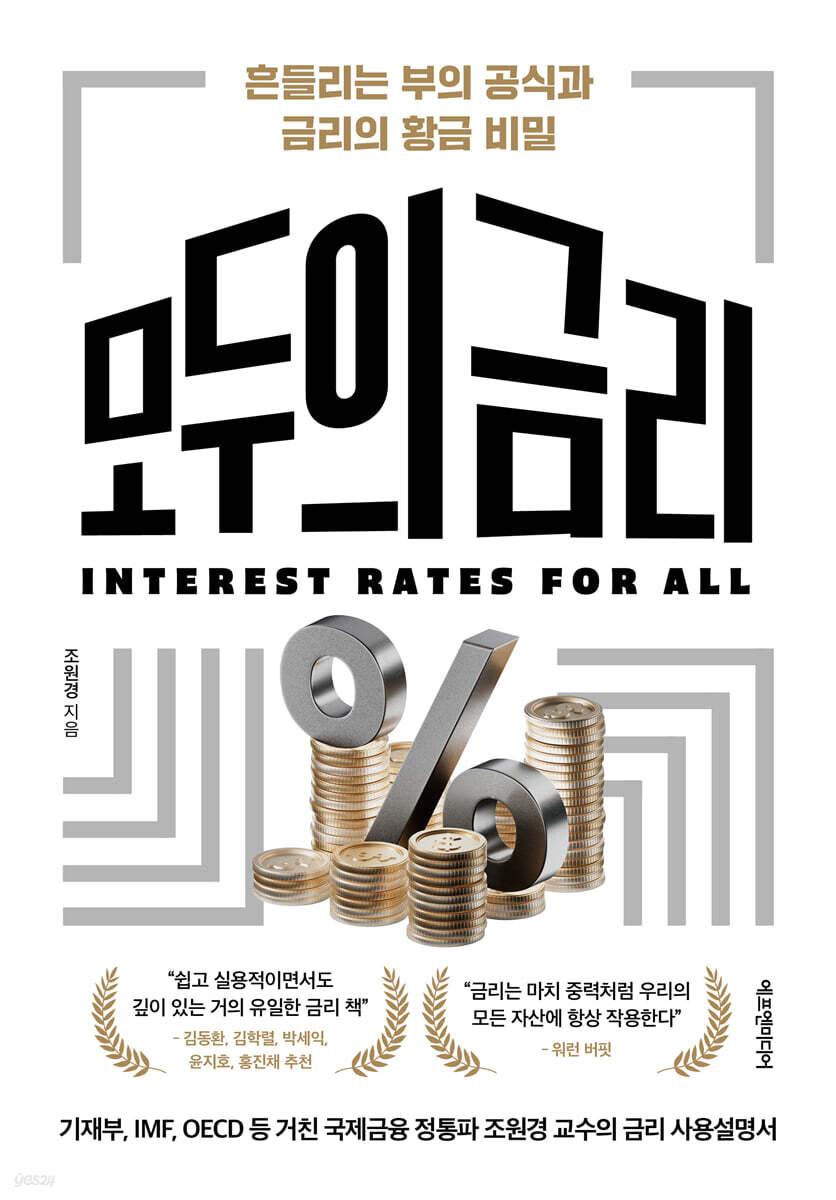
Everyone's interest rate
 |
Description
Book Introduction
- A word from MD
- At the heart of the economy are interest rates.
A new book by author Wonkyung Cho, who has been active on the front lines of international finance.
Analyzes the impact of interest rates on the economy and financial markets from various angles.
This book explains the relationship between interest rates and the economy by presenting various examples of deposits, loans, and short- and long-term interest rates to help readers understand interest rates, which are essential for increasing asset value and managing risk.
October 8, 2024. Economics and Management PD Oh Da-eun
"In an era of rapidly fluctuating interest rates, how can we protect our assets?"
A gentle "interest rate tutoring" blending policy, theory, and domestic and international field experience.
A book that explains in an easy-to-understand way how interest rates work for various assets, from deposits to bonds, foreign exchange, stocks, real estate, raw materials, and cryptocurrencies.
At a time when a 0.25% point change in the U.S. benchmark interest rate can shake global asset markets, this program helps those interested in financial management systematically understand interest rates and develop effective investment strategies.
The author, currently a UNIST professor, is characterized by his vivid experience in government (Ministry of Strategy and Finance) and local government (Ulsan City Deputy Mayor for Economic Affairs) and international organizations (IMF, OECD, IDB) combined with background theory.
It provides insights from the global financial system to everyday financial management and real-world investment cases, and presents a risk management strategy centered on the concept of "margin of safety."
The "Shaky Wealth Formula" section at the end of each chapter summarizes the book's core content and common misconceptions about interest rates.
You can also learn how to read market trends using interest rates, such as whether the inversion of short-term and long-term interest rates is a sign of an economic recession, why the 10-year U.S. Treasury yield is important in the stock market, and what impact interest rate fluctuations have on the real estate market.
“This book covers everything about the financial market, from reading cycles through interest rate fluctuations, estimating exports and capital inflows and outflows through exchange rates, and classifying growth and value stocks through interest rates” (Ji-ho Yoon, Head of Retail Business Division, LS Securities) and “It will be an antidote to those who have tried repeatedly to study interest rates but have been frustrated” (Jin-chae Hong, CEO of Raccoon Asset Management).
A gentle "interest rate tutoring" blending policy, theory, and domestic and international field experience.
A book that explains in an easy-to-understand way how interest rates work for various assets, from deposits to bonds, foreign exchange, stocks, real estate, raw materials, and cryptocurrencies.
At a time when a 0.25% point change in the U.S. benchmark interest rate can shake global asset markets, this program helps those interested in financial management systematically understand interest rates and develop effective investment strategies.
The author, currently a UNIST professor, is characterized by his vivid experience in government (Ministry of Strategy and Finance) and local government (Ulsan City Deputy Mayor for Economic Affairs) and international organizations (IMF, OECD, IDB) combined with background theory.
It provides insights from the global financial system to everyday financial management and real-world investment cases, and presents a risk management strategy centered on the concept of "margin of safety."
The "Shaky Wealth Formula" section at the end of each chapter summarizes the book's core content and common misconceptions about interest rates.
You can also learn how to read market trends using interest rates, such as whether the inversion of short-term and long-term interest rates is a sign of an economic recession, why the 10-year U.S. Treasury yield is important in the stock market, and what impact interest rate fluctuations have on the real estate market.
“This book covers everything about the financial market, from reading cycles through interest rate fluctuations, estimating exports and capital inflows and outflows through exchange rates, and classifying growth and value stocks through interest rates” (Ji-ho Yoon, Head of Retail Business Division, LS Securities) and “It will be an antidote to those who have tried repeatedly to study interest rates but have been frustrated” (Jin-chae Hong, CEO of Raccoon Asset Management).
- You can preview some of the book's contents.
Preview
index
Recommended Reading | Study, Understand, and Apply to Life _ Jiho Yoon
Prologue | Everyone's Interest Rates, Everything About Interest Rates
Chapter 1 Interest Rates as a Margin of Safety
Fate and the Margin of Safety at 5 PM | Moments When It's Better to Cut Your Losses | You Could Be the Winner of a Windfall | Is Your Credit Sufficient? | The Margin of Safety for Bonds, including Treasury and Corporate Bonds | Corporate Credit Ratings and the Margin of Safety for Corporate Bonds | Sovereign Credit Ratings and the Margin of Safety for Government Bonds
[Shaky Wealth Formula 1] Is a higher interest rate better for interest earners?
Chapter 2: The Relationship Between Deposits, Bonds, and Interest Rates
They said the interest rate was 10%, but it's only 1%? | Understanding the Depositor Protection System and Comprehensive Financial Income Taxation | What does the difference between long-term and short-term interest rates mean? | Bond investments become more attractive when interest rates fall | Will the magic of compound interest pay off? | What if you buy long-term bonds and aim for big returns? | Which bond products should you invest in? | Reading the economic cycle through interest rate fluctuations | What factors drive market interest rates? | How to invest in negative interest rates: Understanding zero interest rates, negative interest rates, and bond bubbles
[Shaky Wealth Formula 2] Is there no loss if I hold bonds until maturity?
Chapter 3: Base Rates, Market Interest Rates, and Monetary Policy
The government's incredible control of prices | Treasury bond yields, call rates, CD rates, RP rates, etc. | What impact does the base interest rate have on the market? | Base interest rate forecasting tools ⑴ FOMC and dot plot | Base interest rate forecasting tools ⑵ Fed's preemptive guidance | Appropriate base interest rate, Taylor rule | Relationship between prices and unemployment, Phillips curve | Monetary policy for price stability | Central bank's long-term interest rate adjustment | Is the inversion of short-term and long-term interest rates a harbinger of an economic recession? | The correlation between the US yield inversion and the Korean recession | Central bank monetary policy through interest rates | Financial crisis and US interest rate cut policy | Milton Friedman's gift to Ben Bernanke | Exchange rate arbitrage, carry trade | Risks of interest rate arbitrage | Long-term capital bank bankrupted by interest rate arbitrage
[Shaky Wealth Formula 3] Are short-term interest rates influenced by the Federal Reserve's benchmark interest rate, and are long-term interest rates influenced by economic outlook?
Chapter 4: Interest Rates and the Foreign Exchange Market
Understanding Fixed and Floating Exchange Rate Systems | Fixed Exchange Rate Systems and the 1997 Asian Financial Crisis | Floating Exchange Rate Systems and Exchange Risk | Predicting Exchange Rates is Nearly Impossible | How Did the Dollar Become the World's Currency? | The Global Economy Surrounded by the Strength of the US Dollar | Currency Wars Among Powerful Countries After the COVID-19 Pandemic | The Best Time to Hold Dollars: The Dollar Smile Theory | Understanding the Dollar Index and the 1985 Plaza Accord | I Really Miss Korea's "Three Lows" Boom | The Odd Phenomenon of US Exports Rising Despite a Strong Dollar | Interest Rate Parity Theory: Investment Strategies Using Exchange Rates and Interest Rates | The Correlation Between High US Interest Rates and Capital Outflows from Korea | Why High Exchange Rates Reappeared in the First Half of 2024 | Nicknames and Meanings of Bonds from Various Countries, Including Kimchi Bonds and Arirang Bonds | Things to Consider When Investing in Foreign Currency Deposits and the US Dollar | Foreign Currency Repurchase Agreements to Consider During a Strong Dollar | The Co-movement of the Korean Won and Yuan | Considering the Starbucks Index and the Big Mac Index
[Shaky Wealth Formula 4] Will exports really increase when the exchange rate rises?
Chapter 5: Interest Rates and the Stock Market
Stock prices rise when interest rates are low, but... | Stock prices and interest rates can fall together | Why is the 10-year Treasury yield important? | Stocks and bonds do not always move inversely | What is the correlation between Treasury yields and stocks? | Under what circumstances do low PBR stocks show strength? | Companies with rising sales but being held back by interest rate hikes | Investing in growth and value stocks from an interest rate perspective | The neutral interest rate, an absolute standard for establishing investment strategies | The impact of the difference between short-term and long-term interest rates on investment | Interest rate inversion and opportunities for growth stock investment | The winner is the one who reads the market's emotional ups and downs.
[Shaky Wealth Formula 5] Is buying at a low PER really a loss-free investment?
Chapter 6: Interest Rates and the Real Estate Market
Are rising interest rates bad news for housing prices? | Is an interest rate cut an absolute condition for rising housing prices? | How are real estate prices determined? | Reading the margin of safety in the curse of the skyscraper | Low interest rates and rising housing prices | Real estate bubbles and long-term recessions | Real estate recessions and shadow banking | Floating interest rates and Japan's high housing prices | Interest rate fluctuations and the Korean real estate market | Interest rates determine jeonse and monthly rents | Are housing prices in popular regions around the world all bubbles? | 50-year mortgages maturing by interest rates | Investing in REITs in the era of high interest rates? | Various real estate investment indices such as PIR, RIR, and K-HAI | Thoughts on Seoul's jeonse prices rising for more than a year
[Shaky Wealth Formula 6] Moving steadily to a higher-class place?
Chapter 7: Interest Rates, Commodities, and Cryptocurrency Investment
Is there a clear consensus on the relationship between commodities and interest rates? | The correlation between gold, the dollar, and stocks | The relationship between interest rate cuts and gold prices | Warren Buffett's thoughts on gold investment | Analysis of silver's industrial uses and investment appeal | The correlation between copper and gold in the commodities market | Low-carbon LNG, highlighted by Buffett | Is Bitcoin digital gold? | The principles of cryptocurrency price formation | The correlation between interest rates, cryptocurrencies, and securities
[Shaky Wealth Formula 7] Will Cryptocurrency Cause a Financial Crisis?
Chapter 8: Margin of Safety and the Shaky Wealth Formula
Applying the Margin of Safety to Life | Threats to Our Economy's Margin of Safety | Considering Everyone's Interest Rates in a Shaky World | Reflecting on the Spirit of John Keynes in an Age of Uncertainty
[Shaky Wealth Formula 8] Are passion and great strategy a panacea?
Epilogue | The Daily Life of Uncertainty and an Unwavering Life: My Struggles in Public Service
Prologue | Everyone's Interest Rates, Everything About Interest Rates
Chapter 1 Interest Rates as a Margin of Safety
Fate and the Margin of Safety at 5 PM | Moments When It's Better to Cut Your Losses | You Could Be the Winner of a Windfall | Is Your Credit Sufficient? | The Margin of Safety for Bonds, including Treasury and Corporate Bonds | Corporate Credit Ratings and the Margin of Safety for Corporate Bonds | Sovereign Credit Ratings and the Margin of Safety for Government Bonds
[Shaky Wealth Formula 1] Is a higher interest rate better for interest earners?
Chapter 2: The Relationship Between Deposits, Bonds, and Interest Rates
They said the interest rate was 10%, but it's only 1%? | Understanding the Depositor Protection System and Comprehensive Financial Income Taxation | What does the difference between long-term and short-term interest rates mean? | Bond investments become more attractive when interest rates fall | Will the magic of compound interest pay off? | What if you buy long-term bonds and aim for big returns? | Which bond products should you invest in? | Reading the economic cycle through interest rate fluctuations | What factors drive market interest rates? | How to invest in negative interest rates: Understanding zero interest rates, negative interest rates, and bond bubbles
[Shaky Wealth Formula 2] Is there no loss if I hold bonds until maturity?
Chapter 3: Base Rates, Market Interest Rates, and Monetary Policy
The government's incredible control of prices | Treasury bond yields, call rates, CD rates, RP rates, etc. | What impact does the base interest rate have on the market? | Base interest rate forecasting tools ⑴ FOMC and dot plot | Base interest rate forecasting tools ⑵ Fed's preemptive guidance | Appropriate base interest rate, Taylor rule | Relationship between prices and unemployment, Phillips curve | Monetary policy for price stability | Central bank's long-term interest rate adjustment | Is the inversion of short-term and long-term interest rates a harbinger of an economic recession? | The correlation between the US yield inversion and the Korean recession | Central bank monetary policy through interest rates | Financial crisis and US interest rate cut policy | Milton Friedman's gift to Ben Bernanke | Exchange rate arbitrage, carry trade | Risks of interest rate arbitrage | Long-term capital bank bankrupted by interest rate arbitrage
[Shaky Wealth Formula 3] Are short-term interest rates influenced by the Federal Reserve's benchmark interest rate, and are long-term interest rates influenced by economic outlook?
Chapter 4: Interest Rates and the Foreign Exchange Market
Understanding Fixed and Floating Exchange Rate Systems | Fixed Exchange Rate Systems and the 1997 Asian Financial Crisis | Floating Exchange Rate Systems and Exchange Risk | Predicting Exchange Rates is Nearly Impossible | How Did the Dollar Become the World's Currency? | The Global Economy Surrounded by the Strength of the US Dollar | Currency Wars Among Powerful Countries After the COVID-19 Pandemic | The Best Time to Hold Dollars: The Dollar Smile Theory | Understanding the Dollar Index and the 1985 Plaza Accord | I Really Miss Korea's "Three Lows" Boom | The Odd Phenomenon of US Exports Rising Despite a Strong Dollar | Interest Rate Parity Theory: Investment Strategies Using Exchange Rates and Interest Rates | The Correlation Between High US Interest Rates and Capital Outflows from Korea | Why High Exchange Rates Reappeared in the First Half of 2024 | Nicknames and Meanings of Bonds from Various Countries, Including Kimchi Bonds and Arirang Bonds | Things to Consider When Investing in Foreign Currency Deposits and the US Dollar | Foreign Currency Repurchase Agreements to Consider During a Strong Dollar | The Co-movement of the Korean Won and Yuan | Considering the Starbucks Index and the Big Mac Index
[Shaky Wealth Formula 4] Will exports really increase when the exchange rate rises?
Chapter 5: Interest Rates and the Stock Market
Stock prices rise when interest rates are low, but... | Stock prices and interest rates can fall together | Why is the 10-year Treasury yield important? | Stocks and bonds do not always move inversely | What is the correlation between Treasury yields and stocks? | Under what circumstances do low PBR stocks show strength? | Companies with rising sales but being held back by interest rate hikes | Investing in growth and value stocks from an interest rate perspective | The neutral interest rate, an absolute standard for establishing investment strategies | The impact of the difference between short-term and long-term interest rates on investment | Interest rate inversion and opportunities for growth stock investment | The winner is the one who reads the market's emotional ups and downs.
[Shaky Wealth Formula 5] Is buying at a low PER really a loss-free investment?
Chapter 6: Interest Rates and the Real Estate Market
Are rising interest rates bad news for housing prices? | Is an interest rate cut an absolute condition for rising housing prices? | How are real estate prices determined? | Reading the margin of safety in the curse of the skyscraper | Low interest rates and rising housing prices | Real estate bubbles and long-term recessions | Real estate recessions and shadow banking | Floating interest rates and Japan's high housing prices | Interest rate fluctuations and the Korean real estate market | Interest rates determine jeonse and monthly rents | Are housing prices in popular regions around the world all bubbles? | 50-year mortgages maturing by interest rates | Investing in REITs in the era of high interest rates? | Various real estate investment indices such as PIR, RIR, and K-HAI | Thoughts on Seoul's jeonse prices rising for more than a year
[Shaky Wealth Formula 6] Moving steadily to a higher-class place?
Chapter 7: Interest Rates, Commodities, and Cryptocurrency Investment
Is there a clear consensus on the relationship between commodities and interest rates? | The correlation between gold, the dollar, and stocks | The relationship between interest rate cuts and gold prices | Warren Buffett's thoughts on gold investment | Analysis of silver's industrial uses and investment appeal | The correlation between copper and gold in the commodities market | Low-carbon LNG, highlighted by Buffett | Is Bitcoin digital gold? | The principles of cryptocurrency price formation | The correlation between interest rates, cryptocurrencies, and securities
[Shaky Wealth Formula 7] Will Cryptocurrency Cause a Financial Crisis?
Chapter 8: Margin of Safety and the Shaky Wealth Formula
Applying the Margin of Safety to Life | Threats to Our Economy's Margin of Safety | Considering Everyone's Interest Rates in a Shaky World | Reflecting on the Spirit of John Keynes in an Age of Uncertainty
[Shaky Wealth Formula 8] Are passion and great strategy a panacea?
Epilogue | The Daily Life of Uncertainty and an Unwavering Life: My Struggles in Public Service
Into the book
If I think about it, margin and interest rate were words that dominated my real life outside of school during my childhood.
My father must have calculated that he would at least not suffer any losses while living such a war-like life in the countryside.
At the time, the monopoly liquor wholesale business was my father's strong support.
Because it was a business that not just anyone could do, there was still a profit, or margin, even after borrowing money.
My father must have always thought about the fateful hour of 5 p.m. and come up with the concept of a 'margin of safety.'
--- p.27, from “Chapter 1 Interest Rates as a Margin of Safety”
Suddenly, this thought occurs to me.
The 2% inflation target is not a science.
It's just a political decision by the Fed.
2% is not a statistically proven figure.
There is no specific research or evidence to support the claim that price stability is maximized when the central bank's inflation target is 2%.
Nevertheless, if the Fed protects, it must protect, and interest rates and the stock market will dance because of the Fed Chairman's words.
The Fed Chairman has the most expensive mouth in the world.
--- p.136, from “Chapter 3 Base Interest Rate, Market Interest Rate and Monetary Policy”
When I was a government official, I also considered the defense of the exchange rate value to be important.
Every time that happened, this thought suddenly occurred to me.
The United States observes other countries, but on what basis does the world observe the United States? I've always wondered whether, in a world "of America, by America, for America," the function of restraining this massive nation actually works.
--- p.193, from “Chapter 4 Interest Rates and Foreign Exchange Market”
Rather, you should buy cyclical stocks when they are expensive (high PER) and sell them when they are cheap (low PER).
Because stock prices lead the way, reading these cycles is important when investing in cyclical stocks.
The reason you should buy cyclical stocks at a high PER is because that's when business conditions are at their worst and fear is at its peak.
When cyclical stocks generate a lot of profits, their prices stagnate at their peak.
At this time, PER is low.
Semiconductor stocks such as Samsung Electronics and SK Hynix, chemical stocks such as Lotte Chemical and Korea Petrochemical, and shipbuilding stocks such as HD Hyundai Heavy Industries and Samsung Heavy Industries are representative cyclical stocks that are sensitive to economic conditions.
--- p.317, from “Chapter 5 Interest Rates and the Stock Market”
The fact that the history of the world is so deep-rooted that it dates back to BC opens up the possibility of viewing the world not as a linear process of birth and death, but as a cyclical process of decline and increase.
At the same time, the fact that the proportion of charter contracts is decreasing in both our country and Bolivia reminds us that charter contracts, a rare species worldwide, may soon face extinction.
--- p.357, from “Chapter 6 Interest Rates and the Real Estate Market”
Berkshire Hathaway has invested heavily in Nu Holdings, a Brazilian fintech company focused on Bitcoin that owns its own cryptocurrency, NuCoin.
Even so, it seems unlikely that Buffett will invest in cryptocurrencies, including Bitcoin, which just hit an all-time high in 2024.
Because cryptocurrency investing contradicts the reliable value investing strategy that has supported him for decades.
My father must have calculated that he would at least not suffer any losses while living such a war-like life in the countryside.
At the time, the monopoly liquor wholesale business was my father's strong support.
Because it was a business that not just anyone could do, there was still a profit, or margin, even after borrowing money.
My father must have always thought about the fateful hour of 5 p.m. and come up with the concept of a 'margin of safety.'
--- p.27, from “Chapter 1 Interest Rates as a Margin of Safety”
Suddenly, this thought occurs to me.
The 2% inflation target is not a science.
It's just a political decision by the Fed.
2% is not a statistically proven figure.
There is no specific research or evidence to support the claim that price stability is maximized when the central bank's inflation target is 2%.
Nevertheless, if the Fed protects, it must protect, and interest rates and the stock market will dance because of the Fed Chairman's words.
The Fed Chairman has the most expensive mouth in the world.
--- p.136, from “Chapter 3 Base Interest Rate, Market Interest Rate and Monetary Policy”
When I was a government official, I also considered the defense of the exchange rate value to be important.
Every time that happened, this thought suddenly occurred to me.
The United States observes other countries, but on what basis does the world observe the United States? I've always wondered whether, in a world "of America, by America, for America," the function of restraining this massive nation actually works.
--- p.193, from “Chapter 4 Interest Rates and Foreign Exchange Market”
Rather, you should buy cyclical stocks when they are expensive (high PER) and sell them when they are cheap (low PER).
Because stock prices lead the way, reading these cycles is important when investing in cyclical stocks.
The reason you should buy cyclical stocks at a high PER is because that's when business conditions are at their worst and fear is at its peak.
When cyclical stocks generate a lot of profits, their prices stagnate at their peak.
At this time, PER is low.
Semiconductor stocks such as Samsung Electronics and SK Hynix, chemical stocks such as Lotte Chemical and Korea Petrochemical, and shipbuilding stocks such as HD Hyundai Heavy Industries and Samsung Heavy Industries are representative cyclical stocks that are sensitive to economic conditions.
--- p.317, from “Chapter 5 Interest Rates and the Stock Market”
The fact that the history of the world is so deep-rooted that it dates back to BC opens up the possibility of viewing the world not as a linear process of birth and death, but as a cyclical process of decline and increase.
At the same time, the fact that the proportion of charter contracts is decreasing in both our country and Bolivia reminds us that charter contracts, a rare species worldwide, may soon face extinction.
--- p.357, from “Chapter 6 Interest Rates and the Real Estate Market”
Berkshire Hathaway has invested heavily in Nu Holdings, a Brazilian fintech company focused on Bitcoin that owns its own cryptocurrency, NuCoin.
Even so, it seems unlikely that Buffett will invest in cryptocurrencies, including Bitcoin, which just hit an all-time high in 2024.
Because cryptocurrency investing contradicts the reliable value investing strategy that has supported him for decades.
--- p.426, from “Chapter 7 Interest Rates, Raw Materials, and Cryptocurrency Investment”
Publisher's Review
An economics textbook covering everything about interest rates, "Interest Rates for Everyone," has been published.
"Interest Rate Tutoring" from an economic expert who combines economic theory with practical investment practice.
Understanding interest rates allows you to manage both profits and risk.
Interest rates are like the central nervous system of the modern economic system.
Professor Won-kyung Cho, author of “Interest Rates for Everyone,” said, “Interest rates directly and indirectly affect not only our daily lives but also the bond market, stocks, foreign exchange, real estate, raw materials, and even cryptocurrencies.
He stated his intention in writing this book, saying, “I would be most happy if readers of this book could increase their understanding of the economy and the market through the medium of interest rates and increase their asset value.”
This book begins with deposit interest rates, one of the many financial products we all encounter in our daily lives.
It answers questions from real investors, such as, “They said the interest rate was 10%, but it’s only 1%?”, while also explaining the difference between nominal and real interest rates and the effect of compound interest.
It also covers essential real estate-related issues such as loan interest rates and Korea's unique jeonse system.
It covers a wide range of topics, including how to determine a safe financial institution and the importance of after-tax income, as well as the interest rates that appear in everyday life.
Meanwhile, we also examine interest rates as a hidden driver of the current economic situation.
It unravels complex economic phenomena, such as changes in the U.S. Federal Reserve's interest rate policy, concerns about an economic downturn, and increased volatility in the global economy, focusing on interest rates.
For example, it presents various perspectives and considerations on whether the inversion of short-term and long-term interest rates is a sign of an economic recession or whether other interpretations are possible.
It also covers why the 10-year U.S. Treasury yield is important in the stock market and how interest rate fluctuations affect the real estate market.
This helps readers understand that interest rates are not just numbers, but important indicators of the health of the economy.
Margin of Safety: Investment Strategies in an Age of Uncertainty
"Everyone's Interest Rate" presents a risk management strategy centered on the concept of "margin of safety."
Margin of safety refers to a buffer to prepare for unexpected losses in investments.
The author develops the story by applying this concept to various investment fields.
In bond investing, the margin of safety is closely related to the credit rating of a country or company.
The book explains how to evaluate the margin of safety of bonds such as government bonds and corporate bonds.
In stock investment, the relationship between stock prices and interest rates is analyzed, and the margin of safety is explained through the concept of 'stock risk premium'.
The author also points out the risks of investing in the recently popular 30-year U.S. Treasury bond.
Long-term bonds are sensitive to interest rate fluctuations, so they can incur large losses if interest rates rise.
It's a good example of how even seemingly safe investments always carry risks.
It also offers an interesting perspective on investing in cyclical stocks.
The advice that "cyclical stocks should be bought when they are expensive (high PER) and sold when they are cheap (low PER)" may seem counterintuitive, but it is a strategic approach that takes into account the economic cycle.
This can be seen as an example of applying the safety margin concept in a reverse way.
From private loan interest to the bankruptcy of Silicon Valley Bank
"Everyone's Interest Rate": Understanding Microeconomics and Macroeconomics at Once
This book covers a wide spectrum, from the global financial system to personal financial management.
The author's experience at the Ministry of Strategy and Finance and his academic background combine to provide both micro and macro perspectives.
From a global financial perspective, the book details the impact of the U.S. Federal Reserve's interest rate policy on the global economy.
For example, it explains what the Fed's "dot plot" is and how to interpret it, and why the Fed Chairman's remarks are called "the world's most expensive mouths."
It also analyzes the impact of the strong dollar on the global economy and the relationship between exchange rates and interest rates.
At the same time, it also addresses everyday financial management issues.
For example, it provides practical advice on whether to choose between a jeonse (long-term deposit) and monthly rent, or whether a fixed or variable interest rate is more advantageous when taking out a mortgage loan.
In particular, it explains why Korea's housing market is sensitive to interest rate fluctuations, and points out Korea's low proportion of fixed-rate loans in household loans.
It also covers things to keep in mind when choosing financial products.
For example, it provides in-depth information on financial products, such as the tax exemption benefits of Brazilian government bonds and the risks of foreign currency loans.
It also includes an explanation of financial income taxation, helping you calculate your actual investment returns after considering taxes.
Balancing Economic Theory and Practical Investment
"Everyone's Interest Rate" offers wisdom on how to invest in today's uncertain economic environment.
The author states that “capitalism may be a system that thrives on huge bubbles,” and emphasizes the importance of balanced investment between reason and emotion, between frenzy and cool-headedness.
You should be wary of bubbles, but if you avoid them unconditionally, your profits will be poor.
Even policymakers well-versed in economic theory admit that investment performance may be unsatisfactory.
Next, we present methods for interpreting various economic indicators and phenomena.
For example, it explains that an inversion of short-term and long-term interest rates may not necessarily indicate a recession, and that gold prices tend to rise when real interest rates are negative.
This will enable readers to develop the ability to critically interpret economic news rather than simply accept it.
The author also emphasizes the psychological aspect of investing.
The observation that “once you taste money, you think it’s your skill and become arrogant” points out a common mistake made by many investors.
Instead, the author uses the example of golfer Dustin Johnson to emphasize the importance of a stable strategy rather than excessive greed.
“The effort to stay on the fairway” is also necessary in investing.
Finally, we recommend investing with a long-term perspective rather than short-term profits.
Quoting Warren Buffett, he emphasizes the importance of “the fun of making money and the fun of watching it grow.”
It is the core of unwavering investment principles in times of uncertainty.
"Interest Rate Tutoring" from an economic expert who combines economic theory with practical investment practice.
Understanding interest rates allows you to manage both profits and risk.
Interest rates are like the central nervous system of the modern economic system.
Professor Won-kyung Cho, author of “Interest Rates for Everyone,” said, “Interest rates directly and indirectly affect not only our daily lives but also the bond market, stocks, foreign exchange, real estate, raw materials, and even cryptocurrencies.
He stated his intention in writing this book, saying, “I would be most happy if readers of this book could increase their understanding of the economy and the market through the medium of interest rates and increase their asset value.”
This book begins with deposit interest rates, one of the many financial products we all encounter in our daily lives.
It answers questions from real investors, such as, “They said the interest rate was 10%, but it’s only 1%?”, while also explaining the difference between nominal and real interest rates and the effect of compound interest.
It also covers essential real estate-related issues such as loan interest rates and Korea's unique jeonse system.
It covers a wide range of topics, including how to determine a safe financial institution and the importance of after-tax income, as well as the interest rates that appear in everyday life.
Meanwhile, we also examine interest rates as a hidden driver of the current economic situation.
It unravels complex economic phenomena, such as changes in the U.S. Federal Reserve's interest rate policy, concerns about an economic downturn, and increased volatility in the global economy, focusing on interest rates.
For example, it presents various perspectives and considerations on whether the inversion of short-term and long-term interest rates is a sign of an economic recession or whether other interpretations are possible.
It also covers why the 10-year U.S. Treasury yield is important in the stock market and how interest rate fluctuations affect the real estate market.
This helps readers understand that interest rates are not just numbers, but important indicators of the health of the economy.
Margin of Safety: Investment Strategies in an Age of Uncertainty
"Everyone's Interest Rate" presents a risk management strategy centered on the concept of "margin of safety."
Margin of safety refers to a buffer to prepare for unexpected losses in investments.
The author develops the story by applying this concept to various investment fields.
In bond investing, the margin of safety is closely related to the credit rating of a country or company.
The book explains how to evaluate the margin of safety of bonds such as government bonds and corporate bonds.
In stock investment, the relationship between stock prices and interest rates is analyzed, and the margin of safety is explained through the concept of 'stock risk premium'.
The author also points out the risks of investing in the recently popular 30-year U.S. Treasury bond.
Long-term bonds are sensitive to interest rate fluctuations, so they can incur large losses if interest rates rise.
It's a good example of how even seemingly safe investments always carry risks.
It also offers an interesting perspective on investing in cyclical stocks.
The advice that "cyclical stocks should be bought when they are expensive (high PER) and sold when they are cheap (low PER)" may seem counterintuitive, but it is a strategic approach that takes into account the economic cycle.
This can be seen as an example of applying the safety margin concept in a reverse way.
From private loan interest to the bankruptcy of Silicon Valley Bank
"Everyone's Interest Rate": Understanding Microeconomics and Macroeconomics at Once
This book covers a wide spectrum, from the global financial system to personal financial management.
The author's experience at the Ministry of Strategy and Finance and his academic background combine to provide both micro and macro perspectives.
From a global financial perspective, the book details the impact of the U.S. Federal Reserve's interest rate policy on the global economy.
For example, it explains what the Fed's "dot plot" is and how to interpret it, and why the Fed Chairman's remarks are called "the world's most expensive mouths."
It also analyzes the impact of the strong dollar on the global economy and the relationship between exchange rates and interest rates.
At the same time, it also addresses everyday financial management issues.
For example, it provides practical advice on whether to choose between a jeonse (long-term deposit) and monthly rent, or whether a fixed or variable interest rate is more advantageous when taking out a mortgage loan.
In particular, it explains why Korea's housing market is sensitive to interest rate fluctuations, and points out Korea's low proportion of fixed-rate loans in household loans.
It also covers things to keep in mind when choosing financial products.
For example, it provides in-depth information on financial products, such as the tax exemption benefits of Brazilian government bonds and the risks of foreign currency loans.
It also includes an explanation of financial income taxation, helping you calculate your actual investment returns after considering taxes.
Balancing Economic Theory and Practical Investment
"Everyone's Interest Rate" offers wisdom on how to invest in today's uncertain economic environment.
The author states that “capitalism may be a system that thrives on huge bubbles,” and emphasizes the importance of balanced investment between reason and emotion, between frenzy and cool-headedness.
You should be wary of bubbles, but if you avoid them unconditionally, your profits will be poor.
Even policymakers well-versed in economic theory admit that investment performance may be unsatisfactory.
Next, we present methods for interpreting various economic indicators and phenomena.
For example, it explains that an inversion of short-term and long-term interest rates may not necessarily indicate a recession, and that gold prices tend to rise when real interest rates are negative.
This will enable readers to develop the ability to critically interpret economic news rather than simply accept it.
The author also emphasizes the psychological aspect of investing.
The observation that “once you taste money, you think it’s your skill and become arrogant” points out a common mistake made by many investors.
Instead, the author uses the example of golfer Dustin Johnson to emphasize the importance of a stable strategy rather than excessive greed.
“The effort to stay on the fairway” is also necessary in investing.
Finally, we recommend investing with a long-term perspective rather than short-term profits.
Quoting Warren Buffett, he emphasizes the importance of “the fun of making money and the fun of watching it grow.”
It is the core of unwavering investment principles in times of uncertainty.
GOODS SPECIFICS
- Date of issue: September 25, 2024
- Page count, weight, size: 460 pages | 768g | 152*218*29mm
- ISBN13: 9791194322009
- ISBN10: 119432200X
You may also like
카테고리
korean


korean

![ELLE 엘르 스페셜 에디션 A형 : 12월 [2025]](http://librairie.coreenne.fr/cdn/shop/files/b8e27a3de6c9538896439686c6b0e8fb.jpg?v=1766436872&width=3840)


