

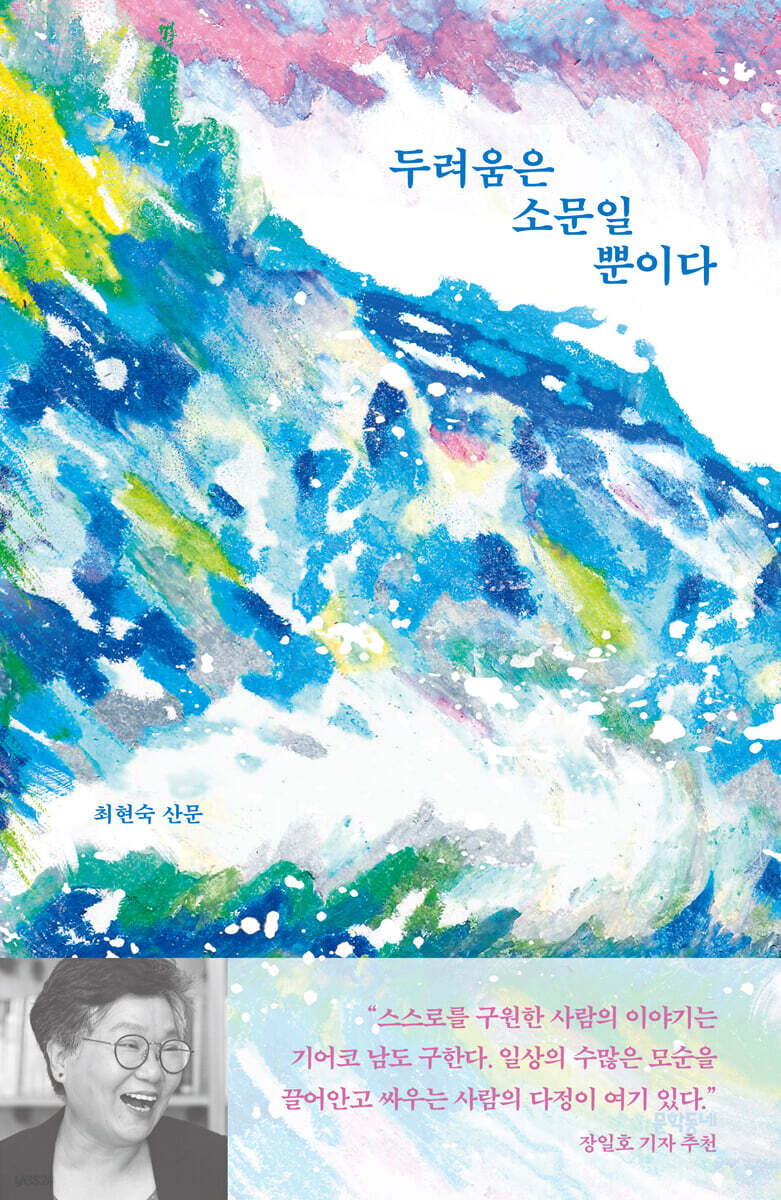
Fear is just a rumor
 |
Description
Book Introduction
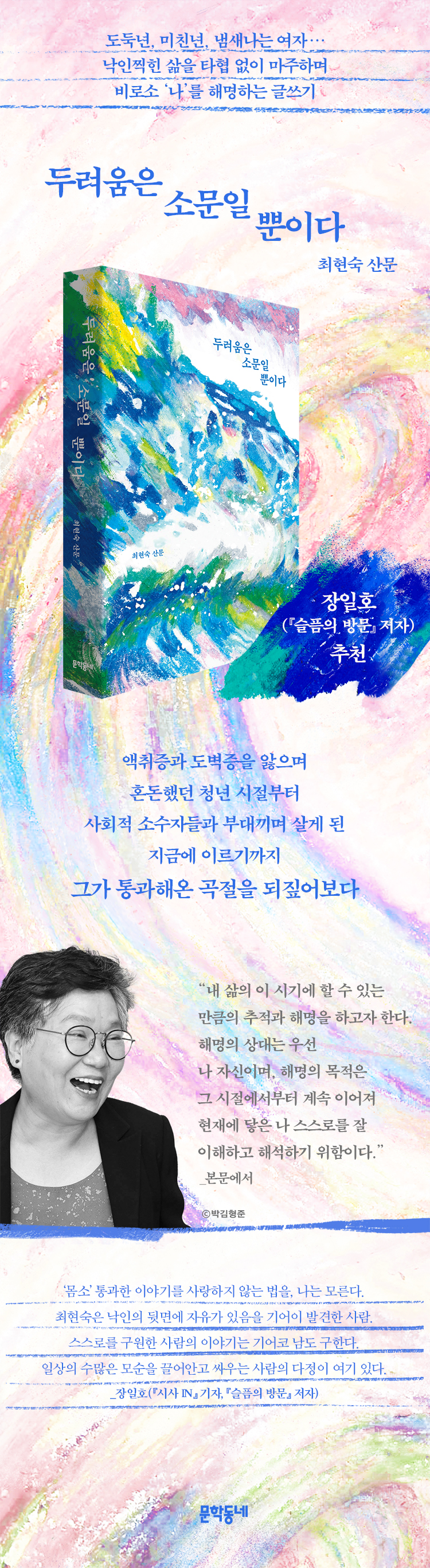
“Fear is just a rumor” is the trace of Choi Hyun-sook, an oral history writer, listening to her own life, not someone else’s.
How did he become a homeless activist and oral history writer?
It traces the twists and turns he has gone through, from his youth when he wandered alone in chaos to the present when he lives with marginalized people.
The pain I had to endure while living a life branded as a thief, a crazy woman, and a smelly woman became the basis for my empathy for the pain of others.
He interprets the feeling of “liking the poor and marginalized, wanting to go to places where such people live,” and the “unconditional thrill” he feels when drawn to them, as stemming from none other than his own life story.
Through this book, he sought to explain himself in the present by digging up old wounds that were difficult to look back on even with the passage of time, such as addiction and alienation.
A person who chose rebellion, betrayal, and resistance, rather than compromise or avoidance, at every step of his life's torment. A person who forged his own path with the power of hatred for the world.
Even now, at the age of sixty-seven, he is “still chasing after the smelly homeless people on the streets, the people living in shantytowns, the addicted, and the crazy women.”
How did he become a homeless activist and oral history writer?
It traces the twists and turns he has gone through, from his youth when he wandered alone in chaos to the present when he lives with marginalized people.
The pain I had to endure while living a life branded as a thief, a crazy woman, and a smelly woman became the basis for my empathy for the pain of others.
He interprets the feeling of “liking the poor and marginalized, wanting to go to places where such people live,” and the “unconditional thrill” he feels when drawn to them, as stemming from none other than his own life story.
Through this book, he sought to explain himself in the present by digging up old wounds that were difficult to look back on even with the passage of time, such as addiction and alienation.
A person who chose rebellion, betrayal, and resistance, rather than compromise or avoidance, at every step of his life's torment. A person who forged his own path with the power of hatred for the world.
Even now, at the age of sixty-seven, he is “still chasing after the smelly homeless people on the streets, the people living in shantytowns, the addicted, and the crazy women.”
- You can preview some of the book's contents.
Preview
index
Prologue: A story about confronting rumors and deception
Part 1: In the midst of chaos and darkness: Facing myself and my family without compromise
I was a thief
smelly being
With the power to hate my father
The story of a noble daughter's struggles in industrial society
Weddings, funerals, and ceremonies—the hardships of being human
Mom's cognitive decline
Tangled Pieces—A Mother's Sexuality, A Father's Care
Observing the deathbed of an eighty-six-year-old grandmother
That man's place
Meeting the Ilrang and the Tiger
Part 2: Fear is just a rumor _ Between the pleasures and pains of an aging body
Circumstances regarding long public transportation use
Living Less Fooled by the Medical Industry
The situation with teeth and dentures
Desiring subject
Women who survive even if they grow old and go crazy while caring for others
Disagreements over interspecies companionship
Some life contexts related to sex
About the aging body
personally
The life of an old woman in an industrial society
On 'Free Death'
Part 3: Without Hope, Without End _ Living and Fighting with the Homeless
Between good intentions and contempt, be careful
At the homeless scene
Getting dirty or familiar
This is the homeless square.
Without hope, without end
Part 1: In the midst of chaos and darkness: Facing myself and my family without compromise
I was a thief
smelly being
With the power to hate my father
The story of a noble daughter's struggles in industrial society
Weddings, funerals, and ceremonies—the hardships of being human
Mom's cognitive decline
Tangled Pieces—A Mother's Sexuality, A Father's Care
Observing the deathbed of an eighty-six-year-old grandmother
That man's place
Meeting the Ilrang and the Tiger
Part 2: Fear is just a rumor _ Between the pleasures and pains of an aging body
Circumstances regarding long public transportation use
Living Less Fooled by the Medical Industry
The situation with teeth and dentures
Desiring subject
Women who survive even if they grow old and go crazy while caring for others
Disagreements over interspecies companionship
Some life contexts related to sex
About the aging body
personally
The life of an old woman in an industrial society
On 'Free Death'
Part 3: Without Hope, Without End _ Living and Fighting with the Homeless
Between good intentions and contempt, be careful
At the homeless scene
Getting dirty or familiar
This is the homeless square.
Without hope, without end
Detailed image
Into the book
Thief.
The first person who said that to me was my mother.
--- p.29
I don't even have wings growing from my armpits, but I smell something.
The origin of the smell is entirely mine and my direction.
It leads me down, not up, not up, not down, not up, to the smelly beings.
It leads us into a world of dirty, smelly, and unsavory existence and situations, not into beauty, nobility, or abundance.
--- pp.50~51
The blind excitement is a signal from my body and my life history calling me.
--- p.51
I forged my own path with the power of hating my father.
--- p.63
The world is increasingly running towards a shallow world where money is the lord, where even the songs of the nobles, which are transparent, are nowhere to be found, and only raw songs of money are rampant, and where the number of impoverished beings who have been pushed out of the world of each person surviving for themselves is increasing without any reason.
--- p.73
The strangest thing about death is that it makes us indifferent to everything.
The dead are completely free from the scrutiny and rituals of the living, as well as from the problems and tasks they were or were struggling with.
Complete freedom at the end.
The inexplicable hope contained in death is that everyone will enjoy the freedom that no one can enjoy while alive after death.
--- p.82
That fear and anger became the strength that allowed me to live as myself.
--- p.112
For wounds to become strength, they must pass through anger and resistance and then meet reflection.
--- p.113
Observing something outside of me is done simultaneously with observing something inside of me.
I repeatedly question and check my inner self and my gaze to see if there is any trace of unjustified hatred.
--- p.163
Humiliation is an asset in my life and a starting point for me to move beyond myself.
--- p.164
Family is a natural disaster and a catastrophe.
--- p.217
The emptiness and hopelessness are the fatal charms of this world.
--- p.224
Aging and death are subjects that I want to focus on simply because of their relentlessness.
--- p.256
I like poor and marginalized people, and I want to go to a place where such people live together.
--- p.350
If it is a disaster that is inevitable and has already come, whether you dwell on the misfortune and feel anxious about it or enjoy it by looking for other possibilities is a matter of perspective and attitude that you acquire throughout your life.
--- pp.352~353
I have survived until now with the strength I gained from surviving.
The first person who said that to me was my mother.
--- p.29
I don't even have wings growing from my armpits, but I smell something.
The origin of the smell is entirely mine and my direction.
It leads me down, not up, not up, not down, not up, to the smelly beings.
It leads us into a world of dirty, smelly, and unsavory existence and situations, not into beauty, nobility, or abundance.
--- pp.50~51
The blind excitement is a signal from my body and my life history calling me.
--- p.51
I forged my own path with the power of hating my father.
--- p.63
The world is increasingly running towards a shallow world where money is the lord, where even the songs of the nobles, which are transparent, are nowhere to be found, and only raw songs of money are rampant, and where the number of impoverished beings who have been pushed out of the world of each person surviving for themselves is increasing without any reason.
--- p.73
The strangest thing about death is that it makes us indifferent to everything.
The dead are completely free from the scrutiny and rituals of the living, as well as from the problems and tasks they were or were struggling with.
Complete freedom at the end.
The inexplicable hope contained in death is that everyone will enjoy the freedom that no one can enjoy while alive after death.
--- p.82
That fear and anger became the strength that allowed me to live as myself.
--- p.112
For wounds to become strength, they must pass through anger and resistance and then meet reflection.
--- p.113
Observing something outside of me is done simultaneously with observing something inside of me.
I repeatedly question and check my inner self and my gaze to see if there is any trace of unjustified hatred.
--- p.163
Humiliation is an asset in my life and a starting point for me to move beyond myself.
--- p.164
Family is a natural disaster and a catastrophe.
--- p.217
The emptiness and hopelessness are the fatal charms of this world.
--- p.224
Aging and death are subjects that I want to focus on simply because of their relentlessness.
--- p.256
I like poor and marginalized people, and I want to go to a place where such people live together.
--- p.350
If it is a disaster that is inevitable and has already come, whether you dwell on the misfortune and feel anxious about it or enjoy it by looking for other possibilities is a matter of perspective and attitude that you acquire throughout your life.
--- pp.352~353
I have survived until now with the strength I gained from surviving.
--- p.353
Publisher's Review
“The story of a person who saves himself inevitably saves others.
“Here lies the affection of a person who embraces and fights against the countless contradictions of everyday life.”
Recommended by Jang Il-ho (Reporter for ‘Sisa IN’, Author of ‘Visit of Sorrow’)!
Thief, crazy bitch, smelly woman…
Facing a branded life without compromise
Writing that finally explains 'me'
Choi Hyun-sook, an oral history writer who has listened to and recorded the lives of the poor, the sick, the uneducated, and the powerless.
He has been more diligent than anyone else in his work, using “ordinary stories of ordinary people” as the main material for his writing, and deeply examining the pain, failures, and limitations of others, interpreting them within a social and historical context to gain insight.
The lives of ordinary people, as told through vivid voices, were each special in their own way.
“Fear is just a rumor” is the trace of Choi Hyun-sook, an oral history writer, listening to her own life, not someone else’s.
How did he become a homeless activist and oral history writer?
It traces the twists and turns he has gone through, from his youth when he wandered alone in chaos to the present when he lives with marginalized people.
The pain I had to endure while living a life branded as a thief, a crazy woman, and a smelly woman became the basis for my empathy for the pain of others.
He interprets the feeling of “liking the poor and marginalized, wanting to go to places where such people live,” and the “unconditional thrill” he feels when drawn to them, as stemming from none other than his own life story.
The self-destruction caused by conflicts with parents since childhood, and the self-deprecation caused by suffering from bromhidrosis and kleptomania are the seeds from which my current life sprouted.
In order to escape from his 'father's house', he married a poor man and walked into poverty on his own two feet. After being married for over twenty years, he met the woman he loved, came out to her, and got divorced.
After experiencing the death of his parents, he also severed ties with his original family.
Through this book, he sought to explain himself in the present by digging up old wounds that were difficult to look back on even with the passage of time, such as addiction and alienation.
A person who chose rebellion, betrayal, and resistance, rather than compromise or avoidance, at every step of his life's torment. A person who forged his own path with the power of hatred for the world.
Even now, at the age of sixty-seven, he is “still chasing after the smelly homeless people on the streets, the people living in shantytowns, the addicted, and the crazy women.”
I want to do as much tracing and clarification as I can at this stage of my life.
The subject of the explanation is, first and foremost, myself, and the purpose of the explanation is to better understand and interpret myself, who has continued from that time and reached the present.
Page 16
Clashing with the world with an inexplicable hope
A record of a life that forged its own path
Choi Hyun-sook spent her teenage and twenties in the midst of confusion due to bromhidrosis and kleptomania.
As a child, he enjoyed playing with many friends due to his active personality and was also good at sports.
However, the bromhidrosis that began as he entered puberty brought him painful humiliation and shame.
The bad smell coming from my body could not be hidden no matter what.
People held their noses and whispered.
The only way to protect yourself is to distance yourself from others before they push you away.
He actively chose to be alone.
Meanwhile, theft, which he believed could only be stopped by detection, was “a fatal wound in his youth and the core of his chaos.”
The habit of stealing money, which had been building up since the experience of 'snatching' money while running errands for his mother, did not completely disappear even after being caught and embarrassed by a 23-year-old classmate.
He recalls that even during the times when he was unable to socialize with people, loitering and self-imposed isolation and loneliness, when he indulged in the night rather than the day, in the darkness rather than the light, and in the midst of chaos and wandering that even he himself could not understand, he could never give up hope for a 'good me' in the future.
That inexplicable hope made me feel even more ashamed.
Part 1, 'In Chaos and Darkness', is a record of looking back on my childhood and youth, which I am only now beginning to understand little by little as I approach my seventies.
It recalls the countless conflicts, clashes, and violence that arose within the family, and also details the process of becoming estranged from the siblings after the mother's death.
It contains the unique and intimate story of Choi Hyun-sook, who was finally liberated from all her clans and became free.
The humor and refreshing insight that emerge from time to time while laying bare all of his contradictions and wounds on the chopping board and exposing them to the flesh and bones strongly suggest the birth of a unique essayist of our time.
I love my inner child who hated himself for being a 'bad kid' and my youth when the self-loathing of being a split personality drove me into wandering and confusion.
And who I am today is a product of those times.
Page 17
The addiction that started when I was nine years old confined me to a path of self-denial, confusion, and wandering for a long time.
I am someone who can neither deny nor confirm.
Those desires remained within me as an inescapable curiosity and orientation toward danger, darkness, and disturbing beings and situations, mixing and clashing with my reason and convictions to forge their own path.
The oppression and self-loathing I felt as a child later transformed into a passion for life and resistance.
The long wandering and suffering on that road ultimately made me mature.
Pages 33-34
The flip side of fear is disgust.
Confirming the truth behind the ominous rumors that circulate without any substance.
Part 2, 'Fear is just a rumor', contains writings written while facing the aging body and mind and observing death around me.
It contains the big and small events that I experience in my daily life as an older woman living in Korea as a single, financially challenged person.
He candidly reveals his crumbling teeth, the increasingly severe pain throughout his body, his slowing movements, and his still vibrant sexuality as an elderly man.
As I check my aging body and mind, I think about how I will face the death that is coming.
Having worked as a caregiver and a manager for the elderly living alone, he has cared for sick and destitute elderly people, and has also closely observed the aging and death of his parents, who could be considered wealthy elderly people. He knows that aging, illness, and death are “the only fair phenomena in a world where everything else is unfair.”
So, the “inevitability of birth, aging, illness, and death” is not something to be hated or feared, but rather something to be willingly accepted and accepted.
Part 3, 'Without Hope, Without End', contains my personal observations and feelings while working in the homeless area near Seoul Station from 2020 to the present.
Through the voices of the wounded, smelly, and poor people living on the streets, it boldly exposes aspects of life that are considered deviant and abnormal.
By looking into the strength with which the poor have endured life, the pride and wisdom they possess, we gain the valuable insight that “even if we fall further, we can somehow survive.”
In a world where there are countless unfair things, instead of being afraid, disliking, or complaining about the inevitable cycle of birth, aging, illness, and death, which is a rare case of fairness, we should just handle the coming cycle well.
The problem is not aging itself, but the inequality among older people due to differences in class, gender, etc., and the discrimination against the elderly.
Page 258
The direction of life is measured by the standards set by the world.
Moving forward “strategically” without compromise
The reason why even the branches of life that one is reluctant to openly discuss with others are so widely revealed is because “all errors can be gradually overcome if one speaks openly about them.”
The various social issues that emerge through the body of this queer, single, elderly woman make us realize once again that 'the most personal is the most political.'
As we examine his tangled family history and the various family types he has experienced, we begin to recognize the illusion of the so-called normal family, and as we discover the inconveniences and difficulties that the elderly commonly experience in their daily lives, we expand our awareness of issues related to the mobility rights of the disabled and the socially disadvantaged.
The sight of people wandering the streets and dying on the streets because they do not have a room to sleep in makes us think about the inequality that is deeply rooted in society and the country.
Like the protagonists of countless oral biographies he recorded, his life, marked by pain and trial and error, leaves behind “various uses for those who read it.”
He began to doubt what was hidden behind things that were taken for granted, and he decided to live his life by looking at the absurdity embedded in norms, systems, and everyday life, and never compromise with it.
Even today, he lives, playing and fighting in the disaster plaza where those whom society has labeled as 'abnormal' gather.
Taking a step further towards “the stinking beings”, not up but down, not rising but falling.
“Here lies the affection of a person who embraces and fights against the countless contradictions of everyday life.”
Recommended by Jang Il-ho (Reporter for ‘Sisa IN’, Author of ‘Visit of Sorrow’)!
Thief, crazy bitch, smelly woman…
Facing a branded life without compromise
Writing that finally explains 'me'
Choi Hyun-sook, an oral history writer who has listened to and recorded the lives of the poor, the sick, the uneducated, and the powerless.
He has been more diligent than anyone else in his work, using “ordinary stories of ordinary people” as the main material for his writing, and deeply examining the pain, failures, and limitations of others, interpreting them within a social and historical context to gain insight.
The lives of ordinary people, as told through vivid voices, were each special in their own way.
“Fear is just a rumor” is the trace of Choi Hyun-sook, an oral history writer, listening to her own life, not someone else’s.
How did he become a homeless activist and oral history writer?
It traces the twists and turns he has gone through, from his youth when he wandered alone in chaos to the present when he lives with marginalized people.
The pain I had to endure while living a life branded as a thief, a crazy woman, and a smelly woman became the basis for my empathy for the pain of others.
He interprets the feeling of “liking the poor and marginalized, wanting to go to places where such people live,” and the “unconditional thrill” he feels when drawn to them, as stemming from none other than his own life story.
The self-destruction caused by conflicts with parents since childhood, and the self-deprecation caused by suffering from bromhidrosis and kleptomania are the seeds from which my current life sprouted.
In order to escape from his 'father's house', he married a poor man and walked into poverty on his own two feet. After being married for over twenty years, he met the woman he loved, came out to her, and got divorced.
After experiencing the death of his parents, he also severed ties with his original family.
Through this book, he sought to explain himself in the present by digging up old wounds that were difficult to look back on even with the passage of time, such as addiction and alienation.
A person who chose rebellion, betrayal, and resistance, rather than compromise or avoidance, at every step of his life's torment. A person who forged his own path with the power of hatred for the world.
Even now, at the age of sixty-seven, he is “still chasing after the smelly homeless people on the streets, the people living in shantytowns, the addicted, and the crazy women.”
I want to do as much tracing and clarification as I can at this stage of my life.
The subject of the explanation is, first and foremost, myself, and the purpose of the explanation is to better understand and interpret myself, who has continued from that time and reached the present.
Page 16
Clashing with the world with an inexplicable hope
A record of a life that forged its own path
Choi Hyun-sook spent her teenage and twenties in the midst of confusion due to bromhidrosis and kleptomania.
As a child, he enjoyed playing with many friends due to his active personality and was also good at sports.
However, the bromhidrosis that began as he entered puberty brought him painful humiliation and shame.
The bad smell coming from my body could not be hidden no matter what.
People held their noses and whispered.
The only way to protect yourself is to distance yourself from others before they push you away.
He actively chose to be alone.
Meanwhile, theft, which he believed could only be stopped by detection, was “a fatal wound in his youth and the core of his chaos.”
The habit of stealing money, which had been building up since the experience of 'snatching' money while running errands for his mother, did not completely disappear even after being caught and embarrassed by a 23-year-old classmate.
He recalls that even during the times when he was unable to socialize with people, loitering and self-imposed isolation and loneliness, when he indulged in the night rather than the day, in the darkness rather than the light, and in the midst of chaos and wandering that even he himself could not understand, he could never give up hope for a 'good me' in the future.
That inexplicable hope made me feel even more ashamed.
Part 1, 'In Chaos and Darkness', is a record of looking back on my childhood and youth, which I am only now beginning to understand little by little as I approach my seventies.
It recalls the countless conflicts, clashes, and violence that arose within the family, and also details the process of becoming estranged from the siblings after the mother's death.
It contains the unique and intimate story of Choi Hyun-sook, who was finally liberated from all her clans and became free.
The humor and refreshing insight that emerge from time to time while laying bare all of his contradictions and wounds on the chopping board and exposing them to the flesh and bones strongly suggest the birth of a unique essayist of our time.
I love my inner child who hated himself for being a 'bad kid' and my youth when the self-loathing of being a split personality drove me into wandering and confusion.
And who I am today is a product of those times.
Page 17
The addiction that started when I was nine years old confined me to a path of self-denial, confusion, and wandering for a long time.
I am someone who can neither deny nor confirm.
Those desires remained within me as an inescapable curiosity and orientation toward danger, darkness, and disturbing beings and situations, mixing and clashing with my reason and convictions to forge their own path.
The oppression and self-loathing I felt as a child later transformed into a passion for life and resistance.
The long wandering and suffering on that road ultimately made me mature.
Pages 33-34
The flip side of fear is disgust.
Confirming the truth behind the ominous rumors that circulate without any substance.
Part 2, 'Fear is just a rumor', contains writings written while facing the aging body and mind and observing death around me.
It contains the big and small events that I experience in my daily life as an older woman living in Korea as a single, financially challenged person.
He candidly reveals his crumbling teeth, the increasingly severe pain throughout his body, his slowing movements, and his still vibrant sexuality as an elderly man.
As I check my aging body and mind, I think about how I will face the death that is coming.
Having worked as a caregiver and a manager for the elderly living alone, he has cared for sick and destitute elderly people, and has also closely observed the aging and death of his parents, who could be considered wealthy elderly people. He knows that aging, illness, and death are “the only fair phenomena in a world where everything else is unfair.”
So, the “inevitability of birth, aging, illness, and death” is not something to be hated or feared, but rather something to be willingly accepted and accepted.
Part 3, 'Without Hope, Without End', contains my personal observations and feelings while working in the homeless area near Seoul Station from 2020 to the present.
Through the voices of the wounded, smelly, and poor people living on the streets, it boldly exposes aspects of life that are considered deviant and abnormal.
By looking into the strength with which the poor have endured life, the pride and wisdom they possess, we gain the valuable insight that “even if we fall further, we can somehow survive.”
In a world where there are countless unfair things, instead of being afraid, disliking, or complaining about the inevitable cycle of birth, aging, illness, and death, which is a rare case of fairness, we should just handle the coming cycle well.
The problem is not aging itself, but the inequality among older people due to differences in class, gender, etc., and the discrimination against the elderly.
Page 258
The direction of life is measured by the standards set by the world.
Moving forward “strategically” without compromise
The reason why even the branches of life that one is reluctant to openly discuss with others are so widely revealed is because “all errors can be gradually overcome if one speaks openly about them.”
The various social issues that emerge through the body of this queer, single, elderly woman make us realize once again that 'the most personal is the most political.'
As we examine his tangled family history and the various family types he has experienced, we begin to recognize the illusion of the so-called normal family, and as we discover the inconveniences and difficulties that the elderly commonly experience in their daily lives, we expand our awareness of issues related to the mobility rights of the disabled and the socially disadvantaged.
The sight of people wandering the streets and dying on the streets because they do not have a room to sleep in makes us think about the inequality that is deeply rooted in society and the country.
Like the protagonists of countless oral biographies he recorded, his life, marked by pain and trial and error, leaves behind “various uses for those who read it.”
He began to doubt what was hidden behind things that were taken for granted, and he decided to live his life by looking at the absurdity embedded in norms, systems, and everyday life, and never compromise with it.
Even today, he lives, playing and fighting in the disaster plaza where those whom society has labeled as 'abnormal' gather.
Taking a step further towards “the stinking beings”, not up but down, not rising but falling.
GOODS SPECIFICS
- Date of issue: July 5, 2023
- Page count, weight, size: 356 pages | 416g | 130*200*21mm
- ISBN13: 9788954693882
- ISBN10: 8954693881
You may also like
카테고리
korean


korean

![GQ KOREA Mark (Monthly): December [2025]](http://librairie.coreenne.fr/cdn/shop/files/8ef265dbbfbf186523ed75ba7319009d.jpg?v=1765340328&width=3840)


