

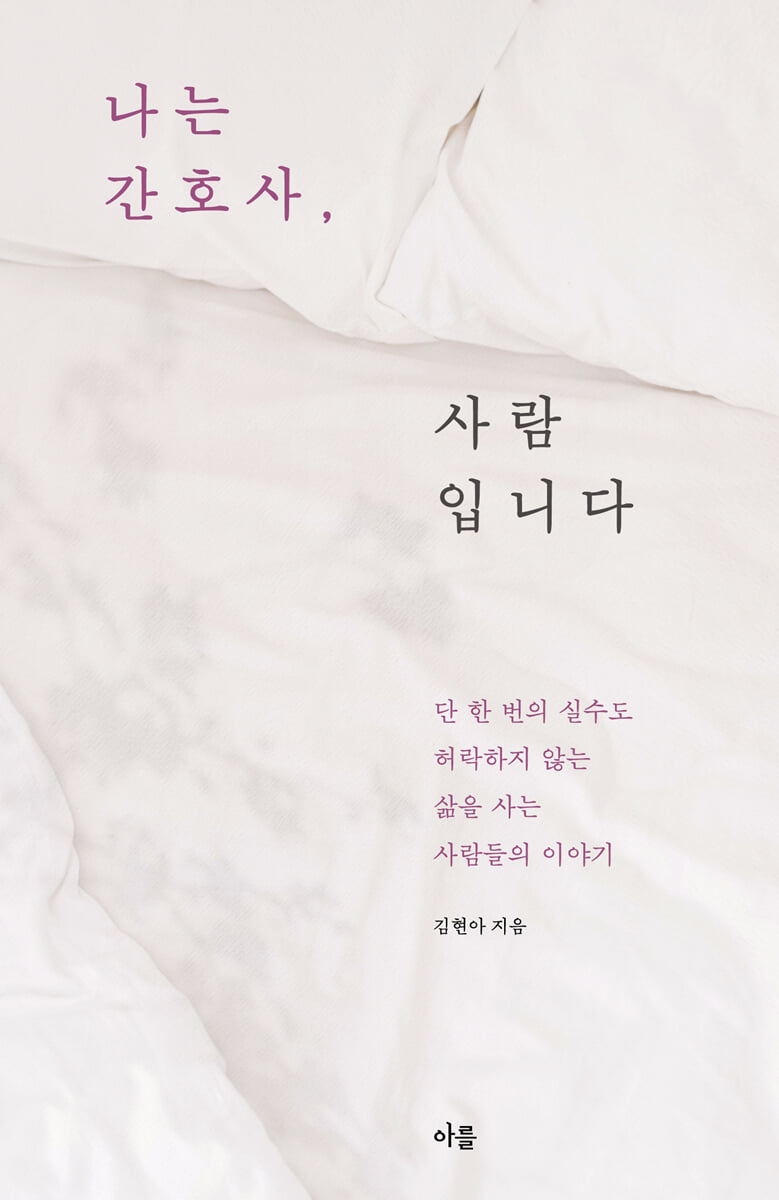
I am a nurse, a person
 |
Description
Book Introduction
"I can't count how many times I shed tears while reading it." "A life-changing book that needs no words." "A book for nurses who urgently need care right now." "A heartwarming, must-read for all Koreans, it reveals the realities of nursing." (From reader reviews)
This is a revised edition of the book "I am a Nurse, a Human," which has garnered sympathy and support from countless readers for its honest portrayal of the joys and sorrows of nurses and their work environments, previously overlooked, based on the life and experiences of a veteran nurse who tirelessly cared for patients in a university hospital surgical intensive care unit for 21 years and 2 months.
The story of how she decided to become a nurse and ended up writing the 'Nurse's Letter' that moved the entire nation, the story of how she struggled to improve the treatment of nurses but was ultimately frustrated by the poor working environment that never improved, and the figures of nurses who tenaciously care for 'their sick patients' in the intensive care unit where they fight against death 24 hours a day and live with a single sense of mission to save even one more life are depicted more dramatically than any movie or drama.
People call them 'angels in white', but in reality, they are called 'warriors of a hundred days' because they have to do 100 things in the field. People who live a life where they do not allow themselves to make a single mistake, nor can they be permitted to do so.
This is a Korean nurse.
This is a revised edition of the book "I am a Nurse, a Human," which has garnered sympathy and support from countless readers for its honest portrayal of the joys and sorrows of nurses and their work environments, previously overlooked, based on the life and experiences of a veteran nurse who tirelessly cared for patients in a university hospital surgical intensive care unit for 21 years and 2 months.
The story of how she decided to become a nurse and ended up writing the 'Nurse's Letter' that moved the entire nation, the story of how she struggled to improve the treatment of nurses but was ultimately frustrated by the poor working environment that never improved, and the figures of nurses who tenaciously care for 'their sick patients' in the intensive care unit where they fight against death 24 hours a day and live with a single sense of mission to save even one more life are depicted more dramatically than any movie or drama.
People call them 'angels in white', but in reality, they are called 'warriors of a hundred days' because they have to do 100 things in the field. People who live a life where they do not allow themselves to make a single mistake, nor can they be permitted to do so.
This is a Korean nurse.
- You can preview some of the book's contents.
Preview
index
Publishing a Revised Edition | Greetings after 5 Years
Preface | The Honest Story of a Nurse Who Was Unknown
Chapter 1: Nurses Fighting the Grim Reaper
A dream traded for overdue insurance premiums
The day I failed the nursing practical exam
Two worlds
Distance between nurse and patient
A nurse who ate the patient's food
Can I continue to live as a nurse?
Sometimes nurses need care too
Nurses are people too
A country where good nurses cannot stay
ICU Story
The nurse who fights the grim reaper
While inserting the IV needle, suddenly
“I survived thanks to you.”
If you don't want your wounded heart to close any longer
That's how you become a nurse
I believe in my decision
Chapter 2: Those Who Came Back from the Dead
- 14 days spent in the midst of the MERS outbreak
female patient in her 50s
Number 15
be caught off guard
Life separation
Cohort isolation
The world closes its heart
Arrows of criticism
Letter from the Nurse
A miracle happens
Cohort Quarantine Ends - Second Letter
One Year After the End of MERS - A Final Letter
Chapter 3: Nursing: A Beautiful and Sad Profession
Last Promise
The first mistake I made
Two deaths
Strangers in the ICU
Another mom
Time to prepare for the final shave
People who only care about money
Airbags and car seats
A grain of rice stuck to a baby photo
Losing memory
A flower is still a flower even if a few petals fall.
The woman who chose American citizenship over her life
Parents who lose a child are forever lost.
The way home
About the ending that could not be kept
The lonely silence of a swearing grandmother
At the age of thirty, the war ended like that.
courtesy towards humans
Be on my side
The meaning of sacrifice
About nursing, that beautiful and sad profession
Conclusion
Preface | The Honest Story of a Nurse Who Was Unknown
Chapter 1: Nurses Fighting the Grim Reaper
A dream traded for overdue insurance premiums
The day I failed the nursing practical exam
Two worlds
Distance between nurse and patient
A nurse who ate the patient's food
Can I continue to live as a nurse?
Sometimes nurses need care too
Nurses are people too
A country where good nurses cannot stay
ICU Story
The nurse who fights the grim reaper
While inserting the IV needle, suddenly
“I survived thanks to you.”
If you don't want your wounded heart to close any longer
That's how you become a nurse
I believe in my decision
Chapter 2: Those Who Came Back from the Dead
- 14 days spent in the midst of the MERS outbreak
female patient in her 50s
Number 15
be caught off guard
Life separation
Cohort isolation
The world closes its heart
Arrows of criticism
Letter from the Nurse
A miracle happens
Cohort Quarantine Ends - Second Letter
One Year After the End of MERS - A Final Letter
Chapter 3: Nursing: A Beautiful and Sad Profession
Last Promise
The first mistake I made
Two deaths
Strangers in the ICU
Another mom
Time to prepare for the final shave
People who only care about money
Airbags and car seats
A grain of rice stuck to a baby photo
Losing memory
A flower is still a flower even if a few petals fall.
The woman who chose American citizenship over her life
Parents who lose a child are forever lost.
The way home
About the ending that could not be kept
The lonely silence of a swearing grandmother
At the age of thirty, the war ended like that.
courtesy towards humans
Be on my side
The meaning of sacrifice
About nursing, that beautiful and sad profession
Conclusion
Detailed image
Into the book
“I owe 230,000 won in overdue insurance premiums, and I need to pay that to receive insurance benefits.”
"ah……."
“Come back with 230,000 won.”
It was a time when high school tuition for one semester was 100,000 won.
When the tuition notice came, my mother had to go around borrowing money for several days.
Sometimes, it wasn't that expensive to go to the hospital.
The office worker emphasized to me again that there was no other way than to bring the money, as I was unable to turn back.
The alley leading out from the community center felt endlessly long.
The dazzlingly clear and bright sunlight filled my face, but I had to stop every now and then to wipe away the tears that suddenly burst out.
I wanted to be a writer, but I didn't think I could make money that way right away.
My mother also wanted me to go to college, but we weren't in a position to retake the college entrance exam.
It had to be something I could safely enter into sexually and something that would be helpful to my family.
The word that came to mind in that brief moment was 'nurse'.
Then, even without health insurance, wouldn't I be able to provide my mother with most of the treatment she needs?
That's when I firmly decided to become a nurse.
Looking back now, it was a naive thought, but I was that desperate.
At that time, I was only eighteen years old.
--- pp.22~23
“Hey, what are you doing? I’m your patient!!”
The seniors who came running prepared endotracheal intubation and called the attending physician.
Another senior patient jumped onto the patient's chest in place of me, who was standing there dumbly, and shouted while pressing hard on the heart.
“What are you doing! One epinephrine, quick!!!”
My hands were shaking as I measured out the medicine with the syringe.
Thanks to the seniors' quick response, the patient was able to overcome the crisis safely, but I had to receive a severe reprimand from them.
“What the hell are you doing!! You almost lost your patient!”
"sorry."
“It’s a matter of life and death.
okay?"
A feeling of guilt came over me.
That's right.
The patient almost died.
Because I was clumsy and scared.
The senior's agitated voice softened a little, perhaps because he felt sorry for me, who was cowering so much.
“Your brain will die in four minutes.
Even if I survive, I'll have to spend the rest of my life lying down.
Every time a patient's heart stops, the nurse in charge freezes and the longer it takes, the more the patient becomes like that.
If you don't know what to do, just stick with it.
Run to me.
“The closer you are to your patient, the higher your patient’s chances of survival.”
From then on, I would always cling to the patient when CPR started.
Even though I was so flustered that I couldn't think of anything to do, I rushed in with my body first.
What my senior said was right.
Every time I pressed the heart that had stopped beating, I desperately wanted him to come back, and I began to think about what I should do to save him.
Then things quickly and naturally took hold of me.
You had to be really close to save that patient.
It was the same for my body as well as my mind.
--- pp.36~37
The profession of a nurse is one in which one must receive proper care before being able to provide the same care to patients.
Giving endless care to my patients without anyone's protection or care was something that ate away at my soul over time.
I tried to pretend to be cheerful, to pretend to be okay, to smile at my patients and not let go of their hands, but the more I did that, the more I was crumbling inside.
It took me a very long time to realize that.
My belief that I should only do my best for the patients entrusted to me at the hospital was wrong.
Unlike doctors, whose every action is monetized, everything a nurse does is included in the patient's hospitalization fee.
Even though I, a nurse, was the first to discover cardiac arrest and jumped on top of the patient, quickly starting cardiac massage and reviving them, even though I stamped my feet and chased the attending physician with the prescription to save the patient in danger, bringing the half-asleep doctor to sit in front of the patient, even though I meticulously checked all the items and medical devices that could determine the patient's life in case of an emergency, even though I prepared every tool and assisted the attending physician perfectly so that he could perform a high-risk procedure on the patient, even though I shaved my deceased patients' last for fear of looking shabby, and even though I stuck my head into their torn anus and washed the feces flowing out dozens of times, anxious to avoid any blemishes in their final appearance, everything I did was lumped together and included in the name of hospitalization fees.
If the hospital didn't make money, nothing the nurses did for the patients got noticed.
Nurses who were 'unprofitable' were increasingly becoming the common people, and it was taken for granted that they would work overtime, and after work, they had to become janitors to cover the cleaning service costs.
Who would think that I, crouching with my head bowed under the bed of the patient I was caring for, would be a nurse who cared for them?
--- pp.58~59
CPR began again.
No matter what the world was like, the intensive care unit was still busy.
It was already the third time.
As soon as cardiac arrest occurred, I jumped on top of the patient and pressed down on the heart with all my strength.
When the attending physician arrived, we prepared to perform endotracheal intubation immediately and quickly injected emergency medication into the patient's body with a syringe.
After taking the central venous catheter and moving it to the cart, I checked the blood pressure.
My hands became faster as I prepared the vasopressor to raise the low blood pressure and hung the IV regulator next to the patient.
While the attending physician was looking for a central vein, he inserted a needle into a vein in my arm so that two packs of red blood cells could be injected simultaneously.
Sweat dripped from my forehead and fell into my eyes, stinging them.
The patient's heart started beating again.
“You are the child who fights the Grim Reaper.”
An old woman who had been watching me for a long time spoke to me as I wiped the sweat running down my eyes.
At that moment, my heart, which had been torn between hopeful and skeptical, felt a weight sink into my chest.
That's right.
I was the one who protected my patients.
I had forgotten about it for a moment.
There was no time to go back and forth between hope and skepticism in order to save them.
My grandmother's words stayed in my heart for a very long time, and I truly became a 'nurse who fights the Grim Reaper' for my patients.
"ah……."
“Come back with 230,000 won.”
It was a time when high school tuition for one semester was 100,000 won.
When the tuition notice came, my mother had to go around borrowing money for several days.
Sometimes, it wasn't that expensive to go to the hospital.
The office worker emphasized to me again that there was no other way than to bring the money, as I was unable to turn back.
The alley leading out from the community center felt endlessly long.
The dazzlingly clear and bright sunlight filled my face, but I had to stop every now and then to wipe away the tears that suddenly burst out.
I wanted to be a writer, but I didn't think I could make money that way right away.
My mother also wanted me to go to college, but we weren't in a position to retake the college entrance exam.
It had to be something I could safely enter into sexually and something that would be helpful to my family.
The word that came to mind in that brief moment was 'nurse'.
Then, even without health insurance, wouldn't I be able to provide my mother with most of the treatment she needs?
That's when I firmly decided to become a nurse.
Looking back now, it was a naive thought, but I was that desperate.
At that time, I was only eighteen years old.
--- pp.22~23
“Hey, what are you doing? I’m your patient!!”
The seniors who came running prepared endotracheal intubation and called the attending physician.
Another senior patient jumped onto the patient's chest in place of me, who was standing there dumbly, and shouted while pressing hard on the heart.
“What are you doing! One epinephrine, quick!!!”
My hands were shaking as I measured out the medicine with the syringe.
Thanks to the seniors' quick response, the patient was able to overcome the crisis safely, but I had to receive a severe reprimand from them.
“What the hell are you doing!! You almost lost your patient!”
"sorry."
“It’s a matter of life and death.
okay?"
A feeling of guilt came over me.
That's right.
The patient almost died.
Because I was clumsy and scared.
The senior's agitated voice softened a little, perhaps because he felt sorry for me, who was cowering so much.
“Your brain will die in four minutes.
Even if I survive, I'll have to spend the rest of my life lying down.
Every time a patient's heart stops, the nurse in charge freezes and the longer it takes, the more the patient becomes like that.
If you don't know what to do, just stick with it.
Run to me.
“The closer you are to your patient, the higher your patient’s chances of survival.”
From then on, I would always cling to the patient when CPR started.
Even though I was so flustered that I couldn't think of anything to do, I rushed in with my body first.
What my senior said was right.
Every time I pressed the heart that had stopped beating, I desperately wanted him to come back, and I began to think about what I should do to save him.
Then things quickly and naturally took hold of me.
You had to be really close to save that patient.
It was the same for my body as well as my mind.
--- pp.36~37
The profession of a nurse is one in which one must receive proper care before being able to provide the same care to patients.
Giving endless care to my patients without anyone's protection or care was something that ate away at my soul over time.
I tried to pretend to be cheerful, to pretend to be okay, to smile at my patients and not let go of their hands, but the more I did that, the more I was crumbling inside.
It took me a very long time to realize that.
My belief that I should only do my best for the patients entrusted to me at the hospital was wrong.
Unlike doctors, whose every action is monetized, everything a nurse does is included in the patient's hospitalization fee.
Even though I, a nurse, was the first to discover cardiac arrest and jumped on top of the patient, quickly starting cardiac massage and reviving them, even though I stamped my feet and chased the attending physician with the prescription to save the patient in danger, bringing the half-asleep doctor to sit in front of the patient, even though I meticulously checked all the items and medical devices that could determine the patient's life in case of an emergency, even though I prepared every tool and assisted the attending physician perfectly so that he could perform a high-risk procedure on the patient, even though I shaved my deceased patients' last for fear of looking shabby, and even though I stuck my head into their torn anus and washed the feces flowing out dozens of times, anxious to avoid any blemishes in their final appearance, everything I did was lumped together and included in the name of hospitalization fees.
If the hospital didn't make money, nothing the nurses did for the patients got noticed.
Nurses who were 'unprofitable' were increasingly becoming the common people, and it was taken for granted that they would work overtime, and after work, they had to become janitors to cover the cleaning service costs.
Who would think that I, crouching with my head bowed under the bed of the patient I was caring for, would be a nurse who cared for them?
--- pp.58~59
CPR began again.
No matter what the world was like, the intensive care unit was still busy.
It was already the third time.
As soon as cardiac arrest occurred, I jumped on top of the patient and pressed down on the heart with all my strength.
When the attending physician arrived, we prepared to perform endotracheal intubation immediately and quickly injected emergency medication into the patient's body with a syringe.
After taking the central venous catheter and moving it to the cart, I checked the blood pressure.
My hands became faster as I prepared the vasopressor to raise the low blood pressure and hung the IV regulator next to the patient.
While the attending physician was looking for a central vein, he inserted a needle into a vein in my arm so that two packs of red blood cells could be injected simultaneously.
Sweat dripped from my forehead and fell into my eyes, stinging them.
The patient's heart started beating again.
“You are the child who fights the Grim Reaper.”
An old woman who had been watching me for a long time spoke to me as I wiped the sweat running down my eyes.
At that moment, my heart, which had been torn between hopeful and skeptical, felt a weight sink into my chest.
That's right.
I was the one who protected my patients.
I had forgotten about it for a moment.
There was no time to go back and forth between hope and skepticism in order to save them.
My grandmother's words stayed in my heart for a very long time, and I truly became a 'nurse who fights the Grim Reaper' for my patients.
--- pp.89~90
Publisher's Review
That's how we became nurses,
That's how we fight the Grim Reaper
The ICU nurse with 21 years of experience, the protagonist of "A Nurse's Letter," which moved the nation.
Kim Hyun-ah's beautiful yet sad story of nurses in this land.
The tears of a new nurse who worked without even having time to eat and ate a patient's food without realizing it, the uniform of a senior nurse who was covered in blood because she didn't even have time to change her sanitary pad, the back of a colleague who couldn't leave work and was mobilized to the event venue and dozed off because they were told to fill the number of people for a hospital event, the sadness of having to work wearing a military bandage even after hurting her back while moving an emergency patient herself because there was no one to move it for her...
People call them 'angels in white', but in reality, they are called 'warriors of a hundred days' because they have to do 100 things in the field. People who live a life where they do not allow themselves to make a single mistake, nor can they be permitted to do so.
This is a Korean nurse.
"I am a Nurse, a Human" is a book written by the author, who worked tirelessly for 21 years and 2 months as a veteran nurse in the surgical intensive care unit of a university hospital, caring for patients. It vividly depicts the joys and sorrows of nurses and the harsh working conditions that no one properly recognized.
The author's honest experiences of growing into a skilled nurse through her early days as a new nurse who was frozen in an emergency situation, the struggles of her fellow nurses who steadfastly protected 'their patients' despite the grueling three-shift work and manpower shortage, and the stories of the warm affection between nurses and patients that sprout in the midst of deep despair are heartbreaking and touching.
“I don’t know how many times I shed tears while reading it.” “A life-changing book that needs no words.” “A book for nurses who need urgent care right now.” “A heartwarming must-read for all citizens that lets them understand the reality of nursing.” This book has been loved by countless readers and has become a book that current nurses especially recommend to each other when they need comfort and encouragement, and a must-read for prospective nurses before becoming nurses.
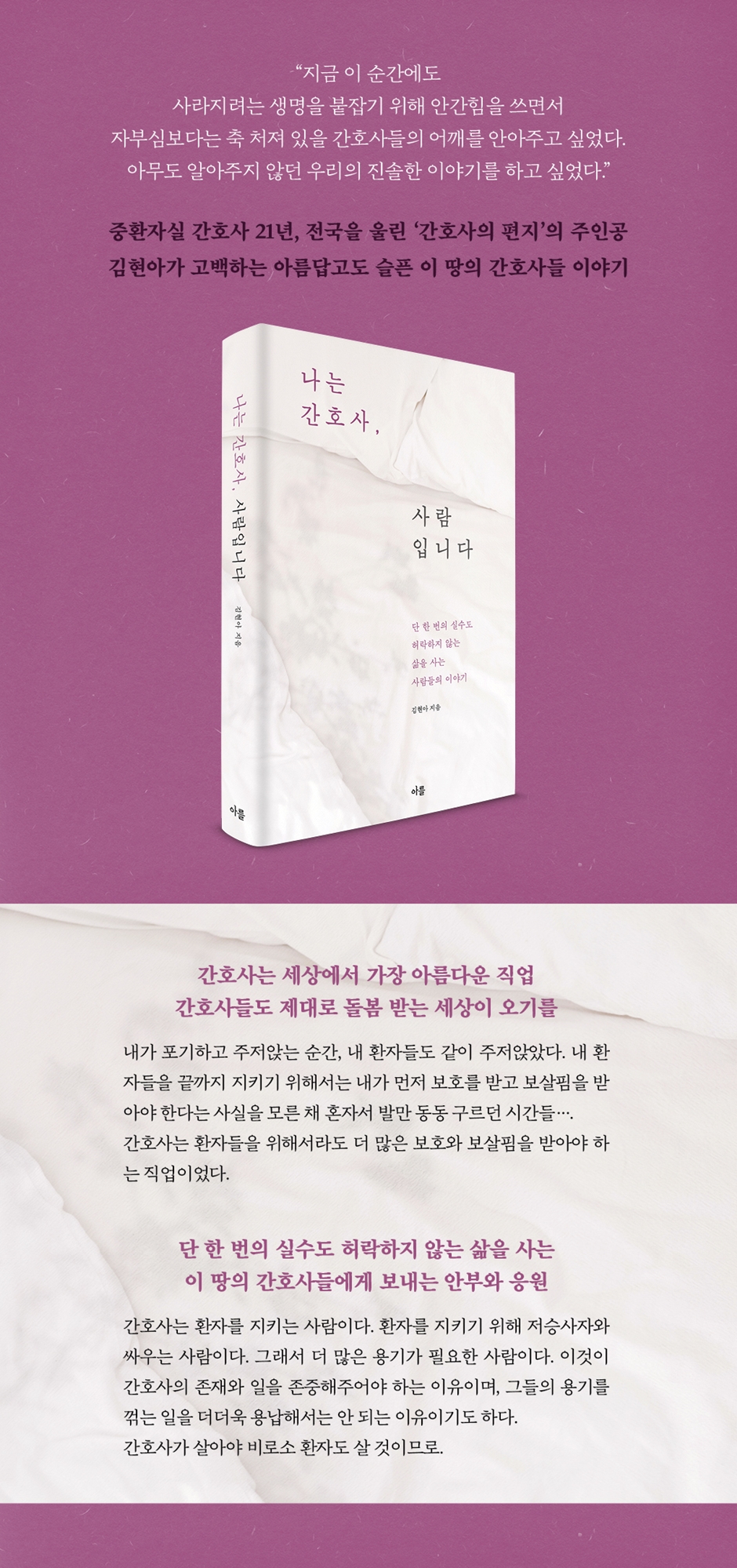
Nursing is the most beautiful profession in the world.
I hope that there will come a world where nurses are properly cared for.
While hospitals are focusing on facility investment and profit generation rather than improving nurse treatment and staffing, nurses are also taking on the role of janitors to cover the reduced cleaning service costs.
As we face the global crisis of COVID-19 and the population in need of care continues to grow, nurses working in the field are still facing severe shortages of personnel, poor working conditions, and frequent human rights violations.
The author says, “If nurses hesitate, patients cannot receive proper nursing care.”
This is an earnest appeal not only to hospitals but also to our society and the people, and a desperate cry that 'nurses are people too.'
“The profession of a nurse is one in which one must receive proper care before being able to provide the same care to patients.
Giving endless care to my patients without anyone's protection or care was something that ate away at my soul over time.
“I tried to pretend to be cheerful, to pretend to be okay, to smile at my patients and not let go of their hands, but the more I did that, the more I was crumbling inside.” (p. 58)
Perhaps that is why the author confesses that the job of a nurse was “a beautiful but sad profession filled with a sense of inferiority.”
“The reason I couldn’t hold back the tears that would sometimes burst out while writing was because I felt sad for the nurses who, even at this very moment, were struggling to hold on to the lives that were about to disappear, and their shoulders must have slumped rather than felt proud, and because I knew the arduous times they had to go through as ‘warriors’ who constantly fought against the grim reaper to protect their patients.
I wanted to hug the drooping shoulders of those who were nurses and those who are nurses now.
“I wanted to tell our honest story, which no one knew about.” (Page 13)
This book, written with all the heart and soul of a surgical intensive care unit nurse over 21 years and 2 months, reveals the transparent truth that nurses desperately need loving protection and care to care for and protect patients until the very end.
The final sentence of this book tells us why we must respect the existence and work of nurses who, even now, are making the world a better place in unseen places, and who fight against the grim reaper to bring patients struggling with death back to life.
“Because only when nurses live can patients live.”
That's how we fight the Grim Reaper
The ICU nurse with 21 years of experience, the protagonist of "A Nurse's Letter," which moved the nation.
Kim Hyun-ah's beautiful yet sad story of nurses in this land.
The tears of a new nurse who worked without even having time to eat and ate a patient's food without realizing it, the uniform of a senior nurse who was covered in blood because she didn't even have time to change her sanitary pad, the back of a colleague who couldn't leave work and was mobilized to the event venue and dozed off because they were told to fill the number of people for a hospital event, the sadness of having to work wearing a military bandage even after hurting her back while moving an emergency patient herself because there was no one to move it for her...
People call them 'angels in white', but in reality, they are called 'warriors of a hundred days' because they have to do 100 things in the field. People who live a life where they do not allow themselves to make a single mistake, nor can they be permitted to do so.
This is a Korean nurse.
"I am a Nurse, a Human" is a book written by the author, who worked tirelessly for 21 years and 2 months as a veteran nurse in the surgical intensive care unit of a university hospital, caring for patients. It vividly depicts the joys and sorrows of nurses and the harsh working conditions that no one properly recognized.
The author's honest experiences of growing into a skilled nurse through her early days as a new nurse who was frozen in an emergency situation, the struggles of her fellow nurses who steadfastly protected 'their patients' despite the grueling three-shift work and manpower shortage, and the stories of the warm affection between nurses and patients that sprout in the midst of deep despair are heartbreaking and touching.
“I don’t know how many times I shed tears while reading it.” “A life-changing book that needs no words.” “A book for nurses who need urgent care right now.” “A heartwarming must-read for all citizens that lets them understand the reality of nursing.” This book has been loved by countless readers and has become a book that current nurses especially recommend to each other when they need comfort and encouragement, and a must-read for prospective nurses before becoming nurses.
Nursing is the most beautiful profession in the world.
I hope that there will come a world where nurses are properly cared for.
While hospitals are focusing on facility investment and profit generation rather than improving nurse treatment and staffing, nurses are also taking on the role of janitors to cover the reduced cleaning service costs.
As we face the global crisis of COVID-19 and the population in need of care continues to grow, nurses working in the field are still facing severe shortages of personnel, poor working conditions, and frequent human rights violations.
The author says, “If nurses hesitate, patients cannot receive proper nursing care.”
This is an earnest appeal not only to hospitals but also to our society and the people, and a desperate cry that 'nurses are people too.'
“The profession of a nurse is one in which one must receive proper care before being able to provide the same care to patients.
Giving endless care to my patients without anyone's protection or care was something that ate away at my soul over time.
“I tried to pretend to be cheerful, to pretend to be okay, to smile at my patients and not let go of their hands, but the more I did that, the more I was crumbling inside.” (p. 58)
Perhaps that is why the author confesses that the job of a nurse was “a beautiful but sad profession filled with a sense of inferiority.”
“The reason I couldn’t hold back the tears that would sometimes burst out while writing was because I felt sad for the nurses who, even at this very moment, were struggling to hold on to the lives that were about to disappear, and their shoulders must have slumped rather than felt proud, and because I knew the arduous times they had to go through as ‘warriors’ who constantly fought against the grim reaper to protect their patients.
I wanted to hug the drooping shoulders of those who were nurses and those who are nurses now.
“I wanted to tell our honest story, which no one knew about.” (Page 13)
This book, written with all the heart and soul of a surgical intensive care unit nurse over 21 years and 2 months, reveals the transparent truth that nurses desperately need loving protection and care to care for and protect patients until the very end.
The final sentence of this book tells us why we must respect the existence and work of nurses who, even now, are making the world a better place in unseen places, and who fight against the grim reaper to bring patients struggling with death back to life.
“Because only when nurses live can patients live.”
GOODS SPECIFICS
- Date of issue: April 19, 2023
- Page count, weight, size: 304 pages | 410g | 130*200*17mm
- ISBN13: 9791198070630
- ISBN10: 1198070633
You may also like
카테고리
korean


korean

![GQ KOREA Mark (Monthly): December [2025]](http://librairie.coreenne.fr/cdn/shop/files/8ef265dbbfbf186523ed75ba7319009d.jpg?v=1765340328&width=3840)


