

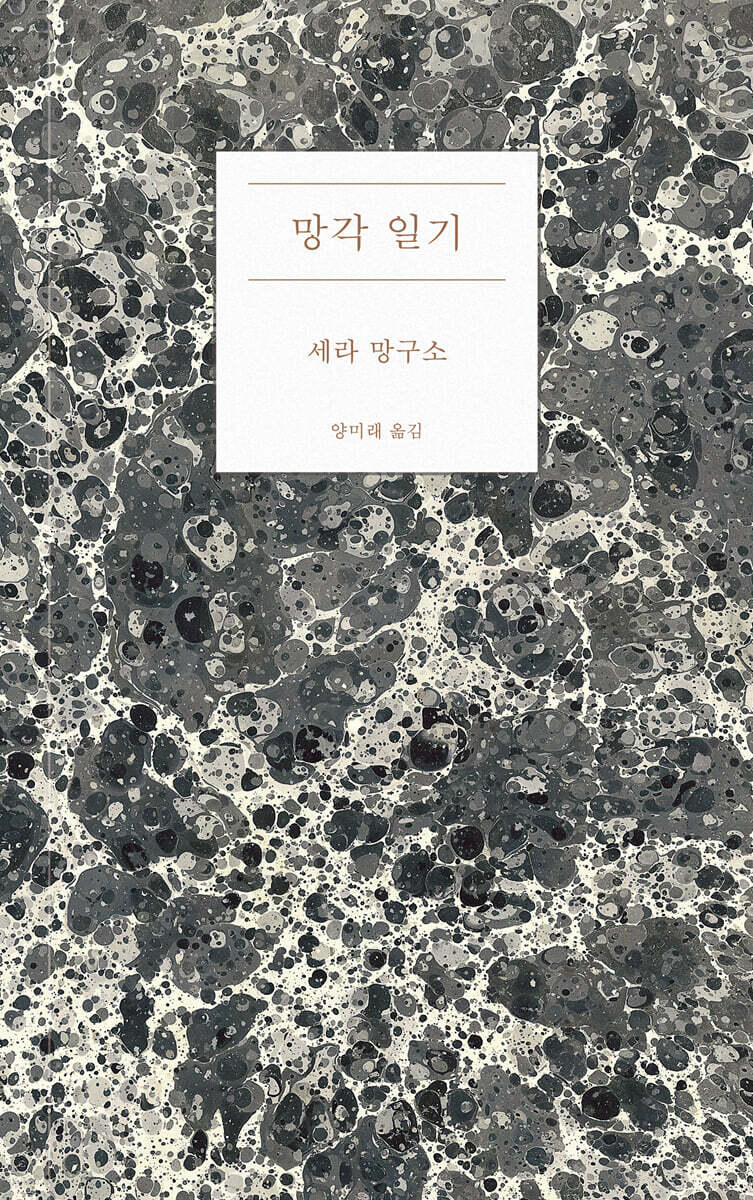
Diary of Oblivion
 |
Description
Book Introduction
Writing for Memory and Forgetting
Sarah Manguso kept a diary obsessively for 25 years.
Because I wanted to resist oblivion, which is like death, and to preserve memories and the flow of time.
Soon she became pregnant and gave birth to a child.
Childbirth and childcare were monumental events that changed his relationship with his diary and with himself.
"The Diary of Oblivion" is a beautiful and bold work that explores the struggles of writing, motherhood, mortality, time, and memory.
Sarah Manguso kept a diary obsessively for 25 years.
Because I wanted to resist oblivion, which is like death, and to preserve memories and the flow of time.
Soon she became pregnant and gave birth to a child.
Childbirth and childcare were monumental events that changed his relationship with his diary and with himself.
"The Diary of Oblivion" is a beautiful and bold work that explores the struggles of writing, motherhood, mortality, time, and memory.
- You can preview some of the book's contents.
Preview
Detailed image

Into the book
I couldn't think of a single way to avoid getting lost in time without writing.
Writing a diary is a series of choices about what to leave out and what to forget.
The reason I write a diary is because I want to support my existence without any gaps through the diary.
I record factual information faithfully.
As if information that is more realistic than my memory adds dignity to the writing, as if such information reveals the truth.
When a memory comes to mind, I drink a glass of wine or coffee.
That one drink helps ease the pain of memory.
However, the effect does not last long.
The memories I want to forget, no matter what I do, I can never forget them.
I think we should be respectful of the things that remain as such persistent memories.
In 150 years, there will not be a single person alive in this world who knows me.
To be forgotten by the world like that, to enter into such a vast and lasting void, is more like death than death itself.
I don't care if perception is imperfect, or if memory is even more imperfect.
But what bothers me is that I don't know why I chose to remember what I remember, or why I thought I remembered it.
And then I became a mother.
After becoming a mother, I began to live a completely different life than before.
From then on, time became linked to mortality.
I continued to keep my journal, but my concerns about losing my memories began to subside.
I forgot to buy milk this week.
I forgot to file my taxes last year.
Still, I continue to live.
I have never understood so clearly that linear time is a compressed version of real time, all time, the ever-flowing eternity.
Now I understand that forgetting is the price I pay for my constant involvement in life, the influence of some force indifferent to time.
Maybe someday I'll find in my diary some moments I've forgotten, moments I've allowed myself to forget, moments my brain was bound to forget in the first place, moments I've willingly forgotten and then willingly brought back to life through writing.
Experience is no longer experience.
Experience is writing.
I'm still writing.
Writing a diary is a series of choices about what to leave out and what to forget.
The reason I write a diary is because I want to support my existence without any gaps through the diary.
I record factual information faithfully.
As if information that is more realistic than my memory adds dignity to the writing, as if such information reveals the truth.
When a memory comes to mind, I drink a glass of wine or coffee.
That one drink helps ease the pain of memory.
However, the effect does not last long.
The memories I want to forget, no matter what I do, I can never forget them.
I think we should be respectful of the things that remain as such persistent memories.
In 150 years, there will not be a single person alive in this world who knows me.
To be forgotten by the world like that, to enter into such a vast and lasting void, is more like death than death itself.
I don't care if perception is imperfect, or if memory is even more imperfect.
But what bothers me is that I don't know why I chose to remember what I remember, or why I thought I remembered it.
And then I became a mother.
After becoming a mother, I began to live a completely different life than before.
From then on, time became linked to mortality.
I continued to keep my journal, but my concerns about losing my memories began to subside.
I forgot to buy milk this week.
I forgot to file my taxes last year.
Still, I continue to live.
I have never understood so clearly that linear time is a compressed version of real time, all time, the ever-flowing eternity.
Now I understand that forgetting is the price I pay for my constant involvement in life, the influence of some force indifferent to time.
Maybe someday I'll find in my diary some moments I've forgotten, moments I've allowed myself to forget, moments my brain was bound to forget in the first place, moments I've willingly forgotten and then willingly brought back to life through writing.
Experience is no longer experience.
Experience is writing.
I'm still writing.
--- From the text
Publisher's Review
Meditations on Journaling
Sarah Manguso, poet, novelist, and memoirist, has been keeping a daily diary for 25 years.
At a time when every moment felt overwhelming, I started writing a diary “to recover within today,” but it became an essential part of my daily routine, and I became someone who “finds it harder not to write in a diary.”
For those who consider journaling a noble act, like daily exercise or charity work, the author says:
“For me, writing a diary is not like a tedious homework.
Instead of spending time exercising or doing something that makes money, I just keep a diary.” Anyone who records aspects of their life in some way, anyone who wants to preserve memories through records, will be able to project themselves into the 『Diary of Oblivion』.
What, how, and why we write.
Here is what Sarah Manguso had to say about this:
#What to write
“Writing a diary is a series of choices, choosing what to leave out and what to forget.” (p. 10)
#How to use it
“I record factual information faithfully.
“As if information that is more realistic than my memory adds dignity to the writing, as if such information reveals the truth.” (p. 33)
#Why do we write?
“The reason I keep a diary is because I want to support my existence without any gaps in it.” (p. 19)
An Alternative to Self-Confessional Writing
This book does not cite Sarah Manguso's 800,000-word diary, written over 25 years.
It is a piece about a diary that does not include any personal diary information.
Sarah Manguso says her diary was not written to be read by anyone.
As the line between private and public records becomes increasingly blurred, the question of disclosure is a topic not only for writers but also for all of us who expose aspects of our lives through social media.
“Sarah Manguso’s writing offers an alternative for writers who write confessionals,” says Leslie Jamison, author of “Practicing Empathy,” who wrote the book’s foreword. “This way of operating the ‘I’ within the text creates a new form of intimacy.
It is not a sympathy born of voyeurism, but a joint exploration.
“Writers and readers explore together the same questions that they inevitably face in the messiness of life,” he says.
The Quest for Linear Time
As time passes, Sarah Manguso becomes pregnant and gives birth to a child.
Childbirth and childcare were monumental events that changed his relationship with his diary and with himself.
As she lives as a mother, Mangguso sometimes loses memories from not so long ago, and sometimes vividly recalls memories from her early life that she would normally not remember.
This experience “serves as an opportunity to let go of the obsession with memories and records that existed in his life, and further changes and deepens his perception of time.”
“I have never understood so clearly that linear time is a compressed version of real time, all time, the ever-flowing eternity.”
To remember and forget
Manguso, who had tried to preserve all of his life's memories and select those he wished to forget, finally "came to understand that forgetting was the price of his constant involvement in life, the influence of some force indifferent to time."
This is the point where writing, which started to capture memories, turns into writing to empty memories.
“Maybe someday I’ll find in my diary some moments I’ve forgotten, moments I’ve allowed myself to forget, moments my brain couldn’t help but forget, moments I’ve willingly forgotten and then willingly brought back to life through writing.
Experience is no longer experience.
Experience is writing.
I'm still writing.
And I'm forgetting everything." When we accept this fact, the diary becomes both a tool for remembering and a tool for forgetting.
A diary belongs to everyone who has the courage to remember and forget.
Sarah Manguso, poet, novelist, and memoirist, has been keeping a daily diary for 25 years.
At a time when every moment felt overwhelming, I started writing a diary “to recover within today,” but it became an essential part of my daily routine, and I became someone who “finds it harder not to write in a diary.”
For those who consider journaling a noble act, like daily exercise or charity work, the author says:
“For me, writing a diary is not like a tedious homework.
Instead of spending time exercising or doing something that makes money, I just keep a diary.” Anyone who records aspects of their life in some way, anyone who wants to preserve memories through records, will be able to project themselves into the 『Diary of Oblivion』.
What, how, and why we write.
Here is what Sarah Manguso had to say about this:
#What to write
“Writing a diary is a series of choices, choosing what to leave out and what to forget.” (p. 10)
#How to use it
“I record factual information faithfully.
“As if information that is more realistic than my memory adds dignity to the writing, as if such information reveals the truth.” (p. 33)
#Why do we write?
“The reason I keep a diary is because I want to support my existence without any gaps in it.” (p. 19)
An Alternative to Self-Confessional Writing
This book does not cite Sarah Manguso's 800,000-word diary, written over 25 years.
It is a piece about a diary that does not include any personal diary information.
Sarah Manguso says her diary was not written to be read by anyone.
As the line between private and public records becomes increasingly blurred, the question of disclosure is a topic not only for writers but also for all of us who expose aspects of our lives through social media.
“Sarah Manguso’s writing offers an alternative for writers who write confessionals,” says Leslie Jamison, author of “Practicing Empathy,” who wrote the book’s foreword. “This way of operating the ‘I’ within the text creates a new form of intimacy.
It is not a sympathy born of voyeurism, but a joint exploration.
“Writers and readers explore together the same questions that they inevitably face in the messiness of life,” he says.
The Quest for Linear Time
As time passes, Sarah Manguso becomes pregnant and gives birth to a child.
Childbirth and childcare were monumental events that changed his relationship with his diary and with himself.
As she lives as a mother, Mangguso sometimes loses memories from not so long ago, and sometimes vividly recalls memories from her early life that she would normally not remember.
This experience “serves as an opportunity to let go of the obsession with memories and records that existed in his life, and further changes and deepens his perception of time.”
“I have never understood so clearly that linear time is a compressed version of real time, all time, the ever-flowing eternity.”
To remember and forget
Manguso, who had tried to preserve all of his life's memories and select those he wished to forget, finally "came to understand that forgetting was the price of his constant involvement in life, the influence of some force indifferent to time."
This is the point where writing, which started to capture memories, turns into writing to empty memories.
“Maybe someday I’ll find in my diary some moments I’ve forgotten, moments I’ve allowed myself to forget, moments my brain couldn’t help but forget, moments I’ve willingly forgotten and then willingly brought back to life through writing.
Experience is no longer experience.
Experience is writing.
I'm still writing.
And I'm forgetting everything." When we accept this fact, the diary becomes both a tool for remembering and a tool for forgetting.
A diary belongs to everyone who has the courage to remember and forget.
GOODS SPECIFICS
- Publication date: December 2, 2022
- Page count, weight, size: 112 pages | 120g | 118*188*9mm
- ISBN13: 9791197559693
- ISBN10: 1197559698
You may also like
카테고리
korean


korean

![GQ KOREA Mark (Monthly): December [2025]](http://librairie.coreenne.fr/cdn/shop/files/8ef265dbbfbf186523ed75ba7319009d.jpg?v=1765340328&width=3840)


