

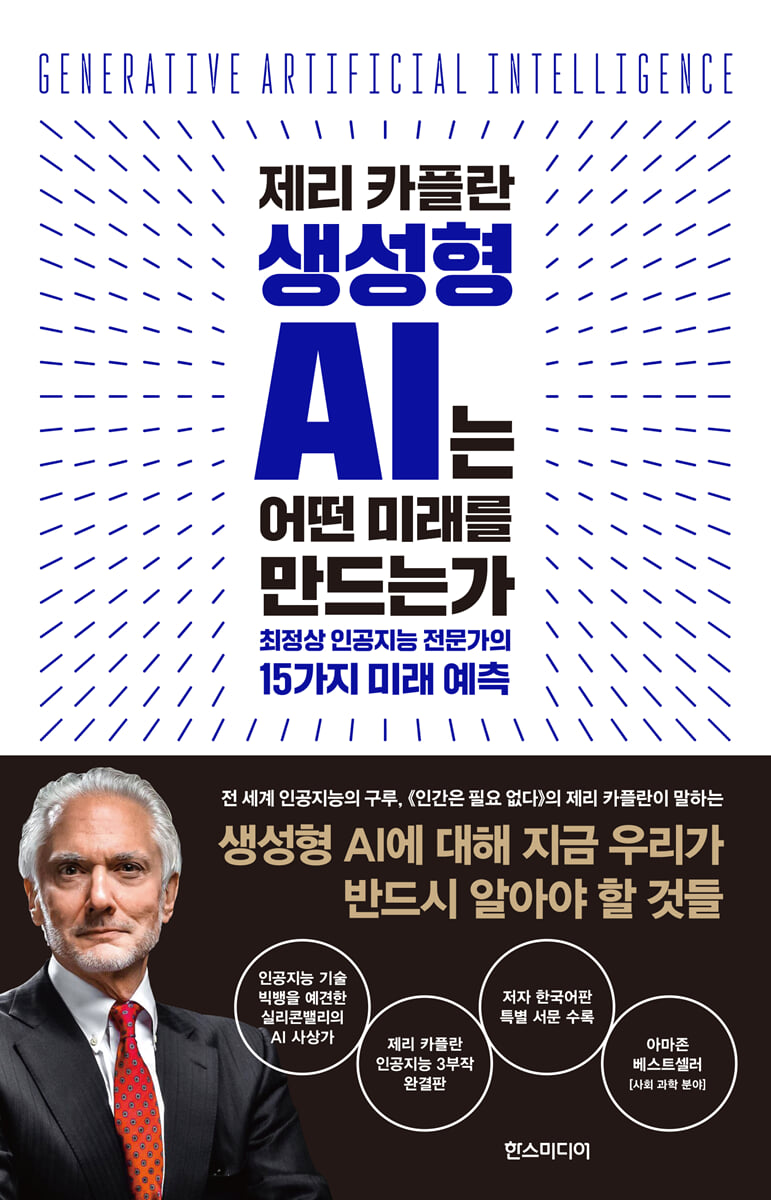
Jerry Kaplan: What Future Will Generative AI Create?
 |
Description
Book Introduction
- A word from MD
-
What We Need to Know in the AI EraA new book by Professor Jerry Kaplan, author of "Humans Are No Longer Needed," which predicted the era of artificial intelligence.
It covers a wide range of topics, from the history of artificial intelligence to how generative AI works and its future prospects.
As we enter the era of rapidly evolving generative AI, let's take a look at what we absolutely need to know from an expert's perspective.
July 5, 2024. Economics and Management PD Kim Sang-geun
Is the era of superintelligence finally dawning?
The era of artificial intelligence that surpasses human intelligence has begun!
What do we absolutely need to know now?
Jerry Kaplan, the world's leading artificial intelligence guru and author of "Humans Are No Longer Needed," says:
What You Need to Know About Generative AI Now
***** Silicon Valley AI thinker who predicted the big bang of artificial intelligence technology
***** The Complete Edition of Jerry Kaplan's Artificial Intelligence Trilogy
***** Includes a special preface by the author to the Korean edition
***** Amazon Bestseller [Social Science Category]
The world has been changing rapidly since the emergence of ChatGPT, which shocked the world in November 2022.
This artificial intelligence, with the somewhat unfamiliar name of 'generative AI,' is rapidly and exceeding expectations in many fields that were expected to remain the exclusive domain of humans for the time being, such as emails, reports, books, images, and music.
Even GPT-4o, announced in May 2024, surpassed the previous text-based communication and demonstrated 'emotional voice conversation' and 'communication at a level that is indistinguishable from a real person', making us realize that the era of superintelligence is finally dawning.
Has the era of artificial intelligence surpassing human intelligence truly arrived? What kind of future will the emergence and development of generative AI create? Is coexistence between humans and artificial intelligence possible? What do we, who must live in the age of generative AI, absolutely need to know now?
Professor Jerry Kaplan, the world's leading artificial intelligence expert and author of the best-selling book "Humans Need Not Apply," which announced the dawn of the artificial intelligence era to the public, has provided an answer to this question in his new book, "Jerry Kaplan: What Future Will Generative AI Create?"
The author argues in this book that the emergence and development of generative AI will accelerate the advancement of science, art, and human knowledge, but will also bring about new risks.
He says that the mountain of challenges we face, such as labor, war, legal status, and copyright, are also realities we must face, and that we must not overlook the philosophical issues surrounding "thinking computers."
The era of artificial intelligence that surpasses human intelligence has begun!
What do we absolutely need to know now?
Jerry Kaplan, the world's leading artificial intelligence guru and author of "Humans Are No Longer Needed," says:
What You Need to Know About Generative AI Now
***** Silicon Valley AI thinker who predicted the big bang of artificial intelligence technology
***** The Complete Edition of Jerry Kaplan's Artificial Intelligence Trilogy
***** Includes a special preface by the author to the Korean edition
***** Amazon Bestseller [Social Science Category]
The world has been changing rapidly since the emergence of ChatGPT, which shocked the world in November 2022.
This artificial intelligence, with the somewhat unfamiliar name of 'generative AI,' is rapidly and exceeding expectations in many fields that were expected to remain the exclusive domain of humans for the time being, such as emails, reports, books, images, and music.
Even GPT-4o, announced in May 2024, surpassed the previous text-based communication and demonstrated 'emotional voice conversation' and 'communication at a level that is indistinguishable from a real person', making us realize that the era of superintelligence is finally dawning.
Has the era of artificial intelligence surpassing human intelligence truly arrived? What kind of future will the emergence and development of generative AI create? Is coexistence between humans and artificial intelligence possible? What do we, who must live in the age of generative AI, absolutely need to know now?
Professor Jerry Kaplan, the world's leading artificial intelligence expert and author of the best-selling book "Humans Need Not Apply," which announced the dawn of the artificial intelligence era to the public, has provided an answer to this question in his new book, "Jerry Kaplan: What Future Will Generative AI Create?"
The author argues in this book that the emergence and development of generative AI will accelerate the advancement of science, art, and human knowledge, but will also bring about new risks.
He says that the mountain of challenges we face, such as labor, war, legal status, and copyright, are also realities we must face, and that we must not overlook the philosophical issues surrounding "thinking computers."
- You can preview some of the book's contents.
Preview
index
Introduction: Is the era of superintelligence finally dawning?
For Korean readers: Generative AI is a remarkable mirror of human culture's evolution.
Chapter 1: The History of Artificial Intelligence
What is artificial intelligence?
Where did the term 'artificial intelligence' originate?
What did the people who attended the Dartmouth conference hope to achieve?
How did AI researchers approach the problem?
What is the physical symbol system hypothesis?
What is machine learning?
How did machine learning come into being?
What are some notable historical milestones in AI?
Chapter 2: What is Generative AI?
What is a Large-Scale Language Model (LLM)?
How do large-scale language models (LLMs) work?
What is 'embedding'?
How do word embeddings represent meaning?
What is an artificial neural network?
What is a transformer?
How do transformers use word embeddings to represent complex concepts?
What is a 'token'?
How can an LLM be applied to nonverbal issues?
What are 'emergent properties' and does an LLM have them?
What is 'jailbreaking' and why is it such a difficult problem?
What are 'hallucinations' and why do LLMs hallucinate?
What other technologies will be used in generative AI?
How will future generative AIs communicate with each other?
What are the potential capabilities of generative AI?
Chapter 3: What Generative AI Changes
What historical precedents can serve as a benchmark for assessing the impact of generative AI?
How will generative AI transform healthcare?
How will generative AI transform the legal system?
How will generative AI transform education?
How will generative AI transform software technology?
How will generative AI transform creative arts and related industries?
Chapter 4: The Future of Work Created by Generative AI
Will generative AI increase unemployment?
How will automation impact the labor market?
Which jobs are most likely to disappear?
Which professions will not be affected?
Which occupations will thrive and grow?
What new industries and jobs will emerge?
What is 'technological unemployment'?
Chapter 5: Expected Risks
How could generative AI be used to promote disinformation and propaganda?
What is 'algorithm bias'?
Will people find emotional comfort in machines instead of humans?
How will generative AI impact the way we communicate?
What is a 'sorting problem'?
Will 'killer robots' appear soon?
Should we worry about 'superintelligence' and 'singularities'?
Chapter 6: The Legal Status of Generative AI
Can computer programs enter into agreements and contracts?
Should generative AI be granted legal rights, such as property ownership?
Could generative AI commit a crime?
How can generative AI be held accountable for criminal acts?
Why not just program generative AI to obey laws and other rules?
Chapter 7: Regulation, Public Policy, and Global Competition
Will generative AI be protected under freedom of expression laws?
Can the results of generative AI be protected by copyright?
What regulatory plans are being considered?
What new laws and regulations would be suitable for generative AI?
Chapter 8: Philosophical Issues and Implications of Artificial Intelligence
What is AI philosophy?
Can computers think?
Can computers be creative?
Can computers have free will?
Can computers be conscious?
Can computers feel?
The Future of Generative AI
Acknowledgements
Americas
For Korean readers: Generative AI is a remarkable mirror of human culture's evolution.
Chapter 1: The History of Artificial Intelligence
What is artificial intelligence?
Where did the term 'artificial intelligence' originate?
What did the people who attended the Dartmouth conference hope to achieve?
How did AI researchers approach the problem?
What is the physical symbol system hypothesis?
What is machine learning?
How did machine learning come into being?
What are some notable historical milestones in AI?
Chapter 2: What is Generative AI?
What is a Large-Scale Language Model (LLM)?
How do large-scale language models (LLMs) work?
What is 'embedding'?
How do word embeddings represent meaning?
What is an artificial neural network?
What is a transformer?
How do transformers use word embeddings to represent complex concepts?
What is a 'token'?
How can an LLM be applied to nonverbal issues?
What are 'emergent properties' and does an LLM have them?
What is 'jailbreaking' and why is it such a difficult problem?
What are 'hallucinations' and why do LLMs hallucinate?
What other technologies will be used in generative AI?
How will future generative AIs communicate with each other?
What are the potential capabilities of generative AI?
Chapter 3: What Generative AI Changes
What historical precedents can serve as a benchmark for assessing the impact of generative AI?
How will generative AI transform healthcare?
How will generative AI transform the legal system?
How will generative AI transform education?
How will generative AI transform software technology?
How will generative AI transform creative arts and related industries?
Chapter 4: The Future of Work Created by Generative AI
Will generative AI increase unemployment?
How will automation impact the labor market?
Which jobs are most likely to disappear?
Which professions will not be affected?
Which occupations will thrive and grow?
What new industries and jobs will emerge?
What is 'technological unemployment'?
Chapter 5: Expected Risks
How could generative AI be used to promote disinformation and propaganda?
What is 'algorithm bias'?
Will people find emotional comfort in machines instead of humans?
How will generative AI impact the way we communicate?
What is a 'sorting problem'?
Will 'killer robots' appear soon?
Should we worry about 'superintelligence' and 'singularities'?
Chapter 6: The Legal Status of Generative AI
Can computer programs enter into agreements and contracts?
Should generative AI be granted legal rights, such as property ownership?
Could generative AI commit a crime?
How can generative AI be held accountable for criminal acts?
Why not just program generative AI to obey laws and other rules?
Chapter 7: Regulation, Public Policy, and Global Competition
Will generative AI be protected under freedom of expression laws?
Can the results of generative AI be protected by copyright?
What regulatory plans are being considered?
What new laws and regulations would be suitable for generative AI?
Chapter 8: Philosophical Issues and Implications of Artificial Intelligence
What is AI philosophy?
Can computers think?
Can computers be creative?
Can computers have free will?
Can computers be conscious?
Can computers feel?
The Future of Generative AI
Acknowledgements
Americas
Detailed image

Into the book
The potential impact of this new technology cannot be overstated.
We are now witnessing a Kitty Hawk moment.
While today's generative AI is built using fixed training data, future versions will undoubtedly overcome these limitations and continuously learn and integrate new information, much like humans.
In other words, while we currently experience the world through human-created content, these limitations will soon disappear as we connect with real-time data sources such as cameras and microphones that will function as our own unique “eyes” and “ears.”
We are literally at the forefront of a new Renaissance, a period of explosive growth in great cultural and intellectual activity.
The Renaissance, from the 14th to the 17th centuries, was a period of great advancement in art, science, technology, and human knowledge, as the focus shifted from religion (centered on God) to the secular world of man.
Perhaps generative AI will usher in a new cultural shift in the focus towards machines, and we will harness the power of synthetic intelligence as a powerful new tool to accelerate progress.
In the future, when we seek informed, objective, and trustworthy advice, we will look to machines, not people.
--- From "Introduction: Is the Age of Superintelligence Finally Coming?"
What is artificial intelligence? It's an easy question to ask, but difficult to answer, for two reasons.
First, there are differing opinions about what intelligence is.
Second, at least for now, there is little reason to believe that machine intelligence has much to do with human intelligence.
Even though they look very similar.
There are several definitions of artificial intelligence (AI), each proposed from a different perspective, but most center on the concept of creating computer programs or machines capable of performing behaviors that would be considered intelligent if performed by humans.
--- From "Chapter 1: History of Artificial Intelligence"
At every step, generative AI will need proof of its capabilities and robust oversight from human experts, or simply direct human approval before acting on its behalf.
Methods such as double-blind trials (the standard for testing the effectiveness of medical treatments) will likely become the norm for validating various systems before allowing them for routine use.
How we harness the immense power of generative AI could be the most momentous decision in human history.
--- From "Chapter 2: What is Generative AI?"
Writing and math will not disappear.
There are many experts in both fields and many ways to refresh your memory when needed.
But what if we allowed people to express themselves in ways that felt comfortable and useful to them, rather than through text? Perhaps the "book reviews" of the future would be videos, teaching creativity and editing skills that will become increasingly useful in a changing world.
Perhaps my grandchildren will no longer need to write coherently, just as I no longer need to scribble on paper.
--- From "Chapter 3: What Generative AI Changes"
It is likely that you will spend much more money in the future than you do now.
This will make possible many dreams that are currently not economically feasible.
Many people spend their free time pursuing hobbies and developing their skills.
Maybe you grow orchids, make Christmas tree decorations, or knit your own clothes.
As people's disposable income increases, many of today's hobbies will become tomorrow's career opportunities.
--- From "Chapter 4: The Future of Labor Created by Generative AI"
We may fail to anticipate all the negative consequences that generative AI could bring, leading to all sorts of unintended consequences.
But this is simply a technological failure, not some inevitable, unexpected next step in human evolution.
In short, machines are not people, and there is no reason to believe, at least for now, that they will suddenly surpass some invisible threshold of self-improvement, establish their own independent goals and desires, and evade our supervision and control.
--- From "Chapter 5 Expected Risks"
While we can certainly be proud of the advancements in computing devices today, it's difficult to imagine why we should care about their well-being and achievements, beyond how they benefit us.
But nature can change things at will.
Can machines feel? What do they know? The crucial question is whether the highly sophisticated, self-replicating, adaptive devices we may be building will inherit the Earth.
Like countless species that have preceded us, humans may be merely a stepping stone to something beyond our comprehension.
--- From "Chapter 8: Philosophical Problems and Implications of Artificial Intelligence"
What makes predictions even more difficult is the ever-changing and evolving nature of generative AI.
Most new technologies (like the light bulb or the airplane) were relatively clear in terms of how they would be useful, and therefore easy to imagine how they would affect the way we live and work.
But generative AI is different.
Clearly, this is a very general tool with many uses.
But that's not all.
Generative AI is a tool that can use other tools.
We are now witnessing a Kitty Hawk moment.
While today's generative AI is built using fixed training data, future versions will undoubtedly overcome these limitations and continuously learn and integrate new information, much like humans.
In other words, while we currently experience the world through human-created content, these limitations will soon disappear as we connect with real-time data sources such as cameras and microphones that will function as our own unique “eyes” and “ears.”
We are literally at the forefront of a new Renaissance, a period of explosive growth in great cultural and intellectual activity.
The Renaissance, from the 14th to the 17th centuries, was a period of great advancement in art, science, technology, and human knowledge, as the focus shifted from religion (centered on God) to the secular world of man.
Perhaps generative AI will usher in a new cultural shift in the focus towards machines, and we will harness the power of synthetic intelligence as a powerful new tool to accelerate progress.
In the future, when we seek informed, objective, and trustworthy advice, we will look to machines, not people.
--- From "Introduction: Is the Age of Superintelligence Finally Coming?"
What is artificial intelligence? It's an easy question to ask, but difficult to answer, for two reasons.
First, there are differing opinions about what intelligence is.
Second, at least for now, there is little reason to believe that machine intelligence has much to do with human intelligence.
Even though they look very similar.
There are several definitions of artificial intelligence (AI), each proposed from a different perspective, but most center on the concept of creating computer programs or machines capable of performing behaviors that would be considered intelligent if performed by humans.
--- From "Chapter 1: History of Artificial Intelligence"
At every step, generative AI will need proof of its capabilities and robust oversight from human experts, or simply direct human approval before acting on its behalf.
Methods such as double-blind trials (the standard for testing the effectiveness of medical treatments) will likely become the norm for validating various systems before allowing them for routine use.
How we harness the immense power of generative AI could be the most momentous decision in human history.
--- From "Chapter 2: What is Generative AI?"
Writing and math will not disappear.
There are many experts in both fields and many ways to refresh your memory when needed.
But what if we allowed people to express themselves in ways that felt comfortable and useful to them, rather than through text? Perhaps the "book reviews" of the future would be videos, teaching creativity and editing skills that will become increasingly useful in a changing world.
Perhaps my grandchildren will no longer need to write coherently, just as I no longer need to scribble on paper.
--- From "Chapter 3: What Generative AI Changes"
It is likely that you will spend much more money in the future than you do now.
This will make possible many dreams that are currently not economically feasible.
Many people spend their free time pursuing hobbies and developing their skills.
Maybe you grow orchids, make Christmas tree decorations, or knit your own clothes.
As people's disposable income increases, many of today's hobbies will become tomorrow's career opportunities.
--- From "Chapter 4: The Future of Labor Created by Generative AI"
We may fail to anticipate all the negative consequences that generative AI could bring, leading to all sorts of unintended consequences.
But this is simply a technological failure, not some inevitable, unexpected next step in human evolution.
In short, machines are not people, and there is no reason to believe, at least for now, that they will suddenly surpass some invisible threshold of self-improvement, establish their own independent goals and desires, and evade our supervision and control.
--- From "Chapter 5 Expected Risks"
While we can certainly be proud of the advancements in computing devices today, it's difficult to imagine why we should care about their well-being and achievements, beyond how they benefit us.
But nature can change things at will.
Can machines feel? What do they know? The crucial question is whether the highly sophisticated, self-replicating, adaptive devices we may be building will inherit the Earth.
Like countless species that have preceded us, humans may be merely a stepping stone to something beyond our comprehension.
--- From "Chapter 8: Philosophical Problems and Implications of Artificial Intelligence"
What makes predictions even more difficult is the ever-changing and evolving nature of generative AI.
Most new technologies (like the light bulb or the airplane) were relatively clear in terms of how they would be useful, and therefore easy to imagine how they would affect the way we live and work.
But generative AI is different.
Clearly, this is a very general tool with many uses.
But that's not all.
Generative AI is a tool that can use other tools.
--- From "Coming Out: The Future of Generative AI"
Publisher's Review
A monumental bestseller that heralded the dawn of the artificial intelligence era for the public.
Jerry Kaplan, author of "No Need for Humans"
The world's leading AI expert looks at generative AI and the future of humanity!
Advances in generative AI have given rise to new types of computer systems that demonstrate remarkable, superhuman abilities in a variety of fields.
Soon, these systems will be providing professional medical services, providing legal advice, drafting documents, creating computer programs, teaching children, and creating music and art.
Generative AI will have a far greater impact on human history than inventions like the wheel, the printing press, penicillin, and the internet.
Have we finally discovered the holy grail of AI—machines that rival or surpass human intelligence? Which industries and professions will thrive, and which will decline? What risks does generative AI pose? How can we ensure that these systems respect our ethical principles? Will the benefits be widely distributed, or will they be concentrated in the hands of a lucky few? How will political systems and international conflicts change? Are we merely stepping stones to new forms of non-biological life, or are we simply becoming increasingly adept at creating useful tools? This book offers striking insights and solutions to the pressing and critical questions facing us today.
Main contents of this book
This book begins with an introduction (Is the era of superintelligence finally dawning?), discussing the background and significance of the emergence of generative AI, as well as what we must pay attention to, and briefly introducing the author's 15 future outlooks.
The first step toward understanding what kind of future generative AI will create begins with understanding the basic history of artificial intelligence through Chapter 1 (History of Artificial Intelligence).
In Chapter 2 (What is Generative AI), we'll explore how generative AI works, and in Chapter 3 (What Will Generative AI Change?), we'll explore the impact of generative AI on the real economy and business.
If you want to know whether generative AI will increase unemployment, which jobs will disappear and which jobs will not be affected, etc., you will find the answers in Chapter 4 (The Future of Work Shaped by Generative AI).
If you want to hear the story on the other side of the rosy future created by generative AI, read Chapter 5 (Expected Risks).
Chapters 6 (The Legal Status of Generative AI) and 7 (Regulation, Public Policy, and Global Competition) then address the questions of readers interested in how society will integrate generative AI.
Readers interested in the humanities should not miss Chapter 8 (Philosophical Issues and Implications of Artificial Intelligence), which covers philosophical questions such as "Can Computers Really Think?" and "Can They Have Creativity, Free Will, and Consciousness?"
Finally, in 'Coming Out' (The Future of Generative AI), the author concludes a series of outlooks and predictions on generative AI.
Generative AI is both a “tool that can use tools” and an “invention that can invent.”
It's difficult enough to predict what humans will invent in the coming decades, but it might be pointless to predict what generative AI might invent.
Because if we can learn from the corpus of human knowledge at a speed that surpasses human thought and use every kind of tool imaginable, it becomes nearly impossible to predict the direction of evolution.
But this is also why we should continue to be interested in the future that generative AI is creating.
There is no future for nations, companies, or individuals who cannot adapt to the changes brought about by generative AI.
This book, "What Future Will Jerry Kaplan's Generative AI Create?", examines the future and the answers to survival.
Jerry Kaplan's 15 Predictions for the Future Made by Generative AI
· Regulations and tools will emerge to mitigate the worst risks generative AI could pose.
Generative AI will continuously learn while in use, remembering what users have said in the past and enabling much more personalized and contextual interactions.
Generative AI will learn directly from real-world devices like cameras and microphones, reducing reliance on human-generated content and resulting in more objective and accurate data.
· The current generative AI's tendency to hallucinate (make up) will be appropriately controlled by using more accurate data, requiring evidence from source materials, and including reliability in generated answers.
· Generative AI will soon be able to examine its own internal workings, a capability that will help them improve their designs.
· A new commercial ecosystem will emerge, comprised of software layers and curated data sets ranging from the very general to the very specific.
· Current concerns that only giant tech companies will dominate this technology will likely prove unfounded.
Because open source, generative AI with relatively good performance and available to anyone will be available for free or at low cost.
· A completely new quality control organization will conduct formal testing to ensure that the systems we use operate as intended and deliver the promised benefits.
· Personal assistants of various styles will assist humans, such as managing phone calls and emails.
· Users will be able to 'hire' generative AI to defend them in court.
· Medical services beyond the current human medical system will be widely available and affordable.
As a result, infant mortality rates in developing countries will decrease and life expectancy will increase.
· Some people, especially the elderly and isolated, will turn to generative AI chatbots for emotional comfort and companionship.
· As assistants and advisors that help increase productivity, generative AI will narrow the gap between amateurs and professionals, and between low and high performers, which could help reduce compensation gaps and address income inequality.
· As generative AI churns out mountains of text, other generative AI systems will constantly compete with it in understanding and summarizing it.
And we will soon live in a strange world where machines read and write for each other, not for humans.
· We will eventually find that generative AI consistently underperforms on certain types of tasks, not because of practical or implementation limitations, but because of fundamental aspects of its design.
Jerry Kaplan, author of "No Need for Humans"
The world's leading AI expert looks at generative AI and the future of humanity!
Advances in generative AI have given rise to new types of computer systems that demonstrate remarkable, superhuman abilities in a variety of fields.
Soon, these systems will be providing professional medical services, providing legal advice, drafting documents, creating computer programs, teaching children, and creating music and art.
Generative AI will have a far greater impact on human history than inventions like the wheel, the printing press, penicillin, and the internet.
Have we finally discovered the holy grail of AI—machines that rival or surpass human intelligence? Which industries and professions will thrive, and which will decline? What risks does generative AI pose? How can we ensure that these systems respect our ethical principles? Will the benefits be widely distributed, or will they be concentrated in the hands of a lucky few? How will political systems and international conflicts change? Are we merely stepping stones to new forms of non-biological life, or are we simply becoming increasingly adept at creating useful tools? This book offers striking insights and solutions to the pressing and critical questions facing us today.
Main contents of this book
This book begins with an introduction (Is the era of superintelligence finally dawning?), discussing the background and significance of the emergence of generative AI, as well as what we must pay attention to, and briefly introducing the author's 15 future outlooks.
The first step toward understanding what kind of future generative AI will create begins with understanding the basic history of artificial intelligence through Chapter 1 (History of Artificial Intelligence).
In Chapter 2 (What is Generative AI), we'll explore how generative AI works, and in Chapter 3 (What Will Generative AI Change?), we'll explore the impact of generative AI on the real economy and business.
If you want to know whether generative AI will increase unemployment, which jobs will disappear and which jobs will not be affected, etc., you will find the answers in Chapter 4 (The Future of Work Shaped by Generative AI).
If you want to hear the story on the other side of the rosy future created by generative AI, read Chapter 5 (Expected Risks).
Chapters 6 (The Legal Status of Generative AI) and 7 (Regulation, Public Policy, and Global Competition) then address the questions of readers interested in how society will integrate generative AI.
Readers interested in the humanities should not miss Chapter 8 (Philosophical Issues and Implications of Artificial Intelligence), which covers philosophical questions such as "Can Computers Really Think?" and "Can They Have Creativity, Free Will, and Consciousness?"
Finally, in 'Coming Out' (The Future of Generative AI), the author concludes a series of outlooks and predictions on generative AI.
Generative AI is both a “tool that can use tools” and an “invention that can invent.”
It's difficult enough to predict what humans will invent in the coming decades, but it might be pointless to predict what generative AI might invent.
Because if we can learn from the corpus of human knowledge at a speed that surpasses human thought and use every kind of tool imaginable, it becomes nearly impossible to predict the direction of evolution.
But this is also why we should continue to be interested in the future that generative AI is creating.
There is no future for nations, companies, or individuals who cannot adapt to the changes brought about by generative AI.
This book, "What Future Will Jerry Kaplan's Generative AI Create?", examines the future and the answers to survival.
Jerry Kaplan's 15 Predictions for the Future Made by Generative AI
· Regulations and tools will emerge to mitigate the worst risks generative AI could pose.
Generative AI will continuously learn while in use, remembering what users have said in the past and enabling much more personalized and contextual interactions.
Generative AI will learn directly from real-world devices like cameras and microphones, reducing reliance on human-generated content and resulting in more objective and accurate data.
· The current generative AI's tendency to hallucinate (make up) will be appropriately controlled by using more accurate data, requiring evidence from source materials, and including reliability in generated answers.
· Generative AI will soon be able to examine its own internal workings, a capability that will help them improve their designs.
· A new commercial ecosystem will emerge, comprised of software layers and curated data sets ranging from the very general to the very specific.
· Current concerns that only giant tech companies will dominate this technology will likely prove unfounded.
Because open source, generative AI with relatively good performance and available to anyone will be available for free or at low cost.
· A completely new quality control organization will conduct formal testing to ensure that the systems we use operate as intended and deliver the promised benefits.
· Personal assistants of various styles will assist humans, such as managing phone calls and emails.
· Users will be able to 'hire' generative AI to defend them in court.
· Medical services beyond the current human medical system will be widely available and affordable.
As a result, infant mortality rates in developing countries will decrease and life expectancy will increase.
· Some people, especially the elderly and isolated, will turn to generative AI chatbots for emotional comfort and companionship.
· As assistants and advisors that help increase productivity, generative AI will narrow the gap between amateurs and professionals, and between low and high performers, which could help reduce compensation gaps and address income inequality.
· As generative AI churns out mountains of text, other generative AI systems will constantly compete with it in understanding and summarizing it.
And we will soon live in a strange world where machines read and write for each other, not for humans.
· We will eventually find that generative AI consistently underperforms on certain types of tasks, not because of practical or implementation limitations, but because of fundamental aspects of its design.
GOODS SPECIFICS
- Date of issue: June 20, 2024
- Format: Hardcover book binding method guide
- Page count, weight, size: 392 pages | 867g | 145*215*30mm
- ISBN13: 9791193712375
- ISBN10: 1193712378
You may also like
카테고리
korean


korean

![GQ KOREA Mark (Monthly): December [2025]](http://librairie.coreenne.fr/cdn/shop/files/8ef265dbbfbf186523ed75ba7319009d.jpg?v=1765340328&width=3840)


