

Old and cool classic records
 |
Description
Book Introduction
“It’s not something to brag about, but I collected these things.” A peek into Haruki Murakami's record library, the culmination of a 60-year-long, sustainable hobby. In addition to his main profession as a novelist, Haruki Murakami is also a music enthusiast who enjoys music all year round and is famous for collecting everything that catches his eye. He has compiled 486 analog records from his personal collection into a single book. The overture to Rossini's opera [The Thieving Magpie] that opens the first chapter of 『The Wind-Up Bird Chronicle』, Schumann's [Carnival] that was born as an impressive short story in 『The First Person Singular』, etc., as well as music that has been used as a major motif in Murakami's works, such as [Scheherazade] that he picked up at a second-hand store just by looking at the cover, and Mozart's string quintet that strangely puts him to sleep whenever he plays it, if you follow the personal episodes related to over 100 famous pieces, you will encounter Murakami's magic that will make you immerse yourself in the story regardless of whether you are a classical music enthusiast or not. His praise for the physical properties of analog records and his affectionate gaze toward conductors and performers, whom he has listened to for a long time, reveal his unique attitude of exploring and revering other fields of art. |
- You can preview some of the book's contents.
Preview
index
Why Analog Records 008
1 Stravinsky's "Petrushka" 016
2 Schumann Symphony No. 2 in C major, Op. 61 019
3 Mozart Piano Concerto No. 25 in C major K. 503 022
4 Rachmaninoff, Rhapsody on a Theme of Paganini, Op. 43 025
5 Chopin Ballade No. 3 in A♭ major, Op. 47 028
6 Faure's Requiem, Op. 48 031
7 Khachaturyan Violin Concerto in D minor, No. 34
8 Mozart Symphony No. 41 in C major, K. 551, 037
9 Richard Strauss's Symphonic Poem "Don Quixote", Op. 35 040
10 Mendelssohn Violin Concerto in E minor, Op. 64 043
11 Groppé, Grand Canyon Suite, 046
12 Beethoven Violin Sonata No. 9 in A major, Op. 47 049
13 Beethoven Violin Sonata No. 5 in F major, "Spring," Op. 24 052
14 Vaughan Williams, Fantasy on a Theme of Tallis, 055
15 Joseph Haydn Piano Sonata No. 48 in C major, Hob.ⅩⅥ/35 058
Joseph Haydn Symphony No. 94 in G major, Op. 61, "Surprise"
17 Brahms Intermezzos, Op. 116, 117, 118, 119 064
18 Shostakovich Piano Concerto No. 1 in C minor, Op. 35
Shostakovich Piano Concerto No. 2 in F major, Op. 102 067
19 Schoenberg's "Purified Night", Op. 4, Orchestral Edition, No. 073
20 Schoenberg's "Purified Night", Op. 4, String Sextet, No. 076
21 Beethoven Piano Trio No. 7 in B♭ major, Op. 97 079
Debussy Preludes, Volume 1, No. 22, No. 82
23 Beethoven Septet in E♭ major, Op. 20 085
24 Bartok String Quartet No. 4, Op. 88
25 Tchaikovsky Violin Concerto in D major, Op. 35 091
26 Rossini's Overture to The Thieving Magpie 094
27 Label String Quartet in F major, No. 097
28 Poulenc's "Gloria" 103
29 Brahms Symphony No. 3 in F major, Op. 90 106
30 Brahms Violin Concerto in D major, Op. 77 109
31 Beethoven Symphony No. 5 in C minor, Op. 67, 115
Beethoven, Symphony No. 6 in F major, Op. 68, 118
33 Bartok, The Strange Official in China, Op. 19 121
34 Handel, Water Music, 124
Mahler Symphony No. 1 in D major, Op. 127
36 Stravinsky, The Firebird Suite 130
37 Schumann, Carnival, Op. 9 133
38 Rachmaninoff Piano Concerto No. 4 in G minor, Op. 40 139
39 Vivaldi Concertos for Viola d'Amore, etc. 142
Beethoven String Quartet No. 14 in C minor, Op. 131, Op. 145
41 Beethoven Piano Concerto No. 1 in C major, Op. 15 151
42 Bloch, Hebrew Rhapsody for Shelomo cello and orchestra, 154
43 Lalo Spanish Symphony in D minor, Op. 21 157
44 Mozart Clarinet Concerto in A major K.622 160
45 Bartok Piano Concerto No. 1, Piano Concerto No. 163
46 Schumann Piano Quintet in E♭ major, Op. 44 166
47 Liszt Piano Concerto No. 1 in E♭ major, Op. 169
48 Mendelssohn Symphony No. 3 in A minor, "Scottish," Op. 56, 172
49 Shostakovich Symphony No. 5 in D minor, Op. 47 175
50 Richard Strauss, Four Last Songs, 178
51 Schubert Piano Sonata No. 21 in B♭ major, D.960 (posthumous) 181
52 Rimsky-Korsakov Symphonic Suite "Scheherazade", Op. 35 187
53 Mozart Piano Quartet No. 1 in G minor, K. 478, 193
54 Chrysler Prop Collection 196
55 Rachmaninoff Symphony No. 2 in E minor, Op. 27 199
56 J.
S. Bach Concerto for Two Violins in D minor, BWV1043, No. 202
57 Stravinsky's "A Soldier's Story" 208
58 Paya, Night in the Spanish Garden 211
59 Mozart String Quintet No. 4 in G minor, K. 516, 217
60 Bartok Concerto for Orchestra 220
61 J.
S. Bach Orchestral Suite No. 2 in B minor, BWV1067, 226
62 Prokofiev Suite "Lieutenant Kidze", Op. 60 229
63 Mozart Piano Concerto No. 20 in D minor, K. 466, 232
Sibelius Symphony No. 5 in E♭ major, Op. 82 235
65 Debussy, "The Sea" 238
66 Mozart Symphony No. 38 in D major, K. 504, Prague, 241
67 Dandy, Symphony on the Songs of the French Mountain People, G major, Op. 25 244
68 J.
S. Bach Concerto for Two Harpsichords No. 2 in C major, BWV1061, 247
69 Schubert String Quintet in C major, D.956, 250
70 Tchaikovsky Symphony No. 6 in B minor, Op. 74 256
71 Grieg Violin Sonata No. 3 in C minor, Op. 45 259
72 Richard Strauss, Don Juan, Opus 20 262
73 Orff's secular cantata, Carmina Burana, 265
74 Brahms Piano Concerto No. 2 in B♭ major, Op. 83 268
75 J.
S. Bach Brandenburg Concerto No. 4 in G major, BWV 1049, 271
76 Liszt Symphonic Poem "Prelude" 274
Franck Violin Sonata in A major, No. 277
78 Johann Strauss's opera "The Gypsy Baron" 280
79 Mahler Symphony No. 4 in G major, Op. 283
80 Tchaikovsky Piano Concerto No. 1 in B♭ minor, Op. 23 286
81 Schumann Cello Concerto in A minor, Op. 129 289
82 Brahms Piano Trio No. 1 in B major, Op. 8 292
Sibelius's Symphonic Poem, "The Daughter of Poyola," Op. 49, 295
84 Mahler, Songs for a Dead Child, 298
85 Delibes' Ballet Suite "Coppélia" 304
86 J.
S. Bach, Musical Offering, BWV 1079, No. 307
87 Tchaikovsky Fantasy Overture "Romeo and Juliet" 310
88 Prokofiev, Scythian Suite, Op. 20 313
89 Mozart String Quartet No. 15 in D minor, K. 421, 316
90 Berg's Lyrical Suite for String Quartet, No. 319
91 Bartók Viola Concerto (posthumous) 322
92 Brahms Piano Quintet in F minor, Op. 34, 325
93 Schubert, Wanderer Fantasy in C major, Op. 15, D.760, 328
94 Bizet's opera "The Pearl Fishers" 331
95 Mozart Horn Concerto No. 3 in E♭ major, K. 447, 334
96 Beethoven Piano Sonata No. 32 in C minor, Op. 111 337
97 The Wonderful World of Thomas Beecham 343
98 The Individual Life of John Ogden 346
99 Markevitch's Pit 349
100 Seiji Ozawa in his youth 352
1 Stravinsky's "Petrushka" 016
2 Schumann Symphony No. 2 in C major, Op. 61 019
3 Mozart Piano Concerto No. 25 in C major K. 503 022
4 Rachmaninoff, Rhapsody on a Theme of Paganini, Op. 43 025
5 Chopin Ballade No. 3 in A♭ major, Op. 47 028
6 Faure's Requiem, Op. 48 031
7 Khachaturyan Violin Concerto in D minor, No. 34
8 Mozart Symphony No. 41 in C major, K. 551, 037
9 Richard Strauss's Symphonic Poem "Don Quixote", Op. 35 040
10 Mendelssohn Violin Concerto in E minor, Op. 64 043
11 Groppé, Grand Canyon Suite, 046
12 Beethoven Violin Sonata No. 9 in A major, Op. 47 049
13 Beethoven Violin Sonata No. 5 in F major, "Spring," Op. 24 052
14 Vaughan Williams, Fantasy on a Theme of Tallis, 055
15 Joseph Haydn Piano Sonata No. 48 in C major, Hob.ⅩⅥ/35 058
Joseph Haydn Symphony No. 94 in G major, Op. 61, "Surprise"
17 Brahms Intermezzos, Op. 116, 117, 118, 119 064
18 Shostakovich Piano Concerto No. 1 in C minor, Op. 35
Shostakovich Piano Concerto No. 2 in F major, Op. 102 067
19 Schoenberg's "Purified Night", Op. 4, Orchestral Edition, No. 073
20 Schoenberg's "Purified Night", Op. 4, String Sextet, No. 076
21 Beethoven Piano Trio No. 7 in B♭ major, Op. 97 079
Debussy Preludes, Volume 1, No. 22, No. 82
23 Beethoven Septet in E♭ major, Op. 20 085
24 Bartok String Quartet No. 4, Op. 88
25 Tchaikovsky Violin Concerto in D major, Op. 35 091
26 Rossini's Overture to The Thieving Magpie 094
27 Label String Quartet in F major, No. 097
28 Poulenc's "Gloria" 103
29 Brahms Symphony No. 3 in F major, Op. 90 106
30 Brahms Violin Concerto in D major, Op. 77 109
31 Beethoven Symphony No. 5 in C minor, Op. 67, 115
Beethoven, Symphony No. 6 in F major, Op. 68, 118
33 Bartok, The Strange Official in China, Op. 19 121
34 Handel, Water Music, 124
Mahler Symphony No. 1 in D major, Op. 127
36 Stravinsky, The Firebird Suite 130
37 Schumann, Carnival, Op. 9 133
38 Rachmaninoff Piano Concerto No. 4 in G minor, Op. 40 139
39 Vivaldi Concertos for Viola d'Amore, etc. 142
Beethoven String Quartet No. 14 in C minor, Op. 131, Op. 145
41 Beethoven Piano Concerto No. 1 in C major, Op. 15 151
42 Bloch, Hebrew Rhapsody for Shelomo cello and orchestra, 154
43 Lalo Spanish Symphony in D minor, Op. 21 157
44 Mozart Clarinet Concerto in A major K.622 160
45 Bartok Piano Concerto No. 1, Piano Concerto No. 163
46 Schumann Piano Quintet in E♭ major, Op. 44 166
47 Liszt Piano Concerto No. 1 in E♭ major, Op. 169
48 Mendelssohn Symphony No. 3 in A minor, "Scottish," Op. 56, 172
49 Shostakovich Symphony No. 5 in D minor, Op. 47 175
50 Richard Strauss, Four Last Songs, 178
51 Schubert Piano Sonata No. 21 in B♭ major, D.960 (posthumous) 181
52 Rimsky-Korsakov Symphonic Suite "Scheherazade", Op. 35 187
53 Mozart Piano Quartet No. 1 in G minor, K. 478, 193
54 Chrysler Prop Collection 196
55 Rachmaninoff Symphony No. 2 in E minor, Op. 27 199
56 J.
S. Bach Concerto for Two Violins in D minor, BWV1043, No. 202
57 Stravinsky's "A Soldier's Story" 208
58 Paya, Night in the Spanish Garden 211
59 Mozart String Quintet No. 4 in G minor, K. 516, 217
60 Bartok Concerto for Orchestra 220
61 J.
S. Bach Orchestral Suite No. 2 in B minor, BWV1067, 226
62 Prokofiev Suite "Lieutenant Kidze", Op. 60 229
63 Mozart Piano Concerto No. 20 in D minor, K. 466, 232
Sibelius Symphony No. 5 in E♭ major, Op. 82 235
65 Debussy, "The Sea" 238
66 Mozart Symphony No. 38 in D major, K. 504, Prague, 241
67 Dandy, Symphony on the Songs of the French Mountain People, G major, Op. 25 244
68 J.
S. Bach Concerto for Two Harpsichords No. 2 in C major, BWV1061, 247
69 Schubert String Quintet in C major, D.956, 250
70 Tchaikovsky Symphony No. 6 in B minor, Op. 74 256
71 Grieg Violin Sonata No. 3 in C minor, Op. 45 259
72 Richard Strauss, Don Juan, Opus 20 262
73 Orff's secular cantata, Carmina Burana, 265
74 Brahms Piano Concerto No. 2 in B♭ major, Op. 83 268
75 J.
S. Bach Brandenburg Concerto No. 4 in G major, BWV 1049, 271
76 Liszt Symphonic Poem "Prelude" 274
Franck Violin Sonata in A major, No. 277
78 Johann Strauss's opera "The Gypsy Baron" 280
79 Mahler Symphony No. 4 in G major, Op. 283
80 Tchaikovsky Piano Concerto No. 1 in B♭ minor, Op. 23 286
81 Schumann Cello Concerto in A minor, Op. 129 289
82 Brahms Piano Trio No. 1 in B major, Op. 8 292
Sibelius's Symphonic Poem, "The Daughter of Poyola," Op. 49, 295
84 Mahler, Songs for a Dead Child, 298
85 Delibes' Ballet Suite "Coppélia" 304
86 J.
S. Bach, Musical Offering, BWV 1079, No. 307
87 Tchaikovsky Fantasy Overture "Romeo and Juliet" 310
88 Prokofiev, Scythian Suite, Op. 20 313
89 Mozart String Quartet No. 15 in D minor, K. 421, 316
90 Berg's Lyrical Suite for String Quartet, No. 319
91 Bartók Viola Concerto (posthumous) 322
92 Brahms Piano Quintet in F minor, Op. 34, 325
93 Schubert, Wanderer Fantasy in C major, Op. 15, D.760, 328
94 Bizet's opera "The Pearl Fishers" 331
95 Mozart Horn Concerto No. 3 in E♭ major, K. 447, 334
96 Beethoven Piano Sonata No. 32 in C minor, Op. 111 337
97 The Wonderful World of Thomas Beecham 343
98 The Individual Life of John Ogden 346
99 Markevitch's Pit 349
100 Seiji Ozawa in his youth 352
Detailed image
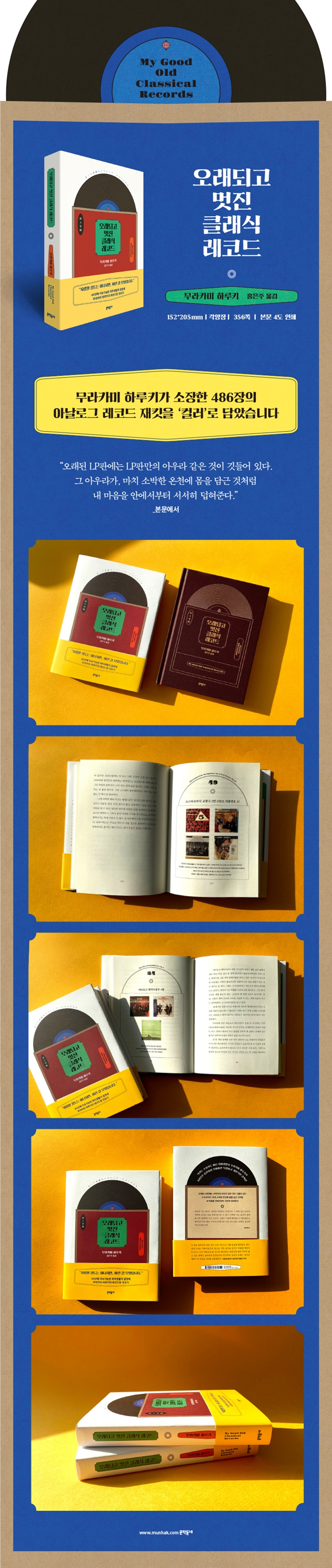
Into the book
Old LP records have an aura that is unique to them.
That aura slowly warms my heart from within, as if I were soaking in a simple hot spring.
(……) Just by looking at the record jacket you like, you can enter the world of music within it through another door.
Maybe I'm too fixated on the form of things.
But since it turned out like this, I decided to accept it and say there was nothing I could do.
After all, life is nothing more than an accumulation of almost meaningless biases.
--- p.12~13 From “Why Analog Records”
In Raymond Chandler's novel The Long Goodbye, there is a scene where private detective Philip Marlowe listens to this violin concerto at home at 3 a.m.
“Khatchaturyan calls this a violin concerto, but to my ears it sounds like the sound of a sagging fan belt in a tractor factory,” is his summary of the piece.
Maybe he was just irritated from not getting enough sleep, but anyway, Mr. Marlowe didn't seem to have a very good impression of this song.
--- p.35 From "Khachaturyan's Violin Concerto in D minor"
Beethoven's face on the jacket of this empty octet member looks quite tricky.
For some reason, his eyes are sharp.
I wonder if he really wrote this song with his eyes shining so brightly.
I don't really know what a genius is.
Still, Mozart certainly wouldn't have made such a scary face.
It was a song that was popular because it was approachable, but Beethoven himself seemed to have been dissatisfied with that.
As if to say, 'This is not what I want to do.'
It's as if he's a full-fledged literary writer whose book just so happened to become a bestseller.
--- p.86 From “Beethoven’s Septet in E♭ major, Op. 20”
There was someone who boasted (who was it?) that 'the three great tragedies of the 20th century are Hitler, the atomic bomb, and modern music', and while nodding slightly and saying 'indeed', I think that Bartok's string quartet is beautiful and attractive music.
--- p.89 From “Bartok String Quartet No. 4”
I remember listening to Mahler's symphony for the first time in my youth and tilting my head in wonder, 'Who on earth would enjoy such strange music that you can't even tell what's what?'
The flow of sound was not well understood.
Because it was music I had never heard before.
But as I listened, I became completely absorbed in the sound, and now I listen intently.
It's a strange thing.
Times change.
The senses also change.
--- p.129 From “Mahler Symphony No. 1 in D major”
I have to admit, the album I listen to most often is the Cleveland SQ CD featuring Yo-Yo Ma, because for some reason I always take a nap on the couch while listening to it.
It's not a boring performance at all, but strangely enough, I feel drowsy as I listen to it and fall into a deep sleep.
That doesn't happen in other performances... ... Anyway, for that reason, I used it quite a lot.
If you like it, please give it a try.
--- p.251 From "Schubert String Quintet in C major, D.956"
My dream is to personally hire a talented string quartet and hear them play this K. 421 right in front of me.
The reason I thought that way is because I saw a scene in the old TV drama "Batman" (when I was in high school) where a string quartet dressed in suits played this song at a party held at the house of the main character Bruce Wayne (Batman).
I exclaimed, "That's cool," and thought, "I should definitely do something like that when I become rich."
Unfortunately, I'm not that rich yet.
--- p.317 From “Mozart String Quartet No. 15 in D minor K.421”
I bought the old recording of Barkhouse in monaural form for a whopping 50 yen at a second-hand store in Takadanobaba.
Every time I see the price tag that says '50 yen' attached to the belt, I bow my head and say, 'I'm so sorry. What should I do?'
It's a performance so excellent that it can't be priced, but I guess it's because of the supply and demand in the market.
It's a flawless performance from beginning to end.
If Professor Bakhaus were to say, "This is what Beethoven is like," I would have no choice but to bow my head and say, "Yes, that's right."
Still, 50 yen is shocking… …
--- p.338 From “Beethoven’s Piano Sonata No. 32 in C minor, Op. 111”
As he became music director of the Boston Symphony Orchestra, his music became more faithful, larger in scale, and deeper with each passing year, but as his position increased, so did his responsibilities.
As a manager who leads many people, your responsibilities also increase.
The higher you go, the stronger the wind becomes.
In comparison, Sage in his younger days was truly at ease.
All you have to do is grab the opportunity that comes your way, ride the wave, and move forward.
His playing during this period is full of such freedom and the pure joy that springs from it.
--- p.354 From "Ozawa Seiji in His Youth"
Publisher's Review
Haruki Murakami's latest essay
Recommended by Park Jong-ho & Kim Gyul-wool!
Haruki Murakami, a hobbyist who is neither a writer nor a collector
A special and personal collection that has been accumulated as a habit for 60 years.
The author, who has been a fan of classical music since high school and has considered it a source of creative work and a long-time hobby, begins this book by saying, “I have been diligently visiting record stores for nearly sixty years because I have a hobby of collecting records.”
Unlike the flashy and diverse LPs released recently for collectors, the author says that the collection is mostly “black vinyl discs recorded from the 1950s to the mid-1960s,” and that it is a haphazard collection with “almost no unity to be found” because it was collected without any particular system or purpose.
However, whenever he has time, he carefully takes care of each album and places it on the turntable, and his sincere affection as a classical music fan is evident in his attentiveness to the subtle differences in the performance depending on not only the conductor and performer, but also the record company and the year of recording.
The author's attitude of praising the physical properties of analog records, saying, "Bringing old, dusty records to the cheap and making them shine as much as possible gives me the greatest joy," creates a unique sense of empathy among those who have collected records with affection regardless of the field, and furthermore, among those who have been reading his novels for a long time.
Classic records that are key to Haruki Murakami's literature
The fun of finding traces of the 'Haruki World' we've encountered in his novels so far.
The book covers a wide range of works, from symphonies and concertos by well-known composers such as Tchaikovsky, Mozart, Rachmaninoff, and Bach, to operas by Rossini and Bizet, and dance music by Delibes.
In addition, the author covers over 100 classical masterpieces, including albums by master conductors that he particularly enjoys listening to, such as Beecham, Ogden, Markevitch, and Ozawa.
It is also fun to find traces of the "Haruki World" that we have encountered in his novels in this extensive list, which prioritizes personal tastes and a list that "happened to be put together" rather than external evaluations.
The overture to Rossini's opera "The Thieving Magpie" that opens the first chapter of "The Wind-Up Bird Chronicle" and Schumann's "Carnival," which was born as an impressive short story in "The First Person Singular," are the first pieces that have appeared in the titles of novels, and the pieces that have played an effective role in revealing the psychology and tastes of the characters in representative works such as Beethoven's piano trio "Archduke" from "Kafka on the Shore" and Brahms's Piano Concerto No. 2 from "Norwegian Wood" are also mentioned.
While listening to Khachaturyan's violin concerto, I sometimes quote a passage from Raymond Chandler's novel, "The Long Goodbye," of which I have repeatedly declared myself a fan.
Selected solely by taste and chance,
Haruki Murakami's playlist of wonders and awe
As a world-renowned writer, you might think he would have his own unique way of appreciating music, but Haruki Murakami's standards for buying and listening to records are extremely personal and simple.
While rummaging through sale boxes, I sometimes pick up a jacket because I like its design, and sometimes I buy it because the price is so cheap.
Some people say that they use some records as background music for naps because they put them to sleep just by playing them.
While freely enjoying it as a hobby that has become a part of daily life, I also humbly look at the traces of musicians who have wasted their talents and disappeared in the cutthroat world of the music business, and calmly trace the footsteps of the maestro in his younger days.
This book is a treasure trove, offering a glimpse into the author's exploration and respect for other fields of art, going beyond mere hobby essays.
Recommended by Park Jong-ho & Kim Gyul-wool!
Haruki Murakami, a hobbyist who is neither a writer nor a collector
A special and personal collection that has been accumulated as a habit for 60 years.
The author, who has been a fan of classical music since high school and has considered it a source of creative work and a long-time hobby, begins this book by saying, “I have been diligently visiting record stores for nearly sixty years because I have a hobby of collecting records.”
Unlike the flashy and diverse LPs released recently for collectors, the author says that the collection is mostly “black vinyl discs recorded from the 1950s to the mid-1960s,” and that it is a haphazard collection with “almost no unity to be found” because it was collected without any particular system or purpose.
However, whenever he has time, he carefully takes care of each album and places it on the turntable, and his sincere affection as a classical music fan is evident in his attentiveness to the subtle differences in the performance depending on not only the conductor and performer, but also the record company and the year of recording.
The author's attitude of praising the physical properties of analog records, saying, "Bringing old, dusty records to the cheap and making them shine as much as possible gives me the greatest joy," creates a unique sense of empathy among those who have collected records with affection regardless of the field, and furthermore, among those who have been reading his novels for a long time.
Classic records that are key to Haruki Murakami's literature
The fun of finding traces of the 'Haruki World' we've encountered in his novels so far.
The book covers a wide range of works, from symphonies and concertos by well-known composers such as Tchaikovsky, Mozart, Rachmaninoff, and Bach, to operas by Rossini and Bizet, and dance music by Delibes.
In addition, the author covers over 100 classical masterpieces, including albums by master conductors that he particularly enjoys listening to, such as Beecham, Ogden, Markevitch, and Ozawa.
It is also fun to find traces of the "Haruki World" that we have encountered in his novels in this extensive list, which prioritizes personal tastes and a list that "happened to be put together" rather than external evaluations.
The overture to Rossini's opera "The Thieving Magpie" that opens the first chapter of "The Wind-Up Bird Chronicle" and Schumann's "Carnival," which was born as an impressive short story in "The First Person Singular," are the first pieces that have appeared in the titles of novels, and the pieces that have played an effective role in revealing the psychology and tastes of the characters in representative works such as Beethoven's piano trio "Archduke" from "Kafka on the Shore" and Brahms's Piano Concerto No. 2 from "Norwegian Wood" are also mentioned.
While listening to Khachaturyan's violin concerto, I sometimes quote a passage from Raymond Chandler's novel, "The Long Goodbye," of which I have repeatedly declared myself a fan.
Selected solely by taste and chance,
Haruki Murakami's playlist of wonders and awe
As a world-renowned writer, you might think he would have his own unique way of appreciating music, but Haruki Murakami's standards for buying and listening to records are extremely personal and simple.
While rummaging through sale boxes, I sometimes pick up a jacket because I like its design, and sometimes I buy it because the price is so cheap.
Some people say that they use some records as background music for naps because they put them to sleep just by playing them.
While freely enjoying it as a hobby that has become a part of daily life, I also humbly look at the traces of musicians who have wasted their talents and disappeared in the cutthroat world of the music business, and calmly trace the footsteps of the maestro in his younger days.
This book is a treasure trove, offering a glimpse into the author's exploration and respect for other fields of art, going beyond mere hobby essays.
GOODS SPECIFICS
- Publication date: March 25, 2022
- Format: Hardcover book binding method guide
- Page count, weight, size: 356 pages | 596g | 159*213*27mm
- ISBN13: 9788954685672
- ISBN10: 8954685676
You may also like
카테고리
korean


korean

![GQ KOREA Mark (Monthly): December [2025]](http://librairie.coreenne.fr/cdn/shop/files/8ef265dbbfbf186523ed75ba7319009d.jpg?v=1765340328&width=3840)


