

Infinite Market
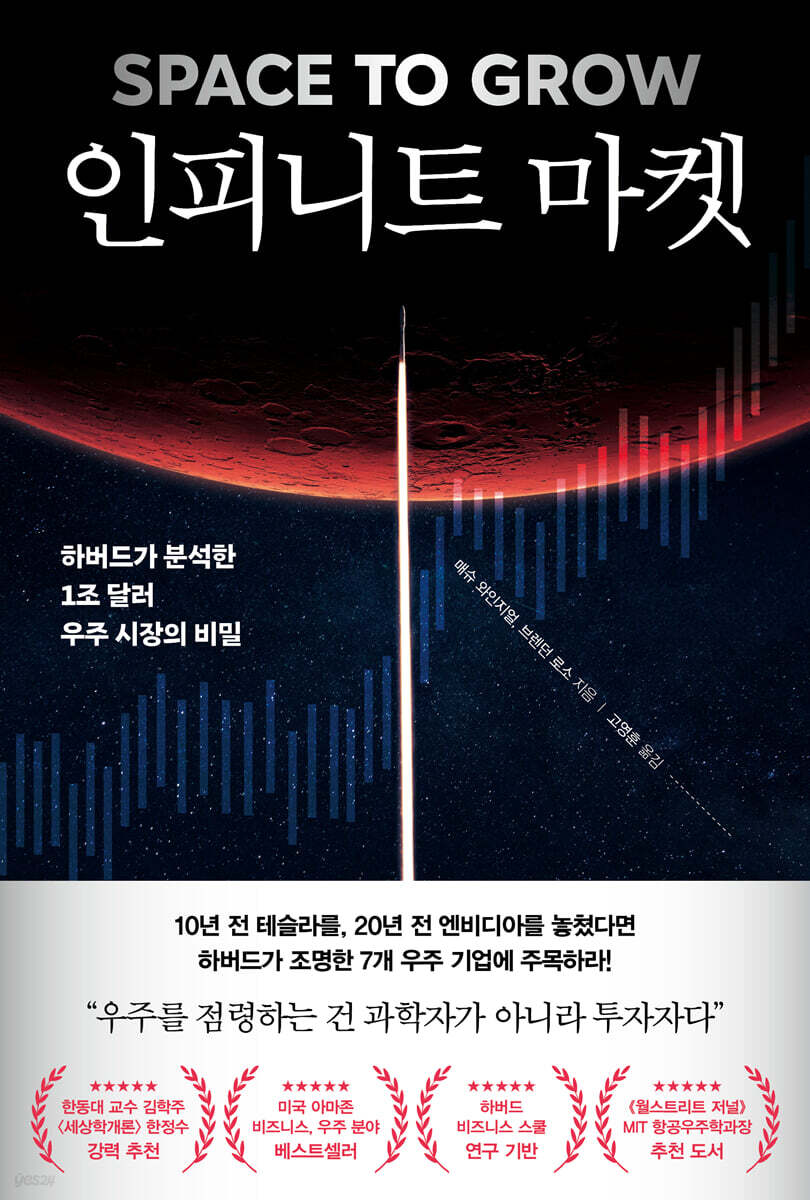 |
Description
Book Introduction
“A market has opened in space.
“Invest or wait and see?”
If you missed Tesla 10 years ago and Nvidia 20 years ago,
Pay attention to the space companies highlighted by Harvard!
★ Strongly recommended by Kim Hak-ju, a financial expert in "Understanding" and Han Jeong-su, an introduction to worldly studies.
★ Amazon Business, Space Category Bestseller
★ Books based on Harvard Business School research and lectures
★ Recommended reading by the Wall Street Journal and the MIT Department of Aeronautics and Astronautics chair
Space is no longer a distant future exploration stage.
Economist Matthew Weingier and strategist Brendan Rosso, who have taught space economics at Harvard Business School, clearly show in their book "Infinite Markets" that space has become a "market."
The commercial space era is being created as private companies such as SpaceX, Blue Origin, Planet, and Astroscale are jumping into the realm of ‘space’, which was previously planned and controlled by the government.
This book is the first popular book to explain, in economic terms, how this change began and how far it will extend.
The authors argue that the plummeting launch costs and explosive growth in the number of satellites over the past two decades are not simply a sign of technological progress, but rather a sign that market mechanisms are starting to work.
As we shift from a system where the government does everything directly to one that encourages the private sector to participate, the same problems of supply and demand, competition, investment, and regulation that we see in the Earth economy are emerging in space.
This book organizes this into a three-step framework of “market construction → market refinement → market coordination,” persuasively demonstrating that economic tools are effective even in the entirely new space of space.
Additionally, the emergence and core technologies of each company, as well as the decline and reorganization process, are analyzed one by one through economic logic, such as SpaceX's reusable rocket technology, Planet's satellite image service, and Astroscale's space debris removal system.
Afterwards, it makes us think together about how we can make money with that technology and how we can apply it to our lives.
Therefore, this book is useful not only for those working in the space industry, but also for entrepreneurs, investors, and policymakers who want to understand how space technology will impact their industries in the future.
The authors warn that while space could become "humanity's final economic frontier," if designed poorly, it could also stifle growth itself.
The rules we create and the roles we choose now will determine whether the space market becomes the exclusive domain of a select few or a new growth engine shared by all industries.
The challenge of space is ultimately another way for humans to expand their markets.
"Infinite Market" is the only must-read to understand its massive expansion.
“Invest or wait and see?”
If you missed Tesla 10 years ago and Nvidia 20 years ago,
Pay attention to the space companies highlighted by Harvard!
★ Strongly recommended by Kim Hak-ju, a financial expert in "Understanding" and Han Jeong-su, an introduction to worldly studies.
★ Amazon Business, Space Category Bestseller
★ Books based on Harvard Business School research and lectures
★ Recommended reading by the Wall Street Journal and the MIT Department of Aeronautics and Astronautics chair
Space is no longer a distant future exploration stage.
Economist Matthew Weingier and strategist Brendan Rosso, who have taught space economics at Harvard Business School, clearly show in their book "Infinite Markets" that space has become a "market."
The commercial space era is being created as private companies such as SpaceX, Blue Origin, Planet, and Astroscale are jumping into the realm of ‘space’, which was previously planned and controlled by the government.
This book is the first popular book to explain, in economic terms, how this change began and how far it will extend.
The authors argue that the plummeting launch costs and explosive growth in the number of satellites over the past two decades are not simply a sign of technological progress, but rather a sign that market mechanisms are starting to work.
As we shift from a system where the government does everything directly to one that encourages the private sector to participate, the same problems of supply and demand, competition, investment, and regulation that we see in the Earth economy are emerging in space.
This book organizes this into a three-step framework of “market construction → market refinement → market coordination,” persuasively demonstrating that economic tools are effective even in the entirely new space of space.
Additionally, the emergence and core technologies of each company, as well as the decline and reorganization process, are analyzed one by one through economic logic, such as SpaceX's reusable rocket technology, Planet's satellite image service, and Astroscale's space debris removal system.
Afterwards, it makes us think together about how we can make money with that technology and how we can apply it to our lives.
Therefore, this book is useful not only for those working in the space industry, but also for entrepreneurs, investors, and policymakers who want to understand how space technology will impact their industries in the future.
The authors warn that while space could become "humanity's final economic frontier," if designed poorly, it could also stifle growth itself.
The rules we create and the roles we choose now will determine whether the space market becomes the exclusive domain of a select few or a new growth engine shared by all industries.
The challenge of space is ultimately another way for humans to expand their markets.
"Infinite Market" is the only must-read to understand its massive expansion.
- You can preview some of the book's contents.
Preview
index
Recommendation
Introduction | The Beginning of Change: The Space Economy Revolution
PART 1: BUILDING THE MARKET
Chapter 1 | Turning Point: Turning Crisis into Opportunity
Chapter 2 | Blue Origin: One Step Forward
Chapter 3 | SpaceX: Opening the Doors to the Space Market
Chapter 4 | Planet: Supply and Demand
Chapter 5 | Space Station: Towards a Hub of Space
Chapter 6 | Capital: Boom and Bust, Deer and Rabbits
Chapter 7 | Artemis: A New Model, Heading to the Moon
PART 2: REFINING THE MARKET
Chapter 8 | Astroscale: Preventing the Tragedy of the Orbital Commons
Chapter 9 | Market Dominance: The Power to Protect Competition and Innovation
Chapter 10 | Made in Space: NASA's "Made in Space"
PART 3: MAKING THE MARKET COORDINATE
Chapter 11 | Planetary Resources: The Debate Surrounding Ownership in Space
Chapter 12 | National Security: The Interconnection of Space and the Military Industry
Conclusion | Opening the Next Chapter of the Space Economy
Messages from Space Leaders
More books to read
Americas
Acknowledgements
Introduction | The Beginning of Change: The Space Economy Revolution
PART 1: BUILDING THE MARKET
Chapter 1 | Turning Point: Turning Crisis into Opportunity
Chapter 2 | Blue Origin: One Step Forward
Chapter 3 | SpaceX: Opening the Doors to the Space Market
Chapter 4 | Planet: Supply and Demand
Chapter 5 | Space Station: Towards a Hub of Space
Chapter 6 | Capital: Boom and Bust, Deer and Rabbits
Chapter 7 | Artemis: A New Model, Heading to the Moon
PART 2: REFINING THE MARKET
Chapter 8 | Astroscale: Preventing the Tragedy of the Orbital Commons
Chapter 9 | Market Dominance: The Power to Protect Competition and Innovation
Chapter 10 | Made in Space: NASA's "Made in Space"
PART 3: MAKING THE MARKET COORDINATE
Chapter 11 | Planetary Resources: The Debate Surrounding Ownership in Space
Chapter 12 | National Security: The Interconnection of Space and the Military Industry
Conclusion | Opening the Next Chapter of the Space Economy
Messages from Space Leaders
More books to read
Americas
Acknowledgements
Detailed image

Into the book
As launch costs fall and launch opportunities increase, a number of new satellite companies have emerged.
Each of them continued to take on new challenges based on their own unique ideas and skills.
Other launch vehicle companies have emerged to challenge SpaceX, and venture capital funding has surged to record levels.
A true space revolution has been triggered.
In 2020, this innovation trend reached another turning point.
SpaceX successfully launched two NASA astronauts to the International Space Station.
With funding from a commercial crewed program, SpaceX has defied skepticism and effectively bridged the gap in American crewed spaceflight left by the Shuttle's retirement.
The private sector-led commercial model has now become the norm.
“It was a really fun experience,” NASA senior official Catherine Lueders recalled.
“It was a truly desperate move to entrust the supply of the International Space Station to the private sector.
--- p.61-62, from “Chapter 1: Turning Point: Turning Crisis into Opportunity”
Blue has been developing New Shepard slowly but steadily, and in 2021, it successfully carried private astronauts on a suborbital commercial flight.
These seats were sold at auction, which allowed us to collect valuable data on actual demand.
As of April 14, 2025, Blue Origin has completed 11 manned flights through the New Shepard program.
During this process, it sent 58 private astronauts into space, making it the company that has sent the most private astronauts into space to date.
Blue is also working on developing a commercial space station, and its Orbital Leap project is the first step toward the rotating space colony envisioned by Jared O'Neill.
Blue emphasizes that its activities, including the Artemis project and Orbital Leap, align with its long-term vision of realizing a space-based economy.
--- p.85-86, from “Chapter 2 Blue Origin: One Step Forward”
Starlink is a prime example of SpaceX's focus on economies of scale and vertical integration, and is one of its most notable projects to date.
The Falcon 9's low launch cost gave Starlink a huge advantage, and Starlink's massive launch demand in turn drove economies of scale for the Falcon 9.
In this way, the two projects are structured to support each other.
Starlink may seem unrelated to the Mars colony, but it is actually central to SpaceX's strategy.
Elon Musk said.
“The global Internet market size is approximately $1 trillion annually.
If we just take 3% of that, that's $30 billion.
It's more than the screw budget.
This is why we started Starlink.
“We’re trying to raise money to go to Mars.”
--- p.124-125, from “Chapter 3 SpaceX: Opening the Door to the Space Market”
Then, in 2022, an incident occurred that suddenly made more people aware of the planet.
It all started when Planet's satellite imagery captured scenes of Russia amassing troops in preparation for an invasion of Ukraine.
As the war escalated into a full-scale war, Planet provided evidence of various missile attacks and battle scenes, and the images made the front pages of major newspapers around the world.
The planet didn't just record things.
Early in the war, when the Ukrainian government asked for help from private satellite observation companies, many companies, including Planet, responded by providing satellite data directly, giving Ukraine a valuable intelligence asset that it could use to understand the situation and plan operations.
Professor Mariel Borowitz, a remote sensing expert at the Jia Institute of Technology, commented:
“The war in Ukraine demonstrated that civilian satellite data can play a crucial role not only in planning military operations but also in shaping public perception of war.”
--- p.157-158, from “Chapter 4 Planet: Supply and Demand”
Axiom believes that as a company that provides space station platforms, it can also gain a competitive advantage in the space tourism market.
Because it provides a place to stay in space, not just space flight.
However, the area that Axiom had the greatest expectations for was ‘in-space manufacturing.’
“In 15 years, this market will overwhelm all others,” said Suffredini.
Like its competitors, Axiom advertised the research and manufacturing potential of microgravity environments, saying:
“The unique effects of microgravity could allow you to dominate a specific market, restructure an industry, or make a decisive breakthrough in your field.
--- p.187, from “Chapter 5 Space Station: Towards the Hub of Space”
While financial markets have long viewed the space industry as a slow-moving sector of large government contractors, they have recently begun to see it as a sector where a virtuous cycle of value creation and capital inflow is forming, much like Silicon Valley software startups.
Startups fueled optimism, confidently predicting a hockey-stick curve of revenue growth.
Of course, the inherent challenges of the space industry, such as complexity, risk, and long development cycles, remain.
Nevertheless, expectations that “space could become a new software industry” swept the market.
“It’s a very interesting story,” said Tess Hatch, a partner at venture capital firm Bessemer Partners, which invested in Rocket Lab and Spire Global at the time.
“Space is an industry that is well worth investing in, just like software.
“It may take a little longer to become profitable, but ultimately, you will be able to achieve a return on your investment that is comparable to that of a software company.”
--- p.211, from “Chapter 6 Capital: Boom and Depression, Deer and Rabbits”
Astroscale's satellite successfully approached a smaller test satellite and docked using magnetic forces.
This is the first demonstration of a magnetic docking mechanism in space.
Afterwards, it signed a contract with the European Space Agency and was awarded a mission to remove a malfunctioning satellite from orbit.
The mission is scheduled for 2026.
We have also begun launching satellites in cooperation with the Japan Aerospace Exploration Agency to closely observe rocket debris and malfunctioning satellites floating in space orbit.
In June 2024, Astroscale's imaging satellite approached and captured images of the rocket body, which had been drifting in orbit for 15 years.
This allows us to collect data on how large pieces of debris move through space.
Astroscale aims to use this observation mission to lay the foundation for changing the reality of numerous upper-stage rockets floating in low-Earth orbit.
--- p.274-275, from “Chapter 8 Astroscale: Preventing the Tragedy of the Orbital Commons”
Made in Space and NASA's Marshall Space Flight Center installed a 3D printing module on the International Space Station, and in 2014, Station Commander Barry Wilmore became the first person to print an object in space.
What he needed was a ratchet wrench.
“It took five days from design to completion,” said Dunn.
“There has never been a faster time to create something in space and put it in someone’s hand.
“If he were on Mars, the process would have been much the same.” Made in Space soon emerged as a prime example of the SBIR program’s success.
NASA has also frequently promoted the company, using it as an example of how technology development can be accelerated through a public-private partnership model.
Although there was only one 3D printer in low Earth orbit, the industry had high hopes for Made in Space.
The first photo they produced of the wrench was widely circulated in the media and became a symbol of the new possibilities of space manufacturing.
--- p.312, from Chapter 10, Made in Space: 'Made in Space' Raised by NASA
Rockets will become cheaper, more powerful, and more abundant.
And this will completely redefine the boundaries of what is considered possible both inside and outside orbit.
Satellites will capture human activity around the globe with ever greater precision and transmit extensive information to every corner of the globe at the speed of light.
Space habitats will soon be realized on a large scale as spaces where humans and technology live and operate together.
As we push our limits, unexpected new capabilities will emerge, which will soon reshape business, life, and society as a whole.
There is still ample room for investment in the space sector.
Despite the industry's energy and excitement, funding in this sector remains woefully inadequate compared to land-based industries.
Today, NASA's share of the federal budget is only about one-tenth of what it was during the Apollo era.
But today's space holds incomparably greater potential for science, technology, economic prosperity, and national security than it did then.
Each of them continued to take on new challenges based on their own unique ideas and skills.
Other launch vehicle companies have emerged to challenge SpaceX, and venture capital funding has surged to record levels.
A true space revolution has been triggered.
In 2020, this innovation trend reached another turning point.
SpaceX successfully launched two NASA astronauts to the International Space Station.
With funding from a commercial crewed program, SpaceX has defied skepticism and effectively bridged the gap in American crewed spaceflight left by the Shuttle's retirement.
The private sector-led commercial model has now become the norm.
“It was a really fun experience,” NASA senior official Catherine Lueders recalled.
“It was a truly desperate move to entrust the supply of the International Space Station to the private sector.
--- p.61-62, from “Chapter 1: Turning Point: Turning Crisis into Opportunity”
Blue has been developing New Shepard slowly but steadily, and in 2021, it successfully carried private astronauts on a suborbital commercial flight.
These seats were sold at auction, which allowed us to collect valuable data on actual demand.
As of April 14, 2025, Blue Origin has completed 11 manned flights through the New Shepard program.
During this process, it sent 58 private astronauts into space, making it the company that has sent the most private astronauts into space to date.
Blue is also working on developing a commercial space station, and its Orbital Leap project is the first step toward the rotating space colony envisioned by Jared O'Neill.
Blue emphasizes that its activities, including the Artemis project and Orbital Leap, align with its long-term vision of realizing a space-based economy.
--- p.85-86, from “Chapter 2 Blue Origin: One Step Forward”
Starlink is a prime example of SpaceX's focus on economies of scale and vertical integration, and is one of its most notable projects to date.
The Falcon 9's low launch cost gave Starlink a huge advantage, and Starlink's massive launch demand in turn drove economies of scale for the Falcon 9.
In this way, the two projects are structured to support each other.
Starlink may seem unrelated to the Mars colony, but it is actually central to SpaceX's strategy.
Elon Musk said.
“The global Internet market size is approximately $1 trillion annually.
If we just take 3% of that, that's $30 billion.
It's more than the screw budget.
This is why we started Starlink.
“We’re trying to raise money to go to Mars.”
--- p.124-125, from “Chapter 3 SpaceX: Opening the Door to the Space Market”
Then, in 2022, an incident occurred that suddenly made more people aware of the planet.
It all started when Planet's satellite imagery captured scenes of Russia amassing troops in preparation for an invasion of Ukraine.
As the war escalated into a full-scale war, Planet provided evidence of various missile attacks and battle scenes, and the images made the front pages of major newspapers around the world.
The planet didn't just record things.
Early in the war, when the Ukrainian government asked for help from private satellite observation companies, many companies, including Planet, responded by providing satellite data directly, giving Ukraine a valuable intelligence asset that it could use to understand the situation and plan operations.
Professor Mariel Borowitz, a remote sensing expert at the Jia Institute of Technology, commented:
“The war in Ukraine demonstrated that civilian satellite data can play a crucial role not only in planning military operations but also in shaping public perception of war.”
--- p.157-158, from “Chapter 4 Planet: Supply and Demand”
Axiom believes that as a company that provides space station platforms, it can also gain a competitive advantage in the space tourism market.
Because it provides a place to stay in space, not just space flight.
However, the area that Axiom had the greatest expectations for was ‘in-space manufacturing.’
“In 15 years, this market will overwhelm all others,” said Suffredini.
Like its competitors, Axiom advertised the research and manufacturing potential of microgravity environments, saying:
“The unique effects of microgravity could allow you to dominate a specific market, restructure an industry, or make a decisive breakthrough in your field.
--- p.187, from “Chapter 5 Space Station: Towards the Hub of Space”
While financial markets have long viewed the space industry as a slow-moving sector of large government contractors, they have recently begun to see it as a sector where a virtuous cycle of value creation and capital inflow is forming, much like Silicon Valley software startups.
Startups fueled optimism, confidently predicting a hockey-stick curve of revenue growth.
Of course, the inherent challenges of the space industry, such as complexity, risk, and long development cycles, remain.
Nevertheless, expectations that “space could become a new software industry” swept the market.
“It’s a very interesting story,” said Tess Hatch, a partner at venture capital firm Bessemer Partners, which invested in Rocket Lab and Spire Global at the time.
“Space is an industry that is well worth investing in, just like software.
“It may take a little longer to become profitable, but ultimately, you will be able to achieve a return on your investment that is comparable to that of a software company.”
--- p.211, from “Chapter 6 Capital: Boom and Depression, Deer and Rabbits”
Astroscale's satellite successfully approached a smaller test satellite and docked using magnetic forces.
This is the first demonstration of a magnetic docking mechanism in space.
Afterwards, it signed a contract with the European Space Agency and was awarded a mission to remove a malfunctioning satellite from orbit.
The mission is scheduled for 2026.
We have also begun launching satellites in cooperation with the Japan Aerospace Exploration Agency to closely observe rocket debris and malfunctioning satellites floating in space orbit.
In June 2024, Astroscale's imaging satellite approached and captured images of the rocket body, which had been drifting in orbit for 15 years.
This allows us to collect data on how large pieces of debris move through space.
Astroscale aims to use this observation mission to lay the foundation for changing the reality of numerous upper-stage rockets floating in low-Earth orbit.
--- p.274-275, from “Chapter 8 Astroscale: Preventing the Tragedy of the Orbital Commons”
Made in Space and NASA's Marshall Space Flight Center installed a 3D printing module on the International Space Station, and in 2014, Station Commander Barry Wilmore became the first person to print an object in space.
What he needed was a ratchet wrench.
“It took five days from design to completion,” said Dunn.
“There has never been a faster time to create something in space and put it in someone’s hand.
“If he were on Mars, the process would have been much the same.” Made in Space soon emerged as a prime example of the SBIR program’s success.
NASA has also frequently promoted the company, using it as an example of how technology development can be accelerated through a public-private partnership model.
Although there was only one 3D printer in low Earth orbit, the industry had high hopes for Made in Space.
The first photo they produced of the wrench was widely circulated in the media and became a symbol of the new possibilities of space manufacturing.
--- p.312, from Chapter 10, Made in Space: 'Made in Space' Raised by NASA
Rockets will become cheaper, more powerful, and more abundant.
And this will completely redefine the boundaries of what is considered possible both inside and outside orbit.
Satellites will capture human activity around the globe with ever greater precision and transmit extensive information to every corner of the globe at the speed of light.
Space habitats will soon be realized on a large scale as spaces where humans and technology live and operate together.
As we push our limits, unexpected new capabilities will emerge, which will soon reshape business, life, and society as a whole.
There is still ample room for investment in the space sector.
Despite the industry's energy and excitement, funding in this sector remains woefully inadequate compared to land-based industries.
Today, NASA's share of the federal budget is only about one-tenth of what it was during the Apollo era.
But today's space holds incomparably greater potential for science, technology, economic prosperity, and national security than it did then.
--- p.382-383, from “Conclusion: Opening the Next Chapter of the Space Economy”
Publisher's Review
"Science launched spaceships, but economics runs the universe."
Supply and demand, investment and recovery, monopoly and competition.
The logic of capital that moves the universe
The universe began as a realm of science, but the forces now changing its orbit are capital and the market.
This book points out the 'market principle' as a driving force greater than the propulsion of a rocket.
As SpaceX and Blue Origin commercialize launch services that were once the domain of the government, and Planet and Astroscale turn satellites and space debris into “commodities,” the principles of supply and demand, investment and recovery, monopoly and competition are already clearly at work in space.
Harvard Business School professors Matthew Winezial and Brendan Rosso explain the complex market dynamics in economic terms.
This three-stage framework—Build, Refine, and Tune—sequentially demonstrates how the space industry is transforming into a complete economic ecosystem, elevating space from a future business to a reality we must understand now.
As a result, space is no longer a national project, but a global business platform created by investors, entrepreneurs, and governments.
The authors ask:
"Will you remain a mere consumer in this market, or will you become a participant in creating a new order?" The space economy has already begun, and the time to choose is short.
Only those who make decisions now will determine the direction of capital flowing off the planet for decades to come.
"The truly rich send their money into space, not to a safe."
The new laws of capitalism are being written 300 kilometers above the ground.
The world's money is flowing upwards right now.
After Tesla and Nvidia, the next frontier that investors are paying attention to is 'space'.
As launch costs dropped by a factor of 20 and the number of satellites increased tenfold, companies began to monetize space beyond just launching rockets.
From Starlink's internet network, to materials research on space stations, to on-orbit manufacturing and data businesses, space is now an extension of the real economy.
The authors trace the flow of new capital through real-world corporate, policy, and investment cases they covered in the classroom at Harvard Business School.
They say.
“The economic analysis tools used to understand the global economy provide a clearer view of the present and future of the space industry.”
This book provides a sobering look at what truly fuels the space industry's growth: the intersection of government budgets, private funding, and technological innovation.
The saying, "Truly rich people send their money into space, not to a safe," is not a metaphor.
Because the infrastructure of all industries, including data, communications, security, and exploration, is starting to operate in orbit outside the Earth.
Today, space is not just a dream, but a new testing ground for capitalism.
This book will serve as a blueprint for that experiment and a strategy guide for those who will seize the opportunities within it.
Supply and demand, investment and recovery, monopoly and competition.
The logic of capital that moves the universe
The universe began as a realm of science, but the forces now changing its orbit are capital and the market.
This book points out the 'market principle' as a driving force greater than the propulsion of a rocket.
As SpaceX and Blue Origin commercialize launch services that were once the domain of the government, and Planet and Astroscale turn satellites and space debris into “commodities,” the principles of supply and demand, investment and recovery, monopoly and competition are already clearly at work in space.
Harvard Business School professors Matthew Winezial and Brendan Rosso explain the complex market dynamics in economic terms.
This three-stage framework—Build, Refine, and Tune—sequentially demonstrates how the space industry is transforming into a complete economic ecosystem, elevating space from a future business to a reality we must understand now.
As a result, space is no longer a national project, but a global business platform created by investors, entrepreneurs, and governments.
The authors ask:
"Will you remain a mere consumer in this market, or will you become a participant in creating a new order?" The space economy has already begun, and the time to choose is short.
Only those who make decisions now will determine the direction of capital flowing off the planet for decades to come.
"The truly rich send their money into space, not to a safe."
The new laws of capitalism are being written 300 kilometers above the ground.
The world's money is flowing upwards right now.
After Tesla and Nvidia, the next frontier that investors are paying attention to is 'space'.
As launch costs dropped by a factor of 20 and the number of satellites increased tenfold, companies began to monetize space beyond just launching rockets.
From Starlink's internet network, to materials research on space stations, to on-orbit manufacturing and data businesses, space is now an extension of the real economy.
The authors trace the flow of new capital through real-world corporate, policy, and investment cases they covered in the classroom at Harvard Business School.
They say.
“The economic analysis tools used to understand the global economy provide a clearer view of the present and future of the space industry.”
This book provides a sobering look at what truly fuels the space industry's growth: the intersection of government budgets, private funding, and technological innovation.
The saying, "Truly rich people send their money into space, not to a safe," is not a metaphor.
Because the infrastructure of all industries, including data, communications, security, and exploration, is starting to operate in orbit outside the Earth.
Today, space is not just a dream, but a new testing ground for capitalism.
This book will serve as a blueprint for that experiment and a strategy guide for those who will seize the opportunities within it.
GOODS SPECIFICS
- Date of issue: December 1, 2025
- Page count, weight, size: 436 pages | 750g | 152*225*25mm
- ISBN13: 9791169851701
- ISBN10: 1169851703
You may also like
카테고리
korean


korean

![GQ KOREA Mark (Monthly): December [2025]](http://librairie.coreenne.fr/cdn/shop/files/8ef265dbbfbf186523ed75ba7319009d.jpg?v=1765340328&width=3840)


