

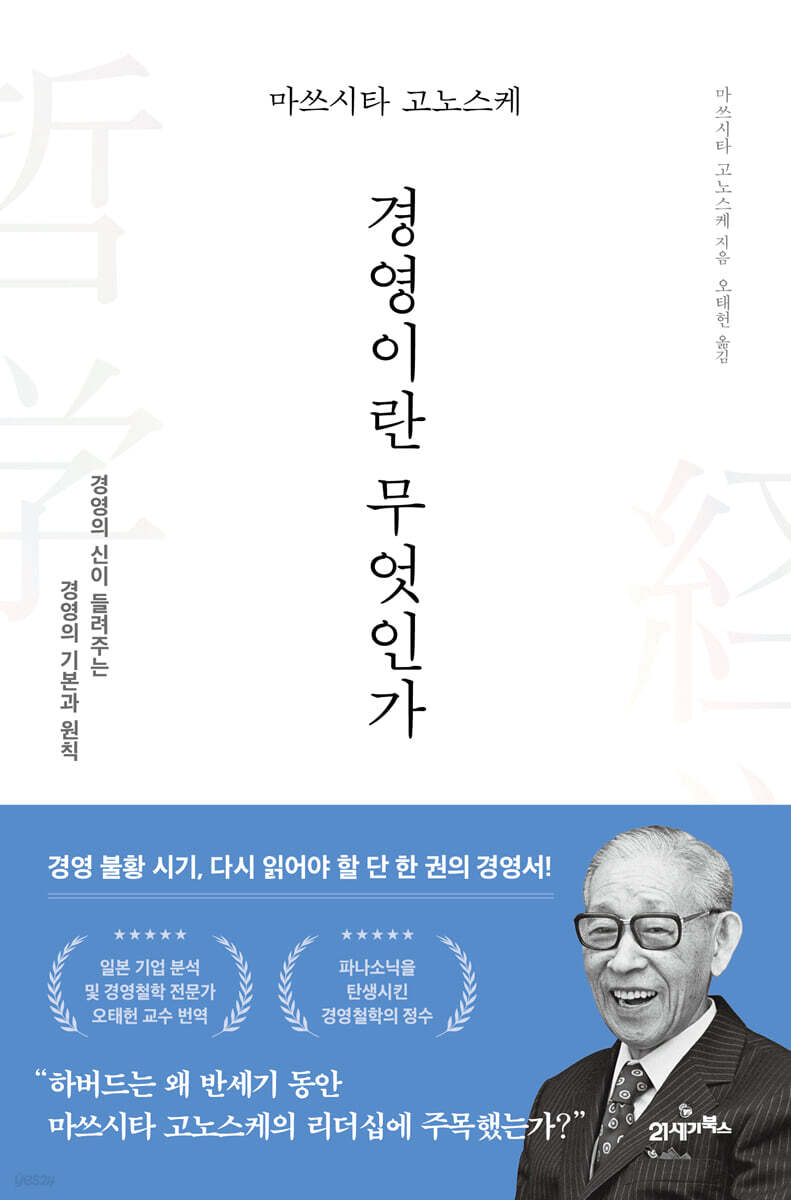
What is Konosuke Matsushita's management?
 |
Description
Book Introduction
I am confident that this book will be a divine tool that will give our companies the wisdom and courage to move forward.
-Son Wook (Chairman of the Sejong Institute for National Management)
Konosuke Matsushita, the 'god of management' who built a small electric company into a 40 trillion won company,
The enlightenment of a boy who started out as a businessman
The process of developing a world-class management philosophy is contained in one book!
“Why has Harvard focused on Konosuke Matsushita’s leadership for half a century?”
The Timeless Essence of Management by Konosuke Matsushita, the "God of Management."
Published by 21st Century Books, "What is Management by Konosuke Matsushita?" is the definitive compilation of the thoughts and philosophy of Konosuke Matsushita, an unparalleled figure in Japanese economic history and known as the "God of Management."
This Korean edition is the first complete translation and compilation of four representative works: 『Business Mindset』(1973), 『Management Mindset』(1974), 『Practical Management Philosophy』(1978), and 『The Value of Self-Acquired Management Know-How is Worth a Million Gold』(1980).
These four volumes provide a snapshot of Matsushita's 80-year management trajectory, from its inception to its growth, implementation in times of crisis, and long-term vision.
Matsushita defined management not as a simple technique or theory, but as “the practice of developing people, building trust, and contributing to society.”
This book embodies core concepts such as 'coexistence and co-prosperity,' 'self-management,' and 'dam management.' It also presents vivid experiences overcoming crises such as the Great Depression, oil shocks, and sales network collapse, as well as specific topics such as customer value, talent development, fair competition, appropriate profits, crisis preparedness, and service spirit, along with abundant anecdotes, making it a guideline that can be applied by anyone, not just managers but also practitioners and office workers.
Starting with the "spirit of business" acquired in the shopping district of his childhood, he expanded the company's mission to social service amidst the ruins of postwar times, and developed a practical philosophy that built the global enterprise Panasonic. This process is not just an individual's success story, but a condensed version of modern management history.
"What is Konosuke Matsushita's Management?" is not simply a memoir by an entrepreneur.
As Konosuke Matsushita said, “A boom is good, but a recession is better,” positive thinking that turns a crisis into an opportunity for growth still serves as a textbook for leadership training and organizational innovation.
In particular, Korean society now faces complex challenges, including digital transformation, global supply chain instability, the climate crisis and pressures for ESG management, and competition for talent.
In this very context, this book will serve as a crucial opportunity to reexamine the essence of management and explore new paths in an era where crisis and uncertainty are the norm.
-Son Wook (Chairman of the Sejong Institute for National Management)
Konosuke Matsushita, the 'god of management' who built a small electric company into a 40 trillion won company,
The enlightenment of a boy who started out as a businessman
The process of developing a world-class management philosophy is contained in one book!
“Why has Harvard focused on Konosuke Matsushita’s leadership for half a century?”
The Timeless Essence of Management by Konosuke Matsushita, the "God of Management."
Published by 21st Century Books, "What is Management by Konosuke Matsushita?" is the definitive compilation of the thoughts and philosophy of Konosuke Matsushita, an unparalleled figure in Japanese economic history and known as the "God of Management."
This Korean edition is the first complete translation and compilation of four representative works: 『Business Mindset』(1973), 『Management Mindset』(1974), 『Practical Management Philosophy』(1978), and 『The Value of Self-Acquired Management Know-How is Worth a Million Gold』(1980).
These four volumes provide a snapshot of Matsushita's 80-year management trajectory, from its inception to its growth, implementation in times of crisis, and long-term vision.
Matsushita defined management not as a simple technique or theory, but as “the practice of developing people, building trust, and contributing to society.”
This book embodies core concepts such as 'coexistence and co-prosperity,' 'self-management,' and 'dam management.' It also presents vivid experiences overcoming crises such as the Great Depression, oil shocks, and sales network collapse, as well as specific topics such as customer value, talent development, fair competition, appropriate profits, crisis preparedness, and service spirit, along with abundant anecdotes, making it a guideline that can be applied by anyone, not just managers but also practitioners and office workers.
Starting with the "spirit of business" acquired in the shopping district of his childhood, he expanded the company's mission to social service amidst the ruins of postwar times, and developed a practical philosophy that built the global enterprise Panasonic. This process is not just an individual's success story, but a condensed version of modern management history.
"What is Konosuke Matsushita's Management?" is not simply a memoir by an entrepreneur.
As Konosuke Matsushita said, “A boom is good, but a recession is better,” positive thinking that turns a crisis into an opportunity for growth still serves as a textbook for leadership training and organizational innovation.
In particular, Korean society now faces complex challenges, including digital transformation, global supply chain instability, the climate crisis and pressures for ESG management, and competition for talent.
In this very context, this book will serve as a crucial opportunity to reexamine the essence of management and explore new paths in an era where crisis and uncertainty are the norm.
- You can preview some of the book's contents.
Preview
index
Recommendation
Before reading this book
Part 1: The Basics of Business and Management
Chapter 1: The Mind of Doing Business
Always believe in the ways of the world│Competition without cooperation leads to destruction│How helpful has it been to customers│To succeed in sales│What should be put before prizes│You must properly understand your store's capabilities│Service that speaks to you│Put a price on invisible value│The greatest reward in running a business│It is not just my business│General hospitals and neighborhood hospitals│Prices in the new era│The best way to increase regular customers│Build relationships with people in the same industry│Products are like children, regular customers are like relatives│Be in charge of purchasing for regular business partners│The stability of the industry is a shared responsibility│The faces of 20 young employees│Treasure products│How much do you understand the value of service│The relationship between consumers and companies is one of virtue and loyalty│Pay attention to regular customers and where to buy│Gratitude to regular customers│The importance of a recommended sales method│Sellers must also contribute to product improvement│It's more fun during a recession│Raise the quality of a store│Profit comes from cost│Always be sensitive to collection and payment│Couple Being on good terms means that there is no absolute peace of mind. Competition is always fair.
Chapter 2 Attitude toward people
The first step to gathering people is to find strengths. To develop talent, you must be good at what you like. Everything in a company is the responsibility of one person. To create people, start by 'knocking'. Employ people with the belief that they are trustworthy. To utilize the wisdom of many people, be happy with suggestions from subordinates. The attitude of the CEO. An unexpected blessing obtained by a wholesaler.
Chapter 3: The Mind of Management
Are you interested in management?│Working over the phone│Promissory notes are banknotes I made│What is management ability│Work starts when you are convinced│Utilize customer complaints│Why I decided to give up on technology introduction│Wait for the right time during a recession│This store's products are a sure thing│The secret to good purchasing│Sales methods that build trust│Do business within the scope of equity capital│Work is enjoyable│Do business within the scope of service you can provide│Management that does not depend on others is important│Market demand is an intangible contract│Improvements brought about by earthquake damage│Treating business partners with rigorous standards│Recognize profits│Eliminate defects│Contribute in both material and spiritual ways│The necessity of advertising│Value the other party's time│Persuasive power needed for management│Business does not proceed only within the budget│Sincerity that risks one's life
Chapter 4: How to Raise People
Recession and talent development│A sense of mission is needed│How to view subordinates│Personnel management prioritizes the principle of putting the right person in the right position│When faced with a difficult situation│Confidence lacking humility is dangerous│A young CEO's secret to doing a good job│Is there anyone who can point out your mistakes│You shouldn't just do as you're told│Become a practical expert through field work│Put your soul into employee training│Send your son to another company│Ask your boss for help│An attitude of thinking anything is okay│Lessons learned from a hotel CEO│It's best to hire people who are qualified│Is the salary level appropriate│Let's properly resolve personnel complaints│Do you have a sense of being a professional│Living as a manager│Am I the right person for the position of manager│The determination to complete a task determines the success or failure of the task│A flexible and fearless organization
Part 2: About Management Philosophy
Chapter 1: 20 Principles to Know When Running a Business
First, establish a management philosophy. │ Everything in the world is constantly created and developed. │ You must have a good view of humanity. │ You must correctly recognize the mission given to you. │ You must follow the laws of nature. │ The reward for management is that the company makes a profit. │ You must coexist and prosper. │ Always think that the world is right. │ You must think that success is inevitable. │ Keep in mind independent management. │ You must practice 'dam management.' │ It is important to manage appropriately. │ A company's competitiveness comes from specialized capabilities. │ You must cultivate talent. │ You must gather the wisdom of all members. │ You must achieve harmony through conflict. │ Management is creative work. │ You must adapt to the changing times. │ You must be interested in politics. │ You must be pure and honest.
Chapter 2: Talking about In-Depth Management
When it rains, use an umbrella│Leading by example motivates employees│Artificial talent cultivation does not succeed│Do you have a cause that no one can oppose│Second-generation management competes with sincerity and passion│There can be no loss in business│A boom is good, but a recession is even better│How to utilize employees' abilities to more than 100%│Entrust, but do not delegate│Personnel selection requires support│Can you know with intuition alone?│Meetings are usually inefficient│The first buyer is the greatest contributor to technological evolution│True purchasing is only possible when you gain the other party's trust even after lowering the price│A CEO is not a strategist│How much has your management ability improved?│I want to manage a business that opens a new era│Let's practice '80 percent management'!│A society where the right managers can exert their power│If you have the will to save, will and wisdom will gather│The cause lies within yourself│A manager who fails to instill dreams in his employees is disqualified│The value of self-acquired management know-how is worth a million dollars
Chapter 3: Living as a Manager
In the end, the CEO is solely responsible. Even an ordinary day can be a valuable experience. Management is not magic. Employees are always watching the CEO. The determination to never back down paves the way. Can you borrow money from your employees when something happens? Are you prepared to die for your employees? You must constantly encourage yourself. The purpose of a CEO's life is to worry about company affairs. Management is done with the right hand, politics with the left. Business continues. We are the main characters of a living play. Being sick and having a long life are separate things. Youth is the youth of the heart.
Translator's Note | Family and Company Mottos of a Traditionally Excellent Company
Author's chronology
Before reading this book
Part 1: The Basics of Business and Management
Chapter 1: The Mind of Doing Business
Always believe in the ways of the world│Competition without cooperation leads to destruction│How helpful has it been to customers│To succeed in sales│What should be put before prizes│You must properly understand your store's capabilities│Service that speaks to you│Put a price on invisible value│The greatest reward in running a business│It is not just my business│General hospitals and neighborhood hospitals│Prices in the new era│The best way to increase regular customers│Build relationships with people in the same industry│Products are like children, regular customers are like relatives│Be in charge of purchasing for regular business partners│The stability of the industry is a shared responsibility│The faces of 20 young employees│Treasure products│How much do you understand the value of service│The relationship between consumers and companies is one of virtue and loyalty│Pay attention to regular customers and where to buy│Gratitude to regular customers│The importance of a recommended sales method│Sellers must also contribute to product improvement│It's more fun during a recession│Raise the quality of a store│Profit comes from cost│Always be sensitive to collection and payment│Couple Being on good terms means that there is no absolute peace of mind. Competition is always fair.
Chapter 2 Attitude toward people
The first step to gathering people is to find strengths. To develop talent, you must be good at what you like. Everything in a company is the responsibility of one person. To create people, start by 'knocking'. Employ people with the belief that they are trustworthy. To utilize the wisdom of many people, be happy with suggestions from subordinates. The attitude of the CEO. An unexpected blessing obtained by a wholesaler.
Chapter 3: The Mind of Management
Are you interested in management?│Working over the phone│Promissory notes are banknotes I made│What is management ability│Work starts when you are convinced│Utilize customer complaints│Why I decided to give up on technology introduction│Wait for the right time during a recession│This store's products are a sure thing│The secret to good purchasing│Sales methods that build trust│Do business within the scope of equity capital│Work is enjoyable│Do business within the scope of service you can provide│Management that does not depend on others is important│Market demand is an intangible contract│Improvements brought about by earthquake damage│Treating business partners with rigorous standards│Recognize profits│Eliminate defects│Contribute in both material and spiritual ways│The necessity of advertising│Value the other party's time│Persuasive power needed for management│Business does not proceed only within the budget│Sincerity that risks one's life
Chapter 4: How to Raise People
Recession and talent development│A sense of mission is needed│How to view subordinates│Personnel management prioritizes the principle of putting the right person in the right position│When faced with a difficult situation│Confidence lacking humility is dangerous│A young CEO's secret to doing a good job│Is there anyone who can point out your mistakes│You shouldn't just do as you're told│Become a practical expert through field work│Put your soul into employee training│Send your son to another company│Ask your boss for help│An attitude of thinking anything is okay│Lessons learned from a hotel CEO│It's best to hire people who are qualified│Is the salary level appropriate│Let's properly resolve personnel complaints│Do you have a sense of being a professional│Living as a manager│Am I the right person for the position of manager│The determination to complete a task determines the success or failure of the task│A flexible and fearless organization
Part 2: About Management Philosophy
Chapter 1: 20 Principles to Know When Running a Business
First, establish a management philosophy. │ Everything in the world is constantly created and developed. │ You must have a good view of humanity. │ You must correctly recognize the mission given to you. │ You must follow the laws of nature. │ The reward for management is that the company makes a profit. │ You must coexist and prosper. │ Always think that the world is right. │ You must think that success is inevitable. │ Keep in mind independent management. │ You must practice 'dam management.' │ It is important to manage appropriately. │ A company's competitiveness comes from specialized capabilities. │ You must cultivate talent. │ You must gather the wisdom of all members. │ You must achieve harmony through conflict. │ Management is creative work. │ You must adapt to the changing times. │ You must be interested in politics. │ You must be pure and honest.
Chapter 2: Talking about In-Depth Management
When it rains, use an umbrella│Leading by example motivates employees│Artificial talent cultivation does not succeed│Do you have a cause that no one can oppose│Second-generation management competes with sincerity and passion│There can be no loss in business│A boom is good, but a recession is even better│How to utilize employees' abilities to more than 100%│Entrust, but do not delegate│Personnel selection requires support│Can you know with intuition alone?│Meetings are usually inefficient│The first buyer is the greatest contributor to technological evolution│True purchasing is only possible when you gain the other party's trust even after lowering the price│A CEO is not a strategist│How much has your management ability improved?│I want to manage a business that opens a new era│Let's practice '80 percent management'!│A society where the right managers can exert their power│If you have the will to save, will and wisdom will gather│The cause lies within yourself│A manager who fails to instill dreams in his employees is disqualified│The value of self-acquired management know-how is worth a million dollars
Chapter 3: Living as a Manager
In the end, the CEO is solely responsible. Even an ordinary day can be a valuable experience. Management is not magic. Employees are always watching the CEO. The determination to never back down paves the way. Can you borrow money from your employees when something happens? Are you prepared to die for your employees? You must constantly encourage yourself. The purpose of a CEO's life is to worry about company affairs. Management is done with the right hand, politics with the left. Business continues. We are the main characters of a living play. Being sick and having a long life are separate things. Youth is the youth of the heart.
Translator's Note | Family and Company Mottos of a Traditionally Excellent Company
Author's chronology
Into the book
In other words, I believe that business competition should not be about subduing the opponent, as in war, but rather about coexistence and mutual prosperity, and about growing and developing together.
In other words, even when we are always in conflict with each other, we must not forget the spirit of harmony and cooperation.
If we continue to fight each other without cooperating, the competition will lead to destruction.
If we only compete fiercely, pushing each other forward, coexistence and prosperity will be impossible, and we may even end up ruining both of us.
--- p.36, from “Competition without cooperation leads to destruction”
A proper merchant in modern society must secure reasonable profits based on his or her own beliefs and business philosophy, value customers, and fulfill social responsibility.
This is the desirable picture that leads to common prosperity in society.
And in order to engage in such desirable commercial practices, you must not just bargain and lower the price, but carefully review the situation from the beginning and set an appropriate price.
And I think the right sales attitude is to convince the customer that you can never lower the price below the fair price.
--- p.66, from “Prices of a New Era”
Recently, I've been hearing stories about some purchasing managers at companies and stores who are acting tyrannically.
Could it be that these people are created by interpreting the saying, "Profit comes from cost," to mean simply buying cheap? This is an overly narrow interpretation; it needs to be interpreted more deeply and broadly.
Doing so will naturally create a mindset that suppliers should be treated as if they were regular customers.
--- p.
111, from “Profit comes from cost”
If you've done your best to think things through, but still aren't sure it's the best solution, you should immediately tell your supervisor honestly about your hesitation and ask for help.
… …
Of course, even if you receive a report, your boss is not a god, so he or she may not come up with a good idea.
In such cases, it is better to ask for help from outside.
Surprisingly, an outside expert may be able to suggest a solution.
There is never any shame in seeking advice from an expert; rather, it is evidence of sincerity in doing your job.
--- p.278, from “Ask Your Boss for Help”
I ran my business with the idea that a 10 percent profit margin was a reasonable profit.
Of course, the standard for reasonable profits will vary depending on the industry or the stage of development of the company.
But whatever the criteria, managers must always keep three things in mind: paying taxes to the government, returning dividends to shareholders, and accumulating funds to sustain the company's mission.
And companies must clearly recognize that securing that appropriate profit is their social responsibility.
--- p.345, from “The compensation for management is that the company makes a profit”
I believe that whether a company can grow vigorously on its own while contributing to society depends entirely on its people.
Therefore, in corporate management, cultivating talent is the most important thing.
When Matsushita Electric was still relatively small, I often told my employees, "When you visit a business partner and they ask you, 'What does your company make?', you should answer, 'We make people. We make electrical products, but before that, we develop people first.'"
--- p.386, from “Cultivate Talent”
Business isn't something you do for just one day.
Since it is something that can be done over a person's lifetime or even for generations, it is effective only when done with the same attitude.
If you are always confused and don't know what to do when people say "it's a boom" or "it's a recession," it's hard to say that you are doing business in the true sense of the word.
So I've been working, telling myself that there are no booms or busts in business.
--- p.449, from “A boom is good, but a recession is better”
The world only looks at the results and the form to tell whether it is a failure or a success.
Those things alone cannot be experiences.
… … If I just spend my time absentmindedly and absentmindedly, I will become a person without any experiences of my own when I grow old.
Managers must strive to broaden their own experiences in these areas, while also ensuring that their employees have similar experiences.
In other words, even when we are always in conflict with each other, we must not forget the spirit of harmony and cooperation.
If we continue to fight each other without cooperating, the competition will lead to destruction.
If we only compete fiercely, pushing each other forward, coexistence and prosperity will be impossible, and we may even end up ruining both of us.
--- p.36, from “Competition without cooperation leads to destruction”
A proper merchant in modern society must secure reasonable profits based on his or her own beliefs and business philosophy, value customers, and fulfill social responsibility.
This is the desirable picture that leads to common prosperity in society.
And in order to engage in such desirable commercial practices, you must not just bargain and lower the price, but carefully review the situation from the beginning and set an appropriate price.
And I think the right sales attitude is to convince the customer that you can never lower the price below the fair price.
--- p.66, from “Prices of a New Era”
Recently, I've been hearing stories about some purchasing managers at companies and stores who are acting tyrannically.
Could it be that these people are created by interpreting the saying, "Profit comes from cost," to mean simply buying cheap? This is an overly narrow interpretation; it needs to be interpreted more deeply and broadly.
Doing so will naturally create a mindset that suppliers should be treated as if they were regular customers.
--- p.
111, from “Profit comes from cost”
If you've done your best to think things through, but still aren't sure it's the best solution, you should immediately tell your supervisor honestly about your hesitation and ask for help.
… …
Of course, even if you receive a report, your boss is not a god, so he or she may not come up with a good idea.
In such cases, it is better to ask for help from outside.
Surprisingly, an outside expert may be able to suggest a solution.
There is never any shame in seeking advice from an expert; rather, it is evidence of sincerity in doing your job.
--- p.278, from “Ask Your Boss for Help”
I ran my business with the idea that a 10 percent profit margin was a reasonable profit.
Of course, the standard for reasonable profits will vary depending on the industry or the stage of development of the company.
But whatever the criteria, managers must always keep three things in mind: paying taxes to the government, returning dividends to shareholders, and accumulating funds to sustain the company's mission.
And companies must clearly recognize that securing that appropriate profit is their social responsibility.
--- p.345, from “The compensation for management is that the company makes a profit”
I believe that whether a company can grow vigorously on its own while contributing to society depends entirely on its people.
Therefore, in corporate management, cultivating talent is the most important thing.
When Matsushita Electric was still relatively small, I often told my employees, "When you visit a business partner and they ask you, 'What does your company make?', you should answer, 'We make people. We make electrical products, but before that, we develop people first.'"
--- p.386, from “Cultivate Talent”
Business isn't something you do for just one day.
Since it is something that can be done over a person's lifetime or even for generations, it is effective only when done with the same attitude.
If you are always confused and don't know what to do when people say "it's a boom" or "it's a recession," it's hard to say that you are doing business in the true sense of the word.
So I've been working, telling myself that there are no booms or busts in business.
--- p.449, from “A boom is good, but a recession is better”
The world only looks at the results and the form to tell whether it is a failure or a success.
Those things alone cannot be experiences.
… … If I just spend my time absentmindedly and absentmindedly, I will become a person without any experiences of my own when I grow old.
Managers must strive to broaden their own experiences in these areas, while also ensuring that their employees have similar experiences.
--- p.514~515, from “Even an Ordinary Day Can Provide Precious Experiences”
Publisher's Review
"Booms are good, busts are better!"
Matsushita's Management Method: Turning Crisis into an Opportunity for Growth
The one management book that leaders who grapple with principles and philosophy every day must read!
Konosuke Matsushita (1894-1989) is called the “God of Management” and is a significant figure in Japanese economic history and world management history.
He left his mother's embrace at the age of nine and began working as a servant. He even dropped out of elementary school and started out with the limitations of poverty and poor health. However, he built a small electrical appliance manufacturing plant with just 100 yen and two employees into the global company Panasonic.
His life was not simply a success story, but a history of management practices driven by the belief that "a company is a place where people are created" and the philosophy of "coexistence and co-prosperity."
Konosuke Matsushita's management philosophy was not a theory developed on a desk, but a product of practice formed through personally overcoming numerous crises.
Even amidst the strong yen recession following the Plaza Accord, two oil shocks, a collapse in demand, and a sales network crisis, he chose trust over layoffs, and he chose long-term survival and growth over short-term profits.
His determination to prioritize the fundamentals of quality, customers, and employees in every moment of crisis established the company not simply as a tool for profit generation, but as a member of the social community.
As a result, Panasonic has developed a resilience that can withstand any crisis, and the Matsushita philosophy has become established as “a management philosophy that turns crises into opportunities.”
This attitude also had a direct influence on later managers.
Kazuo Inamori, founder of Japan's Kyocera Group, respected Matsushita as a "teacher and senior in management philosophy," and made his emphasis on "ideals within leisure" and "management with a mission" the foundation of his own company's operations.
SoftBank Chairman Son Jeong-ui also read Matsushita's lectures and books from the early days of his company's founding, and adopted the attitude that "the future is not something to be predicted, but something to be created" as his management compass.
Both masters remember Matsushita not simply as a model for success, but as a mentor who imparted a philosophy and mental strength that remained unwavering even in times of uncertainty and crisis.
How a nine-year-old charcoal shop clerk's enlightenment became a management philosophy that captured the world's attention...
Discover the 80-year journey of Matsushita's management philosophy in one volume!
"What is Konosuke Matsushita's Management?" is a compilation of four works, systematically showing the formation and development of Matsushita's management philosophy, its journey from implementation to completion.
『Businessman's Mindset』, published in 1973, reveals that his experience as an apprentice in an Osaka shopping district formed the basis of his management philosophy.
It contains the realization that the foundation of management philosophy is the attitude towards customers, honesty, courtesy, and trust.
『Management Mindset』, published in 1974, is a book that declared that the mission of a company is not simply profit, but social service, amidst the chaos following the defeat in the war.
Matsushita's perspective that companies should grow together with the social community amidst the ruins had a great resonance in Japanese society at the time and is considered the forerunner of today's ESG management.
Published in 1978, 『Practical Management Philosophy (????哲?)』 addresses specific issues such as organizational management and judgment, crisis response, and the essence of leadership, and shows what criteria managers should use to make decisions in situations they encounter.
Published in 1980, 『The Value of Self-Acquired Management Know-How is Worth a Million Gold』 is a collection of management tips and wisdom gleaned from experience gained over a lifetime as a manager.
Here, key concepts such as 'coexistence and co-prosperity' (coexistence with business partners and society), 'autonomous management' (independence unshaken by external pressure), and 'dam management' (strategy to contain and utilize crises) are systematically organized.
These four volumes are each valuable independently, but taken together they form a single flow that shows how one man's life and thoughts developed.
Beginning with the enlightenment of his apprenticeship, continuing through the philosophy of postwar reconstruction, practice in the era of global competition, and finally a long-term vision, this trajectory encapsulates the entire course of Matsushita's management philosophy.
Therefore, this compilation was designed to enable readers to fully understand Matsushita not through fragmented anecdotes, but within the structure of philosophy, ideology, practice, and perfection.
"Grow people, move with society, and be one step ahead of change."
The Timeless Essence of Management by Konosuke Matsushita, the "God of Management."
Konosuke Matsushita's management philosophy was not a theory on a desk, but a product of practical experience formed through overcoming numerous crises.
Faced with enormous external shocks, including international trade pressures like the Plaza Accord, two oil shocks, a global economic downturn, and currency fluctuations, he chose trust over layoffs and the basics over short-term measures.
His attitude of using the crisis as a stepping stone for long-term growth rather than a loss of short-term profits stems from his philosophy of “valuing people and growing together with society.”
As a result, Panasonic did not miss opportunities for growth even in times of crisis, proving that the essence of management ultimately lies in "people and trust."
"What is Management by Konosuke Matsushita?" is a management textbook that provides practical guidance to managers seeking new growth engines amidst the growing uncertainty and turmoil of a rapidly changing international situation.
Matsushita's management theory has already left a long legacy in our country.
In his recommendation, Son Wook, Chairman of the Sejong Institute for National Management, stated that he studied and applied Matsushita's management philosophy when he was establishing a 10-year vision at Samsung Electronics and when he was overcoming the IMF foreign exchange crisis.
He emphasized that this book is a practical guide for Korean companies and leaders today, saying, “This book is a divine tool that will give the leaders of the Republic of Korea the wisdom and courage to change their destiny in this chaotic era.”
Although it has been over 30 years since his death, it is clear why this book is worth rereading now.
In an era of artificial intelligence, digital transformation, global upheaval, and uncertainty, what's needed isn't flashy techniques, but the power to return to basics.
Trust, integrity, responsibility, and people-first management are principles that transcend time and borders.
For today's entrepreneurs and business leaders, his philosophy is not simply a legacy of the past; it is a key to breaking through the current chaos, a "magic bullet" that opens the way through crisis.
Matsushita's Management Method: Turning Crisis into an Opportunity for Growth
The one management book that leaders who grapple with principles and philosophy every day must read!
Konosuke Matsushita (1894-1989) is called the “God of Management” and is a significant figure in Japanese economic history and world management history.
He left his mother's embrace at the age of nine and began working as a servant. He even dropped out of elementary school and started out with the limitations of poverty and poor health. However, he built a small electrical appliance manufacturing plant with just 100 yen and two employees into the global company Panasonic.
His life was not simply a success story, but a history of management practices driven by the belief that "a company is a place where people are created" and the philosophy of "coexistence and co-prosperity."
Konosuke Matsushita's management philosophy was not a theory developed on a desk, but a product of practice formed through personally overcoming numerous crises.
Even amidst the strong yen recession following the Plaza Accord, two oil shocks, a collapse in demand, and a sales network crisis, he chose trust over layoffs, and he chose long-term survival and growth over short-term profits.
His determination to prioritize the fundamentals of quality, customers, and employees in every moment of crisis established the company not simply as a tool for profit generation, but as a member of the social community.
As a result, Panasonic has developed a resilience that can withstand any crisis, and the Matsushita philosophy has become established as “a management philosophy that turns crises into opportunities.”
This attitude also had a direct influence on later managers.
Kazuo Inamori, founder of Japan's Kyocera Group, respected Matsushita as a "teacher and senior in management philosophy," and made his emphasis on "ideals within leisure" and "management with a mission" the foundation of his own company's operations.
SoftBank Chairman Son Jeong-ui also read Matsushita's lectures and books from the early days of his company's founding, and adopted the attitude that "the future is not something to be predicted, but something to be created" as his management compass.
Both masters remember Matsushita not simply as a model for success, but as a mentor who imparted a philosophy and mental strength that remained unwavering even in times of uncertainty and crisis.
How a nine-year-old charcoal shop clerk's enlightenment became a management philosophy that captured the world's attention...
Discover the 80-year journey of Matsushita's management philosophy in one volume!
"What is Konosuke Matsushita's Management?" is a compilation of four works, systematically showing the formation and development of Matsushita's management philosophy, its journey from implementation to completion.
『Businessman's Mindset』, published in 1973, reveals that his experience as an apprentice in an Osaka shopping district formed the basis of his management philosophy.
It contains the realization that the foundation of management philosophy is the attitude towards customers, honesty, courtesy, and trust.
『Management Mindset』, published in 1974, is a book that declared that the mission of a company is not simply profit, but social service, amidst the chaos following the defeat in the war.
Matsushita's perspective that companies should grow together with the social community amidst the ruins had a great resonance in Japanese society at the time and is considered the forerunner of today's ESG management.
Published in 1978, 『Practical Management Philosophy (????哲?)』 addresses specific issues such as organizational management and judgment, crisis response, and the essence of leadership, and shows what criteria managers should use to make decisions in situations they encounter.
Published in 1980, 『The Value of Self-Acquired Management Know-How is Worth a Million Gold』 is a collection of management tips and wisdom gleaned from experience gained over a lifetime as a manager.
Here, key concepts such as 'coexistence and co-prosperity' (coexistence with business partners and society), 'autonomous management' (independence unshaken by external pressure), and 'dam management' (strategy to contain and utilize crises) are systematically organized.
These four volumes are each valuable independently, but taken together they form a single flow that shows how one man's life and thoughts developed.
Beginning with the enlightenment of his apprenticeship, continuing through the philosophy of postwar reconstruction, practice in the era of global competition, and finally a long-term vision, this trajectory encapsulates the entire course of Matsushita's management philosophy.
Therefore, this compilation was designed to enable readers to fully understand Matsushita not through fragmented anecdotes, but within the structure of philosophy, ideology, practice, and perfection.
"Grow people, move with society, and be one step ahead of change."
The Timeless Essence of Management by Konosuke Matsushita, the "God of Management."
Konosuke Matsushita's management philosophy was not a theory on a desk, but a product of practical experience formed through overcoming numerous crises.
Faced with enormous external shocks, including international trade pressures like the Plaza Accord, two oil shocks, a global economic downturn, and currency fluctuations, he chose trust over layoffs and the basics over short-term measures.
His attitude of using the crisis as a stepping stone for long-term growth rather than a loss of short-term profits stems from his philosophy of “valuing people and growing together with society.”
As a result, Panasonic did not miss opportunities for growth even in times of crisis, proving that the essence of management ultimately lies in "people and trust."
"What is Management by Konosuke Matsushita?" is a management textbook that provides practical guidance to managers seeking new growth engines amidst the growing uncertainty and turmoil of a rapidly changing international situation.
Matsushita's management theory has already left a long legacy in our country.
In his recommendation, Son Wook, Chairman of the Sejong Institute for National Management, stated that he studied and applied Matsushita's management philosophy when he was establishing a 10-year vision at Samsung Electronics and when he was overcoming the IMF foreign exchange crisis.
He emphasized that this book is a practical guide for Korean companies and leaders today, saying, “This book is a divine tool that will give the leaders of the Republic of Korea the wisdom and courage to change their destiny in this chaotic era.”
Although it has been over 30 years since his death, it is clear why this book is worth rereading now.
In an era of artificial intelligence, digital transformation, global upheaval, and uncertainty, what's needed isn't flashy techniques, but the power to return to basics.
Trust, integrity, responsibility, and people-first management are principles that transcend time and borders.
For today's entrepreneurs and business leaders, his philosophy is not simply a legacy of the past; it is a key to breaking through the current chaos, a "magic bullet" that opens the way through crisis.
GOODS SPECIFICS
- Date of issue: October 22, 2025
- Format: Hardcover book binding method guide
- Page count, weight, size: 576 pages | 674g | 128*188*38mm
- ISBN13: 9791173575082
- ISBN10: 1173575081
You may also like
카테고리
korean


korean

![GQ KOREA Mark (Monthly): December [2025]](http://librairie.coreenne.fr/cdn/shop/files/8ef265dbbfbf186523ed75ba7319009d.jpg?v=1765340328&width=3840)


