

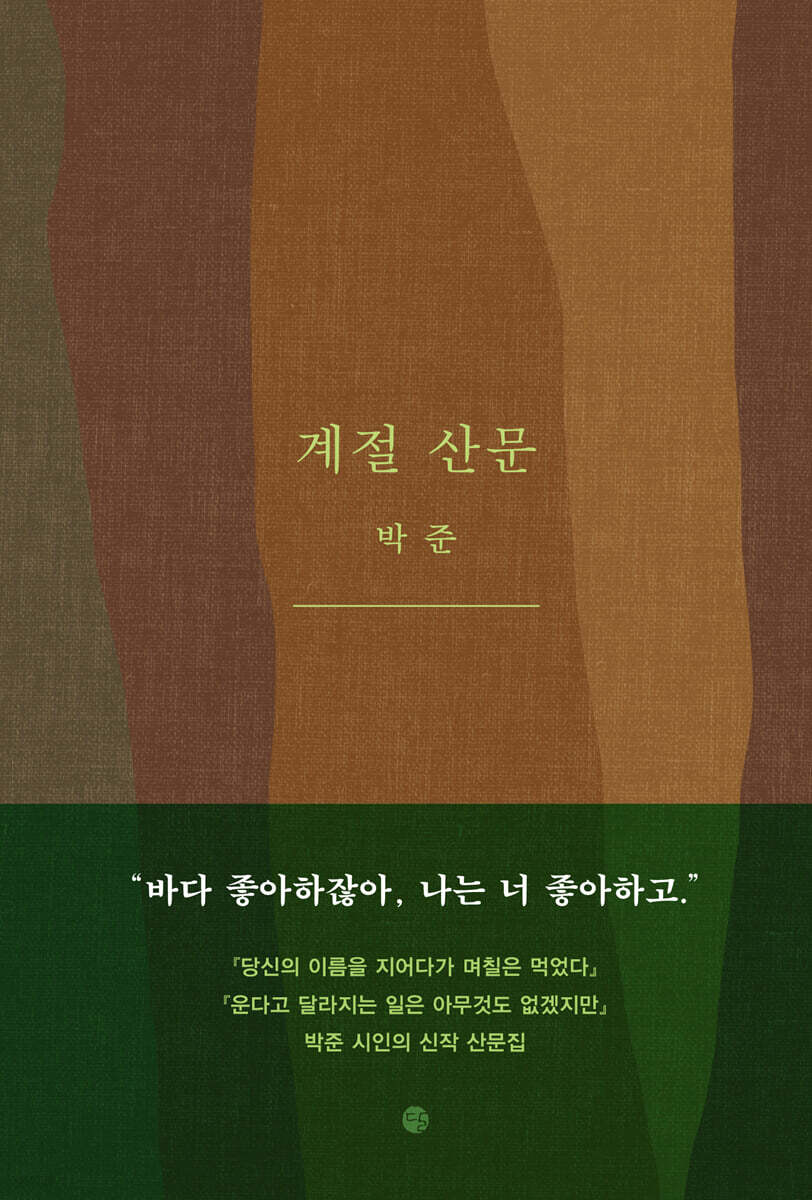
Seasonal Prose
 |
Description
Book Introduction
“I hope that there will be more things that get better as I live. With good things “I might secretly like myself.” The time poet Park Jun visited Seasonal greetings as we count down the days to come Poet Park Jun, who has consistently received love from readers with his poetry collections, “I Made Up Your Name and Ate It for a Few Days” and “We Could See the Rainy Season Together,” and his prose collection, “Nothing Will Change Even If I Cry,” is publishing his second prose collection, “Seasonal Prose.” It has been four years since the publication of my first collection of prose. As readers have long waited, 『Seasonal Prose』 neatly presents the poet's new stories and deepened sentences accumulated over his life. The poet observes the scenes that pass by us at the crossroads of the seasons while we live the time that is given to us as a matter of course, then carefully takes them out and caresses them. Therefore, the emotions and feelings that make up the prose are also delicate and affectionate. In this collection of essays, the writings written in polite language stand out. This seems to be a letter that is sent to someone by folding a page of the season, an intimate monologue of the poet himself, and a reminiscence from the past. The words that were directed at someone soon become blurred and “scattered in various shapes” like the game the poet played as a child, “looking at a streetlight in an empty place and turning my head from side to side.” The poet's story, unfolded in this way, expands and intertwines with the story of the reader reading the book. From the memories of often looking at the 'baduk dot', the big mole on the face that has now disappeared, to the evenings when I stayed in the annex of an old hanok and lived like the owner's grandchild, to the memories of the past such as holding my sister's hand and going to the academy, to the memories of traveling to Sangrim, Gokseong, Jinju, and Ubud, and like remembering winter days while catching the passing breeze and putting words that make up spring in my mouth or exhaling, the 'waiting' and 'longing' that the poet depicts in his own way still make us smile or cry, just as they did in his previous prose collection. In this way, readers encounter their own childhood, or find themselves standing in the middle of a deep forest and suddenly encountering the blue sea. In this way, the temples that unfold like a promenade through the seasons find new colors through the breath of language breathed into them by the poet. |
- You can preview some of the book's contents.
Preview
index
Stationery
New Year's Eve
Sun and Moon Prose
start
Back to the evening
To the evening again
Beginning of Spring
Lee Wol prose
Lighthouse at the End of the World 4
scene
1 night 2 days
Gift - To Senior Soo-kyung
Spring's Soliloquy - Like the Scenery Under the Eaves
riverside
March prose.
Twenty questions of spring
March Letter
Re-session
April Prose
margin
The door of understanding
comedy
April's reply
One by one
Cause and effect
May Prose - Badukijeom
some reading
Back to silence
New dawn
Eating alone
Hell Cafe
June Prose
Around that time
Episode
Summer seat
The feeling of waiting for the rainy season
Dinner and supper
July Prose
From afar, to me
definition
Makguksu
friend
August Prose
To the garden
What kind of calculation
Back to alcohol
September Prose
Dreams and sweat
The conclusion of advice
Again, Haengsin
In front of the post office in autumn
October Prose
The light I hold
road
On the way to school
November Prose - Paper Dolls
To the prayer
Like the cold air on a winter night when you take a deep breath and then suddenly cough.
Count for a long time
December Prose
Back to Labor
Winter sounds
Rest rest rest
In Ubud we
cold and hot
This side and that side
wait
south
bustling
New Year's Eve
Sun and Moon Prose
start
Back to the evening
To the evening again
Beginning of Spring
Lee Wol prose
Lighthouse at the End of the World 4
scene
1 night 2 days
Gift - To Senior Soo-kyung
Spring's Soliloquy - Like the Scenery Under the Eaves
riverside
March prose.
Twenty questions of spring
March Letter
Re-session
April Prose
margin
The door of understanding
comedy
April's reply
One by one
Cause and effect
May Prose - Badukijeom
some reading
Back to silence
New dawn
Eating alone
Hell Cafe
June Prose
Around that time
Episode
Summer seat
The feeling of waiting for the rainy season
Dinner and supper
July Prose
From afar, to me
definition
Makguksu
friend
August Prose
To the garden
What kind of calculation
Back to alcohol
September Prose
Dreams and sweat
The conclusion of advice
Again, Haengsin
In front of the post office in autumn
October Prose
The light I hold
road
On the way to school
November Prose - Paper Dolls
To the prayer
Like the cold air on a winter night when you take a deep breath and then suddenly cough.
Count for a long time
December Prose
Back to Labor
Winter sounds
Rest rest rest
In Ubud we
cold and hot
This side and that side
wait
south
bustling
Detailed image
.jpg)
Into the book
When misfortune comes running without a way
We covered each other's eyes
--- p.25, from “Lighthouse at the End of the World 4”
It is with the delicate, gentle and pure.
It can be said to be gentle, swaying, or cautious, and it is not at odds with the expressions languid and sluggish.
Sometimes it sets and sometimes it flutters, but there are moments when it quietly leans against something and soon it is neatly embroidered.
It seems like you can reach it if you stretch out, but if you grab it, you'll definitely miss it.
It's warm, slow, gentle, and yet distant.
--- p.37, from “March Prose - Twenty Questions of Spring”
As I got older, my Baduk skills expanded.
It was a natural thing that happened as my body grew and my face got bigger.
Now, the mole that was there back then is not visible on my face.
As the spot grows larger and lighter in color, it becomes no different from the skin.
all.
My baduk advantage disappeared like that.
I hope you can join me in mourning over this sad event.
--- pp.62-63, from “Baduk Point”
I hope that there will be more good things in life.
Whether it's something incredibly good, or something as small as the ones I've listed today.
With such good things around me, I might even secretly like myself.
--- p.95, from “July Prose”
What is clear is that whether it's a brief exchange or a lifelong partnership, in the grand scheme of things, it's all just a season. Fortunately, during this season, we capture each other's most beautiful images.
Whether it's a memory or a record.
Now, the first frost has fallen and the temperature has risen.
Our beautiful autumn days are passing by like this again.
--- p.141, from “October Prose”
Because we were close to each other
Time made us laugh
We covered each other's eyes
--- p.25, from “Lighthouse at the End of the World 4”
It is with the delicate, gentle and pure.
It can be said to be gentle, swaying, or cautious, and it is not at odds with the expressions languid and sluggish.
Sometimes it sets and sometimes it flutters, but there are moments when it quietly leans against something and soon it is neatly embroidered.
It seems like you can reach it if you stretch out, but if you grab it, you'll definitely miss it.
It's warm, slow, gentle, and yet distant.
--- p.37, from “March Prose - Twenty Questions of Spring”
As I got older, my Baduk skills expanded.
It was a natural thing that happened as my body grew and my face got bigger.
Now, the mole that was there back then is not visible on my face.
As the spot grows larger and lighter in color, it becomes no different from the skin.
all.
My baduk advantage disappeared like that.
I hope you can join me in mourning over this sad event.
--- pp.62-63, from “Baduk Point”
I hope that there will be more good things in life.
Whether it's something incredibly good, or something as small as the ones I've listed today.
With such good things around me, I might even secretly like myself.
--- p.95, from “July Prose”
What is clear is that whether it's a brief exchange or a lifelong partnership, in the grand scheme of things, it's all just a season. Fortunately, during this season, we capture each other's most beautiful images.
Whether it's a memory or a record.
Now, the first frost has fallen and the temperature has risen.
Our beautiful autumn days are passing by like this again.
--- p.141, from “October Prose”
Because we were close to each other
Time made us laugh
--- p.182, from "Prosperity"
Publisher's Review
"I named it after you and ate it for several days."
"Nothing will change even if you cry."
Poet Park Jun's new prose work, published after four years
With the breath of language breathed by the poet
Seasonal landscapes that find new colors
We cannot talk about time without mentioning the word 'season'.
The time in 『Seasonal Prose』 is not segmented into the seasons we commonly call spring, summer, fall, and winter, but rather, it is a single flow like a gust of wind that permeates our lives.
The order of the writings, from “Ilwol Prose” to “December Prose,” follows the flow of time steadily, but also frequently shifts between them.
As we pass through July, we remember the events of spring, and as we pass through winter, we look at the deep mountains of autumn.
This is in line with the poet's warm heart, who lives calmly in the present while delicately looking back on yesterday and lovingly caring for the future.
We often miss a moment after suffering from it, but the writings in this collection of essays go beyond memories and hopes, allowing us to feel the pouring rain, the blowing wind, and the drifting clouds of the current season.
The book begins with the story of a 'tree' in the opening text, "Mungu," and opens with the next text, "Evening of the Year."
A tree endures time with its whole body and always stands in the same place.
Just as we sense the changing seasons when we see new buds sprouting from trees along the road, green leaves blooming, and then soon changing colors, this book stands in that same spot, welcoming its readers and guiding them into a new season.
The reason the poet came to find readers between the end and beginning of the year is also probably his own New Year's greeting, asking us to begin the year together as if we were opening a bookcase.
After reading the entire collection of essays, I feel like I've followed the poet's lead and finished the year well, but also like I've experienced a certain period in advance, standing somewhere between seeing off and welcoming.
If everything passes and moves forward like this, then you too can gladly set foot on the moon again whenever you feel like it.
Because another brilliant era will greet us again.
"Nothing will change even if you cry."
Poet Park Jun's new prose work, published after four years
With the breath of language breathed by the poet
Seasonal landscapes that find new colors
We cannot talk about time without mentioning the word 'season'.
The time in 『Seasonal Prose』 is not segmented into the seasons we commonly call spring, summer, fall, and winter, but rather, it is a single flow like a gust of wind that permeates our lives.
The order of the writings, from “Ilwol Prose” to “December Prose,” follows the flow of time steadily, but also frequently shifts between them.
As we pass through July, we remember the events of spring, and as we pass through winter, we look at the deep mountains of autumn.
This is in line with the poet's warm heart, who lives calmly in the present while delicately looking back on yesterday and lovingly caring for the future.
We often miss a moment after suffering from it, but the writings in this collection of essays go beyond memories and hopes, allowing us to feel the pouring rain, the blowing wind, and the drifting clouds of the current season.
The book begins with the story of a 'tree' in the opening text, "Mungu," and opens with the next text, "Evening of the Year."
A tree endures time with its whole body and always stands in the same place.
Just as we sense the changing seasons when we see new buds sprouting from trees along the road, green leaves blooming, and then soon changing colors, this book stands in that same spot, welcoming its readers and guiding them into a new season.
The reason the poet came to find readers between the end and beginning of the year is also probably his own New Year's greeting, asking us to begin the year together as if we were opening a bookcase.
After reading the entire collection of essays, I feel like I've followed the poet's lead and finished the year well, but also like I've experienced a certain period in advance, standing somewhere between seeing off and welcoming.
If everything passes and moves forward like this, then you too can gladly set foot on the moon again whenever you feel like it.
Because another brilliant era will greet us again.
GOODS SPECIFICS
- Publication date: December 20, 2021
- Format: Hardcover book binding method guide
- Page count, weight, size: 184 pages | 320g | 136*196*20mm
- ISBN13: 9791158161439
- ISBN10: 1158161433
You may also like
카테고리
korean


korean

![GQ KOREA Mark (Monthly): December [2025]](http://librairie.coreenne.fr/cdn/shop/files/8ef265dbbfbf186523ed75ba7319009d.jpg?v=1765340328&width=3840)


