

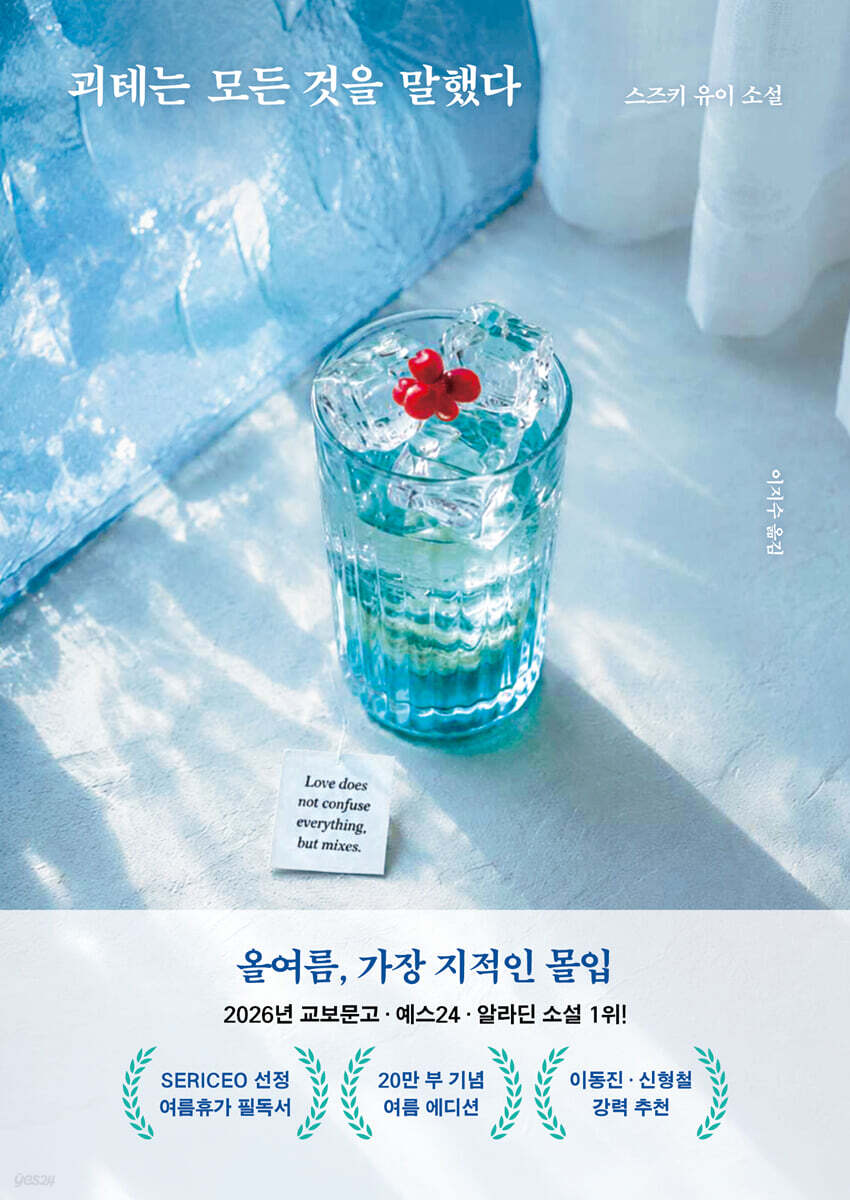
Goethe said it all
 |
Description
Book Introduction
- A word from MD
-
The first full-length novel by a writer who will represent the next generation of Japanese literature.One day, Goethe researcher Deutsch discovers an unidentified Goethe quote.
He pours all his academic passion into finding the source of that one sentence.
A novel that, based on extensive culture and knowledge, leads readers to 'a single sentence that will complete their true life.'
November 25, 2025. Novel/Poetry PD Kim Yu-ri
〈B tv Lee Dong-jin's Phaeacia〉 Selected as the best book of the month!
172nd Akutagawa Prize Winner
A chance to be the first to encounter the next generation of Japanese literature.
A new classic is born in the 21st century.
★ Recommended by critics Lee Dong-jin, Shin Hyeong-cheol, and Eunyu
★ The first person born in the 2000s to win the Akutagawa Prize
★ He shook up the literary world with his first full-length novel, completed in just 30 days.
Renowned Goethe scholar Deutsch discovers an unexplained Goethe quote on a tea bag.
“Love does not confuse everything, but makes it one.” Even though it was an unfamiliar sentence that even he, who had studied Goethe all his life, had never seen, it strangely felt like it perfectly summarized the theory he had been advocating.
Is a statement whose source cannot be found a lie, or a new truth? This single sentence begins to shake up Doichi's life.
"Goethe Said Everything" is the first novel by 23-year-old graduate student Yui Suzuki, and won the 172nd Akutagawa Prize.
The Japanese media praised him as “the rising star of Japanese literature,” comparing him to Umberto Eco, Calvino, and Borges.
In this work, written by a young man in his early twenties, one can feel the rich depth of classical literature and the freshness of a new writer at the same time.
Goethe Told All explores the essence of love, language, and literature through the daily life of a family.
The novel is peppered with a wealth of knowledge of the humanities, from Goethe and Nietzsche to Borges and Mallarmé, but it is also interwoven with somewhat naive and lovable characters, making it accessible.
As the story progresses, the daily life that flows along quietly becomes interconnected, and the different characters become one.
This novel, where scholarship and everyday life, the classics and the modern, each maintain their own distinct characteristics while beautifully blending together, is a story that rereads everything with the warmth of love.
172nd Akutagawa Prize Winner
A chance to be the first to encounter the next generation of Japanese literature.
A new classic is born in the 21st century.
★ Recommended by critics Lee Dong-jin, Shin Hyeong-cheol, and Eunyu
★ The first person born in the 2000s to win the Akutagawa Prize
★ He shook up the literary world with his first full-length novel, completed in just 30 days.
Renowned Goethe scholar Deutsch discovers an unexplained Goethe quote on a tea bag.
“Love does not confuse everything, but makes it one.” Even though it was an unfamiliar sentence that even he, who had studied Goethe all his life, had never seen, it strangely felt like it perfectly summarized the theory he had been advocating.
Is a statement whose source cannot be found a lie, or a new truth? This single sentence begins to shake up Doichi's life.
"Goethe Said Everything" is the first novel by 23-year-old graduate student Yui Suzuki, and won the 172nd Akutagawa Prize.
The Japanese media praised him as “the rising star of Japanese literature,” comparing him to Umberto Eco, Calvino, and Borges.
In this work, written by a young man in his early twenties, one can feel the rich depth of classical literature and the freshness of a new writer at the same time.
Goethe Told All explores the essence of love, language, and literature through the daily life of a family.
The novel is peppered with a wealth of knowledge of the humanities, from Goethe and Nietzsche to Borges and Mallarmé, but it is also interwoven with somewhat naive and lovable characters, making it accessible.
As the story progresses, the daily life that flows along quietly becomes interconnected, and the different characters become one.
This novel, where scholarship and everyday life, the classics and the modern, each maintain their own distinct characteristics while beautifully blending together, is a story that rereads everything with the warmth of love.
- You can preview some of the book's contents.
Preview
index
Prologue
Ⅰ
Ⅱ
Ⅲ
Ⅳ
V
Ⅵ
Epilogue
Author's Note
Translator's Note
Ⅰ
Ⅱ
Ⅲ
Ⅳ
V
Ⅵ
Epilogue
Author's Note
Translator's Note
Detailed image
.jpg)
Into the book
Those words sounded strangely prophetic to Deutsch, who at the time was hoping to become a Goethe expert in Japan, and they soon stuck in his ears and never left him.
“The Germans, you know,” said Johann.
“When quoting a famous quote, even if you don’t know who it is from or if it’s actually your own idea, always add ‘Goethe said.’
Because Goethe said it all.”
--- p.23
I even thought that perhaps once a thought, force, or action is verbalized, it is like a butterfly that has been pinned and neatly placed in a specimen box, never to flap its wings again.
“Das Wort erstirbt schon in der Feder(Words die the moment they touch the brush).” Ah, again.
Eventually, I couldn't stand it without putting everything into words.
Butterflies are beautiful as they fly between flowers and spread pollen.
But a typhoon always has eyes.
All words are really just rushing towards that one point.
Swept away by the torrent of words, Doichi raised his body, grabbed the still point like Ariadne's thread, and pulled it out.
Love does not confuse everything, but mixes.
- Goethe
As I stared at it, I felt like the letters lined up inside were gradually coming to mind.
Beyond the small tag, the whole world seemed blurry.
--- pp.38-39
“Die Liebe verwirrt nicht alles, sondern vermischt es.” Deutsch tried translating the Goethe quote in front of him directly into German and read it out loud.
Then I was surprised that the sentence suddenly felt less Goethe-like.
But if this is really what Goethe said, then it is only natural that someone translated the 18th or 19th century German into English, and then changed it into German by a modern Japanese person.
“Love does not confuse everything, but makes everything whole.” This time, I translated it into Japanese.
Then it became a little bit Goethe-esque.
Of course, what came to Doichi's mind at that time was jam and salad.
Love makes all things whole, like a salad, not confused like jam.
It would be good to translate it in your own way like Doctor Faust.
However, I was still not sure how to interpret 'mix'.
'Confuse', so to speak, is interpreted as a salad-like Germanic expression, as opposed to a fun Germanic expression. But is that really okay?
There was no other way than to find the original text of this saying and judge it in context.
If this is the sentence I had in mind, it would be the quintessence of my Goethe research.
But if not… … .
In any case, Deutsch felt that this famous quote could not be simply glossed over as “Goethe said everything.”
--- pp.44-45
“I don’t think Goethe said everything.
Because it is impossible for one person to say everything.
Still, I think Goethe really wanted to say everything.”
The young man said so.
But the more I thought about it, the more I realized that the saying, “Goethe said everything,” was not at all irrelevant to Deutsch.
--- p.97
Doichi, it is the scholar's duty to find words.
If you go to catch a snake and get eaten by the snake, it doesn't matter.
But words are inconvenient tools to the end.
I just can't seem to get used to it.
I'm still fighting with Kazuko.
Sometimes I interrupt the conversations of young students I meet.
Sometimes I can't understand what someone is saying at all, so I pretend to be deaf and just mumble along... ... I can't find a tool to replace that, so I just keep using it.
“The Germans, you know,” said Johann.
“When quoting a famous quote, even if you don’t know who it is from or if it’s actually your own idea, always add ‘Goethe said.’
Because Goethe said it all.”
--- p.23
I even thought that perhaps once a thought, force, or action is verbalized, it is like a butterfly that has been pinned and neatly placed in a specimen box, never to flap its wings again.
“Das Wort erstirbt schon in der Feder(Words die the moment they touch the brush).” Ah, again.
Eventually, I couldn't stand it without putting everything into words.
Butterflies are beautiful as they fly between flowers and spread pollen.
But a typhoon always has eyes.
All words are really just rushing towards that one point.
Swept away by the torrent of words, Doichi raised his body, grabbed the still point like Ariadne's thread, and pulled it out.
Love does not confuse everything, but mixes.
- Goethe
As I stared at it, I felt like the letters lined up inside were gradually coming to mind.
Beyond the small tag, the whole world seemed blurry.
--- pp.38-39
“Die Liebe verwirrt nicht alles, sondern vermischt es.” Deutsch tried translating the Goethe quote in front of him directly into German and read it out loud.
Then I was surprised that the sentence suddenly felt less Goethe-like.
But if this is really what Goethe said, then it is only natural that someone translated the 18th or 19th century German into English, and then changed it into German by a modern Japanese person.
“Love does not confuse everything, but makes everything whole.” This time, I translated it into Japanese.
Then it became a little bit Goethe-esque.
Of course, what came to Doichi's mind at that time was jam and salad.
Love makes all things whole, like a salad, not confused like jam.
It would be good to translate it in your own way like Doctor Faust.
However, I was still not sure how to interpret 'mix'.
'Confuse', so to speak, is interpreted as a salad-like Germanic expression, as opposed to a fun Germanic expression. But is that really okay?
There was no other way than to find the original text of this saying and judge it in context.
If this is the sentence I had in mind, it would be the quintessence of my Goethe research.
But if not… … .
In any case, Deutsch felt that this famous quote could not be simply glossed over as “Goethe said everything.”
--- pp.44-45
“I don’t think Goethe said everything.
Because it is impossible for one person to say everything.
Still, I think Goethe really wanted to say everything.”
The young man said so.
But the more I thought about it, the more I realized that the saying, “Goethe said everything,” was not at all irrelevant to Deutsch.
--- p.97
Doichi, it is the scholar's duty to find words.
If you go to catch a snake and get eaten by the snake, it doesn't matter.
But words are inconvenient tools to the end.
I just can't seem to get used to it.
I'm still fighting with Kazuko.
Sometimes I interrupt the conversations of young students I meet.
Sometimes I can't understand what someone is saying at all, so I pretend to be deaf and just mumble along... ... I can't find a tool to replace that, so I just keep using it.
--- p.153
Publisher's Review
A single sentence has the power to shake lives.
“Goethe said it all.” There is a joke in Germany.
Whatever you say, if you add “Goethe said -”, it becomes more persuasive in itself.
Yui Suzuki's novel, "Goethe Said Everything," begins with this very sentence.
The protagonist, Hiroba Doichi, is Japan's leading Goethe researcher.
At a restaurant he visits on his wedding anniversary, he discovers an unfamiliar phrase written on the tag of a black tea bag.
“Love does not confuse everything, but mixes.” It has Goethe’s name on it, but even he, who has studied Goethe all his life, has never seen this sentence.
The professor's quest to determine the source of a famous quote soon becomes an intellectual adventure that crosses the boundaries between quotation and truth, language and belief.
A phenomenal feature-length debut from a genius writer born in 2001.
"Goethe Said Everything" is the first full-length novel by Yui Suzuki, born in 2001, completed in just 30 days at a university library.
The author shook up the Japanese literary world by becoming the first writer born in the 2000s to win the Akutagawa Prize for this work.
The judges praised the work as “the birth of a new literature,” and the Japanese press compared him to Umberto Eco, Calvino, and Borges, calling him “a rising star in Japanese literature.”
Behind this rave review lies the literary foundation of his reading volume of 1,000 books a year and his deep interest in classical literature.
At the center of the work is the theme of 'words', which the author has been obsessed with since childhood.
The author, who was an elementary school student at the time of the Great East Japan Earthquake, witnessed adults' differing opinions, which led him to develop skepticism about words and the fundamental question of "which words should I believe?" This experience became the prototype for "Goethe Said Everything."
This work, which combines deep literary knowledge and contemporary experience, shows what a new classic of the 21st century might look like.
For us living in an uncertain era of rapid change day by day, the core message of this work, as translator Lee Ji-su said, “Even if ‘everything has already been said,’ when you say it again in your own words, those words become real,” carries a profound meaning.
How to Read Love at the End of Language
In "Goethe Said Everything," various literary devices are humorously rearranged into the characters' daily lives, and scholarship and love, language and daily life are naturally intertwined.
As Deutsch said of Goethe's Faust, "It is a truly absurd and hopeless product, but it is wrapped in the bond of love," this novel ultimately ties everything together with the 'bond of love.'
The daily lives of Deutsch, his family, his students, and his fellow researchers are interwoven like layers of language, each sentence ultimately converging into a single meaning.
“Goethe said everything.” Whether that statement is a joke or true, this novel asks us:
In a world overflowing with countless words, what do you want to say? What is the one sentence that will complete your life? Does that sentence contain "love"?
“Goethe said it all.” There is a joke in Germany.
Whatever you say, if you add “Goethe said -”, it becomes more persuasive in itself.
Yui Suzuki's novel, "Goethe Said Everything," begins with this very sentence.
The protagonist, Hiroba Doichi, is Japan's leading Goethe researcher.
At a restaurant he visits on his wedding anniversary, he discovers an unfamiliar phrase written on the tag of a black tea bag.
“Love does not confuse everything, but mixes.” It has Goethe’s name on it, but even he, who has studied Goethe all his life, has never seen this sentence.
The professor's quest to determine the source of a famous quote soon becomes an intellectual adventure that crosses the boundaries between quotation and truth, language and belief.
A phenomenal feature-length debut from a genius writer born in 2001.
"Goethe Said Everything" is the first full-length novel by Yui Suzuki, born in 2001, completed in just 30 days at a university library.
The author shook up the Japanese literary world by becoming the first writer born in the 2000s to win the Akutagawa Prize for this work.
The judges praised the work as “the birth of a new literature,” and the Japanese press compared him to Umberto Eco, Calvino, and Borges, calling him “a rising star in Japanese literature.”
Behind this rave review lies the literary foundation of his reading volume of 1,000 books a year and his deep interest in classical literature.
At the center of the work is the theme of 'words', which the author has been obsessed with since childhood.
The author, who was an elementary school student at the time of the Great East Japan Earthquake, witnessed adults' differing opinions, which led him to develop skepticism about words and the fundamental question of "which words should I believe?" This experience became the prototype for "Goethe Said Everything."
This work, which combines deep literary knowledge and contemporary experience, shows what a new classic of the 21st century might look like.
For us living in an uncertain era of rapid change day by day, the core message of this work, as translator Lee Ji-su said, “Even if ‘everything has already been said,’ when you say it again in your own words, those words become real,” carries a profound meaning.
How to Read Love at the End of Language
In "Goethe Said Everything," various literary devices are humorously rearranged into the characters' daily lives, and scholarship and love, language and daily life are naturally intertwined.
As Deutsch said of Goethe's Faust, "It is a truly absurd and hopeless product, but it is wrapped in the bond of love," this novel ultimately ties everything together with the 'bond of love.'
The daily lives of Deutsch, his family, his students, and his fellow researchers are interwoven like layers of language, each sentence ultimately converging into a single meaning.
“Goethe said everything.” Whether that statement is a joke or true, this novel asks us:
In a world overflowing with countless words, what do you want to say? What is the one sentence that will complete your life? Does that sentence contain "love"?
GOODS SPECIFICS
- Date of issue: November 18, 2025
- Format: Hardcover book binding method guide
- Page count, weight, size: 248 pages | 336g | 128*188*17mm
- ISBN13: 9791194530701
- ISBN10: 1194530702
You may also like
카테고리
korean


korean

![ELLE 엘르 스페셜 에디션 A형 : 12월 [2025]](http://librairie.coreenne.fr/cdn/shop/files/b8e27a3de6c9538896439686c6b0e8fb.jpg?v=1766436872&width=3840)


