

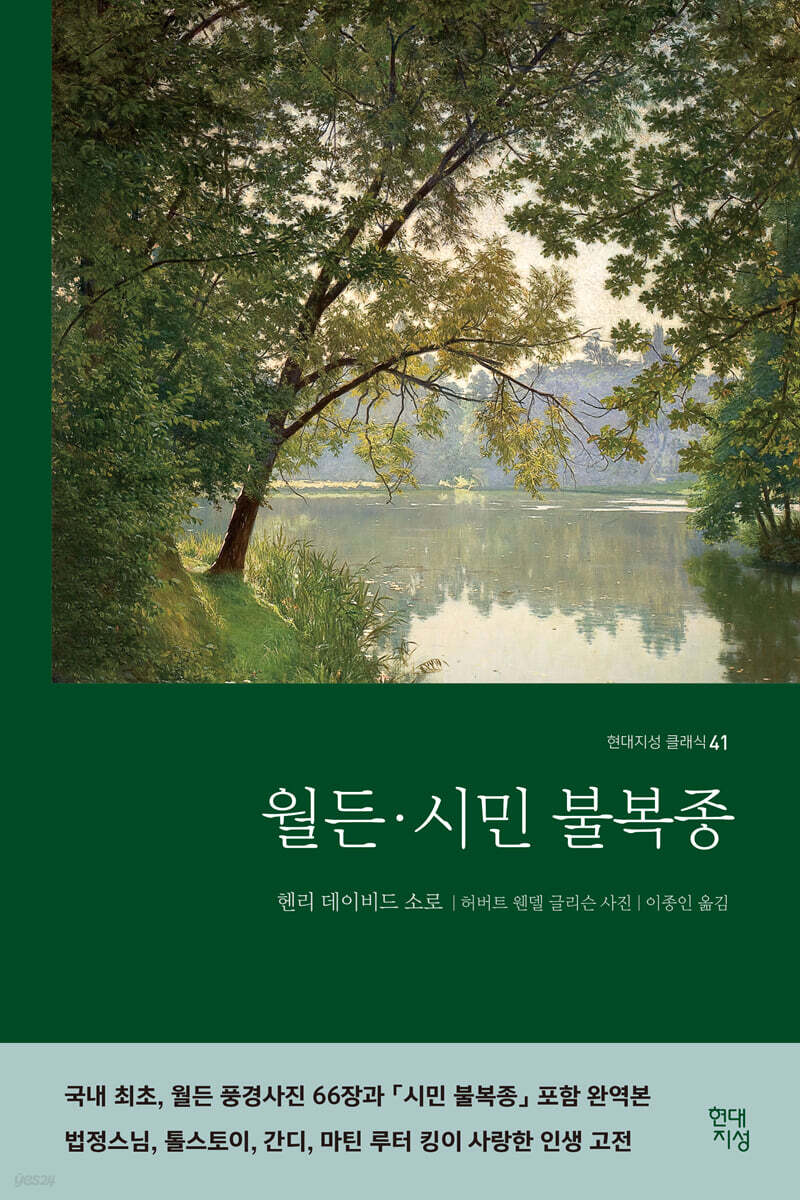
Walden · Civil Disobedience
 |
Description
Book Introduction
The first complete translation in Korea, including 66 Walden landscape photographs and "Civil Disobedience"
A classic life story loved by Buddhist monks, Tolstoy, Gandhi, and Martin Luther King.
Thoreau's masterpieces in a highly readable translation
In the spring of 1845, despite his teacher Emerson's objections, Thoreau borrowed an axe from a friend and went into the woods next to Walden Pond.
There, he cut down pine trees with his own hands and built a house 30 meters from the lakeside. He lived there alone for two years and two months, from July 4, 1845, to September 6, 1847, and wrote down in poetic language the “time of spiritual transformation” he experienced.
Walden strongly argues that people must achieve freedom in their own lives.
To achieve this, we are encouraged to observe nature deeply, simplify our lives, and acknowledge our own uniqueness.
In particular, he emphasized the path to a transcendent world by harmonizing the natural world where everyday experiences take place with the spiritual world that transcends that world, and he personally demonstrated the possibility of this through his contemplative life at Walden Pond.
Thoreau's quiet yet persistent spirit of independence, displayed in Walden and Civil Disobedience, has been a great inspiration to many reformers, spiritual leaders, and artists.
Mahatma Gandhi read "Civil Disobedience" during his exile in Africa and made it the spiritual foundation of the Indian independence movement, and Martin Luther King put the idea of civil disobedience into practice in the northern United States.
Additionally, many environmentalists and labor activists around the world have highly regarded his philosophy of life.
The fact that Thoreau was not just a thinker of words but a thinker of action is evident in the influence his writings had on social and cultural change.
Through Lee Jong-in's delicate yet highly readable translation, a rich and systematic commentary spanning 53 pages (including a chronology) and 274 footnotes, you will experience a new world of Walden, previously obscured by its difficult writing style, ideological background, and obscure metaphors and symbols.
In addition, professional photographer Herbert Wendell Gleason has rearranged 66 photos taken while following Thoreau's footsteps in the order of the text, helping to provide a three-dimensional understanding of Walden.
Thoreau began this experiment on July 4, 1845, America's Independence Day.
The Venerable Pomnyun commented, “Thoreau went to Walden as a student, but when he left, he had become a teacher.”
For readers who live a life of “quiet despair,” lamenting that the life they wanted was not the one they wanted, this book will be a passageway to create “the Independence Day of their lives” and gift “their own Walden.”
A classic life story loved by Buddhist monks, Tolstoy, Gandhi, and Martin Luther King.
Thoreau's masterpieces in a highly readable translation
In the spring of 1845, despite his teacher Emerson's objections, Thoreau borrowed an axe from a friend and went into the woods next to Walden Pond.
There, he cut down pine trees with his own hands and built a house 30 meters from the lakeside. He lived there alone for two years and two months, from July 4, 1845, to September 6, 1847, and wrote down in poetic language the “time of spiritual transformation” he experienced.
Walden strongly argues that people must achieve freedom in their own lives.
To achieve this, we are encouraged to observe nature deeply, simplify our lives, and acknowledge our own uniqueness.
In particular, he emphasized the path to a transcendent world by harmonizing the natural world where everyday experiences take place with the spiritual world that transcends that world, and he personally demonstrated the possibility of this through his contemplative life at Walden Pond.
Thoreau's quiet yet persistent spirit of independence, displayed in Walden and Civil Disobedience, has been a great inspiration to many reformers, spiritual leaders, and artists.
Mahatma Gandhi read "Civil Disobedience" during his exile in Africa and made it the spiritual foundation of the Indian independence movement, and Martin Luther King put the idea of civil disobedience into practice in the northern United States.
Additionally, many environmentalists and labor activists around the world have highly regarded his philosophy of life.
The fact that Thoreau was not just a thinker of words but a thinker of action is evident in the influence his writings had on social and cultural change.
Through Lee Jong-in's delicate yet highly readable translation, a rich and systematic commentary spanning 53 pages (including a chronology) and 274 footnotes, you will experience a new world of Walden, previously obscured by its difficult writing style, ideological background, and obscure metaphors and symbols.
In addition, professional photographer Herbert Wendell Gleason has rearranged 66 photos taken while following Thoreau's footsteps in the order of the text, helping to provide a three-dimensional understanding of Walden.
Thoreau began this experiment on July 4, 1845, America's Independence Day.
The Venerable Pomnyun commented, “Thoreau went to Walden as a student, but when he left, he had become a teacher.”
For readers who live a life of “quiet despair,” lamenting that the life they wanted was not the one they wanted, this book will be a passageway to create “the Independence Day of their lives” and gift “their own Walden.”
- You can preview some of the book's contents.
Preview
index
Walden
1.
Living Economy
2.
Where I Lived and Why I Lived That Way
3.
reading
4.
Sounds of the Forest
5.
solitude
6.
visitors
7.
soybean field
8.
village
9.
lakes
10.
Baker Farm
11.
Higher Law
12.
Neighborhood animals
13.
heating inside the house
14.
People who lived there before and winter visitors
15.
Winter animals
16.
Walden Pond in Winter
17.
spring
18.
Conclusion
civil disobedience
Release | Lee Jong-in
Henry David Thoreau Chronology
1.
Living Economy
2.
Where I Lived and Why I Lived That Way
3.
reading
4.
Sounds of the Forest
5.
solitude
6.
visitors
7.
soybean field
8.
village
9.
lakes
10.
Baker Farm
11.
Higher Law
12.
Neighborhood animals
13.
heating inside the house
14.
People who lived there before and winter visitors
15.
Winter animals
16.
Walden Pond in Winter
17.
spring
18.
Conclusion
civil disobedience
Release | Lee Jong-in
Henry David Thoreau Chronology
Detailed image

Into the book
In fact, people who are suffering from hardship do not have the luxury of living nobly every day.
He is not in a position to maintain human relationships with other people.
His labor becomes less and less valuable in the market.
He just works like a machine and has no time to be anything else.
To grow, we must recognize our own ignorance, but how can we realize this when we are only using what we know? … The world's judgment is a weak tyrant compared to the judgment we place on ourselves.
How a person thinks of himself or herself suggests, or rather determines, his or her fate.
We must free ourselves from the West Indies of fantasy and imagination.
Do you have a Wilberforce who can bring you such self-liberation?
--- p.15-17, 「1.
From “Life Economy”
It's never too late to let go of your prejudices.
No matter how old a way of thinking or behavior is, you should not believe it without verifying it.
What everyone agrees and tolerates as truth today may be revealed as a lie tomorrow.
I believed it was a rain cloud that would make my land fertile, but it turned out to be just a piece of opinion that would disappear like smoke.
…Just as our human constitutions are diverse, nature and life are also diverse.
Who can confidently predict what life will hold for another person? What greater miracle can occur than a momentary glance into another's eyes? We can live through all the ages of the world in an hour.
No, you can live in all the worlds of all times.
History, poetry, mythology! Where else can you read such wonderful and informative accounts of someone else's experience?
--- p.19-22, 「1.
From “Life Economy”
Most luxuries and many of the conveniences that make life comfortable are not only unnecessary, but also a great obstacle to the elevation of the human spirit.
Speaking of luxuries and conveniences, the wisest people of all time lived simpler and more austere lives than the poor.
The ancient philosophers we meet in China, India, Persia, Greece, and elsewhere may have been poor on the outside, but they could not have been so rich on the inside.
There's a lot we don't know about them.
…
Farmers try to solve their livelihood problems with a formula that is more complex than the problem itself.
It's like speculating on a herd of cattle to get a very small amount of money that can buy you a shoelace.
He sets traps with fur springs, using great skill to secure comfort and independence.
But the moment you turn around after setting the trap, your leg gets caught in your own trap.
This is why he is poor.
For similar reasons, we are surrounded by many luxuries, yet we are poor compared with the thousand comforts enjoyed by the savages.
--- p.26, 50, 「1.
From “Life Economy”
Doesn't it remind you of an episode from an Englishman who spent the best years of his life making money and then decided to enjoy questionable freedom in the most worthless years?
He first went to India to make money.
He later returned to England to live the life of a poet.
But instead of going to India, he should have gone up to the attic and written poetry right now.
--- p.75, 「1.
From “Life Economy”
I wanted to live an intentional life, so I went into the woods.
I faced the essential facts of life and examined whether I could learn what life had to teach me.
Because I didn't want to realize when I was about to die that I hadn't lived a full life.
Life is so precious that I didn't want to live anything that wasn't life.
I didn't want to give up on this goal unless it was absolutely necessary.
I wanted to live deeply, sucking out all the marrow of life, living like a Spartan, so strong that I could drive out everything that was not life.
I wanted to cut life wide and deep, push it into a corner, and find out what the most fundamental conditions of life are.
--- p.121, 「2.
From "Where I Lived and Why I Lived That Way"
I love the wide margins that surround my life.
Sometimes on summer mornings, after bathing as usual, I would sit on the sunlit threshold from sunrise until noon, surrounded by pines, walnuts, and lacquer trees, and meditate in complete solitude and silence.
Then the birds would chirp around the house or fly into the house silently.
all.
Then, before you know it, the sun is setting on the west window of the house, and you can hear the sound of a traveler's carriage passing by on the street in the distance.
Then I realize that a lot of time has passed.
Like corn growing tall in the night, I grew a lot in that season, and it was a better season than anything I had ever done with my own two hands.
It was not a deducted time from my life at all, it was a very precious time given to me as a bonus, not included in the normal calculation of time.
…if birds and flowers test me with their own standards, I will pass.
Human beings must discover within themselves what is important to them.
A day in nature is so peaceful that I don't blame him for being lazy like this.
--- p.153, 「4.
From "Sounds of the Forest"
Humans should always listen to the true story of their soul.
It's a faint but steady sound.
When you listen to that sound, you might initially worry that it might lead you to some extreme or madness, but you will eventually find that it does not.
If we face it with faith and determination, we will realize that it is the path we should take.
A small but firm voice of dissent, heard by a single sane human being, may finally overcome the arguments and conventions of humanity.
No one ever loses their way while following their soul.
Following that path may leave you physically weak, but no one can lament that outcome.
Because it is a life lived with conviction, living up to higher principles.
--- p.286, 「11.
From the “Higher Law”
After a quiet winter night, I woke up feeling a certain way.
A question came to me, and I tried in vain to answer it in my dream.
What, how, when, where? But nature, where all creatures live, was dawning.
Nature looked into my wide window with a calm and contented face, and there was no question on her lips.
There are no questions, so there are no answers, and I am now awake to face nature and broad daylight.
The deep snow on the ground dotted with young pine trees and the ridge of the hill where the house stood seemed to say this.
Go forward! Nature asks no questions, and even less does it answer the questions we humans ask.
Nature decided so long ago.
--- p.374, 「16.
From "Winter Lake"
Why do we rush so desperately to succeed, and then commit such desperate acts? If someone doesn't keep pace with their peers, it's because they're being beaten by a different drum.
Have the person walk to the sound of the music he hears.
No matter how careful and far the sound is
Even if it cries out.
It's not so important whether he matures quickly like an apple tree or an oak tree.
Should we force our spring into summer? If the external conditions that suit our nature haven't yet been established, what's the point of forcing another reality into our lives? We're following a vain reality.
You must not wreck while going.
Let's say we decide to work hard to build a blue glass sky.
When the construction of the glass sky is finished, and we see the true blue sky in the ashy place beyond, we will realize that the glass sky is not real, but will we still say that we will build the glass sky?
He is not in a position to maintain human relationships with other people.
His labor becomes less and less valuable in the market.
He just works like a machine and has no time to be anything else.
To grow, we must recognize our own ignorance, but how can we realize this when we are only using what we know? … The world's judgment is a weak tyrant compared to the judgment we place on ourselves.
How a person thinks of himself or herself suggests, or rather determines, his or her fate.
We must free ourselves from the West Indies of fantasy and imagination.
Do you have a Wilberforce who can bring you such self-liberation?
--- p.15-17, 「1.
From “Life Economy”
It's never too late to let go of your prejudices.
No matter how old a way of thinking or behavior is, you should not believe it without verifying it.
What everyone agrees and tolerates as truth today may be revealed as a lie tomorrow.
I believed it was a rain cloud that would make my land fertile, but it turned out to be just a piece of opinion that would disappear like smoke.
…Just as our human constitutions are diverse, nature and life are also diverse.
Who can confidently predict what life will hold for another person? What greater miracle can occur than a momentary glance into another's eyes? We can live through all the ages of the world in an hour.
No, you can live in all the worlds of all times.
History, poetry, mythology! Where else can you read such wonderful and informative accounts of someone else's experience?
--- p.19-22, 「1.
From “Life Economy”
Most luxuries and many of the conveniences that make life comfortable are not only unnecessary, but also a great obstacle to the elevation of the human spirit.
Speaking of luxuries and conveniences, the wisest people of all time lived simpler and more austere lives than the poor.
The ancient philosophers we meet in China, India, Persia, Greece, and elsewhere may have been poor on the outside, but they could not have been so rich on the inside.
There's a lot we don't know about them.
…
Farmers try to solve their livelihood problems with a formula that is more complex than the problem itself.
It's like speculating on a herd of cattle to get a very small amount of money that can buy you a shoelace.
He sets traps with fur springs, using great skill to secure comfort and independence.
But the moment you turn around after setting the trap, your leg gets caught in your own trap.
This is why he is poor.
For similar reasons, we are surrounded by many luxuries, yet we are poor compared with the thousand comforts enjoyed by the savages.
--- p.26, 50, 「1.
From “Life Economy”
Doesn't it remind you of an episode from an Englishman who spent the best years of his life making money and then decided to enjoy questionable freedom in the most worthless years?
He first went to India to make money.
He later returned to England to live the life of a poet.
But instead of going to India, he should have gone up to the attic and written poetry right now.
--- p.75, 「1.
From “Life Economy”
I wanted to live an intentional life, so I went into the woods.
I faced the essential facts of life and examined whether I could learn what life had to teach me.
Because I didn't want to realize when I was about to die that I hadn't lived a full life.
Life is so precious that I didn't want to live anything that wasn't life.
I didn't want to give up on this goal unless it was absolutely necessary.
I wanted to live deeply, sucking out all the marrow of life, living like a Spartan, so strong that I could drive out everything that was not life.
I wanted to cut life wide and deep, push it into a corner, and find out what the most fundamental conditions of life are.
--- p.121, 「2.
From "Where I Lived and Why I Lived That Way"
I love the wide margins that surround my life.
Sometimes on summer mornings, after bathing as usual, I would sit on the sunlit threshold from sunrise until noon, surrounded by pines, walnuts, and lacquer trees, and meditate in complete solitude and silence.
Then the birds would chirp around the house or fly into the house silently.
all.
Then, before you know it, the sun is setting on the west window of the house, and you can hear the sound of a traveler's carriage passing by on the street in the distance.
Then I realize that a lot of time has passed.
Like corn growing tall in the night, I grew a lot in that season, and it was a better season than anything I had ever done with my own two hands.
It was not a deducted time from my life at all, it was a very precious time given to me as a bonus, not included in the normal calculation of time.
…if birds and flowers test me with their own standards, I will pass.
Human beings must discover within themselves what is important to them.
A day in nature is so peaceful that I don't blame him for being lazy like this.
--- p.153, 「4.
From "Sounds of the Forest"
Humans should always listen to the true story of their soul.
It's a faint but steady sound.
When you listen to that sound, you might initially worry that it might lead you to some extreme or madness, but you will eventually find that it does not.
If we face it with faith and determination, we will realize that it is the path we should take.
A small but firm voice of dissent, heard by a single sane human being, may finally overcome the arguments and conventions of humanity.
No one ever loses their way while following their soul.
Following that path may leave you physically weak, but no one can lament that outcome.
Because it is a life lived with conviction, living up to higher principles.
--- p.286, 「11.
From the “Higher Law”
After a quiet winter night, I woke up feeling a certain way.
A question came to me, and I tried in vain to answer it in my dream.
What, how, when, where? But nature, where all creatures live, was dawning.
Nature looked into my wide window with a calm and contented face, and there was no question on her lips.
There are no questions, so there are no answers, and I am now awake to face nature and broad daylight.
The deep snow on the ground dotted with young pine trees and the ridge of the hill where the house stood seemed to say this.
Go forward! Nature asks no questions, and even less does it answer the questions we humans ask.
Nature decided so long ago.
--- p.374, 「16.
From "Winter Lake"
Why do we rush so desperately to succeed, and then commit such desperate acts? If someone doesn't keep pace with their peers, it's because they're being beaten by a different drum.
Have the person walk to the sound of the music he hears.
No matter how careful and far the sound is
Even if it cries out.
It's not so important whether he matures quickly like an apple tree or an oak tree.
Should we force our spring into summer? If the external conditions that suit our nature haven't yet been established, what's the point of forcing another reality into our lives? We're following a vain reality.
You must not wreck while going.
Let's say we decide to work hard to build a blue glass sky.
When the construction of the glass sky is finished, and we see the true blue sky in the ashy place beyond, we will realize that the glass sky is not real, but will we still say that we will build the glass sky?
--- p.432, 「18.
From the “Conclusion”
From the “Conclusion”
Publisher's Review
Breaking the life of 'quiet despair'
A book like an axe that creates an 'Independence Day' in your life.
In the spring of 1845, despite his teacher Emerson's objections, Thoreau borrowed an axe from a friend and went into the woods next to Walden Pond.
There, he cut down pine trees with his own hands and built a house 30 meters from the lakeside. He lived there alone for two years and two months, from July 4, 1845, to September 6, 1847, and wrote down in poetic language the “time of spiritual transformation” he experienced.
The main theme of Walden is that we must achieve freedom in our own lives.
To achieve this, we are encouraged to observe nature deeply, simplify our lives, and acknowledge our own uniqueness.
In particular, he emphasized the path to the transcendent world (third reality) by harmonizing the natural world (first reality) where everyday experiences take place and the spiritual world (second reality) that transcends that world, and he personally proved that this was possible through his contemplative life at Walden Pond.
The pressure from society, civilization, and the system is intense, but the more it is, the more we are told to go into it and do what we can as individuals.
For Thoreau, this manifested itself as self-actualization and non-conformity to American society.
“If a man does not keep pace with his fellows, it is because he is hearing a different drum.
Have the person walk to the sound of the music he hears.
“No matter how careful the sound is and how far away it may come from” (Chapter 18).
Young people all over the world read this sentence and were thrilled.
Thoreau's quiet yet persistent spirit of independence, displayed in Walden and Civil Disobedience, has been a great inspiration to many reformers, spiritual leaders, and artists.
Mahatma Gandhi read "Civil Disobedience" during his exile in Africa and made it the spiritual foundation of the Indian independence movement, and Martin Luther King put the idea of civil disobedience into practice in the northern United States.
His philosophy of life was also highly regarded by many conservationists, environmentalists, and labor activists around the world.
The great Russian author Leo Tolstoy and the French novelist Marcel Proust also loved this book and mentioned it several times, and the poet Robert Frost praised it highly, saying, “Walden is my favorite poem.”
A recent survey of American professors found that Walden was the most important 19th-century text they should teach their students, and Thoreau's book served as a prophetic force in the culture of simplicity that has characterized the 1930s.
The fact that Thoreau was not merely a reclusive thinker but a man of action is evident in the influence his writings had on social and cultural change.
A comprehensive study of Thoreau's many facets—as a great prose writer, a nature lover, a New England mystic, and a powerful social thinker—is ongoing.
A simple, independent and free life
A must-read for aspiring readers
Thoreau states this in the preface to the first edition of Walden:
“I don’t intend to write an article praising discouragement.
Early in the morning, like a rooster standing on its perch and clamoring loudly, I will proudly spread out what I want to say.
“Even if it’s just to wake up my neighbors who are still asleep.” The “disheartening” or “my sleeping neighbors” mentioned here refers to the quiet despair they feel.
This is also revealed in the last 18 chapters.
“I want to speak in a place where there are no boundaries.
"I want to talk to people who are just waking up, as if they were just waking up." Since Thoreau himself went into Walden Woods to find out how to break that kind of life, the theme of Walden is the story that the waking person tells to the person who is just waking up.
Thoreau first woke up at Walden Pond, completed his 'personal myth', and left this book as a gift for future readers who longed for a free life.
In Thoreau's view, readers think they are free, but in reality they live a life of lowly slavery, humiliation, and death.
On the other hand, there is true value in life, which is generally considered worthless, and to discover and practice it, we must simplify our lives.
Therefore, all the paradoxes, metaphors, and other wordplays introduced in Walden are intended to help us stop living a mechanical life and live an independent and free life, a divine life.
Thoreau, too, is not content with observing nature and living a simple life by the lake. After renewing himself, he interrupts his life in Walden and returns to society in order to renew society as a whole.
Having completed my training through reading and living in the forest, I must now return to civilized life to awaken the sleeping being.
The very last sentence of Walden is:
“The day we wake up is the day when dawn finally breaks.
There are many days to dawn ahead.
“The sun is just a star that rises in the morning.”
Thoreau's masterpieces in a highly readable translation
The first complete translation in Korea, including 66 Walden landscape photographs and "Civil Disobedience"
Soro's sentences are poetic.
There are many times when we must read a word in its poetic sense rather than its general meaning.
Sometimes a common word is used with a completely different meaning, or its meaning becomes clear only when it is extended to the entire book, not just the context.
Also, Soro's sentences seem to jump suddenly.
“I don’t want to travel in a comfortable cabin.
Rather, I want to climb up onto the deck, in front of the world's mast.
“Because you can see the moonlight in the mountainous region better from there” (Chapter 18).
While talking about ships, he suddenly starts talking about moonlight in the mountains.
You must meticulously remember the preceding statements in order to understand the sentences that follow.
Without knowing this connection, Thoreau's sentences seem to jump around randomly.
Moreover, there are many paradoxes and oxymorons, and the concrete and the abstract are mixed.
It is also full of metaphors and symbols, most notably Walden Pond, which is both a lake and a place, and a symbol of the human heart and, further, of a perfected soul.
Thoreau quotes Greek mythology, Norse mythology, Native American mythology, and the Bible throughout Walden, and there are 55 classic books on Western mythology that he can prove he quoted in his work.
In addition, if you do not understand the various backgrounds surrounding Walden, such as the construction of the railroad, the idea of Transcendentalism, the relationship between the diary and the work, and the revision of the work, this book becomes nothing more than a naturalist's meticulous observation of nature.
After years of preparation, Modern Intellect Classics presents Walden and Civil Disobedience to readers.
Professional translator Jong-in Lee, who has translated over 300 books, including many major humanities classics (Progress and Poverty, Livy's Complete History of Rome (4 Volumes), Theory of the Leisure Class, Utilitarianism, Gulliver's Travels, The Decline and Fall of the Roman Empire, History of Ancient Rome, etc.), offers a delicate yet highly readable translation and 274 footnotes in the text, which will greatly help in understanding the watertight text.
In particular, the translator has done his best to open up the world of Walden, which has been previously obscured by its difficult style and ideas, and incomprehensible metaphors and symbols, through a rich and systematic explanation spanning 53 pages (250 pages of manuscript paper, including chronology).
This article will provide a thorough explanation of why "Civil Disobedience," which we'll be introducing together this time, is considered one of the most important essays in American cultural history.
In addition, 66 photos taken by professional photographer Herbert Wendell Gleason while following Thoreau's footsteps have been rearranged in the order of the text for the first time in Korea, helping to provide a three-dimensional understanding of Walden.
The Venerable Pomnyun commented, “Thoreau went to Walden as a student, but when he left, he had become a teacher.”
If you read the introduction after reading the main text and then carefully reread the main text, you will experience the joy of walking through the uncharted territory of Walden, and gain great insight into creating your own “myth” to overcome the “quiet despair” Thoreau hoped for.
A book like an axe that creates an 'Independence Day' in your life.
In the spring of 1845, despite his teacher Emerson's objections, Thoreau borrowed an axe from a friend and went into the woods next to Walden Pond.
There, he cut down pine trees with his own hands and built a house 30 meters from the lakeside. He lived there alone for two years and two months, from July 4, 1845, to September 6, 1847, and wrote down in poetic language the “time of spiritual transformation” he experienced.
The main theme of Walden is that we must achieve freedom in our own lives.
To achieve this, we are encouraged to observe nature deeply, simplify our lives, and acknowledge our own uniqueness.
In particular, he emphasized the path to the transcendent world (third reality) by harmonizing the natural world (first reality) where everyday experiences take place and the spiritual world (second reality) that transcends that world, and he personally proved that this was possible through his contemplative life at Walden Pond.
The pressure from society, civilization, and the system is intense, but the more it is, the more we are told to go into it and do what we can as individuals.
For Thoreau, this manifested itself as self-actualization and non-conformity to American society.
“If a man does not keep pace with his fellows, it is because he is hearing a different drum.
Have the person walk to the sound of the music he hears.
“No matter how careful the sound is and how far away it may come from” (Chapter 18).
Young people all over the world read this sentence and were thrilled.
Thoreau's quiet yet persistent spirit of independence, displayed in Walden and Civil Disobedience, has been a great inspiration to many reformers, spiritual leaders, and artists.
Mahatma Gandhi read "Civil Disobedience" during his exile in Africa and made it the spiritual foundation of the Indian independence movement, and Martin Luther King put the idea of civil disobedience into practice in the northern United States.
His philosophy of life was also highly regarded by many conservationists, environmentalists, and labor activists around the world.
The great Russian author Leo Tolstoy and the French novelist Marcel Proust also loved this book and mentioned it several times, and the poet Robert Frost praised it highly, saying, “Walden is my favorite poem.”
A recent survey of American professors found that Walden was the most important 19th-century text they should teach their students, and Thoreau's book served as a prophetic force in the culture of simplicity that has characterized the 1930s.
The fact that Thoreau was not merely a reclusive thinker but a man of action is evident in the influence his writings had on social and cultural change.
A comprehensive study of Thoreau's many facets—as a great prose writer, a nature lover, a New England mystic, and a powerful social thinker—is ongoing.
A simple, independent and free life
A must-read for aspiring readers
Thoreau states this in the preface to the first edition of Walden:
“I don’t intend to write an article praising discouragement.
Early in the morning, like a rooster standing on its perch and clamoring loudly, I will proudly spread out what I want to say.
“Even if it’s just to wake up my neighbors who are still asleep.” The “disheartening” or “my sleeping neighbors” mentioned here refers to the quiet despair they feel.
This is also revealed in the last 18 chapters.
“I want to speak in a place where there are no boundaries.
"I want to talk to people who are just waking up, as if they were just waking up." Since Thoreau himself went into Walden Woods to find out how to break that kind of life, the theme of Walden is the story that the waking person tells to the person who is just waking up.
Thoreau first woke up at Walden Pond, completed his 'personal myth', and left this book as a gift for future readers who longed for a free life.
In Thoreau's view, readers think they are free, but in reality they live a life of lowly slavery, humiliation, and death.
On the other hand, there is true value in life, which is generally considered worthless, and to discover and practice it, we must simplify our lives.
Therefore, all the paradoxes, metaphors, and other wordplays introduced in Walden are intended to help us stop living a mechanical life and live an independent and free life, a divine life.
Thoreau, too, is not content with observing nature and living a simple life by the lake. After renewing himself, he interrupts his life in Walden and returns to society in order to renew society as a whole.
Having completed my training through reading and living in the forest, I must now return to civilized life to awaken the sleeping being.
The very last sentence of Walden is:
“The day we wake up is the day when dawn finally breaks.
There are many days to dawn ahead.
“The sun is just a star that rises in the morning.”
Thoreau's masterpieces in a highly readable translation
The first complete translation in Korea, including 66 Walden landscape photographs and "Civil Disobedience"
Soro's sentences are poetic.
There are many times when we must read a word in its poetic sense rather than its general meaning.
Sometimes a common word is used with a completely different meaning, or its meaning becomes clear only when it is extended to the entire book, not just the context.
Also, Soro's sentences seem to jump suddenly.
“I don’t want to travel in a comfortable cabin.
Rather, I want to climb up onto the deck, in front of the world's mast.
“Because you can see the moonlight in the mountainous region better from there” (Chapter 18).
While talking about ships, he suddenly starts talking about moonlight in the mountains.
You must meticulously remember the preceding statements in order to understand the sentences that follow.
Without knowing this connection, Thoreau's sentences seem to jump around randomly.
Moreover, there are many paradoxes and oxymorons, and the concrete and the abstract are mixed.
It is also full of metaphors and symbols, most notably Walden Pond, which is both a lake and a place, and a symbol of the human heart and, further, of a perfected soul.
Thoreau quotes Greek mythology, Norse mythology, Native American mythology, and the Bible throughout Walden, and there are 55 classic books on Western mythology that he can prove he quoted in his work.
In addition, if you do not understand the various backgrounds surrounding Walden, such as the construction of the railroad, the idea of Transcendentalism, the relationship between the diary and the work, and the revision of the work, this book becomes nothing more than a naturalist's meticulous observation of nature.
After years of preparation, Modern Intellect Classics presents Walden and Civil Disobedience to readers.
Professional translator Jong-in Lee, who has translated over 300 books, including many major humanities classics (Progress and Poverty, Livy's Complete History of Rome (4 Volumes), Theory of the Leisure Class, Utilitarianism, Gulliver's Travels, The Decline and Fall of the Roman Empire, History of Ancient Rome, etc.), offers a delicate yet highly readable translation and 274 footnotes in the text, which will greatly help in understanding the watertight text.
In particular, the translator has done his best to open up the world of Walden, which has been previously obscured by its difficult style and ideas, and incomprehensible metaphors and symbols, through a rich and systematic explanation spanning 53 pages (250 pages of manuscript paper, including chronology).
This article will provide a thorough explanation of why "Civil Disobedience," which we'll be introducing together this time, is considered one of the most important essays in American cultural history.
In addition, 66 photos taken by professional photographer Herbert Wendell Gleason while following Thoreau's footsteps have been rearranged in the order of the text for the first time in Korea, helping to provide a three-dimensional understanding of Walden.
The Venerable Pomnyun commented, “Thoreau went to Walden as a student, but when he left, he had become a teacher.”
If you read the introduction after reading the main text and then carefully reread the main text, you will experience the joy of walking through the uncharted territory of Walden, and gain great insight into creating your own “myth” to overcome the “quiet despair” Thoreau hoped for.
GOODS SPECIFICS
- Date of issue: December 1, 2021
- Page count, weight, size: 536 pages | 668g | 150*225*26mm
- ISBN13: 9791139700503
- ISBN10: 1139700502
You may also like
카테고리
korean


korean

![GQ KOREA Mark (Monthly): December [2025]](http://librairie.coreenne.fr/cdn/shop/files/8ef265dbbfbf186523ed75ba7319009d.jpg?v=1765340328&width=3840)


