

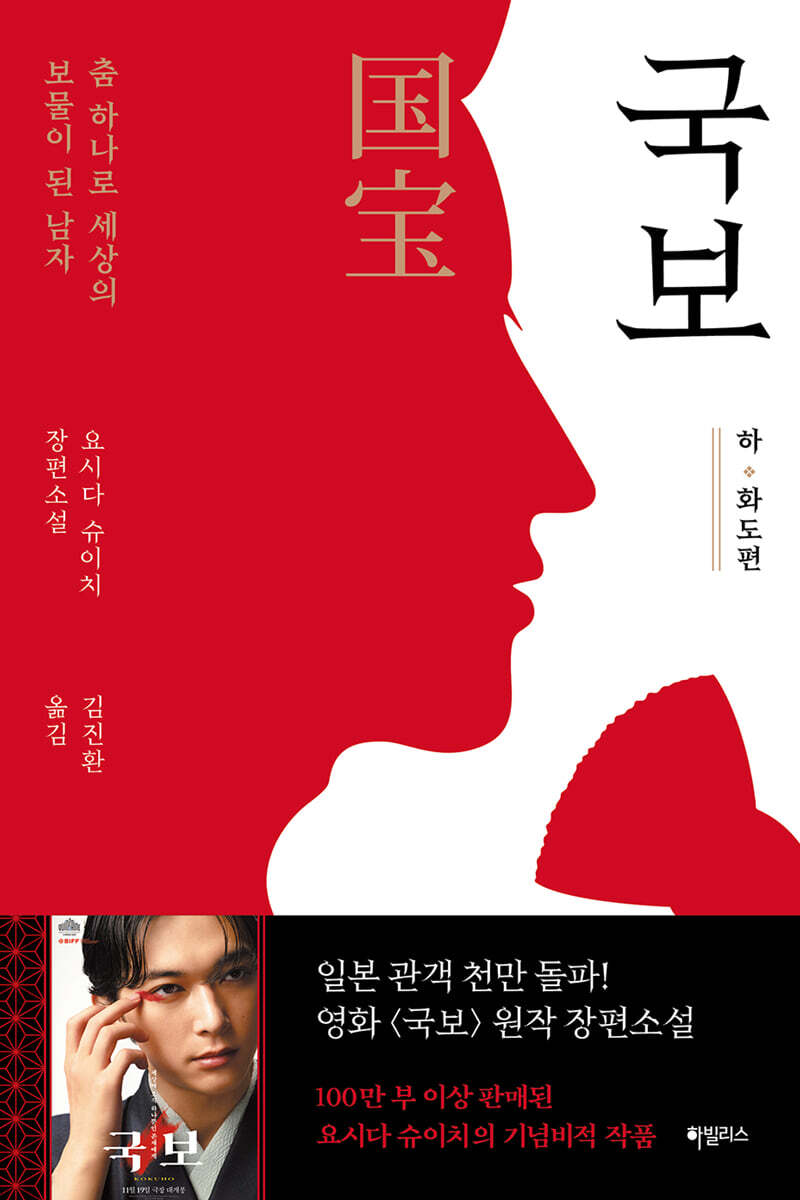
National Treasure: Ha and Hwado
 |
Description
Book Introduction
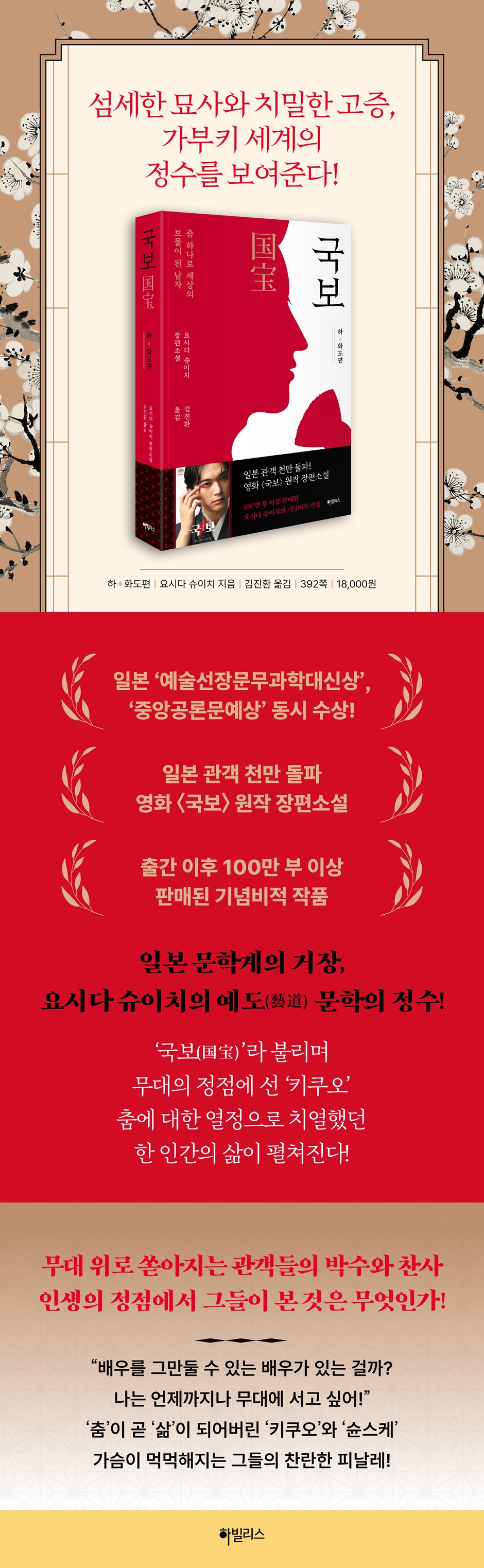
The original novel of the movie [National Treasure], which surpassed 10 million viewers in Japan!
Winner of the 'Minister of Arts, Culture, Sports and Tourism Award' and the 'Central Public Literary Award' at the same time!
More than 1 million copies sold since publication
A monumental work by Shuichi Yoshida!
The film [National Treasure], released in Japan in June 2025, caused a sensation in the Japanese film industry by attracting over 10 million viewers.
This film, which is based on Kabuki, a traditional Japanese culture that is at the same time forgotten by the younger generation, is based on the novel of the same name, "Kokuho," by Shuichi Yoshida, a representative figure in Japanese literature.
The original novel, which was no less beloved than the movie, sold over a million copies after its publication and was loved by the nation.
The author revives the Kabuki culture through the novel, and through the protagonist who devotes his whole heart and soul to creating the perfect dance, acting, and stage, he makes us think about what it means to reach the 'top' of a field.
In particular, the author shows how difficult the life of a Kabuki actor who is pushed to the margins is, and conveys the message that although the rosy life that everyone desires is never easy to come by, we must persevere and move forward.
Through novels, we can reflect on what it means to live life and what it means.
Let's share in the intense lives of the main characters and those around them, the sweat and tears they shed, and the moments of frustration and joy that could not be fully captured in the film.
Winner of the 'Minister of Arts, Culture, Sports and Tourism Award' and the 'Central Public Literary Award' at the same time!
More than 1 million copies sold since publication
A monumental work by Shuichi Yoshida!
The film [National Treasure], released in Japan in June 2025, caused a sensation in the Japanese film industry by attracting over 10 million viewers.
This film, which is based on Kabuki, a traditional Japanese culture that is at the same time forgotten by the younger generation, is based on the novel of the same name, "Kokuho," by Shuichi Yoshida, a representative figure in Japanese literature.
The original novel, which was no less beloved than the movie, sold over a million copies after its publication and was loved by the nation.
The author revives the Kabuki culture through the novel, and through the protagonist who devotes his whole heart and soul to creating the perfect dance, acting, and stage, he makes us think about what it means to reach the 'top' of a field.
In particular, the author shows how difficult the life of a Kabuki actor who is pushed to the margins is, and conveys the message that although the rosy life that everyone desires is never easy to come by, we must persevere and move forward.
Through novels, we can reflect on what it means to live life and what it means.
Let's share in the intense lives of the main characters and those around them, the sweat and tears they shed, and the moments of frustration and joy that could not be fully captured in the film.
- You can preview some of the book's contents.
Preview
index
Chapter 11: The Flower of Evil
Chapter 12: The Incense of the Anti-Soul
Chapter 13: The White Heron
Chapter 14: The Age of Bubbles
Chapter 15: The Dream of the Moon (??の夢)
Chapter 16: The Fall of the Giant
Chapter 17: Fifth-Generation Hanai Baekho
Chapter 18 Sunset in Goseong
Chapter 19: Silk Carp
Chapter 20 National Treasure (??)
commentary
Chapter 12: The Incense of the Anti-Soul
Chapter 13: The White Heron
Chapter 14: The Age of Bubbles
Chapter 15: The Dream of the Moon (??の夢)
Chapter 16: The Fall of the Giant
Chapter 17: Fifth-Generation Hanai Baekho
Chapter 18 Sunset in Goseong
Chapter 19: Silk Carp
Chapter 20 National Treasure (??)
commentary
Detailed image
Into the book
What Takeno had initially envisioned was the plot of "the wonderful revival of Master Tanbaya, who had fallen to the point of becoming a circus clown," but once he opened the lid, he quickly realized that, although they might be Kabuki fans, the majority of the public, who are Kabuki outsiders, did not even know what the word Tanbaya meant in the first place, and of course, they did not know what status the Master there held, so they only had a vague impression of it.
Then, Takeno, who was flustered, immediately changed his strategy and decided to introduce the good vs. evil dichotomy of professional wrestling as a way to attract the public's attention and introduce a villain early on.
Of course, the villain is Kikuo, who took the name of the third-generation descendant Hanjiro, as per the original plot.
And while I was thinking about how to present Kikuo in a way that would appeal to the public, the idea suddenly came to mind: Kikuo's illegitimate child, born to a geisha in Kyoto.
So I consulted with the people in charge, but all I got was ridicule.
“Who would be surprised to hear that an actor has a secret child?”
--- p.17
Although it was a choice he made, Toyoki grew up healthily in poverty, and at the same time, his knowledge of Kabuki, which he had previously harbored mixed feelings about, deepened.
There may have never been a time when Shunsuke spent each day as faithfully as he did during this time.
It was one night that Shunsuke suddenly noticed that Toyoki, who had been sleeping soundly as usual, was breathing heavily.
The moment I closed the book I was reading and stroked Toyoki's small head, a burning heat spread through my palm, and when I hurriedly lifted the blanket, I saw that his once beautiful white skin was covered in red eczema.
It was late at night, and Haru hadn't finished work yet, so Shunsuke, who was anxious, hugged the suffering Toyoki and ran down the stairs of the cheap apartment.
(…syncopation…)
“Toyoki, cheer up.
“Toyoki, hold on a little longer.”
Shunsuke hugged her tightly and ran out onto the main road.
As I race towards the general hospital in the next town, I reach out my arms every time I see a car's headlights, begging them to stop, whether it's a taxi or a regular car, but since no one likes a man loitering on the road in the rain at night, all I get back is annoyed honking of his horn.
“Someone, someone, please help me!”
Still, in Shunsuke's arms, who was trying to cling to a passing car while shouting like that, Toyoki ended his short life, no matter how much he felt and how much pain he must have felt.
Shunsuke arrived at the general hospital soaking wet… … .
"Someone! Someone help me! He's Tanbaya's successor! This child is Tanbaya's important successor!"
--- pp.72-73
There is a strange vividness to the place called backstage.
In this dimly lit place, where even the lights don't reach, the transvestites still smell masculine, while the male lead with white powder on looks somehow feminine. The sound of the stagehands and Kurogo's busy footsteps in bare feet or straw sandals is absorbed into the pine floor as if it were a snowy road.
It would be a place like a blurred boundary between men and women, sound and silence, reality and fantasy, and the living and the dead.
Waiting quietly at the side of the stage to appear were Hikaru Genji and Kikuo, wrapped in lavender Heian period costumes, and when the dimly seeping light revealed their transparently white faces, their beauty was so great that even Tokuji, who was standing next to them…
“I feel strange when I see the young master playing Hikaru Genji.”
She exudes a seductive charm that makes people say things like that.
--- pp.116-117
“When was that? Mr. Kiku was sick in bed, so I asked a nearby bar to make me some egg liquor, and I brought it to them.
Then Kiku-san liked it a lot.
After lying down for a while and chatting about this and that, he said, "This place is really nice." I laughed and said, "What's nice about a dirty hotel like this?" and he said, "That's why it's nice."
‘… …There’s nothing beautiful here.
So, strangely, I feel relieved.
I feel relieved for some reason.
“It’s okay now, it’s like someone is telling me.”
Mankiku, who usually went out to the washroom early in the morning to see off the neighboring guests who were going out to work as day laborers, did not show up until the afternoon that day, so when the innkeeper opened the door, he wondered if he had caught a cold again, and for a moment he doubted his eyes.
It is said that she had put on white powder and rouge on her face, as if she had enjoyed some entertainment the night before. In the dim room where the sunlight did not reach, it seemed for a moment that a beautiful woman of mysterious age was sleeping there.
“Kiku-san, Kiku-san!”
However, no matter how much the innkeeper called, Mankiku did not open his eyes, and when the bewildered owner touched his body, it was said that he had already frozen as cold as a stone.
The death of the 6th generation Onogawa Mankiku, a legendary transvestite who dominated the Kabuki world before and after the war with her captivating performances, was widely reported both domestically and internationally.
However, in the article commemorating his death, instead of mentioning a cheap inn in a shantytown, it was written that he died at the age of ninety-three in his home, an apartment building, which was his final resting place, surrounded by close friends and disciples.
--- pp.194-195
It was at that moment that Shunsuke, who was supposed to get up right away after getting down on his knees while dancing, stumbled once and collapsed.
I continued dancing while sitting down to avoid being caught, but I was clearly feeling dizzy, and the sweat running down my forehead was glistening in the bright lights.
Originally, the boat Kikuo was rowing was supposed to appear when Shunsuke, who had finished dancing on the flower path, arrived on stage, but on the flower path, Shunsuke was dancing hard without even being able to get up and not knowing what to do.
“Hey, I’m going out now.
“Let’s send the boat out.”
The stagehands move in a panic at Kikuo's urgent instructions that are different from the plan.
As soon as Kikuo boards the boat from the side of the stage, he gestures for someone to send him to the right side of the stage, and then begins to row the oar he is holding.
Although the boatman's appearance was different from usual, the shamisen played by the performer on stage was not out of place, and the lighting accurately captured the boatman.
When Kikuo appears, the audience's attention is focused on the stage.
The audience applauds as Kikuo deliberately rows with large movements and looks around the audience as if to tell them to look only at him.
However, in his heart, he only prays, 'Shunsuke, get up quickly.'
If that doesn't work out, she sends a glance at Shunsuke, who is unable to get up from the flower path after getting off the boat first, with the intention of naturally going to greet him, but surprisingly, what she receives in return is Shunsuke's strong gaze saying, "Don't come."
Then, Takeno, who was flustered, immediately changed his strategy and decided to introduce the good vs. evil dichotomy of professional wrestling as a way to attract the public's attention and introduce a villain early on.
Of course, the villain is Kikuo, who took the name of the third-generation descendant Hanjiro, as per the original plot.
And while I was thinking about how to present Kikuo in a way that would appeal to the public, the idea suddenly came to mind: Kikuo's illegitimate child, born to a geisha in Kyoto.
So I consulted with the people in charge, but all I got was ridicule.
“Who would be surprised to hear that an actor has a secret child?”
--- p.17
Although it was a choice he made, Toyoki grew up healthily in poverty, and at the same time, his knowledge of Kabuki, which he had previously harbored mixed feelings about, deepened.
There may have never been a time when Shunsuke spent each day as faithfully as he did during this time.
It was one night that Shunsuke suddenly noticed that Toyoki, who had been sleeping soundly as usual, was breathing heavily.
The moment I closed the book I was reading and stroked Toyoki's small head, a burning heat spread through my palm, and when I hurriedly lifted the blanket, I saw that his once beautiful white skin was covered in red eczema.
It was late at night, and Haru hadn't finished work yet, so Shunsuke, who was anxious, hugged the suffering Toyoki and ran down the stairs of the cheap apartment.
(…syncopation…)
“Toyoki, cheer up.
“Toyoki, hold on a little longer.”
Shunsuke hugged her tightly and ran out onto the main road.
As I race towards the general hospital in the next town, I reach out my arms every time I see a car's headlights, begging them to stop, whether it's a taxi or a regular car, but since no one likes a man loitering on the road in the rain at night, all I get back is annoyed honking of his horn.
“Someone, someone, please help me!”
Still, in Shunsuke's arms, who was trying to cling to a passing car while shouting like that, Toyoki ended his short life, no matter how much he felt and how much pain he must have felt.
Shunsuke arrived at the general hospital soaking wet… … .
"Someone! Someone help me! He's Tanbaya's successor! This child is Tanbaya's important successor!"
--- pp.72-73
There is a strange vividness to the place called backstage.
In this dimly lit place, where even the lights don't reach, the transvestites still smell masculine, while the male lead with white powder on looks somehow feminine. The sound of the stagehands and Kurogo's busy footsteps in bare feet or straw sandals is absorbed into the pine floor as if it were a snowy road.
It would be a place like a blurred boundary between men and women, sound and silence, reality and fantasy, and the living and the dead.
Waiting quietly at the side of the stage to appear were Hikaru Genji and Kikuo, wrapped in lavender Heian period costumes, and when the dimly seeping light revealed their transparently white faces, their beauty was so great that even Tokuji, who was standing next to them…
“I feel strange when I see the young master playing Hikaru Genji.”
She exudes a seductive charm that makes people say things like that.
--- pp.116-117
“When was that? Mr. Kiku was sick in bed, so I asked a nearby bar to make me some egg liquor, and I brought it to them.
Then Kiku-san liked it a lot.
After lying down for a while and chatting about this and that, he said, "This place is really nice." I laughed and said, "What's nice about a dirty hotel like this?" and he said, "That's why it's nice."
‘… …There’s nothing beautiful here.
So, strangely, I feel relieved.
I feel relieved for some reason.
“It’s okay now, it’s like someone is telling me.”
Mankiku, who usually went out to the washroom early in the morning to see off the neighboring guests who were going out to work as day laborers, did not show up until the afternoon that day, so when the innkeeper opened the door, he wondered if he had caught a cold again, and for a moment he doubted his eyes.
It is said that she had put on white powder and rouge on her face, as if she had enjoyed some entertainment the night before. In the dim room where the sunlight did not reach, it seemed for a moment that a beautiful woman of mysterious age was sleeping there.
“Kiku-san, Kiku-san!”
However, no matter how much the innkeeper called, Mankiku did not open his eyes, and when the bewildered owner touched his body, it was said that he had already frozen as cold as a stone.
The death of the 6th generation Onogawa Mankiku, a legendary transvestite who dominated the Kabuki world before and after the war with her captivating performances, was widely reported both domestically and internationally.
However, in the article commemorating his death, instead of mentioning a cheap inn in a shantytown, it was written that he died at the age of ninety-three in his home, an apartment building, which was his final resting place, surrounded by close friends and disciples.
--- pp.194-195
It was at that moment that Shunsuke, who was supposed to get up right away after getting down on his knees while dancing, stumbled once and collapsed.
I continued dancing while sitting down to avoid being caught, but I was clearly feeling dizzy, and the sweat running down my forehead was glistening in the bright lights.
Originally, the boat Kikuo was rowing was supposed to appear when Shunsuke, who had finished dancing on the flower path, arrived on stage, but on the flower path, Shunsuke was dancing hard without even being able to get up and not knowing what to do.
“Hey, I’m going out now.
“Let’s send the boat out.”
The stagehands move in a panic at Kikuo's urgent instructions that are different from the plan.
As soon as Kikuo boards the boat from the side of the stage, he gestures for someone to send him to the right side of the stage, and then begins to row the oar he is holding.
Although the boatman's appearance was different from usual, the shamisen played by the performer on stage was not out of place, and the lighting accurately captured the boatman.
When Kikuo appears, the audience's attention is focused on the stage.
The audience applauds as Kikuo deliberately rows with large movements and looks around the audience as if to tell them to look only at him.
However, in his heart, he only prays, 'Shunsuke, get up quickly.'
If that doesn't work out, she sends a glance at Shunsuke, who is unable to get up from the flower path after getting off the boat first, with the intention of naturally going to greet him, but surprisingly, what she receives in return is Shunsuke's strong gaze saying, "Don't come."
--- pp.250-251
Publisher's Review
“Is there an actor who can quit acting?
“I want to be on stage forever!”
Kikuo's Shunsuke, where "dance" becomes "life"
A heartbreaking finale unfolds!
'Life and Death', 'Hyeon and Sil', 'Man and Woman'
A dreamlike world melting into one
A new realm in Yoshida Shuichi's literature
The final journey of Kikuo and Shunsuke, lifelong rivals but also brothers-like friends, unfolds in the second volume of "National Treasure."
Their brilliant lives as actors and their fiery passion for dancing and acting are vividly depicted through the first volume, "Youth Edition," and the second volume, "Hwado Edition."
《National Treasure》 goes beyond the existing literary world of Yoshida Shuichi and shows a new realm.
Through this novel, he realistically expresses the charm of the dreamlike world of Kabuki, where disparate things such as 'life and death', 'truth and reality', and 'man and woman' melt into one.
In particular, through the characters in the novel, it interestingly portrays the human being's constant efforts to reach the realm of art and life.
If the first volume, "Youth Chapter," of "Kokuho" focuses on the process of the main characters, "Kikuo" and "Shunsuke," undergoing rigorous training to emerge as Kabuki actors, the second volume, "Hwado Chapter," focuses on the process of "Kikuo" and "Shunsuke" establishing their own unique artistic worlds in their respective fields.
Kikuo and Shunsuke went their separate ways over the succession of 'Hanai Hanjiro'.
As they go through dramatic life changes, their pride as Kabuki actors and their passion for dancing and acting on stage become stronger.
An unwavering commitment to a 'perfect stage'
What drives them forward
After a long period of wandering, Shunsuke returned to the Tanbaya family and became more internally strong as a Kabuki actor.
Shunsuke, who abandoned his family name and moved from small stage to small stage to gain various experiences in search of the answer to acting and dancing that only he could do, became even stronger as an actor.
As he faces reality at a young age, he explodes the emotions of joy, anger, sorrow, and pleasure he has kept in his heart through dance and acting on stage.
And the audience who sees Shunsuke's dance and acting are moved by his effort and spirit and give him loud applause and cheers.
Like Shunsuke, Kikuo also constantly strives to show off his own unique dancing and acting skills on stage.
After the death of his second-generation grandson, Hanai Hanjiro, who was like a father to him and a teacher, Kikuo was reduced to playing only supporting roles with little importance on stage, let alone leading roles.
Despite it being an important time for him to take another step forward as an actor, the stage that allowed him to do so was hard to come by.
In the end, Kikuo, in an attempt to overcome this situation, moves from the traditional Kabuki stage to the 'new school'.
Shinpa, a branch of traditional Kabuki, was characterized by its active introduction of elements of Western theater.
The transfer to the Shinpa side is a 'godsend' for Kikuo.
Kikuo's performance on the midwife stage, which showcased her beauty, created a breath of fresh air and even gave her the opportunity to perform with a world-renowned female soprano singer.
With this, Shunsuke, who stands at the center of the traditional Kabuki stage, becomes a Kabuki actor who receives worldwide attention.
Through Kikuo and Shunsuke, who dedicate themselves to creating the "perfect stage," the author shows what it means to be the best in one's field.
What they have in common, even though they seem different, is that they do not settle for the current results.
Rather, he seeks to reach 'perfection' by using the audience's response as a catalyst to find and improve his own shortcomings.
Both of them constantly push themselves to reach their peak as actors and artists, to dance and act flawlessly and to satisfy themselves.
Some might call them 'precise', 'obsessed', 'perfectionist', and 'unsatisfied'.
But we also know that the world we live in is changed by those who make efforts that border on blindness, bordering on obsession.
I think the author wanted to remind us of this message of life through Kikuo and Shunsuke.
“I want to be on stage forever!”
Kikuo's Shunsuke, where "dance" becomes "life"
A heartbreaking finale unfolds!
'Life and Death', 'Hyeon and Sil', 'Man and Woman'
A dreamlike world melting into one
A new realm in Yoshida Shuichi's literature
The final journey of Kikuo and Shunsuke, lifelong rivals but also brothers-like friends, unfolds in the second volume of "National Treasure."
Their brilliant lives as actors and their fiery passion for dancing and acting are vividly depicted through the first volume, "Youth Edition," and the second volume, "Hwado Edition."
《National Treasure》 goes beyond the existing literary world of Yoshida Shuichi and shows a new realm.
Through this novel, he realistically expresses the charm of the dreamlike world of Kabuki, where disparate things such as 'life and death', 'truth and reality', and 'man and woman' melt into one.
In particular, through the characters in the novel, it interestingly portrays the human being's constant efforts to reach the realm of art and life.
If the first volume, "Youth Chapter," of "Kokuho" focuses on the process of the main characters, "Kikuo" and "Shunsuke," undergoing rigorous training to emerge as Kabuki actors, the second volume, "Hwado Chapter," focuses on the process of "Kikuo" and "Shunsuke" establishing their own unique artistic worlds in their respective fields.
Kikuo and Shunsuke went their separate ways over the succession of 'Hanai Hanjiro'.
As they go through dramatic life changes, their pride as Kabuki actors and their passion for dancing and acting on stage become stronger.
An unwavering commitment to a 'perfect stage'
What drives them forward
After a long period of wandering, Shunsuke returned to the Tanbaya family and became more internally strong as a Kabuki actor.
Shunsuke, who abandoned his family name and moved from small stage to small stage to gain various experiences in search of the answer to acting and dancing that only he could do, became even stronger as an actor.
As he faces reality at a young age, he explodes the emotions of joy, anger, sorrow, and pleasure he has kept in his heart through dance and acting on stage.
And the audience who sees Shunsuke's dance and acting are moved by his effort and spirit and give him loud applause and cheers.
Like Shunsuke, Kikuo also constantly strives to show off his own unique dancing and acting skills on stage.
After the death of his second-generation grandson, Hanai Hanjiro, who was like a father to him and a teacher, Kikuo was reduced to playing only supporting roles with little importance on stage, let alone leading roles.
Despite it being an important time for him to take another step forward as an actor, the stage that allowed him to do so was hard to come by.
In the end, Kikuo, in an attempt to overcome this situation, moves from the traditional Kabuki stage to the 'new school'.
Shinpa, a branch of traditional Kabuki, was characterized by its active introduction of elements of Western theater.
The transfer to the Shinpa side is a 'godsend' for Kikuo.
Kikuo's performance on the midwife stage, which showcased her beauty, created a breath of fresh air and even gave her the opportunity to perform with a world-renowned female soprano singer.
With this, Shunsuke, who stands at the center of the traditional Kabuki stage, becomes a Kabuki actor who receives worldwide attention.
Through Kikuo and Shunsuke, who dedicate themselves to creating the "perfect stage," the author shows what it means to be the best in one's field.
What they have in common, even though they seem different, is that they do not settle for the current results.
Rather, he seeks to reach 'perfection' by using the audience's response as a catalyst to find and improve his own shortcomings.
Both of them constantly push themselves to reach their peak as actors and artists, to dance and act flawlessly and to satisfy themselves.
Some might call them 'precise', 'obsessed', 'perfectionist', and 'unsatisfied'.
But we also know that the world we live in is changed by those who make efforts that border on blindness, bordering on obsession.
I think the author wanted to remind us of this message of life through Kikuo and Shunsuke.
GOODS SPECIFICS
- Date of issue: November 21, 2025
- Page count, weight, size: 392 pages | 140*210*30mm
- ISBN13: 9791142334306
- ISBN10: 1142334309
You may also like
카테고리
korean


korean

![ELLE 엘르 스페셜 에디션 A형 : 12월 [2025]](http://librairie.coreenne.fr/cdn/shop/files/b8e27a3de6c9538896439686c6b0e8fb.jpg?v=1766436872&width=3840)


