

There's Love, and Human Traits: A Science Fiction Poetry Collection
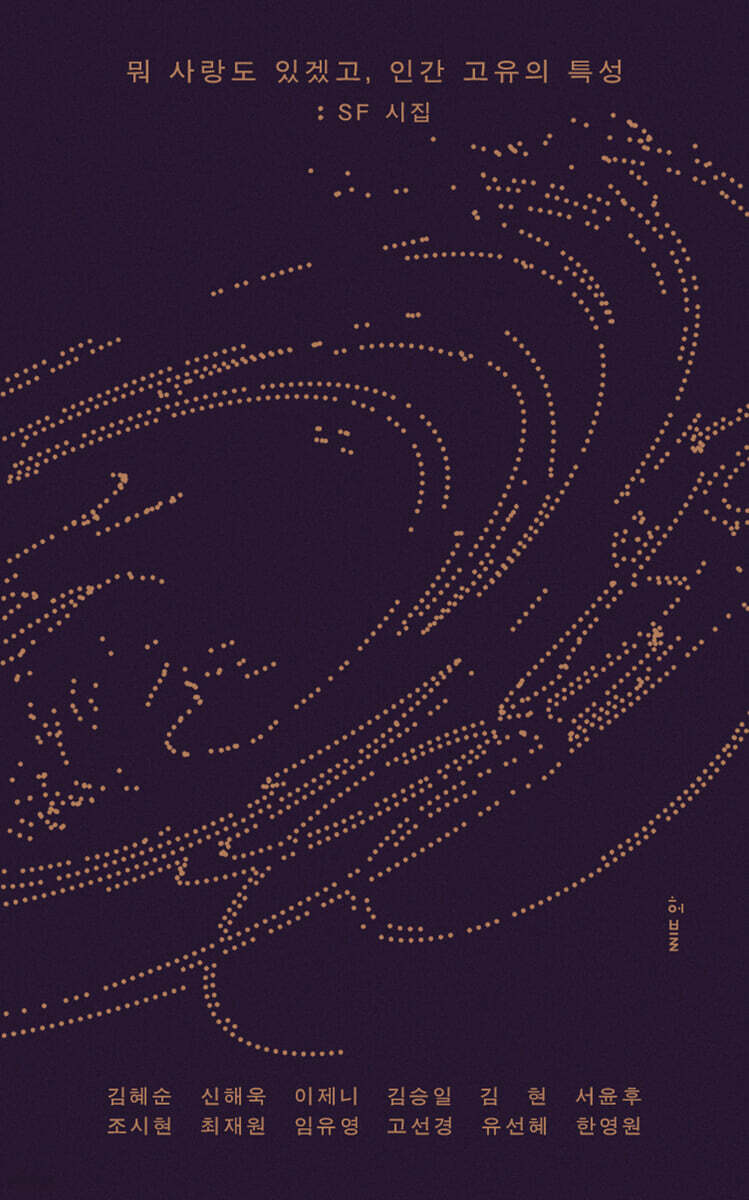 |
Description
Book Introduction
- A word from MD
-
If there is something that is both science fiction and poeticHubble, which has been expanding the foundation of Korean science fiction novels, has published Korea's first 'science fiction poetry collection.'
From Korea's leading poet Kim Hye-soon to young poets Ko Seon-gyeong and Yoo Seon-hye, who write poetry with a new sensibility, twelve poets present the eternity of poetry and the infinity of science fiction.
November 28, 2025. Novel/Poetry PD Kim Yu-ri
Korea's first science fiction poetry collection published by Hubble
“The universe is a wide playground for dogs to walk.
Whenever I feel scared, I imagine that.”
Hubble published "What Love Is, and the Uniquely Human Traits: A Science Fiction Poetry Collection."
This book is the first poetry collection published by Hubble, which has mainly published science fiction novels, and is also the first poetry collection in Korea to be called a science fiction poetry collection.
Kim Hye-soon, Shin Hae-wook, Lee Je-ni, Kim Seung-il, Kim Hyeon, Seo Yoon-hoo, Jo Si-hyeon, Choi Jae-won, Lim Yu-yeong, Go Seon-gyeong, Yoo Seon-hye, Han Yeong-won.
This volume contains the results of poets who have each established their own unique territory, to the point where no special formula is needed, exploring the intersection of the unique characteristics of poetry and science fiction.
This poetry collection is especially special because it consists of new works (or previously published works in literary magazines) that have not been included in the poets' individual poetry collections. For example, you can see for the first time in this book three new works by poet Kim Hye-soon, which she is presenting for the first time since her recent work, Synchronized Sea Anemone.
This science fiction poetry collection shines with the uniqueness of each poet's poetic language and the world of strangeness and wonder that emerges when science fiction elements are combined.
However, the starting point remains in one house or flow called the SF poetry 'house'.
In the case of a typical anthology, since it is a collection of works by several authors, it is organized in a chronological order by author, but in this poetry collection, the poems of the 12 poets are scattered around, so that the reader cannot tell which poem is by whom, but is able to sense the science fiction poetry within a suitably orchestrated flow.
Because in a collection of poems, individual poems are contextualized by the poems that come before and after them, and by their peculiar connections, forming a constellation.
This science fiction poetry collection, which encompasses poems on species and individuals, queerness, biophilia, transformation, nature, the universe, infinity, extraterrestriality, time, the other, and love, scatters like starlight and vibrates as a single book.
“The universe is a wide playground for dogs to walk.
Whenever I feel scared, I imagine that.”
Hubble published "What Love Is, and the Uniquely Human Traits: A Science Fiction Poetry Collection."
This book is the first poetry collection published by Hubble, which has mainly published science fiction novels, and is also the first poetry collection in Korea to be called a science fiction poetry collection.
Kim Hye-soon, Shin Hae-wook, Lee Je-ni, Kim Seung-il, Kim Hyeon, Seo Yoon-hoo, Jo Si-hyeon, Choi Jae-won, Lim Yu-yeong, Go Seon-gyeong, Yoo Seon-hye, Han Yeong-won.
This volume contains the results of poets who have each established their own unique territory, to the point where no special formula is needed, exploring the intersection of the unique characteristics of poetry and science fiction.
This poetry collection is especially special because it consists of new works (or previously published works in literary magazines) that have not been included in the poets' individual poetry collections. For example, you can see for the first time in this book three new works by poet Kim Hye-soon, which she is presenting for the first time since her recent work, Synchronized Sea Anemone.
This science fiction poetry collection shines with the uniqueness of each poet's poetic language and the world of strangeness and wonder that emerges when science fiction elements are combined.
However, the starting point remains in one house or flow called the SF poetry 'house'.
In the case of a typical anthology, since it is a collection of works by several authors, it is organized in a chronological order by author, but in this poetry collection, the poems of the 12 poets are scattered around, so that the reader cannot tell which poem is by whom, but is able to sense the science fiction poetry within a suitably orchestrated flow.
Because in a collection of poems, individual poems are contextualized by the poems that come before and after them, and by their peculiar connections, forming a constellation.
This science fiction poetry collection, which encompasses poems on species and individuals, queerness, biophilia, transformation, nature, the universe, infinity, extraterrestriality, time, the other, and love, scatters like starlight and vibrates as a single book.
- You can preview some of the book's contents.
Preview
index
Part 1
SF | The Story | Report on the Carnivore Planet | Love, Freedom, and Peace | Marrying a Drone | Crunch | On the (Old) Horizon | Apocalypse | Self-Introduction | Console | Becoming - Mirror Looking at the Mirror | Some may find the hotel in the infinite hotel in infinity
Part 2
Mothman Observatory | Critical Infection | Your Retro | End-of-the-century Question | Monster Chamber | Robot Heart | Future Log | Every Day Feels a Little Like Sunday | This Is How the World Ends
Not a thud, but a whimper.
| At the Beach | Emily's Room | Becoming - Little Blue on Gray | Miscellaneous Notes on the Black Dog | White Deer
Part 3
Grace in parentheses One grace | Him and the dog | Face | Small jellyfish | In the future, no one will be a sinner like this | Becoming a sinner | Twin | Becoming - a drop in a drop | Pot | Vast point about small things | Nutshell | Only eternity was shining
commentary
How could you not love? · Ina Young
SF | The Story | Report on the Carnivore Planet | Love, Freedom, and Peace | Marrying a Drone | Crunch | On the (Old) Horizon | Apocalypse | Self-Introduction | Console | Becoming - Mirror Looking at the Mirror | Some may find the hotel in the infinite hotel in infinity
Part 2
Mothman Observatory | Critical Infection | Your Retro | End-of-the-century Question | Monster Chamber | Robot Heart | Future Log | Every Day Feels a Little Like Sunday | This Is How the World Ends
Not a thud, but a whimper.
| At the Beach | Emily's Room | Becoming - Little Blue on Gray | Miscellaneous Notes on the Black Dog | White Deer
Part 3
Grace in parentheses One grace | Him and the dog | Face | Small jellyfish | In the future, no one will be a sinner like this | Becoming a sinner | Twin | Becoming - a drop in a drop | Pot | Vast point about small things | Nutshell | Only eternity was shining
commentary
How could you not love? · Ina Young
Detailed image

Into the book
Now the time for my poetry reading is approaching, but crows and locusts are not leaving my mouth. Do these listeners know that the universe is not outside?
--- From "Emily's Room"
A bitter list of alienation that makes me what I am: things that do not belong to me.
A list of unidentifiable losses.
A list of swept away loneliness.
It's indiscriminate.
Equal.
--- From "A Grace in Parentheses"
Infinity is growing and shrinking between circles, lines, planes, points, earth, and wind.
--- From "Becoming - A Mirror Looking at a Mirror"
I said I went for a walk in a state of despair.
He said that we should live better.
He said that while hating those who live only to live better.
--- From "Console"
It must be dreaming of the mystery of spontaneous human abandonment, with spiky, green leaves sprouting from the forehead.
--- From "Becoming a Sinner"
The bouquet I'm holding today is a cosmic explosion
Do you want to receive it in one hand? Do you want to hold it with both hands?
--- From "Marrying a Drone"
The universe is a wide playground for dogs to walk, and whenever I feel scared, I imagine it like that.
--- From "Crunch"
The peculiar air that is found in research labs and hospital hallways
Wandering around without being able to see, hear, or smell
For the helpless and talkative ghosts
--- From "Face"
You never know what kind of poetry you'll end up writing, and you might learn a little bit as you write, or if you're unlucky, you might never know.
--- From "Everyday is a little like Sunday"
But honey, of course, I'll disappear.
You must live to remember me.
--- From "Love, Freedom, and Peace"
The hypothesis that humans are the only creatures that cry because they are sad is debatable.
Humans are probably the only creatures that create monsters because they are sad.
--- From "Fin-of-the-Century Questions"
sucked into the light
Floating through time
Expanding little by little
Feeling yourself in the mother
--- From "Emily's Room"
A bitter list of alienation that makes me what I am: things that do not belong to me.
A list of unidentifiable losses.
A list of swept away loneliness.
It's indiscriminate.
Equal.
--- From "A Grace in Parentheses"
Infinity is growing and shrinking between circles, lines, planes, points, earth, and wind.
--- From "Becoming - A Mirror Looking at a Mirror"
I said I went for a walk in a state of despair.
He said that we should live better.
He said that while hating those who live only to live better.
--- From "Console"
It must be dreaming of the mystery of spontaneous human abandonment, with spiky, green leaves sprouting from the forehead.
--- From "Becoming a Sinner"
The bouquet I'm holding today is a cosmic explosion
Do you want to receive it in one hand? Do you want to hold it with both hands?
--- From "Marrying a Drone"
The universe is a wide playground for dogs to walk, and whenever I feel scared, I imagine it like that.
--- From "Crunch"
The peculiar air that is found in research labs and hospital hallways
Wandering around without being able to see, hear, or smell
For the helpless and talkative ghosts
--- From "Face"
You never know what kind of poetry you'll end up writing, and you might learn a little bit as you write, or if you're unlucky, you might never know.
--- From "Everyday is a little like Sunday"
But honey, of course, I'll disappear.
You must live to remember me.
--- From "Love, Freedom, and Peace"
The hypothesis that humans are the only creatures that cry because they are sad is debatable.
Humans are probably the only creatures that create monsters because they are sad.
--- From "Fin-of-the-Century Questions"
sucked into the light
Floating through time
Expanding little by little
Feeling yourself in the mother
--- From "Nutshell"
Publisher's Review
“There is a world that only intuition can open,
Poets will write poetry without science fiction,
“SF needs poets.”
The possibilities that SF poetry can show
SF and Shirani, how can these two intertwine?
『What if there was love, and the unique characteristics of humans: a collection of science fiction poems』, of course, depicts science fiction elements or materials such as robots, artificial intelligence, alien planets, the future/monsters, apocalypse, strange things-mutations, disasters/biologies, the human, the inhuman, climate, ecology, and nature, but the emphasis is on 'poetry'.
As critic Ina Young points out in her commentary on the poetry collection, while science fiction (SF) exists within the conceptual contradiction of the meeting of science and fiction, it builds the world through 'speculation' about universal laws, while SF poetry demonstrates the power of 'intuition'.
If a novel builds a world based on logic, poetry is a language of intuition that suddenly emerges and instantly changes the world.
A language that pierces through the protrusion, the flash, the surge, the leap, the ambiguity.
If we suddenly realize that our lives may not have any great logic or special cause and effect, wouldn't poetic language feel closer to the truth?
This is why “science fiction needs poets” because “there is a world that only intuition can open,” like a sudden flash of light.
The point where science fiction and poetry harmonize well is probably the form of time and existence.
If a novel designs time through plot, “in poetry, language itself is the medium of time.”
A poem can indicate time and open up multiple time zones with just one sentence.
Poetry deals with past, present, and future, existence as eternal possibility.
(Recall the quantum mechanical idea that multiple states exist simultaneously before they are observed.) Poetry knows very well that the universe is nonlinear, and so perhaps the most accurate representation of the universe cannot but be 'metaphorical'.
At that time, in countless times and spaces, SF poetry meets the other.
So this is also the most poetic way.
By breaking down subjectivity, becoming entangled, and even showing the various forms and capacities of love.
Because “there must be something cosmic about love, something that transcends the human realm.”
And the way love is appealed to and expressed becomes music and waves, with "sounds that overwhelm meaning and uncontrolled rhythms." If you want to experience the countless wonders that flow between science fiction and poetry, be sure to open this book.
Poets will write poetry without science fiction,
“SF needs poets.”
The possibilities that SF poetry can show
SF and Shirani, how can these two intertwine?
『What if there was love, and the unique characteristics of humans: a collection of science fiction poems』, of course, depicts science fiction elements or materials such as robots, artificial intelligence, alien planets, the future/monsters, apocalypse, strange things-mutations, disasters/biologies, the human, the inhuman, climate, ecology, and nature, but the emphasis is on 'poetry'.
As critic Ina Young points out in her commentary on the poetry collection, while science fiction (SF) exists within the conceptual contradiction of the meeting of science and fiction, it builds the world through 'speculation' about universal laws, while SF poetry demonstrates the power of 'intuition'.
If a novel builds a world based on logic, poetry is a language of intuition that suddenly emerges and instantly changes the world.
A language that pierces through the protrusion, the flash, the surge, the leap, the ambiguity.
If we suddenly realize that our lives may not have any great logic or special cause and effect, wouldn't poetic language feel closer to the truth?
This is why “science fiction needs poets” because “there is a world that only intuition can open,” like a sudden flash of light.
The point where science fiction and poetry harmonize well is probably the form of time and existence.
If a novel designs time through plot, “in poetry, language itself is the medium of time.”
A poem can indicate time and open up multiple time zones with just one sentence.
Poetry deals with past, present, and future, existence as eternal possibility.
(Recall the quantum mechanical idea that multiple states exist simultaneously before they are observed.) Poetry knows very well that the universe is nonlinear, and so perhaps the most accurate representation of the universe cannot but be 'metaphorical'.
At that time, in countless times and spaces, SF poetry meets the other.
So this is also the most poetic way.
By breaking down subjectivity, becoming entangled, and even showing the various forms and capacities of love.
Because “there must be something cosmic about love, something that transcends the human realm.”
And the way love is appealed to and expressed becomes music and waves, with "sounds that overwhelm meaning and uncontrolled rhythms." If you want to experience the countless wonders that flow between science fiction and poetry, be sure to open this book.
GOODS SPECIFICS
- Date of issue: November 28, 2025
- Page count, weight, size: 196 pages | 128*205*20mm
- ISBN13: 9791193078747
- ISBN10: 1193078741
You may also like
카테고리
korean


korean

![GQ KOREA Mark (Monthly): December [2025]](http://librairie.coreenne.fr/cdn/shop/files/8ef265dbbfbf186523ed75ba7319009d.jpg?v=1765340328&width=3840)


