

Diary
 |
Description
Book Introduction
- A word from MD
-
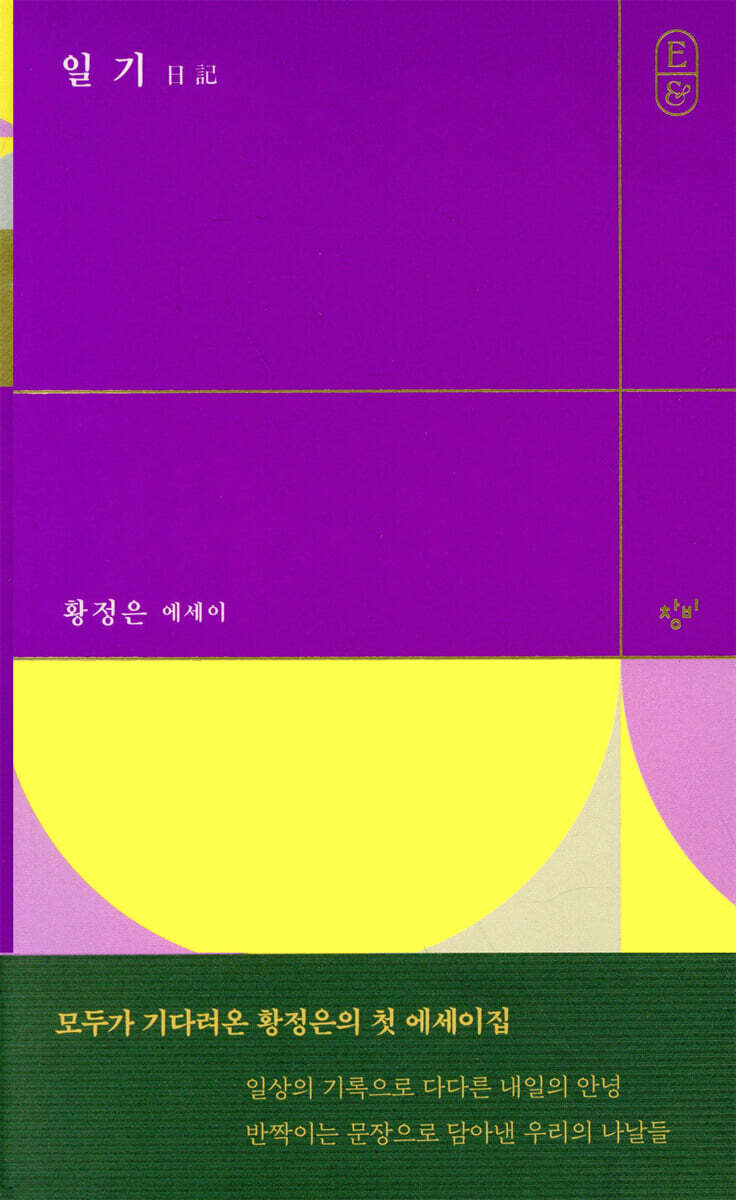
Novelist Hwang Jeong-eun's first essayNovelist Hwang Jeong-eun's first essay has been published.
As the title, ‘Diary’ suggests, it contains the author’s records of certain days.
From everyday episodes about a day changed by COVID-19 and a nephew's doodles, to discrimination, hatred, child abuse, and the Sewol Ferry disaster.
Sending love and comfort with sparkling sentences.
October 15, 2021. Essay PD Kim Tae-hee
Hwang Jeong-eun's eagerly awaited first essay collection
Tomorrow's well-being reached through daily records
Our days captured in sparkling sentences
The first collection of essays by Hwang Jeong-eun, an author whose name alone excites readers and who writes the most beautiful sentences in Korea today, has been published.
The author rarely published works other than novels, to the point that in his acceptance speech for the Manhae Literary Award (2019), he stated that in order to write novels, “I have to save even the sentences I use to reply to emails.”
Moreover, this publication has already captured the attention of not only Hwang Jeong-eun's established fan base but also numerous readers, as it offers a glimpse into the author's veiled real life.
The book broadly depicts a map of Hwang Jeong-eun's mind, from episodes drawn from everyday life, such as flowers blooming in the garden even amidst the social distancing due to COVID-19, and the author exploring the secrets of her young nephew's doodles, to profound thoughts that raise questions about society, such as child abuse deaths and the Sewol Ferry seen from Mokpo Port.
This publication holds special significance as it is the first book in Changbi's new 'Essay&' series.
Essay & will be a series that reveals Changbi's unique color by discovering stories that shine between everyday life and the world and compiling them into books that resonate with society.
Tomorrow's well-being reached through daily records
Our days captured in sparkling sentences
The first collection of essays by Hwang Jeong-eun, an author whose name alone excites readers and who writes the most beautiful sentences in Korea today, has been published.
The author rarely published works other than novels, to the point that in his acceptance speech for the Manhae Literary Award (2019), he stated that in order to write novels, “I have to save even the sentences I use to reply to emails.”
Moreover, this publication has already captured the attention of not only Hwang Jeong-eun's established fan base but also numerous readers, as it offers a glimpse into the author's veiled real life.
The book broadly depicts a map of Hwang Jeong-eun's mind, from episodes drawn from everyday life, such as flowers blooming in the garden even amidst the social distancing due to COVID-19, and the author exploring the secrets of her young nephew's doodles, to profound thoughts that raise questions about society, such as child abuse deaths and the Sewol Ferry seen from Mokpo Port.
This publication holds special significance as it is the first book in Changbi's new 'Essay&' series.
Essay & will be a series that reveals Changbi's unique color by discovering stories that shine between everyday life and the world and compiling them into books that resonate with society.
- You can preview some of the book's contents.
Preview
index
Diary
One year
Don't say sorry
I tried to write a story about books and bookshelves,
Folk song bookshelf
Mokpo-bound wooden bus
walk
Cookie Diary
To dry bracken
scar
Diary
Author's Note
Americas
One year
Don't say sorry
I tried to write a story about books and bookshelves,
Folk song bookshelf
Mokpo-bound wooden bus
walk
Cookie Diary
To dry bracken
scar
Diary
Author's Note
Americas
Into the book
Stay healthy.
I've been using these words as my final greeting for a long time.
I know it's imperfect, vague, naive, and unfair, but I always write with heart.
I hope you stay healthy all the time.
I still hope for your health.
Stay healthy.
Let's all stay healthy and see each other again.
Again, anytime, anywhere.
--- From "Diary"
That's my oldest memory.
Wait for the wave.
--- From "I Tried to Write a Story About Books and Bookshelf"
I found the doodles my nephew had made a month after he left, as he was walking around with a pencil in his hand.
It was around this time last year.
I wrote the name Minyosang on the pine bookshelf.
Folk song award.
Who is the Minyosang?
I was amazed and amazed that my four-year-old nephew could write a complete letter and it wasn't even his own name, but someone else's.
The adults wondered among themselves who he was.
I couldn't erase it, so I left the name as is and just wiped the dust off it, but the graphite seeped into the wood and the letters became blurred.
--- "Folk Song Bookshelf"
Yet I often say I hope and I believe.
For example, I believe in the good intentions of people and the desire to hope for your health.
I still have faith that I will believe without doubt, but I still have faith that I hope for and that I will move in that direction.
In other words, I have love, and I hope I won't lose it while I live.
Praying between thunderstorms.
I've been using these words as my final greeting for a long time.
I know it's imperfect, vague, naive, and unfair, but I always write with heart.
I hope you stay healthy all the time.
I still hope for your health.
Stay healthy.
Let's all stay healthy and see each other again.
Again, anytime, anywhere.
--- From "Diary"
That's my oldest memory.
Wait for the wave.
--- From "I Tried to Write a Story About Books and Bookshelf"
I found the doodles my nephew had made a month after he left, as he was walking around with a pencil in his hand.
It was around this time last year.
I wrote the name Minyosang on the pine bookshelf.
Folk song award.
Who is the Minyosang?
I was amazed and amazed that my four-year-old nephew could write a complete letter and it wasn't even his own name, but someone else's.
The adults wondered among themselves who he was.
I couldn't erase it, so I left the name as is and just wiped the dust off it, but the graphite seeped into the wood and the letters became blurred.
--- "Folk Song Bookshelf"
Yet I often say I hope and I believe.
For example, I believe in the good intentions of people and the desire to hope for your health.
I still have faith that I will believe without doubt, but I still have faith that I hope for and that I will move in that direction.
In other words, I have love, and I hope I won't lose it while I live.
Praying between thunderstorms.
--- From "To Dry Bracken"
Publisher's Review
“Love is with me,
“I hope I don’t lose it while I live.”
The excitement and joy of a single day
The first chapter of 『Diary』, "Diary," and the next chapter, "One Year," are stories that arose when COVID-19 entered the author's daily life after moving to Paju.
Since many things have changed, such as how to take care of oneself as a manuscript worker and how to meet a roommate, the writer has been frequently observing the vacant lot in front of his house, called 'Bandalteo'.
As the seasons change, the crescent moon transforms into a farm where plants grow and a playground where children can roll their eyes.
Looking at the year of the half-moon leads to imagining the universe, and in front of that vast time, the author prays for the well-being of 'beings with destiny.'
The author's young nephews appear in "I Tried to Write a Story of Books and Bookshelf" and "Folk Song Bookshelf."
The author's thoughts on discrimination and hatred are skillfully interspersed with cute episodes, such as the author's first memory of "waves," the story of taking his nephew to the sea for the first time, and the name "Minyosang" carved by his nephew on a bookshelf where books had become mixed up during a move.
This overlaps with the author's love for her favorite animated film, Anne of Green Gables, in "I Don't Say I'm Sorry," which turns into a chilling story about an abused child, striking the reader's heart.
Hwang Jeong-eun is a writer known for her consistent comments on the Sewol Ferry Disaster, and “Mokpohaeng” is the story of the writer’s visit to Mokpo New Port every year since 2017.
Sewol Ferry tells us what it means to Hwang Jeong-eun and what it should be to us, through the author's own experience, without assertion or eloquence.
"A Walk" is a story about the flower pots the author takes care of and the walk.
This is a particularly welcome chapter for readers who are curious about how the body and mind required to write a manuscript are trained, and what path Hwang Jeong-eun actually takes and what she thinks.
The author stated in the book that he “wrote it with the intention of making it a diary that could be read like eating a cookie” (p. 161).
This chapter, titled "Cookie Diary," is about what led me to that idea.
In the middle, the reasons why the author does not write a 'recommendation' and the cases where he had to write one anyway are revealed, and this is the moment when one of the long-held secrets of Hwang Jeong-eun's fandom is revealed.
“To Dry Bracken” and “Traces” contain the author’s past.
The author's story of violence, long ago, weighs heavily on the reader's heart, yet within it, he experiences a peculiar moment of comfort and emotion.
“It’s not your fault”
Healing Sentences Readers Must Read Now
The author, who is “innately in love” (page 134), tried to express love more than anything else.
The author says, “I often say I hope and I say I believe” (page 160) and “I also love those hearts that can say they love” (author’s note).
The sincerity that can be felt in the messages of well-being that the author sends several times throughout the book, such as “I hope you are well” (page 8), is also likely thanks to this love.
And the questions asked with love return like echoes with deep resonance, remaining in our hearts over and over again.
『Diary』 has received enthusiastic support from readers since its serialization on Changbi's reading experience platform 'Switch' (switch.changbi.com), which led to the sale of the 'Switch Edition' for Switch members and an explosive response.
The reason for this positive response stems from the fact that Hwang Jeong-eun has published her first collection of essays, and that the everyday life contained within it does not disappear with the passage of time, but rather contains questions that will remain with us for a long time.
『Diary』 presents a wondrous reading experience that creates a diary about life in the reader's mind the moment they close the book.
Author's Note
What kind of days are these records of?
Since it is also a personal record of someone, I titled it ‘Diary’ so that readers who are not curious about it can avoid it.
I've written several times that I will never write again.
In the text to be revised
Even if you hide what you can't say or something
I had a great time writing the articles included here.
During the past time when I lived with literature as my purpose rather than as a subject,
I've always loved literature and it's always been the best thing for me.
Thanks to the persuasion of Professor Hwang Hye-sook of Changbi, I was able to muster up the courage to write prose.
I was able to continue the series thanks to the editing and advice of Professor Lee Jin-hyeok.
Thanks to my roommate's skills, my younger siblings' questions, and the plants from the Korea Flower Farmers' Association
I was able to finish the series without any problems.
In the process of reviewing the manuscript, Professor Lee Jin-hyeok in particular helped me a lot.
We thought about it together.
Thank you.
We would also like to thank those who left messages of support on the rolling paper.
I also love those hearts that can say they love me.
I hope you all are well.
rolling paper
A reader message sent to Sojak during the serialization of 'Switch'
“While reading, I feel like I keep hearing the author’s voice.
“The writings that had a voice recited during podcasts or book talks, like overtones, somehow had a lonely and affectionate quality to them, and I wanted to read them carefully for a long time.”
“Thanks to the author, I thought a lot about loving people and the world.
“It seems only those who love feel angry, sad, happy, and want to change something. I want to continue reading your writing.”
“Many things become clearer as I look at the world through the author’s eyes.
thank you."
“I was so happy throughout the series, which seemed long but was short.
Your writing is a source of comfort and strength in my life.
I was happy to be able to share the author's daily life with you.
“I hope you always stay healthy.”
“I hope the day will come soon when this diary is published as a book using the author’s favorite paper and font.”
“Each and every letter of Hwang Jeong-eun’s name is a storm, thunder, and sunshine to me.
“I wish this series would continue forever.”
“I hope I don’t lose it while I live.”
The excitement and joy of a single day
The first chapter of 『Diary』, "Diary," and the next chapter, "One Year," are stories that arose when COVID-19 entered the author's daily life after moving to Paju.
Since many things have changed, such as how to take care of oneself as a manuscript worker and how to meet a roommate, the writer has been frequently observing the vacant lot in front of his house, called 'Bandalteo'.
As the seasons change, the crescent moon transforms into a farm where plants grow and a playground where children can roll their eyes.
Looking at the year of the half-moon leads to imagining the universe, and in front of that vast time, the author prays for the well-being of 'beings with destiny.'
The author's young nephews appear in "I Tried to Write a Story of Books and Bookshelf" and "Folk Song Bookshelf."
The author's thoughts on discrimination and hatred are skillfully interspersed with cute episodes, such as the author's first memory of "waves," the story of taking his nephew to the sea for the first time, and the name "Minyosang" carved by his nephew on a bookshelf where books had become mixed up during a move.
This overlaps with the author's love for her favorite animated film, Anne of Green Gables, in "I Don't Say I'm Sorry," which turns into a chilling story about an abused child, striking the reader's heart.
Hwang Jeong-eun is a writer known for her consistent comments on the Sewol Ferry Disaster, and “Mokpohaeng” is the story of the writer’s visit to Mokpo New Port every year since 2017.
Sewol Ferry tells us what it means to Hwang Jeong-eun and what it should be to us, through the author's own experience, without assertion or eloquence.
"A Walk" is a story about the flower pots the author takes care of and the walk.
This is a particularly welcome chapter for readers who are curious about how the body and mind required to write a manuscript are trained, and what path Hwang Jeong-eun actually takes and what she thinks.
The author stated in the book that he “wrote it with the intention of making it a diary that could be read like eating a cookie” (p. 161).
This chapter, titled "Cookie Diary," is about what led me to that idea.
In the middle, the reasons why the author does not write a 'recommendation' and the cases where he had to write one anyway are revealed, and this is the moment when one of the long-held secrets of Hwang Jeong-eun's fandom is revealed.
“To Dry Bracken” and “Traces” contain the author’s past.
The author's story of violence, long ago, weighs heavily on the reader's heart, yet within it, he experiences a peculiar moment of comfort and emotion.
“It’s not your fault”
Healing Sentences Readers Must Read Now
The author, who is “innately in love” (page 134), tried to express love more than anything else.
The author says, “I often say I hope and I say I believe” (page 160) and “I also love those hearts that can say they love” (author’s note).
The sincerity that can be felt in the messages of well-being that the author sends several times throughout the book, such as “I hope you are well” (page 8), is also likely thanks to this love.
And the questions asked with love return like echoes with deep resonance, remaining in our hearts over and over again.
『Diary』 has received enthusiastic support from readers since its serialization on Changbi's reading experience platform 'Switch' (switch.changbi.com), which led to the sale of the 'Switch Edition' for Switch members and an explosive response.
The reason for this positive response stems from the fact that Hwang Jeong-eun has published her first collection of essays, and that the everyday life contained within it does not disappear with the passage of time, but rather contains questions that will remain with us for a long time.
『Diary』 presents a wondrous reading experience that creates a diary about life in the reader's mind the moment they close the book.
Author's Note
What kind of days are these records of?
Since it is also a personal record of someone, I titled it ‘Diary’ so that readers who are not curious about it can avoid it.
I've written several times that I will never write again.
In the text to be revised
Even if you hide what you can't say or something
I had a great time writing the articles included here.
During the past time when I lived with literature as my purpose rather than as a subject,
I've always loved literature and it's always been the best thing for me.
Thanks to the persuasion of Professor Hwang Hye-sook of Changbi, I was able to muster up the courage to write prose.
I was able to continue the series thanks to the editing and advice of Professor Lee Jin-hyeok.
Thanks to my roommate's skills, my younger siblings' questions, and the plants from the Korea Flower Farmers' Association
I was able to finish the series without any problems.
In the process of reviewing the manuscript, Professor Lee Jin-hyeok in particular helped me a lot.
We thought about it together.
Thank you.
We would also like to thank those who left messages of support on the rolling paper.
I also love those hearts that can say they love me.
I hope you all are well.
rolling paper
A reader message sent to Sojak during the serialization of 'Switch'
“While reading, I feel like I keep hearing the author’s voice.
“The writings that had a voice recited during podcasts or book talks, like overtones, somehow had a lonely and affectionate quality to them, and I wanted to read them carefully for a long time.”
“Thanks to the author, I thought a lot about loving people and the world.
“It seems only those who love feel angry, sad, happy, and want to change something. I want to continue reading your writing.”
“Many things become clearer as I look at the world through the author’s eyes.
thank you."
“I was so happy throughout the series, which seemed long but was short.
Your writing is a source of comfort and strength in my life.
I was happy to be able to share the author's daily life with you.
“I hope you always stay healthy.”
“I hope the day will come soon when this diary is published as a book using the author’s favorite paper and font.”
“Each and every letter of Hwang Jeong-eun’s name is a storm, thunder, and sunshine to me.
“I wish this series would continue forever.”
GOODS SPECIFICS
- Publication date: October 18, 2021
- Page count, weight, size: 204 pages | 218g | 118*188*12mm
- ISBN13: 9788936438586
- ISBN10: 8936438581
You may also like
카테고리
korean


korean

![GQ KOREA Mark (Monthly): December [2025]](http://librairie.coreenne.fr/cdn/shop/files/8ef265dbbfbf186523ed75ba7319009d.jpg?v=1765340328&width=3840)


