

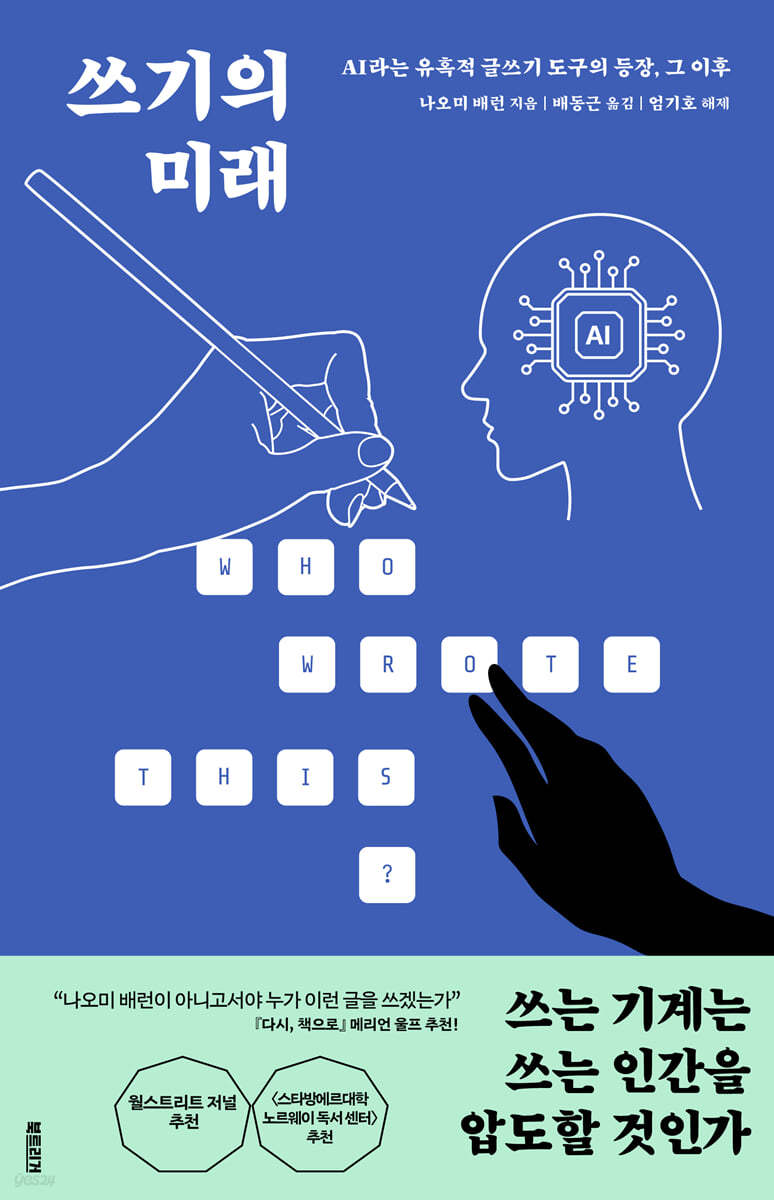
The Future of Writing
 |
Description
Book Introduction
The era of large language models (LLMs),
Where is human reading and writing headed?
Since OpenAI released ChatGPT in December 2022, generative AI has become a full-fledged part of our lives.
Not just ChatGPT.
Cutting-edge IT technologies have become familiar tools for us, providing convenience through features like auto-complete and spell checkers.
These are effective and practical functions that can truly be called the advancement of mankind.
These tools allow us to gain greater productivity and efficiency, freeing up our financial and time resources for more effective use.
But on the other hand, there is an awkward problem.
If we continue to use these "deceptively convenient" tools, where will our unique human linguistic abilities go? We've already encountered various problems stemming from this.
Can humans effectively coexist with AI through a "division of labor"? If so, how? Will AI pose a threat to the creativity humans display through writing? Will AI redefine the concept of "authorship"? And returning to the human question—what writing abilities are worth protecting? In this book, author Naomi Baron, a linguist and educator who has been interested in AI since early on, offers insightful, sometimes critical, reflections on the intersection of AI, language, and writing, presenting us with various questions and perspectives that arise from this.
It also highlights the evolution of language and writing as a result of technological advancements, and the complex challenges and opportunities presented by AI.
Where is human reading and writing headed?
Since OpenAI released ChatGPT in December 2022, generative AI has become a full-fledged part of our lives.
Not just ChatGPT.
Cutting-edge IT technologies have become familiar tools for us, providing convenience through features like auto-complete and spell checkers.
These are effective and practical functions that can truly be called the advancement of mankind.
These tools allow us to gain greater productivity and efficiency, freeing up our financial and time resources for more effective use.
But on the other hand, there is an awkward problem.
If we continue to use these "deceptively convenient" tools, where will our unique human linguistic abilities go? We've already encountered various problems stemming from this.
Can humans effectively coexist with AI through a "division of labor"? If so, how? Will AI pose a threat to the creativity humans display through writing? Will AI redefine the concept of "authorship"? And returning to the human question—what writing abilities are worth protecting? In this book, author Naomi Baron, a linguist and educator who has been interested in AI since early on, offers insightful, sometimes critical, reflections on the intersection of AI, language, and writing, presenting us with various questions and perspectives that arise from this.
It also highlights the evolution of language and writing as a result of technological advancements, and the complex challenges and opportunities presented by AI.
- You can preview some of the book's contents.
Preview
index
Introduction: Human Writers Meet AI Autonomous Language Machines
Part 1 Writing Class
Chapter 1: Literacy Overview
Chapter 2: Why Humans Write—and Rewrite
Chapter 3: Composition and Its Mad Consequences
Part 2: If machines could write
Chapter 4: Dreams of a Language Machine
Chapter 5: Natural Language Processing: Automatic Language Machines
Chapter 6: The Resurgence of Machine Translation
Part 3 When computers write
Chapter 7: The Emergence of AI Authors
Chapter 8: AI Threatens Writers' Jobs
Chapter 9: AI Creativity
Part 4: If Computers Cooperate with Us
Chapter 10: AI Like Jeeves
Chapter 11: Symbiosis between Humans and AI
Chapter 12: Do We Always Welcome AI?
Chapter 13: Why Human Authorship Matters
Release: Writing is exciting.
Part 1 Writing Class
Chapter 1: Literacy Overview
Chapter 2: Why Humans Write—and Rewrite
Chapter 3: Composition and Its Mad Consequences
Part 2: If machines could write
Chapter 4: Dreams of a Language Machine
Chapter 5: Natural Language Processing: Automatic Language Machines
Chapter 6: The Resurgence of Machine Translation
Part 3 When computers write
Chapter 7: The Emergence of AI Authors
Chapter 8: AI Threatens Writers' Jobs
Chapter 9: AI Creativity
Part 4: If Computers Cooperate with Us
Chapter 10: AI Like Jeeves
Chapter 11: Symbiosis between Humans and AI
Chapter 12: Do We Always Welcome AI?
Chapter 13: Why Human Authorship Matters
Release: Writing is exciting.
Detailed image

Into the book
Imagine if computers could write as reliably as humans, or perhaps even better.
Does that really matter? Should we welcome such developments? Should we? These questions aren't about a world that might be possible.
AI is already expanding its reach into business documents, emails, newspapers, and blogs.
Writers are looking to AI for inspiration and collaboration.
What is worrying is whether, in the coming future, not only human writing skills, but any job at all, will remain a viable domain for humans.
Let's think about a writing assignment in school.
If we can't tell whether the author of an essay or term paper is George or GPT-3, we'll need to figure out how to assign "meaningful" writing assignments.
The problem doesn't end with students.
Swedish researcher Almira Osmanovic Tunström tasked GPT-3 with writing a paper about itself. With minimal human editing, the AI-generated paper was surprisingly coherent, complete with references. As AI's language-generating capabilities rapidly advance, it's time to pause and reflect.
Humans have struggled for thousands of years to develop a writing system.
Every reader of this book has invested countless hours honing their writing skills.
Through the medium of writing, humans were able to express their thoughts, communicate with others, and leave behind a lasting record.
But now, with AI generating language, we live in a world where it's unclear who created these records.
--- From "Introduction: Human Writers Meet AI Automatic Language Machines"
“The moment we entrust our well-being to tools and replace them with numbers, we no longer have ownership of it.
“Data replaces our self-consciousness.”
If wearable smart devices take over the task of tracking our health, we risk neglecting to take care of ourselves.
We become a series of numbers, not a body of flesh and blood.
The same thing can happen with writing.
If we leave the editing work to AI, the motivation to revise, re-examine, and rewrite our writing will gradually disappear, as computer tools will process it in a slick manner.
Have we given up on the problem of writing skills? Not yet.
One criterion is the results of a survey asking companies what skills they value when hiring college graduates.
Writing skills remained a high priority.
In a 2018 survey, the National Association of Colleges and Employers (NACE) found that 82 percent of U.S. employers surveyed were looking for candidates with strong writing skills.
Problem-solving skills came in slightly lower at 81 percent, while teamwork and collaboration came in third at 79 percent.
There has been some shift in priorities since 2018.
In a 2022 survey, problem solving rose to first place with 86 percent of respondents preferring it, while writing skills dropped to 73 percent.
It's unclear why the value employers place on writing skills fell by 9 percent.
Perhaps it's the increasing frequency and power of AI tools that help employees keep their documents neat and tidy.
--- From "Chapter 2: Why Do Humans Write—and Rewrite?"
It's becoming increasingly difficult to know what to believe when we read something online.
The dilemma arises when judging social media posts, videos, and search results.
At least we have language on our side.
Most of the posts and search results are in languages we speak or at least can read.
Although many people don't go to other sources to verify the authenticity of something, they can do so if they choose to.
Machine translation is here.
As Lynne Bowker, a professor of translation and information studies at the University of Ottawa, reminded me, we don't always know when an online text we're reading has been translated by an AI translator.
These translators are embedded in web browsers and social media sites and work automatically.
The big problem, Bowker says, is that “we don’t even know to ask ourselves whether we can trust it or not.”
We face similar problems with text generation programs like GPT-3 and ChatGPT.
It is also difficult to distinguish whether text generation is human or machine-generated.
And when we can't tell the difference, we usually don't even think to ask.
--- From "Chapter 6: The Resurrection of Machine Translation"
When translated to its highest level, it becomes an art, not a job.
It is an art practiced by creative writers, beginning by delving into a language, culture, era, and even the mind of the original author.
By gathering these strands, the translator uses his or her writing skills to create something new while remaining faithful to the original work.
Not all translations—even those of delicate literature—are creative works in themselves.
But even if the translations are not memorable, the translators still strive to create their own unique voice.
There has been a long-standing debate in the translation industry about how much of a translator's personal voice should be revealed.
What about scribes and interpreters? Translators (and indeed, all types of writers) aren't the only intermediaries who convey a personal voice.
Consider voice actors who record audiobooks.
Or musicians too.
Beethoven enthusiasts can easily distinguish between David Oistrakh and Anne-Sophie Mutter's performances of the violin concerto. What happens to the voice and creativity of translators when AI encroaches on the literary realm?
--- From "Chapter 8: AI Threatens Writers' Jobs"
As machines become increasingly AI-driven, it becomes increasingly difficult to determine which tasks are best left to machines and which to leave to humans.
We face this dilemma in AI and human writing.
So, what will we give up and what will we keep for ourselves in both our personal and professional lives? The choice is ours.
However, to help you decide, I suggest that each of you create your own evaluation sheet.
It doesn't have to be anything too grand, but you should set some benchmarks that will guide your own writing style.
It doesn't have to be a uniform decision.
After all, it's your choice.
It would be something like this.
'Hey AI, draft my email reply.
'I'll decide on the grammar and style.' Present your own inviolable domain of authority.
But before making that decision, be honest about your own time constraints, your willpower being tested, and your occasional procrastination.
--- From Chapter 13, “Why Human Authorship Matters”
From whose perspective and in what sense does "new" mean something new? What does it mean to add value? Creativity is still a "something" that requires constant effort and elucidation to understand its true nature.
The question of how creative AI is, then, hinges on how we define creativity, which is entirely tied to our "human" interest in understanding our own possibilities and limitations.
However, the author emphasizes the distinct differences between AI's creativity in writing and human writing.
When we say a work is original, we look not only at the work itself, but also at the life of its author and the times in which he lived.
Can we truly separate the works of Han Kang, the first Korean to win the Nobel Prize in Literature, from the era of the Jeju April 3 Incident and the Gwangju Democratization Movement on May 18? Can we not consider how, and through what channels, the pain of those times, permeated her life, whether she personally experienced it or not? This is what we call life.
AI will not yet, and for a very long time to come, have a life as an author.
But this doesn't mean that AI will never surpass humans.
Rather, we need to shift our perspective. From asking what uniquely human characteristics distinguish us from AI, we should instead write about what kind of ethical cooperative relationship humans should have with AI.
Does that really matter? Should we welcome such developments? Should we? These questions aren't about a world that might be possible.
AI is already expanding its reach into business documents, emails, newspapers, and blogs.
Writers are looking to AI for inspiration and collaboration.
What is worrying is whether, in the coming future, not only human writing skills, but any job at all, will remain a viable domain for humans.
Let's think about a writing assignment in school.
If we can't tell whether the author of an essay or term paper is George or GPT-3, we'll need to figure out how to assign "meaningful" writing assignments.
The problem doesn't end with students.
Swedish researcher Almira Osmanovic Tunström tasked GPT-3 with writing a paper about itself. With minimal human editing, the AI-generated paper was surprisingly coherent, complete with references. As AI's language-generating capabilities rapidly advance, it's time to pause and reflect.
Humans have struggled for thousands of years to develop a writing system.
Every reader of this book has invested countless hours honing their writing skills.
Through the medium of writing, humans were able to express their thoughts, communicate with others, and leave behind a lasting record.
But now, with AI generating language, we live in a world where it's unclear who created these records.
--- From "Introduction: Human Writers Meet AI Automatic Language Machines"
“The moment we entrust our well-being to tools and replace them with numbers, we no longer have ownership of it.
“Data replaces our self-consciousness.”
If wearable smart devices take over the task of tracking our health, we risk neglecting to take care of ourselves.
We become a series of numbers, not a body of flesh and blood.
The same thing can happen with writing.
If we leave the editing work to AI, the motivation to revise, re-examine, and rewrite our writing will gradually disappear, as computer tools will process it in a slick manner.
Have we given up on the problem of writing skills? Not yet.
One criterion is the results of a survey asking companies what skills they value when hiring college graduates.
Writing skills remained a high priority.
In a 2018 survey, the National Association of Colleges and Employers (NACE) found that 82 percent of U.S. employers surveyed were looking for candidates with strong writing skills.
Problem-solving skills came in slightly lower at 81 percent, while teamwork and collaboration came in third at 79 percent.
There has been some shift in priorities since 2018.
In a 2022 survey, problem solving rose to first place with 86 percent of respondents preferring it, while writing skills dropped to 73 percent.
It's unclear why the value employers place on writing skills fell by 9 percent.
Perhaps it's the increasing frequency and power of AI tools that help employees keep their documents neat and tidy.
--- From "Chapter 2: Why Do Humans Write—and Rewrite?"
It's becoming increasingly difficult to know what to believe when we read something online.
The dilemma arises when judging social media posts, videos, and search results.
At least we have language on our side.
Most of the posts and search results are in languages we speak or at least can read.
Although many people don't go to other sources to verify the authenticity of something, they can do so if they choose to.
Machine translation is here.
As Lynne Bowker, a professor of translation and information studies at the University of Ottawa, reminded me, we don't always know when an online text we're reading has been translated by an AI translator.
These translators are embedded in web browsers and social media sites and work automatically.
The big problem, Bowker says, is that “we don’t even know to ask ourselves whether we can trust it or not.”
We face similar problems with text generation programs like GPT-3 and ChatGPT.
It is also difficult to distinguish whether text generation is human or machine-generated.
And when we can't tell the difference, we usually don't even think to ask.
--- From "Chapter 6: The Resurrection of Machine Translation"
When translated to its highest level, it becomes an art, not a job.
It is an art practiced by creative writers, beginning by delving into a language, culture, era, and even the mind of the original author.
By gathering these strands, the translator uses his or her writing skills to create something new while remaining faithful to the original work.
Not all translations—even those of delicate literature—are creative works in themselves.
But even if the translations are not memorable, the translators still strive to create their own unique voice.
There has been a long-standing debate in the translation industry about how much of a translator's personal voice should be revealed.
What about scribes and interpreters? Translators (and indeed, all types of writers) aren't the only intermediaries who convey a personal voice.
Consider voice actors who record audiobooks.
Or musicians too.
Beethoven enthusiasts can easily distinguish between David Oistrakh and Anne-Sophie Mutter's performances of the violin concerto. What happens to the voice and creativity of translators when AI encroaches on the literary realm?
--- From "Chapter 8: AI Threatens Writers' Jobs"
As machines become increasingly AI-driven, it becomes increasingly difficult to determine which tasks are best left to machines and which to leave to humans.
We face this dilemma in AI and human writing.
So, what will we give up and what will we keep for ourselves in both our personal and professional lives? The choice is ours.
However, to help you decide, I suggest that each of you create your own evaluation sheet.
It doesn't have to be anything too grand, but you should set some benchmarks that will guide your own writing style.
It doesn't have to be a uniform decision.
After all, it's your choice.
It would be something like this.
'Hey AI, draft my email reply.
'I'll decide on the grammar and style.' Present your own inviolable domain of authority.
But before making that decision, be honest about your own time constraints, your willpower being tested, and your occasional procrastination.
--- From Chapter 13, “Why Human Authorship Matters”
From whose perspective and in what sense does "new" mean something new? What does it mean to add value? Creativity is still a "something" that requires constant effort and elucidation to understand its true nature.
The question of how creative AI is, then, hinges on how we define creativity, which is entirely tied to our "human" interest in understanding our own possibilities and limitations.
However, the author emphasizes the distinct differences between AI's creativity in writing and human writing.
When we say a work is original, we look not only at the work itself, but also at the life of its author and the times in which he lived.
Can we truly separate the works of Han Kang, the first Korean to win the Nobel Prize in Literature, from the era of the Jeju April 3 Incident and the Gwangju Democratization Movement on May 18? Can we not consider how, and through what channels, the pain of those times, permeated her life, whether she personally experienced it or not? This is what we call life.
AI will not yet, and for a very long time to come, have a life as an author.
But this doesn't mean that AI will never surpass humans.
Rather, we need to shift our perspective. From asking what uniquely human characteristics distinguish us from AI, we should instead write about what kind of ethical cooperative relationship humans should have with AI.
--- From "Unboxing: Writing is Exciting"
Publisher's Review
The temptation of efficiency, overwhelming humans
Will Generative AI Change the Landscape of Human Writing?
In December 2022, OpenAI's generative AI ChatGPT surprised the world with its ability to read and write.
Since then, it has rapidly penetrated various fields such as creation, translation, journalism, and law, causing tectonic shifts across industries.
But the most fundamental changes are occurring in the field of education.
In December 2024, during the American college assignment season, ChatGPT's servers crashed due to a surge in users.
This phenomenon is not limited to the United States.
College students in Korea also have a serious dependence on ChatGPT, and as of June 2024, it is estimated that approximately 3.15 million people in Korea alone are using this AI.
Naomi Baron, who presented reading strategies for the digital transformation era in "How to Read Again," explores the two axes of human literacy and AI's writing ability, focusing on the theme of "writing," and envisions the future they will create when they are intertwined.
The author, who began researching AI in the 1970s, the early days of computing, analyzes from an academic perspective how the rapidly changing technological environment affects human thought and expression.
As we enter the era of giant language models (LLMs), generative AIs, including ChatGPT, are emerging.
Increasingly sophisticated and sophisticated technologies, such as automatic spelling correction, text completion, and faster-than-human machine translation, are revolutionizing and making human life more convenient.
While we rejoice in this efficiency, the author warns that such convenience doesn't always benefit us. If we overrely rely on AI-suggested methods and pre-written texts, we risk losing the skills we acquired as children—thinking, reading, and writing—as well as the ability to write as a platform for expressing our own unique thoughts.
Furthermore, the author discusses a broader range of issues beyond mere factual inaccuracies, repetitive language, and a stiff writing style, including the potential consequences of AI for writing professions and the impact on society, including the impact on human employment and job satisfaction.
The author, who stands at the center of the rapidly changing educational landscape, especially as an educator, concretely demonstrates the practical changes in AI and writing through survey results on the differences between handwriting and typing, the spell-checking and editing process, and how students utilize AI.
As we rapidly enter the AI era,
The most pressing questions about writing past and future
As the title suggests, this book deals with the act of writing and its future.
It also consists of 4 parts and 13 separate chapters, but in the Korean version, it is published in 4 parts for convenience.
Part 1 explores the emergence of writing for humans and why we write, examines the American academic tradition of writing, and examines how AI functions in both areas.
Part 2 also outlines the development of AI technology.
Beginning with the emergence of the "first intelligent machine," we cover the "first natural language processing process," and examine where "natural language processing" fits within the larger program known as AI.
Along with this, we cover the history of the success story of machine translation.
Part 3 explores the context in which AI began to play a role in human writing.
We explore AI's role in specialized industries and consider its potential impact on employment and worker satisfaction.
We also explore the various creative possibilities of generative AI beyond the realm of writing.
Part 4 explores the various ways AI can assist non-experts—"everyday writers." We examine the concept of "humans in the loop"—from the perspective of enhancing human writing through collaboration with AI, and consider which aspects of human writing skills are worth preserving.
Through various survey examples, we explore what ordinary people in the digital age think about the value of human writing skills.
Chapter 13, the final chapter, concludes the book by asking where we are going.
We must recognize that as technology evolves, so too will our choices.
In the midst of a great transformation in writing
How to find your own answers and write our future correctly
Collaboration with AI may open up new possibilities, but such "coexistence" requires prior consideration and discussion.
We need to discuss the fundamental dilemmas arising from the advancement of AI technology, including the question, "Can we discover creativity in AI creations? Should we acknowledge it?"
The author makes us ponder everything from philosophical questions like these to practical responses, such as which writing tasks should be shared with AI and how much should be delegated amid technological advancements.
Now is the time when we cannot avoid coexistence with AI, even if we don't want to.
However, the important issue will be how, to what extent, and to what extent they will coexist and coexist.
Amidst these changes, we must also consider how we can protect ourselves, including our ability to write, a human asset.
The author urges us, as individuals and as members of society, to decide how far we will go in cooperating with AI.
It also reminds us of the cognitive and social benefits of writing, a precious skill that humanity must protect from AI.
This book's in-depth exploration of generative AI leads back to the fundamental question: "Why do humans write? Why do we reread, reflect, and rewrite?"
It makes readers deeply consider why humans should not give up their sovereignty as authors, and makes them reflect once again on the meaning of human existence.
Will Generative AI Change the Landscape of Human Writing?
In December 2022, OpenAI's generative AI ChatGPT surprised the world with its ability to read and write.
Since then, it has rapidly penetrated various fields such as creation, translation, journalism, and law, causing tectonic shifts across industries.
But the most fundamental changes are occurring in the field of education.
In December 2024, during the American college assignment season, ChatGPT's servers crashed due to a surge in users.
This phenomenon is not limited to the United States.
College students in Korea also have a serious dependence on ChatGPT, and as of June 2024, it is estimated that approximately 3.15 million people in Korea alone are using this AI.
Naomi Baron, who presented reading strategies for the digital transformation era in "How to Read Again," explores the two axes of human literacy and AI's writing ability, focusing on the theme of "writing," and envisions the future they will create when they are intertwined.
The author, who began researching AI in the 1970s, the early days of computing, analyzes from an academic perspective how the rapidly changing technological environment affects human thought and expression.
As we enter the era of giant language models (LLMs), generative AIs, including ChatGPT, are emerging.
Increasingly sophisticated and sophisticated technologies, such as automatic spelling correction, text completion, and faster-than-human machine translation, are revolutionizing and making human life more convenient.
While we rejoice in this efficiency, the author warns that such convenience doesn't always benefit us. If we overrely rely on AI-suggested methods and pre-written texts, we risk losing the skills we acquired as children—thinking, reading, and writing—as well as the ability to write as a platform for expressing our own unique thoughts.
Furthermore, the author discusses a broader range of issues beyond mere factual inaccuracies, repetitive language, and a stiff writing style, including the potential consequences of AI for writing professions and the impact on society, including the impact on human employment and job satisfaction.
The author, who stands at the center of the rapidly changing educational landscape, especially as an educator, concretely demonstrates the practical changes in AI and writing through survey results on the differences between handwriting and typing, the spell-checking and editing process, and how students utilize AI.
As we rapidly enter the AI era,
The most pressing questions about writing past and future
As the title suggests, this book deals with the act of writing and its future.
It also consists of 4 parts and 13 separate chapters, but in the Korean version, it is published in 4 parts for convenience.
Part 1 explores the emergence of writing for humans and why we write, examines the American academic tradition of writing, and examines how AI functions in both areas.
Part 2 also outlines the development of AI technology.
Beginning with the emergence of the "first intelligent machine," we cover the "first natural language processing process," and examine where "natural language processing" fits within the larger program known as AI.
Along with this, we cover the history of the success story of machine translation.
Part 3 explores the context in which AI began to play a role in human writing.
We explore AI's role in specialized industries and consider its potential impact on employment and worker satisfaction.
We also explore the various creative possibilities of generative AI beyond the realm of writing.
Part 4 explores the various ways AI can assist non-experts—"everyday writers." We examine the concept of "humans in the loop"—from the perspective of enhancing human writing through collaboration with AI, and consider which aspects of human writing skills are worth preserving.
Through various survey examples, we explore what ordinary people in the digital age think about the value of human writing skills.
Chapter 13, the final chapter, concludes the book by asking where we are going.
We must recognize that as technology evolves, so too will our choices.
In the midst of a great transformation in writing
How to find your own answers and write our future correctly
Collaboration with AI may open up new possibilities, but such "coexistence" requires prior consideration and discussion.
We need to discuss the fundamental dilemmas arising from the advancement of AI technology, including the question, "Can we discover creativity in AI creations? Should we acknowledge it?"
The author makes us ponder everything from philosophical questions like these to practical responses, such as which writing tasks should be shared with AI and how much should be delegated amid technological advancements.
Now is the time when we cannot avoid coexistence with AI, even if we don't want to.
However, the important issue will be how, to what extent, and to what extent they will coexist and coexist.
Amidst these changes, we must also consider how we can protect ourselves, including our ability to write, a human asset.
The author urges us, as individuals and as members of society, to decide how far we will go in cooperating with AI.
It also reminds us of the cognitive and social benefits of writing, a precious skill that humanity must protect from AI.
This book's in-depth exploration of generative AI leads back to the fundamental question: "Why do humans write? Why do we reread, reflect, and rewrite?"
It makes readers deeply consider why humans should not give up their sovereignty as authors, and makes them reflect once again on the meaning of human existence.
GOODS SPECIFICS
- Date of issue: January 15, 2025
- Page count, weight, size: 628 pages | 720g | 142*220*30mm
- ISBN13: 9791193378328
- ISBN10: 119337832X
You may also like
카테고리
korean


korean

![GQ KOREA Mark (Monthly): December [2025]](http://librairie.coreenne.fr/cdn/shop/files/8ef265dbbfbf186523ed75ba7319009d.jpg?v=1765340328&width=3840)


