

The art of stock selection
 |
Description
Book Introduction
Don't chase this stock and that stock,
Cast your net and wait leisurely
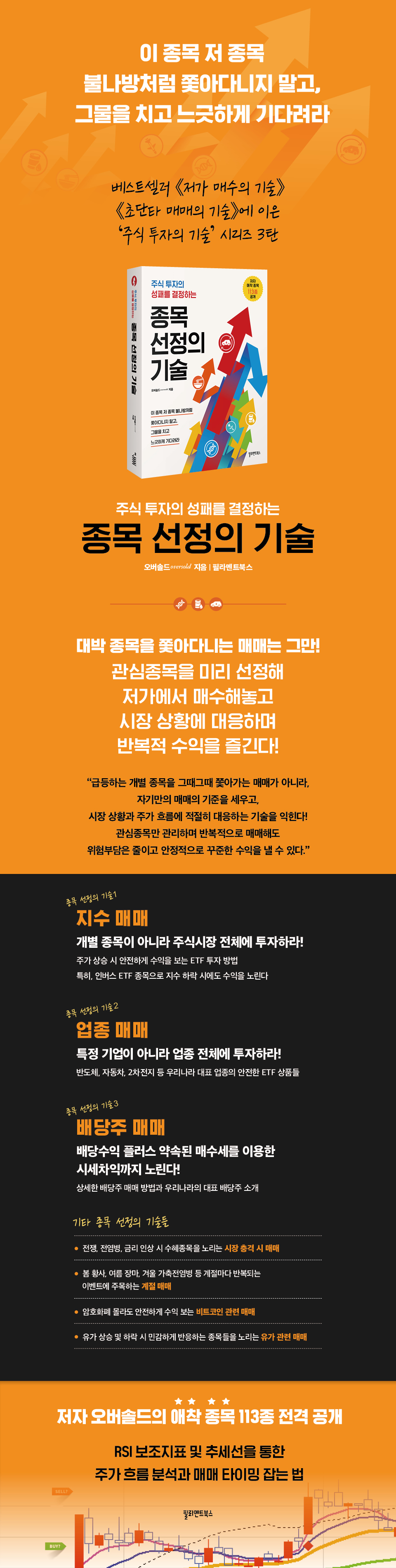
The third installment in the "Stock Investment Techniques" series by Oversold, author of the bestselling stock investment books "The Art of Buying Dip" and "The Art of High-Short-Term Trading."
《The Art of Stock Selection》 does not specifically tell you which stocks will hit the jackpot.
Rather, it is faithful to the basics of stock investment.
In other words, rather than chasing individual stocks that are rising rapidly, you should clearly establish your own trading standards and learn the skills to respond appropriately to market conditions and stock price trends.
This book teaches you how to generate stable and consistent profits while reducing risk by selecting stocks of interest in advance, purchasing them when they are low (using the author's "Benefits of Buying at Low Prices Technique"), and repeatedly trading them in response to changing market conditions.
Specifically, the author divides the stocks to be traded into seven categories: 'index trading', which invests in the entire stock market rather than individual stocks; 'industry trading', which invests in Korea's representative industries rather than specific companies; 'dividend stock trading', which aims for price differences in addition to dividend income; and 'market shock trading', which targets stocks that benefit from market shocks. He explains in detail how to select stocks of interest and how to roughly understand the stock price flow and determine the timing of trading using the RSI auxiliary indicator and trend lines.
Cast your net and wait leisurely
The third installment in the "Stock Investment Techniques" series by Oversold, author of the bestselling stock investment books "The Art of Buying Dip" and "The Art of High-Short-Term Trading."
《The Art of Stock Selection》 does not specifically tell you which stocks will hit the jackpot.
Rather, it is faithful to the basics of stock investment.
In other words, rather than chasing individual stocks that are rising rapidly, you should clearly establish your own trading standards and learn the skills to respond appropriately to market conditions and stock price trends.
This book teaches you how to generate stable and consistent profits while reducing risk by selecting stocks of interest in advance, purchasing them when they are low (using the author's "Benefits of Buying at Low Prices Technique"), and repeatedly trading them in response to changing market conditions.
Specifically, the author divides the stocks to be traded into seven categories: 'index trading', which invests in the entire stock market rather than individual stocks; 'industry trading', which invests in Korea's representative industries rather than specific companies; 'dividend stock trading', which aims for price differences in addition to dividend income; and 'market shock trading', which targets stocks that benefit from market shocks. He explains in detail how to select stocks of interest and how to roughly understand the stock price flow and determine the timing of trading using the RSI auxiliary indicator and trend lines.
- You can preview some of the book's contents.
Preview
index
preface
1.
As you go in
Have you ever been kicked by a running horse?
Wouldn't you have to meet rich friends to become rich?
How many and what kind of chickens do you have in your coop?
There is no reason not to go up in any category.
A Brief Understanding of the RSI Indicator
2.
Index trading items
What is the first thing you should learn when investing in stocks?
Let's study stock indices
Understanding stock index trends through trend lines
Important issues and solutions
ETF products that profit from rising stock indices
Individual stocks that benefit from rising stock indices
ETF products that profit from falling stock prices
In conclusion
3.
Industry trading items
Before investing in individual stocks, let's invest with a view to the industry as a whole.
semiconductor industry
automotive industry
Secondary battery industry
Pharmaceutical and bio industries
In conclusion
4.
Dividend investment items
Dividend stock investment from a supply and demand perspective
Dividend stock investment made easier with changes in dividend policy.
Dividend-related rules that are easy to understand
Let's study dividend stock investing through real-world examples.
Finding Dividend Stocks I
Finding Dividend Stocks II
Investment using dividend-related ETF products
ETF products that provide monthly dividends
In conclusion
5.
Stocks to trade during market shocks and index declines
War (and armed conflict, fear of war)
Epidemic
interest rate hike
In conclusion
6.
Seasonal trading items
Seasonal stocks - Flexible management of stocks that exhibit regular recurrence.
Spring: Stocks related to fine dust and yellow dust
Summer: Rainy season and typhoon damage cleanup activities - pesticides and fertilizers
Summer: Rainy Season and Typhoon Damage Cleanup Activities - Waste Disposal
Summer: Vacations and Travel Abroad
Summer: Hot and humid air conditioning
Fall/Winter: Avian influenza, foot-and-mouth disease, African swine fever
In conclusion
7.
Bitcoin-related trading items
A look at Bitcoin's stock price movement
Trading Bitcoin-related stocks: Woori Technology Investment
In conclusion
8.
Oil-related trading items
Causes of rising oil prices
The standard for understanding oil prices: WTI prices
Stocks that benefit from rising oil prices
Stocks that benefit from falling oil prices
In conclusion
Special Appendix: Oversold's Favorite Items
Conclusion
Let's open an ISA account
Keep track of your interests
If you want to trade various stocks
1.
As you go in
Have you ever been kicked by a running horse?
Wouldn't you have to meet rich friends to become rich?
How many and what kind of chickens do you have in your coop?
There is no reason not to go up in any category.
A Brief Understanding of the RSI Indicator
2.
Index trading items
What is the first thing you should learn when investing in stocks?
Let's study stock indices
Understanding stock index trends through trend lines
Important issues and solutions
ETF products that profit from rising stock indices
Individual stocks that benefit from rising stock indices
ETF products that profit from falling stock prices
In conclusion
3.
Industry trading items
Before investing in individual stocks, let's invest with a view to the industry as a whole.
semiconductor industry
automotive industry
Secondary battery industry
Pharmaceutical and bio industries
In conclusion
4.
Dividend investment items
Dividend stock investment from a supply and demand perspective
Dividend stock investment made easier with changes in dividend policy.
Dividend-related rules that are easy to understand
Let's study dividend stock investing through real-world examples.
Finding Dividend Stocks I
Finding Dividend Stocks II
Investment using dividend-related ETF products
ETF products that provide monthly dividends
In conclusion
5.
Stocks to trade during market shocks and index declines
War (and armed conflict, fear of war)
Epidemic
interest rate hike
In conclusion
6.
Seasonal trading items
Seasonal stocks - Flexible management of stocks that exhibit regular recurrence.
Spring: Stocks related to fine dust and yellow dust
Summer: Rainy season and typhoon damage cleanup activities - pesticides and fertilizers
Summer: Rainy Season and Typhoon Damage Cleanup Activities - Waste Disposal
Summer: Vacations and Travel Abroad
Summer: Hot and humid air conditioning
Fall/Winter: Avian influenza, foot-and-mouth disease, African swine fever
In conclusion
7.
Bitcoin-related trading items
A look at Bitcoin's stock price movement
Trading Bitcoin-related stocks: Woori Technology Investment
In conclusion
8.
Oil-related trading items
Causes of rising oil prices
The standard for understanding oil prices: WTI prices
Stocks that benefit from rising oil prices
Stocks that benefit from falling oil prices
In conclusion
Special Appendix: Oversold's Favorite Items
Conclusion
Let's open an ISA account
Keep track of your interests
If you want to trade various stocks
Detailed image
Publisher's Review
7 Ways to Select Stocks of Interest for Trading
① Index Trading: The author says that beginners in the stock market should learn to trade based on stock indices that reflect the overall market situation rather than chasing individual stocks.
The author explains how to identify the upward and downward trends of stock indices using the RSI auxiliary indicator and trend lines, and shows how to profit from both upward and downward movements of stock indices.
This is investing in listed index funds (ETFs) offered by various domestic and foreign asset management companies.
ETF products that reflect the overall KOSPI market situation are like diversifying investments across all stocks, so they can generate more stable profits compared to the risk of trading individual stocks.
In particular, by applying the 'low-price buying technique' to various products, such as leveraged ETF products that provide two to three times the return during a rising stock price period and inverse ETF products that generate returns by investing during a falling stock price period, you can reliably generate profits during both rising and falling stock prices.
② Industry Trading: If a specific industry is booming, industry trading guarantees higher profits than index trading targeting the entire market.
Even at this time, you can reduce investment risk by investing in ETF products that invest in entire industries rather than specific companies.
The author introduces representative ETF products focusing on the semiconductor, automobile, secondary battery, and pharmaceutical/bio industries, where Korea has global competitiveness.
③ Dividend Stock Trading: Stocks that pay dividends not only offer dividend income, but also have a high probability of attracting a large number of buyers seeking the yield. Therefore, by increasing your holdings and then selling them before the ex-dividend date, you can profit from price differences.
The author provides detailed guidance on how to trade dividend stocks, from explaining dividend-related terms to checking the dividend schedule, reading dividend decision announcements, dividend-related ETF products, and even actual dividend stock trading examples.
④ Trading during market shocks: This is an investment method that prepares for market shocks such as war, epidemics, and interest rate hikes by purchasing stocks that are likely to benefit in advance at low prices.
Specifically, the author focuses on oil and shipping-related stocks during the Middle East conflict, natural gas and grain/food production-related stocks during the Ukraine-Russia conflict, rare earth-related stocks during the US-China conflict, and gold and weapons-related stocks during the defense industry.
In the event of a major pandemic like COVID-19, stocks to watch include those related to masks, hand sanitizers, and diagnostic kits. In the event of an interest rate hike, keep an eye on banking and insurance stocks.
⑤ Seasonal Trading: This section covers stocks related to events that recur periodically each year, such as fine dust and yellow dust in the spring (e.g., air purifier filters), monsoon rains and typhoons in the summer (pesticides, fertilizers, and waste disposal due to crop damage), vacations and overseas travel (beach fashion, travel agencies, air conditioning), and livestock infectious diseases such as avian influenza and foot-and-mouth disease in the fall and winter (veterinary medicine).
⑥ Bitcoin-related trading: This article introduces a safe way to generate profits by investing in Bitcoin-related stocks without directly investing in high-risk cryptocurrencies.
⑦Oil-related trading: We examine stocks that benefit from rising oil prices (oil refining and oil sales-related stocks) and stocks that benefit from falling oil prices (Korea Electric Power Corporation, Korean Air, KCC, etc.).
In this special appendix, Oversold introduces and explains the '113 Oversold's Favorite Stocks' that he usually pays attention to and enjoys trading, along with charts from the past two years and four months.
① Index Trading: The author says that beginners in the stock market should learn to trade based on stock indices that reflect the overall market situation rather than chasing individual stocks.
The author explains how to identify the upward and downward trends of stock indices using the RSI auxiliary indicator and trend lines, and shows how to profit from both upward and downward movements of stock indices.
This is investing in listed index funds (ETFs) offered by various domestic and foreign asset management companies.
ETF products that reflect the overall KOSPI market situation are like diversifying investments across all stocks, so they can generate more stable profits compared to the risk of trading individual stocks.
In particular, by applying the 'low-price buying technique' to various products, such as leveraged ETF products that provide two to three times the return during a rising stock price period and inverse ETF products that generate returns by investing during a falling stock price period, you can reliably generate profits during both rising and falling stock prices.
② Industry Trading: If a specific industry is booming, industry trading guarantees higher profits than index trading targeting the entire market.
Even at this time, you can reduce investment risk by investing in ETF products that invest in entire industries rather than specific companies.
The author introduces representative ETF products focusing on the semiconductor, automobile, secondary battery, and pharmaceutical/bio industries, where Korea has global competitiveness.
③ Dividend Stock Trading: Stocks that pay dividends not only offer dividend income, but also have a high probability of attracting a large number of buyers seeking the yield. Therefore, by increasing your holdings and then selling them before the ex-dividend date, you can profit from price differences.
The author provides detailed guidance on how to trade dividend stocks, from explaining dividend-related terms to checking the dividend schedule, reading dividend decision announcements, dividend-related ETF products, and even actual dividend stock trading examples.
④ Trading during market shocks: This is an investment method that prepares for market shocks such as war, epidemics, and interest rate hikes by purchasing stocks that are likely to benefit in advance at low prices.
Specifically, the author focuses on oil and shipping-related stocks during the Middle East conflict, natural gas and grain/food production-related stocks during the Ukraine-Russia conflict, rare earth-related stocks during the US-China conflict, and gold and weapons-related stocks during the defense industry.
In the event of a major pandemic like COVID-19, stocks to watch include those related to masks, hand sanitizers, and diagnostic kits. In the event of an interest rate hike, keep an eye on banking and insurance stocks.
⑤ Seasonal Trading: This section covers stocks related to events that recur periodically each year, such as fine dust and yellow dust in the spring (e.g., air purifier filters), monsoon rains and typhoons in the summer (pesticides, fertilizers, and waste disposal due to crop damage), vacations and overseas travel (beach fashion, travel agencies, air conditioning), and livestock infectious diseases such as avian influenza and foot-and-mouth disease in the fall and winter (veterinary medicine).
⑥ Bitcoin-related trading: This article introduces a safe way to generate profits by investing in Bitcoin-related stocks without directly investing in high-risk cryptocurrencies.
⑦Oil-related trading: We examine stocks that benefit from rising oil prices (oil refining and oil sales-related stocks) and stocks that benefit from falling oil prices (Korea Electric Power Corporation, Korean Air, KCC, etc.).
In this special appendix, Oversold introduces and explains the '113 Oversold's Favorite Stocks' that he usually pays attention to and enjoys trading, along with charts from the past two years and four months.
GOODS SPECIFICS
- Date of issue: September 20, 2024
- Page count, weight, size: 552 pages | 1,110g | 170*225*32mm
- ISBN13: 9791166892899
- ISBN10: 1166892891
You may also like
카테고리
korean


korean

![GQ KOREA Mark (Monthly): December [2025]](http://librairie.coreenne.fr/cdn/shop/files/8ef265dbbfbf186523ed75ba7319009d.jpg?v=1765340328&width=3840)


