

The Death of Ivan Ilyich
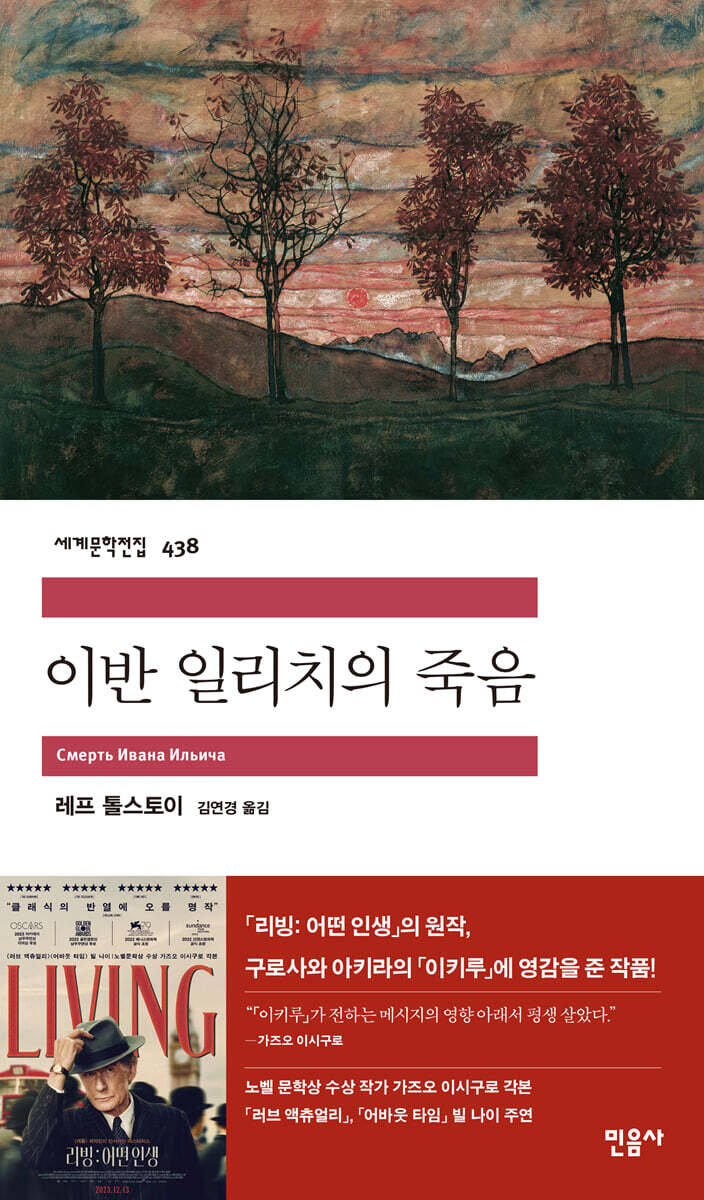 |
Description
Book Introduction
“Everything is the same.
As time goes by, it seems more and more like death.
I imagined I was climbing a mountain, but in reality I was steadily going down the mountain.
“As I climbed the mountain, life was drifting away beneath me.” - From the text
The novella "The Death of Ivan Ilyich" by Leo Tolstoy, a representative Russian writer who has had a profound influence on the lives and values of people around the world, has been published in Minumsa's World Literature Collection.
Tolstoy's life was more eventful and fulfilling than anyone else's, with many contrasting and even contradictory aspects: a landowner who owned a vast estate, a philanthropist who gave up all his wealth to help poor peasants, a prodigal son intoxicated with pleasure, and a seeker of profound truth.
Even in his life, which was so full of twists and turns, there was one particularly decisive event: the so-called near-death experience he had at the Arzamas Inn in 1869.
He had been preoccupied with the question of 'life and death' from an early age due to the successive deaths of his brothers and relatives (he even considered suicide due to the death of his eldest brother) and the numerous deaths he witnessed during the Crimean War.
In the meantime, Tolstoy, who experienced true death, that is, 'his own death', began to look at life and the world from a completely new perspective, and was completely transformed around this time.
After publishing his masterpiece, Anna Karenina, in 1878, Tolstoy entered into a literary silence for nearly ten years. In 1882, he declared his conversion through his memoir, Confession, and began to seriously seek the truth, asking questions such as, "What is the meaning of life that cannot be destroyed even by death?" and "How should humans live?"
Tolstoy, who was serving as a juror at the Tula Regional Court, suddenly heard the news of a prosecutor's death. Based on this incident, he finally completed a novel, "The Death of Ivan Ilyich," which is the culmination of his ideology and outlook on life.
While countless works throughout history have explored the theme of death, few depict the process of dying as vividly as The Death of Ivan Ilyich. Few novels capture so truthfully the darkness of emptiness that descends at the moment of death, the splendid peace that follows, and the complacent indifference of the living who surround the deceased.
Perhaps that is why The Death of Ivan Ilyich is read anew every time, bringing new wonders, and is constantly being reborn in a form that is always appropriate for the times.
As time goes by, it seems more and more like death.
I imagined I was climbing a mountain, but in reality I was steadily going down the mountain.
“As I climbed the mountain, life was drifting away beneath me.” - From the text
The novella "The Death of Ivan Ilyich" by Leo Tolstoy, a representative Russian writer who has had a profound influence on the lives and values of people around the world, has been published in Minumsa's World Literature Collection.
Tolstoy's life was more eventful and fulfilling than anyone else's, with many contrasting and even contradictory aspects: a landowner who owned a vast estate, a philanthropist who gave up all his wealth to help poor peasants, a prodigal son intoxicated with pleasure, and a seeker of profound truth.
Even in his life, which was so full of twists and turns, there was one particularly decisive event: the so-called near-death experience he had at the Arzamas Inn in 1869.
He had been preoccupied with the question of 'life and death' from an early age due to the successive deaths of his brothers and relatives (he even considered suicide due to the death of his eldest brother) and the numerous deaths he witnessed during the Crimean War.
In the meantime, Tolstoy, who experienced true death, that is, 'his own death', began to look at life and the world from a completely new perspective, and was completely transformed around this time.
After publishing his masterpiece, Anna Karenina, in 1878, Tolstoy entered into a literary silence for nearly ten years. In 1882, he declared his conversion through his memoir, Confession, and began to seriously seek the truth, asking questions such as, "What is the meaning of life that cannot be destroyed even by death?" and "How should humans live?"
Tolstoy, who was serving as a juror at the Tula Regional Court, suddenly heard the news of a prosecutor's death. Based on this incident, he finally completed a novel, "The Death of Ivan Ilyich," which is the culmination of his ideology and outlook on life.
While countless works throughout history have explored the theme of death, few depict the process of dying as vividly as The Death of Ivan Ilyich. Few novels capture so truthfully the darkness of emptiness that descends at the moment of death, the splendid peace that follows, and the complacent indifference of the living who surround the deceased.
Perhaps that is why The Death of Ivan Ilyich is read anew every time, bringing new wonders, and is constantly being reborn in a form that is always appropriate for the times.
- You can preview some of the book's contents.
Preview
index
1
2
3
4
5
6
7
8
9
10
11
12
Commentary on the work
Author's chronology
2
3
4
5
6
7
8
9
10
11
12
Commentary on the work
Author's chronology
Detailed image

Publisher's Review
A profound insight that fiercely delves into the true meaning of life and death.
A wondrous masterpiece that encapsulates the thoughts and philosophy of the great author Leo Tolstoy.
The original work of the movie "Living: A Life of its Own",
A work that inspired Akira Kurosawa's "Ikiru"!
Best works selected by the Nobel Institute
“Everything is the same.
As time goes by, it seems more and more like death.
I imagined I was climbing a mountain, but in reality I was steadily going down the mountain.
“As I climbed the mountain, life was drifting away beneath me.” - From the text
The novella "The Death of Ivan Ilyich" by Leo Tolstoy, a representative Russian writer who has had a profound influence on the lives and values of people around the world, has been published in Minumsa's World Literature Collection.
Tolstoy's life was more eventful and fulfilling than anyone else's, with many contrasting and even contradictory aspects: a landowner who owned a vast estate, a philanthropist who gave up all his wealth to help poor peasants, a prodigal son intoxicated with pleasure, and a seeker of profound truth.
Even in his life, which was so full of twists and turns, there was one particularly decisive event: the so-called near-death experience he had at the Arzamas Inn in 1869.
He had been preoccupied with the question of 'life and death' from an early age due to the successive deaths of his brothers and relatives (he even considered suicide due to the death of his eldest brother) and the numerous deaths he witnessed during the Crimean War.
In the meantime, Tolstoy, who experienced true death, that is, 'his own death', began to look at life and the world from a completely new perspective, and was completely transformed around this time.
After publishing his masterpiece, Anna Karenina, in 1878, Tolstoy entered into a literary silence for nearly ten years. In 1882, he declared his conversion through his memoir, Confession, and began to seriously seek the truth, asking questions such as, "What is the meaning of life that cannot be destroyed even by death?" and "How should humans live?"
Tolstoy, who was serving as a juror at the Tula Regional Court, suddenly heard the news of a prosecutor's death. Based on this incident, he finally completed a novel, "The Death of Ivan Ilyich," which is the culmination of his ideology and outlook on life.
While countless works throughout history have explored the theme of death, few depict the process of dying as vividly as The Death of Ivan Ilyich. Few novels capture so truthfully the darkness of emptiness that descends at the moment of death, the splendid peace that follows, and the complacent indifference of the living who surround the deceased.
Perhaps that is why The Death of Ivan Ilyich is read anew every time, bringing new wonders, and is constantly being reborn in a form that is always appropriate for the times.
"Could it be that I've been living wrong? But I've done everything right. What could possibly have gone wrong?" - From the text
'Death.
Yes, death.
They don't know anything, they don't want to know, and they don't feel pity.
Just enjoy it.
It's the same for them too, they're all going to die anyway.
Like an idiot.
I'm leaving a little early, they're leaving a little later.
The same thing will happen to them.' - From the text
Those gathered in the courtroom hear the news of the death of their colleague Ivan Ilyich.
People mourn his death and contemplate the changes that will happen to them, such as promotions and transfers.
I also feel annoyed inside as I worry about the trouble of visiting the bereaved family and what words of comfort to offer them.
What kind of life did Ivan Ilyich, who passed away so unremarkably, lead? Yes, Ivan Ilyich's life was as ordinary and simple as his death.
Ivan Ilyich, who was a successful man with a comfortable family, was simply injured in the side one unlucky day and his health deteriorated rapidly after that.
As he gradually becomes aware that death is approaching, he becomes consumed by doubt and despair, constantly questioning whether he has lived a good life and what a truly happy and meaningful life is.
The Death of Ivan Ilyich, newly translated with elegant prose by novelist and translator Kim Yeon-kyung, who has been studying Russian literature for the past several decades and introducing important works into Korean, is a work that synthesizes the meaning of life and death that Leo Tolstoy, in his later years, finally realized through earnest and thorough composition, with sophisticated and challenging writing.
This work, written by Tolstoy, who lived through a life of constant change and suffering, yearning for truth throughout his life, seeks to reveal the ultimate purpose of life and the value of death. It can be said to be his response to the fundamental question of humanity: "What is a good life, and what is death?"
Tolstoy's most perfect work, "The Death of Ivan Ilyich," considered a "small masterpiece," still stands by us as a beacon of life.
A wondrous masterpiece that encapsulates the thoughts and philosophy of the great author Leo Tolstoy.
The original work of the movie "Living: A Life of its Own",
A work that inspired Akira Kurosawa's "Ikiru"!
Best works selected by the Nobel Institute
“Everything is the same.
As time goes by, it seems more and more like death.
I imagined I was climbing a mountain, but in reality I was steadily going down the mountain.
“As I climbed the mountain, life was drifting away beneath me.” - From the text
The novella "The Death of Ivan Ilyich" by Leo Tolstoy, a representative Russian writer who has had a profound influence on the lives and values of people around the world, has been published in Minumsa's World Literature Collection.
Tolstoy's life was more eventful and fulfilling than anyone else's, with many contrasting and even contradictory aspects: a landowner who owned a vast estate, a philanthropist who gave up all his wealth to help poor peasants, a prodigal son intoxicated with pleasure, and a seeker of profound truth.
Even in his life, which was so full of twists and turns, there was one particularly decisive event: the so-called near-death experience he had at the Arzamas Inn in 1869.
He had been preoccupied with the question of 'life and death' from an early age due to the successive deaths of his brothers and relatives (he even considered suicide due to the death of his eldest brother) and the numerous deaths he witnessed during the Crimean War.
In the meantime, Tolstoy, who experienced true death, that is, 'his own death', began to look at life and the world from a completely new perspective, and was completely transformed around this time.
After publishing his masterpiece, Anna Karenina, in 1878, Tolstoy entered into a literary silence for nearly ten years. In 1882, he declared his conversion through his memoir, Confession, and began to seriously seek the truth, asking questions such as, "What is the meaning of life that cannot be destroyed even by death?" and "How should humans live?"
Tolstoy, who was serving as a juror at the Tula Regional Court, suddenly heard the news of a prosecutor's death. Based on this incident, he finally completed a novel, "The Death of Ivan Ilyich," which is the culmination of his ideology and outlook on life.
While countless works throughout history have explored the theme of death, few depict the process of dying as vividly as The Death of Ivan Ilyich. Few novels capture so truthfully the darkness of emptiness that descends at the moment of death, the splendid peace that follows, and the complacent indifference of the living who surround the deceased.
Perhaps that is why The Death of Ivan Ilyich is read anew every time, bringing new wonders, and is constantly being reborn in a form that is always appropriate for the times.
"Could it be that I've been living wrong? But I've done everything right. What could possibly have gone wrong?" - From the text
'Death.
Yes, death.
They don't know anything, they don't want to know, and they don't feel pity.
Just enjoy it.
It's the same for them too, they're all going to die anyway.
Like an idiot.
I'm leaving a little early, they're leaving a little later.
The same thing will happen to them.' - From the text
Those gathered in the courtroom hear the news of the death of their colleague Ivan Ilyich.
People mourn his death and contemplate the changes that will happen to them, such as promotions and transfers.
I also feel annoyed inside as I worry about the trouble of visiting the bereaved family and what words of comfort to offer them.
What kind of life did Ivan Ilyich, who passed away so unremarkably, lead? Yes, Ivan Ilyich's life was as ordinary and simple as his death.
Ivan Ilyich, who was a successful man with a comfortable family, was simply injured in the side one unlucky day and his health deteriorated rapidly after that.
As he gradually becomes aware that death is approaching, he becomes consumed by doubt and despair, constantly questioning whether he has lived a good life and what a truly happy and meaningful life is.
The Death of Ivan Ilyich, newly translated with elegant prose by novelist and translator Kim Yeon-kyung, who has been studying Russian literature for the past several decades and introducing important works into Korean, is a work that synthesizes the meaning of life and death that Leo Tolstoy, in his later years, finally realized through earnest and thorough composition, with sophisticated and challenging writing.
This work, written by Tolstoy, who lived through a life of constant change and suffering, yearning for truth throughout his life, seeks to reveal the ultimate purpose of life and the value of death. It can be said to be his response to the fundamental question of humanity: "What is a good life, and what is death?"
Tolstoy's most perfect work, "The Death of Ivan Ilyich," considered a "small masterpiece," still stands by us as a beacon of life.
GOODS SPECIFICS
- Date of issue: December 8, 2023
- Page count, weight, size: 144 pages | 214g | 132*225*20mm
- ISBN13: 9788937464386
- ISBN10: 8937464381
You may also like
카테고리
korean


korean

![ELLE 엘르 스페셜 에디션 A형 : 12월 [2025]](http://librairie.coreenne.fr/cdn/shop/files/b8e27a3de6c9538896439686c6b0e8fb.jpg?v=1766436872&width=3840)


