

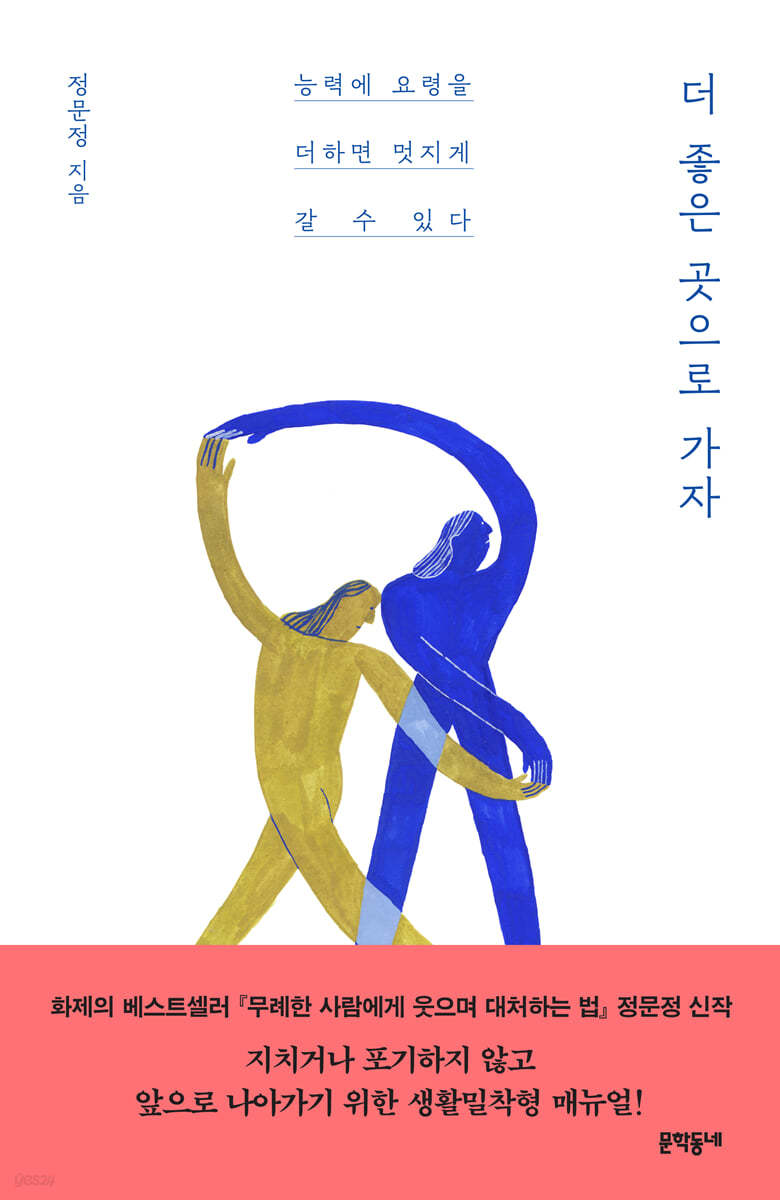
Let's go to a better place
 |
Description
Book Introduction
“Just because you were an unhappy child doesn’t mean you have to be an unhappy adult. If you survive anyway, after you become an adult “You have to practice rewriting your life story for the better.” Recommended by announcer Lim Hyun-joo and Kim So-yeon, CEO of [Newnic]! Without getting tired or giving up A practical manual for moving forward "Let's Go to a Better Place" is a new collection of essays by Jeong Moon-jeong, author of the 500,000-copy bestseller "How to Deal with Rude People with a Smile." While the previous work focused on teaching people how to maintain a safe distance in relationships without getting hurt, this new work contains work and life tips for those who cannot even dream of a better life because they do not have access to even the basic manuals necessary for growth. The author honestly shares his experience of 'habitually choosing unhappiness' and extends a hand to break the cycle of self-pity and move together 'to a better place'. So, let's become people who leave behind resentment and sadness and take a brave step toward where we want to go. In a society where "fairness" has become a sensitive issue across generations, when we feel that the circumstances we have been given are insignificant, we easily blame the world or our own background. This book contains a vivid, practical manual for moving forward confidently and proudly without getting tired or giving up. My previous work, "How to Smile and Deal with Rude People," which was loved by many readers, was a book that taught timid newcomers to learn how to express themselves appropriately and to first establish a safe distance. So, what should you do after establishing a distance that minimizes harm? This book discusses steps you can take immediately afterward. We can't be the youngest forever, so we can't just stand there and protect what we have, but we have to carefully expand our territory. As we grow older, we become more vulnerable to the hurt we've been through, and as we learn more, we become more fearful, often leaving us helpless in the face of new endeavors. We've compiled a manual on adult attitudes and emotional management that you can refer to in such times. _From 'Prologue' |
- You can preview some of the book's contents.
Preview
index
Prologue: Tips for Living a Better Life
Part 1: Things You Hate Without Reason Leave a Wound
My own talisman that I want to believe is real
How difficult it is to be generous when you are poor
What if my parents are rude?
Maybe you don't like it because you don't know
The unrealistic reality needed to endure reality
To you who did not inherit the cultural heritage
The moment when you become evil without malice
There is a wound in something that is hated without reason.
Enduring the ambiguous me
How to Live a Second Life
To avoid being fooled by fake adults
It wasn't abandoned, it was found
Part 2: Hold the speed and balance like an egg
Can you survive without being a company employee?
Setting a daily mood threshold
I'm not the only one who does this.
There is no second chance in the company.
Things you see when you accidentally become a team leader
That person will never be above you
Between 'We don't deserve to be tired' and 'What does this mean?'
How to Handle Envy and Jealousy in a Mature Way
A tender and lonely encounter
I'll listen to everything, but I'll make the decision.
If you tell me to be grateful, I won't be grateful
You shouldn't raise a child
Part 3: Let's Go to a Better Place
Don't just live for today, you have to live for tomorrow and next year too.
Talking about money without crying
You have to buy time with money
Practice distinguishing between good and bad
A misfortune that fits the body perfectly
Unfair adult relationships
A person whose strengths outweigh his weaknesses
Let's go to a better place
Can an ordinary person create extraordinary content?
Just as I have wounds, you too must have wounds in places you can't see.
The darkness of the past is left behind in base camp
Part 1: Things You Hate Without Reason Leave a Wound
My own talisman that I want to believe is real
How difficult it is to be generous when you are poor
What if my parents are rude?
Maybe you don't like it because you don't know
The unrealistic reality needed to endure reality
To you who did not inherit the cultural heritage
The moment when you become evil without malice
There is a wound in something that is hated without reason.
Enduring the ambiguous me
How to Live a Second Life
To avoid being fooled by fake adults
It wasn't abandoned, it was found
Part 2: Hold the speed and balance like an egg
Can you survive without being a company employee?
Setting a daily mood threshold
I'm not the only one who does this.
There is no second chance in the company.
Things you see when you accidentally become a team leader
That person will never be above you
Between 'We don't deserve to be tired' and 'What does this mean?'
How to Handle Envy and Jealousy in a Mature Way
A tender and lonely encounter
I'll listen to everything, but I'll make the decision.
If you tell me to be grateful, I won't be grateful
You shouldn't raise a child
Part 3: Let's Go to a Better Place
Don't just live for today, you have to live for tomorrow and next year too.
Talking about money without crying
You have to buy time with money
Practice distinguishing between good and bad
A misfortune that fits the body perfectly
Unfair adult relationships
A person whose strengths outweigh his weaknesses
Let's go to a better place
Can an ordinary person create extraordinary content?
Just as I have wounds, you too must have wounds in places you can't see.
The darkness of the past is left behind in base camp
Into the book
Becoming an adult is about developing your own perspective and making choices that fit that perspective, but this race is so brutal that even if you start out excited, you'll soon find yourself lost in the crowd and trying to find a comfortable path.
If you don't want to forget your destination even if you're wandering around, you should keep the kind words you heard at least once, the words you want to believe to be true, in a conspicuous place.
For people who have a lot of talismans filled with positive words, it is much easier to believe in their own choices.
--- p.18~19
As we accumulate experience in judging based on our own feelings rather than vague guesses, we come to know ourselves better and learn how to deal with people better.
Don't assume you like or dislike something without actually experiencing it, distinguish between opinion and prejudice, and don't judge others' experiences unless they are evil, but rather be curious.
Through these efforts, I want to properly like and clearly dislike.
To deepen, broaden, and admire often.
--- p.37~38
We live in a world where parents' information, connections, and manners are passed down, but I hope you don't just cry about not having them.
There's no need to be overwhelmed, but don't try to ignore it either, thinking it's not important.
If you repeatedly treat things that are not given to you as if you don't need them, a cynical attitude will become your overall attitude toward life.
Just find it calmly and bring it near me.
If there is no one around you who is like a book, then at least through a book.
I still believe that even if it takes more time, I can broaden my horizons and add them to my emotional library.
I want to believe that.
--- p.50
Talent isn't just for the gifted. It may also be found in the consistency to not give up on something you love, even if it means earning money by doing something you have to do, if you feel like you can't make money doing it.
--- p.69
I learned that professionals don't show their feelings and don't bring them into their work and let it negatively affect them.
Isn't there a book called "Don't Let Your Mood Be Your Attitude"?
When I went to work, I tried to work in a good mood.
But this was too difficult for me, a worldly person.
It is nearly impossible to maintain peace of mind and be a considerate person while working for money.
Incidents were happening here and there, but I couldn't keep my mind at peace.
--- p.104
Whether I had no money or just started to have money, I was hesitant.
If you want it but hate it, you can't help but be in conflict.
The desire to earn a lot of money, but not to be tied down by it.
The desire to envy the rich while dismissing them as nothing special.
The mind that thinks money is important, but knows that it isn't everything.
And yet, I have a suspicion that maybe that's not all, but maybe a significant portion.
--- p.194
Self-esteem is not a jewel that has been polished to a high purity, free from impurities such as inferiority complex, sense of entitlement, and victim mentality. Rather, it is more like bread that has been baked after a long time by fermenting the nature of a person.
Because truly high self-esteem isn't about being ignorant of pain, it's about being victorious, having risen above what's been given and declaring that you won't dwell on those scars any longer.
Because we are explorers who have decided to leave the darkness of the past behind at base camp and boldly walk towards the scenery where good things await us higher up.
If you don't want to forget your destination even if you're wandering around, you should keep the kind words you heard at least once, the words you want to believe to be true, in a conspicuous place.
For people who have a lot of talismans filled with positive words, it is much easier to believe in their own choices.
--- p.18~19
As we accumulate experience in judging based on our own feelings rather than vague guesses, we come to know ourselves better and learn how to deal with people better.
Don't assume you like or dislike something without actually experiencing it, distinguish between opinion and prejudice, and don't judge others' experiences unless they are evil, but rather be curious.
Through these efforts, I want to properly like and clearly dislike.
To deepen, broaden, and admire often.
--- p.37~38
We live in a world where parents' information, connections, and manners are passed down, but I hope you don't just cry about not having them.
There's no need to be overwhelmed, but don't try to ignore it either, thinking it's not important.
If you repeatedly treat things that are not given to you as if you don't need them, a cynical attitude will become your overall attitude toward life.
Just find it calmly and bring it near me.
If there is no one around you who is like a book, then at least through a book.
I still believe that even if it takes more time, I can broaden my horizons and add them to my emotional library.
I want to believe that.
--- p.50
Talent isn't just for the gifted. It may also be found in the consistency to not give up on something you love, even if it means earning money by doing something you have to do, if you feel like you can't make money doing it.
--- p.69
I learned that professionals don't show their feelings and don't bring them into their work and let it negatively affect them.
Isn't there a book called "Don't Let Your Mood Be Your Attitude"?
When I went to work, I tried to work in a good mood.
But this was too difficult for me, a worldly person.
It is nearly impossible to maintain peace of mind and be a considerate person while working for money.
Incidents were happening here and there, but I couldn't keep my mind at peace.
--- p.104
Whether I had no money or just started to have money, I was hesitant.
If you want it but hate it, you can't help but be in conflict.
The desire to earn a lot of money, but not to be tied down by it.
The desire to envy the rich while dismissing them as nothing special.
The mind that thinks money is important, but knows that it isn't everything.
And yet, I have a suspicion that maybe that's not all, but maybe a significant portion.
--- p.194
Self-esteem is not a jewel that has been polished to a high purity, free from impurities such as inferiority complex, sense of entitlement, and victim mentality. Rather, it is more like bread that has been baked after a long time by fermenting the nature of a person.
Because truly high self-esteem isn't about being ignorant of pain, it's about being victorious, having risen above what's been given and declaring that you won't dwell on those scars any longer.
Because we are explorers who have decided to leave the darkness of the past behind at base camp and boldly walk towards the scenery where good things await us higher up.
--- p.253
Publisher's Review
“You work hard, but you have no talent.”
I can't change the conditions given to me, but
I can only choose my attitude toward that condition.
There are some tips I wish I had known in advance.
These are very simple tips, but if you know them, you won't have to go far.
A small gesture that can ease difficult human relationships.
But not everyone knows the tricks.
Some people inherit cultural capital naturally, while others take a step forward without even knowing it.
If you have many people around you who can share their experiences, a virtuous cycle of achieving new things based on the perspectives they've gained can be created. If not, you're likely to feel fear before taking on a challenge.
There are complex reasons for the unfair starting line.
The author persistently delves into the poverty and discrimination he experienced as a child, describing that time as one dominated by an “ambiguous unhappiness.”
Living expenses were tight, not enough to starve, but enough to pay for department retreats. I wanted to write and become a journalist, but I was surrounded by words that encouraged me to give up, disguised as realistic advice, like, “It’s hard to become a journalist if you don’t graduate from a university in Seoul,” and “The best women can be are just teachers or civil servants.”
In an environment where spending is prioritized over investing in experiences that enrich our minds, the saying, "With that money, I could rather do ○○" becomes the standard for all spending.
If you keep having to choose between equally good options, life itself becomes stagnant and you become resigned to the idea that no matter how hard you try, there is no room for improvement.
Actually, many people do.
However, the author says that although I cannot change the conditions given to me, I can choose my attitude toward those conditions.
Along with the 'tough' life tips you need at that time.
As I grew older, I realized that some people had easily acquired information that I either didn't know or struggled to find out.
We were living in completely different worlds.
The difference comes from the network of connections between people called social (relationship) capital.
The size of your dreams can often be determined by whether you have people around you to ask for advice when you have questions and whether you can easily find role models.
When you have abundant related capital, you gain more experience, gain insight, and take on new challenges, creating a virtuous cycle.
Once you start making money, you need to invest in yourself to move to a better place.
It's about reducing the information gap by learning about the field you want and interacting with people who are already working in related fields.
Pages 74-75
Don't be afraid to talk about money
Let's talk about what we deserve
Let's find something that we really like, not something that's just okay.
Writer Jeong Moon-jeong, who has worked for a long time at 『University Tomorrow』, a magazine that covers trends among people in their twenties, has been writing for a long time about 'money' and 'building relationships', which are the main concerns of young people.
It was a concern for young readers, but it was also his main interest.
Why don't people offer something without revealing the exact price they'll pay? Why is it so difficult to talk openly about money? Why do I always feel like I'm the "eul" (give-up) even in relationships?
Dealing with this situation requires 'practicing what's not bad and what you really like.'
The habit of spending based on cost-effectiveness may console oneself with the idea that it is rational, but it can also result in missing out on opportunities to experience the best and the greatest.
If you keep meeting people who are just okay, you will end up being pushed around by the situation without being able to look into your emotions carefully.
It is actually not easy to distinguish between what is good and what is not bad at once.
The practice begins with building self-esteem little by little by achieving small accomplishments.
In an age where comparing factors like income, tastes, and appearance has become so commonplace and easy, the idea of preserving self-esteem may sound like an empty cry.
Self-esteem comes not from external recognition, but from a subjective belief in one's own potential, and grows through experiences of small accomplishments.
As positive memories accumulate, I can turn my life in a better direction at the moment of choice.
Author Jeong Moon-jeong says:
If I ever learn that I am worthy of love and acceptance, I can never go back.
So let's move on to a better place.
together.
Let's stop making bad predictions about our own lives.
Just because you were an unhappy child doesn't mean you have to be an unhappy adult.
Avoiding happiness, thinking that it will never be yours, or always thinking of the end before happiness and becoming impatient.
To break this habit, you have to practice choosing between the unhappiness you know and the happiness you don't know.
Let's stop with the ominous predictions, wear some nice new clothes, and meet someone who makes you feel good to be around.
If you make these choices, there may come a day when happiness becomes as comfortable as a tailor-made suit.
Page 216
I can't change the conditions given to me, but
I can only choose my attitude toward that condition.
There are some tips I wish I had known in advance.
These are very simple tips, but if you know them, you won't have to go far.
A small gesture that can ease difficult human relationships.
But not everyone knows the tricks.
Some people inherit cultural capital naturally, while others take a step forward without even knowing it.
If you have many people around you who can share their experiences, a virtuous cycle of achieving new things based on the perspectives they've gained can be created. If not, you're likely to feel fear before taking on a challenge.
There are complex reasons for the unfair starting line.
The author persistently delves into the poverty and discrimination he experienced as a child, describing that time as one dominated by an “ambiguous unhappiness.”
Living expenses were tight, not enough to starve, but enough to pay for department retreats. I wanted to write and become a journalist, but I was surrounded by words that encouraged me to give up, disguised as realistic advice, like, “It’s hard to become a journalist if you don’t graduate from a university in Seoul,” and “The best women can be are just teachers or civil servants.”
In an environment where spending is prioritized over investing in experiences that enrich our minds, the saying, "With that money, I could rather do ○○" becomes the standard for all spending.
If you keep having to choose between equally good options, life itself becomes stagnant and you become resigned to the idea that no matter how hard you try, there is no room for improvement.
Actually, many people do.
However, the author says that although I cannot change the conditions given to me, I can choose my attitude toward those conditions.
Along with the 'tough' life tips you need at that time.
As I grew older, I realized that some people had easily acquired information that I either didn't know or struggled to find out.
We were living in completely different worlds.
The difference comes from the network of connections between people called social (relationship) capital.
The size of your dreams can often be determined by whether you have people around you to ask for advice when you have questions and whether you can easily find role models.
When you have abundant related capital, you gain more experience, gain insight, and take on new challenges, creating a virtuous cycle.
Once you start making money, you need to invest in yourself to move to a better place.
It's about reducing the information gap by learning about the field you want and interacting with people who are already working in related fields.
Pages 74-75
Don't be afraid to talk about money
Let's talk about what we deserve
Let's find something that we really like, not something that's just okay.
Writer Jeong Moon-jeong, who has worked for a long time at 『University Tomorrow』, a magazine that covers trends among people in their twenties, has been writing for a long time about 'money' and 'building relationships', which are the main concerns of young people.
It was a concern for young readers, but it was also his main interest.
Why don't people offer something without revealing the exact price they'll pay? Why is it so difficult to talk openly about money? Why do I always feel like I'm the "eul" (give-up) even in relationships?
Dealing with this situation requires 'practicing what's not bad and what you really like.'
The habit of spending based on cost-effectiveness may console oneself with the idea that it is rational, but it can also result in missing out on opportunities to experience the best and the greatest.
If you keep meeting people who are just okay, you will end up being pushed around by the situation without being able to look into your emotions carefully.
It is actually not easy to distinguish between what is good and what is not bad at once.
The practice begins with building self-esteem little by little by achieving small accomplishments.
In an age where comparing factors like income, tastes, and appearance has become so commonplace and easy, the idea of preserving self-esteem may sound like an empty cry.
Self-esteem comes not from external recognition, but from a subjective belief in one's own potential, and grows through experiences of small accomplishments.
As positive memories accumulate, I can turn my life in a better direction at the moment of choice.
Author Jeong Moon-jeong says:
If I ever learn that I am worthy of love and acceptance, I can never go back.
So let's move on to a better place.
together.
Let's stop making bad predictions about our own lives.
Just because you were an unhappy child doesn't mean you have to be an unhappy adult.
Avoiding happiness, thinking that it will never be yours, or always thinking of the end before happiness and becoming impatient.
To break this habit, you have to practice choosing between the unhappiness you know and the happiness you don't know.
Let's stop with the ominous predictions, wear some nice new clothes, and meet someone who makes you feel good to be around.
If you make these choices, there may come a day when happiness becomes as comfortable as a tailor-made suit.
Page 216
GOODS SPECIFICS
- Publication date: March 10, 2021
- Page count, weight, size: 256 pages | 318g | 130*200*14mm
- ISBN13: 9788954677837
- ISBN10: 8954677835
You may also like
카테고리
korean


korean

![GQ KOREA Mark (Monthly): December [2025]](http://librairie.coreenne.fr/cdn/shop/files/8ef265dbbfbf186523ed75ba7319009d.jpg?v=1765340328&width=3840)


