

Japan is coming
 |
Description
Book Introduction
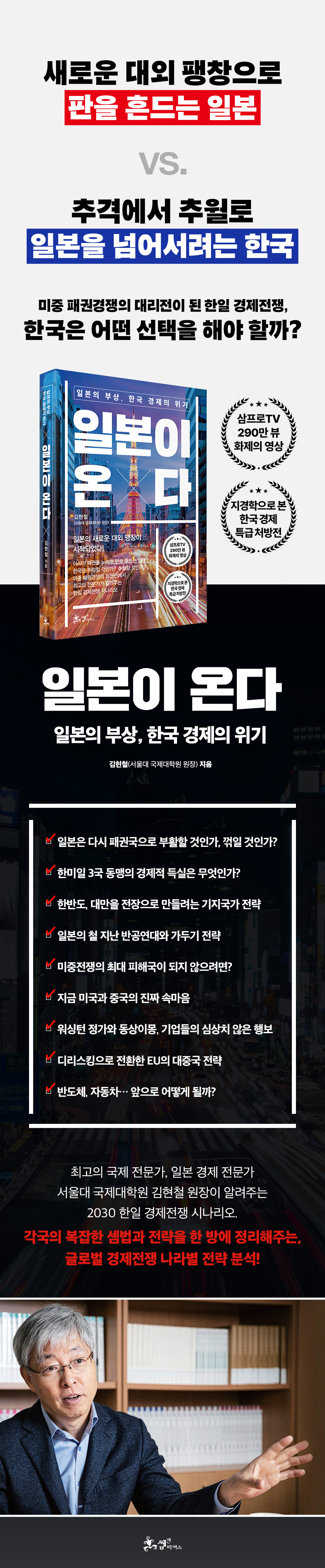
The Korea-Japan economic war has become the front line of the US-China hegemony competition.
Will Korea fall or overtake?
In the era of multipolarity and derisking, Japan began a new round of external expansion.
Japan, striving to regain Asian hegemony, is shaking things up, while South Korea, striving to surpass Japan, has moved beyond its pursuit. What will become of the two economies? Will trilateral cooperation among South Korea, the US, and Japan truly benefit or harm the Korean economy? What choice should South Korea make in the South Korea-Japan economic war, which has become a proxy war for the US-China hegemony rivalry?
This book shows the major trends of the rapidly changing international situation and delves into the true intentions of the United States, China, and Japan.
It also contains a special prescription for the Korean economy, proposed by Kim Hyun-chul, a leading Japanese economic expert and Dean of Seoul National University's Graduate School of International Studies, regarding the choices that the Korean economy, which has already become the world's 10th largest economy and 7th largest trading nation, should make and what is holding back economic growth.
From the perspective of geoeconomics and political economy, it also provides an easy-to-understand explanation of the strategies that advanced countries leading the global economy are pursuing to protect their own interests.
This book contains essential information for managers and investors curious about the US-China hegemony and the Korea-Japan economic war scenario.
Will Korea fall or overtake?
In the era of multipolarity and derisking, Japan began a new round of external expansion.
Japan, striving to regain Asian hegemony, is shaking things up, while South Korea, striving to surpass Japan, has moved beyond its pursuit. What will become of the two economies? Will trilateral cooperation among South Korea, the US, and Japan truly benefit or harm the Korean economy? What choice should South Korea make in the South Korea-Japan economic war, which has become a proxy war for the US-China hegemony rivalry?
This book shows the major trends of the rapidly changing international situation and delves into the true intentions of the United States, China, and Japan.
It also contains a special prescription for the Korean economy, proposed by Kim Hyun-chul, a leading Japanese economic expert and Dean of Seoul National University's Graduate School of International Studies, regarding the choices that the Korean economy, which has already become the world's 10th largest economy and 7th largest trading nation, should make and what is holding back economic growth.
From the perspective of geoeconomics and political economy, it also provides an easy-to-understand explanation of the strategies that advanced countries leading the global economy are pursuing to protect their own interests.
This book contains essential information for managers and investors curious about the US-China hegemony and the Korea-Japan economic war scenario.
- You can preview some of the book's contents.
Preview
index
Prologue: Japan's New Foreign Expansion and the Future of the Korean Economy
Part 1.
The mirror called Japan
1.
Where did the lost 30 years begin?
A turning point in a scholar's life | My encounter with Japanese companies during a recession | The world's second-largest economy, Japan at its peak | A recession black hole opens where the bubble burst | A series of economic shocks and failed reforms | Why Abenomics is half-baked | "If things continue this way, Japan will perish."
2.
How does politics hinder the economy?
The beginning of a bad relationship, the 'Plaza Accord' | The United States that tied the arms and legs of Japanese companies | Why did politicians disguise defeat as the end of the war? | How did the samurai become American poodles? | 'Structured irresponsibility' where no one takes responsibility | A flawed economic prescription that has produced side effects everywhere | The first advanced country to experience a 'population cliff' | Kishida's new capitalism for expanding aggregate demand | Is it possible to have 'happy people in a country of despair'?
Part 2.
Korea, the country that created a miracle
3.
The miracle of globalization is more amazing than the miracle of the Han River.
Opening our eyes to a developed country, yet still a developing country in terms of reforms? | Strong materialism and the myth of growth | From land reform to the sloping development model | Exploiting the Cold War structure to open export routes | 'Trilateral cooperation between Korea, the US, and Japan': What does Japan want then and now? | A miracle country that overcame the middle-income trap | 'Globalization' that began quickly after the Cold War ended | Thanks to backpackers and goose dads | "The world is wide and there's a lot to do."
4.
The digital revolution that laid the foundation for pursuit
Is everyone already a cell phone user? | Japan's Galapagos Keitai | The world's second-largest internet-connected digital powerhouse | Excessive caution holds back internet penetration in Japan | Digital TV surpasses analog powerhouses | Lessons to be learned from the fall of electronics powerhouse Sony | Overtaking Japan, as seen on Montjuic
5.
Korea's imperial management, chasing Japan's lord management
Japanese companies allow themselves to be caught up in the global competition | Emperor management vs.
Lord Management | Shareholder Capitalism vs. Employee Capitalism | The Critical Secret to Success: The Leadership of Emperors | How Did the Korean Wave Beat Cool Japan? | The Korean Wave M-Belt and the Popularity of Korean Ramen | Real Wages Already Higher in Korea Than in Japan
Part 3.
Japan's new external expansion
6.
Japan shakes the game, Korea is in danger
The Senkaku Islands Dispute and the Beginning of Anti-Chinese Sentiment | The President's Visit to Dokdo and the Emperor's Remarks | Frozen Korea-Japan Relations: From Anti-Korean to Anti-Korean | "Let's Unite the Indian and Pacific Oceans to Contain China" | The Thucydides Trap and Trump's Planned War | Will the Economy Be Used as a Tool for Security? | "The World Could Experience a Lost Decade"
7.
The resumption of the Korea-Japan economic war
Abe, the blood boiling in the conservative right wing | The dream of Nobusuke Kishi, the monster of the Showa era and a Class A war criminal | The reason Abe and Pence were late to dinner | The meticulous saboteur who blocked peace on the Korean Peninsula | Japan, which is trying to become a base station behind the Korean Peninsula | Outdated anti-communist solidarity and confinement strategy | Japan's export restrictions and the start of the Korea-Japan economic war | Korea and Japan targeting each other's weak points
Part 4.
The future Korea chooses
8.
Korea's Global Economic Strategy
What the IMF's Economic Warfare Report Warns of | What if the US and OECD Join Forces to Compete with China? | Korea Will Be the Biggest Loser of US-China Competition | Japan Uses US Power to Contain China | Money is Thicker Than Blood and Ideology | Solutions to Reduce Excessive Dependence on China | India to Become the World's Third-Largest Economy by 2030 | ASEAN's Potential for Hallyu Love | The New Southern Policy and ASEAN Centrality | The Natural Attitude of an Independent Sovereign State
9.
Korea's domestic economic strategy
Industrial Innovation, Now from Chasing to Overtaking|Manufacturing Renaissance 2030, Grow the Big 3|The Third Venture Boom, How to Maintain the Heat and Seize Opportunities|Commercial Innovation, Combine Global and Digital in Self-Employment|There is no advanced country without inclusion and a safety net|Healing the sense of loss and restoring a vibrant organizational culture|Is education that restores the social ladder possible?|An 'Innovative Inclusive Nation' where inclusion and innovation cycle virtuously|The economic growth rate of advanced countries is converging on 2%|Korea begins to overtake Japan's income|What makes life meaningful?
10.
Will the Korean economy collapse or catch up?
The Korean economy sucked into a rabbit hole | Declaration of de-China and promotion of anti-China sentiment | NATO summit and invitation to a new Cold War | America's no-free lunch | Oyabun and Kobun, and Kobun's Kobun's Kobun | Korea and Japan regressing to 1905 | Korean public officials possessed by the Japanese right wing | The fallacy of colonial modernization theory | The spirit of Korean capitalism: "Who are you?" | The Sony generation is gone, the Kim Yuna generation is coming | The final gateway to becoming an advanced nation: establishing independence
Epilogue _ Back on the path to growth and inclusion
Acknowledgements
References
Find the picture
About the Author
Part 1.
The mirror called Japan
1.
Where did the lost 30 years begin?
A turning point in a scholar's life | My encounter with Japanese companies during a recession | The world's second-largest economy, Japan at its peak | A recession black hole opens where the bubble burst | A series of economic shocks and failed reforms | Why Abenomics is half-baked | "If things continue this way, Japan will perish."
2.
How does politics hinder the economy?
The beginning of a bad relationship, the 'Plaza Accord' | The United States that tied the arms and legs of Japanese companies | Why did politicians disguise defeat as the end of the war? | How did the samurai become American poodles? | 'Structured irresponsibility' where no one takes responsibility | A flawed economic prescription that has produced side effects everywhere | The first advanced country to experience a 'population cliff' | Kishida's new capitalism for expanding aggregate demand | Is it possible to have 'happy people in a country of despair'?
Part 2.
Korea, the country that created a miracle
3.
The miracle of globalization is more amazing than the miracle of the Han River.
Opening our eyes to a developed country, yet still a developing country in terms of reforms? | Strong materialism and the myth of growth | From land reform to the sloping development model | Exploiting the Cold War structure to open export routes | 'Trilateral cooperation between Korea, the US, and Japan': What does Japan want then and now? | A miracle country that overcame the middle-income trap | 'Globalization' that began quickly after the Cold War ended | Thanks to backpackers and goose dads | "The world is wide and there's a lot to do."
4.
The digital revolution that laid the foundation for pursuit
Is everyone already a cell phone user? | Japan's Galapagos Keitai | The world's second-largest internet-connected digital powerhouse | Excessive caution holds back internet penetration in Japan | Digital TV surpasses analog powerhouses | Lessons to be learned from the fall of electronics powerhouse Sony | Overtaking Japan, as seen on Montjuic
5.
Korea's imperial management, chasing Japan's lord management
Japanese companies allow themselves to be caught up in the global competition | Emperor management vs.
Lord Management | Shareholder Capitalism vs. Employee Capitalism | The Critical Secret to Success: The Leadership of Emperors | How Did the Korean Wave Beat Cool Japan? | The Korean Wave M-Belt and the Popularity of Korean Ramen | Real Wages Already Higher in Korea Than in Japan
Part 3.
Japan's new external expansion
6.
Japan shakes the game, Korea is in danger
The Senkaku Islands Dispute and the Beginning of Anti-Chinese Sentiment | The President's Visit to Dokdo and the Emperor's Remarks | Frozen Korea-Japan Relations: From Anti-Korean to Anti-Korean | "Let's Unite the Indian and Pacific Oceans to Contain China" | The Thucydides Trap and Trump's Planned War | Will the Economy Be Used as a Tool for Security? | "The World Could Experience a Lost Decade"
7.
The resumption of the Korea-Japan economic war
Abe, the blood boiling in the conservative right wing | The dream of Nobusuke Kishi, the monster of the Showa era and a Class A war criminal | The reason Abe and Pence were late to dinner | The meticulous saboteur who blocked peace on the Korean Peninsula | Japan, which is trying to become a base station behind the Korean Peninsula | Outdated anti-communist solidarity and confinement strategy | Japan's export restrictions and the start of the Korea-Japan economic war | Korea and Japan targeting each other's weak points
Part 4.
The future Korea chooses
8.
Korea's Global Economic Strategy
What the IMF's Economic Warfare Report Warns of | What if the US and OECD Join Forces to Compete with China? | Korea Will Be the Biggest Loser of US-China Competition | Japan Uses US Power to Contain China | Money is Thicker Than Blood and Ideology | Solutions to Reduce Excessive Dependence on China | India to Become the World's Third-Largest Economy by 2030 | ASEAN's Potential for Hallyu Love | The New Southern Policy and ASEAN Centrality | The Natural Attitude of an Independent Sovereign State
9.
Korea's domestic economic strategy
Industrial Innovation, Now from Chasing to Overtaking|Manufacturing Renaissance 2030, Grow the Big 3|The Third Venture Boom, How to Maintain the Heat and Seize Opportunities|Commercial Innovation, Combine Global and Digital in Self-Employment|There is no advanced country without inclusion and a safety net|Healing the sense of loss and restoring a vibrant organizational culture|Is education that restores the social ladder possible?|An 'Innovative Inclusive Nation' where inclusion and innovation cycle virtuously|The economic growth rate of advanced countries is converging on 2%|Korea begins to overtake Japan's income|What makes life meaningful?
10.
Will the Korean economy collapse or catch up?
The Korean economy sucked into a rabbit hole | Declaration of de-China and promotion of anti-China sentiment | NATO summit and invitation to a new Cold War | America's no-free lunch | Oyabun and Kobun, and Kobun's Kobun's Kobun | Korea and Japan regressing to 1905 | Korean public officials possessed by the Japanese right wing | The fallacy of colonial modernization theory | The spirit of Korean capitalism: "Who are you?" | The Sony generation is gone, the Kim Yuna generation is coming | The final gateway to becoming an advanced nation: establishing independence
Epilogue _ Back on the path to growth and inclusion
Acknowledgements
References
Find the picture
About the Author
Detailed image
Into the book
At the beginning of the summit, President Xi Jinping first brought up Japan.
Bringing up Japan first at a summit with South Korea was highly unusual in itself, but the intensity of the remark surprised many.
But for me, a Japan expert, this was a new discovery.
The fact that China brought up the Japan issue even at the summit with South Korea, given its ongoing confrontation with Japan, foreshadowed that Sino-Japanese relations would deteriorate and become even more strained in the future. (…) While the course of history is influenced by various factors, the South Korea-China summit at the end of 2017 marked a major historical turning point.
The following year, President Trump launched a trade war by imposing high tariffs on goods imported from China.
And in the same year, the name of the Hawaii-based 'Pacific Command' was changed to 'Indo-Pacific Command', further blatantly increasing military confrontation.
--- p.13, from “Prologue _ Japan’s New External Expansion and the Future of the Korean Economy”
In particular, because the Tokyo Olympics have long been held up by the Abe administration as a symbol of Japan's revival, the Japanese government has been lukewarm in discovering confirmed cases of COVID-19 or sharing the situation.
However, a pandemic also broke out in Japan, which imposed a blanket ban on foreign visitors and issued emergency measures restricting the operation of stores.
This was a direct hit to the declining Japanese economy.
In the second quarter of 2020, the economic growth rate recorded 7.8%, renewing the largest decline since the war.
Prime Minister Abe abruptly resigned, citing chronic illness as an excuse, but the success of his economic policy, Abenomics, also came to a dismal end after being hit hard by the coronavirus.
During the so-called "lost 20 years" following the bubble burst, Japan's real economic growth rate was 0.8%.
And the real economic growth rate during the Abenomics period was 0.9%.
Although it was outwardly impressive, the result fell far short of the 2% economic growth rate he had targeted.
--- p.41, from “Why is Abenomics only half-baked?”
So, what is the fundamental cause of Japan's prolonged economic stagnation? And what prescription was the right one? Various studies have been conducted on this issue, and among them, two causes that offer insight are as follows.
One is that while the long-term recession began with the emergence and collapse of a bubble, the biggest change was population decline, particularly the decline in the working-age population.
The so-called 'population cliff' and long-term stagnation occurred together.
This was a reason Japan had not thought about for a while.
Around the same time, the European economy also fell into a prolonged recession, but the demographic shock took a long time to manifest itself.
Moreover, Europe has mitigated the impact of population decline to some extent through inter-country migration and immigration due to economic integration.
But Japan was the first developed country to experience a population shock at such a rapid pace.
As the low birth rate and aging population rapidly progressed, the working-age population rapidly decreased, which had a huge impact on the economy.
--- p.65, from “A Wrong Economic Prescription That Has Caused Side Effects Everywhere”
I remember being shocked when I saw on the news in 2020, during the coronavirus pandemic, that the Japanese government was counting the number of severely ill patients nationwide by fax.
However, in the case of Japan, an analog-advanced country, fax was a very convenient means of communication for all citizens until the 1990s, so the benefits of the new technology called the Internet were not very noticeable.
In particular, what fueled this sentiment was the Japanese government's miscalculation of building a nationwide Internet network using ISDN coaxial cables, as explained above.
Because our country built its internet network using ADSL optical cables, citizens experienced high-speed internet and felt that it was fast and convenient.
However, in the case of Japan, the Internet was laid with coaxial cables at a speed not much different from the speed of sending a fax, so there was no significant difference from the user's perspective. (...) Digital technology has the characteristic of being quickly distributed and then having a rapid increase in users before the investment is easily recovered.
The choice to build an internet network with optical cables, like in Korea, was a reckless choice from an analog perspective.
Connecting not only the main network but also each household with optical cables could have been a foolish choice, not to mention reckless.
However, in the realm of digital technology, this recklessness and boldness actually turned out to be the right choice, and Japan's rational choice ended up being the wrong one.
--- p.120, from “Excessive caution holds back the spread of the Internet in Japan”
Phrases like “lack of leadership” and “management without strategy” were the most important key terms used to criticize Japanese companies during the economic downturn.
When sales and profits decline, companies turn to their CEOs to step up and demonstrate leadership to overcome the crisis.
The manager must lead the organization in a coordinated manner with a sound strategy.
However, during the long-term recession, Japanese companies did not show this kind of behavior, and many people criticized Japanese management for lacking leadership and strategy.
Japanese corporate CEOs are quite different from Korean managers.
In Korea, managers are like emperors who wield all power, so it is called 'emperor management', but in Japan, managers are like feudal lords (called lords in Japan) who exist but do not reign, so it is called 'lord management'.
--- p.135, 「Emperor Management vs.
From “Master’s Management”
The 'Thucydides Trap' refers to the phenomenon of extreme structural tensions occurring when a newly rising power threatens to usurp the position of an existing ruling power.
Allison explains that the Peloponnesian War (431–404 BC), as described by the Greek historian Thucydides, was the result of structural tensions between the rapidly rising power of Athens and Sparta, which sought to contain it.
He argued that the 'Thucydides Trap' had occurred a total of 16 times around the world over the past 500 years, and that 12 of them had led to war.
From this perspective, China has already followed the United States to its limits and declared the "great revival of the Chinese nation (Chinese Dream)" within it, so America's containment is a set procedure.
Of course, this war could be avoided if China scales back its ambitions, but if not, a trade war, cyber war, and localized conflicts at sea are inevitable, he argued.
The book caused a stir in the United States because it partly justified the inevitable nature of Trump's diplomatic actions.
In particular, his argument was introduced and received attention in Korea because it reflected the perspective of the American mainstream.
--- p.173, from “The Thucydides Trap and Trump’s Planned War”
The countermeasure to this was the Korean people's refusal to travel to Japan.
(…) The Liberal Democratic Party had a stronger support base in local small and medium-sized cities than in large cities.
Local small and medium-sized cities were hit hard by the long-term economic downturn and were also the main targets of 'local extinction.'
If we can attract foreign tourists to this area, it will not only greatly help revitalize the local economy, but it will also be a good way to maintain the Liberal Democratic Party's support base.
Therefore, the Liberal Democratic Party created a local revitalization headquarters and strongly implemented a policy to promote local tourism.
As a result of such policies, tourism in small and medium-sized cities in Japan became active, and the people who went there were mainly Koreans.
Wise Koreans have taken note of this point.
Local tourism was Japan's weak point.
Japan considered Korea's semiconductor industry a weak point and attempted to attack it, so Korea retaliated by refusing to allow tourism to its provinces.
This worked better than expected.
As Korean tourists stopped coming, LDP lawmakers in small and medium-sized cities in the provinces took a hit, and they gradually began to turn critical of the Abe administration.
This became a key turning point for the regime change.
--- p.206, from “Korea and Japan Targeting Each Other’s Vulnerable Points”
In Japanese organizations, even if the leader is somewhat incompetent, the members follow the leader's instructions.
So somehow the organization turns around.
However, in Korean organizations, if the leader is incompetent, the members immediately rebel, so the organization itself does not function.
Moreover, even in a smoothly running organization, Korean members will eventually challenge the Little Emperor.
If the little emperor demonstrates leadership and achieves good results, there is no problem, but if not, there will inevitably be members within the organization who will challenge him by asking, “Who are you?” and demand the little emperor’s replacement.
Hearing this story, I felt like my long-standing homework was solved.
The spirit of Korean capitalism is a spirit of challenge represented by 'Who are you?'
These emperors, each brimming with a spirit of challenge, pioneered new worlds in their own spheres, and thanks to their achievements, Korea as a whole has grown.
--- p.321, from “The Spirit of Korean Capitalism, “Who Are You?”
There is no government that wins over its people.
In particular, the United States, a cutting-edge capitalist country, cannot afford to be defeated by companies that prioritize the power of capital.
The United States is a country where the government changes through elections every four years.
In such a system, corporate political donations are a key factor in influencing the outcome of presidential elections.
Knowing this, the U.S. Treasury Department and the White House National Security Advisor took action first, and the president followed suit.
The result was the Hiroshima G7 Joint Declaration in May 2023.
But even if decoupling is changed to derisking in five years, the hegemonic power, the United States, will not be able to easily put away its sword once it has drawn it.
For some time, the United States, China, and other countries will continue to grope in the dark about derisking.
Furthermore, Japan, which had been actively pursuing the Indo-Pacific strategy, realized that it could not continue to play the role of a shock force as it watched the changing United States.
In particular, as the power of the new mainstream, including Abe, gradually wanes, the policy toward China is also being revised.
But in the meantime, conflicts between countries and factions intensified, and the world economy suffered a major shock.
It was the result of Japan's clumsy approach.
Bringing up Japan first at a summit with South Korea was highly unusual in itself, but the intensity of the remark surprised many.
But for me, a Japan expert, this was a new discovery.
The fact that China brought up the Japan issue even at the summit with South Korea, given its ongoing confrontation with Japan, foreshadowed that Sino-Japanese relations would deteriorate and become even more strained in the future. (…) While the course of history is influenced by various factors, the South Korea-China summit at the end of 2017 marked a major historical turning point.
The following year, President Trump launched a trade war by imposing high tariffs on goods imported from China.
And in the same year, the name of the Hawaii-based 'Pacific Command' was changed to 'Indo-Pacific Command', further blatantly increasing military confrontation.
--- p.13, from “Prologue _ Japan’s New External Expansion and the Future of the Korean Economy”
In particular, because the Tokyo Olympics have long been held up by the Abe administration as a symbol of Japan's revival, the Japanese government has been lukewarm in discovering confirmed cases of COVID-19 or sharing the situation.
However, a pandemic also broke out in Japan, which imposed a blanket ban on foreign visitors and issued emergency measures restricting the operation of stores.
This was a direct hit to the declining Japanese economy.
In the second quarter of 2020, the economic growth rate recorded 7.8%, renewing the largest decline since the war.
Prime Minister Abe abruptly resigned, citing chronic illness as an excuse, but the success of his economic policy, Abenomics, also came to a dismal end after being hit hard by the coronavirus.
During the so-called "lost 20 years" following the bubble burst, Japan's real economic growth rate was 0.8%.
And the real economic growth rate during the Abenomics period was 0.9%.
Although it was outwardly impressive, the result fell far short of the 2% economic growth rate he had targeted.
--- p.41, from “Why is Abenomics only half-baked?”
So, what is the fundamental cause of Japan's prolonged economic stagnation? And what prescription was the right one? Various studies have been conducted on this issue, and among them, two causes that offer insight are as follows.
One is that while the long-term recession began with the emergence and collapse of a bubble, the biggest change was population decline, particularly the decline in the working-age population.
The so-called 'population cliff' and long-term stagnation occurred together.
This was a reason Japan had not thought about for a while.
Around the same time, the European economy also fell into a prolonged recession, but the demographic shock took a long time to manifest itself.
Moreover, Europe has mitigated the impact of population decline to some extent through inter-country migration and immigration due to economic integration.
But Japan was the first developed country to experience a population shock at such a rapid pace.
As the low birth rate and aging population rapidly progressed, the working-age population rapidly decreased, which had a huge impact on the economy.
--- p.65, from “A Wrong Economic Prescription That Has Caused Side Effects Everywhere”
I remember being shocked when I saw on the news in 2020, during the coronavirus pandemic, that the Japanese government was counting the number of severely ill patients nationwide by fax.
However, in the case of Japan, an analog-advanced country, fax was a very convenient means of communication for all citizens until the 1990s, so the benefits of the new technology called the Internet were not very noticeable.
In particular, what fueled this sentiment was the Japanese government's miscalculation of building a nationwide Internet network using ISDN coaxial cables, as explained above.
Because our country built its internet network using ADSL optical cables, citizens experienced high-speed internet and felt that it was fast and convenient.
However, in the case of Japan, the Internet was laid with coaxial cables at a speed not much different from the speed of sending a fax, so there was no significant difference from the user's perspective. (...) Digital technology has the characteristic of being quickly distributed and then having a rapid increase in users before the investment is easily recovered.
The choice to build an internet network with optical cables, like in Korea, was a reckless choice from an analog perspective.
Connecting not only the main network but also each household with optical cables could have been a foolish choice, not to mention reckless.
However, in the realm of digital technology, this recklessness and boldness actually turned out to be the right choice, and Japan's rational choice ended up being the wrong one.
--- p.120, from “Excessive caution holds back the spread of the Internet in Japan”
Phrases like “lack of leadership” and “management without strategy” were the most important key terms used to criticize Japanese companies during the economic downturn.
When sales and profits decline, companies turn to their CEOs to step up and demonstrate leadership to overcome the crisis.
The manager must lead the organization in a coordinated manner with a sound strategy.
However, during the long-term recession, Japanese companies did not show this kind of behavior, and many people criticized Japanese management for lacking leadership and strategy.
Japanese corporate CEOs are quite different from Korean managers.
In Korea, managers are like emperors who wield all power, so it is called 'emperor management', but in Japan, managers are like feudal lords (called lords in Japan) who exist but do not reign, so it is called 'lord management'.
--- p.135, 「Emperor Management vs.
From “Master’s Management”
The 'Thucydides Trap' refers to the phenomenon of extreme structural tensions occurring when a newly rising power threatens to usurp the position of an existing ruling power.
Allison explains that the Peloponnesian War (431–404 BC), as described by the Greek historian Thucydides, was the result of structural tensions between the rapidly rising power of Athens and Sparta, which sought to contain it.
He argued that the 'Thucydides Trap' had occurred a total of 16 times around the world over the past 500 years, and that 12 of them had led to war.
From this perspective, China has already followed the United States to its limits and declared the "great revival of the Chinese nation (Chinese Dream)" within it, so America's containment is a set procedure.
Of course, this war could be avoided if China scales back its ambitions, but if not, a trade war, cyber war, and localized conflicts at sea are inevitable, he argued.
The book caused a stir in the United States because it partly justified the inevitable nature of Trump's diplomatic actions.
In particular, his argument was introduced and received attention in Korea because it reflected the perspective of the American mainstream.
--- p.173, from “The Thucydides Trap and Trump’s Planned War”
The countermeasure to this was the Korean people's refusal to travel to Japan.
(…) The Liberal Democratic Party had a stronger support base in local small and medium-sized cities than in large cities.
Local small and medium-sized cities were hit hard by the long-term economic downturn and were also the main targets of 'local extinction.'
If we can attract foreign tourists to this area, it will not only greatly help revitalize the local economy, but it will also be a good way to maintain the Liberal Democratic Party's support base.
Therefore, the Liberal Democratic Party created a local revitalization headquarters and strongly implemented a policy to promote local tourism.
As a result of such policies, tourism in small and medium-sized cities in Japan became active, and the people who went there were mainly Koreans.
Wise Koreans have taken note of this point.
Local tourism was Japan's weak point.
Japan considered Korea's semiconductor industry a weak point and attempted to attack it, so Korea retaliated by refusing to allow tourism to its provinces.
This worked better than expected.
As Korean tourists stopped coming, LDP lawmakers in small and medium-sized cities in the provinces took a hit, and they gradually began to turn critical of the Abe administration.
This became a key turning point for the regime change.
--- p.206, from “Korea and Japan Targeting Each Other’s Vulnerable Points”
In Japanese organizations, even if the leader is somewhat incompetent, the members follow the leader's instructions.
So somehow the organization turns around.
However, in Korean organizations, if the leader is incompetent, the members immediately rebel, so the organization itself does not function.
Moreover, even in a smoothly running organization, Korean members will eventually challenge the Little Emperor.
If the little emperor demonstrates leadership and achieves good results, there is no problem, but if not, there will inevitably be members within the organization who will challenge him by asking, “Who are you?” and demand the little emperor’s replacement.
Hearing this story, I felt like my long-standing homework was solved.
The spirit of Korean capitalism is a spirit of challenge represented by 'Who are you?'
These emperors, each brimming with a spirit of challenge, pioneered new worlds in their own spheres, and thanks to their achievements, Korea as a whole has grown.
--- p.321, from “The Spirit of Korean Capitalism, “Who Are You?”
There is no government that wins over its people.
In particular, the United States, a cutting-edge capitalist country, cannot afford to be defeated by companies that prioritize the power of capital.
The United States is a country where the government changes through elections every four years.
In such a system, corporate political donations are a key factor in influencing the outcome of presidential elections.
Knowing this, the U.S. Treasury Department and the White House National Security Advisor took action first, and the president followed suit.
The result was the Hiroshima G7 Joint Declaration in May 2023.
But even if decoupling is changed to derisking in five years, the hegemonic power, the United States, will not be able to easily put away its sword once it has drawn it.
For some time, the United States, China, and other countries will continue to grope in the dark about derisking.
Furthermore, Japan, which had been actively pursuing the Indo-Pacific strategy, realized that it could not continue to play the role of a shock force as it watched the changing United States.
In particular, as the power of the new mainstream, including Abe, gradually wanes, the policy toward China is also being revised.
But in the meantime, conflicts between countries and factions intensified, and the world economy suffered a major shock.
It was the result of Japan's clumsy approach.
--- p.336, from “Epilogue _ Back on the Path of Growth and Inclusion”
Publisher's Review
The Korean economy succeeded in catching up with Japan after its 'lost 30 years'.
Can we overtake Japan, which is struggling with new external expansion?
The release of contaminated water, the US-ROK-Japan summit, and the Japanese stock market are in turmoil…
Japan is hotter than ever.
Contrary to expectations that the "lost 30 years" would be further dented by the pandemic counterpunch, the Japanese stock market is booming and tourists are flocking to the country thanks to the weak yen.
Will Japan truly rise again as a leading power in Asia? Or will it be merely a final spark, soon to fade? Will the dreams of great power diplomacy envisioned by Abe during his lifetime, such as the Indo-Pacific strategy and the Quad, ever be realized?
Professor Kim Hyun-chul, a leading expert on the Japanese economy and dean of Seoul National University's Graduate School of International Studies, criticized the current situation, saying, "Japan is attempting a new external expansion and shaking up the international order."
Japan's past attempts at external expansion, such as the Imjin War and the Pacific War, brought about the worst possible outcomes, throwing not only Asia but the entire world into chaos, and Korea was always a victim of these events.
Japan is attempting expansion again and is coming to the Korean Peninsula.
Korea, which has become a whale-level advanced economy through the miracle of digitalization and globalization,
How can we win the economic war with Japan, which is shaking things up?
At the end of last year, a video from Sampro TV became a huge topic of conversation.
The video “The Japanese Economy Sinked, but the Korean Economy Was Different,” in which Kim Hyun-chul, Dean of Seoul National University’s Graduate School of International Studies and a leading expert on the Japanese economy and international affairs, compared the Korean and Japanese economies, has received close to 3 million cumulative views.
In his new book, “Japan is Coming,” Director Kim Hyun-chul compares and analyzes the Korean and Japanese economies over the past 30 years and, within the larger picture of the volatile international situation, explains the path the Korean economy should take going forward, dividing it into domestic and foreign strategies.
The book first explains how Korea succeeded in catching up with Japan.
The "Miracle on the Han River," which transformed Korea from a developing country to a middle-income nation, is certainly remarkable, but even more remarkable is how quickly it rode the wave of globalization and surged ahead in the digital and mobile revolution.
While Japan, once the world's second-largest economy, is sinking deeper into a quagmire due to a series of external shocks, including the Plaza Accord, Korea is leading the way in globalization and digitalization and is on the verge of overtaking Japan.
But suddenly, Japan is attempting to expand abroad, once again disrupting the international order. It seeks to leverage the US's influence through the Indo-Pacific Economic Framework (IPEF) to contain China, and aims to heighten tensions in Taiwan and the Korean Peninsula, thereby positioning itself as a base for profit.
An economy that develops on the basis of tension between politics and the people
There is hope in the Korean capitalist spirit represented by "Who are you?"
Why is Japan coming back? What impact will this have on the Korean economy? What impact will it have on the Korean Peninsula and our lives? Why is the economic growth rate plummeting to 1% despite the absence of any major external shocks? Who is obscuring the true nature of the crisis with the vague term "complex economic crisis"?
As the pandemic shifted to a multipolar system and derisking, countries around the world scrambled to protect their economies.
This book presents the strategies of major countries such as the United States, China, and the European Union, and explains how Japan's misguided expansion is affecting the Korean economy.
It also covers a wide range of topics, including politics, economics, history, and culture, and contains strategies for riding the wave of major domestic and international trends to seize critical moments.
President Kim Hyun-chul said, “At the root of the economy lies the spirit, and what sustains this spirit is history.” He explained from a completely new perspective how the economies and politics of Korea and Japan, the domestic economy and the global economy, and the past and present are connected.
Additionally, unlike the obedient Japanese, the Korean capitalist spirit, represented by the question, “Who are you?” and the outstanding skills and challenging spirit of the “Kim Yuna generation,” once again confirm that there is hope for the Korean economy no matter how much politics holds it back.
Can we overtake Japan, which is struggling with new external expansion?
The release of contaminated water, the US-ROK-Japan summit, and the Japanese stock market are in turmoil…
Japan is hotter than ever.
Contrary to expectations that the "lost 30 years" would be further dented by the pandemic counterpunch, the Japanese stock market is booming and tourists are flocking to the country thanks to the weak yen.
Will Japan truly rise again as a leading power in Asia? Or will it be merely a final spark, soon to fade? Will the dreams of great power diplomacy envisioned by Abe during his lifetime, such as the Indo-Pacific strategy and the Quad, ever be realized?
Professor Kim Hyun-chul, a leading expert on the Japanese economy and dean of Seoul National University's Graduate School of International Studies, criticized the current situation, saying, "Japan is attempting a new external expansion and shaking up the international order."
Japan's past attempts at external expansion, such as the Imjin War and the Pacific War, brought about the worst possible outcomes, throwing not only Asia but the entire world into chaos, and Korea was always a victim of these events.
Japan is attempting expansion again and is coming to the Korean Peninsula.
Korea, which has become a whale-level advanced economy through the miracle of digitalization and globalization,
How can we win the economic war with Japan, which is shaking things up?
At the end of last year, a video from Sampro TV became a huge topic of conversation.
The video “The Japanese Economy Sinked, but the Korean Economy Was Different,” in which Kim Hyun-chul, Dean of Seoul National University’s Graduate School of International Studies and a leading expert on the Japanese economy and international affairs, compared the Korean and Japanese economies, has received close to 3 million cumulative views.
In his new book, “Japan is Coming,” Director Kim Hyun-chul compares and analyzes the Korean and Japanese economies over the past 30 years and, within the larger picture of the volatile international situation, explains the path the Korean economy should take going forward, dividing it into domestic and foreign strategies.
The book first explains how Korea succeeded in catching up with Japan.
The "Miracle on the Han River," which transformed Korea from a developing country to a middle-income nation, is certainly remarkable, but even more remarkable is how quickly it rode the wave of globalization and surged ahead in the digital and mobile revolution.
While Japan, once the world's second-largest economy, is sinking deeper into a quagmire due to a series of external shocks, including the Plaza Accord, Korea is leading the way in globalization and digitalization and is on the verge of overtaking Japan.
But suddenly, Japan is attempting to expand abroad, once again disrupting the international order. It seeks to leverage the US's influence through the Indo-Pacific Economic Framework (IPEF) to contain China, and aims to heighten tensions in Taiwan and the Korean Peninsula, thereby positioning itself as a base for profit.
An economy that develops on the basis of tension between politics and the people
There is hope in the Korean capitalist spirit represented by "Who are you?"
Why is Japan coming back? What impact will this have on the Korean economy? What impact will it have on the Korean Peninsula and our lives? Why is the economic growth rate plummeting to 1% despite the absence of any major external shocks? Who is obscuring the true nature of the crisis with the vague term "complex economic crisis"?
As the pandemic shifted to a multipolar system and derisking, countries around the world scrambled to protect their economies.
This book presents the strategies of major countries such as the United States, China, and the European Union, and explains how Japan's misguided expansion is affecting the Korean economy.
It also covers a wide range of topics, including politics, economics, history, and culture, and contains strategies for riding the wave of major domestic and international trends to seize critical moments.
President Kim Hyun-chul said, “At the root of the economy lies the spirit, and what sustains this spirit is history.” He explained from a completely new perspective how the economies and politics of Korea and Japan, the domestic economy and the global economy, and the past and present are connected.
Additionally, unlike the obedient Japanese, the Korean capitalist spirit, represented by the question, “Who are you?” and the outstanding skills and challenging spirit of the “Kim Yuna generation,” once again confirm that there is hope for the Korean economy no matter how much politics holds it back.
GOODS SPECIFICS
- Date of issue: September 27, 2023
- Page count, weight, size: 360 pages | 544g | 140*210*21mm
- ISBN13: 9791165348182
- ISBN10: 1165348187
You may also like
카테고리
korean


korean

![GQ KOREA Mark (Monthly): December [2025]](http://librairie.coreenne.fr/cdn/shop/files/8ef265dbbfbf186523ed75ba7319009d.jpg?v=1765340328&width=3840)


