

Bird's Gift
 |
Description
Book Introduction
Reuniting with the girl we loved and cherished back then
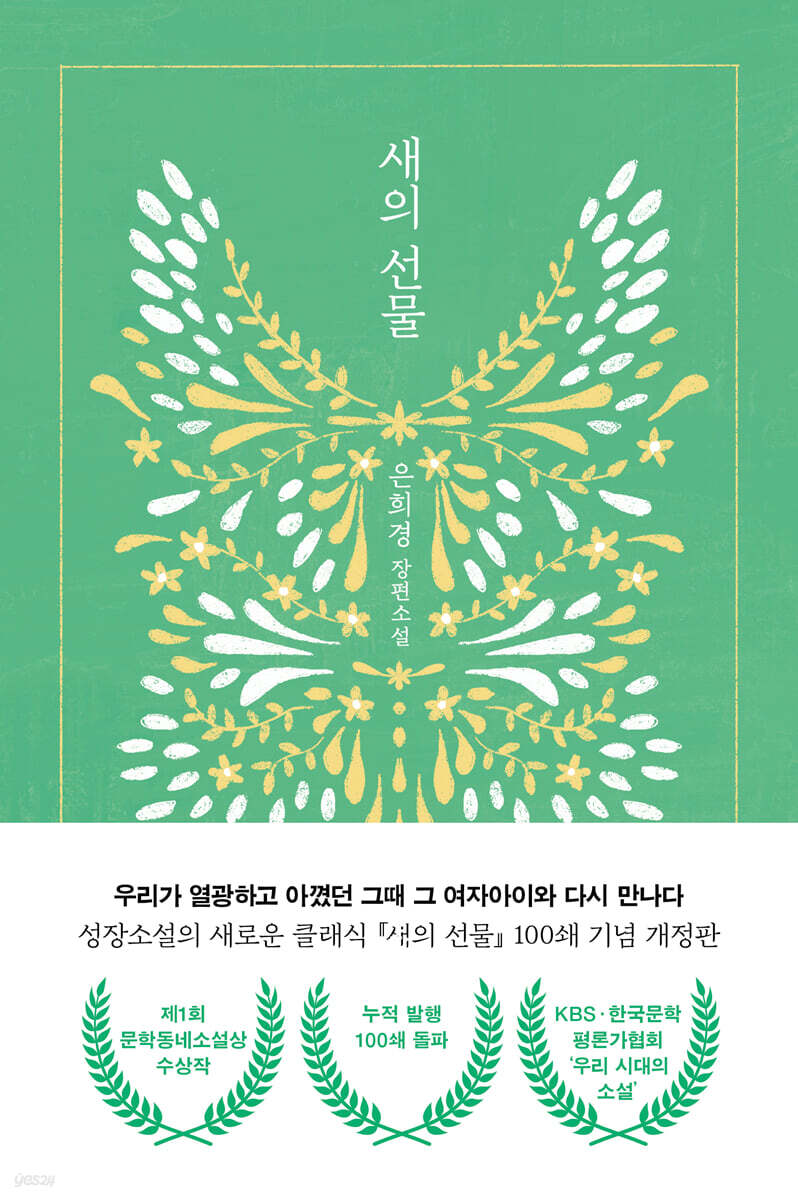
A new classic in coming-of-age fiction: The Bird's Gift, a revised edition commemorating the 100th printing.
Eun Hee-kyung, the author who has always led today's Korean literature with new questions and leaps forward, presents 『A Bird's Gift』, her first full-length novel and winner of the first Munhakdongne Novel Award, in a revised edition commemorating the publication of her 100th printing, with a new cover and refined sentences and expressions.
The 100th printing of 『The Bird's Gift』, which has been consistently loved for nearly 30 years since its publication in 1995 and has established itself as a new milestone in coming-of-age novels, is a significant record in that it was achieved through the sympathy and love of readers across generations.
Author Eun Hee-kyung says that she looked back at the book for the first time after the first edition was published in order to work on a revised edition.
This is his first book, which he completed after making his literary debut in 1995 through the New Year’s literary contest and, after a period of no requests, going to a temple in a remote area and working on it for several months.
The energy and passion the author poured into his work over a considerable period of time still vividly resonates with us today, 27 years later.
This revised edition, which preserves the passion of that time while carefully refining the words from a present-day perspective and exquisitely refining the landscape of that time, will keep us immersed in a full and passionate time from the moment we open the book until the very end.
A new classic in coming-of-age fiction: The Bird's Gift, a revised edition commemorating the 100th printing.
Eun Hee-kyung, the author who has always led today's Korean literature with new questions and leaps forward, presents 『A Bird's Gift』, her first full-length novel and winner of the first Munhakdongne Novel Award, in a revised edition commemorating the publication of her 100th printing, with a new cover and refined sentences and expressions.
The 100th printing of 『The Bird's Gift』, which has been consistently loved for nearly 30 years since its publication in 1995 and has established itself as a new milestone in coming-of-age novels, is a significant record in that it was achieved through the sympathy and love of readers across generations.
Author Eun Hee-kyung says that she looked back at the book for the first time after the first edition was published in order to work on a revised edition.
This is his first book, which he completed after making his literary debut in 1995 through the New Year’s literary contest and, after a period of no requests, going to a temple in a remote area and working on it for several months.
The energy and passion the author poured into his work over a considerable period of time still vividly resonates with us today, 27 years later.
This revised edition, which preserves the passion of that time while carefully refining the words from a present-day perspective and exquisitely refining the landscape of that time, will keep us immersed in a full and passionate time from the moment we open the book until the very end.
- You can preview some of the book's contents.
Preview
index
Prologue: After I Was Twelve, I Didn't Need to Grow Up _009
How to Separate Pain from Pain_015
There was a mirror where only you could see yourself as pretty _024
The stinking void beneath your feet _040
Qualifications of a Fickle Man's Wife _057
There's a lot of laundry on Sundays _077
Young Jury of Dates _085
The theft was only a pretense _104
I only want to do what is forbidden, and I don't want to do what is forced _116
You must leave without hope _133
Coincidences Called Fate _161
Oedipus, or the Fateful Masturbation _170
My Nenna died and was buried in the ground _187
Taming the Sweetness of Sorrow _207
No one takes an adventure with their life partner _227
Why do mosquitoes bite the soles of your feet? _235
Without a birth or nipples _249
The Boy of the Moon_275
A Good Thing to Do in an Empty House on a Fall Day _306
The brighter the light, the deeper the shadow _331
I saw her under the apple tree _356
People Who Only Come to Light After Death _378
Snowy Night _400
Epilogue: Life Goes On by Covering Up Wounds _424
First Edition Author's Note _433
Revised Edition Author's Note _435
How to Separate Pain from Pain_015
There was a mirror where only you could see yourself as pretty _024
The stinking void beneath your feet _040
Qualifications of a Fickle Man's Wife _057
There's a lot of laundry on Sundays _077
Young Jury of Dates _085
The theft was only a pretense _104
I only want to do what is forbidden, and I don't want to do what is forced _116
You must leave without hope _133
Coincidences Called Fate _161
Oedipus, or the Fateful Masturbation _170
My Nenna died and was buried in the ground _187
Taming the Sweetness of Sorrow _207
No one takes an adventure with their life partner _227
Why do mosquitoes bite the soles of your feet? _235
Without a birth or nipples _249
The Boy of the Moon_275
A Good Thing to Do in an Empty House on a Fall Day _306
The brighter the light, the deeper the shadow _331
I saw her under the apple tree _356
People Who Only Come to Light After Death _378
Snowy Night _400
Epilogue: Life Goes On by Covering Up Wounds _424
First Edition Author's Note _433
Revised Edition Author's Note _435
Detailed image
Into the book
Even now, in order to overcome all the objects of conquest, from disgust and hatred to even love, I always look straight at them.
--- p.10
Only those who have no expectations of love fall in love easily.
And my willingness to give up everything for love comes from my cynicism about life.
I've always taken my life for granted, thinking that I only live with things I don't care if I lose them right now.
It's not a great irony that only those who expect nothing from life are truly sincere about it.
--- p.11~12
My distance from my life begins with separating myself into the 'me that is seen' and the 'me that is observed.'
I always see myself.
I let the 'visible me' lead my life, and I make the 'looking me' see it.
This habit of having another self inside me watch my every move is something that has been going on for more than twenty years.
So my life has been sustained only by the constant tension of keeping life at arm's length from me.
I always want to watch my life from outside the streets.
--- p.12
The reason I had easy access to adults' secrets was because I was a child.
To be precise, it's because 'it makes you look like a child'.
Adults are so prepared to see children as just children that they can easily handle them, so simple characteristics like being cute or smart are enough to make them look like children.
--- p.20
It must have been from that time that I began to hate other people's gaze.
(…) But it was precisely because I hated being observed by others that I learned how to hide myself earlier than anyone else.
--- p.22
I've always thought that the world is a place where luck holds the power.
That idea has been supplemented by the fairly sound doctrine that one must put in the effort to get the chance to have luck.
--- p.51
There are two types of feelings when it comes to liking someone: the beautiful and good kind and the annoying but honest kind.
Feelings of love always start with affection, but if you don't feel affection towards someone, the relationship cannot last long.
Because good information is a much more generous emotion than bad information.
Also, a beautiful affection that has a clear reason for love disappears when that reason disappears, but an unconditional affection that arises between two people who are stuck together is a much more persistent emotion.
Love is complete only when it has both sides of emotion, with the addition of hate and good feelings.
--- p.136~137
Love is arbitrary.
There is a foolish blindness in love that makes you believe that even a small kindness is an impatience to win your favor, and that a passing glance is a sign of an intention to leave a fateful imprint on your heart.
--- p.198~199
A cynical person is sincere about life.
The more obsessed a person is with life, the more he or she is dissatisfied with it and the more dishonest he or she is.
--- p.248
There's nothing more infuriating than someone playing the good victim while you're playing the villain, and nothing encourages your villainy more than that.
--- p.292
Breaking up completely means stopping the time we spent together.
It is to preserve the memories in their entirety.
Since we will never meet again after this, there is no need to worry about the memories of the past time being distorted by the new time.
Therefore, a complete separation is what completes the memory.
--- p.305
The decisive solution to all important matters is always provided by chance.
When we have used complex calculations and meticulous logic and still cannot reach a conclusion, chance solves that difficult and important task with absurd ease.
--- p.327
I have long since learned that good and evil coexist in the human heart, even without having to listen to my grandmother.
I know that both good and evil have an equal place in my heart, and I have no intention of claiming that either is my true self.
--- p.344
How close is the me that we think we are to the truth of our existence?
--- p.357
It happened to me because life had something to say to me.
--- p.369
As time passed, people seemed to somehow overcome the pain.
There was also oblivion to overcome the pain.
--- p.386
Life is like that too.
Life is driven by absurd and insignificant coincidences.
So don't try to figure out the meaning.
Life is a joke.
--- p.403
Ultimately, we may come to the conclusion that it is impossible to live without betraying someone, even if we did not intend to.
It's as if we're all inexplicably intertwined, as if we don't have any particular meaning to each other, but just as it's impossible to live in this life without becoming someone's enemy, there is always a will to live.
--- p.10
Only those who have no expectations of love fall in love easily.
And my willingness to give up everything for love comes from my cynicism about life.
I've always taken my life for granted, thinking that I only live with things I don't care if I lose them right now.
It's not a great irony that only those who expect nothing from life are truly sincere about it.
--- p.11~12
My distance from my life begins with separating myself into the 'me that is seen' and the 'me that is observed.'
I always see myself.
I let the 'visible me' lead my life, and I make the 'looking me' see it.
This habit of having another self inside me watch my every move is something that has been going on for more than twenty years.
So my life has been sustained only by the constant tension of keeping life at arm's length from me.
I always want to watch my life from outside the streets.
--- p.12
The reason I had easy access to adults' secrets was because I was a child.
To be precise, it's because 'it makes you look like a child'.
Adults are so prepared to see children as just children that they can easily handle them, so simple characteristics like being cute or smart are enough to make them look like children.
--- p.20
It must have been from that time that I began to hate other people's gaze.
(…) But it was precisely because I hated being observed by others that I learned how to hide myself earlier than anyone else.
--- p.22
I've always thought that the world is a place where luck holds the power.
That idea has been supplemented by the fairly sound doctrine that one must put in the effort to get the chance to have luck.
--- p.51
There are two types of feelings when it comes to liking someone: the beautiful and good kind and the annoying but honest kind.
Feelings of love always start with affection, but if you don't feel affection towards someone, the relationship cannot last long.
Because good information is a much more generous emotion than bad information.
Also, a beautiful affection that has a clear reason for love disappears when that reason disappears, but an unconditional affection that arises between two people who are stuck together is a much more persistent emotion.
Love is complete only when it has both sides of emotion, with the addition of hate and good feelings.
--- p.136~137
Love is arbitrary.
There is a foolish blindness in love that makes you believe that even a small kindness is an impatience to win your favor, and that a passing glance is a sign of an intention to leave a fateful imprint on your heart.
--- p.198~199
A cynical person is sincere about life.
The more obsessed a person is with life, the more he or she is dissatisfied with it and the more dishonest he or she is.
--- p.248
There's nothing more infuriating than someone playing the good victim while you're playing the villain, and nothing encourages your villainy more than that.
--- p.292
Breaking up completely means stopping the time we spent together.
It is to preserve the memories in their entirety.
Since we will never meet again after this, there is no need to worry about the memories of the past time being distorted by the new time.
Therefore, a complete separation is what completes the memory.
--- p.305
The decisive solution to all important matters is always provided by chance.
When we have used complex calculations and meticulous logic and still cannot reach a conclusion, chance solves that difficult and important task with absurd ease.
--- p.327
I have long since learned that good and evil coexist in the human heart, even without having to listen to my grandmother.
I know that both good and evil have an equal place in my heart, and I have no intention of claiming that either is my true self.
--- p.344
How close is the me that we think we are to the truth of our existence?
--- p.357
It happened to me because life had something to say to me.
--- p.369
As time passed, people seemed to somehow overcome the pain.
There was also oblivion to overcome the pain.
--- p.386
Life is like that too.
Life is driven by absurd and insignificant coincidences.
So don't try to figure out the meaning.
Life is a joke.
--- p.403
Ultimately, we may come to the conclusion that it is impossible to live without betraying someone, even if we did not intend to.
It's as if we're all inexplicably intertwined, as if we don't have any particular meaning to each other, but just as it's impossible to live in this life without becoming someone's enemy, there is always a will to live.
--- p.429
Publisher's Review
★ Winner of the 1st Munhakdongne Novel Award ★ Cumulative publication exceeds 100 printings
★ KBSㆍKorea Literature Critics Association 'Novels of Our Time'
Eun Hee-kyung, the author who has always led today's Korean literature with new questions and leaps forward, presents 『A Bird's Gift』, her first full-length novel and winner of the first Munhakdongne Novel Award, in a revised edition commemorating the publication of her 100th printing, with a new cover and refined sentences and expressions.
The 100th printing of 『The Bird's Gift』, which has been consistently loved for nearly 30 years since its publication in 1995 and has established itself as a new milestone in coming-of-age novels, is a significant record in that it was achieved through the sympathy and love of readers across generations.
“It’s a book I still love enough to recommend to anyone” (Kim Cho-yeop), “It’s the mainstay of my literature and the book that helped me overcome the loneliness of my teenage years” (Park Sang-young), “Like many others who read “The Bird’s Gift,” I became a fan of author Eun Hee-kyung after reading this book” (Choi Eun-young), etc. 『The Bird’s Gift』 has had a strong influence on many writers and has become the most exciting and intimate doorway to Korean literature. With its lovable characters, detailed descriptions of the 1960s, and rich and precise sentences that awaken the charm of the Korean language, it is not only a textbook for full-length novels in its own right, but it was also a decisive step that turned Korean novels in a different direction from before.
Author Eun Hee-kyung says that she looked back at the book for the first time after the first edition was published in order to work on a revised edition.
This is his first book, which he completed after making his literary debut in 1995 through the New Year’s literary contest and, after a period of no requests, going to a temple in a remote area and working on it for several months.
The energy and passion the author poured into his work over a considerable period of time still vividly resonates with us today, 27 years later.
This revised edition, which preserves the passion of that time while carefully refining the words from a present-day perspective and exquisitely refining the landscape of that time, will keep us immersed in a full and passionate time from the moment we open the book until the very end.
“It happened to me because life had something to say to me.”
Twelve years old, drawn from the perspective of a child who has already completed his life
A brilliant insight into the truth of life and love.
In the winter of 1969, when you open the front door of the house leading to the ‘Seohung-dong Persimmon Tree House’ in the village, you can see two houses and one small house centered around a well.
One side of the house is the owner's house, and it houses 'Aunt Young-ok' who is late getting out of bed even though the sun has risen, 'Grandma' who is getting ready to go work in the field while sulking at her aunt, and 'Jin-hee', a twelve-year-old girl who casually looks at the two arguing people.
When Jinhee was six years old, her mother passed away, and her father disappeared, leaving her in the care of her grandmother. With the keen intuition and keen observation of someone who realized that “life was not very kind from the start” (p. 15), she sees through the events that happen in front of her and the people around her.
What do people look like in Jinhee's eyes? Their appearances are so diverse and unique that each and every one of them could be considered both a proper noun and a common noun representing a certain type.
First of all, 'General's Mother' and 'General', who live in another house, catch our attention.
Jang-gun, who likes to gossip and feels better when he interferes in everything, has a mother who occasionally upsets people, and Jang-gun, who “was born as an illegitimate child and could not escape the fate of a filial son from the moment he was born” (p. 320), is naive and innocent, so he is always chosen as Jin-hee’s observation and experiment subject.
What about the people of 'Gwangjin Terra' and 'New Style Yangjangjeom' who are sitting in a four-room gadget house?
The dissolute and pretentious ‘man of fortune’ of this era, ‘Mr. Gwangjin Terra’, who starts his chronicle with ‘This man, Park Gwangjin, in his old days’ whenever he opens his mouth, the deep-hearted ‘Mrs. Gwangjin Terra’ who diligently makes a living beside him, and ‘Sister Miss Lee’ who works as a maid at a tailor shop and hones her skills “for the ambition of rising in social status” (p. 110) breathe humorous vitality into the work throughout the novel, and at times heighten the tension, strongly immersing the reader.
And on the other side of the novel lies a detailed and rich description of the era.
Aunt Young-ok's love story, which began with a pen pal, vividly portrays the love and breakups of the youth of that time, and the impulsive behavior of the calm and understanding Gwangjin Terra woman, who one day explodes with "tremendous explosive force" the pain in her heart that she had been "holding tight" (p. 76), makes us guess at the intensity of the pressure that was oppressing women at that time.
And Jinhee's reading list, which is so diverse that she considers it "completed my insight into life" (p. 155), and the political situation of the time, which changed rapidly and sometimes determined someone's fate, also add richness to the novel.
But the decisive scene in 『The Bird's Gift』 is, above all, the moment that imprints on us the famous attitude of “dividing myself into ‘the seen me’ and ‘the looking me’” (p. 12).
My distance from my life begins with separating myself into the 'me that is seen' and the 'me that is observed.'
I always see myself.
I let the 'visible me' lead my life, and I make the 'looking me' see it.
This habit of having another self inside me watch my every move is something that has been going on for more than twenty years.
So my life has been sustained only by the constant tension of keeping life at arm's length from me.
I always want to watch my life from outside the streets. (Same side)
An attitude learned by a twelve-year-old who realizes that life is not kind to him.
This attitude of trying to lead life coolly by separating oneself into the 'visible me' and the 'observing me' seems to tell us that coolness is not the same as coolness or coldness, but another word for sincerity.
Looking at the things that happen to you objectively and trying to interpret them from your own perspective is an attitude that only someone who lives sincerely can have.
The moment when Eun Hee-kyung's signature sharpness and keenness were born was filled with such a burning passion for life.
★
“I reread the entire book for the first time to prepare a revised edition.
I keep seeing myself from the time I was writing this novel.
At that time, I was intimidated by the anxiety that everything I had believed might be wrong.
I felt neglected and incompetent, but the daily routine that I had to perform came without fail every day.
At night, I would write in my household account book with a tired and grimacing face, hoping that morning would never come.
I thought I couldn't want love anymore because I had to become the kind of person I hated.
Still, it was a time when I was good at joking.
Calm jokes about misfortune and loneliness.
It was a kind of daring that was allowed me at that time.
The more desperate I was, the more dry and stern my words became, hoping that if I were to be harsh to myself first, bad luck would be more lenient towards me.
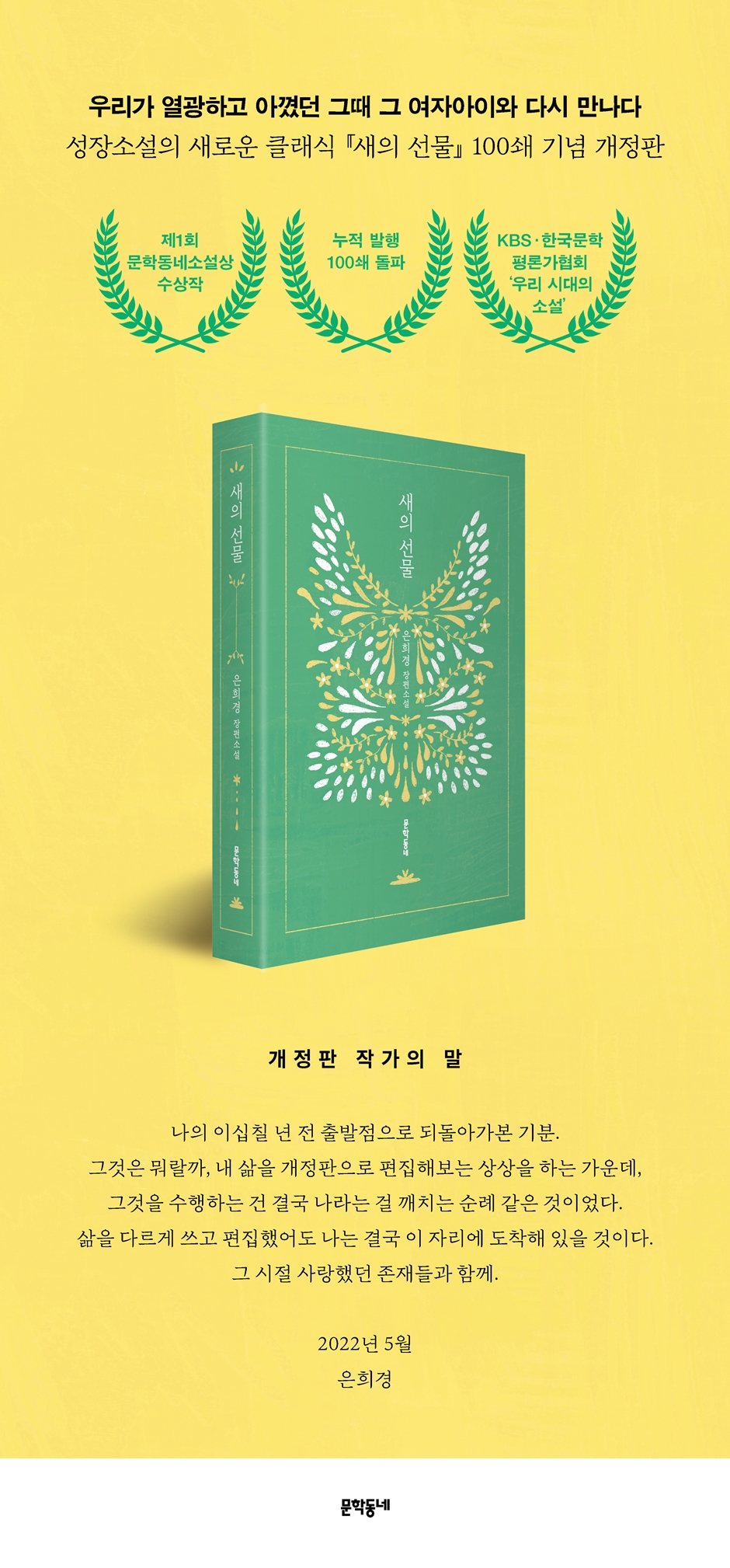
(…)
I feel like I've gone back to my starting point twenty-seven years ago.
It was, what could I say, a pilgrimage of imagining myself editing my life into a revised edition, only to realize that it was ultimately me who was doing it.
Even if I had written and edited my life differently, I would still be here in the end.
“With the people I loved back then.” _From the author’s note in the revised edition
★ KBSㆍKorea Literature Critics Association 'Novels of Our Time'
Eun Hee-kyung, the author who has always led today's Korean literature with new questions and leaps forward, presents 『A Bird's Gift』, her first full-length novel and winner of the first Munhakdongne Novel Award, in a revised edition commemorating the publication of her 100th printing, with a new cover and refined sentences and expressions.
The 100th printing of 『The Bird's Gift』, which has been consistently loved for nearly 30 years since its publication in 1995 and has established itself as a new milestone in coming-of-age novels, is a significant record in that it was achieved through the sympathy and love of readers across generations.
“It’s a book I still love enough to recommend to anyone” (Kim Cho-yeop), “It’s the mainstay of my literature and the book that helped me overcome the loneliness of my teenage years” (Park Sang-young), “Like many others who read “The Bird’s Gift,” I became a fan of author Eun Hee-kyung after reading this book” (Choi Eun-young), etc. 『The Bird’s Gift』 has had a strong influence on many writers and has become the most exciting and intimate doorway to Korean literature. With its lovable characters, detailed descriptions of the 1960s, and rich and precise sentences that awaken the charm of the Korean language, it is not only a textbook for full-length novels in its own right, but it was also a decisive step that turned Korean novels in a different direction from before.
Author Eun Hee-kyung says that she looked back at the book for the first time after the first edition was published in order to work on a revised edition.
This is his first book, which he completed after making his literary debut in 1995 through the New Year’s literary contest and, after a period of no requests, going to a temple in a remote area and working on it for several months.
The energy and passion the author poured into his work over a considerable period of time still vividly resonates with us today, 27 years later.
This revised edition, which preserves the passion of that time while carefully refining the words from a present-day perspective and exquisitely refining the landscape of that time, will keep us immersed in a full and passionate time from the moment we open the book until the very end.
“It happened to me because life had something to say to me.”
Twelve years old, drawn from the perspective of a child who has already completed his life
A brilliant insight into the truth of life and love.
In the winter of 1969, when you open the front door of the house leading to the ‘Seohung-dong Persimmon Tree House’ in the village, you can see two houses and one small house centered around a well.
One side of the house is the owner's house, and it houses 'Aunt Young-ok' who is late getting out of bed even though the sun has risen, 'Grandma' who is getting ready to go work in the field while sulking at her aunt, and 'Jin-hee', a twelve-year-old girl who casually looks at the two arguing people.
When Jinhee was six years old, her mother passed away, and her father disappeared, leaving her in the care of her grandmother. With the keen intuition and keen observation of someone who realized that “life was not very kind from the start” (p. 15), she sees through the events that happen in front of her and the people around her.
What do people look like in Jinhee's eyes? Their appearances are so diverse and unique that each and every one of them could be considered both a proper noun and a common noun representing a certain type.
First of all, 'General's Mother' and 'General', who live in another house, catch our attention.
Jang-gun, who likes to gossip and feels better when he interferes in everything, has a mother who occasionally upsets people, and Jang-gun, who “was born as an illegitimate child and could not escape the fate of a filial son from the moment he was born” (p. 320), is naive and innocent, so he is always chosen as Jin-hee’s observation and experiment subject.
What about the people of 'Gwangjin Terra' and 'New Style Yangjangjeom' who are sitting in a four-room gadget house?
The dissolute and pretentious ‘man of fortune’ of this era, ‘Mr. Gwangjin Terra’, who starts his chronicle with ‘This man, Park Gwangjin, in his old days’ whenever he opens his mouth, the deep-hearted ‘Mrs. Gwangjin Terra’ who diligently makes a living beside him, and ‘Sister Miss Lee’ who works as a maid at a tailor shop and hones her skills “for the ambition of rising in social status” (p. 110) breathe humorous vitality into the work throughout the novel, and at times heighten the tension, strongly immersing the reader.
And on the other side of the novel lies a detailed and rich description of the era.
Aunt Young-ok's love story, which began with a pen pal, vividly portrays the love and breakups of the youth of that time, and the impulsive behavior of the calm and understanding Gwangjin Terra woman, who one day explodes with "tremendous explosive force" the pain in her heart that she had been "holding tight" (p. 76), makes us guess at the intensity of the pressure that was oppressing women at that time.
And Jinhee's reading list, which is so diverse that she considers it "completed my insight into life" (p. 155), and the political situation of the time, which changed rapidly and sometimes determined someone's fate, also add richness to the novel.
But the decisive scene in 『The Bird's Gift』 is, above all, the moment that imprints on us the famous attitude of “dividing myself into ‘the seen me’ and ‘the looking me’” (p. 12).
My distance from my life begins with separating myself into the 'me that is seen' and the 'me that is observed.'
I always see myself.
I let the 'visible me' lead my life, and I make the 'looking me' see it.
This habit of having another self inside me watch my every move is something that has been going on for more than twenty years.
So my life has been sustained only by the constant tension of keeping life at arm's length from me.
I always want to watch my life from outside the streets. (Same side)
An attitude learned by a twelve-year-old who realizes that life is not kind to him.
This attitude of trying to lead life coolly by separating oneself into the 'visible me' and the 'observing me' seems to tell us that coolness is not the same as coolness or coldness, but another word for sincerity.
Looking at the things that happen to you objectively and trying to interpret them from your own perspective is an attitude that only someone who lives sincerely can have.
The moment when Eun Hee-kyung's signature sharpness and keenness were born was filled with such a burning passion for life.
★
“I reread the entire book for the first time to prepare a revised edition.
I keep seeing myself from the time I was writing this novel.
At that time, I was intimidated by the anxiety that everything I had believed might be wrong.
I felt neglected and incompetent, but the daily routine that I had to perform came without fail every day.
At night, I would write in my household account book with a tired and grimacing face, hoping that morning would never come.
I thought I couldn't want love anymore because I had to become the kind of person I hated.
Still, it was a time when I was good at joking.
Calm jokes about misfortune and loneliness.
It was a kind of daring that was allowed me at that time.
The more desperate I was, the more dry and stern my words became, hoping that if I were to be harsh to myself first, bad luck would be more lenient towards me.
(…)
I feel like I've gone back to my starting point twenty-seven years ago.
It was, what could I say, a pilgrimage of imagining myself editing my life into a revised edition, only to realize that it was ultimately me who was doing it.
Even if I had written and edited my life differently, I would still be here in the end.
“With the people I loved back then.” _From the author’s note in the revised edition
GOODS SPECIFICS
- Date of issue: June 3, 2022
- Page count, weight, size: 440 pages | 522g | 133*200*26mm
- ISBN13: 9788954687041
- ISBN10: 8954687040
You may also like
카테고리
korean


korean

![ELLE 엘르 스페셜 에디션 A형 : 12월 [2025]](http://librairie.coreenne.fr/cdn/shop/files/b8e27a3de6c9538896439686c6b0e8fb.jpg?v=1766436872&width=3840)


