

Thick data
 |
Description
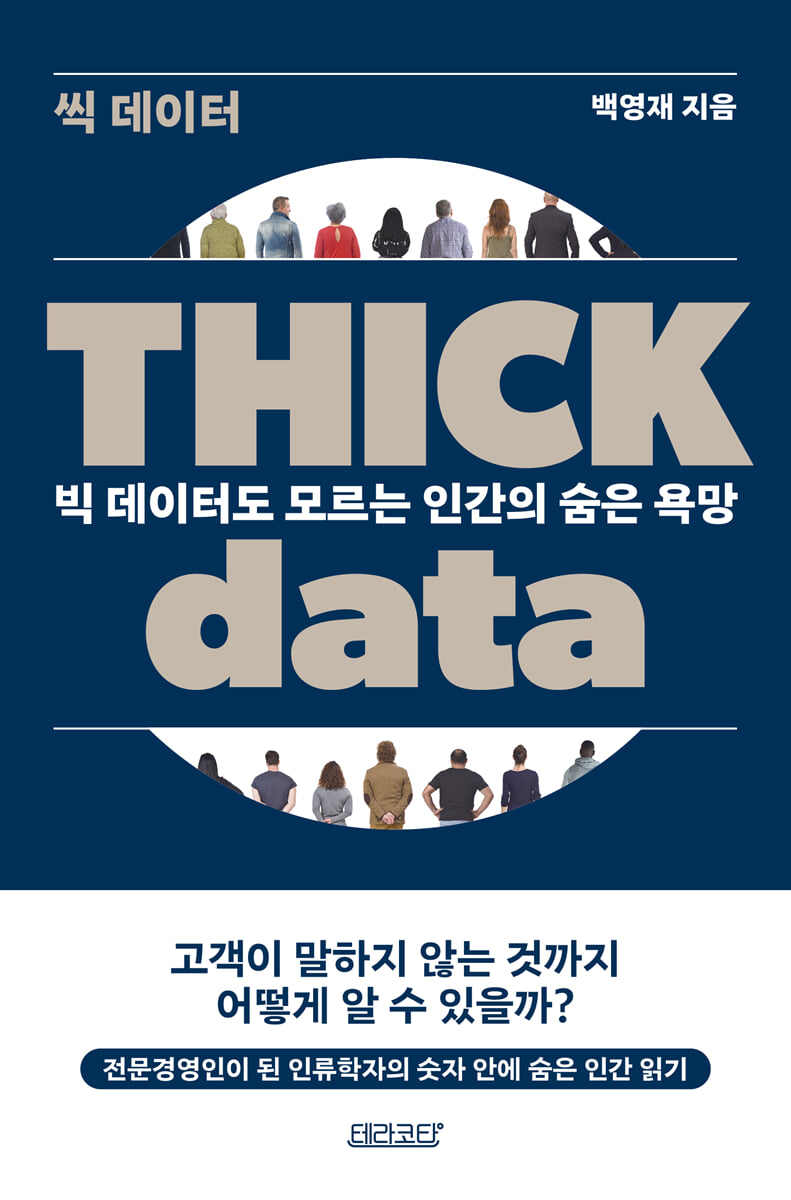
Book Introduction
Top companies like Netflix, Adidas, and Lego Why focus on thick data? We live in the age of big data, where massive amounts of data and cutting-edge algorithms offer the ultimate solution. As the saying goes, "Google God knows everything," I believe that big data can be used to interpret and delve into human hidden desires. However, no matter how much big data you collect, it is just numbers and not the entire picture of a human being. The author of this book says that to properly utilize big data, we need a new type of data called thick data, based on a humanities understanding. Thick data, which means 'thick data', explains the context and meaning contained in people's actual experiences and actions. While big data can only explain 'what and how much,' thick data tells us 'what happened, in what context, and why.' Top companies like Netflix, Adidas, and Lego are also paying attention to thick data because they can provide clues to predicting the future through 'why' rather than 'what.' This book emphasizes that only thick data reveals the real face and real experiences of humans that big data has intentionally neglected in its pursuit of standardization, and presents methodologies for collecting thick data and various ways to utilize it. |
- You can preview some of the book's contents.
Preview
index
introduction
PART 1: Anthropology: A Sophisticated Lens for Understanding Consumers
01 An Anthropological Perspective on the Business Behind the Scenes
Not 'despite being an anthropologist' but 'because he is an anthropologist'
Why the World's Leading Companies Work with Anthropologists
02 Cultural Relativism: Think Consumer-Centered
Breaking free from corporate centricity reveals consumers' hidden needs.
A global company in name only vs.
A global company to the core
The Korean market is no longer a burden.
03 A Holistic Approach: Consumers Are Not Just Numbers, They Exist in Our Daily Lives
There is no one in the Excel sheet.
21st-century companies want talent with a holistic perspective.
The power to imagine connections and relationships through the eyes of a bug
04 Participant Observation: Consumers Are Not Rational
Truths discovered by chance through participant observation
Consumers don't just seek benefits and convenience.
PART 2: Thick data knows the truth that big data doesn't.
01 Business insights come from thick data, not big data.
Understand the hidden meaning in the situation and context.
Insights into the "why" gained from a contextual "story"
02 What can thick data give us?
Netflix observes the reality of binge-watching in viewers' living rooms.
LEGO focuses on the essence of 'play' rather than the toys children want.
Adidas prepares for the next 20 years with thick data.
Ideo, which uses empathy and observation as its most powerful weapons.
03 THICK Framework for Obtaining Thick Data
Tolerance: Be tolerant of the unfamiliar based on cultural relativism.
Hidden desire: Discover consumers' hidden desires through observation.
Informants: Actively utilize extreme consumers and your own advisory group.
Context: Focus on the overall context, not just what the consumer says.
Kindred spirit: Empathize with consumers through engagement.
04 Beyond Thick Data to Smart Data
Gain insight with thick data, prove it with big data, and execute it with smart data.
Google's Human Truth: A Model Solution for Deriving Smart Data
PART 3: How to Discover Business Opportunities with Thick Data
01 Consumers Don't Tell the Truth
Don't ask consumers what they want; figure it out yourself.
To innovate, focus on the customer experience.
02 Meeting the end consumer reveals new opportunities.
Products are not used only as the developer intended.
Pay attention to how consumers use your product.
03 Consumers buy pride, not things.
Harley-Davidson sells experiences, not motorcycles.
Fans are one-person creators and one-person marketers for the brand.
Businesses create regulars, but relationships create fandom.
04 A consumer-centric mindset begins with corporate culture.
From a hierarchical vertical organization to a flexible horizontal organization
Small Habits Change Corporate Culture and Drive Innovation
05 How are internal capabilities for generating thick data created?
Why Store Employees Can Come Up with Ingenious Ideas
What Makes Organizations Different When It Comes to Creative Ideas?
06 Embracing diversity makes the future mine.
The talent companies should be looking for is not experts, but people on the periphery.
People who cross boundaries lead the future.
07 Even in the ChatGPT era, we are still primitive people.
There are no "accidental conflicts" when working from home.
The Secret to Success Found in Human Nature
The truth lies in the real world, not in virtual space.
* Articles, books, and websites referenced while writing this book
PART 1: Anthropology: A Sophisticated Lens for Understanding Consumers
01 An Anthropological Perspective on the Business Behind the Scenes
Not 'despite being an anthropologist' but 'because he is an anthropologist'
Why the World's Leading Companies Work with Anthropologists
02 Cultural Relativism: Think Consumer-Centered
Breaking free from corporate centricity reveals consumers' hidden needs.
A global company in name only vs.
A global company to the core
The Korean market is no longer a burden.
03 A Holistic Approach: Consumers Are Not Just Numbers, They Exist in Our Daily Lives
There is no one in the Excel sheet.
21st-century companies want talent with a holistic perspective.
The power to imagine connections and relationships through the eyes of a bug
04 Participant Observation: Consumers Are Not Rational
Truths discovered by chance through participant observation
Consumers don't just seek benefits and convenience.
PART 2: Thick data knows the truth that big data doesn't.
01 Business insights come from thick data, not big data.
Understand the hidden meaning in the situation and context.
Insights into the "why" gained from a contextual "story"
02 What can thick data give us?
Netflix observes the reality of binge-watching in viewers' living rooms.
LEGO focuses on the essence of 'play' rather than the toys children want.
Adidas prepares for the next 20 years with thick data.
Ideo, which uses empathy and observation as its most powerful weapons.
03 THICK Framework for Obtaining Thick Data
Tolerance: Be tolerant of the unfamiliar based on cultural relativism.
Hidden desire: Discover consumers' hidden desires through observation.
Informants: Actively utilize extreme consumers and your own advisory group.
Context: Focus on the overall context, not just what the consumer says.
Kindred spirit: Empathize with consumers through engagement.
04 Beyond Thick Data to Smart Data
Gain insight with thick data, prove it with big data, and execute it with smart data.
Google's Human Truth: A Model Solution for Deriving Smart Data
PART 3: How to Discover Business Opportunities with Thick Data
01 Consumers Don't Tell the Truth
Don't ask consumers what they want; figure it out yourself.
To innovate, focus on the customer experience.
02 Meeting the end consumer reveals new opportunities.
Products are not used only as the developer intended.
Pay attention to how consumers use your product.
03 Consumers buy pride, not things.
Harley-Davidson sells experiences, not motorcycles.
Fans are one-person creators and one-person marketers for the brand.
Businesses create regulars, but relationships create fandom.
04 A consumer-centric mindset begins with corporate culture.
From a hierarchical vertical organization to a flexible horizontal organization
Small Habits Change Corporate Culture and Drive Innovation
05 How are internal capabilities for generating thick data created?
Why Store Employees Can Come Up with Ingenious Ideas
What Makes Organizations Different When It Comes to Creative Ideas?
06 Embracing diversity makes the future mine.
The talent companies should be looking for is not experts, but people on the periphery.
People who cross boundaries lead the future.
07 Even in the ChatGPT era, we are still primitive people.
There are no "accidental conflicts" when working from home.
The Secret to Success Found in Human Nature
The truth lies in the real world, not in virtual space.
* Articles, books, and websites referenced while writing this book
Detailed image

Into the book
Since receiving my Ph.D. in Anthropology from Yale University, I have worked for leading companies such as McKinsey & Company, CJ, Blizzard Entertainment Korea, Google, and Philip Morris Korea for the past 20 years.
I believe that this career was possible not 'despite being a humanities major' but 'because I am a humanities major.'
Anthropologists define themselves as 'marginal men'.
When studying a group, to deeply empathize with its members without losing objectivity, one must firmly maintain the perspective of an outsider and an insider, that is, a bystander.
As someone with a peripheral identity, I've spent the past two decades exploring two seemingly unconnected worlds: anthropology and business, discovering and solidifying a path between them.
This book is both an anthropological record of my journey and a business report.
---From the "Preface"
Once they learn even a little about Korean culture, their attitude changes to, "We understand what Korean users want, so we'll try to reflect that."
It is not a difficult or unusual request, but rather a reasonable request with a socio-cultural context.
Consumers do not exist only as consumers.
Before they are consumers, they are members of numerous communities: their country, region, workplace, family, and taste communities.
Therefore, we should not limit them to users sitting in front of a computer or shoppers checking price tags at a supermarket counter.
Only by trying to understand in a holistic way what they talk about, where, when, with whom, why they laugh and why they get angry, where they focus their attention, and what they think about, can we begin to see their consumption patterns.
---From "PART 1 03 Holistic Approach: Consumers are not numbers, but exist in everyday life"
Big data and thick data can complement each other.
Big data, which is quantitative information, allows us to know 'what and how much,' while thick data, which is qualitative information, allows us to gain insight into 'why and in what context.'
Big data relying on machine learning can pursue accuracy, while thick data relying on human learning can pursue universal truth.
Big data, which identifies patterns by eliminating variables, is advantageous when uncertainty is low, while thick data, which accommodates complexity, is helpful when uncertainty is high.
If big data tells us what happened in the past and what is happening now, thick data tells us what will happen in the future and what we don't know yet.
---From "PART 2 01 Business insights come from thick data, not big data"
Why does it matter 'why' it happened?
If you don't know why you succeeded or failed, you can't carry over past success to the present, nor can you escape past failure.
For example, Blizzard didn't really understand why StarCraft I was such a huge success in Korea.
For this reason, StarCraft II was bound to have disappointing results in Korea.
If Blizzard had accurately analyzed the reasons why Koreans were crazy about StarCraft I, following the three steps mentioned above, they could have obtained smart data that would have led to the success of the next series and made StarCraft II a hit in Korea.
As Blizzard's case clearly shows, the clue to predicting the future always lies in the "why," not the "what."
Only smart data, which proves the insights of thick data with big data, can tell us what is happening and why, and can serve as an accurate standard for predicting the future.
---「PART 2 04.
From "Beyond Thick Data to Smart Data"
The reason consumer research doesn't yield innovative ideas is because consumers don't fully understand their own latent needs.
We are often unaware of the need or discomfort we feel in a particular situation until someone reminds us of it.
When P&G visited consumers' homes and observed how they used their detergents, they found that most consumers dissolved the detergent in water and stirred it with a stick.
However, consumers consistently said they had no complaints about P&G detergents.
Why didn't they say that the detergent didn't dissolve in water and was inconvenient?
It's not that he lied, he just didn't realize he was stirring the water he had mixed detergent in.
Through this participant observation, P&G developed a detergent that was highly soluble in water, and only after discovering this detergent in supermarkets did consumers become aware of their habit of mixing the detergent in water and stirring it.
It was only after a new product that solved the inconvenience was released that consumers themselves began to recognize the inconvenience they had experienced.
I believe that this career was possible not 'despite being a humanities major' but 'because I am a humanities major.'
Anthropologists define themselves as 'marginal men'.
When studying a group, to deeply empathize with its members without losing objectivity, one must firmly maintain the perspective of an outsider and an insider, that is, a bystander.
As someone with a peripheral identity, I've spent the past two decades exploring two seemingly unconnected worlds: anthropology and business, discovering and solidifying a path between them.
This book is both an anthropological record of my journey and a business report.
---From the "Preface"
Once they learn even a little about Korean culture, their attitude changes to, "We understand what Korean users want, so we'll try to reflect that."
It is not a difficult or unusual request, but rather a reasonable request with a socio-cultural context.
Consumers do not exist only as consumers.
Before they are consumers, they are members of numerous communities: their country, region, workplace, family, and taste communities.
Therefore, we should not limit them to users sitting in front of a computer or shoppers checking price tags at a supermarket counter.
Only by trying to understand in a holistic way what they talk about, where, when, with whom, why they laugh and why they get angry, where they focus their attention, and what they think about, can we begin to see their consumption patterns.
---From "PART 1 03 Holistic Approach: Consumers are not numbers, but exist in everyday life"
Big data and thick data can complement each other.
Big data, which is quantitative information, allows us to know 'what and how much,' while thick data, which is qualitative information, allows us to gain insight into 'why and in what context.'
Big data relying on machine learning can pursue accuracy, while thick data relying on human learning can pursue universal truth.
Big data, which identifies patterns by eliminating variables, is advantageous when uncertainty is low, while thick data, which accommodates complexity, is helpful when uncertainty is high.
If big data tells us what happened in the past and what is happening now, thick data tells us what will happen in the future and what we don't know yet.
---From "PART 2 01 Business insights come from thick data, not big data"
Why does it matter 'why' it happened?
If you don't know why you succeeded or failed, you can't carry over past success to the present, nor can you escape past failure.
For example, Blizzard didn't really understand why StarCraft I was such a huge success in Korea.
For this reason, StarCraft II was bound to have disappointing results in Korea.
If Blizzard had accurately analyzed the reasons why Koreans were crazy about StarCraft I, following the three steps mentioned above, they could have obtained smart data that would have led to the success of the next series and made StarCraft II a hit in Korea.
As Blizzard's case clearly shows, the clue to predicting the future always lies in the "why," not the "what."
Only smart data, which proves the insights of thick data with big data, can tell us what is happening and why, and can serve as an accurate standard for predicting the future.
---「PART 2 04.
From "Beyond Thick Data to Smart Data"
The reason consumer research doesn't yield innovative ideas is because consumers don't fully understand their own latent needs.
We are often unaware of the need or discomfort we feel in a particular situation until someone reminds us of it.
When P&G visited consumers' homes and observed how they used their detergents, they found that most consumers dissolved the detergent in water and stirred it with a stick.
However, consumers consistently said they had no complaints about P&G detergents.
Why didn't they say that the detergent didn't dissolve in water and was inconvenient?
It's not that he lied, he just didn't realize he was stirring the water he had mixed detergent in.
Through this participant observation, P&G developed a detergent that was highly soluble in water, and only after discovering this detergent in supermarkets did consumers become aware of their habit of mixing the detergent in water and stirring it.
It was only after a new product that solved the inconvenience was released that consumers themselves began to recognize the inconvenience they had experienced.
---From "PART 3 01 Consumers Don't Tell the Truth"
Publisher's Review
The true desires of humans that cannot be known through big data
In a world where everything we do becomes data, many people say that big data can reveal hidden human desires.
However, no matter how large a volume of data is secured, big data is just numbers.
For example, Nokia ultimately failed because it relied solely on big data to predict whether people would buy expensive smartphones like the iPhone.
On the other hand, Lego had a time when it was in crisis, but it was able to make a miraculous recovery by listening to what children and parents truly wanted.
Companies that have succeeded in reviving their businesses have focused on thick data, which reveals the real face and real experiences of humans that big data has intentionally ignored.
While big data can only explain 'what and how much' with quantitative information, thick data can provide insight into what happened, in what context, and why with qualitative information.
This book argues that big data, often called the "god of the 21st century," is actually only half the truth, and that to complement it, we must focus on thick data based on a humanistic understanding.
Consumers are not logical and rational beings as assumed in orthodox economics.
Consumers' judgments are often irrational, fluid, and unstable, and their true desires are always deeply hidden and not revealed.
Therefore, to deeply understand consumers, we must understand the context and meaning behind their actual experiences and behaviors.
In that sense, the author of this book emphasizes that both big data and thick data are necessary if a company wants to fully understand its consumers.
An anthropologist's sophisticated lens provides a deep understanding of consumers.
The author of this book has worked for leading companies such as McKinsey & Company, CJ, Blizzard Entertainment Korea, Google, and Philip Morris Korea for the past 20 years since receiving a Ph.D. in Anthropology from Yale University.
This career was possible because I majored in humanities.
He explored two seemingly unconnected worlds—anthropology and business—and forged a strong path between them.
This book is both an anthropological record and a business report of the author's journey.
In today's world, where consumer experience is as important as the quality of products and services, only companies that understand consumers better and more deeply can survive.
Anthropology can be explained by its philosophical background of cultural relativism, its problem-solving approach of holistic approach, and its research methodology of participant observation. When these three anthropological perspectives are applied to business, they become a sophisticated lens that provides a deep understanding of consumers.
Furthermore, anthropology is an effective tool for diagnosing the present state of a company and predicting the future, as it provides insight into where humanity has come and where it is headed.
How to Discover Business Opportunities with Thick Data
This book introduces the "THICK Framework," five methods for gathering thick consumer data based on an anthropological perspective. The THICK Framework encompasses five methodologies: Tolerance, a generous approach to unfamiliarity grounded in cultural relativism; Hidden Desire, which uncovers consumers' hidden desires through observation; Informants, which actively utilizes extreme consumers and a personal advisory group; Context, which focuses on the overall context rather than consumers' words; and Kindred Spirit, which empathizes with consumers through participation.
The process of collecting thick data in these ways, gaining insight, proving it with big data, and then executing it with smart data helps predict the future in a rapidly changing business environment.
The author of this book says that big data can show what is happening, but it cannot tell us 'why' it happened.
Therefore, rather than relying solely on consumer research based on big data, we must accurately identify and understand consumers' unconscious habits and behaviors according to the THICK framework to generate innovative ideas and business opportunities.
In a world where everything we do becomes data, many people say that big data can reveal hidden human desires.
However, no matter how large a volume of data is secured, big data is just numbers.
For example, Nokia ultimately failed because it relied solely on big data to predict whether people would buy expensive smartphones like the iPhone.
On the other hand, Lego had a time when it was in crisis, but it was able to make a miraculous recovery by listening to what children and parents truly wanted.
Companies that have succeeded in reviving their businesses have focused on thick data, which reveals the real face and real experiences of humans that big data has intentionally ignored.
While big data can only explain 'what and how much' with quantitative information, thick data can provide insight into what happened, in what context, and why with qualitative information.
This book argues that big data, often called the "god of the 21st century," is actually only half the truth, and that to complement it, we must focus on thick data based on a humanistic understanding.
Consumers are not logical and rational beings as assumed in orthodox economics.
Consumers' judgments are often irrational, fluid, and unstable, and their true desires are always deeply hidden and not revealed.
Therefore, to deeply understand consumers, we must understand the context and meaning behind their actual experiences and behaviors.
In that sense, the author of this book emphasizes that both big data and thick data are necessary if a company wants to fully understand its consumers.
An anthropologist's sophisticated lens provides a deep understanding of consumers.
The author of this book has worked for leading companies such as McKinsey & Company, CJ, Blizzard Entertainment Korea, Google, and Philip Morris Korea for the past 20 years since receiving a Ph.D. in Anthropology from Yale University.
This career was possible because I majored in humanities.
He explored two seemingly unconnected worlds—anthropology and business—and forged a strong path between them.
This book is both an anthropological record and a business report of the author's journey.
In today's world, where consumer experience is as important as the quality of products and services, only companies that understand consumers better and more deeply can survive.
Anthropology can be explained by its philosophical background of cultural relativism, its problem-solving approach of holistic approach, and its research methodology of participant observation. When these three anthropological perspectives are applied to business, they become a sophisticated lens that provides a deep understanding of consumers.
Furthermore, anthropology is an effective tool for diagnosing the present state of a company and predicting the future, as it provides insight into where humanity has come and where it is headed.
How to Discover Business Opportunities with Thick Data
This book introduces the "THICK Framework," five methods for gathering thick consumer data based on an anthropological perspective. The THICK Framework encompasses five methodologies: Tolerance, a generous approach to unfamiliarity grounded in cultural relativism; Hidden Desire, which uncovers consumers' hidden desires through observation; Informants, which actively utilizes extreme consumers and a personal advisory group; Context, which focuses on the overall context rather than consumers' words; and Kindred Spirit, which empathizes with consumers through participation.
The process of collecting thick data in these ways, gaining insight, proving it with big data, and then executing it with smart data helps predict the future in a rapidly changing business environment.
The author of this book says that big data can show what is happening, but it cannot tell us 'why' it happened.
Therefore, rather than relying solely on consumer research based on big data, we must accurately identify and understand consumers' unconscious habits and behaviors according to the THICK framework to generate innovative ideas and business opportunities.
GOODS SPECIFICS
- Date of issue: July 17, 2023
- Page count, weight, size: 248 pages | 145*220*20mm
- ISBN13: 9791198180339
- ISBN10: 1198180331
You may also like
카테고리
korean


korean

![GQ KOREA Mark (Monthly): December [2025]](http://librairie.coreenne.fr/cdn/shop/files/8ef265dbbfbf186523ed75ba7319009d.jpg?v=1765340328&width=3840)


