

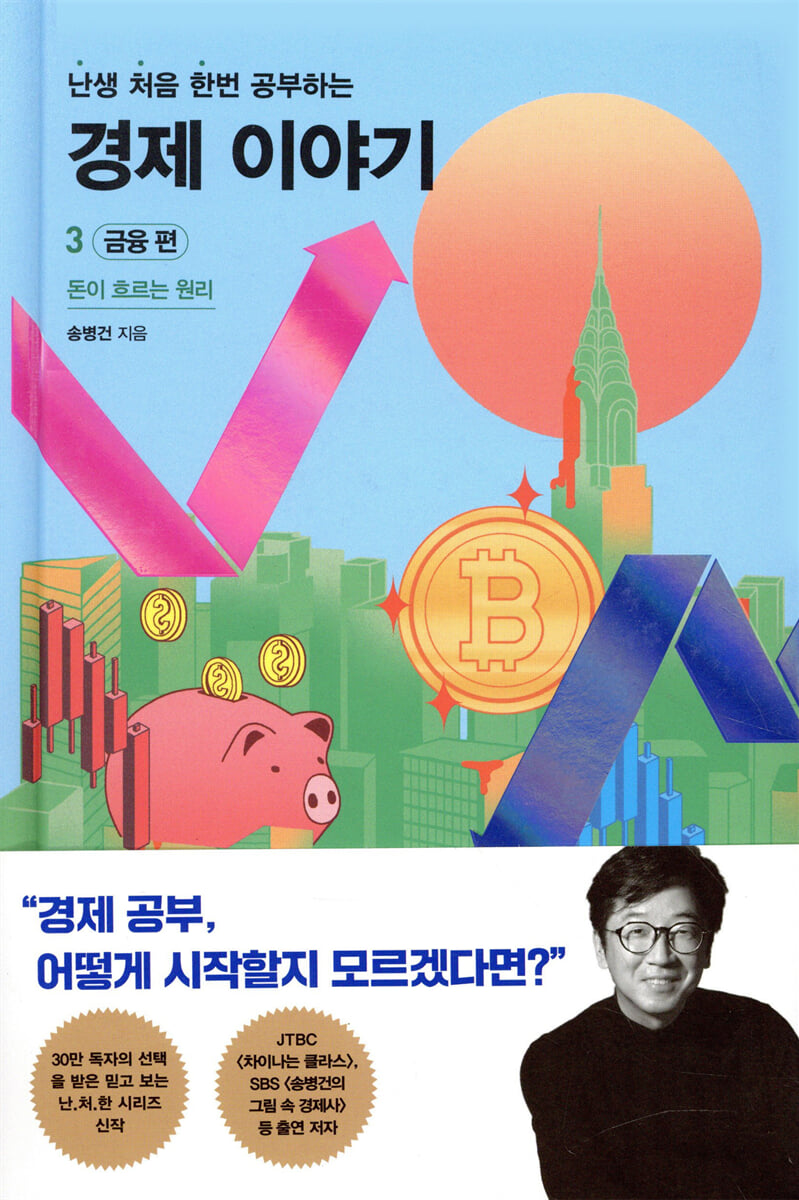
Awkward Economic Stories Part 3: Finance
 |
Description
Book Introduction
Volume 3 of "The Tough Economic Story," the finance section, comprehensively covers how the financial world surrounding us divides, splits, flows, and absorbs money.
A particularly important stage is the bank, and among them, the central bank.
This is because it is an institution that decides and implements financial policies that affect our daily lives, including adjusting the base interest rate.
This book organizes confusing financial knowledge, focusing on banks, interest rates, inflation, and exchange rates, into an easy-to-understand format.
And that's not all.
We also cover various financial products that you may have heard of but not fully understood.
It allows students to naturally learn the principles and risks of derivatives, including stocks, funds, futures, and options.
By following the author's friendly lectures, you will experience the experience of understanding finance, which once seemed difficult, in an easy way.
A particularly important stage is the bank, and among them, the central bank.
This is because it is an institution that decides and implements financial policies that affect our daily lives, including adjusting the base interest rate.
This book organizes confusing financial knowledge, focusing on banks, interest rates, inflation, and exchange rates, into an easy-to-understand format.
And that's not all.
We also cover various financial products that you may have heard of but not fully understood.
It allows students to naturally learn the principles and risks of derivatives, including stocks, funds, futures, and options.
By following the author's friendly lectures, you will experience the experience of understanding finance, which once seemed difficult, in an easy way.
- You can preview some of the book's contents.
Preview
index
Ⅰ In the Beginning, There Was Debt - Finance and Risk
▶ Human life has a rhythm.
01 Unavoidable Finance
02 The Heart of Capitalism: Banks
▶ A decisive moment in banking
II How to Create Something Out of Nothing - Inflation of Credit
▶ Early history of coins and banknotes
01 What is money?
02 Is the goal price stability?
03 Principles of Exchange Rate Movement
▶ Reserve Currencies in History
III. Money that Expands Endlessly - Financial Investments Here and Now
▶ What is the best way to show off your wealth?
01 Stocks, Opening the Door to Investment
02 Fund, Building a Big Ship
03 The World of Futures, Options, and Derivatives
04 The Present and Future of Finance
▶ Why would you want to issue a digital currency?
▶ Human life has a rhythm.
01 Unavoidable Finance
02 The Heart of Capitalism: Banks
▶ A decisive moment in banking
II How to Create Something Out of Nothing - Inflation of Credit
▶ Early history of coins and banknotes
01 What is money?
02 Is the goal price stability?
03 Principles of Exchange Rate Movement
▶ Reserve Currencies in History
III. Money that Expands Endlessly - Financial Investments Here and Now
▶ What is the best way to show off your wealth?
01 Stocks, Opening the Door to Investment
02 Fund, Building a Big Ship
03 The World of Futures, Options, and Derivatives
04 The Present and Future of Finance
▶ Why would you want to issue a digital currency?
Detailed image

Into the book
Here, let's first understand the role of finance.
The basics are this.
When your money is transformed into financial assets through financial institutions, it can reach a much wider world.
Surplus funds, that is, money that was stranded in someone's pocket and had no immediate use, can now be transferred to someone who needs it.
---From "Part 1, Chapter 1, 'Inescapable Finance'"
Today, we buy gold at a price that fluctuates based on market supply and demand. That wasn't the case in Britain at one time.
If you take your banknotes to the bank, they will immediately exchange them for gold.
Exchanging banknotes for precious metals in this way is called convertibility.
Banknotes that can be exchanged for gold and silver are called convertible banknotes, and today's banknotes that cannot be exchanged for gold and silver are called inconvertible banknotes.
---From "Part 2, Chapter 1, 'What is Money?'"
Some people like it when prices go up.
For example, inflation is beneficial to those who own real assets such as land, factories, apartments, or gold and silver.
This is because when inflation occurs, the value of currency falls and the relative value of real assets rises.
When prices rise, housing prices also rise, and landlords use that as a reason to raise rents from tenants. Similar things happen in every sector.
----From "Part 2, Chapter 2, 'Is the Goal Price Stability?'"
Quantitative easing is like a shock to the heart.
When performing CPR, you are told to perform chest compressions first, and if consciousness does not return, use a defibrillator.
Quantitative easing is the first shock to the collapsed economy with a base interest rate cut, but when there is no sign of recovery, it is like using a shock absorber.
---From "Part 2, Chapter 2, 'Is the Goal Price Stability?'"
For example, let's assume that an American investor invested $10,000 in the domestic bond market when the dollar was worth 800 won.
If you exchanged dollars into won, you would have invested about 8 million won.
But what if, with your investment return of approximately 10%, the exchange rate rises to 1,000 won per dollar? With a return of 800,000 won, your total assets in Korean won would be 8.8 million won. However, if you convert it back to dollars, it would be worth only $8,800, effectively shrinking your principal.
The exchange rate fluctuations have caused the valuation of the currencies to change.
If you suffer a loss in this way, it is called an exchange loss, and if you suffer a profit, it is called an exchange gain.
It means loss or profit due to exchange rate difference.
---From "Part 2, Chapter 3, 'The Principle of Exchange Rate Movement'"
But there are more compelling reasons why the dollar remains the default currency in today's global trade markets.
Today, the dollar is linked to a resource far more important than gold in modern society.
It's energy.
More specifically, it refers to oil.
The dollar is linked to oil? How so?
The United States has long recognized the value of oil.
In 1974, three years after the Nixon Shock abolished the gold standard, then-US Secretary of State Henry Kissinger visited Saudi Arabia, then leading the Organization of Petroleum Exporting Countries (OPEC), and concluded a surprising agreement.
The content was that when buying and selling OPEC oil, payments could only be made in dollars, and oil prices were also to be set based on dollars.
Simply put, they've made it impossible to trade crude oil without the dollar.
---From "Part 2, Chapter 3, 'The Principle of Exchange Rate Movement'"
But when the first joint-stock company was created 400 years ago, shareholders' meetings were primarily for discussing dividends.
Even back then, shareholders and inside directors would fight over dividends.
This is the story of the Dutch East India Company, founded in 1602.
When the East India Company first issued stock, it promised to pay out 5% of its capital to shareholders every time it made a profit, but it never kept its word.
Instead, he used the money to expand his business, including buying new ships.
Minority shareholders who did not receive the dividends they wanted staged protests, denouncing management for not paying proper dividends.
---From "Part 3, Chapter 1, 'Stocks, Opening the Door to Investment'"
Private equity funds can do things other funds can't.
For example, you can acquire control of a company by purchasing a large amount of bonds or stocks from a failing company and transform it into a sound company.
Then you resell it and make a profit.
Since not all private equity funds perform this role, private equity funds for this purpose are called PEFs or private equity funds.
Corporate mergers and acquisitions, one of the most important issues in the market, are actively occurring as private equity funds restructure insolvent companies.
---From "Part 3, Chapter 2, 'Funds, Building a Big Ship'"
However, compared to the value of the currencies of smaller countries, Bitcoin may actually be more stable.
In addition to Bitcoin, there are many different coins emerging these days. Some of them are created by trustworthy multinational corporations, while others are pegged to the US dollar.
These cryptocurrencies may be less volatile than the currencies of smaller countries.
---From "Part 3, Chapter 4, 'The Present and Future of Finance'"
The growth of derivatives has played a major role in the expansion of financial markets.
The financial market rapidly expanded as futures and options, which are made by further processing securities, increased.
The derivatives market is now more than seven times the size of global GDP.
We've already entered an era where giant hedge funds manage more money than the national budgets of small countries, and this trend will only intensify.
The basics are this.
When your money is transformed into financial assets through financial institutions, it can reach a much wider world.
Surplus funds, that is, money that was stranded in someone's pocket and had no immediate use, can now be transferred to someone who needs it.
---From "Part 1, Chapter 1, 'Inescapable Finance'"
Today, we buy gold at a price that fluctuates based on market supply and demand. That wasn't the case in Britain at one time.
If you take your banknotes to the bank, they will immediately exchange them for gold.
Exchanging banknotes for precious metals in this way is called convertibility.
Banknotes that can be exchanged for gold and silver are called convertible banknotes, and today's banknotes that cannot be exchanged for gold and silver are called inconvertible banknotes.
---From "Part 2, Chapter 1, 'What is Money?'"
Some people like it when prices go up.
For example, inflation is beneficial to those who own real assets such as land, factories, apartments, or gold and silver.
This is because when inflation occurs, the value of currency falls and the relative value of real assets rises.
When prices rise, housing prices also rise, and landlords use that as a reason to raise rents from tenants. Similar things happen in every sector.
----From "Part 2, Chapter 2, 'Is the Goal Price Stability?'"
Quantitative easing is like a shock to the heart.
When performing CPR, you are told to perform chest compressions first, and if consciousness does not return, use a defibrillator.
Quantitative easing is the first shock to the collapsed economy with a base interest rate cut, but when there is no sign of recovery, it is like using a shock absorber.
---From "Part 2, Chapter 2, 'Is the Goal Price Stability?'"
For example, let's assume that an American investor invested $10,000 in the domestic bond market when the dollar was worth 800 won.
If you exchanged dollars into won, you would have invested about 8 million won.
But what if, with your investment return of approximately 10%, the exchange rate rises to 1,000 won per dollar? With a return of 800,000 won, your total assets in Korean won would be 8.8 million won. However, if you convert it back to dollars, it would be worth only $8,800, effectively shrinking your principal.
The exchange rate fluctuations have caused the valuation of the currencies to change.
If you suffer a loss in this way, it is called an exchange loss, and if you suffer a profit, it is called an exchange gain.
It means loss or profit due to exchange rate difference.
---From "Part 2, Chapter 3, 'The Principle of Exchange Rate Movement'"
But there are more compelling reasons why the dollar remains the default currency in today's global trade markets.
Today, the dollar is linked to a resource far more important than gold in modern society.
It's energy.
More specifically, it refers to oil.
The dollar is linked to oil? How so?
The United States has long recognized the value of oil.
In 1974, three years after the Nixon Shock abolished the gold standard, then-US Secretary of State Henry Kissinger visited Saudi Arabia, then leading the Organization of Petroleum Exporting Countries (OPEC), and concluded a surprising agreement.
The content was that when buying and selling OPEC oil, payments could only be made in dollars, and oil prices were also to be set based on dollars.
Simply put, they've made it impossible to trade crude oil without the dollar.
---From "Part 2, Chapter 3, 'The Principle of Exchange Rate Movement'"
But when the first joint-stock company was created 400 years ago, shareholders' meetings were primarily for discussing dividends.
Even back then, shareholders and inside directors would fight over dividends.
This is the story of the Dutch East India Company, founded in 1602.
When the East India Company first issued stock, it promised to pay out 5% of its capital to shareholders every time it made a profit, but it never kept its word.
Instead, he used the money to expand his business, including buying new ships.
Minority shareholders who did not receive the dividends they wanted staged protests, denouncing management for not paying proper dividends.
---From "Part 3, Chapter 1, 'Stocks, Opening the Door to Investment'"
Private equity funds can do things other funds can't.
For example, you can acquire control of a company by purchasing a large amount of bonds or stocks from a failing company and transform it into a sound company.
Then you resell it and make a profit.
Since not all private equity funds perform this role, private equity funds for this purpose are called PEFs or private equity funds.
Corporate mergers and acquisitions, one of the most important issues in the market, are actively occurring as private equity funds restructure insolvent companies.
---From "Part 3, Chapter 2, 'Funds, Building a Big Ship'"
However, compared to the value of the currencies of smaller countries, Bitcoin may actually be more stable.
In addition to Bitcoin, there are many different coins emerging these days. Some of them are created by trustworthy multinational corporations, while others are pegged to the US dollar.
These cryptocurrencies may be less volatile than the currencies of smaller countries.
---From "Part 3, Chapter 4, 'The Present and Future of Finance'"
The growth of derivatives has played a major role in the expansion of financial markets.
The financial market rapidly expanded as futures and options, which are made by further processing securities, increased.
The derivatives market is now more than seven times the size of global GDP.
We've already entered an era where giant hedge funds manage more money than the national budgets of small countries, and this trend will only intensify.
---From "Part 3, Chapter 4, 'The Present and Future of Finance'"
Publisher's Review
★ An irreplaceable economic user manual that you can read once and use for a lifetime!
★ A new challenge for the "Embarrassing Series," chosen by 300,000 readers! Economics is finally easy to read!
★ Newspaper materials to help you read economic articles on your own, illustrations to help you understand the text, online quizzes to review what you've learned, and even glossaries that explain difficult terms!
The more anxious you become, the more you need to start from the basics! Now is the time to study the economic principles that will last a lifetime!
You may have experienced feeling anxious when you hear economic news every day.
There are rumors of soaring prices, of interest rates fluctuating…
Even if it doesn't directly impact my life right away, hearing news like this makes me feel anxious.
"The Difficult Economic Story" tells us to stop trembling with anxiety and start learning about the fundamental principles of how the economy works.
There are many economics books on the market, but it is difficult to find one that provides a solid foundation.
Most books either list out bits of information or jump to conclusions about which stocks to buy, or the content is too specialized for the average person to understand and apply.
There was a desperate need for an entertaining, practical economics textbook that would help anyone, from any perspective, understand the economy.
"The Embarrassing Economic Story" was launched with that very role in mind.
Professor Song Byeong-geon of the Department of Economics at Sungkyunkwan University participated in the writing.
Professor Song Byeong-geon has been publishing high-quality educational books for the general public, striving to introduce economics as an interesting story rather than a specialized field.
As my major is economic history, I used a variety of historical examples to help people understand complex realities.
The author says, “I hope that everyone who has found economics difficult will be able to easily overcome the economic barrier with this book.”
As the author literally tells the story, you will have the experience of suddenly becoming familiar with unfamiliar economics.
A sound economics primer for everyone: more entertaining than novels and more useful than YouTube.
The Awkward Series is a proven guide for readers who want to learn new knowledge.
The series 『Embarrassing Stories of Art』 (by Yang Jeong-mu), 『Embarrassing Classical Classes』 (by Min Eun-gi), and 『Embarrassing Stories of Oriental Art』 (by Kang Hee-jung), which have already been loved by many readers, have all established themselves as friendly introductory books that definitely scratch an itch.
The core message running through these series is that they present practical knowledge that is helpful in real life at a level that is accessible to the general public.
The kindness of the awkward series shines even brighter when it comes to the difficult subject of economics.
As with previous series, the text is structured in a conversational style and reads smoothly, as if listening to it.
Unlike other economics books, which spew vague technical terms or list rigid graphs, this book actively utilizes familiar, everyday language and interesting storytelling.
The abundant photographs and witty illustrations throughout the book, combined with the author's usual strength of "explaining the economy using visual materials," maximize the sense of presence and immersion.
The author's content, combined with the series' unique format, has created a great synergy effect in terms of 'economic storytelling.'
In addition, the comprehensive structure, including economic articles, quizzes, and glossary of terms, helps readers fully digest and review what they have learned.
Through this book, you will no longer feel obligated to learn about economics, but will be able to begin studying economics for real.
Anyone who has had financial difficulties, come here!
Finance is something that many people are curious about, but few actually know about. The third protagonist of 'Awkward Economic Stories' is finance.
If you built the basics of economics in Volume 1 and expanded your thinking to the global level through Volume 2, Markets and Trade, you'll learn the principles that make money flow in Volume 3, Finance.
When we think of finance, we often think of complex financial products, but ultimately, finance is about the flow of money.
And at its core is the heart of capitalism: the 'bank'.
By following what banks do, what their sources of income are, and how they increase the money supply, you will naturally come to understand the stage where finance takes place.
The most important of these is the central bank.
The primary goal of the central bank, which is responsible for currency issuance and financial policy, is none other than price stability.
Central banks do their best to stabilize the economy, such as striking a balance between excessive inflation and deflation and intervening in the foreign exchange market to adjust exchange rates. Their decisions, like dominoes, have a significant impact on our daily lives.
From the nature of money to the full story of Japan's lost 30 years, you'll hear a wide range of stories about prices, interest rates, and exchange rates, focusing on the role of the central bank.
We cannot leave out financial stories for investment purposes.
It provides an easy-to-understand explanation of the principles behind financial products such as stocks, funds, derivatives including futures and options, and fintech and cryptocurrencies.
Even those who cringe at the mere mention of the word "finance" will be able to let go of their prejudices through this section on finance and understand the principles of how money flows and will flow in the world we live in.
★ A new challenge for the "Embarrassing Series," chosen by 300,000 readers! Economics is finally easy to read!
★ Newspaper materials to help you read economic articles on your own, illustrations to help you understand the text, online quizzes to review what you've learned, and even glossaries that explain difficult terms!
The more anxious you become, the more you need to start from the basics! Now is the time to study the economic principles that will last a lifetime!
You may have experienced feeling anxious when you hear economic news every day.
There are rumors of soaring prices, of interest rates fluctuating…
Even if it doesn't directly impact my life right away, hearing news like this makes me feel anxious.
"The Difficult Economic Story" tells us to stop trembling with anxiety and start learning about the fundamental principles of how the economy works.
There are many economics books on the market, but it is difficult to find one that provides a solid foundation.
Most books either list out bits of information or jump to conclusions about which stocks to buy, or the content is too specialized for the average person to understand and apply.
There was a desperate need for an entertaining, practical economics textbook that would help anyone, from any perspective, understand the economy.
"The Embarrassing Economic Story" was launched with that very role in mind.
Professor Song Byeong-geon of the Department of Economics at Sungkyunkwan University participated in the writing.
Professor Song Byeong-geon has been publishing high-quality educational books for the general public, striving to introduce economics as an interesting story rather than a specialized field.
As my major is economic history, I used a variety of historical examples to help people understand complex realities.
The author says, “I hope that everyone who has found economics difficult will be able to easily overcome the economic barrier with this book.”
As the author literally tells the story, you will have the experience of suddenly becoming familiar with unfamiliar economics.
A sound economics primer for everyone: more entertaining than novels and more useful than YouTube.
The Awkward Series is a proven guide for readers who want to learn new knowledge.
The series 『Embarrassing Stories of Art』 (by Yang Jeong-mu), 『Embarrassing Classical Classes』 (by Min Eun-gi), and 『Embarrassing Stories of Oriental Art』 (by Kang Hee-jung), which have already been loved by many readers, have all established themselves as friendly introductory books that definitely scratch an itch.
The core message running through these series is that they present practical knowledge that is helpful in real life at a level that is accessible to the general public.
The kindness of the awkward series shines even brighter when it comes to the difficult subject of economics.
As with previous series, the text is structured in a conversational style and reads smoothly, as if listening to it.
Unlike other economics books, which spew vague technical terms or list rigid graphs, this book actively utilizes familiar, everyday language and interesting storytelling.
The abundant photographs and witty illustrations throughout the book, combined with the author's usual strength of "explaining the economy using visual materials," maximize the sense of presence and immersion.
The author's content, combined with the series' unique format, has created a great synergy effect in terms of 'economic storytelling.'
In addition, the comprehensive structure, including economic articles, quizzes, and glossary of terms, helps readers fully digest and review what they have learned.
Through this book, you will no longer feel obligated to learn about economics, but will be able to begin studying economics for real.
Anyone who has had financial difficulties, come here!
Finance is something that many people are curious about, but few actually know about. The third protagonist of 'Awkward Economic Stories' is finance.
If you built the basics of economics in Volume 1 and expanded your thinking to the global level through Volume 2, Markets and Trade, you'll learn the principles that make money flow in Volume 3, Finance.
When we think of finance, we often think of complex financial products, but ultimately, finance is about the flow of money.
And at its core is the heart of capitalism: the 'bank'.
By following what banks do, what their sources of income are, and how they increase the money supply, you will naturally come to understand the stage where finance takes place.
The most important of these is the central bank.
The primary goal of the central bank, which is responsible for currency issuance and financial policy, is none other than price stability.
Central banks do their best to stabilize the economy, such as striking a balance between excessive inflation and deflation and intervening in the foreign exchange market to adjust exchange rates. Their decisions, like dominoes, have a significant impact on our daily lives.
From the nature of money to the full story of Japan's lost 30 years, you'll hear a wide range of stories about prices, interest rates, and exchange rates, focusing on the role of the central bank.
We cannot leave out financial stories for investment purposes.
It provides an easy-to-understand explanation of the principles behind financial products such as stocks, funds, derivatives including futures and options, and fintech and cryptocurrencies.
Even those who cringe at the mere mention of the word "finance" will be able to let go of their prejudices through this section on finance and understand the principles of how money flows and will flow in the world we live in.
GOODS SPECIFICS
- Publication date: June 21, 2022
- Format: Hardcover book binding method guide
- Page count, weight, size: 436 pages | 684g | 135*205*28mm
- ISBN13: 9791162732267
- ISBN10: 1162732261
You may also like
카테고리
korean


korean

![GQ KOREA Mark (Monthly): December [2025]](http://librairie.coreenne.fr/cdn/shop/files/8ef265dbbfbf186523ed75ba7319009d.jpg?v=1765340328&width=3840)


