

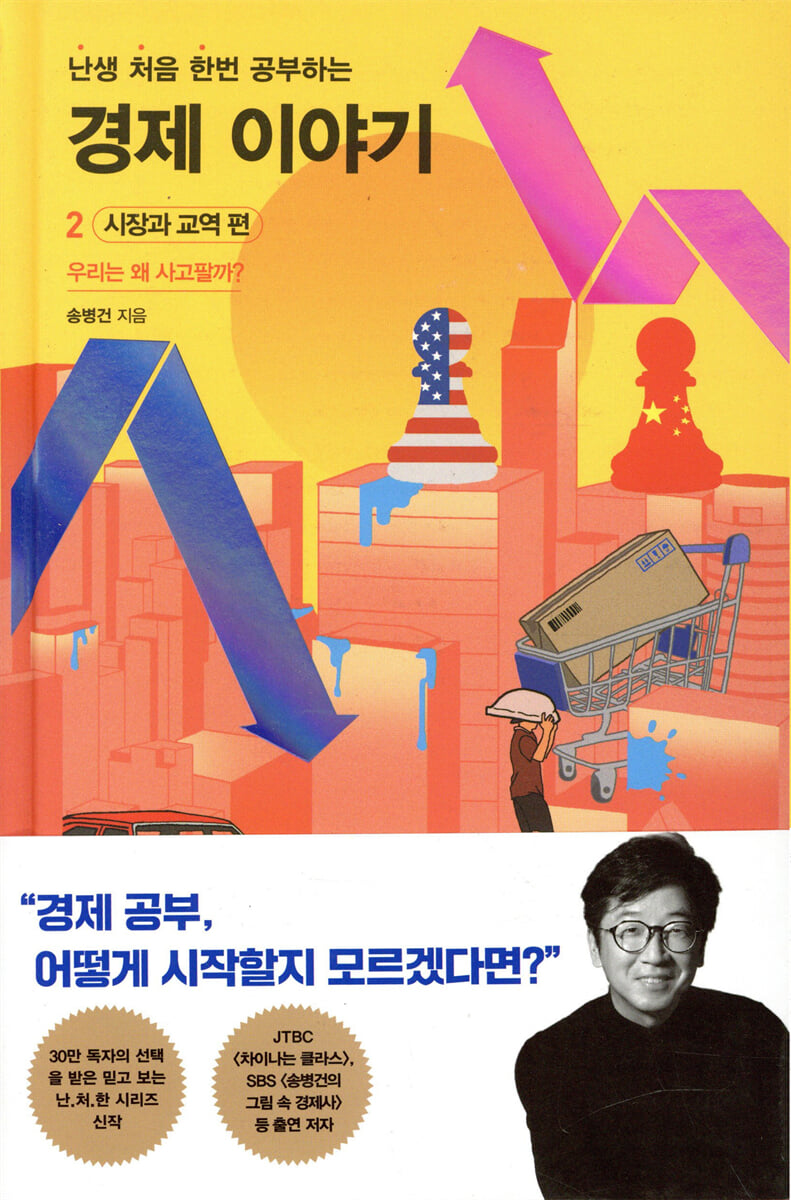
Awkward Economic Stories Part 2: Markets and Trade
 |
Description
Book Introduction
Volume 2 of "Embarrassing Economic Stories," on markets and trade, deals with economic activities based on exchange.
When we hear the word 'exchange', we often think of barter, but exchange is a much larger and broader category of activity that includes buying and selling using money.
Wherever exchange takes place, a 'market' is created, and the market operates according to its own principles.
This book examines not only the principles of markets but also the changes that occur when different markets are connected through trade.
It also covers current issues.
Through the example of our country, which grew by leveraging both free trade and protectionism, and the ongoing US-China trade conflict, we raise profound questions about the essence of trade.
Covering every aspect of our connected world, this book will serve as a telescope that broadens your economic perspective.
When we hear the word 'exchange', we often think of barter, but exchange is a much larger and broader category of activity that includes buying and selling using money.
Wherever exchange takes place, a 'market' is created, and the market operates according to its own principles.
This book examines not only the principles of markets but also the changes that occur when different markets are connected through trade.
It also covers current issues.
Through the example of our country, which grew by leveraging both free trade and protectionism, and the ongoing US-China trade conflict, we raise profound questions about the essence of trade.
Covering every aspect of our connected world, this book will serve as a telescope that broadens your economic perspective.
- You can preview some of the book's contents.
Preview
index
Ⅰ Trade, the Seed of Prosperity - The Meaning of Buying and Selling
▶ A Look Back at the Mask Shortage
01 Trade that created the world we know today
02 The trading humans survived
▶ Three exchange methods invented by mankind
II Markets Are Everywhere - What the Connected World Gains and Losses
▶ Landscapes created by the Age of Exploration
01 Exchange is the market
02 When different markets are connected
03 Shadows of a Connected World
▶ Even this was a global trade item
III Shaken Trade, the Coming Crisis - How Trade Becomes a Weapon
▶ The Image War Between Free Trade and Protectionism
01 Free Trade and Protectionism: The Never-ending Debate
02 Free trade, the world order, stands at a crossroads.
03 The return of protectionism
▶ When were people most unhappy?
▶ A Look Back at the Mask Shortage
01 Trade that created the world we know today
02 The trading humans survived
▶ Three exchange methods invented by mankind
II Markets Are Everywhere - What the Connected World Gains and Losses
▶ Landscapes created by the Age of Exploration
01 Exchange is the market
02 When different markets are connected
03 Shadows of a Connected World
▶ Even this was a global trade item
III Shaken Trade, the Coming Crisis - How Trade Becomes a Weapon
▶ The Image War Between Free Trade and Protectionism
01 Free Trade and Protectionism: The Never-ending Debate
02 Free trade, the world order, stands at a crossroads.
03 The return of protectionism
▶ When were people most unhappy?
Detailed image

Into the book
Exchange does not only mean bartering, exchanging goods for one another.
Buying goods with money is also an exchange.
The only difference is whether you exchange it for goods or money.
In economics, any space where exchange takes place is called a market.
Wherever exchange takes place, there is always a market, and so the order of the market and the benefits of exchange are a pair.
It may seem simple now, but it is a very profound truth.
---From "Part 1, Chapter 1, 'Trade That Made Today's World'"
We usually only learn that cities emerged with the advent of agriculture.
However, the development of cities is closely related to trade.
Jericho grew into the first city because it was a trading hub where very special goods were traded.
The protagonist who gave birth to the first city was salt, the seasoning that enriches your table every day.
---"Part 1, Chapter 2: 'The Trading Human Survived'
For a small supermarket to grow into a bakery specializing in bread or a fruit specialty store, the surrounding market must grow.
Even if it's not as much as Gangnam Station, there needs to be some level of demand to support it.
The way goods are supplied depends on the size of the demand, that is, the size of the market.
---From "Part 2, Chapter 2, 'When Different Markets Connect'"
Specialization and division of labor are important in the production process because they can significantly increase productivity without increasing working hours.
The pin factory example from Adam Smith's The Wealth of Nations is very famous.
Let's assume that an ordinary factory worker makes pins by hand from start to finish, without any help from machines.
No matter how hard you try, you can only make about 20 a day.
However, if you analyze the pin manufacturing process in detail and divide it into 18 steps, and have ten people take charge of these divided processes, you can make up to 48,000 pins per day.
Before division of labor, a worker who could only make 20 pins a day was able to make 4,800 pins after becoming part of the division of labor.
Working hours remained the same, but production increased 240-fold.
---From "Part 2, Chapter 2, 'When Different Markets Connect'"
It's obvious that it's not tradeable now, but in the past, there were things that were tradeable, including voting rights.
Before the "one person, one vote" electoral principle became a given, it was common in 18th-century England for landowners to buy peasants' votes.
At that time, voting principles such as secret ballot and direct voting were not properly established, so vote buying and selling occurred frequently.
It was only after the British Parliament amended the electoral law several times that vote buying was eradicated.
---From "Part 2, Chapter 3, 'Shadows of the Connected World'"
Even in everyday life, we often hear the words, “I don’t have enough capital” or “I don’t have any capital.”
Strictly speaking, capital is a different concept from money as we generally use it.
The key is that it grows on its own.
Of course, it doesn't just grow by itself if left alone. It means that it is used to mobilize other factors of production, such as land or machinery, and ultimately returns as greater capital.
The funds we commonly refer to as 'business capital' can be said to be capital.
Furthermore, capitalism refers to a system that guarantees economic activities that utilize capital to produce and consume and obtain profits.
---From "Part 2, Chapter 3, 'Shadows of the Connected World'"
Of course, because the process of economic development is dynamic, there are opportunities for latecomers to turn things around.
Just because you start a little late doesn't mean you have to fall behind forever. You can also try to advance your industry to close the gap with the leaders.
If industrial advancement is successful in this way, the specialized industries of the two countries will become similar, resulting in competition rather than mutual complementarity. If this competition intensifies, it will lead to a situation called trade conflict or even a trade war.
In this way, trade conflicts can be seen as an inevitable and natural occurrence that inevitably arises in the process of expanding free trade.
Because everyone wants to specialize in high value-added industries.
---From "Part 3, Chapter 1, 'Free Trade and Protectionism: The Never-ending Debate'"
To help you understand, let's divide the world's population into four groups: the upper and lower classes in developed countries, and the upper and lower classes in developing countries.
Trade tends to benefit three groups: the upper classes in developed and developing countries, and the lower classes in developing countries.
But for the remaining group, the lower classes of developed countries, the story is a bit different.
Unlike the three groups mentioned above, who can be said to be beneficiaries of trade, there are people in the lower classes of developed countries whose livelihoods are affected by trade.
Like the people of the Rust Belt and the farmers in our country's grape groves.
---From "Part 3, Chapter 3, 'The Return of the Protectionist Era'"
It seems likely that the current protectionist trend will continue for the time being.
Since the tendency to prioritize one's own country has already become stronger, especially in some developed countries, it seems that it will take quite some time for this atmosphere to reverse.
To make matters worse, Russia's invasion of Ukraine in 2022 led to sharp increases in global energy and food prices, exacerbating supply chain crises.
Even if the COVID-19 crisis ends, protectionist movements are likely to remain dominant for 5 to 10 years.
If that happens, cooperation to solve global problems may also become difficult.
It's deeply regrettable that I, too, am forced to draw a negative conclusion, but it seems clear that we have entered an era where we must live with caution.
Buying goods with money is also an exchange.
The only difference is whether you exchange it for goods or money.
In economics, any space where exchange takes place is called a market.
Wherever exchange takes place, there is always a market, and so the order of the market and the benefits of exchange are a pair.
It may seem simple now, but it is a very profound truth.
---From "Part 1, Chapter 1, 'Trade That Made Today's World'"
We usually only learn that cities emerged with the advent of agriculture.
However, the development of cities is closely related to trade.
Jericho grew into the first city because it was a trading hub where very special goods were traded.
The protagonist who gave birth to the first city was salt, the seasoning that enriches your table every day.
---"Part 1, Chapter 2: 'The Trading Human Survived'
For a small supermarket to grow into a bakery specializing in bread or a fruit specialty store, the surrounding market must grow.
Even if it's not as much as Gangnam Station, there needs to be some level of demand to support it.
The way goods are supplied depends on the size of the demand, that is, the size of the market.
---From "Part 2, Chapter 2, 'When Different Markets Connect'"
Specialization and division of labor are important in the production process because they can significantly increase productivity without increasing working hours.
The pin factory example from Adam Smith's The Wealth of Nations is very famous.
Let's assume that an ordinary factory worker makes pins by hand from start to finish, without any help from machines.
No matter how hard you try, you can only make about 20 a day.
However, if you analyze the pin manufacturing process in detail and divide it into 18 steps, and have ten people take charge of these divided processes, you can make up to 48,000 pins per day.
Before division of labor, a worker who could only make 20 pins a day was able to make 4,800 pins after becoming part of the division of labor.
Working hours remained the same, but production increased 240-fold.
---From "Part 2, Chapter 2, 'When Different Markets Connect'"
It's obvious that it's not tradeable now, but in the past, there were things that were tradeable, including voting rights.
Before the "one person, one vote" electoral principle became a given, it was common in 18th-century England for landowners to buy peasants' votes.
At that time, voting principles such as secret ballot and direct voting were not properly established, so vote buying and selling occurred frequently.
It was only after the British Parliament amended the electoral law several times that vote buying was eradicated.
---From "Part 2, Chapter 3, 'Shadows of the Connected World'"
Even in everyday life, we often hear the words, “I don’t have enough capital” or “I don’t have any capital.”
Strictly speaking, capital is a different concept from money as we generally use it.
The key is that it grows on its own.
Of course, it doesn't just grow by itself if left alone. It means that it is used to mobilize other factors of production, such as land or machinery, and ultimately returns as greater capital.
The funds we commonly refer to as 'business capital' can be said to be capital.
Furthermore, capitalism refers to a system that guarantees economic activities that utilize capital to produce and consume and obtain profits.
---From "Part 2, Chapter 3, 'Shadows of the Connected World'"
Of course, because the process of economic development is dynamic, there are opportunities for latecomers to turn things around.
Just because you start a little late doesn't mean you have to fall behind forever. You can also try to advance your industry to close the gap with the leaders.
If industrial advancement is successful in this way, the specialized industries of the two countries will become similar, resulting in competition rather than mutual complementarity. If this competition intensifies, it will lead to a situation called trade conflict or even a trade war.
In this way, trade conflicts can be seen as an inevitable and natural occurrence that inevitably arises in the process of expanding free trade.
Because everyone wants to specialize in high value-added industries.
---From "Part 3, Chapter 1, 'Free Trade and Protectionism: The Never-ending Debate'"
To help you understand, let's divide the world's population into four groups: the upper and lower classes in developed countries, and the upper and lower classes in developing countries.
Trade tends to benefit three groups: the upper classes in developed and developing countries, and the lower classes in developing countries.
But for the remaining group, the lower classes of developed countries, the story is a bit different.
Unlike the three groups mentioned above, who can be said to be beneficiaries of trade, there are people in the lower classes of developed countries whose livelihoods are affected by trade.
Like the people of the Rust Belt and the farmers in our country's grape groves.
---From "Part 3, Chapter 3, 'The Return of the Protectionist Era'"
It seems likely that the current protectionist trend will continue for the time being.
Since the tendency to prioritize one's own country has already become stronger, especially in some developed countries, it seems that it will take quite some time for this atmosphere to reverse.
To make matters worse, Russia's invasion of Ukraine in 2022 led to sharp increases in global energy and food prices, exacerbating supply chain crises.
Even if the COVID-19 crisis ends, protectionist movements are likely to remain dominant for 5 to 10 years.
If that happens, cooperation to solve global problems may also become difficult.
It's deeply regrettable that I, too, am forced to draw a negative conclusion, but it seems clear that we have entered an era where we must live with caution.
---From "Part 3, Chapter 3, 'The Return of the Protectionist Era'"
Publisher's Review
★ An irreplaceable economic user manual that you can read once and use for a lifetime!
★ A new challenge for the "Embarrassing Series," chosen by 300,000 readers! Economics is finally easy to read!
★ Newspaper materials to help you read economic articles on your own, illustrations to help you understand the text, online quizzes to review what you've learned, and even glossaries that explain difficult terms!
The more anxious you become, the more you need to start from the basics! Now is the time to study the economic principles that will last a lifetime!
You may have experienced feeling anxious when you hear economic news every day.
There are rumors of soaring prices, of interest rates fluctuating…
Even if it doesn't directly impact my life right away, hearing news like this makes me feel anxious.
"The Difficult Economic Story" tells us to stop trembling with anxiety and start learning about the fundamental principles of how the economy works.
There are many economics books on the market, but it is difficult to find one that provides a solid foundation.
Most books either list out bits of information or jump to conclusions about which stocks to buy, or the content is too specialized for the average person to understand and apply.
There was a desperate need for an entertaining, practical economics textbook that would allow anyone, from any perspective, to understand the economy.
"The Embarrassing Economic Story" was launched with that very role in mind.
Professor Song Byeong-geon of the Department of Economics at Sungkyunkwan University participated in the writing.
Professor Song Byeong-geon has been publishing high-quality educational books for the general public, striving to introduce economics as an interesting story rather than a specialized field.
As my major is economic history, I used a variety of historical examples to help people understand complex realities.
The author says, “I hope that everyone who has found economics difficult will be able to easily overcome the economic barrier with this book.”
As the author says, if you follow the story, you will have the experience of suddenly becoming familiar with unfamiliar economics.
A sound economics primer for everyone: more entertaining than novels and more useful than YouTube.
The Awkward Series is a proven guide for readers who want to learn new knowledge.
The series 『Embarrassing Stories of Art』 (by Yang Jeong-mu), 『Embarrassing Classical Classes』 (by Min Eun-gi), and 『Embarrassing Stories of Oriental Art』 (by Kang Hee-jung), which have already been loved by many readers, have all established themselves as friendly introductory books that definitely scratch an itch.
The core message running through these series is that they present practical knowledge that is helpful in real life at a level that is accessible to the general public.
The kindness of the awkward series shines even brighter when it comes to the difficult subject of economics.
As with previous series, the text is structured in a conversational style and reads smoothly, as if listening to it.
Unlike other economics books, which spew vague technical terms or list rigid graphs, this book actively utilizes familiar, everyday language and interesting storytelling.
The abundant photographs and witty illustrations throughout the book, combined with the author's usual strength of "explaining the economy using visual materials," maximize the sense of presence and immersion.
The author's content, combined with the series' unique format, has created a great synergy effect in terms of 'economic storytelling.'
In addition, the comprehensive structure, including economic articles, quizzes, and glossary of terms, helps readers fully digest and review what they have learned.
Through this book, you will no longer feel obligated to learn about economics, but will be able to begin studying economics for real.
The awkward economic series, this time on 'Markets and Trade'!
How can the blockage of a single strait in the Middle East cause our economy to fluctuate? Why do foreign companies sell their products only in Korea at high prices? Why do major powers fight over trade? The answers to all these questions are contained in the second volume of "The Difficult Economic Story," the chapter on markets and trade.
While the first book, Basics, explained the economic principles that permeate our daily lives, the Markets and Trade section delves deeper, examining how trade transforms us and the economy, and the principles that govern the market, the venue for exchange.
We often think that trade has nothing to do with our daily lives, but that is not the case.
Since the beginning of time, humanity has lived by exchanging what it needs with one another, and modern capitalist society runs on the exchange of countless goods.
But where exchange takes place, there is something that inevitably arises: a ‘market.’
The market allocates resources efficiently according to its own principles.
Market efficiency is maximized, especially when different markets meet and integrate.
Of course, that's not all.
Behind the world connected to the market, there is a dark shadow of exploitation that we have turned a blind eye to.
The Markets and Trade section covers both the ups and downs of a connected world, providing a balanced view of the path we must take going forward.
Finally, we address the debate between ‘free trade’ and ‘protectionism,’ a hot potato in the global trade order.
It contains timely stories, from the story of our country's growth through both free trade and protectionism to the full extent of the ongoing US-China trade conflict.
The Markets and Trade section, which explains the order of the connected world, continues with the third volume, Finance.
★ A new challenge for the "Embarrassing Series," chosen by 300,000 readers! Economics is finally easy to read!
★ Newspaper materials to help you read economic articles on your own, illustrations to help you understand the text, online quizzes to review what you've learned, and even glossaries that explain difficult terms!
The more anxious you become, the more you need to start from the basics! Now is the time to study the economic principles that will last a lifetime!
You may have experienced feeling anxious when you hear economic news every day.
There are rumors of soaring prices, of interest rates fluctuating…
Even if it doesn't directly impact my life right away, hearing news like this makes me feel anxious.
"The Difficult Economic Story" tells us to stop trembling with anxiety and start learning about the fundamental principles of how the economy works.
There are many economics books on the market, but it is difficult to find one that provides a solid foundation.
Most books either list out bits of information or jump to conclusions about which stocks to buy, or the content is too specialized for the average person to understand and apply.
There was a desperate need for an entertaining, practical economics textbook that would allow anyone, from any perspective, to understand the economy.
"The Embarrassing Economic Story" was launched with that very role in mind.
Professor Song Byeong-geon of the Department of Economics at Sungkyunkwan University participated in the writing.
Professor Song Byeong-geon has been publishing high-quality educational books for the general public, striving to introduce economics as an interesting story rather than a specialized field.
As my major is economic history, I used a variety of historical examples to help people understand complex realities.
The author says, “I hope that everyone who has found economics difficult will be able to easily overcome the economic barrier with this book.”
As the author says, if you follow the story, you will have the experience of suddenly becoming familiar with unfamiliar economics.
A sound economics primer for everyone: more entertaining than novels and more useful than YouTube.
The Awkward Series is a proven guide for readers who want to learn new knowledge.
The series 『Embarrassing Stories of Art』 (by Yang Jeong-mu), 『Embarrassing Classical Classes』 (by Min Eun-gi), and 『Embarrassing Stories of Oriental Art』 (by Kang Hee-jung), which have already been loved by many readers, have all established themselves as friendly introductory books that definitely scratch an itch.
The core message running through these series is that they present practical knowledge that is helpful in real life at a level that is accessible to the general public.
The kindness of the awkward series shines even brighter when it comes to the difficult subject of economics.
As with previous series, the text is structured in a conversational style and reads smoothly, as if listening to it.
Unlike other economics books, which spew vague technical terms or list rigid graphs, this book actively utilizes familiar, everyday language and interesting storytelling.
The abundant photographs and witty illustrations throughout the book, combined with the author's usual strength of "explaining the economy using visual materials," maximize the sense of presence and immersion.
The author's content, combined with the series' unique format, has created a great synergy effect in terms of 'economic storytelling.'
In addition, the comprehensive structure, including economic articles, quizzes, and glossary of terms, helps readers fully digest and review what they have learned.
Through this book, you will no longer feel obligated to learn about economics, but will be able to begin studying economics for real.
The awkward economic series, this time on 'Markets and Trade'!
How can the blockage of a single strait in the Middle East cause our economy to fluctuate? Why do foreign companies sell their products only in Korea at high prices? Why do major powers fight over trade? The answers to all these questions are contained in the second volume of "The Difficult Economic Story," the chapter on markets and trade.
While the first book, Basics, explained the economic principles that permeate our daily lives, the Markets and Trade section delves deeper, examining how trade transforms us and the economy, and the principles that govern the market, the venue for exchange.
We often think that trade has nothing to do with our daily lives, but that is not the case.
Since the beginning of time, humanity has lived by exchanging what it needs with one another, and modern capitalist society runs on the exchange of countless goods.
But where exchange takes place, there is something that inevitably arises: a ‘market.’
The market allocates resources efficiently according to its own principles.
Market efficiency is maximized, especially when different markets meet and integrate.
Of course, that's not all.
Behind the world connected to the market, there is a dark shadow of exploitation that we have turned a blind eye to.
The Markets and Trade section covers both the ups and downs of a connected world, providing a balanced view of the path we must take going forward.
Finally, we address the debate between ‘free trade’ and ‘protectionism,’ a hot potato in the global trade order.
It contains timely stories, from the story of our country's growth through both free trade and protectionism to the full extent of the ongoing US-China trade conflict.
The Markets and Trade section, which explains the order of the connected world, continues with the third volume, Finance.
GOODS SPECIFICS
- Publication date: June 21, 2022
- Format: Hardcover book binding method guide
- Page count, weight, size: 380 pages | 610g | 135*205*26mm
- ISBN13: 9791162732250
- ISBN10: 1162732253
You may also like
카테고리
korean


korean

![GQ KOREA Mark (Monthly): December [2025]](http://librairie.coreenne.fr/cdn/shop/files/8ef265dbbfbf186523ed75ba7319009d.jpg?v=1765340328&width=3840)


