

Diary of the Times
 |
Description
Book Introduction
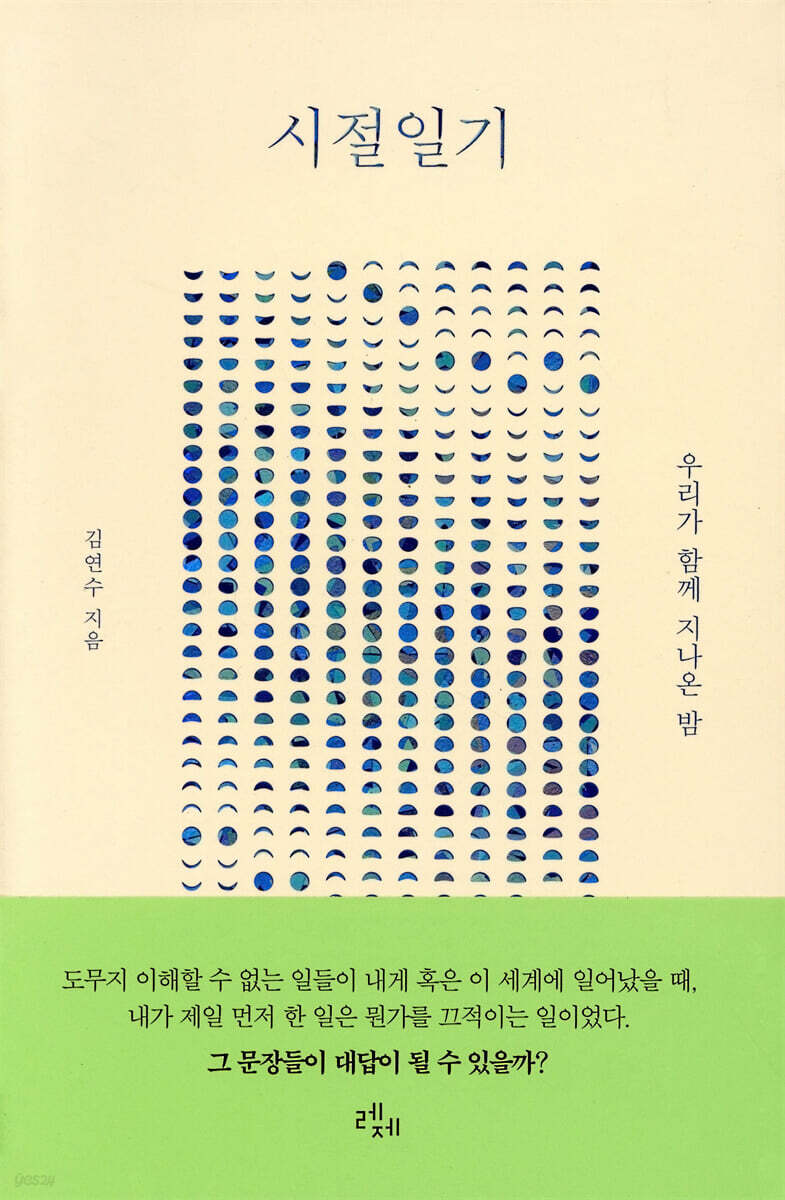
When something completely incomprehensible happened to me or to the world, the first thing I did was to scribble something down. (……) Could those sentences be the answer? 『Diary of the Times_The Nights We Spent Together』 is a personal diary and a record of Kim Yeon-su's work as an author, written down over the past ten years. Within that time, he was an ordinary individual and a father in the society called the Republic of Korea, an adult in his forties who perhaps most intensely contemplated an era, and a writer who must always look into, contemplate, and record the here and now. He is a man who constantly thinks about writing, pauses, and then writes again. Twenty-five years have passed since he began his literary career by publishing poetry and novels, and he still asks questions about the profession of writing. For him, asking questions is like 'writing'. |
- You can preview some of the book's contents.
Preview
index
Prologue: My Writings, Self-Written Writings 5
Part 1: Future Hopes, Grandma 13
Part 2: The Opposite of Truth Is Not Lies, but Forgetting 57
Part 3: That's how parting becomes a song 109
Part 4: My Proper Use of the Word 151
Part 5: The Novelist After the Burning 221
References + 302
ps Love's Thoughts, 2014, 305
Part 1: Future Hopes, Grandma 13
Part 2: The Opposite of Truth Is Not Lies, but Forgetting 57
Part 3: That's how parting becomes a song 109
Part 4: My Proper Use of the Word 151
Part 5: The Novelist After the Burning 221
References + 302
ps Love's Thoughts, 2014, 305
Publisher's Review
What can literature do in this hellish world?
but……
Literature cannot adequately mourn the suffering of others.
The black shadow clings to the heart like dregs and does not fall off.
The task of literature is to abandon the desire to quickly conclude mourning and to embrace this ambiguous feeling that cannot be shaken off because it is impossible to interpret.
Therefore, it must be rewritten and reread forever.
Every day, like laborers, workers, and farmers, until night falls upon us again. (p. 49)
A novelist is someone who is in the process of becoming a novelist.
A novelist is someone who is currently writing a novel.
If there is a spiritual element to novel writing, this is it.
A novelist writes novels to become himself.
(……) Every time I try something new, I fail. That is the fate of every novelist, after my debut, after my soot. (pp. 52-53)
Kim Yeon-su, who is probably always “a person who writes novels,” was born in 1970.
Over the past decade, the young writer Kim Yeon-su has spent her entire forties.
In his forties, in the midst of adulthood, he directly and indirectly witnessed, heard, experienced, endured, and faced events such as the Yongsan tragedy, the sinking of the Sewol ferry, the blacklist in the cultural world, and the candlelight vigils of 2016.
His gaze, questions, and concerns have become more sensitive and deeper in the meantime.
In his time, of course, ‘we’ were also there.
It was a time that he and we passed together, endured together, and faced together.
In it, we closed our eyes for days, lost our words, and put down our pens.
It took quite some time to open my eyes again, find my words, pick up my pen, and return to my daily life.
The author constantly asks, over and over again, what can an individual, unable to control even the time of his own life, do in the great flow of history that moves the world?
What can literature do, what can art do… … and these questions ultimately come down to the problem of writing, which is his vocation.
The questions and some of the answers in this book may help us to reaffirm what power made Kim Yeon-su the novelist she is today.
Where was the starting point of his literature/writing, and where is he headed through his writing?
If the time we delay becomes our own life, how should we endure it? This question led me to this novel.
I am interested not in history that functions properly on a macro level, but in history that is endlessly delayed in the lives of individuals.
I am drawn to the coincidences, myths, and fates that humans create to endure the time when causality is delayed.
(……)
Our lives resemble a river that meanders down the stream.
Human time often lags behind and sometimes even flows backwards.
Every time that happens, we fall into deep darkness, but I think that's when we have to go with the flow.
When we completely surrender ourselves to the history that flows ceaselessly even in the darkness, we become post-modern humans, contemporaries.
Then I can fully understand humanity.
Still, when we surrender ourselves to the flow of history, fearless of loneliness in the depths of the night, our despair can be read by one another.
The consolation of literature begins here. (pp. 296-301)
By reading books, seeing paintings, movies, and plays, meeting people, and encountering events he cannot understand or handle, he 'writes' without rest, and continues, more and more, ceaselessly, 'becomes' a novelist.
And, while we 'read' him who 'writes' without rest and asks questions incessantly, we discover together the time of 'nevertheless'.
That power takes us one step further.
To endure this, novelists write novels, directors make movies, and poets write poetry.
Likewise, to endure, people read novels and poetry and watch movies.
They must read and write every day, not to complete their mourning, but because mourning is impossible. (p. 44)
This book may be our diary, written and read together, through him.
As each of us progresses little by little in our own ways, the daily records he writes as a writer and as an individual ultimately become the story of us all.
So, the reason why you love someone so much is because they are irreplaceable.
_A story that ultimately leads to the light
Kim Je-hoon's mother, Lee Ji-yeon, says that no matter how dark it is or how long it takes, she can wait.
Instead, he said he wanted to do something in the meantime, and that he plans to resume calligraphy, which he had done for about ten years but had stopped due to illness.
(……) While waiting in the darkness, Lee Ji-yeon says.
“The feeling of brushstrokes on my fingertips is vivid in my eyes.
“I think it would be great if I could do what I want and become a great light in the hearts of others, a bright light.” (p. 83)
In the darkness, even a little light feels dazzling.
Light in the darkness.
It's a light for just one person.
That's why it's a miracle.
Even after losing a son, we know that he wants to be a light in the hearts of others, even without experiencing it ourselves.
In the diaries of the past ten years, we have spent some nights together.
And within it, we could also find small lights.
This book is a record of the nights he and I spent together, and a record of the small light we discovered within them.
Even though it may feel like we are in a state of despair right now, we are ultimately moving towards the light, together.
In the dark, we see only darkness.
That is the sorrow and despair of humanity.
A person in darkness needs light to see this world differently.
(……) I don’t know how to escape from sadness and despair and look at this world differently.
Isn't it similar to seeing the world in such a new light, like the Easter scene in my hometown, where I woke up one night and all the flowers in the neighborhood were in bloom? (p. 94)
The last chapter of this book, "ps Thoughts on Love, 2014," is a short story that can be said to be a story about the books Kim Yeon-su has read over the past ten years, records of the world, questions about writing, and the light she discovered within them.
Love that is only possible after it is over.
It is always only later that we realize that it was love.
Now all I can think of is your back.
What did his face look like? I try to think about it, but I only see his back, just his back.
Even though I didn't love your back, I only remember your back as you turned and walked away on the autumn street, and your back as you fell asleep, sweating, in the summer room.
(……)
It's a strange thing, isn't it?
I thought that when you were by my side, it wouldn't matter if I didn't have hands or feet or a heart, or even if I never existed in this world in the first place.
Still, I was born into this world, saw and learned so much, and grew up like that. In this world, not only I but countless other people live, and among all those people, there is someone like you, and it seems like a miracle that we met and fell in love.
My usefulness was there. (pp. 327-328)
Things that you only realize after the fact, and the records of them.
This may not be just love.
Perhaps this novel is a different answer to the questions the author has been asking over and over again for the past decade.
but……
Literature cannot adequately mourn the suffering of others.
The black shadow clings to the heart like dregs and does not fall off.
The task of literature is to abandon the desire to quickly conclude mourning and to embrace this ambiguous feeling that cannot be shaken off because it is impossible to interpret.
Therefore, it must be rewritten and reread forever.
Every day, like laborers, workers, and farmers, until night falls upon us again. (p. 49)
A novelist is someone who is in the process of becoming a novelist.
A novelist is someone who is currently writing a novel.
If there is a spiritual element to novel writing, this is it.
A novelist writes novels to become himself.
(……) Every time I try something new, I fail. That is the fate of every novelist, after my debut, after my soot. (pp. 52-53)
Kim Yeon-su, who is probably always “a person who writes novels,” was born in 1970.
Over the past decade, the young writer Kim Yeon-su has spent her entire forties.
In his forties, in the midst of adulthood, he directly and indirectly witnessed, heard, experienced, endured, and faced events such as the Yongsan tragedy, the sinking of the Sewol ferry, the blacklist in the cultural world, and the candlelight vigils of 2016.
His gaze, questions, and concerns have become more sensitive and deeper in the meantime.
In his time, of course, ‘we’ were also there.
It was a time that he and we passed together, endured together, and faced together.
In it, we closed our eyes for days, lost our words, and put down our pens.
It took quite some time to open my eyes again, find my words, pick up my pen, and return to my daily life.
The author constantly asks, over and over again, what can an individual, unable to control even the time of his own life, do in the great flow of history that moves the world?
What can literature do, what can art do… … and these questions ultimately come down to the problem of writing, which is his vocation.
The questions and some of the answers in this book may help us to reaffirm what power made Kim Yeon-su the novelist she is today.
Where was the starting point of his literature/writing, and where is he headed through his writing?
If the time we delay becomes our own life, how should we endure it? This question led me to this novel.
I am interested not in history that functions properly on a macro level, but in history that is endlessly delayed in the lives of individuals.
I am drawn to the coincidences, myths, and fates that humans create to endure the time when causality is delayed.
(……)
Our lives resemble a river that meanders down the stream.
Human time often lags behind and sometimes even flows backwards.
Every time that happens, we fall into deep darkness, but I think that's when we have to go with the flow.
When we completely surrender ourselves to the history that flows ceaselessly even in the darkness, we become post-modern humans, contemporaries.
Then I can fully understand humanity.
Still, when we surrender ourselves to the flow of history, fearless of loneliness in the depths of the night, our despair can be read by one another.
The consolation of literature begins here. (pp. 296-301)
By reading books, seeing paintings, movies, and plays, meeting people, and encountering events he cannot understand or handle, he 'writes' without rest, and continues, more and more, ceaselessly, 'becomes' a novelist.
And, while we 'read' him who 'writes' without rest and asks questions incessantly, we discover together the time of 'nevertheless'.
That power takes us one step further.
To endure this, novelists write novels, directors make movies, and poets write poetry.
Likewise, to endure, people read novels and poetry and watch movies.
They must read and write every day, not to complete their mourning, but because mourning is impossible. (p. 44)
This book may be our diary, written and read together, through him.
As each of us progresses little by little in our own ways, the daily records he writes as a writer and as an individual ultimately become the story of us all.
So, the reason why you love someone so much is because they are irreplaceable.
_A story that ultimately leads to the light
Kim Je-hoon's mother, Lee Ji-yeon, says that no matter how dark it is or how long it takes, she can wait.
Instead, he said he wanted to do something in the meantime, and that he plans to resume calligraphy, which he had done for about ten years but had stopped due to illness.
(……) While waiting in the darkness, Lee Ji-yeon says.
“The feeling of brushstrokes on my fingertips is vivid in my eyes.
“I think it would be great if I could do what I want and become a great light in the hearts of others, a bright light.” (p. 83)
In the darkness, even a little light feels dazzling.
Light in the darkness.
It's a light for just one person.
That's why it's a miracle.
Even after losing a son, we know that he wants to be a light in the hearts of others, even without experiencing it ourselves.
In the diaries of the past ten years, we have spent some nights together.
And within it, we could also find small lights.
This book is a record of the nights he and I spent together, and a record of the small light we discovered within them.
Even though it may feel like we are in a state of despair right now, we are ultimately moving towards the light, together.
In the dark, we see only darkness.
That is the sorrow and despair of humanity.
A person in darkness needs light to see this world differently.
(……) I don’t know how to escape from sadness and despair and look at this world differently.
Isn't it similar to seeing the world in such a new light, like the Easter scene in my hometown, where I woke up one night and all the flowers in the neighborhood were in bloom? (p. 94)
The last chapter of this book, "ps Thoughts on Love, 2014," is a short story that can be said to be a story about the books Kim Yeon-su has read over the past ten years, records of the world, questions about writing, and the light she discovered within them.
Love that is only possible after it is over.
It is always only later that we realize that it was love.
Now all I can think of is your back.
What did his face look like? I try to think about it, but I only see his back, just his back.
Even though I didn't love your back, I only remember your back as you turned and walked away on the autumn street, and your back as you fell asleep, sweating, in the summer room.
(……)
It's a strange thing, isn't it?
I thought that when you were by my side, it wouldn't matter if I didn't have hands or feet or a heart, or even if I never existed in this world in the first place.
Still, I was born into this world, saw and learned so much, and grew up like that. In this world, not only I but countless other people live, and among all those people, there is someone like you, and it seems like a miracle that we met and fell in love.
My usefulness was there. (pp. 327-328)
Things that you only realize after the fact, and the records of them.
This may not be just love.
Perhaps this novel is a different answer to the questions the author has been asking over and over again for the past decade.
GOODS SPECIFICS
- Date of publication: July 22, 2019
- Page count, weight, size: 336 pages | 380g | 130*200*18mm
- ISBN13: 9791196722005
- ISBN10: 1196722005
You may also like
카테고리
korean


korean

![GQ KOREA Mark (Monthly): December [2025]](http://librairie.coreenne.fr/cdn/shop/files/8ef265dbbfbf186523ed75ba7319009d.jpg?v=1765340328&width=3840)


