

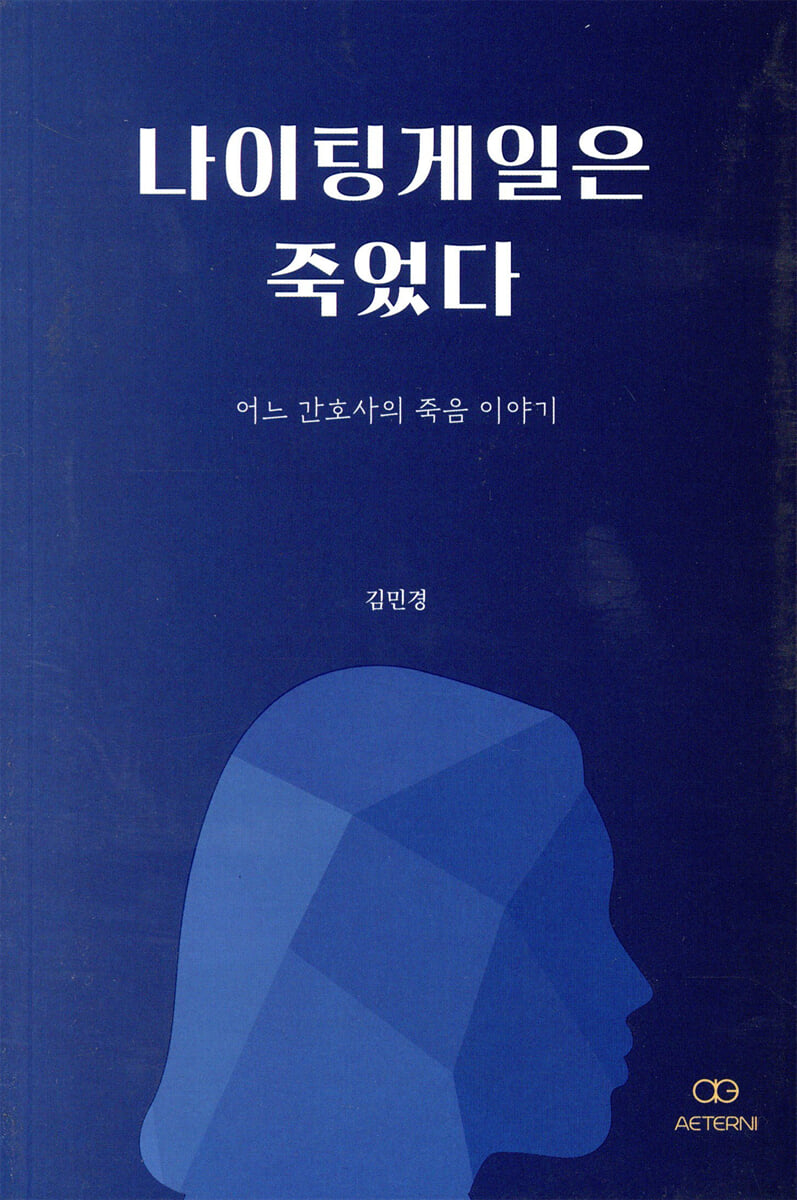
The nightingale is dead
 |
Description
Book Introduction
"The Nightingale is Dead" is the life and reality of nurses in Korea.
I hope that people will read this book and learn about the true lives and realities of nurses in Korea.
I hope that people will read this book and learn about the true lives and realities of nurses in Korea.
index
Part 1: Famous (The Story of a Nurse's Death)
1.
The day I first saw death
2.
How far is it alive?
3.
While I'm alive, I want to stay alive
4.
Life is finite for everyone.
5.
Excessive milk is not necessary
6.
Where and how
7.
Death alone is cold and bitter.
8.
“I think I’ve lived well enough.”
9.
Still family
10.
Memories I want to remember
11.
goodbye
12.
objectification
13.
Death, do not fear it
Part 2: The Nightingale is Dead
1.
What we do while others sleep
2.
What we do when others wake up
3.
We too need time to mourn
4.
Comforting moonlight on the way home from work
5.
Off days, emotional
6.
One night shift, reviewing
7.
So it's hard for nurses
8.
When someone notices our hardships
9.
Coupon for 3rd shift
10.
They say that even in the Joseon Dynasty, people ate and worked.
11.
I will change the nurse's shift.
1.
The day I first saw death
2.
How far is it alive?
3.
While I'm alive, I want to stay alive
4.
Life is finite for everyone.
5.
Excessive milk is not necessary
6.
Where and how
7.
Death alone is cold and bitter.
8.
“I think I’ve lived well enough.”
9.
Still family
10.
Memories I want to remember
11.
goodbye
12.
objectification
13.
Death, do not fear it
Part 2: The Nightingale is Dead
1.
What we do while others sleep
2.
What we do when others wake up
3.
We too need time to mourn
4.
Comforting moonlight on the way home from work
5.
Off days, emotional
6.
One night shift, reviewing
7.
So it's hard for nurses
8.
When someone notices our hardships
9.
Coupon for 3rd shift
10.
They say that even in the Joseon Dynasty, people ate and worked.
11.
I will change the nurse's shift.
Into the book
When I first saw the patient die, I was so shocked that I felt like I had seen something I shouldn't have seen.
I never knew that a living person could die so quickly.
I really didn't know that life and death were so close together.
---From "Famous: The Story of a Nurse's Death"
How many times have I experienced death here and thought about the finiteness of life?
In order to fully enjoy the life that has been given to us, we must stop looking only at the pain and trials that lie before us.
---From "Famous: The Story of a Nurse's Death"
'Death', which I could not have imagined if I had not witnessed it firsthand, feels objectively before me today.
One day, won't my body also become so bloodless that my heart stops and I stop breathing?
What will my death look like at that moment?
What kind of life should I live until that day comes?
---From "Famous: The Story of a Nurse's Death"
The slight annoyance I felt towards her for asking for painkillers made me feel even more sorry in the face of her death.
I wish I could have said a few warm words.
What if I could have looked into her heart and consoled her?
I was embarrassed and ashamed of myself for just looking like a busy nurse.
---From "The Nightingale is Dead"
I tried to set my own priorities, but in the end, work today was chaos itself.
Because all of the patients' complaints, demands, and even urgent emergency situations were mixed together.
I had no choice but to work as if I was being chased at a speed that was neither walking nor running.
The day passed by so many times that I couldn't hold my breath.
Maybe that's why.
I felt strange and sad for no reason as I felt the dawn air on my way home from work.
---From "The Nightingale is Dead"
Things that seemed so natural to them were becoming, one by one, not so natural.
The same was true of her husband's presence.
She didn't know how many times she had to hold back tears before she could accept the existence of her husband, who could never be taken for granted.
I never knew that a living person could die so quickly.
I really didn't know that life and death were so close together.
---From "Famous: The Story of a Nurse's Death"
How many times have I experienced death here and thought about the finiteness of life?
In order to fully enjoy the life that has been given to us, we must stop looking only at the pain and trials that lie before us.
---From "Famous: The Story of a Nurse's Death"
'Death', which I could not have imagined if I had not witnessed it firsthand, feels objectively before me today.
One day, won't my body also become so bloodless that my heart stops and I stop breathing?
What will my death look like at that moment?
What kind of life should I live until that day comes?
---From "Famous: The Story of a Nurse's Death"
The slight annoyance I felt towards her for asking for painkillers made me feel even more sorry in the face of her death.
I wish I could have said a few warm words.
What if I could have looked into her heart and consoled her?
I was embarrassed and ashamed of myself for just looking like a busy nurse.
---From "The Nightingale is Dead"
I tried to set my own priorities, but in the end, work today was chaos itself.
Because all of the patients' complaints, demands, and even urgent emergency situations were mixed together.
I had no choice but to work as if I was being chased at a speed that was neither walking nor running.
The day passed by so many times that I couldn't hold my breath.
Maybe that's why.
I felt strange and sad for no reason as I felt the dawn air on my way home from work.
---From "The Nightingale is Dead"
Things that seemed so natural to them were becoming, one by one, not so natural.
The same was true of her husband's presence.
She didn't know how many times she had to hold back tears before she could accept the existence of her husband, who could never be taken for granted.
---From "The Nightingale is Dead"
Publisher's Review
A book that supports Korean nurses who couldn't say they were having a hard time even though it was hard.
- Nurses are not expendable commodities that work in three shifts.
Nurses aren't just people who give injections.
Whether you have a lot of money or not, whether you are good or bad, we are the nurses who take care of you day and night, but who cannot take care of ourselves.
-
Despite the importance of the role nurses play in society, our society still lacks a proper understanding of the professional value of nurses.
It is no exaggeration to say that most people only know nurses as someone who works in three shifts and gives injections.
By accurately portraying the reality of nurses in Korea, this book provides readers with an opportunity to reflect on the lives of nurses in Korea.
He never tries to teach a moral, nor does he nag or force anyone.
The author simply writes about her life as a nurse in South Korea in a calm and silent manner.
This is precisely why current and former nurses will cry when they read this book.
The reason why people who aspire to become nurses shed tears while reading this book also stems from the author's attitude.
It is true that there is still a culture in the field that regards nurses as mere consumables for machines, and the reality that nurses' treatment and environment must be explained on a daily basis is also proof that something is very wrong in our society.
I don't know much about it, but I dare say that nursing is a profession that does better work than any other profession.
Above all, as people who are closest to us in relation to our death, they are with us until the moment of our death and provide nursing care until the very end.
Did you know that when you die in a hospital, nurses will close your eyes, change your clothes, and remove any tubes inserted into your body, among other things, to perform various post-mortem procedures?
These are not people who just spend the night in the hospital, unable to eat on time or go to the bathroom as they please.
"The Nightingale is Dead" is the life of a nurse in South Korea.
It's reality.
There is no superficial story.
I hope that people will read this book and learn about the true reality of nurses in Korea.
- Through this book, I would like to pay tribute to all the nurses who are running around in life-or-death situations, their hair disheveled, their underwear soaked, and their makeup smeared.
/ Yoo Seong-hee (a student who teaches and learns at Chonnam National University College of Nursing)
- The reason I kept crying while reading the book is because it is the author's story, but it is also my story, and perhaps the story of all nurses.
/ Ji Jeong-hwa (Nurse at Seoul Asan Medical Center)
- The author's honest and candid accounts of her daily life in the hospital shed light on fundamental questions that many nurses, burdened by their busy schedules, have never fully grasped.
/ Jeong Su-jin (former nurse at Seoul National University Hospital)
- Many nurses and nursing students will nod their heads while reading this book, and even if they are not nurses, it will be an opportunity for many readers to think about what death is and what kind of being a nurse is.
I need to start talking about death with my family right away and put the author's advice into practice.
/ Lim Jeong-hyeon (Seoul National University College of Nursing, 4th year)
- Reading the experiences of a senior nurse who has already experienced the challenges that one will face on the path of nursing not only evokes empathy, but also makes one once again resolve to become a good nurse through indirect experience.
/ Joo Na-young (Seoul National University College of Nursing, 4th year)
- Nurses are not expendable commodities that work in three shifts.
Nurses aren't just people who give injections.
Whether you have a lot of money or not, whether you are good or bad, we are the nurses who take care of you day and night, but who cannot take care of ourselves.
-
Despite the importance of the role nurses play in society, our society still lacks a proper understanding of the professional value of nurses.
It is no exaggeration to say that most people only know nurses as someone who works in three shifts and gives injections.
By accurately portraying the reality of nurses in Korea, this book provides readers with an opportunity to reflect on the lives of nurses in Korea.
He never tries to teach a moral, nor does he nag or force anyone.
The author simply writes about her life as a nurse in South Korea in a calm and silent manner.
This is precisely why current and former nurses will cry when they read this book.
The reason why people who aspire to become nurses shed tears while reading this book also stems from the author's attitude.
It is true that there is still a culture in the field that regards nurses as mere consumables for machines, and the reality that nurses' treatment and environment must be explained on a daily basis is also proof that something is very wrong in our society.
I don't know much about it, but I dare say that nursing is a profession that does better work than any other profession.
Above all, as people who are closest to us in relation to our death, they are with us until the moment of our death and provide nursing care until the very end.
Did you know that when you die in a hospital, nurses will close your eyes, change your clothes, and remove any tubes inserted into your body, among other things, to perform various post-mortem procedures?
These are not people who just spend the night in the hospital, unable to eat on time or go to the bathroom as they please.
"The Nightingale is Dead" is the life of a nurse in South Korea.
It's reality.
There is no superficial story.
I hope that people will read this book and learn about the true reality of nurses in Korea.
- Through this book, I would like to pay tribute to all the nurses who are running around in life-or-death situations, their hair disheveled, their underwear soaked, and their makeup smeared.
/ Yoo Seong-hee (a student who teaches and learns at Chonnam National University College of Nursing)
- The reason I kept crying while reading the book is because it is the author's story, but it is also my story, and perhaps the story of all nurses.
/ Ji Jeong-hwa (Nurse at Seoul Asan Medical Center)
- The author's honest and candid accounts of her daily life in the hospital shed light on fundamental questions that many nurses, burdened by their busy schedules, have never fully grasped.
/ Jeong Su-jin (former nurse at Seoul National University Hospital)
- Many nurses and nursing students will nod their heads while reading this book, and even if they are not nurses, it will be an opportunity for many readers to think about what death is and what kind of being a nurse is.
I need to start talking about death with my family right away and put the author's advice into practice.
/ Lim Jeong-hyeon (Seoul National University College of Nursing, 4th year)
- Reading the experiences of a senior nurse who has already experienced the challenges that one will face on the path of nursing not only evokes empathy, but also makes one once again resolve to become a good nurse through indirect experience.
/ Joo Na-young (Seoul National University College of Nursing, 4th year)
GOODS SPECIFICS
- Date of issue: April 15, 2019
- Page count, weight, size: 224 pages | 128*188*17mm
- ISBN13: 9791196443146
- ISBN10: 1196443149
You may also like
카테고리
korean


korean

![GQ KOREA Mark (Monthly): December [2025]](http://librairie.coreenne.fr/cdn/shop/files/8ef265dbbfbf186523ed75ba7319009d.jpg?v=1765340328&width=3840)


