

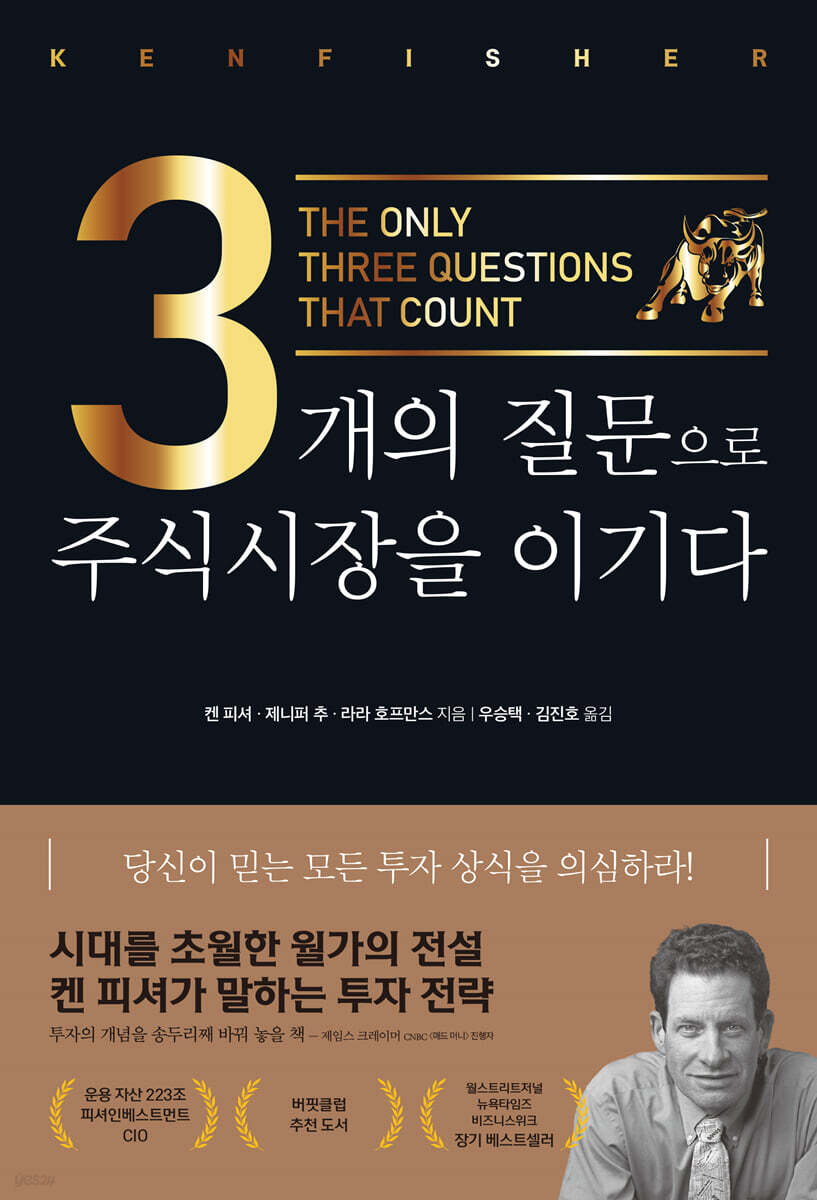
Beat the Stock Market with 3 Questions (Recover Edition)
 |
Description
Book Introduction
The only way to beat the stock market is to invest with common sense!
Is it possible to beat the stock market in today's competitive investment environment? By the time I invest based on good information, stock prices have already risen, and others have already made their investments ahead of me.
Therefore, the best way to invest successfully is to know what others don't know.
This book teaches you the scientific method of asking three questions to find out what others don't know, the only way to beat the market.
It also introduces methods for developing successful investments and continuously discovering things that others do not know.
The author, Ken Fisher, is the son of legendary investor Philip Fisher. After entering the investment world, he worked for his father's company for over ten years, honing his skills.
However, he did not stop at the knowledge and know-how he learned from his father, but based on this, he created his own unique investment technique.
A representative example is the PSR (Price-to-Sales Ratio), which is currently used as an investment indicator by all investors, and this was also developed through three questions.
Ken Fisher is currently a global money manager managing over $45 billion worldwide and has maintained the highest stock price prediction success rate for several years.
Is it possible to beat the stock market in today's competitive investment environment? By the time I invest based on good information, stock prices have already risen, and others have already made their investments ahead of me.
Therefore, the best way to invest successfully is to know what others don't know.
This book teaches you the scientific method of asking three questions to find out what others don't know, the only way to beat the market.
It also introduces methods for developing successful investments and continuously discovering things that others do not know.
The author, Ken Fisher, is the son of legendary investor Philip Fisher. After entering the investment world, he worked for his father's company for over ten years, honing his skills.
However, he did not stop at the knowledge and know-how he learned from his father, but based on this, he created his own unique investment technique.
A representative example is the PSR (Price-to-Sales Ratio), which is currently used as an investment indicator by all investors, and this was also developed through three questions.
Ken Fisher is currently a global money manager managing over $45 billion worldwide and has maintained the highest stock price prediction success rate for several years.
- You can preview some of the book's contents.
Preview
index
Preface to the Korean edition
Translator's Preface
Recommendation
Acknowledgements
preface
Chapter 1_ First Question: Are You Believing the Wrong Thing?
How to distinguish between fact and myth
What is the correlation between the facts?
Always look at things from a different perspective
When you're really, really wrong
Chapter 2_ Second Question: What can you see that others don't?
Seeing through what others cannot see through
Ignore the sound of stones crunching in the forest.
Get the latest news and investment trends right
The Shocking Truth About the Yield Curve
What the yields are telling you
The principle of presidential term rotation
Chapter 3_ Third Question What on earth is my brain doing right now?
It's not your fault - blame evolution.
Breaking the Stone Age Code: Pride and Regret
The Great Conqueror's Favorite Tricks
Pull your head out of the cave
Chapter 4: Capital Market Techniques
Putting Capital Market Techniques into Practice
Good while it lasts
Be accurate in your predictions, but don't try to imitate the pros.
A Great Life Through Global Benchmarking
Chapter 5_ When there is nothing to say about it!
Johns Hopkins, My Grandfather, Life Lessons, and Learning from Gertrude
Oil vs. Stocks
Without the witching effect, the January effect would ruin the Santa Claus Rally.
So sell in May
Chapter 6_ No, it's the opposite.
When you are really, really wrong
The multiplier effect and the iPod-using drug addict
Let's trade the trade deficit
new gold standard
Chapter 7: The Shocking Truth
Supply and demand, that's it
M&A fever
Weak dollar, strong dollar - what matters?
Chapter 8: The Great Despiser and the Stone Age Brain
Predictable market
Anatomy of a Bubble
Some basic rules
What causes a bear market?
Chapter 9: Putting It All Together
Stick to your strategy and stick to it.
4 important rules
Finally revealed! How to pick winning stocks
When should I sell my stocks?
Conclusion_ Time to say goodbye
Transformism
Into the book
Q1. Are you believing something wrong?
--- p.49
Historically, markets have actually performed above average following large fiscal deficits, not only in the United States but globally.
There is no reason to fear deficit.
Rather, bear markets occurred immediately after large fiscal surpluses.
--- p.60
Before you solidify any beliefs about investing, try approaching it with a fresh perspective.
Think like a madman! Be creative! Turn things upside down, think the opposite, change the inside out.
Don't think intuitively, think the opposite.
--- p.79
Even if I had read it, I would have felt disgusted after reading the first chapter and skipped it.
They will reject the truth, preferring superstition and calling me a fool.
Actually, that's what I wish for.
Because if you see me as a fool and think I'm wrong, I know I can use these truisms for a long time.
If most people accept this logic, I will have to find out something else that others do not know.
--- p.100
Second lesson
When thinking about the stock market, remember what Stein didn't get.
Science is undoubtedly far more important than art.
People often say this:
'The market is part science and part art.'
Think of capital markets as a science.
The market is in some ways a true science, and in some ways a place where mistakes are made.
Learn something previously unknown.
Imagine you are at Johns Hopkins in 1900, and your goal is to help us learn something previously unknown.
What will help you is not something fictional, but something that others don't know about.
If you want to be an artist, go to Paris and become an artist.
If you want to do something related to markets, become a capital markets scientist.
--- p.49
Historically, markets have actually performed above average following large fiscal deficits, not only in the United States but globally.
There is no reason to fear deficit.
Rather, bear markets occurred immediately after large fiscal surpluses.
--- p.60
Before you solidify any beliefs about investing, try approaching it with a fresh perspective.
Think like a madman! Be creative! Turn things upside down, think the opposite, change the inside out.
Don't think intuitively, think the opposite.
--- p.79
Even if I had read it, I would have felt disgusted after reading the first chapter and skipped it.
They will reject the truth, preferring superstition and calling me a fool.
Actually, that's what I wish for.
Because if you see me as a fool and think I'm wrong, I know I can use these truisms for a long time.
If most people accept this logic, I will have to find out something else that others do not know.
--- p.100
Second lesson
When thinking about the stock market, remember what Stein didn't get.
Science is undoubtedly far more important than art.
People often say this:
'The market is part science and part art.'
Think of capital markets as a science.
The market is in some ways a true science, and in some ways a place where mistakes are made.
Learn something previously unknown.
Imagine you are at Johns Hopkins in 1900, and your goal is to help us learn something previously unknown.
What will help you is not something fictional, but something that others don't know about.
If you want to be an artist, go to Paris and become an artist.
If you want to do something related to markets, become a capital markets scientist.
--- p.306~307
Publisher's Review
Long-time bestseller in the Wall Street Journal, New York Times, and BusinessWeek
Ken Fisher, son of legendary investor Philip Fisher, one of the 400 richest Americans by Forbes, a top market forecaster, and a money manager managing $45 billion, reveals his winning investment strategy.
Question all the investment wisdom you believe in!
When you try to invest based on good information, the stock price has already risen and other people have already invested and are enjoying the benefits.
How can I invest one step ahead of others?
The best way to invest successfully is to know what others don't know.
However, this does not mean that insider trading or other illegal, unethical, or immoral activities occur.
It also does not mean advice from professional investors, news information, or buy/sell points that only I know.
The 'things that others don't know' mentioned here refers to 'common sense', not 'information'.
Despite repeated investment failures, many investors, both professional and amateur, still rely on flawed common sense when investing.
Here are some examples:
1.
Stocks with high P/Es are riskier than stocks with low P/Es.
2.
A large government budget deficit is a bad thing.
3.
A weak US dollar is bad for the stock market.
4.
Rising interest rates are bad for the stock market.
Conversely, lower interest rates are good.
5.
Tax cuts increase government debt, which is bad for the stock market.
6.
High oil prices have a negative impact on the stock market and the economy.
7.
When the economy is good, the stock market is good too.
8.
Stock markets in high-growth countries perform better than those in low-growth countries.
9.
Small-cap stocks are better than large-cap stocks
10.
Stocks of companies with high growth rates are better than stocks of companies with low growth rates.
11.
Relatively cheap stocks are better.
12.
Current account and trade deficits are not good for the stock market.
These are the principles that investors have long believed in without a doubt and used as the basis for investment.
Would you believe that all these orthodox investment principles are flawed? This book debunks the traditional market myths we rely on as the foundation of our investment decisions, using scientific evidence and a startlingly powerful analysis.
As a result, it introduces a method that eliminates misconceptions and establishes sound investment principles, allowing you to discover things that only you know but others do not.
3 Questions to Beat the Stock Market
When you realize that the investment common sense that all investors take for granted is actually wrong, you gain a great investment weapon that only you know about and no one else knows about.
The question is, what is it that only I know and no one else knows?
And how do you know?
Using the '3 Questions' approach, you can build your own investment foundation that you can use throughout your life.
So what are those 'questions'?
First question: “What is something that I believe to be true but is actually false?”
This question gives us a realistic look at the stock market phenomena.
The incorrect investment common sense we saw earlier can be good examples.
So, this question can help people avoid making common, but costly, mistakes.
Second question: “What can I see that others can’t?”
This question is something that all investors believe in, but it's actually a new fact that I learned based on the first question, which revealed that it was a wrong investment belief.
This allows you to see profit patterns that others cannot see.
Third question: “Is my brain blinding me right now?”
Our brains tend to believe what others believe and process things in a set way.
This question prevents you from investing the way others do.
It also helps us understand the relationship between today's stock market and investors.
In this book, the author shares his own investment know-how, gained through three questions.
Additionally, it explains the process by which this know-how was acquired and details how you can use these three questions to establish your own investment foundation.
In other words, each of these three questions is explained with every possible means to continuously improve readers' investment performance.
In this book, readers will learn how to use three questions to analyze the overall market, sectors, and individual stocks.
A book that will completely change the concept of investing!
This book is Ken Fisher's first to be published in Korea, and is a compilation of the knowledge and methods he has gained over 30 years of investment experience.
Immediately after its publication in the United States, it became a long-term bestseller in major economic publications such as the Wall Street Journal, the New York Times, and Business Week, as well as on Amazon, and is still receiving rave reviews from readers.
Now, don't be satisfied with small profits using investment techniques created by others.
Don't choose the stock that everyone recommends.
Never invest based on experience without scientific analysis.
It's okay if you're not smart.
It's okay if you don't have a lot of investment knowledge.
The important thing is to see what others don't know.
This book explains in detail how to do this.
Ken Fisher, son of legendary investor Philip Fisher, one of the 400 richest Americans by Forbes, a top market forecaster, and a money manager managing $45 billion, reveals his winning investment strategy.
Question all the investment wisdom you believe in!
When you try to invest based on good information, the stock price has already risen and other people have already invested and are enjoying the benefits.
How can I invest one step ahead of others?
The best way to invest successfully is to know what others don't know.
However, this does not mean that insider trading or other illegal, unethical, or immoral activities occur.
It also does not mean advice from professional investors, news information, or buy/sell points that only I know.
The 'things that others don't know' mentioned here refers to 'common sense', not 'information'.
Despite repeated investment failures, many investors, both professional and amateur, still rely on flawed common sense when investing.
Here are some examples:
1.
Stocks with high P/Es are riskier than stocks with low P/Es.
2.
A large government budget deficit is a bad thing.
3.
A weak US dollar is bad for the stock market.
4.
Rising interest rates are bad for the stock market.
Conversely, lower interest rates are good.
5.
Tax cuts increase government debt, which is bad for the stock market.
6.
High oil prices have a negative impact on the stock market and the economy.
7.
When the economy is good, the stock market is good too.
8.
Stock markets in high-growth countries perform better than those in low-growth countries.
9.
Small-cap stocks are better than large-cap stocks
10.
Stocks of companies with high growth rates are better than stocks of companies with low growth rates.
11.
Relatively cheap stocks are better.
12.
Current account and trade deficits are not good for the stock market.
These are the principles that investors have long believed in without a doubt and used as the basis for investment.
Would you believe that all these orthodox investment principles are flawed? This book debunks the traditional market myths we rely on as the foundation of our investment decisions, using scientific evidence and a startlingly powerful analysis.
As a result, it introduces a method that eliminates misconceptions and establishes sound investment principles, allowing you to discover things that only you know but others do not.
3 Questions to Beat the Stock Market
When you realize that the investment common sense that all investors take for granted is actually wrong, you gain a great investment weapon that only you know about and no one else knows about.
The question is, what is it that only I know and no one else knows?
And how do you know?
Using the '3 Questions' approach, you can build your own investment foundation that you can use throughout your life.
So what are those 'questions'?
First question: “What is something that I believe to be true but is actually false?”
This question gives us a realistic look at the stock market phenomena.
The incorrect investment common sense we saw earlier can be good examples.
So, this question can help people avoid making common, but costly, mistakes.
Second question: “What can I see that others can’t?”
This question is something that all investors believe in, but it's actually a new fact that I learned based on the first question, which revealed that it was a wrong investment belief.
This allows you to see profit patterns that others cannot see.
Third question: “Is my brain blinding me right now?”
Our brains tend to believe what others believe and process things in a set way.
This question prevents you from investing the way others do.
It also helps us understand the relationship between today's stock market and investors.
In this book, the author shares his own investment know-how, gained through three questions.
Additionally, it explains the process by which this know-how was acquired and details how you can use these three questions to establish your own investment foundation.
In other words, each of these three questions is explained with every possible means to continuously improve readers' investment performance.
In this book, readers will learn how to use three questions to analyze the overall market, sectors, and individual stocks.
A book that will completely change the concept of investing!
This book is Ken Fisher's first to be published in Korea, and is a compilation of the knowledge and methods he has gained over 30 years of investment experience.
Immediately after its publication in the United States, it became a long-term bestseller in major economic publications such as the Wall Street Journal, the New York Times, and Business Week, as well as on Amazon, and is still receiving rave reviews from readers.
Now, don't be satisfied with small profits using investment techniques created by others.
Don't choose the stock that everyone recommends.
Never invest based on experience without scientific analysis.
It's okay if you're not smart.
It's okay if you don't have a lot of investment knowledge.
The important thing is to see what others don't know.
This book explains in detail how to do this.
GOODS SPECIFICS
- Publication date: February 15, 2022
- Page count, weight, size: 592 pages | 928g | 160*235*35mm
- ISBN13: 9791190122160
- ISBN10: 1190122162
You may also like
카테고리
korean


korean

![GQ KOREA Mark (Monthly): December [2025]](http://librairie.coreenne.fr/cdn/shop/files/8ef265dbbfbf186523ed75ba7319009d.jpg?v=1765340328&width=3840)


