

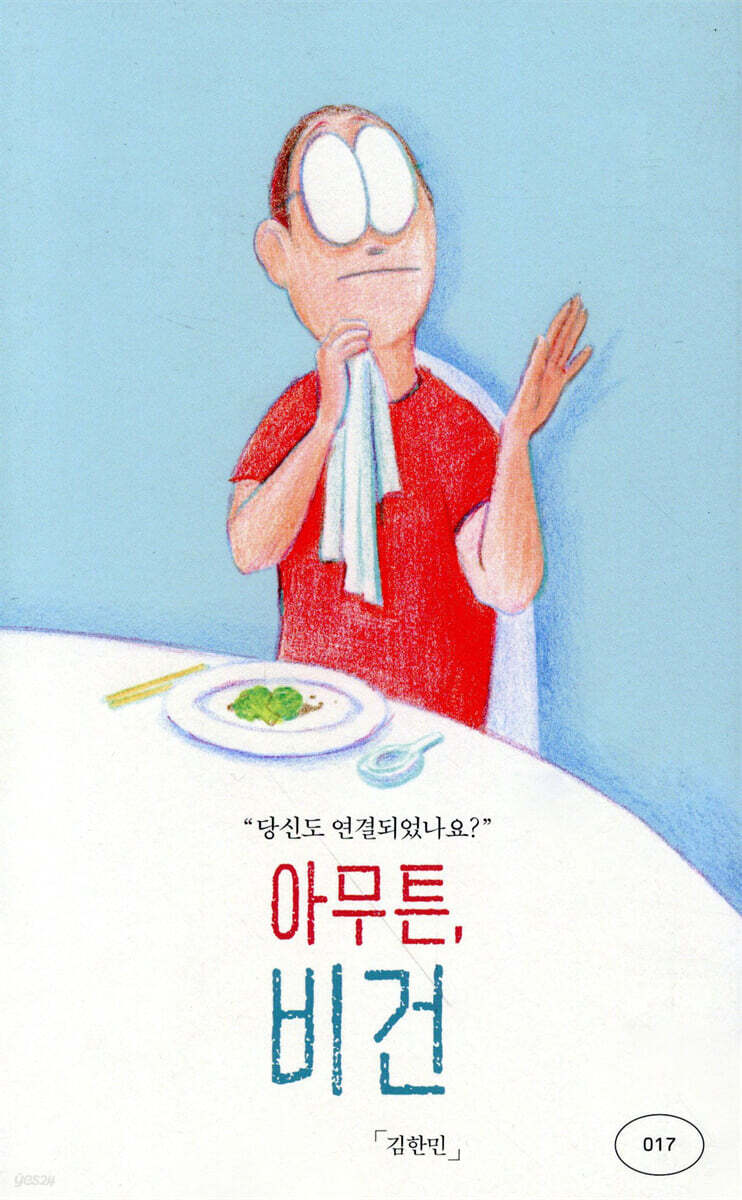
Anyway, vegan
 |
Description
Book Introduction
One day, writer Kim Han-min saw something, realized something, and decided that things couldn't go on like this, so he tried to change.
The results of the experiment were good, and they got better over time, so much so that I now wanted to share them with others.
That change is living as a 'vegan', which means not eating animals or using products made from animal fur or leather.
Author Kim Han-min, who has published unique graphic novels such as “A Room Resembling a Comet,” “Experts in the Off-Season,” and “Cafe Limbo,” and is also an activist for the marine environmental group “Sea Shepherd,” carefully unravels in this book how he, who once enjoyed meat like everyone else, became a vegan, how he has continued to do so, and how animals ultimately came to him.
It also suggests ways to make small, 'vegan' efforts, helping you move towards veganism slowly without getting caught up in perfection.
The final part presents the logic and philosophy of veganism by introducing frequently asked questions about veganism and providing answers to them.
The results of the experiment were good, and they got better over time, so much so that I now wanted to share them with others.
That change is living as a 'vegan', which means not eating animals or using products made from animal fur or leather.
Author Kim Han-min, who has published unique graphic novels such as “A Room Resembling a Comet,” “Experts in the Off-Season,” and “Cafe Limbo,” and is also an activist for the marine environmental group “Sea Shepherd,” carefully unravels in this book how he, who once enjoyed meat like everyone else, became a vegan, how he has continued to do so, and how animals ultimately came to him.
It also suggests ways to make small, 'vegan' efforts, helping you move towards veganism slowly without getting caught up in perfection.
The final part presents the logic and philosophy of veganism by introducing frequently asked questions about veganism and providing answers to them.
- You can preview some of the book's contents.
Preview
index
other
truth
determination
possession
Real-life
Reactions
Information
Epilogue
truth
determination
possession
Real-life
Reactions
Information
Epilogue
Into the book
This book is about typing.
Let's start with a poem, like the words of the philosopher Levinas.
A truly human life
It is not a quiet life that is satisfied with the level of mere existence.
Living a life worthy of a human being
It is a life of waking up and waking up again and again.
I wholeheartedly agree.
I also believe that real life begins when my attention shifts from myself to others.
The moment the other's story becomes my story, the other is no longer the other, and instead, a strange collective called "we" is born. --- p.7
We don't think about animals.
If we were to survey the average Korean who doesn't own a dog or cat, the average amount of time they spend thinking about animals per day would probably be somewhere between 1 and 5 seconds.
There is not a single person who lives a single day without relying on animals, such as when avoiding pigeons on the street because they are 'dirty' or when swatting mosquitoes.
To us, animals are like water and air.
I can't live without it, but it's so obvious that I don't even think about it.
But unlike water and air, animals have consciousness.
There are emotions too.
So we can't harm the water and the air, but we can harm animals.
That can give you a lot too.
--- p.15
A vegan is not simply a vegetarian.
Veganism is a consumer movement and a person who refuses to consume products made from animals.
They do not eat meat, dairy products such as cheese or milk, eggs, or fish, and they do not buy products other than food such as leather, fur, wool, crocodile skin, or ivory.
More strictly, we reject products obtained through animal exploitation, even if they are not directly animal products like honey, and in the same sense, we reject exploitative products like dolphin shows.
However, since the largest proportion of this is food, it is not entirely wrong to say that it is a strict vegetarian diet.
--- p.15
“Why did you become vegan?”
Which country has conducted a survey with this question (Korea has a too small population for such a survey).
People often cite animal, environmental, and health concerns as the three reasons for becoming vegan, and interestingly, the most common reason for becoming vegan was because of animals.
Health and environment followed.
If you had asked me, I think I would have answered like this.
I also think animals are very important, but ultimately, veganism is a health issue.
Putting the bodies of living beings who suffered terribly and died miserably into your mouth every day.
That's not going to make your soul healthy.
The impact of meat consumption on nature and the health of the body has already been sufficiently explained.
Therefore, animal issues can be said to be the health of the soul, environmental issues can be said to be the health of nature, and health issues can be said to be the health of the body.
--- p.34
Becoming a conscious person is easier than you think.
Even if you just talk about it, it won't be easily exposed.
Marxists can live in a capitalist society and enjoy the full benefits of capitalism without any shame.
Even feminists have a hard time determining whether a person is real or not unless a special opportunity arises.
How many foolish leftists are there who call themselves progressives but live extremely conservative lives?
Even self-proclaimed environmentalists working for environmental groups easily rationalize this.
People who work in the energy sector can drink coffee from disposable cups without hesitation, and those who handle plastic waste can afford to idle their cars.
There are loopholes that allow you to escape criticism without being criticized for not living up to the ideals you advocate.
Vegans are not like that.
No other ideology has a narrower gap between what it claims to be and what it practices than vegans.
Therefore, there are few cases where 'coming out' has such a big impact on real life as veganism.
Because at least three times a day, at every meal, we face a moment of choice.
If you try it yourself, you will feel that the attention or 'surveillance' from those around you increases to the point where it becomes burdensome.
Even for gay people who have come out, their sexual identity isn't always a topic of conversation.
At least there's an implicit agreement that romance belongs to the private sphere, but food is perceived as something anyone can say anything about, and in Korea, where group dining culture is developed, the negative effects are even more severe.
So, being vegan in Korea feels like cultivating one's own way.
--- p.56
Let's start with a poem, like the words of the philosopher Levinas.
A truly human life
It is not a quiet life that is satisfied with the level of mere existence.
Living a life worthy of a human being
It is a life of waking up and waking up again and again.
I wholeheartedly agree.
I also believe that real life begins when my attention shifts from myself to others.
The moment the other's story becomes my story, the other is no longer the other, and instead, a strange collective called "we" is born. --- p.7
We don't think about animals.
If we were to survey the average Korean who doesn't own a dog or cat, the average amount of time they spend thinking about animals per day would probably be somewhere between 1 and 5 seconds.
There is not a single person who lives a single day without relying on animals, such as when avoiding pigeons on the street because they are 'dirty' or when swatting mosquitoes.
To us, animals are like water and air.
I can't live without it, but it's so obvious that I don't even think about it.
But unlike water and air, animals have consciousness.
There are emotions too.
So we can't harm the water and the air, but we can harm animals.
That can give you a lot too.
--- p.15
A vegan is not simply a vegetarian.
Veganism is a consumer movement and a person who refuses to consume products made from animals.
They do not eat meat, dairy products such as cheese or milk, eggs, or fish, and they do not buy products other than food such as leather, fur, wool, crocodile skin, or ivory.
More strictly, we reject products obtained through animal exploitation, even if they are not directly animal products like honey, and in the same sense, we reject exploitative products like dolphin shows.
However, since the largest proportion of this is food, it is not entirely wrong to say that it is a strict vegetarian diet.
--- p.15
“Why did you become vegan?”
Which country has conducted a survey with this question (Korea has a too small population for such a survey).
People often cite animal, environmental, and health concerns as the three reasons for becoming vegan, and interestingly, the most common reason for becoming vegan was because of animals.
Health and environment followed.
If you had asked me, I think I would have answered like this.
I also think animals are very important, but ultimately, veganism is a health issue.
Putting the bodies of living beings who suffered terribly and died miserably into your mouth every day.
That's not going to make your soul healthy.
The impact of meat consumption on nature and the health of the body has already been sufficiently explained.
Therefore, animal issues can be said to be the health of the soul, environmental issues can be said to be the health of nature, and health issues can be said to be the health of the body.
--- p.34
Becoming a conscious person is easier than you think.
Even if you just talk about it, it won't be easily exposed.
Marxists can live in a capitalist society and enjoy the full benefits of capitalism without any shame.
Even feminists have a hard time determining whether a person is real or not unless a special opportunity arises.
How many foolish leftists are there who call themselves progressives but live extremely conservative lives?
Even self-proclaimed environmentalists working for environmental groups easily rationalize this.
People who work in the energy sector can drink coffee from disposable cups without hesitation, and those who handle plastic waste can afford to idle their cars.
There are loopholes that allow you to escape criticism without being criticized for not living up to the ideals you advocate.
Vegans are not like that.
No other ideology has a narrower gap between what it claims to be and what it practices than vegans.
Therefore, there are few cases where 'coming out' has such a big impact on real life as veganism.
Because at least three times a day, at every meal, we face a moment of choice.
If you try it yourself, you will feel that the attention or 'surveillance' from those around you increases to the point where it becomes burdensome.
Even for gay people who have come out, their sexual identity isn't always a topic of conversation.
At least there's an implicit agreement that romance belongs to the private sphere, but food is perceived as something anyone can say anything about, and in Korea, where group dining culture is developed, the negative effects are even more severe.
So, being vegan in Korea feels like cultivating one's own way.
--- p.56
--- p.56
Publisher's Review
Anyway, Vegan, the story is simple.
One day, writer Kim Han-min saw something, realized something, and decided that things couldn't go on like this, so he tried to change.
The results of the experiment were good, and they got better over time, so much so that I now wanted to share them with others.
That change is living as a 'vegan', which means not eating animals or using products made from animal fur or leather.
How I Became Vegan and How I'm Still Going Vegan
Author Kim Han-min, who has published unique graphic novels such as “A Room Resembling a Comet,” “Experts in the Off-Season,” and “Cafe Limbo,” and is also an activist for the marine environmental group “Sea Shepherd,” carefully unravels in this book how he, who once enjoyed meat like everyone else, became a vegan, how he has continued to do so, and how animals ultimately came to him.
It also suggests ways to make small, 'vegan' efforts, helping you move towards veganism slowly without getting caught up in perfection.
The final part presents the logic and philosophy of veganism by introducing frequently asked questions about veganism and providing answers to them.
Factory farming: animals are born solely to die.
In his book, author Kim Han-min seeks to share the truth about what happens to the production and consumption of meat and dairy products.
In today's factory farming, livestock are merely commodities produced and processed for consumption.
There is no life for animals there.
A being born to die.
So there is only pain.
They are under tremendous stress due to being kept in such close quarters that they cannot even move their bodies properly, and it is not uncommon for managers to abuse and beat the animals.
In harsh environments, the risk of disease and mortality for animals is high, and the only way to keep them alive is to over-administer antibiotics.
Sick animals are neglected or thrown away alive like trash.
Moreover, the work that goes into slaughtering animals in a short period of time and at the lowest cost is far from the “humane slaughter” that slaughterhouses talk about.
The most important truth here is hidden by a big lie.
It is a lie that you can only be healthy if you eat meat, and that being only a vegetarian is bad for your health.
Here, author Kim Han-min proves through his own experience and scientific information that meat and dairy products are completely useless and that one can live a healthy life, or even healthier, as a vegan.
People often say this to vegans:
“Life is so tiring.”
“Does it change just because you’re the only one doing it?”
“The world doesn’t change overnight.”
These are very familiar words.
Because it's a phrase we often hear in the face of issues like feminism, sexual minorities, and refugees.
If we become trapped in the belief that 'the world is unchanging,' we will end up focusing solely on our own comfort and end up making no positive impact on the world.
On the other hand, there are people who do not ignore the problem, but deeply embrace fundamental change and put it into practice, however small, in their daily lives.
When they become aware of a problem, they are the ones who think, “At least my country doesn’t want to contribute to this situation,” and they are the ones who believe in change even when it seems far away.
I hope vegan is an adjective rather than a noun.
The goal of veganism is not to achieve perfection.
It is about deciding and practicing to minimize the suffering caused to the Earth and animals and to live a healthier and more ethical life.
It has been argued that it is far more effective for society as a whole for many people to live more 'veganly' than for a few perfect vegans.
For saving animals, protecting the environment, and for public health.
Even author Kim Han-min himself admits that he is not perfect.
But I never give up on trying to get a little better every day.
Because once we become a vegan-friendly society, we know that the practice will become easier and the number of vegans will inevitably increase.
Rather than saying, “If it’s not going to be perfect, I won’t even start,” value the attitude of doing your best in a given situation.
So, I would say that vegan is an adjective before it is an identity or a noun.
If even small, "vegan" efforts are given sufficient meaning, veganism will grow beyond a minority movement into an influential, large-scale consumer movement, Kim Han-min asserts.
In fact, such changes are happening in some countries right now.
The core of veganism is not 'rejection' but 'connection'.
Becoming vegan is about reclaiming, through our own awakening and power, the intuitive connection we all had with animals as children, a rich connection that has been severed by big industry and soulless experts.
Ultimately, 『Anyway, Vegan』 is a story about people who practice that connection.
One day, writer Kim Han-min saw something, realized something, and decided that things couldn't go on like this, so he tried to change.
The results of the experiment were good, and they got better over time, so much so that I now wanted to share them with others.
That change is living as a 'vegan', which means not eating animals or using products made from animal fur or leather.
How I Became Vegan and How I'm Still Going Vegan
Author Kim Han-min, who has published unique graphic novels such as “A Room Resembling a Comet,” “Experts in the Off-Season,” and “Cafe Limbo,” and is also an activist for the marine environmental group “Sea Shepherd,” carefully unravels in this book how he, who once enjoyed meat like everyone else, became a vegan, how he has continued to do so, and how animals ultimately came to him.
It also suggests ways to make small, 'vegan' efforts, helping you move towards veganism slowly without getting caught up in perfection.
The final part presents the logic and philosophy of veganism by introducing frequently asked questions about veganism and providing answers to them.
Factory farming: animals are born solely to die.
In his book, author Kim Han-min seeks to share the truth about what happens to the production and consumption of meat and dairy products.
In today's factory farming, livestock are merely commodities produced and processed for consumption.
There is no life for animals there.
A being born to die.
So there is only pain.
They are under tremendous stress due to being kept in such close quarters that they cannot even move their bodies properly, and it is not uncommon for managers to abuse and beat the animals.
In harsh environments, the risk of disease and mortality for animals is high, and the only way to keep them alive is to over-administer antibiotics.
Sick animals are neglected or thrown away alive like trash.
Moreover, the work that goes into slaughtering animals in a short period of time and at the lowest cost is far from the “humane slaughter” that slaughterhouses talk about.
The most important truth here is hidden by a big lie.
It is a lie that you can only be healthy if you eat meat, and that being only a vegetarian is bad for your health.
Here, author Kim Han-min proves through his own experience and scientific information that meat and dairy products are completely useless and that one can live a healthy life, or even healthier, as a vegan.
People often say this to vegans:
“Life is so tiring.”
“Does it change just because you’re the only one doing it?”
“The world doesn’t change overnight.”
These are very familiar words.
Because it's a phrase we often hear in the face of issues like feminism, sexual minorities, and refugees.
If we become trapped in the belief that 'the world is unchanging,' we will end up focusing solely on our own comfort and end up making no positive impact on the world.
On the other hand, there are people who do not ignore the problem, but deeply embrace fundamental change and put it into practice, however small, in their daily lives.
When they become aware of a problem, they are the ones who think, “At least my country doesn’t want to contribute to this situation,” and they are the ones who believe in change even when it seems far away.
I hope vegan is an adjective rather than a noun.
The goal of veganism is not to achieve perfection.
It is about deciding and practicing to minimize the suffering caused to the Earth and animals and to live a healthier and more ethical life.
It has been argued that it is far more effective for society as a whole for many people to live more 'veganly' than for a few perfect vegans.
For saving animals, protecting the environment, and for public health.
Even author Kim Han-min himself admits that he is not perfect.
But I never give up on trying to get a little better every day.
Because once we become a vegan-friendly society, we know that the practice will become easier and the number of vegans will inevitably increase.
Rather than saying, “If it’s not going to be perfect, I won’t even start,” value the attitude of doing your best in a given situation.
So, I would say that vegan is an adjective before it is an identity or a noun.
If even small, "vegan" efforts are given sufficient meaning, veganism will grow beyond a minority movement into an influential, large-scale consumer movement, Kim Han-min asserts.
In fact, such changes are happening in some countries right now.
The core of veganism is not 'rejection' but 'connection'.
Becoming vegan is about reclaiming, through our own awakening and power, the intuitive connection we all had with animals as children, a rich connection that has been severed by big industry and soulless experts.
Ultimately, 『Anyway, Vegan』 is a story about people who practice that connection.
GOODS SPECIFICS
- Publication date: November 22, 2018
- Page count, weight, size: 174 pages | 200g | 110*178*20mm
- ISBN13: 9791186602447
- ISBN10: 1186602449
You may also like
카테고리
korean


korean

![GQ KOREA Mark (Monthly): December [2025]](http://librairie.coreenne.fr/cdn/shop/files/8ef265dbbfbf186523ed75ba7319009d.jpg?v=1765340328&width=3840)


