

Reflections from Prison
 |
Description
Book Introduction
Reading the classics of our time!
In the preface to his book, “Discourse - Shin Young-bok’s Last Lecture,” Professor Shin Young-bok said, “Books, like people, cannot help but follow their own path.
If you think about it, it's right that every text is always reread.
“The writer dies and the reader is constantly being born,” he said.
As if these words were a prophecy, the teacher left this book as his last book before passing away (the books 『Together Forest』 and 『Like the First Time』 that came out after 『Discourse』 were both revised and expanded editions, so 『Discourse』 became the teacher's last book during his lifetime).
As the teacher said, "Reflections from Prison" continues to create new generations of readers even now that the author is no longer around.
When this book first came out in 1988, the teacher's noble thoughts soared beyond the prison walls and tore down the walls of thought of countless people imprisoned outside.
Even after a generation has passed, it still resonates with countless people and has established itself as a classic of our time.
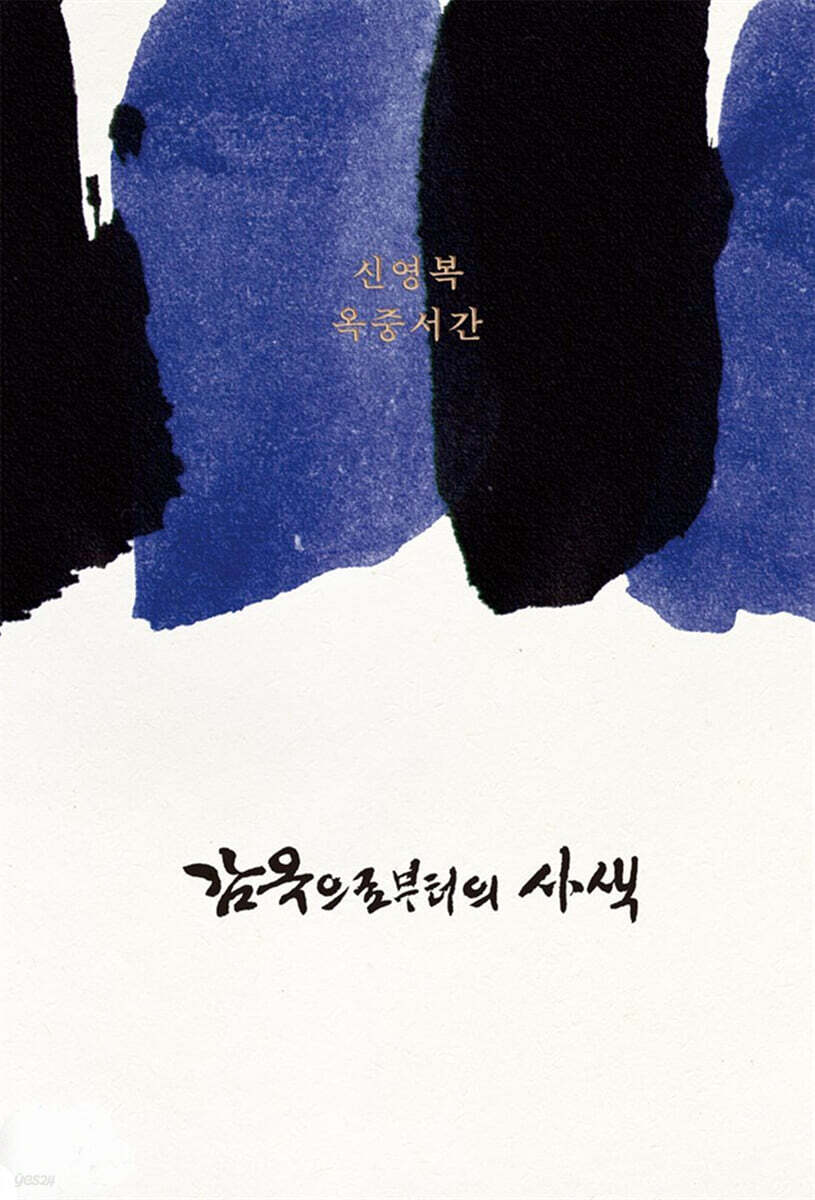
The “3rd edition” being published this time is being presented anew with a new cover design to commemorate the 30th anniversary of its publication and a redesign to improve the readability of the text.
In the preface to his book, “Discourse - Shin Young-bok’s Last Lecture,” Professor Shin Young-bok said, “Books, like people, cannot help but follow their own path.
If you think about it, it's right that every text is always reread.
“The writer dies and the reader is constantly being born,” he said.
As if these words were a prophecy, the teacher left this book as his last book before passing away (the books 『Together Forest』 and 『Like the First Time』 that came out after 『Discourse』 were both revised and expanded editions, so 『Discourse』 became the teacher's last book during his lifetime).
As the teacher said, "Reflections from Prison" continues to create new generations of readers even now that the author is no longer around.
When this book first came out in 1988, the teacher's noble thoughts soared beyond the prison walls and tore down the walls of thought of countless people imprisoned outside.
Even after a generation has passed, it still resonates with countless people and has established itself as a classic of our time.
The “3rd edition” being published this time is being presented anew with a new cover design to commemorate the 30th anniversary of its publication and a redesign to improve the readability of the text.
- You can preview some of the book's contents.
Preview
index
Preface to the first edition
Preface to the reprinted version of "Postcard"
Preface to the Augmented Edition
A letter floating under the old castle [Namhansanseong Army Prison, January 1969 - September 1970]
Warming myself with my breath / Love is something to be cultivated / Lonely weathering / Short notes / People like plants / Sitting in a solitary cell / Memories of the petition / Writing on the mud / The dawn of the 70s / Writing floating under the castle
Solitary Confinement [Anyang Prison, September 1970–February 1971]
Subjective orientation rather than objective achievement
Standing in a clump of short grass [Daejeon Prison, February 1971 - February 1986]
My brother's wedding / Factory departure / Branches over leaves / Understanding over worry / Old poetry and Churchill / My parents' lives / Wishing my father good luck / Flowers blooming at the top of winter / Spring even in a foreign land / My father's study of the mission hall / Bound together in one volume / Ha Jeong-il-yeop / The snow melts and collects in the nail / To elevate my thoughts / A beautiful woman / Calluses on the thumb / Concerned about my mother's worries / A good mother-in-law / The body temperature of a neighbor / Winter jumping into spring / A world where people cultivate the values of the country and bring peace to the world / A difficult experience / Airplanes and speed / Humanity and art / Rejoicing in a commemorative trip / A lost child in the forest of history / Carried on the back of a single spring ray / Spring fills the window / The relationship theory of calligraphy / Waste in search of a shortcut / Flowers and butterflies / Abandonment and nurturing / To my mother who has become a grandmother / It's always spring outside / Like the foolish old man moving a mountain / The sound of two bells / A magic pen and a brush / The face of the people / A short year, a long day / The moon rising from the window / A post horse inside a prison cell / By the waters of Changrang / Dot painting in October / Looking for the house I moved to / A postcard to the triangle / A postcard for the New Year / A finger pointing at myself / The heat is only in the city / The moon of Chuseok / A seed of grass in a prison cell / An idol in a cave / A guest / A letter from an Indian / A spring that cannot be contained in one postcard / You have to plant rice to get rice / A dandelion seed that flew into the room / Even sadness nurtures people / The season of retreat / Soaking my feet in the river / The sound of sparrows and the wind blowing through noodles / Chuseongmanjeong Chungjeokjeok (Autumn sounds full of insects in the garden??) / On a snowy day / Winter is still winter / Seodo / After the rain and the beginning of spring / Even dreams become prison / Nothing more to lose / Making rainbows on eyelashes / A single pansy / A summer I want to stand in the sun / In the spacious shade / Marigold / Lighting a lamp in the evening is like a stream that opens to the sea / The sky beyond the bars / The smell of the earth / In the emptiness of the warehouse / In front of my mother / Standing on the land of a pair of shoes / The eternal string of the umbilical cord / Low place / Departure and sending off / My mother's calligraphy / Sparrow at dawn / The heart of the East / A meeting like a landscape painting / The painful whip of time / Silence and babbling / Raising a crescent moon / Flame / A year of blooming and falling / Nothing [無] is soon used [用] / Spring buds / Handshake / An umbrella in a pair of wooden shoes / Time accumulated in a bundle / A parasol branch on the window / Like putting a full moon in a bowl of water / A barley field hill / The smell of grass, the smell of soil / A single seed of humanity in the midst of hardship / The sadness of a bird lying on the ground / Grandfather's memories / A monk with shaved hair in blue clothes / Life in writing / Pale hands / Chrysanthemums robbed of their nights / The shell of thoughts / Skill and firmness / Dropping fallen leaves and burying them as fertilizer / Thick ground felt underfoot / Windows and doors / Living apart / To open one's eyes to greater pain / A small snow-green sprout of grass / Teacher Jeonghyang / The sound awakened by darkness / A butterfly that flew over the wall / Calligraphy and talent for writing / A mother's love lit by a warm lamp / Jjabo, a chicken in prison / Like meeting waves in the sea / Hwandong / The realism of swearing / Ox / History is a living thing Conversation / Each one's truth / The well is deep water / A new pine tree grows in that soil / Weeping / Father's study / Similar faces / Prison is a classroom / Reading Father's book 『Samyeongdangsilgi』 / Standing in the yard with the moon on its feet / Autumn's thoughts / Going underground / Wife and mother / The meaning of the traces of time / The wake-up call at winter dawn / Galgeun-tang and Chunhyangga / Standing as a single short grass / Reason and emotion in the wall / Mother in a dream / Rain that hits us together / Crime and sentence / Present projected into the past / Second theme of African folk song / Father's consistent study / Kkotsuni / Hatred is a way to love / The urge to stand in the rain / Heavy soil / Corruption and development / Dokdasan's regret / Mother's national body / Mung bean seeds? / Protective coloration and tattoos / Mother's place / Without a hill to look up to / The weight of trials / Reliving the past / People resemble their times more than their parents / One step at a time / On this land buried and buried by tens of thousands of sleeps / Let's put down the prison bag / Old prison and new prison / Closed space, open spirit / Norma of corruption / The creation of the people / The warm sunlight that poured down on my whole body / Six days of vacation / The yellow hair of the red-light district / Water tends to gather / Pulling out weeds / A master of work / A long-term net / Years spent kneeling / Reaping rice / The highest form of relationship / New Year's Day / Year rings / Wisdom and courage / A life lived in rent / The difference between young and old / Mother by the lake / Meeting in the rain without an umbrella / Filling the empty space again / Waste of pain / Life in prison in summer / A week with mother / Our path to take / Small failures / The eighteenth triangle in prison / The final meaning / The wisdom of Indong (忍冬) / It is time for spring to come
I Want to Walk [Jeonju Prison, February 1986 - August 1988]
A new toothbrush / A strange environment, a new encounter / In my moving box / A chorus of birds at dawn / Mt. Moak / Gyesu’s complaint / Like trees soaking in water / Love is something to be shared / A death that never ends / About prison clothes / A tin-pot sewing machine / Becoming a parent’s pet / The rabbit’s peace / Rise up, rabbit / On New Year’s Day / Even the remaining snow melts away in the rain / Maybe this time / The philosophy at the bottom / Mother’s hanging lantern / A prisoner’s teeth / A servant bird’s scolding / Like a conscript who is used to prison life / A story turned upside down / A vacation that has uprooted itself / Treating my father-in-law / A cold that comes with the changing of seasons / Chuseok / A bunch of idle chatter / A rice cake believer / Wansan Chilbong / As I face my twentieth prison sentence / I want to walk / Thinking of Baekundae / A small fight divided into small pieces / Even though I broke the bowl / The cuckoo outside the jade wall / What is a baby, what is a mother
Preface to the reprinted version of "Postcard"
Preface to the Augmented Edition
A letter floating under the old castle [Namhansanseong Army Prison, January 1969 - September 1970]
Warming myself with my breath / Love is something to be cultivated / Lonely weathering / Short notes / People like plants / Sitting in a solitary cell / Memories of the petition / Writing on the mud / The dawn of the 70s / Writing floating under the castle
Solitary Confinement [Anyang Prison, September 1970–February 1971]
Subjective orientation rather than objective achievement
Standing in a clump of short grass [Daejeon Prison, February 1971 - February 1986]
My brother's wedding / Factory departure / Branches over leaves / Understanding over worry / Old poetry and Churchill / My parents' lives / Wishing my father good luck / Flowers blooming at the top of winter / Spring even in a foreign land / My father's study of the mission hall / Bound together in one volume / Ha Jeong-il-yeop / The snow melts and collects in the nail / To elevate my thoughts / A beautiful woman / Calluses on the thumb / Concerned about my mother's worries / A good mother-in-law / The body temperature of a neighbor / Winter jumping into spring / A world where people cultivate the values of the country and bring peace to the world / A difficult experience / Airplanes and speed / Humanity and art / Rejoicing in a commemorative trip / A lost child in the forest of history / Carried on the back of a single spring ray / Spring fills the window / The relationship theory of calligraphy / Waste in search of a shortcut / Flowers and butterflies / Abandonment and nurturing / To my mother who has become a grandmother / It's always spring outside / Like the foolish old man moving a mountain / The sound of two bells / A magic pen and a brush / The face of the people / A short year, a long day / The moon rising from the window / A post horse inside a prison cell / By the waters of Changrang / Dot painting in October / Looking for the house I moved to / A postcard to the triangle / A postcard for the New Year / A finger pointing at myself / The heat is only in the city / The moon of Chuseok / A seed of grass in a prison cell / An idol in a cave / A guest / A letter from an Indian / A spring that cannot be contained in one postcard / You have to plant rice to get rice / A dandelion seed that flew into the room / Even sadness nurtures people / The season of retreat / Soaking my feet in the river / The sound of sparrows and the wind blowing through noodles / Chuseongmanjeong Chungjeokjeok (Autumn sounds full of insects in the garden??) / On a snowy day / Winter is still winter / Seodo / After the rain and the beginning of spring / Even dreams become prison / Nothing more to lose / Making rainbows on eyelashes / A single pansy / A summer I want to stand in the sun / In the spacious shade / Marigold / Lighting a lamp in the evening is like a stream that opens to the sea / The sky beyond the bars / The smell of the earth / In the emptiness of the warehouse / In front of my mother / Standing on the land of a pair of shoes / The eternal string of the umbilical cord / Low place / Departure and sending off / My mother's calligraphy / Sparrow at dawn / The heart of the East / A meeting like a landscape painting / The painful whip of time / Silence and babbling / Raising a crescent moon / Flame / A year of blooming and falling / Nothing [無] is soon used [用] / Spring buds / Handshake / An umbrella in a pair of wooden shoes / Time accumulated in a bundle / A parasol branch on the window / Like putting a full moon in a bowl of water / A barley field hill / The smell of grass, the smell of soil / A single seed of humanity in the midst of hardship / The sadness of a bird lying on the ground / Grandfather's memories / A monk with shaved hair in blue clothes / Life in writing / Pale hands / Chrysanthemums robbed of their nights / The shell of thoughts / Skill and firmness / Dropping fallen leaves and burying them as fertilizer / Thick ground felt underfoot / Windows and doors / Living apart / To open one's eyes to greater pain / A small snow-green sprout of grass / Teacher Jeonghyang / The sound awakened by darkness / A butterfly that flew over the wall / Calligraphy and talent for writing / A mother's love lit by a warm lamp / Jjabo, a chicken in prison / Like meeting waves in the sea / Hwandong / The realism of swearing / Ox / History is a living thing Conversation / Each one's truth / The well is deep water / A new pine tree grows in that soil / Weeping / Father's study / Similar faces / Prison is a classroom / Reading Father's book 『Samyeongdangsilgi』 / Standing in the yard with the moon on its feet / Autumn's thoughts / Going underground / Wife and mother / The meaning of the traces of time / The wake-up call at winter dawn / Galgeun-tang and Chunhyangga / Standing as a single short grass / Reason and emotion in the wall / Mother in a dream / Rain that hits us together / Crime and sentence / Present projected into the past / Second theme of African folk song / Father's consistent study / Kkotsuni / Hatred is a way to love / The urge to stand in the rain / Heavy soil / Corruption and development / Dokdasan's regret / Mother's national body / Mung bean seeds? / Protective coloration and tattoos / Mother's place / Without a hill to look up to / The weight of trials / Reliving the past / People resemble their times more than their parents / One step at a time / On this land buried and buried by tens of thousands of sleeps / Let's put down the prison bag / Old prison and new prison / Closed space, open spirit / Norma of corruption / The creation of the people / The warm sunlight that poured down on my whole body / Six days of vacation / The yellow hair of the red-light district / Water tends to gather / Pulling out weeds / A master of work / A long-term net / Years spent kneeling / Reaping rice / The highest form of relationship / New Year's Day / Year rings / Wisdom and courage / A life lived in rent / The difference between young and old / Mother by the lake / Meeting in the rain without an umbrella / Filling the empty space again / Waste of pain / Life in prison in summer / A week with mother / Our path to take / Small failures / The eighteenth triangle in prison / The final meaning / The wisdom of Indong (忍冬) / It is time for spring to come
I Want to Walk [Jeonju Prison, February 1986 - August 1988]
A new toothbrush / A strange environment, a new encounter / In my moving box / A chorus of birds at dawn / Mt. Moak / Gyesu’s complaint / Like trees soaking in water / Love is something to be shared / A death that never ends / About prison clothes / A tin-pot sewing machine / Becoming a parent’s pet / The rabbit’s peace / Rise up, rabbit / On New Year’s Day / Even the remaining snow melts away in the rain / Maybe this time / The philosophy at the bottom / Mother’s hanging lantern / A prisoner’s teeth / A servant bird’s scolding / Like a conscript who is used to prison life / A story turned upside down / A vacation that has uprooted itself / Treating my father-in-law / A cold that comes with the changing of seasons / Chuseok / A bunch of idle chatter / A rice cake believer / Wansan Chilbong / As I face my twentieth prison sentence / I want to walk / Thinking of Baekundae / A small fight divided into small pieces / Even though I broke the bowl / The cuckoo outside the jade wall / What is a baby, what is a mother
Publisher's Review
“Just as the flesh buried in the ground withers and rots away during the 20 years of imprisonment that tore at our hearts, revealing white, shining bones, this record of the sparkling thoughts of a young man who withered and melted away and grew is this ‘Thoughts from Prison.’
This is a portrait of life with boundless depth, in the form of a book.” _ From a book review by literary critic Kim Myeong-in (December 2, 1988, inaugural issue of [Women’s Newspaper])
Reading the classics of our time!
A book must be read three times.
First, read the text,
Next, read the author,
And ultimately, it has to be read by the reader himself who is reading it.
All authors are grounded in the socio-historical foundations of their time.
That's why you should read the author.
The same goes for why readers must read themselves.
Reading is a new birth.
It is a constant escape that leads to the death of the author and the birth of the reader.
True reading is three readings.
_ Shin Young-bok, "Seo Sam-dok"
In the preface to his book, “Discourse - Shin Young-bok’s Last Lecture,” Professor Shin Young-bok said, “Books, like people, cannot help but follow their own path.
If you think about it, it's right that every text is always reread.
“The writer dies and the reader is constantly being born,” he said.
As if these words were a prophecy, the teacher left this book as his last book before passing away (the books 『Together Forest』 and 『Like the First Time』 that came out after 『Discourse』 were both revised and expanded editions, so 『Discourse』 became the teacher's last book during his lifetime).
As the teacher said, "Reflections from Prison" continues to create new generations of readers even now that the author is no longer around.
When this book first came out in 1988, the teacher's noble thoughts soared beyond the prison walls and tore down the walls of thought of countless people imprisoned outside.
Even after a generation has passed, it still resonates with countless people and has established itself as a classic of our time.
The “3rd edition” being published this time is being presented anew with a new cover design to commemorate the 30th anniversary of its publication and a redesign to improve the readability of the text.
* “Until today, among the award-winning or essay-based literature published in our country, I have never read a book as excellent as this one.
It's like reading Confucius's Analects, or like reading the poetry of Pascal or Montaigne, each and every phrase is deeply and warmly penetrating, while at the same time carrying a high degree of tragic beauty.
This article overwhelms the reader in terms of style.
“Highly restrained, whispering yet poignant and with a strong spirit, the moment we read the first verse, we are literally frozen in place as if we have been touched by a high-voltage power line passing high in the sky near Taebaek Mountain, and are drawn into the very essence of human life.” _ Novelist Lee Ho-cheol (from the Monthly Joongang Book Review, 1988)
* “It is the breath of an infinite world within a brick wall.
They become living words, and they clearly shake up our minds, which are worn out by various pollutions.” - Lee Jae-jeong, Dean of the Anglican Theological Seminary (currently Superintendent of Education of Gyeonggi Province) (from a book review in Monthly Chosun, April 1993)
* “His magic and charm lies in telling hot, powerful stories in a low, quiet way.
Yet, it exerts the power to awaken one's sense of heat and justice.
It is the result of deep and honest reflection.
He exemplifies the difference between oratory and writing, while also showing us the human way of life and the path to human dignity.
“Also, his calligraphy, which is called ‘Minjungche’, and his deep, gentle, and elegant sentences, which should be called ‘Sinyeongbokche’, are literature of a high level that everyone should see and learn from.” _ Novelist Jo Jeong-rae (Recommendation)
* “His writings are not just for reading once, but are also valuable and worth reading as a guide to life, as they offer a warm perspective on life, things, and our daily lives, while also providing much enlightenment.” _ Sister Hae-in Lee (Recommendation)
* “After reading the writing poured out on a single postcard, it is so dense and moving that you cannot move on to the next article.
There were times when I would open the bookshelf, put it against my chest, and just sit there, lost in thought.
“It took me two months to read one book.” _ Myongji University Professor Yoo Hong-jun (Recommendation)
* “It was a great blessing to have encountered Mr. Shin Young-bok’s collection of letters from prison, ‘Thoughts from Prison.’
While serving 20 years and 20 days in prison, the teacher must have been filled with distrust, despair, and hatred, but he bravely pulled out those poisonous weeds and cultivated the seeds of faith, hope, and love.
“Among my acquaintances, there is not a single one who has not cried after reading your writings, and some even claim that you are the elder statesman of Korea. What greater praise could there be?” _ Father Jeong Yang-mo (Recommendation)
* “This 『Reflections from Prison』 is a record of the sparkling thoughts of a young man who, during his 20 years of imprisonment, withered and rotted away, like bones that shine white and are pulled out, just like the flesh buried in the ground during that time that tore at our hearts.
“This is a portrait of life with boundless depth, in the form of a book.” _ Literary critic Kim Myeong-in (from a book review in the inaugural issue of [Women’s Newspaper], December 2, 1988)
* “His 20 years in prison were the most intense period of the democratization movement in Korean society.
His writing, permeated with his love and concern for his family, fellow inmates, and Korean society, reawakened a fundamental question that people sometimes forget in the midst of intense practice: "Why am I on this path?"
“Whether democratization succeeds or fails, whether regionalism is broken or not, whether globalization takes place or not, what is more important is the fact that all people are completed through relationships with others with whom they are directly or indirectly connected, and that society and history are created through such ‘relationships.’” _ Professor Kim Hyung-chan, Department of Philosophy, Korea University (from a Dong-A Ilbo article in September 2005)
* “It is not easy for thoughts and actions to be in harmony, but Mr. Shin Young-bok showed us an example of the unity of knowledge and action, and of words and actions being consistent.
You wrote something that made you feel the warmth of human beings in a desolate place like prison.
Deep thought and reflection stood out.
… … The writings in this book calmly and deeply delve into human problems that are easily overlooked, reaching the essence of things.
Above all, I analyzed human relationships with trust and affection.
… … It can be read by people of all ages, but I especially hope that high school and college students, and young people just entering society, will read it.
“Because it can be a rudder dynamic at a time when you have to take your first steps into society and design your life on your own.” _ The late Rep. Roh Hoe-chan (from a 2008 Weekly Korea article)
* “Outside the book, I was indifferent to what I had and anxious about what I didn’t have.
The life contained in the book demanded comparison from me.
My dark times were luxurious and excessive.
I decided that I wouldn't spend my one and only twenties wearing a tie and signing an attendance sheet to go to work.
After my discharge, I chose a more free path.
The salary was a third of what it would be, and the work was rough.
That choice greatly amplified the magnitude of the events that followed.
Unpredictable variables appeared one after another.
Choices were made and the consequences meticulously intervened in my life.
But I had one unshakable standard.
I always weighed which choices would give me more freedom in the future.
If I could turn back time, I would make the same choice.
“Just like the first time.” _Architect Seo Hyun (from Kyunghyang Shinmun’s “Seo Hyun’s Book of My Life,” July 2014)
* “Shin Young-bok’s Prison” gives us, living today, a homework assignment.
To break out of the 'closed prison' we have created for ourselves.
Do we love people? Are we, consumed by greed and selfishness, truly living open lives? Perhaps we are trapped in the same "summer prison" he experienced.
A prison that makes you feel like the person next to you is nothing more than a lump of heat at 37 degrees Celsius and makes you hate them.
“Isn’t it time for a primitive winter friendship, where you can overcome the cold with the warmth of someone else’s body?” _ Editorialist Park Jong-ryul (from a column by Nocut News, January 17, 2016)
* “Reflections from Prison” is the thought of prison.
For 20 years and 20 days from 1968, the 'elite thought criminal' lived with the 'people at the bottom' and constantly pondered the similarities and differences between himself and them.
Because of this, he could not enjoy the 'privilege' of men who could live without thinking, but he became a rare human being who became a man without creating a typist.
“It is a state that can be reached after ten million times of loneliness.” - Peace studies researcher Jeong Hee-jin (from “Jeong Hee-jin’s Notes,” Hankyoreh, June 2017)
High class and integrity, the birth of a famous essay
This book is a collection of letters sent to his family by a prisoner who lived in English for 20 years and 20 days due to the Tonghyeokdang incident.
In the image of Mr. Shin Young-bok, who calmly reflects on himself and the world without emotional agitation even while living in a closed space, we can paradoxically confirm how empty and shameful the comfort of everyday people in this era outside the walls is.
The teacher's writing has a feeling of freshness like the cold dawn air.
Moreover, the clear spring-like appearance of his soul, which flows from his writing style, shows that unjust physical oppression cannot damage an individual's upright beliefs and character.
And throughout the text, there is an unwavering sense of warmth and generosity.
We have selected famous passages from this book that have been passed around since its first publication.
* However, if we consider that all these thoughts begin and end only as ideas in the head, there is no beginning or end, no precedence or continuity, and the whole thing becomes empty.
But I want to grow a tree inside me.
It is true that it is not a forest, and it is not a proper evergreen tree.
The soil is not fertile and the hands that harvest it are pale.
I'm still worried about how we'll endure the salty weather, heavy rain, and freezing snow.
But this one tree, though planted within me, will one day have to break through my heart and branch outwards.
_From "Writing from Under the Fortress" at Namhansanseong Army Prison, January 1969 - September 1970
* It is not that spring comes because swallows fly, but rather that swallows fly because it is spring.
_From “The Value of the World and the Peace of the Nation” on May 3, 1976
* The thing I most regretted leaving behind during this move was the ‘window.’
The window, which overlooked the gentle ridges and the barley fields of May and June, was a clear spring that moistened our dry eyes.
But if you think about it, 'door' is better than 'window'.
If the window is a world of quiet contemplation, the door opens into a field of powerful practice.
It cannot be denied that the window where one stands quietly in front of it, focuses on the distance, and closes one's thoughts is a precious 'sunny spot of meditation', but it cannot be distinguished from the progress itself where one resolutely opens the door and moves forward with one's whole body.
_From "Windows and Doors" by Semo in 1981
* Everyone wakes up this morning under the blanket they slept under last night, but I think the fact that there is a 'night' between yesterday and today is like providing a great possibility, a hope.
_From “The Sound of Darkness Waking Up” on March 9, 1982
* When people who live in different alleys and have different experiences live together in one room, conversations often turn into intense arguments.
… … For islanders, the sun rises from the sea and sets in the sea, for mountaineers, the sun rises from the mountain peak and sets on the mountain peak, and for Seoulites, the sun rises from the building and sets on the building.
This becomes a firm 'fact' that islanders cannot convince mountain people, and Seoulites cannot convince islanders.
_From "Each One's Truth" on July 13, 1982
* People can only help themselves, and helping others may only be helping them 'help themselves'.
That's why I like Aragon's verse: "To teach is simply to speak of hope."
I believe that helping someone is not about holding an umbrella, but about showing empathy and solidarity by walking together in the rain.
_From “Rain Together” on March 29, 1983
* The will to internalize the 64kg weight that fills countless spaces and a very small part of them, the high jade wall and the freedom of the blue sky that it cannot contain… … .
In short, this relationship, based on the uncomfortable correspondence between closed space and open mind, clearly reveals the paradoxical nature of the relationship I must have with the confinement space of the prison.
It is a relationship of so-called tension and conflict, aimed in the opposite direction of domestication.
It should be said that it is something that comes before the relationship, a search for the relationship itself.
(Omitted) I believe that the strong sense of solidarity that exists not only among those who are locked up but also among many others is the powerful force that opens up closed spaces, allows us to breathe the blue sky… … and thus allows us to step onto a vast continent that generously embraces even tension and conflict.
I think that forming a relationship begins with sharing 'pain'.
_From “Closed Space, Open Mind” on April 26, 1984
* Just as we can follow any stream to the sea, even in the smallest and most lonely alley, the roots of the people grow there.
This is the unique popular character of the people.
What is lacking is the parties' thorough zeitgeist and flexible artistry.
_From "The People's Creation" on May 22, 1984
* What the rings of a tree teach us is that trees grow even in winter.
And the fact is that the part that grows in winter is much harder than the part that grows in summer.
Even though it stands with its feet planted in the frozen ground and its arms outstretched in the wind and snow without a single leaf to catch a single ray of sunlight, the tree is growing its arms, its chest, and the spring of next year.
_From "Night" on December 28, 1984
* They say that summer is better than winter for the poor, but we in prison live in poverty even more, but we would rather choose winter.
Because the decisive fact that instantly nullifies all ten or twenty advantages of summer imprisonment is that summer imprisonment makes you hate the person right next to you.
The narrow bed where you have to lie on your side and sleep makes the person next to you feel like a lump of heat at 37℃.
This is a punishment of punishments, a stark contrast to the primal friendship of winter, where one overcomes the cold by relying on the body heat of the person next to them.
It is a very unfortunate thing to hate those closest to you and to be hated by those closest to you.
Moreover, the fact that the cause of the hatred is not due to one's own deliberate actions, but rather to one's own existence makes the misfortune very desperate.
But what makes us unhappy more than anything else is that the object of our hatred is not perceived correctly rationally, but is perceived incorrectly by our peripheral senses, and even though we know this, we are unable to correct our feelings of hatred and the object of our hatred, which is the self-loathing we feel.
_From "Summer Prison Life" on August 28, 1985
* It is said that once upon a time, a rabbit and a turtle had a race.
The fast rabbit far outpaced the slow turtle.
But the rabbit looked down on the turtle and lay down to sleep on the grass halfway.
Then I ended up losing to the turtle.
A rabbit that underestimates a turtle and falls asleep is bad, but a turtle that sneaks past a sleeping rabbit and wins first place is also bad.
… … Let’s wake up the sleeping rabbit and become the turtle that goes with it.
Let's be such great friends.
_From "Rise Up, Rabbit" on December 30, 1986
* When it snows, we have to wear all the biting cold behind the snow, but it doesn't snow even once. Young friends waited and waited, and on a day when it snowed for three days straight, they finally built a snowman in the corner of the playground.
A snowman standing in the yard.
The words engraved on the chest with a piece of briquette are eerie.
“I want to walk.”
The words that make us realize that we have legs that cannot walk, but they hit our foreheads like a hard snowball.
_From "I Want to Walk" on January 30, 1988
Virtual Interview: Teacher, I have a question!
The teacher's neat handwriting and illustrations, written in iron pen on yellow paper issued in prison, and the stories in the sealed postcards with the "Censored" stamp, preserve the pain of an era imprinted with dark modern history.
Beginning with the fear and resentment felt in a cold winter prison cell, the book then unfolds over a long period of time, revealing understanding and affection for the people in the dark space where he must live for a long time, his love for his family, and his calm acceptance of his fate as an individual in history.
Since the publication of the first edition of this book in 1988, Professor Shin Young-bok has been interviewed by numerous media outlets and has received questions from many readers.
If the teacher were alive, he would have been asked similar questions after the publication of this 30th anniversary edition.
So, I've compiled the most frequently asked questions and the teacher's answers.
Although this is a virtual question and answer series, the teacher's answers are a compilation of the teacher's words from numerous media interviews and articles, with only a few minor editing changes to the endings.
Q.
Looking at the teacher's postcard, there are almost no mistakes and it is written neatly and cleanly.
How can you write a postcard like that?
A.
When writing a letter from prison, you must write it within a limited time in front of a censor.
So, there is no time to think deeply about the contents of the letter.
So, I would write letters in my head, erase them, and write them again, so that I would always have a concise letter in my head before I picked up my pen.
I've already gone through countless reflections in my head.
Q.
In postcards, the expression 'we' is especially often used instead of 'I' or 'I'.
I'm curious as to why you wrote "we" instead of "me" in your letters to your family.
A.
While most political prisoners live in solitary confinement and plan their reading schedules, I learned about life at the bottom by working in a factory alongside other prisoners, and I also realized that they were my own reflection.
So in my letters, the word "we" appears instead of the word "I."
They are my age too.
Q.
Looking at the recipients of the postcards, there are my parents, older brother, and younger brother, but there are also many letters sent to my sister-in-law and my uncle.
In the outside world, it seems like Sister-in-law and Sister-in-law aren't such easy recipients...
A.
My sister-in-law and my brother-in-law have done a lot of good things for me.
You also sent me letters often.
Mr. Gyesu wrote about his husband, his children, and his feelings about everyday life, and I wrote about my thoughts on the opposite sex, life as a prisoner, and the things and lives of those incarcerated.
And at that time, the system of collective punishment was alive and well like a sharp blade.
I was also worried that I might cause trouble to my older brother and younger brother.
“The small, cubic parcel you sent me was as curious as a dice.
Three pairs of socks.
It was Chuseok.
I tried them on my hands first.
The old desire to put on my New Year's shoes and go out into the alley is starting to come back to me.
I remember my friends telling me I was a pervert.
Some say that the ghost of a wandering clown is possessed by a wandering clown, others say that it is possessed by a god of fortune, but I like the interpretation that it is a wandering of a person who has not yet given up on his dreams and goes out in search of them.
If you fly a kite high in the wind, the wind will never let it rest.
“In reality, I think that a retreat is often a loss of dreams, and that a considerable amount of dreams are pursued in the midst of the hardships of wandering.” _From “Station Horse in the Prison Window” on October 4, 1977
Q.
How did this book come into being?
A.
I had originally kept the letters I had sent at home, but they happened to be seen by my juniors who were working to free prisoners of conscience.
So, this collection was serialized in the Peace Newspaper in 1988 under the title “Thoughts from Prison,” and it was so well-received that it was published as a book.
It was originally supposed to be published as a book along with my parole, but it was held back for about a month due to concerns that it might influence my parole decision, and then published as "Reflections from Prison."
Q.
How did you feel when this book was published?
A.
I was truly embarrassed by the word 'thought' in the book's title.
When I was released, the title and content of the book had already been decided, and all I did was write the title in calligraphy.
And I wanted to name this book 'A Letter I Want to Rewrite'.
The writings in this book are letters that could not be fully written due to multiple layers of censorship.
I had to borrow a writing instrument and write under the supervision of a prison guard, and the letter I wrote had to have the warden's censorship stamp.
Self-censorship, not wanting to worry the recipients' families, also made me hesitate often when writing.
And I plan to write a new book based on this letter in the future.
In prison, where no writing was permitted, letters were the only way to leave a trail of thoughts.
So I can conjure up a book from a single word in a censored letter.
(* In fact, all of Shin Young-bok's subsequent books were inspired by this book, "Thoughts from Prison.")
This is a portrait of life with boundless depth, in the form of a book.” _ From a book review by literary critic Kim Myeong-in (December 2, 1988, inaugural issue of [Women’s Newspaper])
Reading the classics of our time!
A book must be read three times.
First, read the text,
Next, read the author,
And ultimately, it has to be read by the reader himself who is reading it.
All authors are grounded in the socio-historical foundations of their time.
That's why you should read the author.
The same goes for why readers must read themselves.
Reading is a new birth.
It is a constant escape that leads to the death of the author and the birth of the reader.
True reading is three readings.
_ Shin Young-bok, "Seo Sam-dok"
In the preface to his book, “Discourse - Shin Young-bok’s Last Lecture,” Professor Shin Young-bok said, “Books, like people, cannot help but follow their own path.
If you think about it, it's right that every text is always reread.
“The writer dies and the reader is constantly being born,” he said.
As if these words were a prophecy, the teacher left this book as his last book before passing away (the books 『Together Forest』 and 『Like the First Time』 that came out after 『Discourse』 were both revised and expanded editions, so 『Discourse』 became the teacher's last book during his lifetime).
As the teacher said, "Reflections from Prison" continues to create new generations of readers even now that the author is no longer around.
When this book first came out in 1988, the teacher's noble thoughts soared beyond the prison walls and tore down the walls of thought of countless people imprisoned outside.
Even after a generation has passed, it still resonates with countless people and has established itself as a classic of our time.
The “3rd edition” being published this time is being presented anew with a new cover design to commemorate the 30th anniversary of its publication and a redesign to improve the readability of the text.
* “Until today, among the award-winning or essay-based literature published in our country, I have never read a book as excellent as this one.
It's like reading Confucius's Analects, or like reading the poetry of Pascal or Montaigne, each and every phrase is deeply and warmly penetrating, while at the same time carrying a high degree of tragic beauty.
This article overwhelms the reader in terms of style.
“Highly restrained, whispering yet poignant and with a strong spirit, the moment we read the first verse, we are literally frozen in place as if we have been touched by a high-voltage power line passing high in the sky near Taebaek Mountain, and are drawn into the very essence of human life.” _ Novelist Lee Ho-cheol (from the Monthly Joongang Book Review, 1988)
* “It is the breath of an infinite world within a brick wall.
They become living words, and they clearly shake up our minds, which are worn out by various pollutions.” - Lee Jae-jeong, Dean of the Anglican Theological Seminary (currently Superintendent of Education of Gyeonggi Province) (from a book review in Monthly Chosun, April 1993)
* “His magic and charm lies in telling hot, powerful stories in a low, quiet way.
Yet, it exerts the power to awaken one's sense of heat and justice.
It is the result of deep and honest reflection.
He exemplifies the difference between oratory and writing, while also showing us the human way of life and the path to human dignity.
“Also, his calligraphy, which is called ‘Minjungche’, and his deep, gentle, and elegant sentences, which should be called ‘Sinyeongbokche’, are literature of a high level that everyone should see and learn from.” _ Novelist Jo Jeong-rae (Recommendation)
* “His writings are not just for reading once, but are also valuable and worth reading as a guide to life, as they offer a warm perspective on life, things, and our daily lives, while also providing much enlightenment.” _ Sister Hae-in Lee (Recommendation)
* “After reading the writing poured out on a single postcard, it is so dense and moving that you cannot move on to the next article.
There were times when I would open the bookshelf, put it against my chest, and just sit there, lost in thought.
“It took me two months to read one book.” _ Myongji University Professor Yoo Hong-jun (Recommendation)
* “It was a great blessing to have encountered Mr. Shin Young-bok’s collection of letters from prison, ‘Thoughts from Prison.’
While serving 20 years and 20 days in prison, the teacher must have been filled with distrust, despair, and hatred, but he bravely pulled out those poisonous weeds and cultivated the seeds of faith, hope, and love.
“Among my acquaintances, there is not a single one who has not cried after reading your writings, and some even claim that you are the elder statesman of Korea. What greater praise could there be?” _ Father Jeong Yang-mo (Recommendation)
* “This 『Reflections from Prison』 is a record of the sparkling thoughts of a young man who, during his 20 years of imprisonment, withered and rotted away, like bones that shine white and are pulled out, just like the flesh buried in the ground during that time that tore at our hearts.
“This is a portrait of life with boundless depth, in the form of a book.” _ Literary critic Kim Myeong-in (from a book review in the inaugural issue of [Women’s Newspaper], December 2, 1988)
* “His 20 years in prison were the most intense period of the democratization movement in Korean society.
His writing, permeated with his love and concern for his family, fellow inmates, and Korean society, reawakened a fundamental question that people sometimes forget in the midst of intense practice: "Why am I on this path?"
“Whether democratization succeeds or fails, whether regionalism is broken or not, whether globalization takes place or not, what is more important is the fact that all people are completed through relationships with others with whom they are directly or indirectly connected, and that society and history are created through such ‘relationships.’” _ Professor Kim Hyung-chan, Department of Philosophy, Korea University (from a Dong-A Ilbo article in September 2005)
* “It is not easy for thoughts and actions to be in harmony, but Mr. Shin Young-bok showed us an example of the unity of knowledge and action, and of words and actions being consistent.
You wrote something that made you feel the warmth of human beings in a desolate place like prison.
Deep thought and reflection stood out.
… … The writings in this book calmly and deeply delve into human problems that are easily overlooked, reaching the essence of things.
Above all, I analyzed human relationships with trust and affection.
… … It can be read by people of all ages, but I especially hope that high school and college students, and young people just entering society, will read it.
“Because it can be a rudder dynamic at a time when you have to take your first steps into society and design your life on your own.” _ The late Rep. Roh Hoe-chan (from a 2008 Weekly Korea article)
* “Outside the book, I was indifferent to what I had and anxious about what I didn’t have.
The life contained in the book demanded comparison from me.
My dark times were luxurious and excessive.
I decided that I wouldn't spend my one and only twenties wearing a tie and signing an attendance sheet to go to work.
After my discharge, I chose a more free path.
The salary was a third of what it would be, and the work was rough.
That choice greatly amplified the magnitude of the events that followed.
Unpredictable variables appeared one after another.
Choices were made and the consequences meticulously intervened in my life.
But I had one unshakable standard.
I always weighed which choices would give me more freedom in the future.
If I could turn back time, I would make the same choice.
“Just like the first time.” _Architect Seo Hyun (from Kyunghyang Shinmun’s “Seo Hyun’s Book of My Life,” July 2014)
* “Shin Young-bok’s Prison” gives us, living today, a homework assignment.
To break out of the 'closed prison' we have created for ourselves.
Do we love people? Are we, consumed by greed and selfishness, truly living open lives? Perhaps we are trapped in the same "summer prison" he experienced.
A prison that makes you feel like the person next to you is nothing more than a lump of heat at 37 degrees Celsius and makes you hate them.
“Isn’t it time for a primitive winter friendship, where you can overcome the cold with the warmth of someone else’s body?” _ Editorialist Park Jong-ryul (from a column by Nocut News, January 17, 2016)
* “Reflections from Prison” is the thought of prison.
For 20 years and 20 days from 1968, the 'elite thought criminal' lived with the 'people at the bottom' and constantly pondered the similarities and differences between himself and them.
Because of this, he could not enjoy the 'privilege' of men who could live without thinking, but he became a rare human being who became a man without creating a typist.
“It is a state that can be reached after ten million times of loneliness.” - Peace studies researcher Jeong Hee-jin (from “Jeong Hee-jin’s Notes,” Hankyoreh, June 2017)
High class and integrity, the birth of a famous essay
This book is a collection of letters sent to his family by a prisoner who lived in English for 20 years and 20 days due to the Tonghyeokdang incident.
In the image of Mr. Shin Young-bok, who calmly reflects on himself and the world without emotional agitation even while living in a closed space, we can paradoxically confirm how empty and shameful the comfort of everyday people in this era outside the walls is.
The teacher's writing has a feeling of freshness like the cold dawn air.
Moreover, the clear spring-like appearance of his soul, which flows from his writing style, shows that unjust physical oppression cannot damage an individual's upright beliefs and character.
And throughout the text, there is an unwavering sense of warmth and generosity.
We have selected famous passages from this book that have been passed around since its first publication.
* However, if we consider that all these thoughts begin and end only as ideas in the head, there is no beginning or end, no precedence or continuity, and the whole thing becomes empty.
But I want to grow a tree inside me.
It is true that it is not a forest, and it is not a proper evergreen tree.
The soil is not fertile and the hands that harvest it are pale.
I'm still worried about how we'll endure the salty weather, heavy rain, and freezing snow.
But this one tree, though planted within me, will one day have to break through my heart and branch outwards.
_From "Writing from Under the Fortress" at Namhansanseong Army Prison, January 1969 - September 1970
* It is not that spring comes because swallows fly, but rather that swallows fly because it is spring.
_From “The Value of the World and the Peace of the Nation” on May 3, 1976
* The thing I most regretted leaving behind during this move was the ‘window.’
The window, which overlooked the gentle ridges and the barley fields of May and June, was a clear spring that moistened our dry eyes.
But if you think about it, 'door' is better than 'window'.
If the window is a world of quiet contemplation, the door opens into a field of powerful practice.
It cannot be denied that the window where one stands quietly in front of it, focuses on the distance, and closes one's thoughts is a precious 'sunny spot of meditation', but it cannot be distinguished from the progress itself where one resolutely opens the door and moves forward with one's whole body.
_From "Windows and Doors" by Semo in 1981
* Everyone wakes up this morning under the blanket they slept under last night, but I think the fact that there is a 'night' between yesterday and today is like providing a great possibility, a hope.
_From “The Sound of Darkness Waking Up” on March 9, 1982
* When people who live in different alleys and have different experiences live together in one room, conversations often turn into intense arguments.
… … For islanders, the sun rises from the sea and sets in the sea, for mountaineers, the sun rises from the mountain peak and sets on the mountain peak, and for Seoulites, the sun rises from the building and sets on the building.
This becomes a firm 'fact' that islanders cannot convince mountain people, and Seoulites cannot convince islanders.
_From "Each One's Truth" on July 13, 1982
* People can only help themselves, and helping others may only be helping them 'help themselves'.
That's why I like Aragon's verse: "To teach is simply to speak of hope."
I believe that helping someone is not about holding an umbrella, but about showing empathy and solidarity by walking together in the rain.
_From “Rain Together” on March 29, 1983
* The will to internalize the 64kg weight that fills countless spaces and a very small part of them, the high jade wall and the freedom of the blue sky that it cannot contain… … .
In short, this relationship, based on the uncomfortable correspondence between closed space and open mind, clearly reveals the paradoxical nature of the relationship I must have with the confinement space of the prison.
It is a relationship of so-called tension and conflict, aimed in the opposite direction of domestication.
It should be said that it is something that comes before the relationship, a search for the relationship itself.
(Omitted) I believe that the strong sense of solidarity that exists not only among those who are locked up but also among many others is the powerful force that opens up closed spaces, allows us to breathe the blue sky… … and thus allows us to step onto a vast continent that generously embraces even tension and conflict.
I think that forming a relationship begins with sharing 'pain'.
_From “Closed Space, Open Mind” on April 26, 1984
* Just as we can follow any stream to the sea, even in the smallest and most lonely alley, the roots of the people grow there.
This is the unique popular character of the people.
What is lacking is the parties' thorough zeitgeist and flexible artistry.
_From "The People's Creation" on May 22, 1984
* What the rings of a tree teach us is that trees grow even in winter.
And the fact is that the part that grows in winter is much harder than the part that grows in summer.
Even though it stands with its feet planted in the frozen ground and its arms outstretched in the wind and snow without a single leaf to catch a single ray of sunlight, the tree is growing its arms, its chest, and the spring of next year.
_From "Night" on December 28, 1984
* They say that summer is better than winter for the poor, but we in prison live in poverty even more, but we would rather choose winter.
Because the decisive fact that instantly nullifies all ten or twenty advantages of summer imprisonment is that summer imprisonment makes you hate the person right next to you.
The narrow bed where you have to lie on your side and sleep makes the person next to you feel like a lump of heat at 37℃.
This is a punishment of punishments, a stark contrast to the primal friendship of winter, where one overcomes the cold by relying on the body heat of the person next to them.
It is a very unfortunate thing to hate those closest to you and to be hated by those closest to you.
Moreover, the fact that the cause of the hatred is not due to one's own deliberate actions, but rather to one's own existence makes the misfortune very desperate.
But what makes us unhappy more than anything else is that the object of our hatred is not perceived correctly rationally, but is perceived incorrectly by our peripheral senses, and even though we know this, we are unable to correct our feelings of hatred and the object of our hatred, which is the self-loathing we feel.
_From "Summer Prison Life" on August 28, 1985
* It is said that once upon a time, a rabbit and a turtle had a race.
The fast rabbit far outpaced the slow turtle.
But the rabbit looked down on the turtle and lay down to sleep on the grass halfway.
Then I ended up losing to the turtle.
A rabbit that underestimates a turtle and falls asleep is bad, but a turtle that sneaks past a sleeping rabbit and wins first place is also bad.
… … Let’s wake up the sleeping rabbit and become the turtle that goes with it.
Let's be such great friends.
_From "Rise Up, Rabbit" on December 30, 1986
* When it snows, we have to wear all the biting cold behind the snow, but it doesn't snow even once. Young friends waited and waited, and on a day when it snowed for three days straight, they finally built a snowman in the corner of the playground.
A snowman standing in the yard.
The words engraved on the chest with a piece of briquette are eerie.
“I want to walk.”
The words that make us realize that we have legs that cannot walk, but they hit our foreheads like a hard snowball.
_From "I Want to Walk" on January 30, 1988
Virtual Interview: Teacher, I have a question!
The teacher's neat handwriting and illustrations, written in iron pen on yellow paper issued in prison, and the stories in the sealed postcards with the "Censored" stamp, preserve the pain of an era imprinted with dark modern history.
Beginning with the fear and resentment felt in a cold winter prison cell, the book then unfolds over a long period of time, revealing understanding and affection for the people in the dark space where he must live for a long time, his love for his family, and his calm acceptance of his fate as an individual in history.
Since the publication of the first edition of this book in 1988, Professor Shin Young-bok has been interviewed by numerous media outlets and has received questions from many readers.
If the teacher were alive, he would have been asked similar questions after the publication of this 30th anniversary edition.
So, I've compiled the most frequently asked questions and the teacher's answers.
Although this is a virtual question and answer series, the teacher's answers are a compilation of the teacher's words from numerous media interviews and articles, with only a few minor editing changes to the endings.
Q.
Looking at the teacher's postcard, there are almost no mistakes and it is written neatly and cleanly.
How can you write a postcard like that?
A.
When writing a letter from prison, you must write it within a limited time in front of a censor.
So, there is no time to think deeply about the contents of the letter.
So, I would write letters in my head, erase them, and write them again, so that I would always have a concise letter in my head before I picked up my pen.
I've already gone through countless reflections in my head.
Q.
In postcards, the expression 'we' is especially often used instead of 'I' or 'I'.
I'm curious as to why you wrote "we" instead of "me" in your letters to your family.
A.
While most political prisoners live in solitary confinement and plan their reading schedules, I learned about life at the bottom by working in a factory alongside other prisoners, and I also realized that they were my own reflection.
So in my letters, the word "we" appears instead of the word "I."
They are my age too.
Q.
Looking at the recipients of the postcards, there are my parents, older brother, and younger brother, but there are also many letters sent to my sister-in-law and my uncle.
In the outside world, it seems like Sister-in-law and Sister-in-law aren't such easy recipients...
A.
My sister-in-law and my brother-in-law have done a lot of good things for me.
You also sent me letters often.
Mr. Gyesu wrote about his husband, his children, and his feelings about everyday life, and I wrote about my thoughts on the opposite sex, life as a prisoner, and the things and lives of those incarcerated.
And at that time, the system of collective punishment was alive and well like a sharp blade.
I was also worried that I might cause trouble to my older brother and younger brother.
“The small, cubic parcel you sent me was as curious as a dice.
Three pairs of socks.
It was Chuseok.
I tried them on my hands first.
The old desire to put on my New Year's shoes and go out into the alley is starting to come back to me.
I remember my friends telling me I was a pervert.
Some say that the ghost of a wandering clown is possessed by a wandering clown, others say that it is possessed by a god of fortune, but I like the interpretation that it is a wandering of a person who has not yet given up on his dreams and goes out in search of them.
If you fly a kite high in the wind, the wind will never let it rest.
“In reality, I think that a retreat is often a loss of dreams, and that a considerable amount of dreams are pursued in the midst of the hardships of wandering.” _From “Station Horse in the Prison Window” on October 4, 1977
Q.
How did this book come into being?
A.
I had originally kept the letters I had sent at home, but they happened to be seen by my juniors who were working to free prisoners of conscience.
So, this collection was serialized in the Peace Newspaper in 1988 under the title “Thoughts from Prison,” and it was so well-received that it was published as a book.
It was originally supposed to be published as a book along with my parole, but it was held back for about a month due to concerns that it might influence my parole decision, and then published as "Reflections from Prison."
Q.
How did you feel when this book was published?
A.
I was truly embarrassed by the word 'thought' in the book's title.
When I was released, the title and content of the book had already been decided, and all I did was write the title in calligraphy.
And I wanted to name this book 'A Letter I Want to Rewrite'.
The writings in this book are letters that could not be fully written due to multiple layers of censorship.
I had to borrow a writing instrument and write under the supervision of a prison guard, and the letter I wrote had to have the warden's censorship stamp.
Self-censorship, not wanting to worry the recipients' families, also made me hesitate often when writing.
And I plan to write a new book based on this letter in the future.
In prison, where no writing was permitted, letters were the only way to leave a trail of thoughts.
So I can conjure up a book from a single word in a censored letter.
(* In fact, all of Shin Young-bok's subsequent books were inspired by this book, "Thoughts from Prison.")
GOODS SPECIFICS
- Date of publication: October 30, 2018
- Page count, weight, size: 488 pages | 714g | 153*225*30mm
- ISBN13: 9788971999110
- ISBN10: 897199911X
You may also like
카테고리
korean


korean

![GQ KOREA Mark (Monthly): December [2025]](http://librairie.coreenne.fr/cdn/shop/files/8ef265dbbfbf186523ed75ba7319009d.jpg?v=1765340328&width=3840)


