

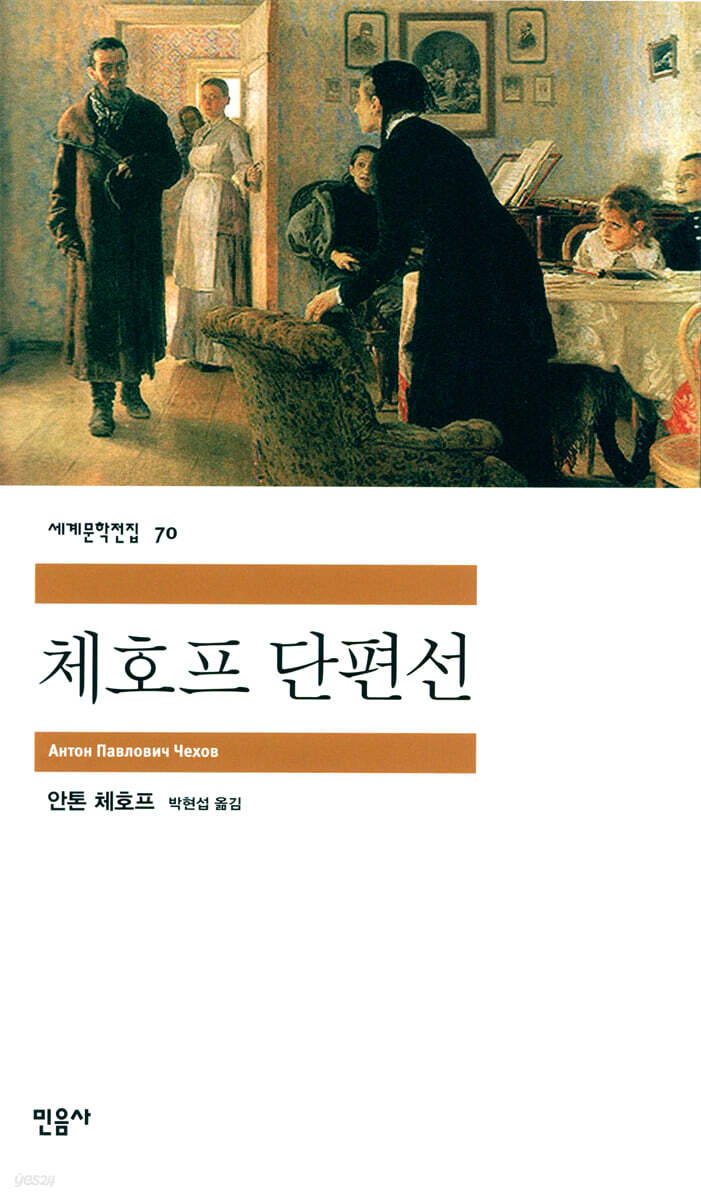
Chekhov's short stories
 |
Description
Book Introduction
A dramatic drama of laughter and tears written by Chekhov, the genius of Russian short story literature.
Anton Chekhov, a genius of short story writing who led the golden age of Russian literature
An anthology of works that go beyond simple humor to create a lyrical aesthetic that is both poetic and profound.
A warm realism that embraces the tragedy of life born from contradictions and absurdities.
“Before life crushes me, you crush life first.
“Take everything you can from life.”
A collection of short stories by Chekhov, who led the 19th century short story literature, which is called the golden age of Russian literature along with Pushkin and Gogol, has been published by Minumsa.
Chekhov's collection, published as the 70th volume of the World Literature Collection, includes nine short stories introduced in Korea for the first time: "Fear," "The Grasshopper," "Drama," "Verochka," "The Beauty," "The Mirror," "The Bet," "Typhus," and "The Bishop," as well as "The Death of a Manager," a work that exemplifies Chekhov's novel structure.
These works all capture the essence and irony of life by reproducing trivial everyday events through a diverse cast of characters.
On the one hand, they induce laughter through humor, but behind it, there is a sadness that no human being can avoid, and these are masterpieces that elevate the 'truth and beauty of life to the realm of poetry.'
An anthology of works that go beyond simple humor to create a lyrical aesthetic that is both poetic and profound.
A warm realism that embraces the tragedy of life born from contradictions and absurdities.
“Before life crushes me, you crush life first.
“Take everything you can from life.”
A collection of short stories by Chekhov, who led the 19th century short story literature, which is called the golden age of Russian literature along with Pushkin and Gogol, has been published by Minumsa.
Chekhov's collection, published as the 70th volume of the World Literature Collection, includes nine short stories introduced in Korea for the first time: "Fear," "The Grasshopper," "Drama," "Verochka," "The Beauty," "The Mirror," "The Bet," "Typhus," and "The Bishop," as well as "The Death of a Manager," a work that exemplifies Chekhov's novel structure.
These works all capture the essence and irony of life by reproducing trivial everyday events through a diverse cast of characters.
On the one hand, they induce laughter through humor, but behind it, there is a sadness that no human being can avoid, and these are masterpieces that elevate the 'truth and beauty of life to the realm of poetry.'
- You can preview some of the book's contents.
Preview
index
1.
Death of Management
2.
horror
3.
Grasshopper
4.
drama
5.
Verochka
6.
Beauty
7.
mirror
8.
bet
9.
typhus
10.
bishop
Commentary on the Work - Chekhov, the Master of the Modern Short Story / Park Hyeon-seop
Author's Chronology
Death of Management
2.
horror
3.
Grasshopper
4.
drama
5.
Verochka
6.
Beauty
7.
mirror
8.
bet
9.
typhus
10.
bishop
Commentary on the Work - Chekhov, the Master of the Modern Short Story / Park Hyeon-seop
Author's Chronology
Publisher's Review
A warm realism that embraces the tragedy of life born from contradictions and absurdities.
The short stories included in this collection were published between 1883 and 1902, representing the early, middle, and late periods of Chekhov's literature.
However, rather than a clear distinction between the works, one can glimpse the main creative techniques and consistent thematic consciousness of Chekhov's literature.
For example, "The Death of an Official," considered one of the masterpieces of the Chekhonte period (early creative period), humorously depicts the mechanism by which a very trivial incident (the protagonist Chervyakov sneezing on the back of a general's head while watching an opera) escalates uncontrollably due to the protagonist's foolishness.
In particular, the short sentence “And he died” that concludes the work is a method of ending that is often seen in other short stories.
The ending, where the author never hesitates in the face of death and faces it decisively, is also confirmed in other works such as "Drama" and "Bejjangi."
This composition may seem abrupt, but if we focus on the diverse and contradictory reactions of humans who accept it rather than the external aspects of the event itself, we can discover an optimism that breathes persistently within the author's seemingly gloomy pessimism.
This dualistic worldview originated from a realist's love for revealing the everyday lives and tragic emotions of ordinary people in a transitional Russia, where a new society was emerging.
In Olga ("The Grasshopper"), who blames her own vanity and foolishness for driving her husband, who was rising like a star in the medical world while pouring out his utmost love right next to her, to death; in "Verochka", which depicts the eternal mystery of the relationship between men and women with delicate lyricism; in "The Beauty", which contains a meditation on the essence of beauty; in "The Bet", which longs for the ultimate truth but realizes that it can never be achieved; in "Typhus", where the protagonist, after waking up from a coma, learns that his sister died because of him but cannot overcome his animalistic joy at being alive, communication between characters is cut off and the ending either ends in death or remains indeterminate, evoking a bitter sorrow at a reality full of contradictions.
But behind it all, there is a strong humor that makes you laugh.
In a harsh reality filled with materialism and greed, laughter becomes an effective means of covering up the tragedy of life.
In this way, incompatible elements appear simultaneously in Chekhov's literature, and characteristics such as laughter and sorrow, the gloomy resignation and subversion of everyday life, went on to become key signs foreshadowing the emergence of the modern short story.
Representative literary successors mentioned include Katherine Mansfield, James Joyce, Virginia Woolf, Hemingway, and Nadine Gordimer.
The short stories included in this collection were published between 1883 and 1902, representing the early, middle, and late periods of Chekhov's literature.
However, rather than a clear distinction between the works, one can glimpse the main creative techniques and consistent thematic consciousness of Chekhov's literature.
For example, "The Death of an Official," considered one of the masterpieces of the Chekhonte period (early creative period), humorously depicts the mechanism by which a very trivial incident (the protagonist Chervyakov sneezing on the back of a general's head while watching an opera) escalates uncontrollably due to the protagonist's foolishness.
In particular, the short sentence “And he died” that concludes the work is a method of ending that is often seen in other short stories.
The ending, where the author never hesitates in the face of death and faces it decisively, is also confirmed in other works such as "Drama" and "Bejjangi."
This composition may seem abrupt, but if we focus on the diverse and contradictory reactions of humans who accept it rather than the external aspects of the event itself, we can discover an optimism that breathes persistently within the author's seemingly gloomy pessimism.
This dualistic worldview originated from a realist's love for revealing the everyday lives and tragic emotions of ordinary people in a transitional Russia, where a new society was emerging.
In Olga ("The Grasshopper"), who blames her own vanity and foolishness for driving her husband, who was rising like a star in the medical world while pouring out his utmost love right next to her, to death; in "Verochka", which depicts the eternal mystery of the relationship between men and women with delicate lyricism; in "The Beauty", which contains a meditation on the essence of beauty; in "The Bet", which longs for the ultimate truth but realizes that it can never be achieved; in "Typhus", where the protagonist, after waking up from a coma, learns that his sister died because of him but cannot overcome his animalistic joy at being alive, communication between characters is cut off and the ending either ends in death or remains indeterminate, evoking a bitter sorrow at a reality full of contradictions.
But behind it all, there is a strong humor that makes you laugh.
In a harsh reality filled with materialism and greed, laughter becomes an effective means of covering up the tragedy of life.
In this way, incompatible elements appear simultaneously in Chekhov's literature, and characteristics such as laughter and sorrow, the gloomy resignation and subversion of everyday life, went on to become key signs foreshadowing the emergence of the modern short story.
Representative literary successors mentioned include Katherine Mansfield, James Joyce, Virginia Woolf, Hemingway, and Nadine Gordimer.
GOODS SPECIFICS
- Date of issue: November 30, 2002
- Page count, weight, size: 205 pages | 346g | 132*224*20mm
- ISBN13: 9788937460708
- ISBN10: 893746070X
You may also like
카테고리
korean


korean

![ELLE 엘르 스페셜 에디션 A형 : 12월 [2025]](http://librairie.coreenne.fr/cdn/shop/files/b8e27a3de6c9538896439686c6b0e8fb.jpg?v=1766436872&width=3840)


