

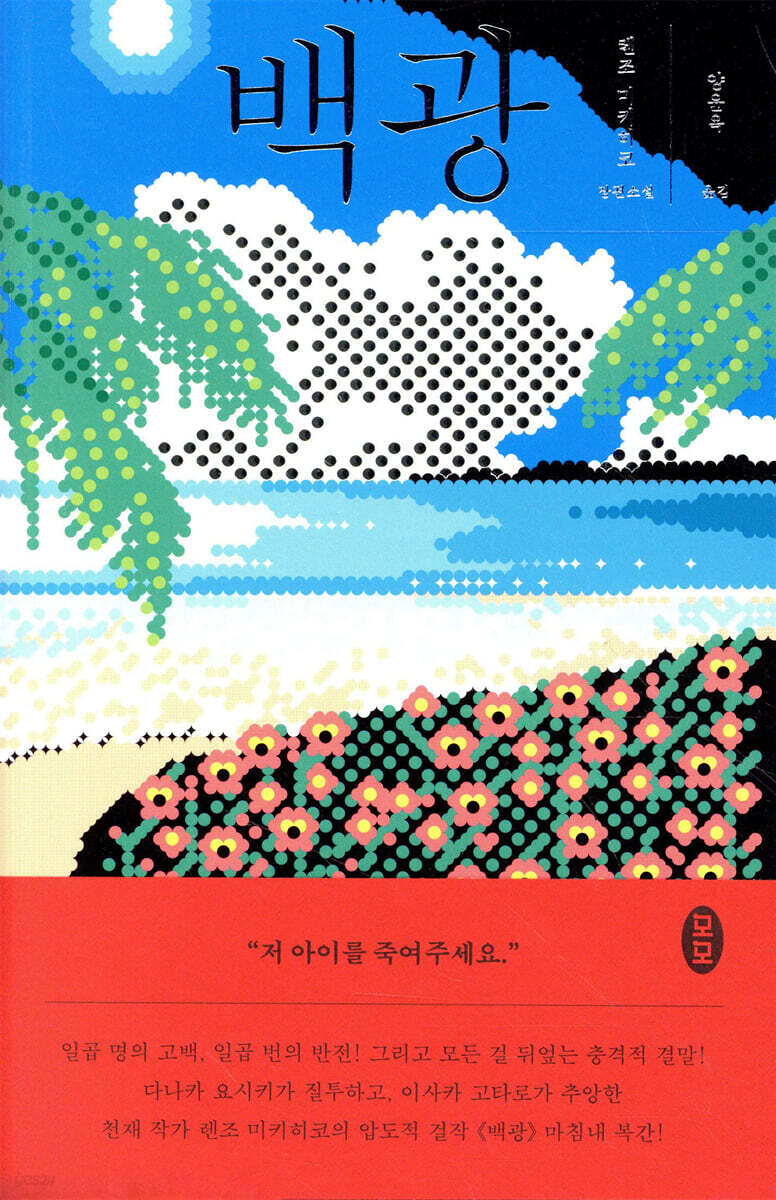
White light
 |
Description
Book Introduction
- A word from MD
- On a hot summer day, the body of a four-year-old girl is found in the courtyard of a house.
As the case unfolds, the family's hidden secrets are revealed one by one, and the story takes a series of twists and turns.
What is true and what is false, the desire behind that ordinary and calm-looking face?
-Novel PD Park Hyung-wook
“Please kill that child.”
A dazzling, thrilling, and breathtakingly captivating romance mystery
Renzo Mikihiko is considered a true genius writer by readers, critics, and fellow writers.
In each of his published works, he has presented a unique world of works that satisfy the genre's fun with meticulous narrative tricks and surprising twists, while also presenting a human drama centered around misguided love between a man and a woman in a lyrical style that also possesses a high level of literary quality.
"White Light," a novel representing the world of Renzo Mikihiko's work and renowned for its repeated twists and turns, has been published.
A hot summer day that felt like the whole world was melting.
The body of a four-year-old girl is found in the courtyard of a house.
The mother of the child who was having an affair at a hotel at the time of the child's death, the father of the child who was trying to expose his wife's affair, the aunt who went to make a dental appointment, the grandfather who was keeping watch over the house with the child, the uncle who stopped by the house for a moment, and even a strange man who ran out of the house in a hurry...
Surrounded by the body of a young girl, an ordinary family confesses shocking truths they have been hiding, accusing each other of being the murderer.
With each confession, the culprit changes and the case flips in an unbelievable twist. Who is telling the truth and who is lying? And who is the real culprit behind the girl's murder?
A dazzling, thrilling, and breathtakingly captivating romance mystery
Renzo Mikihiko is considered a true genius writer by readers, critics, and fellow writers.
In each of his published works, he has presented a unique world of works that satisfy the genre's fun with meticulous narrative tricks and surprising twists, while also presenting a human drama centered around misguided love between a man and a woman in a lyrical style that also possesses a high level of literary quality.
"White Light," a novel representing the world of Renzo Mikihiko's work and renowned for its repeated twists and turns, has been published.
A hot summer day that felt like the whole world was melting.
The body of a four-year-old girl is found in the courtyard of a house.
The mother of the child who was having an affair at a hotel at the time of the child's death, the father of the child who was trying to expose his wife's affair, the aunt who went to make a dental appointment, the grandfather who was keeping watch over the house with the child, the uncle who stopped by the house for a moment, and even a strange man who ran out of the house in a hurry...
Surrounded by the body of a young girl, an ordinary family confesses shocking truths they have been hiding, accusing each other of being the murderer.
With each confession, the culprit changes and the case flips in an unbelievable twist. Who is telling the truth and who is lying? And who is the real culprit behind the girl's murder?
- You can preview some of the book's contents.
Preview
index
1 - 11
Translator's Note
Translator's Note
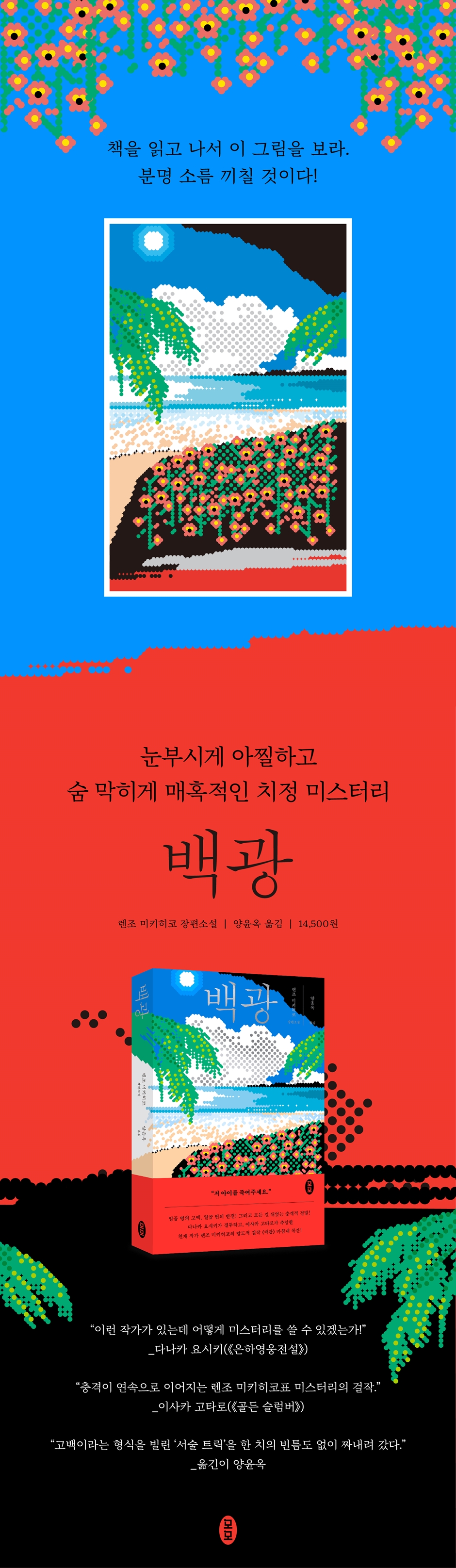
Detailed image
Into the book
That night during the war, when he set out on his way to death, seeing off with cheers and his wife's smile, and after a arduous voyage, he arrived at an island in the South Pacific, a primary-colored island floating in the blue sea, with the sunlight shining down like a blazing flame.
No matter how many times I think of those two things, they occupy my mind and body just as clearly as the first time.
--- p.14~15
“If you’re looking for the girl, the young man buried her under the palm tree over there earlier….”
The words that came out of the stone-like back felt unrealistic, like an auditory hallucination, and were more empty than silence.
“There is no such thing as a palm tree.
“That’s a hibiscus.”
Satoko said this with a creepy look on her father-in-law's face as he cast a fixed gaze at a tree standing on one side of the garden.
--- p.43
Something that had been lurking in this house for so long began to seep out little by little after my mother-in-law passed away, and finally burst out in the form of the death of a girl.
No, I didn't vomit everything out because of this incident.
The trash that this house had hidden, wrapped in black plastic bags, was not even able to be completely disposed of by the incident, and now, a week later, it has rotted and decayed in the late summer heat, finally giving off an unpleasant smell… .
--- p.81
It must be Naoko's hair.
Because it looks exactly like Yukiko's own hair.
As expected, Hirata had met Naoko in some way that day… .
But still, Hirata is not the culprit.
The real culprit is me.
I didn't step out of my hotel room that day.
But I was watching everything that happened in the garden of that house at that time.
Behind the zelkova tree, with the same expression as the wolf in this picture book.
--- pp.139~140
As I watched the old man, who kept trying to hang himself with a flower vine, but ended up falling over and laughing instead of dying, I somehow began to think that even Naoko's death wasn't such a sad event.
For the past two years, Satoko had been dealing with the old man's bizarre words and actions on her own, feeling a sense of exhaustion that tore at her nerves and left her with nothing she could do about it. But for some reason, at this moment, for the first time, Satoko felt that the old man wasn't crazy.
Rather, only this old man is normal, and we are the ones who are crazy.
People, including me, who only accept death as something cruel and sad are the ones who are crazy… .
--- p.186
As an adult, Yukiko has one thing in common with her older sister:
A body that arouses men just by existing… .
If she were glass, she would be hot, flexible liquid glass, still in a molten state.
A body that changes shape and wiggles freely as if playing with a man.
Using that body as a weapon, Yukiko tried to take what her sister had.
--- p.225
“You can kill me,” the woman says.
“It’s okay, you too can be free from suffering, and this child too can be free from suffering.
This child has a happy face like an angel, but in reality, he is crying because his small body cannot handle all the hatred from you and others.
So this child will also be comfortable… .
For everyone.
So it's okay."
No matter how many times I think of those two things, they occupy my mind and body just as clearly as the first time.
--- p.14~15
“If you’re looking for the girl, the young man buried her under the palm tree over there earlier….”
The words that came out of the stone-like back felt unrealistic, like an auditory hallucination, and were more empty than silence.
“There is no such thing as a palm tree.
“That’s a hibiscus.”
Satoko said this with a creepy look on her father-in-law's face as he cast a fixed gaze at a tree standing on one side of the garden.
--- p.43
Something that had been lurking in this house for so long began to seep out little by little after my mother-in-law passed away, and finally burst out in the form of the death of a girl.
No, I didn't vomit everything out because of this incident.
The trash that this house had hidden, wrapped in black plastic bags, was not even able to be completely disposed of by the incident, and now, a week later, it has rotted and decayed in the late summer heat, finally giving off an unpleasant smell… .
--- p.81
It must be Naoko's hair.
Because it looks exactly like Yukiko's own hair.
As expected, Hirata had met Naoko in some way that day… .
But still, Hirata is not the culprit.
The real culprit is me.
I didn't step out of my hotel room that day.
But I was watching everything that happened in the garden of that house at that time.
Behind the zelkova tree, with the same expression as the wolf in this picture book.
--- pp.139~140
As I watched the old man, who kept trying to hang himself with a flower vine, but ended up falling over and laughing instead of dying, I somehow began to think that even Naoko's death wasn't such a sad event.
For the past two years, Satoko had been dealing with the old man's bizarre words and actions on her own, feeling a sense of exhaustion that tore at her nerves and left her with nothing she could do about it. But for some reason, at this moment, for the first time, Satoko felt that the old man wasn't crazy.
Rather, only this old man is normal, and we are the ones who are crazy.
People, including me, who only accept death as something cruel and sad are the ones who are crazy… .
--- p.186
As an adult, Yukiko has one thing in common with her older sister:
A body that arouses men just by existing… .
If she were glass, she would be hot, flexible liquid glass, still in a molten state.
A body that changes shape and wiggles freely as if playing with a man.
Using that body as a weapon, Yukiko tried to take what her sister had.
--- p.225
“You can kill me,” the woman says.
“It’s okay, you too can be free from suffering, and this child too can be free from suffering.
This child has a happy face like an angel, but in reality, he is crying because his small body cannot handle all the hatred from you and others.
So this child will also be comfortable… .
For everyone.
So it's okay."
--- p.284
Publisher's Review
“How can you write a mystery when there is a writer like this!”
Yoshiki Tanaka (Legend of the Galactic Heroes)
"A masterpiece of mystery, with a series of shocking twists and turns from Renzo Mikihiko."
Kotaro Isaka (Golden Slumber)
“After I close the last page
How the author constantly engages the reader's inferential brain
Only then will you realize that you were the one who controlled and stimulated them!”
Translated by Yang Yun-ok
It has eaten away at the inner world of an ordinary family.
A story about a terrible desire
Keizo, an elderly man with dementia, lives comfortably under one roof with his son Ryusuke, his daughter-in-law Satoko, and his granddaughter Kayo.
But their ordinary daily life is shattered when Naoko, the daughter of Satoko's younger sister, is found dead.
Then the truth leaks out from Satoko's mouth.
“This house has never been ordinary and peaceful.
“Everyone just pretended.” (p.193)
A woman who has an affair without hesitation and gives birth to a child as a spoil of war, a man who attempts suicide while turning a blind eye to his wife's infidelity, a woman who is tired of being a dutiful, wise wife, and loving mother, and a man who lives in the memory of a murder he committed in the South Pacific decades ago. This family, who appear to be ordinary people, are actually men and women seething with desire, jealousy, betrayal, revenge, and even murderous intent.
"Baek Gwang" thoroughly exposes how easily broken masks of "ordinariness," "peace," "normality," and "common sense" are.
Renzo Mikihiko fully displays this critical awareness with outstanding literary quality and his uniquely captivating style.
Yukiko, a character described as “a body that arouses men just by existing, a hot, flexible liquid glass that lives as its body commands” (p. 225), reminds us of how powerful desire is compared to morality or ethics.
Also, by intertwining the sweltering midsummer heat that envelops the skin, the primary colorful splendor of a South Pacific island, and the dark, sticky atmosphere of a home, it conveys the dangerous and dark desires that ordinary people hide and barely endure beneath their seemingly peaceful daily lives, and the distorted inner world caused by them, through a sensual metaphor.
I've been wanting to read a mystery like this!
The shocking pleasure of meticulously designed tricks and chain of twists
Would you believe that every element of a novel is designed with a trick? In "Baekkwang," everything is a trick: the characterization, the dialogue, the description of the situation, and even the way the story unfolds.
The character introduced as “a kind and generous man” (p. 172) is called “a boring and unattractive person” (p. 59), or Takehiko, who seduced her by saying “I want to hug you (the man) right now” (p. 115), threatens her by saying “I’m a man who’s only interested in women” and “The pleasure you tasted in my wife’s body was stolen from me, so how about you pay for it in a disgusting way by being beaten by an animal?” (p. 115), or the fact that the see-through clothes “seem to be intended to stimulate the viewer by emphasizing the flesh tone through the black mesh rather than covering it up” (p. 95), easily surpasses the reader’s expectations.
Above all, what is truly soul-stirring is the seven consecutive twists and turns through the narrative technique of ‘confession.’
Each character confesses that they will tell the truth.
But when you hear the confession of the next person, you realize that the confession you heard before was only that person's truth, or the truth for that person, and rather a trick to infer a false culprit.
The unexpectedness of the seven twists and turns that follow the confessions of the seven people shocks the readers.
Readers are simply amazed by the power of meticulously calculated sentences that lead readers to make predictions and then overturn those predictions each time.
“I tried to kill you, but I also tried to save you.”
The truth lies beyond the binary.
『Baek Gwang』 is full of clashes of antonyms.
Good and evil, sin and punishment, love and hate, faith and betrayal, confession and lies, people and dolls (objects pretending to be people), dementia and pretending to have dementia.
If everything in the world were clearly divided into dichotomies, there would be no chaos.
But this novel realistically shows that everyone commits sins without any particular intention, leaving the reader feeling horrified and confused.
The author's skill in freely crossing over conflicting concepts is not only used for the fun of tricks or reversals, but also goes a step further to become a thematic consciousness.
Furthermore, this novel repeatedly overturns the preconceived notions of good and bad people, blurring the boundaries between good and bad and making us think about the clear standards of good and evil.
If what is good to one is evil to another, then what is good and what is evil?
Just as “I melt into the white light of a summer noon and cannot even remember clearly what I did” (p. 168), truth may be something “dim, as if viewed through several layers of cloudy glass” (p. 9).
Yoshiki Tanaka (Legend of the Galactic Heroes)
"A masterpiece of mystery, with a series of shocking twists and turns from Renzo Mikihiko."
Kotaro Isaka (Golden Slumber)
“After I close the last page
How the author constantly engages the reader's inferential brain
Only then will you realize that you were the one who controlled and stimulated them!”
Translated by Yang Yun-ok
It has eaten away at the inner world of an ordinary family.
A story about a terrible desire
Keizo, an elderly man with dementia, lives comfortably under one roof with his son Ryusuke, his daughter-in-law Satoko, and his granddaughter Kayo.
But their ordinary daily life is shattered when Naoko, the daughter of Satoko's younger sister, is found dead.
Then the truth leaks out from Satoko's mouth.
“This house has never been ordinary and peaceful.
“Everyone just pretended.” (p.193)
A woman who has an affair without hesitation and gives birth to a child as a spoil of war, a man who attempts suicide while turning a blind eye to his wife's infidelity, a woman who is tired of being a dutiful, wise wife, and loving mother, and a man who lives in the memory of a murder he committed in the South Pacific decades ago. This family, who appear to be ordinary people, are actually men and women seething with desire, jealousy, betrayal, revenge, and even murderous intent.
"Baek Gwang" thoroughly exposes how easily broken masks of "ordinariness," "peace," "normality," and "common sense" are.
Renzo Mikihiko fully displays this critical awareness with outstanding literary quality and his uniquely captivating style.
Yukiko, a character described as “a body that arouses men just by existing, a hot, flexible liquid glass that lives as its body commands” (p. 225), reminds us of how powerful desire is compared to morality or ethics.
Also, by intertwining the sweltering midsummer heat that envelops the skin, the primary colorful splendor of a South Pacific island, and the dark, sticky atmosphere of a home, it conveys the dangerous and dark desires that ordinary people hide and barely endure beneath their seemingly peaceful daily lives, and the distorted inner world caused by them, through a sensual metaphor.
I've been wanting to read a mystery like this!
The shocking pleasure of meticulously designed tricks and chain of twists
Would you believe that every element of a novel is designed with a trick? In "Baekkwang," everything is a trick: the characterization, the dialogue, the description of the situation, and even the way the story unfolds.
The character introduced as “a kind and generous man” (p. 172) is called “a boring and unattractive person” (p. 59), or Takehiko, who seduced her by saying “I want to hug you (the man) right now” (p. 115), threatens her by saying “I’m a man who’s only interested in women” and “The pleasure you tasted in my wife’s body was stolen from me, so how about you pay for it in a disgusting way by being beaten by an animal?” (p. 115), or the fact that the see-through clothes “seem to be intended to stimulate the viewer by emphasizing the flesh tone through the black mesh rather than covering it up” (p. 95), easily surpasses the reader’s expectations.
Above all, what is truly soul-stirring is the seven consecutive twists and turns through the narrative technique of ‘confession.’
Each character confesses that they will tell the truth.
But when you hear the confession of the next person, you realize that the confession you heard before was only that person's truth, or the truth for that person, and rather a trick to infer a false culprit.
The unexpectedness of the seven twists and turns that follow the confessions of the seven people shocks the readers.
Readers are simply amazed by the power of meticulously calculated sentences that lead readers to make predictions and then overturn those predictions each time.
“I tried to kill you, but I also tried to save you.”
The truth lies beyond the binary.
『Baek Gwang』 is full of clashes of antonyms.
Good and evil, sin and punishment, love and hate, faith and betrayal, confession and lies, people and dolls (objects pretending to be people), dementia and pretending to have dementia.
If everything in the world were clearly divided into dichotomies, there would be no chaos.
But this novel realistically shows that everyone commits sins without any particular intention, leaving the reader feeling horrified and confused.
The author's skill in freely crossing over conflicting concepts is not only used for the fun of tricks or reversals, but also goes a step further to become a thematic consciousness.
Furthermore, this novel repeatedly overturns the preconceived notions of good and bad people, blurring the boundaries between good and bad and making us think about the clear standards of good and evil.
If what is good to one is evil to another, then what is good and what is evil?
Just as “I melt into the white light of a summer noon and cannot even remember clearly what I did” (p. 168), truth may be something “dim, as if viewed through several layers of cloudy glass” (p. 9).
GOODS SPECIFICS
- Publication date: February 14, 2022
- Page count, weight, size: 320 pages | 314g | 122*188*20mm
- ISBN13: 9791191043617
- ISBN10: 1191043614
You may also like
카테고리
korean


korean

![ELLE 엘르 스페셜 에디션 A형 : 12월 [2025]](http://librairie.coreenne.fr/cdn/shop/files/b8e27a3de6c9538896439686c6b0e8fb.jpg?v=1766436872&width=3840)


