

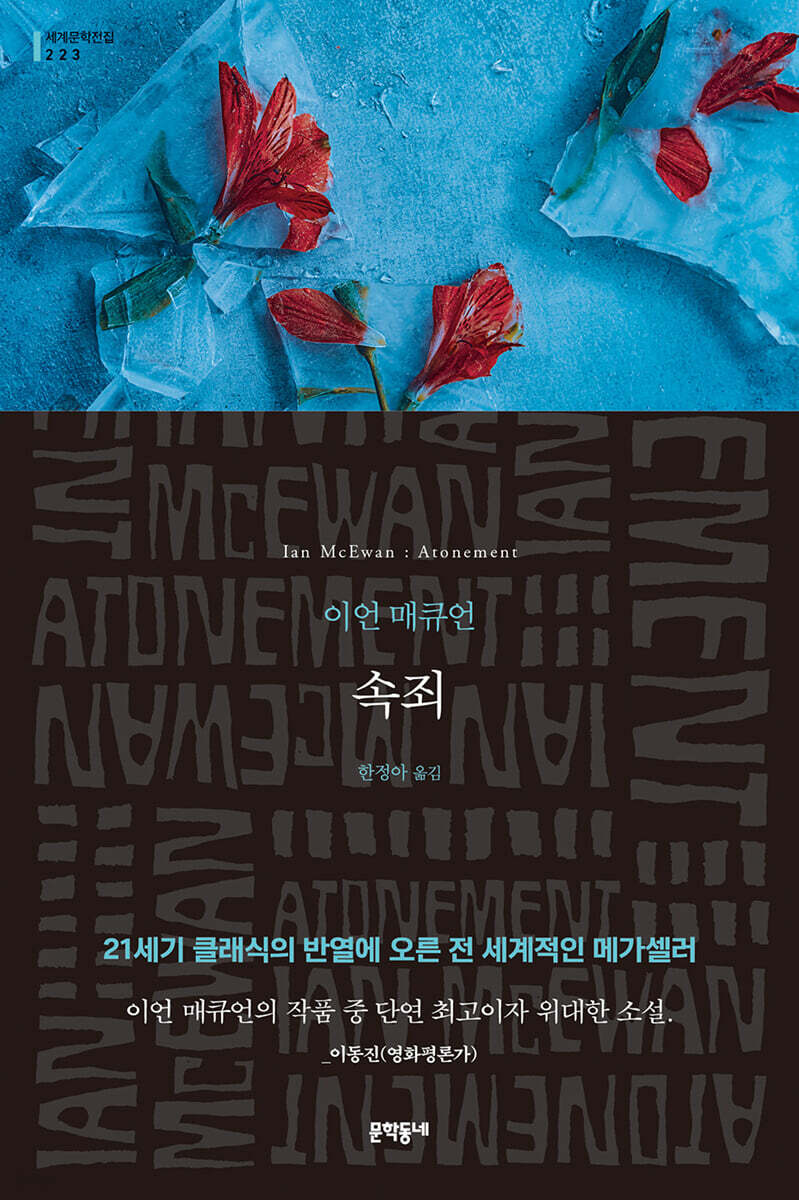
expiation
 |
Description
Book Introduction
We present a new edition of Ian McEwan's masterpiece, the global megaseller Atonement, a representative work of modern English literature.
Since its first introduction in Korea in 2003, it has been reprinted and consistently loved. Twenty years later, it has been republished as part of a world literature collection, offering a more meticulously refined translation and an opportunity to encounter Ian McEwan's world of work in a more complete edition.
This work, which depicts the great catastrophe caused by an innocent misunderstanding in childhood and the atonement that lasts a lifetime, is Ian McEwan's eighth full-length novel. It is considered a masterpiece that has created an explosive response worldwide and marked a turning point in his writing career, and it is also the culmination of his life's work.
Having won the Booker Prize for "Amsterdam" (1998) and been recognized as an important writer of modern English literature, it was only natural that there would be a lot of interest in McEwan's next work, and "Atonement," published in 2001, was a masterpiece that perfectly lived up to everyone's ever-increasing expectations.
The media was quick to praise this work, which deeply moved the reader with its unique, sophisticated narrative and suspenseful writing, its sharp insight into human psychology, and its compassion for humanity and mature perspective.
Rave reviews followed, with "Atonement" being included on the "Best Book of the Year" lists of almost every major media outlet by the end of the year, including "A masterpiece in a word" ([New York Times]), "one of the few works truly worthy of the title 'masterpiece'" ([Economist]), and "even by the standards of writers who write good work, it is exceptional."
Readers' reactions were in line with those of critics.
Although the Booker Prize, which it was nominated for the fourth time that year, went to Australian author Peter Carey's "The True Story of the Kelly Gang," the general consensus was that "Atonement" was by no means inferior to the work, and when it competed again with Peter Carey for the People's Booker Prize, which is selected by direct voting by readers hosted by the British broadcaster BBC, readers gave their hand to "Atonement."
The work's impact extended to visuals, and in 2007, the film [Atonement], based on this work, was released. It was nominated for six Academy Awards, won the British Academy Awards for Best Picture and Best Art Direction, and the Golden Globe Award for Best Picture.
『Atonement』, which has established itself as McEwan's masterpiece and a great work, has been consistently mentioned to this day, including being named one of the '100 Best Novels of All Time' by Time, the Observer, and the Telegraph, and one of the '100 Best Books of the 21st Century' by the Guardian, and has risen to the ranks of a 21st-century classic. It has been translated into 42 languages and is consistently loved by readers around the world.
Since its first introduction in Korea in 2003, it has been reprinted and consistently loved. Twenty years later, it has been republished as part of a world literature collection, offering a more meticulously refined translation and an opportunity to encounter Ian McEwan's world of work in a more complete edition.
This work, which depicts the great catastrophe caused by an innocent misunderstanding in childhood and the atonement that lasts a lifetime, is Ian McEwan's eighth full-length novel. It is considered a masterpiece that has created an explosive response worldwide and marked a turning point in his writing career, and it is also the culmination of his life's work.
Having won the Booker Prize for "Amsterdam" (1998) and been recognized as an important writer of modern English literature, it was only natural that there would be a lot of interest in McEwan's next work, and "Atonement," published in 2001, was a masterpiece that perfectly lived up to everyone's ever-increasing expectations.
The media was quick to praise this work, which deeply moved the reader with its unique, sophisticated narrative and suspenseful writing, its sharp insight into human psychology, and its compassion for humanity and mature perspective.
Rave reviews followed, with "Atonement" being included on the "Best Book of the Year" lists of almost every major media outlet by the end of the year, including "A masterpiece in a word" ([New York Times]), "one of the few works truly worthy of the title 'masterpiece'" ([Economist]), and "even by the standards of writers who write good work, it is exceptional."
Readers' reactions were in line with those of critics.
Although the Booker Prize, which it was nominated for the fourth time that year, went to Australian author Peter Carey's "The True Story of the Kelly Gang," the general consensus was that "Atonement" was by no means inferior to the work, and when it competed again with Peter Carey for the People's Booker Prize, which is selected by direct voting by readers hosted by the British broadcaster BBC, readers gave their hand to "Atonement."
The work's impact extended to visuals, and in 2007, the film [Atonement], based on this work, was released. It was nominated for six Academy Awards, won the British Academy Awards for Best Picture and Best Art Direction, and the Golden Globe Award for Best Picture.
『Atonement』, which has established itself as McEwan's masterpiece and a great work, has been consistently mentioned to this day, including being named one of the '100 Best Novels of All Time' by Time, the Observer, and the Telegraph, and one of the '100 Best Books of the 21st Century' by the Guardian, and has risen to the ranks of a 21st-century classic. It has been translated into 42 languages and is consistently loved by readers around the world.
- You can preview some of the book's contents.
Preview
index
Part 1 … 11
Part 2 … 275
Part 3 … 383
London 1999… 503
Acknowledgments … 535
Commentary | Imagination that destroys the world and imagination that makes it beautiful… 537
Ian McEwan Chronology … 545
Part 2 … 275
Part 3 … 383
London 1999… 503
Acknowledgments … 535
Commentary | Imagination that destroys the world and imagination that makes it beautiful… 537
Ian McEwan Chronology … 545
Into the book
Briony, who believes she has embarked on a path to becoming a full-fledged writer, now finds satisfaction on a different level.
Writing not only gave me the thrill of discovering my own secrets, but also the pleasure of minimizing the world and holding it in my hand.
In just five pages, I was able to paint a world that was far more joyful than a toy farm.
--- p.19
The novel was direct and simple, so nothing could intervene between the author and the reader.
There was no room for personal greed or incompetence, no need to feel pressured by time, and no need to fret over limited resources.
Just write whatever you imagine and wish for, and a perfect world will be born.
--- p.62
How quickly does the story of life end?
I was neither overwhelmed nor disillusioned.
But I just thought it was cruel that it ended so quickly.
--- p.223
She had blindly walked into a maze of her own making, and was too young, too afraid, and too eager to please others to dare turn back.
She was either not naturally independent or was too young to be independent.
--- p.252
Robbie silently repeated the last two sentences in the darkness.
The reason for my life.
A reason to live, not a reason to live.
That was it.
She was his reason for living, her reason for surviving.
--- p.304
As she pushed her shoulder towards the farmhouse gate, the distinctive siren sound of a Stuka began to be heard.
Nightmares become reality through the power of science.
Someone, a mere human, imagined and created these devilish sounds.
And the effect was perfect.
The sound was terrifying, growing louder and louder, foreshadowing the impending doom for all.
It was telling us that no one can be an exception to fate.
--- p.341
Although it wasn't her intention, the letter hit her where it hurt.
Couldn't a girl come between them and bring terrible misfortune upon them? Yes, indeed, that could happen.
And so it was.
Did he think he could hide this fact by writing a trivial novel with his meager writing skills? Did he perhaps try to satisfy his vanity by submitting it to a magazine? The lengthy descriptions of light, stone, and water, the narrative divided into three perspectives, the endless silence that persists without any real action.
Nothing could hide her cowardice.
Did she really believe she could hide behind a so-called modern writing style, imitating others, and drown her guilt in the stream of consciousness—the stream of consciousness of three people, at that? Nothing in her novels was missing from her life.
What she didn't want to face head-on in life was also missing from the novel.
That was the very thing that had to be left out to make it a true novel.
What should she do now? What she lacked wasn't the spine of her novel.
It was her own spine, the spine of her life.
--- p.458
This is the question that has plagued me for the past fifty-nine years.
If the novelist is a godlike being with absolute power to determine outcomes, how can he possibly atone for his sins? There is no being he can rely on, reconcile with, or forgive.
There is no one outside the novelist.
The novelist sets limits and conditions in his imagination.
There can be no atonement, neither for God nor for the novelist.
Even though he is an atheist.
For a novelist, atonement is always an impossible task, and that is the important thing.
There is only an effort for atonement.
Writing not only gave me the thrill of discovering my own secrets, but also the pleasure of minimizing the world and holding it in my hand.
In just five pages, I was able to paint a world that was far more joyful than a toy farm.
--- p.19
The novel was direct and simple, so nothing could intervene between the author and the reader.
There was no room for personal greed or incompetence, no need to feel pressured by time, and no need to fret over limited resources.
Just write whatever you imagine and wish for, and a perfect world will be born.
--- p.62
How quickly does the story of life end?
I was neither overwhelmed nor disillusioned.
But I just thought it was cruel that it ended so quickly.
--- p.223
She had blindly walked into a maze of her own making, and was too young, too afraid, and too eager to please others to dare turn back.
She was either not naturally independent or was too young to be independent.
--- p.252
Robbie silently repeated the last two sentences in the darkness.
The reason for my life.
A reason to live, not a reason to live.
That was it.
She was his reason for living, her reason for surviving.
--- p.304
As she pushed her shoulder towards the farmhouse gate, the distinctive siren sound of a Stuka began to be heard.
Nightmares become reality through the power of science.
Someone, a mere human, imagined and created these devilish sounds.
And the effect was perfect.
The sound was terrifying, growing louder and louder, foreshadowing the impending doom for all.
It was telling us that no one can be an exception to fate.
--- p.341
Although it wasn't her intention, the letter hit her where it hurt.
Couldn't a girl come between them and bring terrible misfortune upon them? Yes, indeed, that could happen.
And so it was.
Did he think he could hide this fact by writing a trivial novel with his meager writing skills? Did he perhaps try to satisfy his vanity by submitting it to a magazine? The lengthy descriptions of light, stone, and water, the narrative divided into three perspectives, the endless silence that persists without any real action.
Nothing could hide her cowardice.
Did she really believe she could hide behind a so-called modern writing style, imitating others, and drown her guilt in the stream of consciousness—the stream of consciousness of three people, at that? Nothing in her novels was missing from her life.
What she didn't want to face head-on in life was also missing from the novel.
That was the very thing that had to be left out to make it a true novel.
What should she do now? What she lacked wasn't the spine of her novel.
It was her own spine, the spine of her life.
--- p.458
This is the question that has plagued me for the past fifty-nine years.
If the novelist is a godlike being with absolute power to determine outcomes, how can he possibly atone for his sins? There is no being he can rely on, reconcile with, or forgive.
There is no one outside the novelist.
The novelist sets limits and conditions in his imagination.
There can be no atonement, neither for God nor for the novelist.
Even though he is an atheist.
For a novelist, atonement is always an impossible task, and that is the important thing.
There is only an effort for atonement.
--- p.533
Publisher's Review
A hot afternoon where time stands still,
A tragedy between young lovers brought about by a girl's misunderstanding
And the arduous atonement of a novelist's lifelong attempt to turn it back!
The story begins in 1935, in a suburban mansion, during the last good times for the British upper class before the outbreak of World War II.
In Part One, Briony Tallis is a thirteen-year-old girl who dreams of becoming a writer. She is imaginative, sensitive, and also needs order in the world around her to feel satisfied.
Cecilia, Briony's older sister, returns home after graduating from college and is plagued by a vague sense of frustration and a sense of duty to become independent.
And then there's Robbie Turner, Cecilia's childhood friend and the son of the Tallis family's housekeeper.
Robbie, who has been keeping Cecilia at a distance due to class differences and the budding sexual tension between them, and Cecilia, who senses this and feels an inexpressible resentment, meet in the garden on a hot summer afternoon.
The two engage in a brawl over a vase, and when the vase breaks and falls into the fountain, Cecilia, overcome by an inexplicable rage, takes off her clothes and dives into the water.
And from the upper floor window of the mansion, Brianna watches the scene with bated breath.
That evening, another incident occurs at the mansion.
The twin brothers who were staying at Tallis' house went missing, and even Paul Marshall, who was visiting as a guest, was mobilized to go find the children, but the twins' older sister, Lola, was raped.
Having witnessed the mysterious behavior between Robbie and Cecilia a few hours earlier and added her own imagination to it, Briony points out Robbie as the rapist, and the fates of Robbie, a bright young man who was planning to go to medical school, and Cecilia, who has belatedly realized her love for him, are headed toward tragedy.
In the second half, the novel jumps forward in time and takes readers into the midst of World War II.
In Part 2, Robbie, who was serving time in prison for rape, goes to war in exchange for early release and experiences hell on the battlefields of France.
This is a section that stands out for Ian McEwan's faithful historical research and his masterful depiction of it in a vivid, tangible way. It depicts the turbulent situation of the Allied forces retreating from the Maginot Line to Dunkirk, the horror of bombing, and the collective violence committed by soldiers driven to despair by the lack of ships to return home.
Part 3 depicts Briony's struggle to atone for her mistakes as she abandons her comfortable home life in London, where she volunteers as a nurse to care for wounded soldiers in the midst of the brutal war, while also writing a novel.
Ironically, Lola marries the person who brought about all this tragedy, and Briony seeks out Cecilia to apologize and make things right.
Cecilia left home after the incident that summer night and started working as a nurse before Brianna, living alone.
When Briony unexpectedly encounters Robbie at her sister's boarding house, she realizes that neither the horrific mistake she made nor the devastating war could separate them.
But did the two lovers really have a happy ending?
Ian McEwan, the greatest intellectual of modern English literature
His life's work, a culmination of everything he has done
"Atonement" captivates readers with its meticulous composition, thrilling storyline reminiscent of a movie, excellent psychological descriptions of characters with distinct personalities, and delicate yet solemn writing style.
The first half of the story, which moves between the main characters' perspectives and in which coincidences, misunderstandings, and malice are exquisitely intertwined to create a terrifying outcome, creates tension by fully displaying the writer's unique ability to control suspense. In the second half, which captures the futility and horror of war and the various levels of violence that humans are capable of, the meticulous narrative based on thorough research and the macroscopic insight into historical consciousness combine to make you feel the artistic technique that has reached the realm of a craftsman.
This work is a novel that confesses a love for English literature while also contemplating the essence of literary creation.
Jane Austen, Samuel Richardson, TS
Elliot, DH
Writers who have left a strong mark on the history of English literature, such as Lawrence, are mentioned, and existential literary critics such as Cyril Connolly and Elizabeth Bowen appear, and the protagonist Briony is strongly influenced by Virginia Woolf in the process of becoming a novelist.
And Briony's life, which sought to atone for his lifelong sins by writing novels, is itself a serious question that McEwan poses about the power and limitations of imagination and its product, literary works.
As the novel moves toward its conclusion, these metafictional elements combine with the overall story to create a weighty resonance.
What fate awaits Briony and the two lovers whose fates were completely shaken by Briony?
As each piece slowly falls into place, finally reaching a shocking and moving conclusion, readers will experience the joy and lingering emotions that only a first-rate novel can deliver.
▶ Recommendation
It's a love story, a war story, and a tale of the destructive power of imagination.
It is an orchestral novel that combines all the themes the author has explored: the ruin brought about by innocence, past events with lasting effects, and evil intruding into ordinary life.
In a word, a masterpiece.
McEwan's ability to control the suspense of a story has reached the level of a master.
_The New York Times
It's rare to find a work that deserves the title of "masterpiece," but this one truly deserves it.
A novel of incredible depth and shining with compassion and insight into humanity.
_The Economist
Even by the standards of a writer who writes well, 『Atonement』 is an outstanding work.
The work is consistently persuasive and its unique, refined style resonates deeply.
_times
In this masterful novel, which explores the conflict between chance and ethical choice, not a single word is chosen by chance.
_San Francisco Chronicle
A work that I would consider Ian McEwan's greatest masterpiece without any conflict.
_London Review of Books
A novel famous for its exquisite ending can easily forget its beginning.
But 『Atonement』 has the power to make you return to the first page after reading to the end.
_Vulture
With his penetrating psychological insight, sensual moments, and a free hand in using historical details, he created a novelistic world that anyone can't help but immerse themselves in.
_The Wall Street Journal
McEwan is an unrivaled giant of British literature.
A fascinatingly bizarre, original, and compelling novel.
_The Independent
This is both a critique of fiction and a defense of fiction.
_New Republic
A beautiful and enchanting panorama of fiction.
_John Updike
A tragedy between young lovers brought about by a girl's misunderstanding
And the arduous atonement of a novelist's lifelong attempt to turn it back!
The story begins in 1935, in a suburban mansion, during the last good times for the British upper class before the outbreak of World War II.
In Part One, Briony Tallis is a thirteen-year-old girl who dreams of becoming a writer. She is imaginative, sensitive, and also needs order in the world around her to feel satisfied.
Cecilia, Briony's older sister, returns home after graduating from college and is plagued by a vague sense of frustration and a sense of duty to become independent.
And then there's Robbie Turner, Cecilia's childhood friend and the son of the Tallis family's housekeeper.
Robbie, who has been keeping Cecilia at a distance due to class differences and the budding sexual tension between them, and Cecilia, who senses this and feels an inexpressible resentment, meet in the garden on a hot summer afternoon.
The two engage in a brawl over a vase, and when the vase breaks and falls into the fountain, Cecilia, overcome by an inexplicable rage, takes off her clothes and dives into the water.
And from the upper floor window of the mansion, Brianna watches the scene with bated breath.
That evening, another incident occurs at the mansion.
The twin brothers who were staying at Tallis' house went missing, and even Paul Marshall, who was visiting as a guest, was mobilized to go find the children, but the twins' older sister, Lola, was raped.
Having witnessed the mysterious behavior between Robbie and Cecilia a few hours earlier and added her own imagination to it, Briony points out Robbie as the rapist, and the fates of Robbie, a bright young man who was planning to go to medical school, and Cecilia, who has belatedly realized her love for him, are headed toward tragedy.
In the second half, the novel jumps forward in time and takes readers into the midst of World War II.
In Part 2, Robbie, who was serving time in prison for rape, goes to war in exchange for early release and experiences hell on the battlefields of France.
This is a section that stands out for Ian McEwan's faithful historical research and his masterful depiction of it in a vivid, tangible way. It depicts the turbulent situation of the Allied forces retreating from the Maginot Line to Dunkirk, the horror of bombing, and the collective violence committed by soldiers driven to despair by the lack of ships to return home.
Part 3 depicts Briony's struggle to atone for her mistakes as she abandons her comfortable home life in London, where she volunteers as a nurse to care for wounded soldiers in the midst of the brutal war, while also writing a novel.
Ironically, Lola marries the person who brought about all this tragedy, and Briony seeks out Cecilia to apologize and make things right.
Cecilia left home after the incident that summer night and started working as a nurse before Brianna, living alone.
When Briony unexpectedly encounters Robbie at her sister's boarding house, she realizes that neither the horrific mistake she made nor the devastating war could separate them.
But did the two lovers really have a happy ending?
Ian McEwan, the greatest intellectual of modern English literature
His life's work, a culmination of everything he has done
"Atonement" captivates readers with its meticulous composition, thrilling storyline reminiscent of a movie, excellent psychological descriptions of characters with distinct personalities, and delicate yet solemn writing style.
The first half of the story, which moves between the main characters' perspectives and in which coincidences, misunderstandings, and malice are exquisitely intertwined to create a terrifying outcome, creates tension by fully displaying the writer's unique ability to control suspense. In the second half, which captures the futility and horror of war and the various levels of violence that humans are capable of, the meticulous narrative based on thorough research and the macroscopic insight into historical consciousness combine to make you feel the artistic technique that has reached the realm of a craftsman.
This work is a novel that confesses a love for English literature while also contemplating the essence of literary creation.
Jane Austen, Samuel Richardson, TS
Elliot, DH
Writers who have left a strong mark on the history of English literature, such as Lawrence, are mentioned, and existential literary critics such as Cyril Connolly and Elizabeth Bowen appear, and the protagonist Briony is strongly influenced by Virginia Woolf in the process of becoming a novelist.
And Briony's life, which sought to atone for his lifelong sins by writing novels, is itself a serious question that McEwan poses about the power and limitations of imagination and its product, literary works.
As the novel moves toward its conclusion, these metafictional elements combine with the overall story to create a weighty resonance.
What fate awaits Briony and the two lovers whose fates were completely shaken by Briony?
As each piece slowly falls into place, finally reaching a shocking and moving conclusion, readers will experience the joy and lingering emotions that only a first-rate novel can deliver.
▶ Recommendation
It's a love story, a war story, and a tale of the destructive power of imagination.
It is an orchestral novel that combines all the themes the author has explored: the ruin brought about by innocence, past events with lasting effects, and evil intruding into ordinary life.
In a word, a masterpiece.
McEwan's ability to control the suspense of a story has reached the level of a master.
_The New York Times
It's rare to find a work that deserves the title of "masterpiece," but this one truly deserves it.
A novel of incredible depth and shining with compassion and insight into humanity.
_The Economist
Even by the standards of a writer who writes well, 『Atonement』 is an outstanding work.
The work is consistently persuasive and its unique, refined style resonates deeply.
_times
In this masterful novel, which explores the conflict between chance and ethical choice, not a single word is chosen by chance.
_San Francisco Chronicle
A work that I would consider Ian McEwan's greatest masterpiece without any conflict.
_London Review of Books
A novel famous for its exquisite ending can easily forget its beginning.
But 『Atonement』 has the power to make you return to the first page after reading to the end.
_Vulture
With his penetrating psychological insight, sensual moments, and a free hand in using historical details, he created a novelistic world that anyone can't help but immerse themselves in.
_The Wall Street Journal
McEwan is an unrivaled giant of British literature.
A fascinatingly bizarre, original, and compelling novel.
_The Independent
This is both a critique of fiction and a defense of fiction.
_New Republic
A beautiful and enchanting panorama of fiction.
_John Updike
GOODS SPECIFICS
- Date of issue: February 28, 2023
- Page count, weight, size: 556 pages | 700g | 140*210*35mm
- ISBN13: 9788954690799
- ISBN10: 8954690793
You may also like
카테고리
korean


korean

![ELLE 엘르 스페셜 에디션 A형 : 12월 [2025]](http://librairie.coreenne.fr/cdn/shop/files/b8e27a3de6c9538896439686c6b0e8fb.jpg?v=1766436872&width=3840)


