

The Future of Real Estate in Korea
 |
Description
Book Introduction
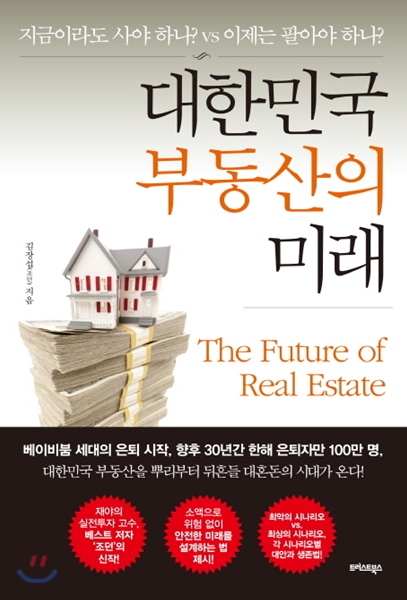
Baby boomers are starting to retire, with 1 million retirees expected annually over the next 30 years. An era of great chaos is coming that will shake the real estate industry in Korea to its core! [The Future of Real Estate in Korea] is a book written by an investment expert who has set aside his investor greed and written it honestly and boldly. It is a masterpiece that fully encompasses both macro and micro trends by mobilizing all of his abilities. South Korea's real estate market is at a crossroads between 'crisis' and 'opportunity.' In a situation where both the worst-case scenario and the best-case scenario are possible, there are bound to be those who cry and those who laugh depending on which direction it goes. We take a deep dive into what the worst-case scenario is and what the best-case scenario is. And it suggests a way to survive in any scenario, that is, an intersection that rises in any case. This book also presents investment methods for the future. It presents investment directions for rental properties, including jeonse (monthly rent), apartments, villas, officetels, commercial properties, and auctions, and even covers ways to avoid vacancies and achieve effective results with less money by leveraging leverage. It also includes information on renting out share houses, which will become the main source of income for future retirees, and long-term land investment methods. |
- You can preview some of the book's contents.
Preview
index
The Future of Real Estate in Korea
Interview with the Author - Should I Buy, Sell, or Switch?
Prologue_What is the worst-case scenario and what is the best-case scenario?
Part 1: The Past and Present of Real Estate in Korea
The history of real estate that cannot be overlooked
Before 2000: Auction investment period / Before 2004: Pre-sale right investment period / Before 2006: Reconstruction apartment investment period / Until March 2007: Redevelopment villa investment period / Until June 2007: Seoul, metropolitan area officetel investment period / Before 2012: Local real estate investment period / Before 2014: Metropolitan area real estate investment period / Present: Seoul real estate investment period
A small, low-risk safety net: a 10 million won investment method
Redevelopment / Officetel Investment / Local Investment / Metropolitan Area Commercial Building / Metropolitan Area Apartment Investment
Don't be fooled by numbers, have eyes that see the truth.
The laws of the world that only I didn't know about
Build an automatic wealth system that will keep you rich for life without you having to work.
Labor / Land / Capital
Why do house prices rise 10-fold and land prices rise 1,000-fold?
Part 2: The Future of Real Estate in Korea
Is this the beginning of a recession or a harbinger of a boom?
Earlier retirement, longer life expectancy
Why should I become a renter?
Things You Must Know Before Starting Your Own Business
The problem isn't deflation, it's low growth.
Fading growth momentum
Aging population/youth unemployment/the decline of the middle class
Globalization actually promotes low growth.
Decrease in disposable income
What will happen to interest rates in Korea?
Mortgage loan regulations: What's next, and what impact will they have?
Part 3: South Korean Real Estate: Worst-Case Versus Best-Case Scenario
South Korean Real Estate: Worst-Case and Best-Case Scenarios
Worst-case scenario 1: Will we follow in Japan's footsteps with an aging society and new city problems?
The inevitable super-aging society
Worst Case Scenario 2: Why did the Satori Generation end up in Tokyo?
Worst-Case Scenario 3: Will We Face a Population Cliff in 2018?
Worst-Case Scenario 4: Why Are House Prices So Different in Japan and Europe?
Worst-Case Scenario 5: Global Economic Risks, Wall Street Conspiracy Theories, and the Outlook for Korea's Real Estate Market
Best-case scenario 1: Will allowing foreigners (Chinese) to purchase domestic real estate trigger a surge in prices?
Best-case scenario 2: Unification of North and South Korea creates a storm in the real estate market.
After unification, pay attention to changes in the value of South Korean and North Korean currencies.
What is the fate of the DMZ?
What is the direction of land investment in North Korea?
If unification happens, will the North Korean region rise, or will Seoul and the metropolitan area rise?
Where can we survive both the worst and best-case scenarios?
Part 4 The Future of Real Estate Investment
Standards for high-yield real estate
How to find new investment opportunities?
Gather data / Think / Practice and verify / Sell
5 Things to Remember When Investing in Real Estate
Vacancy / Actual investment amount / Rate of return / Past transaction price / Whether transaction is possible
The success or failure of a real estate rental business hinges on vacancy rates and leverage.
Oversupply / Supply is constant but demand is decreasing / Job mobility / Leveraged investments
You can't buy it cheap.
Auctions are about buying at the 'market price'.
How to win a profitable item at auction
Sharehouse Investment: A Future Trend and Alternative in Real Estate Investment
Seoul Villa Investment Method
Real estate investment near subway stations in Seoul
Let's become rich through long-term investment.
How to Make Money After 60 Without Worrying
Summary & Investment
Summary1 Why should I get into the real estate rental business?
Summary 2 Five Variables That Will Determine the Future
Summary3 Land Investment Methods
Summary 4 Saving with Land
Summary 5 How to Invest in Seoul's Monthly Rent
Interview with the Author - Should I Buy, Sell, or Switch?
Prologue_What is the worst-case scenario and what is the best-case scenario?
Part 1: The Past and Present of Real Estate in Korea
The history of real estate that cannot be overlooked
Before 2000: Auction investment period / Before 2004: Pre-sale right investment period / Before 2006: Reconstruction apartment investment period / Until March 2007: Redevelopment villa investment period / Until June 2007: Seoul, metropolitan area officetel investment period / Before 2012: Local real estate investment period / Before 2014: Metropolitan area real estate investment period / Present: Seoul real estate investment period
A small, low-risk safety net: a 10 million won investment method
Redevelopment / Officetel Investment / Local Investment / Metropolitan Area Commercial Building / Metropolitan Area Apartment Investment
Don't be fooled by numbers, have eyes that see the truth.
The laws of the world that only I didn't know about
Build an automatic wealth system that will keep you rich for life without you having to work.
Labor / Land / Capital
Why do house prices rise 10-fold and land prices rise 1,000-fold?
Part 2: The Future of Real Estate in Korea
Is this the beginning of a recession or a harbinger of a boom?
Earlier retirement, longer life expectancy
Why should I become a renter?
Things You Must Know Before Starting Your Own Business
The problem isn't deflation, it's low growth.
Fading growth momentum
Aging population/youth unemployment/the decline of the middle class
Globalization actually promotes low growth.
Decrease in disposable income
What will happen to interest rates in Korea?
Mortgage loan regulations: What's next, and what impact will they have?
Part 3: South Korean Real Estate: Worst-Case Versus Best-Case Scenario
South Korean Real Estate: Worst-Case and Best-Case Scenarios
Worst-case scenario 1: Will we follow in Japan's footsteps with an aging society and new city problems?
The inevitable super-aging society
Worst Case Scenario 2: Why did the Satori Generation end up in Tokyo?
Worst-Case Scenario 3: Will We Face a Population Cliff in 2018?
Worst-Case Scenario 4: Why Are House Prices So Different in Japan and Europe?
Worst-Case Scenario 5: Global Economic Risks, Wall Street Conspiracy Theories, and the Outlook for Korea's Real Estate Market
Best-case scenario 1: Will allowing foreigners (Chinese) to purchase domestic real estate trigger a surge in prices?
Best-case scenario 2: Unification of North and South Korea creates a storm in the real estate market.
After unification, pay attention to changes in the value of South Korean and North Korean currencies.
What is the fate of the DMZ?
What is the direction of land investment in North Korea?
If unification happens, will the North Korean region rise, or will Seoul and the metropolitan area rise?
Where can we survive both the worst and best-case scenarios?
Part 4 The Future of Real Estate Investment
Standards for high-yield real estate
How to find new investment opportunities?
Gather data / Think / Practice and verify / Sell
5 Things to Remember When Investing in Real Estate
Vacancy / Actual investment amount / Rate of return / Past transaction price / Whether transaction is possible
The success or failure of a real estate rental business hinges on vacancy rates and leverage.
Oversupply / Supply is constant but demand is decreasing / Job mobility / Leveraged investments
You can't buy it cheap.
Auctions are about buying at the 'market price'.
How to win a profitable item at auction
Sharehouse Investment: A Future Trend and Alternative in Real Estate Investment
Seoul Villa Investment Method
Real estate investment near subway stations in Seoul
Let's become rich through long-term investment.
How to Make Money After 60 Without Worrying
Summary & Investment
Summary1 Why should I get into the real estate rental business?
Summary 2 Five Variables That Will Determine the Future
Summary3 Land Investment Methods
Summary 4 Saving with Land
Summary 5 How to Invest in Seoul's Monthly Rent
Publisher's Review
The Future of Real Estate in Korea
Baby boomers are starting to retire, with 1 million retirees expected annually over the next 30 years.
An era of great chaos is coming that will shake the real estate industry in Korea to its core!
Worst-case scenario vs. best-case scenario: 'crisis' or 'opportunity'?
[The Future of Real Estate in Korea] is a book written by an investment expert who has set aside his investor greed and written it honestly and boldly. It is a masterpiece that fully encompasses both macro and micro trends by mobilizing all of his abilities.
South Korea's real estate market is at a crossroads between 'crisis' and 'opportunity.'
In a situation where both the worst-case scenario and the best-case scenario are possible, there are bound to be those who cry and those who laugh depending on which direction we go.
We take a deep dive into what the worst-case scenario is and what the best-case scenario is.
And it suggests a way to survive in any scenario, that is, an intersection that rises in any case.
Should I buy a house now or sell it now?
They are all wrong.
Where to buy and where to sell is already determined, and it is where you can survive both worst-case and best-case scenarios.
Where you want to sell, you have to sell quickly, and where you want to buy, you have to buy now.
This is because we are entering an era where only the rising places will rise, and where the falling places are expected to experience a severe decline.
If it goes up, a surge like London is expected, and if it goes down, a plunge like Japan is expected.
Whether you are an investor or a resident, you need to buy a place to live to survive in the future.
The idea that it's okay if the price of the house falls because you're going to live in it anyway is likely to lead to regret and failure.
We suggest places to live and sell, focusing on Seoul and the metropolitan area, first and second new cities, and local areas.
An era of great chaos is coming that will shake the real estate industry in Korea to its core!
With the baby boomer generation starting to retire, and with 1 million retirees expected each year over the next 30 years, we are entering an era of great chaos that will shake the real estate industry in Korea to its core.
From the growing number of retirees who will be a burden on the South Korean economy to the demographic cliff caused by the low birth rate, the future of real estate is seemingly heading towards a worst-case scenario.
The global economy is heading towards a recession, and Korea is moving beyond the recession and entering a period of long-term low growth.
The problem of youth unemployment, the phenomenon of housing hollowing out due to excessive supply, the decline of the middle class, declining disposable income, and even regulations on mortgage loans are casting a dark shadow over the real estate market in South Korea.
However, the possibility that real estate prices in South Korea will skyrocket like those in advanced Western countries cannot be ruled out.
The explosive growth of single-person and two-person households, the unification of North and South Korea, will likely be a catalyst, and the possibility of Chinese investment in Korea, which has fueled a global real estate boom, is also increasing.
If the fruits of economic growth have been enjoyed and the whole economy has risen, the future is expected to be an era of differentiation, with a clear distinction between those rising and those falling.
How should people who buy homes in areas where prices are falling cope? Where should they buy homes for their retirement, and how should they utilize those homes? Find the answers.
The current state of real estate in Korea, its imminent future, and key alternatives!
This book also presents investment methods for the future.
It presents investment directions for rental properties, including jeonse (monthly rent), apartments, villas, officetels, commercial properties, and auctions, and even covers ways to avoid vacancies and achieve effective results with less money by leveraging leverage.
It also includes information on renting out share houses, which will become the main source of income for future retirees, and long-term land investment methods.
Baby boomers are starting to retire, with 1 million retirees expected annually over the next 30 years.
An era of great chaos is coming that will shake the real estate industry in Korea to its core!
Worst-case scenario vs. best-case scenario: 'crisis' or 'opportunity'?
[The Future of Real Estate in Korea] is a book written by an investment expert who has set aside his investor greed and written it honestly and boldly. It is a masterpiece that fully encompasses both macro and micro trends by mobilizing all of his abilities.
South Korea's real estate market is at a crossroads between 'crisis' and 'opportunity.'
In a situation where both the worst-case scenario and the best-case scenario are possible, there are bound to be those who cry and those who laugh depending on which direction we go.
We take a deep dive into what the worst-case scenario is and what the best-case scenario is.
And it suggests a way to survive in any scenario, that is, an intersection that rises in any case.
Should I buy a house now or sell it now?
They are all wrong.
Where to buy and where to sell is already determined, and it is where you can survive both worst-case and best-case scenarios.
Where you want to sell, you have to sell quickly, and where you want to buy, you have to buy now.
This is because we are entering an era where only the rising places will rise, and where the falling places are expected to experience a severe decline.
If it goes up, a surge like London is expected, and if it goes down, a plunge like Japan is expected.
Whether you are an investor or a resident, you need to buy a place to live to survive in the future.
The idea that it's okay if the price of the house falls because you're going to live in it anyway is likely to lead to regret and failure.
We suggest places to live and sell, focusing on Seoul and the metropolitan area, first and second new cities, and local areas.
An era of great chaos is coming that will shake the real estate industry in Korea to its core!
With the baby boomer generation starting to retire, and with 1 million retirees expected each year over the next 30 years, we are entering an era of great chaos that will shake the real estate industry in Korea to its core.
From the growing number of retirees who will be a burden on the South Korean economy to the demographic cliff caused by the low birth rate, the future of real estate is seemingly heading towards a worst-case scenario.
The global economy is heading towards a recession, and Korea is moving beyond the recession and entering a period of long-term low growth.
The problem of youth unemployment, the phenomenon of housing hollowing out due to excessive supply, the decline of the middle class, declining disposable income, and even regulations on mortgage loans are casting a dark shadow over the real estate market in South Korea.
However, the possibility that real estate prices in South Korea will skyrocket like those in advanced Western countries cannot be ruled out.
The explosive growth of single-person and two-person households, the unification of North and South Korea, will likely be a catalyst, and the possibility of Chinese investment in Korea, which has fueled a global real estate boom, is also increasing.
If the fruits of economic growth have been enjoyed and the whole economy has risen, the future is expected to be an era of differentiation, with a clear distinction between those rising and those falling.
How should people who buy homes in areas where prices are falling cope? Where should they buy homes for their retirement, and how should they utilize those homes? Find the answers.
The current state of real estate in Korea, its imminent future, and key alternatives!
This book also presents investment methods for the future.
It presents investment directions for rental properties, including jeonse (monthly rent), apartments, villas, officetels, commercial properties, and auctions, and even covers ways to avoid vacancies and achieve effective results with less money by leveraging leverage.
It also includes information on renting out share houses, which will become the main source of income for future retirees, and long-term land investment methods.
GOODS SPECIFICS
- Date of issue: June 1, 2016
- Page count, weight, size: 352 pages | 624g | 153*224*30mm
- ISBN13: 9791195675456
- ISBN10: 1195675453
You may also like
카테고리
korean


korean

![GQ KOREA Mark (Monthly): December [2025]](http://librairie.coreenne.fr/cdn/shop/files/8ef265dbbfbf186523ed75ba7319009d.jpg?v=1765340328&width=3840)


